Tahoe woman repurposes old skis into furniture

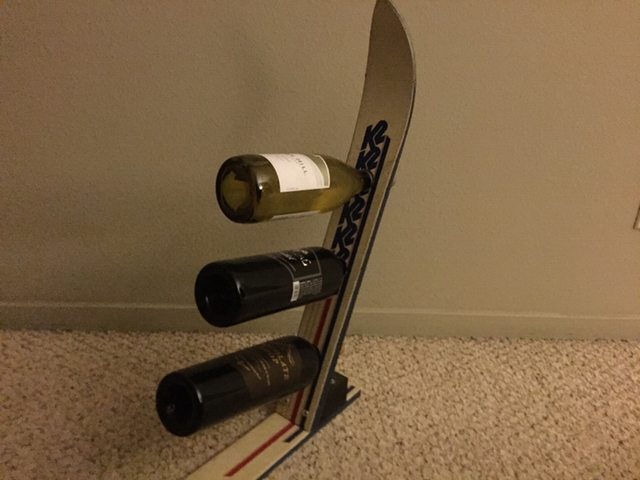
Marianne Rosenfeld makes wine holders similar to this one. Photo/LTN

Marianne Rosenfeld makes wine holders similar to this one. Photo/LTN

By Cathie Anderson, Sacramento Bee

Up the hill at Placerville’s Snowline Hospice, employees know Marianne Rosenfeld as “The Ski Lady” because she picks up old skis that people donate to the nonprofit’s processing center and refashions them into chairs.

Rosenfeld hauls the skis farther up the mountain to South Lake Tahoe where, at some point in the future, they will have a date with her chop saw, she said. She likes to collect skis from the foothills and valley floor because she gets the right kind to make her four styles of chairs and benches.

“In Lake Tahoe, everybody skis. It’s the culture. It’s all we do, so in the minds of people up there, an old ski might be from ’98 or 2000. That’s old to us,” Rosenfeld said. “But people down here who don’t ski that much, when they say ‘old ski,’ they mean ’70s. When I come down here, I really get a lot of skis. The term ‘old’ is different for everybody.”

Rosenfeld prefers the older skis because their runners still have the straight edges rather than the curved, parabolic shape of today’s skis.

Read the whole story


Heavenly plans to tweak ski experience for ’16

Improvements are in the works to make it easier to get back to the Tamarack lift. Photo/LTN file

Improvements are in the works to make it easier to get back to the Tamarack lift. Photo/LTN file

By Kathryn Reed

Changes to Heavenly Mountain Resort that are expected to be ready for the 2016-17 ski season are mostly based on what skiers have requested.

The resort wants to:

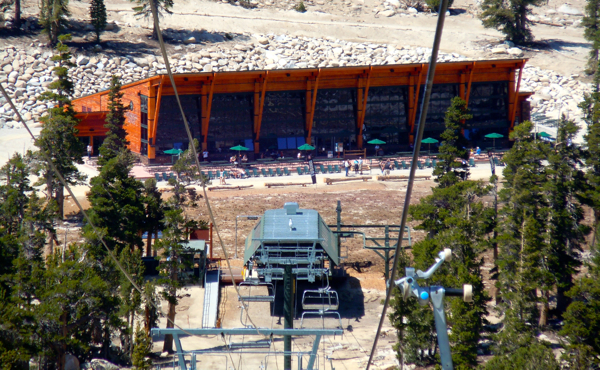
·      Build a permanent 300-square-foot ticket sales kiosk adjacent to the Bear Cave Ski School near Tamarack Lodge;

·      Relocate the Red Fir handle tow lift to the right side of the Easy Street Trail to reduce user conflicts;

·      Install a nearly 300-foot magic carpet surface to primarily be used for ski school activities on the lower Easy Street Trail near the relocated Red Fir lift;

·      Widen Tamarack Return Trail by about 125 feet on 1.3 acres;

·      Limb and remove trees under the Blue Streak Zipline to provide easier seasonal removal and installation of the lines.

“This is what guests have asked for,” Russ Pecoraro, spokesman for Heavenly, told Lake Tahoe News. “We are constantly looking for ways to improve the experience.”

The U.S. Forest Service, whose land the projects would be built on, is asking the public to weigh in on the proposals.

“This proposal does not amend the master plan. The project is consistent with the vision described in Heavenly’s Master Development Plan,” Lisa Herron with the Lake Tahoe Basin Management Unit told Lake Tahoe News.

It’s possible as many as 200 trees will be removed. Pecoraro said widening California Trail will make it easier for riders to get back to Tamarack Express.

“With some of the teaching terrain up there we don’t have the lifts in the ideal places to access the terrain for beginners,” Pecoraro said.

The kiosk being built next to the Bear Cave Ski School would also be open in the summer to sell tickets for the ropes courses and other amenities available when there isn’t snow on the ground. It would replace the temporary structures that exist today.

Pecoraro, per company policy, would not reveal what the price tag is for these improvements.

The goal is to secure necessary permits this winter and begin work in the spring after the resort closes for the winter season. It is not anticipated that the construction will impact summer activities, Pecoraro said.

—–

Notes:

·      The deadline to comment is Dec. 21.

·      The proposal is available online.

·      For more info, contact Matt Dickinson at the USFS at 530.543.2769.


Criminal skiers cutting down trees in wilderness

By Heather Hansman, Outside

In late September, a hiker in New Mexico’s Santa Fe National Forest encountered a shocking sight: a several-hundred-yard swath of felled trees on a hillside in the Pecos Wilderness. Whoever did it leveled off hundreds of englemann spruce and subalpine fir trees a few inches above the roots and left the cuttings on the ground—a clear indication that it wasn’t the act of an illegal timber operation or someone looking for some free firewood.

No, it was most likely perpetrated by backcountry skiers looking to set up a ski run in time for winter.

Felling trees in a national wilderness area violates the Wilderness Act and is a federal misdemeanor. Wilderness areas are the most highly protected federal land: development is prohibited in an effort to keep them as natural as possible.

Whoever is responsible for the cutting, if caught, could face six months in jail or up to $6,000 in fines, depending on the extent of the damage, which investigators are calculating now.

The Pecos incident wasn’t an isolated case of so-called glading, which involves cutting down trees to carve out enough space for makeshift ski runs. As backcountry use is increasing—the Snowsports Industry Association says sales of backcountry gear like touring-compatible ski boots and accessories were up 12 percent from 2013 to 2014—land managers are trying to find ways to encourage recreation while still regulating illegal use.

Read the whole story


DC commish says yes to gas tax, no to sales tax

By Anne Knowles

MINDEN — The Douglas County Board of County Commissioners this week voted to raise the gas tax to pay for road maintenance, but failed to pass a sales tax bump to fund a list of countywide projects.

The additional gas tax will make possible much needed road improvements, but the failure of the sales tax hike means the county may not be able to tap into some state and federal matching funds, and will likely struggle to find other ways to pay for each of the dozen projects.

Those proposed projects include total maximum daily load maintenance of catchments, including Kahle urban catchment, Logan Creek, Lakeridge and Lake Village general improvement districts and Cave Rock.

Burke Creek, Rabe Meadow, Nevada Beach sunset
Burke Creek in Stateline is one storm drainage that has had work done to it. Photo/LTN file                              
Projects/county costs to have been funded by failed sales tax: • Stormwater master plan/remediation projects — $500,000 • TDML maintenance of catchments — $450,000  • Highway 395 alternate route study — $1.8 million  • Road maintenance — $4 million • Turn lane on Highway 208 at Albite Road — $200,000 •Roundabout at Highway 88-Centerville Lane — $650,000 •Roundabout at Highway 756-Waterloo Lane — $400,000 • Heybourne Road extension — $1.5 million • Muller Parkway extension — $3.8 million • Ranchos connectivity path — $800,000 •Martin Slough trail, phase II — $60,000 • Pony Express trail, upper portion — $100,000                                                                                               Source: Douglas County

The price tag for the county portion of those projects totals $14.3 million. The sales tax increase, which had an expiration date, was expected to generate $15 million over its 10-year life.

But the total cost is much higher. Some projects would be paid in total by the county, but others, such as a study for an alternative route for Highway 395, would be completed with $7.2 million in additional funds from the state and feds that could be obtained if the county puts up $1.8 million.

“We have the opportunity to kill an awful lot of birds with a relatively small stone,” Commissioner Greg Lynn said at the Dec. 3 meeting while arguing in favor of the tax change. “If we don’t do this, each one will require a separate source now.”

The 5-cent per gallon jump in the county’s gas tax was passed with a vote of 4-1, with Commissioner Barry Penzel voting no.

“It’s a matter of principle,” Penzel said during a discussion before the vote. “When we’re talking about taking money out of taxpayers’ pockets we should at least ask their permission.”

The hike is expected to generate $900,000 annually.

Jim Nichols, county manager, said $600,000 would be earmarked for road maintenance.

The county has a huge backlog of road repairs, amounting to tens of millions of dollars, which it has recently been paying for through allocations from the county’s general fund.

“We have been robbing Peter to pay Paul and not looking to the future,” Commissioner Steven Thaler said. “Public comment seems to be evenly divided. The roads need to be fixed. This is a no-brainer to me.”

During public comment, resident Bob Ballou echoed Penzel.

“These taxes, while they may be for good purposes, ought to be approved by the entire public,” Ballou said.

Nichols said the remaining $300,000 raised by the higher tax would be leveraged to get state and federal grants for the South Shore Revitalization Project, locally known as the loop road.

“We’re not going to benefit from a lot of this,” said Linda Foster, county resident, during public comment. “We’re paying for improvements at the lake that helps the business up there.”

Several people spoke in favor of the tax hike, including Bill Chernock, executive director of the Carson Valley Chamber of Commerce.

“We need an infrastructure that works. Everybody is paying, businesses, visitors, local residents. And there is a rough correlation between how much you pay and how much you use the roads,” said Chernock. “And as far as the Highway 50 portion to make the loop road, that is going to happen. We can start building that fund now and get proactive. That money does flow down the hill.”

The commission also passed a plan for projects to be paid for by the defeated infrastructure sales tax.

The resolution on the projects was required before the commission could take up the tax itself, which was a 0.25 percent increase in the sales tax.

The resolution passed relatively easily, although there was some dissatisfaction with the agreed upon list of projects, even among supporters.

“I support the tax. Do I like the list? No, I hate the list,” said county resident Carlo Luri. “But is it fair? Yes, it benefits the most people in the county.”

Commissioner Lynn agreed.

“I don’t like the list either, but it represents a wide array of stakeholders and will transform the county if all of them can be implemented,” he said.

The tax itself needed a two-thirds majority or four votes. It failed, with Commissioners Doug Johnson and Penzel voting no.

“I’m not afraid of going out there and saying these are good projects, we need this tax,” said Penzel. “This doesn’t have to end the story. We can get it on the ballot.”

District Attorney Doug Ritchie was asked if there is time to get a ballot approved before the next election. He said there are several types of measures and it would depend on which one was pursued.

The three commissioners in support of the sales tax hike each tried to persuade their dissenting colleagues.

Commissioner Thaler said the commission was elected to make big decisions and that the voters had the power to repeal the tax hike.

“They’ve done it before,” he said. “If we don’t pass this, it dies.”

Commissioner Nancy McDermid pointed to Elko County, an equally conservative county, which this week passed a 0.25 percent increase in its sales tax.

“They are not a receiving county, they are a giving county,” said McDermid.

McDermid was referring to the fact that some taxes collected by Nevada’s 17 counties are pooled and redistributed through the consolidated tax distribution.

As a result, Clark, Washoe and Elko counties put in more money than they get back and the remaining 14 counties, including Douglas, receive more than they contribute.

“Now we’re going to hold out our hands while we let others tax themselves?” she asked. “How do we look at the people in Elko and say thank you for raising your taxes?”

Commissioner Lynn conceded it wasn’t an easy choice.

“The timing could be better. It is difficult to bring forward two taxes at once,” he said. “But the gas and sales tax are complementary and if we don’t do this, then shame on us.”


Reno-to-Vegas interstate in highway bill deal

By Associated Press

WASHINGTON — The House and Senate have reached agreement on a five-year, $281 billion transportation bill that would increase spending to address the nation’s aging and congested highways and transit systems, including an extension of the future Interstate 11 connecting Reno and Las Vegas.

The bill would put an end to the cycle of temporary extensions and threatened shutdowns of transportation programs that have bedeviled Congress for the past seven years, making it difficult for states to plan long-term projects.

A draft of the bill boosts highway spending by 14.9 percent and transit spending by 18.1 percent over the life of the bill, said Jeff Davis, an expert on transportation spending with the nonprofit Eno Center for Transportation.

Included in the bill is an extension for the future I-11, which as it currently stands would connect Las Vegas with Phoenix. Nevada’s Washington delegation, including Democratic Senate Minority Leader Harry Reid and Republican Sen. Dean Heller, has lobbied for an extension to Reno.

Heller said in a news release the inclusion of the Reno extension was a boon for the the state’s economy.

“Today’s news that the extension of I-11 was included in the final highway bill is a major win for our state,” Heller said. “Connecting Phoenix, Las Vegas, and Northern Nevada will spur long-term economic development, create jobs, and bolster international trade.”

But the bill still falls far short of the $400 billion over six years that Transportation Secretary Anthony Foxx has said is necessary to keep traffic congestion from worsening, and it puts off the difficult decision of how to pay for transportation programs in a way that’s sustainable for the long term. The federal 18.4 cents a gallon gas tax, the main source of Highway Trust Fund revenues, hasn’t been increased since 1993 and no longer is enough to cover annual spending on transportation programs.


El Niño not a big deal, according to Lake Tahoe area public works and utility employees

January is usually when the brunt of an El Nino strikes Lake Tahoe. Photos/LTN file

January is usually when the brunt of an El Nino strikes Lake Tahoe. Photos/LTN file

By Susan Wood

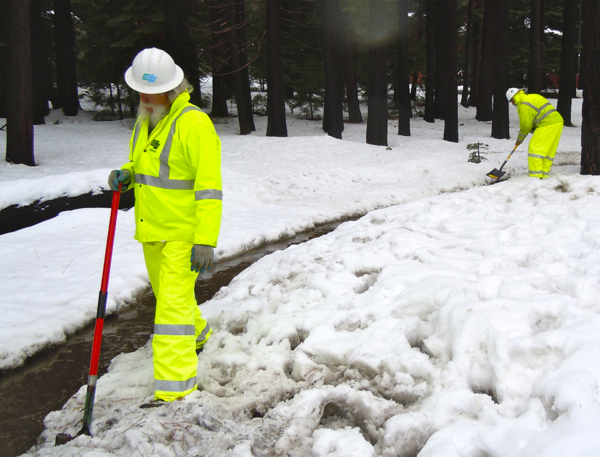
Despite the weather phenomenon known as the Christ child that is expected to pack a devilish punch to the West this winter, most Lake Tahoe-area government agencies are conducting business as usual in terms of preparing for it.

Public works departments from one end of the lake to the other beef up resources for winter snow and wind compared with other seasons, but this winter could bring what climatologists and other scientists refer to as a Godzilla El Niño. The weather phenomenon is characterized as a warming of the eastern Pacific and delivers wet storms to the California coast starting near Christmas. It often means more snow to the Sierra Nevada, but may translate to rain given the warmer air temperatures to match the ocean mercury. The large El Niños in 1982-83 and 1997-98 brought flooding (including at the Reno Tahoe International Airport), landslides and huge snow loads for residents, motorists and utility companies to deal with.

With that, Tahoe residents may hope the public agencies and utility companies are as confident about handling El Niño-driven storms as the weather forecasters and climatologists are about it bringing major weather events.
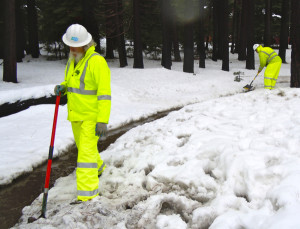
Caltrans crews in December 2010 work on a flooding issue along Highway 89.

Caltrans crews in December 2010 work on a flooding issue along Highway 89.

Latitude wise, Lake Tahoe remains at the cusp of wet versus dry, as is the case with all El Niños years. What might be different in what we’re seeing in recent years are the overall effects of climate change – which has shown to bring extreme weather events. The other unknown may revolve around California coming off an unprecedented four-year drought. Dry ground and heavy, sudden rainfall could turn into flooding in some areas.

With that, sand bags will be available for residents at stations on Rufus Allen Boulevard and Ruby Way through the city of South Lake Tahoe – the one government agency with some winter prep measures that are substantive this year compared to others.

Much of what the city’s Public Works Department is doing for the possibility of heavy snow or other precipitation comes in either a warning or behind the scenes efforts.

“What we want people to know is we can’t clear all streets immediately, but we’ll certainly try. If a big storm from El Niño produces the mother of a storm, chances are we’re not going to get to residential areas as fast,” Assistant Public Works Director Jim Marino told Lake Tahoe News. “We might go through and do a single pass.”

During these times, the city will focus on the major thoroughfares such as Al Tahoe Boulevard, Pioneer Trail and Tenth Street in its eight zones. It has a dozen graders at its disposal, placing four in storage because the harsh winter takes its toll on the machines.

“We’re really not doing anything out of the ordinary. I don’t project any changes (to what the city is doing) –just education,” Marino said.

He has a point. What’s new is the city is launching a web portal in which residents may report a public works-related issue in their neighborhood. For example, citizens may report online water drainage or snow removal issues at the foot of their driveways. An investigator will respond to the service request. From that, a work order is developed and tracked through email so the homeowner or stakeholder may see the progress of fixing the issue.
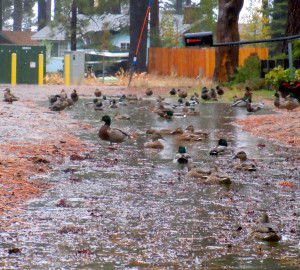
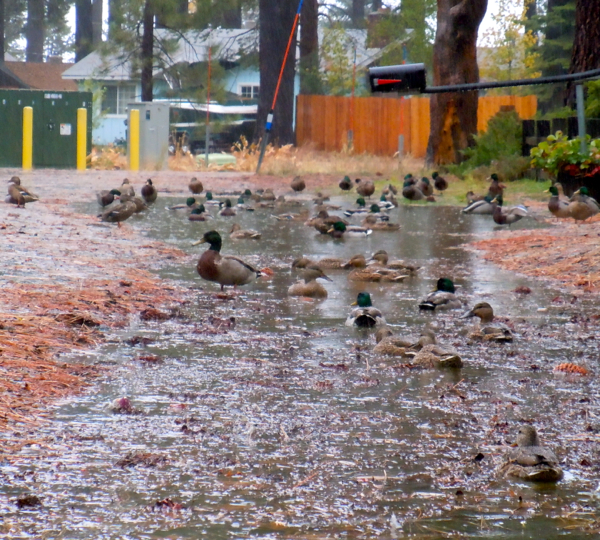
Some South Lake Tahoe streets have drainage issues every winter.

Some South Lake Tahoe streets have drainage issues every winter.

The other new measure for city snow removal involves fun and access – as in clearing the bike paths along Highway 50 and Al Tahoe Boulevard.

Fun and frolic aside, it’s still “business as usual” in preparing for winter for El Dorado County, according to Community Development Deputy Director Don Spear. The county’s snow removal equipment is ready and “on line for any storm that comes our way,” he added. Backhoes and culvert cleaning machines are also at the county’s disposal.

“We have hired extra help for snow removal in the Tahoe basin as we always do every year,” Spear said.

Douglas County maintains there’s limited responsibility for its public works-community development teams in the Tahoe basin. Private contractors plow county-maintained roads.

“While we have no set policies for these roads, snow plowing is provided as needed in response to weather and road conditions. The general rule is that the roads are plowed when 2 inches of snow are accumulated,” said Carl Ruschmeyer, who manages the road system in the Nevada county.

Placer County will bolster its roads with sand and salt, but nothing out of the ordinary.

“It’s not so different than what we’ve done in years past,” said Kevin Tabor, who manages the public works for the county along Tahoe’s West Shore. “(This is) because every winter has the possibility of being a bad winter.”

The states managing the roads relative to Lake Tahoe have put out their regular winter driving messages with a few added measures.

Like every year, the Nevada Department of Transportation started its winter preparations in August by readying more than 80 snowplows and other pieces of snow and ice equipment. More than 32,000 cubic yards of salt and sand have been stockpiled in the area.

The sand is combined with salt and wetted with brine (a water-salt solution) to create more dense sand that “helps reduce how quickly the ice forms and sticks to the road,” NDOT Assistant District Engineer for Maintenance Mike Fuess explained.

And although Caltrans officials admit El Niño “predictions do come to fruition,” the local district claims it “will be ready for any rain, sleet or snow coming our way.”

As usual for pre-winter prep, trucks have been converted to sanders and snowplows, loaders, graders, rotary blowers and tow trucks are at the district’s disposal. Drainage and culverts have been cleared and inspected. Sand, salt and brine have been stocked up. This year, more than 100 independent contract chain installers are signed up, and Caltrans seasonal workers have been hired.

“Our maintenance forces will be ready for any weather conditions this winter,” Andrew Brandt, deputy director of maintenance and traffic operations for the district, told Lake Tahoe News. “Our winter operation plans are in place to address everything from flooding on our valley highways to heavy snow on the Sierra roadways.”

Caltrans has also been busy replacing and installing new snow stakes along mountain highways, cleaning culverts and drainage ditches and trimming trees.

The latter represents a major concern every winter for utility companies like Liberty Energy, which services the California side of Lake Tahoe with electrical power.

“We’ve spent millions over the last four years trimming. We can’t eliminate all trees, but we’ve done what we can do,” spokesman Randy Kelly said. “We don’t know what this winter will bring. There’s been a lot of talk.”

There’s no beefing up of staff this year, but Liberty Energy is part of a mutual assistance network with other energy providers that share resources if one particular area is hard hit. Last year, wind storms created havoc in December and February.

“Wind is our biggest problem, but snow can be,” Kelly added. He used an example in which motorists have the potential of sliding into power poles.
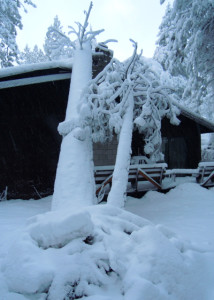
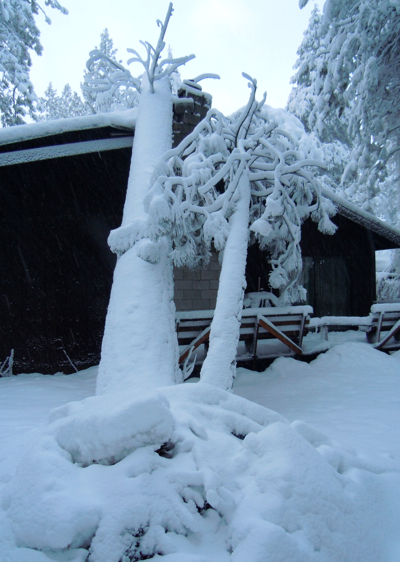
Wet storms often cause trees to fall onto structures or across power lines.

Wet storms often cause trees to fall onto structures or across power lines.

Nevada Energy representatives have indicated the utility company servicing the electrical needs across the border that it plans to do nothing out of the ordinary compared to other winters.

“We’re always looking at the weather,” spokeswoman Katie Nannini said. “A big storm can happen no matter what the predictions are.”

And even if many agencies are conducting business as usual in reaction to extraordinary predictions about this winter, residents might not be judging from the reaction of some roofing companies on the South Shore.

Three local roofing companies’ answering machines were jammed with messages declaring they’re not accepting any more jobs because they’re too booked up.

“We’ve seen an uptick in business due to the forecast of El Niño,” Chris Marchesseault of AAA Roofing told Lake Tahoe News.

A few Sierra Nevada organizations have some concerns about what happens at the ground level.

The League to Save Lake Tahoe shared its most notable concern – lake clarity.

“A stormier winter would mean more stormwater runoff pouring through storm drains and into the lake. So if we get more storms, we’ll be spending extra time working with local jurisdictions and our volunteer pipe keepers to figure out which pipes are bringing the most pollution into the lake,” League Natural Resources Manager Zack Bradford told Lake Tahoe News.

The League manages a tour de force of volunteers who monitor water and debris buildup at drains and pipes. At a recent honorary volunteer dinner, the League hinted to its people to be at a heightened state of alert this year if El Niño materializes like some of the forecasts.

Stormwater managers in particular have more concern than perhaps most agency representatives because it encompasses their jobs.

Russ Wigart, who heads El Dorado County’s stormwater program, has recently expressed concern about a 100-year storm meaning 100-year runoff.

Ditto from Placer County’s water runoff specialist Andy Fecko, who recently deemed El Niño and heavy precipitation as “disastrous” in the Sacramento Bee in respect to West Slope concerns.

And for the feds, their main concern on the West Slope of El Dorado County is the King Fire burn area. Of the 90,000 acres engulfed, the U.S. Forest Service owns two-thirds. That span has Eldorado National Forest officials concerned of safety issues if heavy rainfall causes mudslides.

“The first year after the fire we expanded our capacity of handling erosion and channeling debris under the road,” Forest Service spokeswoman Jennifer Chapman said. She added the heli mulching as another measure on the steep slopes of where the fire burned in particular in the Brush Creek Reservoir and along 11 Pines Road.

“The main message to the public is anybody driving through the King Fire area should be particularly aware if it’s raining,” she said.

And with the early winter starting, the Forest Service has noted that avalanches have already occurred in the Carson Pass area because of the sporadic snow-rain combination as the Sierra Avalanche Center has reported.

“These things make the snow unstable,” Chapman said.


Retirees sue S. Lake Tahoe over health benefits

By Kathryn Reed

Retirees from the city of South Lake Tahoe are suing their former employer over the changes to the health benefits that took effect the first of this year.

“What the city has done essentially is thrown the retirees under the bus. They don’t have the power to negotiate now that they are retired,” Joe Rose, attorney with Rose Law in Sacramento, told Lake Tahoe News. “These were loyal public servants. They should be able to sit down with the city leadership and have a meaningful dialog. If we can’t resolve our disagreements, we will do our best to resolve the retiree benefits in court.”

The city in July rejected the initial claim filed by the firm on behalf of the nearly 160 retirees who are part of the city of South Lake Tahoe Retirees Association. The lawsuit was filed Dec. 1 in U.S. District Court in Sacramento. The suit was filed now because the statute of limitations to do so is Dec. 31.

City Attorney Tom Watson did not return a phone call.

City Manager Nancy Kerry on Thursday said she was unaware of the lawsuit.

“First I’ve heard of it,” Kerry told Lake Tahoe News when called Dec. 3. “I have not received a filing or been served or anything.”

It was Kerry’s idea, and one the council unanimously approved a year ago, to revamp the health care plan for current and retired workers. By changing the health care plan, eliminating retiree health benefits for employees not yet retired, and modifying coverage the city estimated a cost savings of $1.5 million a year for three years beginning with last fiscal year.

Retirees don’t have a separate contract with the city once they retire. They are subjected to whatever the current employees agree to.

The retirees’ attorney contends the agreements entered into when they were working provided a certain level of health care, and that they are legally binding and enforceable. He believes what the city did was illegal, and is seeking to have the prior benefits package restored. Retirees are also seeking to be reimbursed for any health care expenses incurred since the change took place that would have been covered by the previous plan, and they want the city to pay their attorneys’ fees.

The changes adopted last fall created what is called Plan A. That is a basic health plan that has a $5,500 deductible. The city picks up the cost for singles, couples and families. Vision and dental are no longer offered. If people want a better plan, they may pay the difference for it.

South Lake Tahoe is the only public entity in the Lake Tahoe Basin that offers any retirees medical coverage.


Vail Resorts to spend $30M on worker housing

By Jason Blevins, Denver Post

Vail Resorts on Wednesday promised $30 million toward employee housing projects in the California, Colorado and Utah mountain communities where its ski areas are powerful economic drivers. The money is intended for partnerships in towns such South Lake Tahoe and Truckee; Breckenridge, Vail and Avon in Colorado;  and Utah’s Park City.

“We are here with money and we want to partner and collaborate with these communities to get projects off the ground,” Vail Resorts CEO Rob Katz said. “We need to combine our money with others — towns, counties, other businesses. That’s the only way to get enough housing built. The need is real.”

Resorts are pursuing out-of-the-box plans — such as temporary trailers and tiny-home communities for workers — to help locals who are struggling to find a home for the season.

Vail has pledged its own land, cash and long-term lease guarantees that could help municipal projects securing financing as the spark to get projects rolling.

Vail Resorts owns and manages about 3,200 beds around its Vail, Beaver Creek, Breckenridge, Keystone, Heavenly, Northstar, Kirkwood and Park City resorts. The company has added 650 beds over the past three years, but that hasn’t been enough to meet the demand.

Read the whole story


One-of-a-kind trees shine at Tahoe festival


Tantalizing Tango by Belen Urrutia is the overall winner at this year's festival. Photo/Carolyn E. Wright/Copyright

Tantalizing Tango by Belen Urrutia is the overall winner at this year’s festival of trees. Photo Copyright 2015 Carolyn E. Wright

By Kathryn Reed

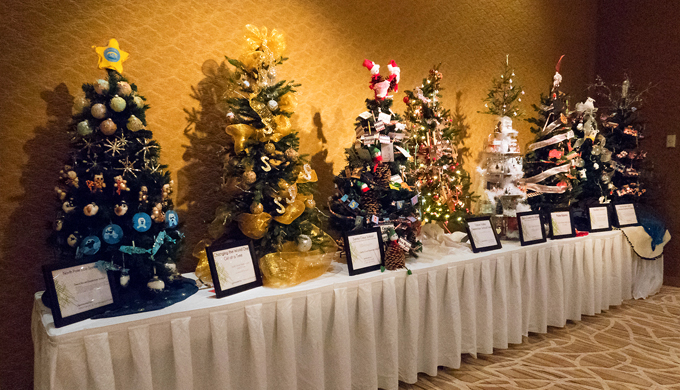
STATELINE – Imagination, creativity and artistry come together to capture the holiday spirit in mostly untraditional ways at the Barton Foundation’s Festival of Tree and Lights. This is because these are no ordinary evergreens.

Eleven trees have either been ornately or whimsically transformed from a barren (fake) conifer into a one-of-a-kind Christmas wonder.

creativity award went to Jeri Oishi and the Enchanted Florist team for Steampunk Christmas. Photo/Carolyn E. Wright/Copyright

Jeri Oishi and the Enchanted Florist team won for creativity. Photo Copyright 2015 Carolyn E. Wright

Now in its seventh year, the festival is a showcase for designers to demonstrate their innovative ways to decorate a tree. Schoolchildren get in the act as well – but with much smaller trees. Barton employees show their originality with decorative wreaths.

The five-day festival has a variety of events for all ages, from a hospital for teddy bears to a station for writing letters to Santa to a fancy adults-only gala.

This is the foundation’s biggest fundraiser. All proceeds benefit the trauma center at Barton Memorial Hospital.

Untraditional is what captured the judge’s attention. Best of show in the designer category went to Tantalizing Tango by Belen Urrutia. This also won for being the most elegant.

No Place Like Home by Cyndy Brown-Carlson is the winner of the best themed tree. Photo Copyright 2015 Carolyn E. Wright

No Place Like Home by Cyndy Brown-Carlson is the winner of the best themed tree. Photo Copyright 2015 Carolyn E. Wright

The red and black-themed tree stands out in the room. It’s not hard to envision a couple from Argentina doing the tango on the false dance floor surrounding the tree.

The creativity award went to Jeri Oishi and the Enchanted Florist team for Steampunk Christmas. An upside down tree is a definite rarity.

The best interpretation of the theme went to No Place Like Home by Cyndy Brown-Carlson. Hers was also one of the larger displays.

This take on the “Wizard of Oz” was replete with a bicycle and Toto, as well as ruby red slippers in a glass case.

Other winners were:

Most South Shore schools competed with classroom-made ornaments. Photo/Carolyn E. Wright/Copyright

Most South Shore schools competed with classroom-made ornaments. Photo Copyright 2015 Carolyn E. Wright

In the schools category:

·       Lake Tahoe Homeschoolers – best ornaments

·       Sierra House Elementary School – best use of theme

·       Lake Tahoe Homeschoolers – most creative.

Best Barton wreaths:

·       I’m Dreaming of a Wine Christmas by Barton Laboratory Department.

—–

Notes:

·      The festival runs through Dec. 6 at MontBleu in Stateline.

·      The schedule and details are online.


How El Niño affects the weather

By Brian Clark Howard, National Geographic

This year’s hurricane season is winding down. And as meteorologists predicted, there was above average activity in the eastern and central Pacific and less than usual in the Atlantic. The reason, also as predicted: a strong El Niño.

El Niño may have also contributed to October 2015 being the warmest on record, at 1.76 degree above the 20th century average for the month.

Now we’ll begin to see the weather phenomenon’s influence on winter storms and rainfall. But that doesn’t mean drought-stricken California can celebrate just yet.

El Niño is the periodic warming of water in the Pacific Ocean every few years. When it occurs, it means more energy is available for storms to form there. El Niño also affects wind shear, which is when air currents at a lower altitude blow in a different direction from winds higher in the atmosphere. Strong wind shear makes it harder for hurricanes to form.

Read the whole story