UV light may be invasive weed killer at Tahoe

John J. Paoluccio uses weeds from Lake Tahoe to test his UV mechanism. Photos/Provided

John J. Paoluccio uses weeds from Lake Tahoe to test his UV mechanism. Photos/Provided

By Kathryn Reed

Ultraviolet light might be the answer to ridding Lake Tahoe of milfoil and other invasive weeds.

In controlled lab tests the box like device has been effective at killing various weeds that are not native to Tahoe and that have become a problem.

John J. Paoluccio, president of Inventive Resources Inc., is presenting his mechanism this morning to the Near Shore Agency Working Group at a meeting on the South Shore. Regulatory agencies will be there as well as scientists from UNR and UC Davis.

“TRPA is certainly open to looking at any and all potential approaches to fighting AIS at Lake Tahoe, but we will also look to our colleagues in the science and research community for their expert guidance to determine what tools will be the most effective on a location-by-location basis,” Tom Lotshaw with Tahoe Regional Planning Agency told Lake Tahoe News.

Paoluccio has used Lake Tahoe water and five species of plants from here to test his apparatus in his lab in the Central Valley. He’s been able to kill weeds at a depth of 30 feet.

“This technique can be turned on and off,” Paoluccio told Lake Tahoe News. “Herbicides are like a bowl. They will not be forgiving, especially if there is an accident.”

His firm’s main focus is water treatment devices, some of which are being used in the basin.

Paoluccio is hoping regulatory agencies will allow him to test his product before any chemicals are used in the lake. Lahontan Regional Water Quality Control Board has OK’d the use of herbicides in Lake Tahoe on a case-by-case basis.
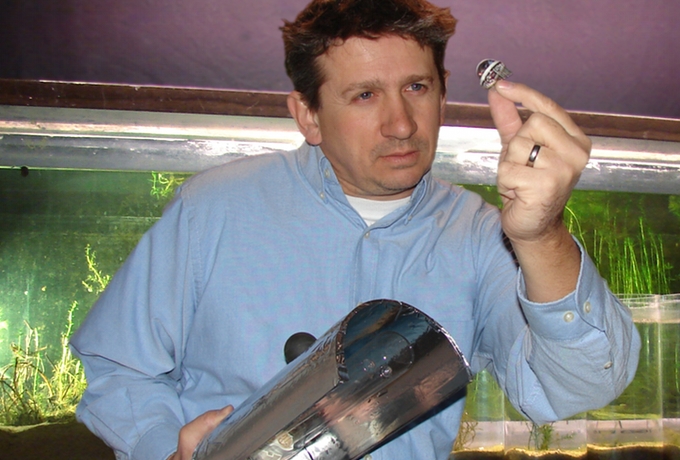
Ultraviolet is John J. Paoluccio answer to eradicating invasive plants from Lake Tahoe. Photo/Provided

Ultraviolet is John J. Paoluccio’s answer to eradicating invasive plants from Lake Tahoe. Photo/Provided

The Tahoe Keys Property Association spent a quarter million dollars to study long-term eradication plans. Part of the plan includes chemicals. Today TKPOA spends about $400,000 a year on a harvester that in part spreads the milfoil through the channels of the South Lake Tahoe neighborhood, never really doing anything more than mowing the spindly weed.

When the Keys did its study Paoluccio’s technique was not part of the mix because it wasn’t available.

However, Paoluccio has been working with ultraviolet light for about 10 years. His first creation was to use the light in caves to kill microorganisms that were degrading the rocks.

He then saw the Keys’ harvester and figured there had to be a better way to do things in Tahoe. This led to the start of his experiment. As a second homeowner in Tahoe, the interest is also personal.

Paoluccio, who is a Lakeside Water District customer, has seen the milfoil choke that marina, just not to the extent of the Keys.

Lakeside Water District, which has 150 customers near the state line in South Lake Tahoe, is concerned any chemical application at the Keys would negatively impact its water supply. All of Lakeside’s water is drawn from the lake.

“What we are trying to do is slow down, if not stop permanently, the effort that is going on at the Keys to use herbicides,” Andy Engelhardt, vice president of Lakeside Park Association, told Lake Tahoe News. His group wants to be the test site for Paoluccio’s creation.

Paoluccio said to treat Lakeside Marina with his device it would take about 30 days, 10 hours a day.

The light damages the DNA and cell structure of the aquatic invasive weeds. This stops reproduction and eliminates the weed in a few days.

“The UV light is basically burning the plants,” Paoluccio said.

A patent on the mechanism is pending.

It can be applied either by dropping a box like device that resembles how an umbrella works over the infested area or using a mat. The latter would be good to reach under docks.

Paoluccio said noise could be used to deter fish from that area so the light would not affect them. With the shield over the light, it would not be reaching beyond the designated area.

Before a pilot project were to be implemented Paoluccio said he would need to secure funding to build the appropriate mechanism.




Nev. incubator’s mission: Improve water management

By Daniel Rothberg, Las Vegas Sun

It has attracted interest from a company from Canada and one from California, established operating agreements with two companies in Israel, begun negotiating with three companies from Europe, started examining partnerships in Dubai and opened an ongoing dialog with the public utility in Singapore.

The Center of Excellence, a nonprofit incubator at the Desert Research Institute for water technology startups, has come a long way since it first received funding in 2013. And in the last six months, thanks to an infusion of funding during the legislative session, it’s shifted into a higher gear in its quest to improve conservation of one of the most coveted resources in Nevada: water. Its two most recent calls for business proposals — one of which closed Tuesday and the other in September — generated interest from about 30 companies.

The basic premise of its model is to bring companies to Nevada with research and development funding to support projects that simultaneously satisfy the demands of the state’s water agencies. This, officials say, will spur economic development in water technology, an area where Nevada has plenty of experience, while supporting higher-education research.

Read the whole story


California drafts plan for gray wolves

By Scott Smith, AP

Gray wolves could be stripped of state endangered species protections once at least 50 of the animals are roaming in California, wildlife officials said last week.

The California Department of Fish and Wildlife released a draft plan for managing gray wolves, which were granted protections last year but whose numbers are growing. It outlines efforts to minimize livestock loss and ways to ensure there’s enough prey for wolves, other predators and hunters.

Under California’s protections, gray wolves can’t be killed or hunted. U.S. law also protects wolves in most of the nation, except for Idaho, Montana and parts of Washington, Oregon and Utah, but there is a pending proposal to strip federal protections from most of the Lower 48 states, including California.

Once there are between 50 and 75 wolves in California, the state’s proposal suggests considering whether wolves should be removed from a list of endangered animals.

Wolves were hunted to extinction in California nearly a century ago, but a lone wolf called OR-7 crossed the northern border from Oregon in 2011, marking their return. Remote cameras in Siskiyou County earlier this year captured two adults and five pups, called the Shasta Pack.

Environmentalists herald their return as an icon of California’s western landscape, while ranchers fear wolf packs will kill valuable livestock.

Fifty doesn’t sound like many wolves, but Northern California doesn’t have enough wild prey to support that number of predators, said Kirk Wilbur, spokesman for the California Cattlemen’s Association. He fears that wolves will remain forever under the state’s protection, depriving ranchers of the ability to kill them and protecting their cattle.

“We had concerns with listing them in the first place,” Wilbur said.

Amaroq Weiss, a wolf advocate at the Center for Biological Diversity, said the state proposes removing protections for gray wolves just as they gain a solid foothold in California.

“We disagree with the proposal to weaken protections before wolves have truly recovered in California,” she said.

However, any discussion of removing protections at this point is a premature, said Jordan Traverso, a spokeswoman for the Department of Fish and Wildlife. She said it is hard to know whether wolves will flourish to that degree in California.

“It’s impossible to speculate what Mother Nature would do,” Traverso said. “We have no idea.”

Officials will take public comment on the plan through mid-February before it is adopted. Comments will also be accepted via e-mail atwolfplan@wildlife.ca.gov.


SLTFD not giving up ambulance duties

By Kathryn Reed

The South Lake Tahoe City Council on Monday took steps to reduce overtime in the fire department and ensure ambulances are staffed with appropriate medical personnel.

In July the council voted to turn over the ambulance service to Lake Valley Fire Protection District. South Lake Tahoe and Lake Valley fire departments make up what is called the Cal-Tahoe Joint Powers Authority. That entity operates the ambulance contract on the East Slope for El Dorado County

One reason South Lake Tahoe wanted out of the ambulance business is because of the interagency transfers. This takes employees out-of-pocket at times for an entire shift as they transport people to medical facilities outside the Tahoe basin. With a firefighter in that ambulance, it meant fewer people on duty to do that job. Plus, firefighters tend to make more money than an EMT. Lake Valley believed the compensation to make those runs was a profitable endeavor.

Lake Valley, based in Meyers, has dragged its feet to take on the responsibilities like it said it wanted to do and would do. This in turn has cost the city money to continue to staff the ambulances.

SLTFD Fire Chief Jeff Meston said he is still willing to negotiate a deal with Lake Valley, but for now he has to take care of his people, the city and be cognizant of his budget.

While Lake Valley Fire Chief Gareth Harris, board President Dave Huber and JPA Executive Director Ryan Wagoner all asked the council to delay the vote, they didn’t explain why things were taking so long.

Huber wants the Lake Valley board and City Council to have a joint meeting. He did not say what might be accomplished if this were to happen. The council expressed zero interest in such a gathering.

Earlier this year Lake Valley firefighters had a vote of no confidence in their chief. However, the board continues to keep him on.

The City Council voted 4-0-1 on Dec. 7 to change the contract with the firefighters’ association, which will then modify the staffing. Councilwoman Joann Conner abstained. At one time she was on the Cal-Tahoe JPA. She resigned from that post earlier this year.

With South Lake Tahoe removing firefighters from ambulances, it will save the city money and could mean less support for Lake Valley because no one in the ambulance can fight a fire.

Lake Valley Fire Protection District runs about five firefighters per shift, in large part relying on the free assistance of South Lake Tahoe, CalFire and the U.S. Forest Service. Those agencies all help each other out.

Seventy percent of the calls SLTFD goes on are medical emergencies. Firefighters respond to 30 to 40 calls a year. Most days there are 16 people on duty.

Going forward SLTFD ambulances will be staffed with paramedics and emergency medical technicians. Six EMTs will be starting Dec. 14.

The other change is three battalion chief positions are being resurrected after being eliminated in 2011. Testing for those jobs is being done now.

The other change for SLTFD is engines will now be staffed with three firefighters.

With an ambulance and an engine responding to most events, it means five people instead of the current four will arrive.

The change in staffing in many ways is not new. It’s what the city had in 2001 when the JPA agreement started, Meston said.

—–

In other action:

·      On a 3-2 vote the council repealed the plastic bag ban affecting everyone but grocery stores. Councilmembers Hal Cole, whose idea it was revisit the issue, along with Tom Davis and Joann Conner voted in favor of the change.

·      The council heard an update on the loop road from Tahoe Transportation District Executive Carl Hasty, with the same info that was available at last week’s open house. There will be a public workshop in early 2016 where the public can ask questions and get answers.


David mayor of SLT; council marginalizes Conner

Austin Sass and Wendy David are now mayor pro tem and mayor, respectively, of South Lake Tahoe. Photo/LTN

Austin Sass and Wendy David are now mayor pro tem and mayor, respectively, of South Lake Tahoe. Photo/LTN

By Kathryn Reed

Without unanimous support of their colleagues, Wendy David is now mayor of South Lake Tahoe and Austin Sass is mayor pro tem.

Councilwoman JoAnn Conner abstained from both votes this morning without saying why.

As is customary with the December council meeting, the electeds voted among themselves as to who will be the two leaders for the next year as well as which council member will represent the city on a variety of boards.

No one besides David expressed an interest in being mayor.

Councilman Tom Davis was the first to throw his hat into the ring for mayor pro tem.

Conner said it was important for the mayor and mayor pro tem to attend ceremonial functions. She listed a few where that did not happen, to which then Mayor Hal Cole had to correct her to say he attended things she wasn’t aware of.

During Sass’ proclamation as to why he should be mayor pro tem he stated how the position is so much more than attending functions, and that it is more about leadership.

David agreed. “Leadership does equal making decisions,” she said.

She threw her support behind Sass, saying the two had worked well together on committees in the past year.

Cole, hearing what David had to say about Sass, sided with her.

The votes for mayor and mayor pro tem were 4-0-1.

This was the same vote for the commissions, with Conner abstaining.

The council changed how it voted on entities beyond the council by having members weigh in on their desired position before the Dec. 7 meeting. At the meeting each council member voted on a preprinted ballot for whom they wanted for each position.

Conner was essentially removed from all of her duties except for one that has her working with people outside of Lake Tahoe. She remains the representative to the League of California Cities.

This comes on the heels of Conner having been censured by the council earlier this fall and being banned from talking to staff. Those actions were the result of her bullying nature that has resulted in city employees filing complaints against her and other leaders in the community like El Dorado County Supervisor Sue Novasel and Lake Tahoe Community College President Kindred Murillo voicing their inability to work with Conner.

The committee-board reps are:

·      California Tahoe Conservancy – Davis

·      El Dorado County LAFCO – Sass

·      Tahoe Regional Planning Agency – Cole, Sass as alternate

·      Tahoe Transportation District – Sass, Davis as alternate

·      Abandoned Vehicle Abatement – Cole

·      Cal-Tahoe JPA – David and Davis

·      Clean Tahoe – David

·      Tahoe Prosperity Center – David

·      Lake Tahoe Visitors Authority – Davis

·      Recreation JPA – Sass

·      Waste Management Authority JPA – David, Davis as alternate

·      Redevelopment Successor Agency – Cole, Davis as alternate

·      Community Play Consortium – David.

The ballot came with some standing committees being eliminated or representation to the committee being eliminated. Because this is a policy decision that had not been put on the agenda it will come back for a future vote.

The proposal is to not send a council member to the following entities’ board meetings:

·      Lake Tahoe South Shore Chamber of Commerce

·      South Tahoe Chamber of Commerce

·      South Lake Tahoe Lodging Association

·      South Tahoe Public Utility District.

It is proposed to eliminate the following city committees or subcommittees because they are considered completed:

·      Airport Master Plan

·      Parks and Recreation Master Plan

·      LTUSD, LTCC MOU

·      Single Room Occupancy

·      Policy for Giving to Nonprofits

·      Warm Room Project

·      Senior Citizens Center.


Bones from Pearl Harbor tomb ship may be identified

By Michael E. Ruane, Washington Post

OFFUTT AIR FORCE BASE, Neb. — Inside an old aircraft factory here, behind the glass windows of a pristine laboratory, the lost crew of the USS Oklahoma rests on special tables covered in black foam.

Their bones are brown with age after 50 years in the ground and, before that, months entombed in their sunken battleship beneath the oily waters of Pearl Harbor.

Legs, arms, ribs, vertebrae. Some have blue tags tied with string, identifying the type of bone. Some have beige tags, indicating that experts also want samples for DNA testing.

They are the unidentified remains of hundreds of sailors and Marines who perished 74 years ago Monday, when Japan launched a surprise air attack on Hawaii and plunged the United States into World War II.

Now, seven decades later, the government is trying to put names to the old salts and teenage sailors who died when their ship was sunk by enemy torpedoes Sunday morning, Dec. 7, 1941.

Read the whole story


Vacuum exists among top ranks of EDC

By Kathryn Reed

El Dorado County is lacking leadership. There is no permanent chief administrative officer, no permanent assistant chief administrative officer, no IT director, no risk manager, and no chief deputy county counsel.

The county for more than a year has had an interim CAO – which is the top position.

It won’t be until January at the earliest that supervisors Sue Novasel and Brian Veerkamp present to their colleagues the names of firms that could be hired to find a CAO. Impeding the process today are the holidays and the fact papers have been filed to recall all five supervisors. The latter could make the pool of candidates small.

Novasel said she hopes three to five CAO candidates would be interviewed in March or April.

There has been no explanation as to why the board has been so slow to take any action until now.

Pamela Knorr, current human resources chief, had been appointed interim CAO in November 2014 after the board essentially fired Terri Daly. Knorr had the position until June, at which time the board appointed Larry Combs acting chief administrative officer.

Combs makes $92,000 a year to work 20 hours a week. In addition to this he collects $185,167.92 a year from Sutter County and a $13,689.60 from Merced County. The latter two figures are his respective pensions from having been CAO in those counties. The Sutter allocation will soon top $190,000 with cost of living adjustments.

Combs’ decisions as CAO of Sutter County have the state now asking for $3.1 million because of MediCal overcharges and other unauthorized expenses, the Appeal Democrat newspaper reported in November. Sutter is a tiny county and that kind of hit to its budget would be similar to El Dorado County having to come up with $6 million.

Combs is also chair of the California Statewide Communities Development Authority. This group oversees the California PACE Program or Property Assessed Clean Energy. In September the supervisors agreed to implement this program. It is free except for administrative costs, which were not disclosed in the staff report. He is not paid for his work on CSCDA, so it is it not legally a conflict of interest for Combs to have recommended the county work with this group.

Instead of waiting for the Board of Supervisors to hire a CAO, Combs is looking for an assistant. Most head honchos like to pick their subordinates. This likely won’t be the case in El Dorado County.

“We were hoping to be able to hire the assistant CAO when we hire a permanent CAO, but that process is just beginning,” Novasel told Lake Tahoe News. “We feel it is better to go out for an assistant CAO now rather than wait.”

Michael Ciccozzi has been on loan from the County Counsels Office to be acting CAO. That office wants him back.

“He didn’t want to apply for CAO so we thought it best to get another assistant, so Larry is out looking for a good assistant,” Novasel said.

Combs did not return multiple phone calls so it is not known what he is looking for in an assistant, when he hopes to have that person on board or what type of background check might be done on this future employee.

When it came to doing the background check on Combs, Novasel said the county’s Human Resources Department conducted it. There was never any background check done on Knorr, though, who heads the HR Department and was fired as CAO in Alpine County.

Lack of background checks or ones without any substance are the norm in El Dorado County.

It’s possible this may change. Novasel said the firm that is hired for the permanent CAO search would do the background check on people the county might hire for that position.


Uber launching service in Lake Tahoe

By Jason Hildago, Reno Gazette-Journal

Fresh powder apparently isn’t the only thing hitting Lake Tahoe in December.

Ridesharing service Uber is planning a simultaneous launch on both sides of Tahoe before the end of the year, filling a key market in its Nevada and California territories.

Uber was not able to provide a specific date for the launch but it could happen as early as late this week, spokeswoman Laura Zapata told the Reno Gazette-Journal.

“We’re building supply and gearing up for it,” Zapata said by phone. “People have been asking about Tahoe, especially here in the Bay Area right now because they’re hearing that ski season is going to be awesome.”

Read the whole story


Tahoe woman striving for Olympic skicross team

Whitney Gardner at a World Cup event earlier this year. Photo/Clément Bucco-Lechat

Whitney Gardner at a World Cup event earlier this year. Photo/Clément Bucco-Lechat

By Scott Powers, Team USA

Whitney Gardner realized quickly she was overmatched when she first competed in the Audi FIS Ski Cross World Cup.

The competition was stronger and more experienced. The jumps intimidated her. The features scared her. The courses were too challenging. She was constantly falling. She just wasn’t meeting her own expectations.

Ever since she transitioned into skicross from alpine skiing, Gardner had strove to someday compete on the World Cup tour. But now that she was there, she had to admit she wasn’t ready. That was difficult.

“It was hard because it was my dream,” said Gardner, who grew up in a family of skiers in South Lake Tahoe. “I never thought I wouldn’t, but it was so distant. It was surreal I was able to compete. I didn’t know if I would have the opportunity again, so I took it.”

The 21-year-old Gardner is concentrating on her upcoming World Cup season, but somewhere always in her mind is reaching the Olympic Winter Games. Skicross has been contested at the past two Winter Games, but the United States has yet to qualify a women’s competitor.

Read the whole story


Genoa’s hanging tree a reminder of the past

The hanging tree in Genoa is a reminder of one of the town's less savory moments. Photo/Kathryn Reed

The hanging tree in Genoa is a relic from one of the town’s less savory moments. Photo/Kathryn Reed

By Kathryn Reed

GENOA – In the Old West justice was often swift and outside the legal system – especially in the more unruly mining towns. Places like Bodie were accustomed to recording a killing a day.

But Genoa was different. It was a civilized trading post in the late 1800s. So when a mob took the law into its own hands to hang a man it rattled the 1,000 or so residents. Newspapers, though, called it “Nevada justice.”

Today, that “hanging tree” still exists on Genoa Lane in a cluster of cottonwoods. A plaque is posted on the tree. It reads:

            “On this tree, early morning Nov. 25, 1897

            occurred the blackest episode in the

            history of Nevada. Adam Uber of

            Calaveras Co. Cal. was forcefully taken

            from jail abused and hanged by an

            angry mob, for the pistol killing of

            Hans Anderson a local teamster in a

            Millersville bar room brawl.”

One hundred and twenty-eight years later people are still talking about it. Daniel Wassmund with Nevada State Parks last month led a group to the tree and spilled forth the details about one of the area’s darker moments.

The two men knew each other. Some would say Anderson was Uber’s only friend even though Anderson didn’t really claim Uber as a friend. Uber had made his way out west from Pennsylvania at age 15. Before arriving in Genoa he had been living in Calaveras County.

The two ended up at the same bar in Millersville, which was between Minden and Gardnerville. Red Eye was Uber’s drink of choice that night. “A strong, homemade libation,” is how Wassmund described it. An argument ensued and Uber ended up shooting Anderson.

Uber was taken to the jail inside the courthouse in Genoa. His rich uncle paid for his attorney, who had his client plead not guilty on the grounds of mental deficiency. Reports are that Uber was so drunk he didn’t remember the shooting. He had woken up in jail not knowing why he was there.

The locals were not satisfied with how the court proceedings were going.

At 2am the sheriff heard banging and opened the door to find 15 angry men with guns. The constable was greeted in much the same manner. The mob got the keys to the jail and dragged Uber into the dark night. Via a wagon they took him to what is now known as the hanging tree.

As Wassmund tells the story, the horses got spooked and Uber was left dangling.

“His last words are a curse on everyone,” Wassmund said. “No one knew if the curses had spiritual value. They were scared of what they didn’t know.”

To make sure Uber was really dead they fired nine shots into his body.

Some of the men believed to be part of the vigilante act died in peculiar ways; like the constable who had a horrible plowing accident. All were blamed on the curse of Uber.

To this day some say they see Uber’s silhouette in the mist on a full moon, others hear his footsteps at the museum at Mormon Station State Historic Park in Genoa.