Pet waste a major pollutant outdoors and at home

Vancouver, B.C., uses humor to get people to pick up after pets. Photo/LTN

By Wes Siler, Outside

In the United States, pet dogs produce 21.2 billion pounds of poop each year. All that poop is polluting water sources, both in urban areas and the backcountry, largely because dog owners aren’t doing a good enough job picking it up. Let’s look at the reasons why dog poop has become such a problem, and examine what we can do about it.

Two reasons: There’s too much of it and it’s full of bacteria and parasites. 

To study the issue, the Leave No Trace Center for Outdoor Ethics tracked “canine defecation events” on Boulder, Colorado’s Open Space and Mountain Parks lands for a little over a month last summer. Those 45,000 acres see 5.3 million human visits each year, and many of those visitors bring their dogs along, resulting in 60,000 pounds of left-behind dog poop each year.

Read the whole story


Storms filling up Lake Tahoe, nears legal limit

By Benjamin Spillman, Reno Gazette-Journal

It took a near-miracle but Lake Tahoe is once again holding enough water to supply Reno for as many as three years.

That’s after a dismal start to winter during which snowpack in the Lake Tahoe basin was just 25 percent of the median peak on March 1.

“We will expect to be brim-full at both Boca and Stampede, just like last year,” said Dave Wathen, chief deputy water master in Reno. “If we have a full Tahoe that typically gets us through three dry years.”

During a snow survey on Monday at Slide Mountain, Wathen said Lake Tahoe is within about a foot of its legal storage limit with more rain and snow on the way.

Read the whole story


EDC-SLT not rushing to solve 56-acre conflict

Twenty El Dorado County families bought this area in the 1920s for $7,500 from D.L. Bliss. Ever since they leased it to South Lake Tahoe the two government bodies have been squabbling. Photo/Kathryn Reed

By Kathryn Reed

It will be 12 years ago this fall that four design teams vied for the opportunity to develop what is known as the 56-acre parcel in South Lake Tahoe. The future of much of that land is still undetermined because the city and county are not on the same page.

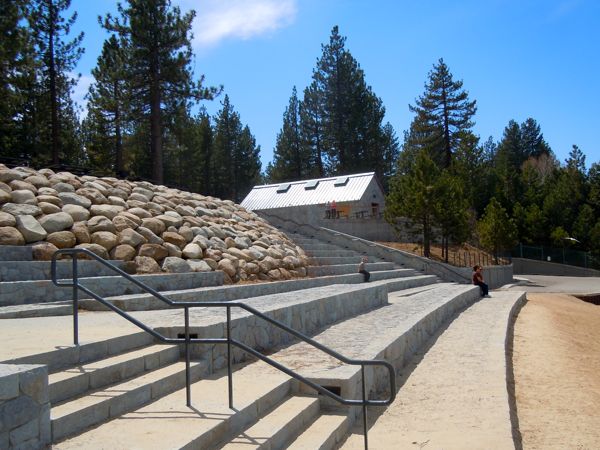
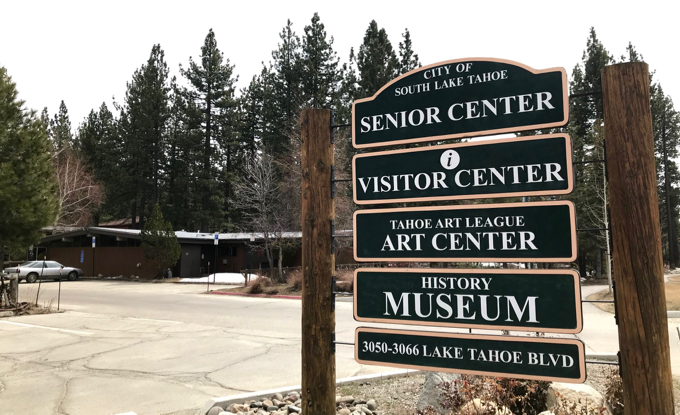
The county owns about 41 of those acres, which is home to El Dorado Beach (Lakeview Commons), Campground by the Lake, Tahoe Art League, South Lake Tahoe Senior Center, Lake Tahoe Museum, and Lake Tahoe Visitors Center.

The city owns about 15 acres in the area, which is where the rec center, ice rink and heavy equipment yard are located.

A lease was entered in 1968 giving the city the right to use about 38.8 acres in this central location of South Lake Tahoe. The county retained 1 acre for the library.

A revision to the lease was made in 1972. That agreement expires on June 30, 2023. It in part says the purpose is to “provide recreational, social, and cultural facilities on the property located in such a manner as to enhance the natural beauty of the property.”

Through the years changes have been made and documents added to the file, especially as Lakeview Commons was developed. That was a $6.5 million investment by the California Tahoe Conservancy.

Here are some of the provisions in the lease:
· The city is responsible for all financing, maintenance, and development of all facilities to be constructed or placed on the property. 

· The city is responsible to maintain the entire leased area at no cost to the county. 

· The responsibility and authority for the management and control of the leased premises and all the structures thereon is vested solely in the City, provided there is no breach of the lease. 

· If the city fails or refuses to carry out the lease provisions, the city shall nevertheless remain obligated to pay for maintenance of facilities and improvements while the lease is in effect. 

· Either the city or the county may terminate the lease if the other party fails to remedy a default of the lease terms and conditions within 90 days of receiving written notice of the default. 

· If the city brings legal action to obtain title to the leased property, the county may terminate the lease. 

· Upon termination of the lease for any reason including at the end of the 55‐year term, the ownership of all improvements constructed or placed on the property vest in the county. 

· The city assumes all risk of personal injury and property damage in connection with city occupation of the lease property, and indemnifies the county against related claims and liabilities. 

· The city agrees to pay for all utilities and services provided to the leased premises.
· The city agrees to provide free water service from the well located on the lease premises to the mosquito abatement facilities. 

· The city shall not assign lease or sublease without county’s approval. 

· The prevailing party in any legal action shall receive reasonable attorney’s fee.

A study commissioned and paid for by South Lake Tahoe and El Dorado County was prepared by Foothill Associates. While portions have done since late last year, it is not expected to before the City Council until May 1.

Acting City Manager Jeff Meston only recently obtained copies of the report. “I believe that staff will take direction from City Council, and then do what they wish. It is pretty clear to us this is a council decision/direction issue.”

El Dorado County CAO Don Ashton told Lake Tahoe News, “At this time there are no plans for a formal discussion with the Board of Supervisors since the city is responsible for the management and maintenance of the property for at least the next five years, and longer for Lakeview Commons.”

Lake Tahoe News also asked Ashton: Does county staff agree with the preferred recommendation of the city operating the facilities with a long term lease from the county? Why or why not? Would the county consider selling the property to the city? Why or why not? At what price? Would the county consider being a partner in developing the land in ways that were proposed in the charrette that was done a decade or so ago? If the city were to want to develop the site in some manner, what would the city (other than presumably footing the bill) need to do? In other words, what “permission” would the county need to give for future development? Where will vector control be relocated and when? Does the county expect to contribute to any of the maintenance needs prior to entering another lease with the city — assuming one is agreed to? What will the county do if the city says it doesn’t want anything to do with the 56 acres or even select areas? What if the city only wants responsibility for part of the area — say the campground and Lakeview Commons?

Ashton’s response was: “(Those) questions are speculative and hypothetical in nature so I’m unable to answer.”

Ultimately it will be up to the elected bodies on how to go forward.

South Lake Tahoe Mayor Wendy David told LTN, “I have not digested and read in detail enough yet to comment on the recommendations.”

El Dorado County Supervisor Sue Novasel was on the community committee back in 2006. She did not respond to Lake Tahoe News’ inquiry asking what she thought of the study and its recommendations.

The city doesn’t want to invest in the property if it won’t have control over it for a long period of time, and the county doesn’t want to part with what is prime real estate. The city as the renter believes the county as landlord ought to be paying more of the upkeep.

Until the two government bodies find a resolution the approach is more like putting a Band-Aid on problems instead of a whole knee replacement. That scenario isn’t working well, especially at someplace like Campground by the Lake that needs to have the restrooms/showers replaced at an estimated cost of $600,000.

“As indicated in the report the county needs to maintain ownership of the acreage in order to be compliant with our General Plan requirements,” Ashton said.

Of course general plans can be changed if elected have the will to do so.

The consultants recommend the city continue as the lessee and managing the facilities as one unit so the income could be moved around as needed. Changes to the subleases are also suggested to include regular and deferred maintenance agreements, utilities, annual repairs, and a five-year budget.

The report states, “… the success of this approach will require a commitment on the part of all parties to provide oversight, expense and revenue tracking, and record keeping in accordance with their respective roles. Annual updates to the operating budget and CIP should be made, and periodic facility assessments conducted to ensure preventive maintenance is being done and to identify upcoming major maintenance projects.”


Study: Little chance of new affordable housing at Tahoe

By Associated Press

A new study on housing availability in western Nevada says there’s little hope of expanding affordable rental opportunities for residents on the shore of Lake Tahoe.

The study concludes the “sheer expense” of development in Douglas County from south of Sand Harbor to the California line “makes it impractical for the development of affordable housing.”

Read the whole story


Wildfire prevention takes a backseat in Calif.

By Julie Cart, CalMatters

Dave Kinateder has a keen eye for trees. But when Kinateder, a fire ecologist in the Plumas National Forest, surveys a hillside lush with pines, he doesn’t see abundance or the glory of nature’s bounty.

He sees a disaster-in-waiting.

“It’s a ticking time bomb,” he said, gazing across the dense, green carpet of trees near Quincy, a small community high in the northern Sierra Nevada.

Last year’s wildfires, the worst in modern California history, have put a microscope on the forests that cover a third of the state – in particular, on managing these wooded lands in ways that would reduce the frequency and intensity of such blazes.

California is grappling with the counterintuitive dilemma of too many trees, packed too closely together, robbed of the space they need to thrive—and with how to clear out more than 100 million dead trees, felled by drought or insects, that provide tinder for the next infernos.

Curing these unhealthy forests is difficult and expensive, and as with human health, prevention is far less costly than treatment. But these days the state firefighting agency, CalFire, spends the bulk of its resources battling fires rather than practicing preventive measures.

At stake is nothing less than life, property, air quality and the lands that hold most of California’s water. A state commission recently prescribed radical changes to address what it terms the “neglect” of California’s largest forests.

A 19th-century California forest would have held fewer than 50 trees an acre. Today the state’s forests have grown to an unnatural 300 to 500 trees an acre, or more. That doesn’t count the 2 million drought-stressed trees a month lost to bark beetles that have killed entire stands.

Gov. Jerry Brown, who in 2014 declared tree mortality a state of emergency, said in his January state of the state address that California needs to manage its forests more intelligently. He vowed to convene a task force “to review thoroughly the way our forests are managed and suggest ways to reduce the threat of devastating fires.”

California has dozens of agencies attacking problem but still cannot keep up with the work. Crews around the state have been busy clearing trees as fast as funding allows. This wielding of chainsaws they call “whacking and stacking” leaves massive wood piles along highways in some areas. But it amounts to no more than triage: Cal Fire removes trees on fewer than 40,000 acres a year, far short of its goal of clearing a half-million acres annually.

Kinateder estimates that removing trees in this way costs as much as $1,400 an acre. By comparison, controlled burns—those set by fire managers to remove vegetation from forests—is a bargain at less than $150 an acre. Fighting a wildfire comes in at just over $800 an acre, according to the report.

Far from the forest floor, California officials are wrestling with the financial and environmental cost of the state’s forest practices. At a hearing in March in Sacramento, legislators listened to lurid descriptions of raging fire and wrenching stories of human misery recounted by a stream of state and local officials: flames rearing up like an enormous beast, residents running for their lives, neighborhoods leveled, fire burning so hot and for so long that soils were rendered sterile.

A portion of the proceedings focused on a recent report about wildfires and forest health from the Little Hoover Commission, an independent state oversight agency that gave its findings to the governor and Legislature in February. The document pulled no punches, calling the state of the Sierra Nevada’s forests “an unprecedented environmental catastrophe.”

It cited a century of “mismanaging” the 10 million wooded acres in the Sierra, calling out state and federal firefighting agencies for their longstanding policy of aggressively putting out all fires rather than letting those that can safely burn do so, thereby thinning the choked woodlands.

Helge Eng, deputy director of CalFire, acknowledged the report was “spot on” in its assessment of the state of the Sierra, adding that the analysis “did an especially good job of recognizing that there are no easy, black-and-white answers to the problems we are facing.”

CalFire boasts that it stops 95 percent of fires at 10 acres or less, saving lives, property and entire forests from conflagration. Fire experts argue that a negative could be turned into a positive if fire bosses let them burn while still steering them away from people and structures and toward overgrown wildlands in need of clearing.

That’s an approach sometimes used by the National Park Service, but it’s difficult to defend when forests are ablaze, frightening the public and many elected officials alike.

Still, the report said, “it is not enough for agency leaders, scientists and advocates to recognize the benefits of fire as a tool; the bureaucracy of the state government and public sentiment as a whole must undergo a culture shift to embrace fire as a tool for forest health.”

Eng said CalFire is considering adopting the managed-burn approach, when appropriate, but noted that federal firefighters are often working in wild settings, away from development.

“CalFire’s mission is different; we protect life and property” in areas that may be densely populated, Eng said in a written response to questions. “There is most often not an opportunity to let a fire burn. The risk to human life is just too great.”

The report also detailed a public safety threat from 129 million dead trees, the crushing cost—up to $1,000 a tree—to private property owners to have trees removed from their land and the enormous burden on rural governments to both recover from fire and prepare their forests to mitigate the intensity of the next one. In no uncertain terms, the commission prescribed dramatically ramping up tree-thinning projects and, as awful as the optics are, creating and controlling some fires to achieve the same result.

Eng agreed that the state firefighting agency was far from achieving its “aspirational” goal of clearing a half-million acres of land each year, citing such impediments as “the logistics of capacity of staff and equipment and environmental compliance,” among other factors.

In a moment notable for its rarity in Sacramento, there was bipartisan agreement in the hearing room this month about the problem, its scope and the appropriate measures to deal with it. Focus more intensely on the problem, they agreed, and throw money at it. The state spent $900 million fighting fires last year. Just one of those late-season blazes caused more than $9 billion in reported property damage.

“We’ve made mistakes, and we’ve created systems that are unwieldy…. It’s all of our fault,” Jim Branham, executive officer of the Sierra Nevada Conservancy, a state agency, told CalMatters. “Money alone won’t solve it, but we won’t solve it without money, either.”

The mosaic of land ownership in California means the state owns only 2 percent of the forests but has legal responsibility over much more: 31 million acres, including land in rural counties.

CalFire received more than $200 million for forest health projects last year and has proposed an additional $160 million for the next fiscal year. Those sums are on top of the agency’s current $2.7 billion budget. CalFire, in turn, doles out millions of those dollars in grants to local governments and community groups to do some thinning themselves, and it teams with the federal Forest Service to tackle clearing projects.

 The work to improve forest health dovetails with other state priorities—protecting water sources and reducing greenhouse-gas emissions.

The Sierra Nevada range is the headwaters for 60 percent of California’s developed water supply. Burned, denuded hillsides don’t store water efficiently when it rains. Sediment cascades downhill, filling streams, affecting water quality and loading up reservoirs, reducing their storage capacity

The carbon equation is equally direct: When trees burn or decay, they release greenhouse gases. The 2013 Rim Fire near Yosemite National Park produced emissions equal to those of 2.3 million cars in a year.

Prescribed burns emit less carbon than higher-intensity fires, because managed fire is aimed at smaller trees and shrubs. Cleared forest land may still ignite, but it will burn with less intensity and fewer emissions.

Moreover, when trees die, they stop absorbing carbon from the atmosphere. The state depends on that critical service to help reduce greenhouse gases. Research suggests that severely burned areas regrow with shrubs or grasses, plants that store about 10 percent less carbon than trees do.

John Moorlach, a Republican state senator from Costa Mesa, suggests the Democratic governor, a champion of the fight against climate change, has a “gigantic blind spot” when it comes to reducing carbon emissions. Moorlach said in an interview that Brown’s emphasis on electric cars, for example, ignores the role of fire in California’s greenhouse gas inventory.

“We’re being absolute phonies about climate change if we are not dealing with the real driver of greenhouse gas; that’s these wildfires,” said Moorlach. He has proposed that the state dedicate 25 percent of the revenue from its cap and trade grreenhouse-gas-reduction system to help counties’ fire mitigation efforts.

Counties would welcome the help. Randy Hanvelt, a supervisor in Tuolumne County, said that where forest management is concerned, there’s a “leadership problem.”

“Talk is cheap,” he said. “We have got ourselves a giant colossal mess. This is a war of sorts. Time is against us. Every available tool has to be applied.”

One such tool is carefully designed burns. But the meticulous planning necessary can take two to three years, and the burns require favorable weather, a permit from the local air district and, crucially, buy-in from local communities that must first be educated about the benefits. And controlled doesn’t mean risk-free.

“Politically, you have to have the ability to make mistakes and move on,” he said.

Nick Bunch, who plans thinning projects for the Plumas National Forest, pointed to a partly cleared hillside outside of Quincy where one of his extensively planned prescribed burns went awry, undone by a shift in the wind.

“We were about an hour into the burn and the smoke started going into town,” Bunch said, shaking his head at the memory. Even though the burn was going as planned, the smoke was not acceptable to nearby residents, who protested to fire officials. “Phones started ringing. Calls were made, and we shut it down.”

Another method is used in Florida, which trains and certifies private property owners to burn their overgrown land and provides limited liability coverage in some cases. Florida cleared 2.1 million acres this way last year. Scott Stephens, who heads a wildland fire research lab at UC Berkeley, said the widespread adoption of the policy has educated residents on both its benefits and risks.

Back in Plumas County, a hulking building in a parking lot outside a community health complex may offer the final piece of the forest-health puzzle: creating a market for trees removed from California’s forests.

Part of a project managed by the Sierra Institute for Community and Environment, the unremarkable square structure shows a potential use for California trees. The building is the state’s first to be fully constructed from cross-laminated timber—layers of wood pressed together to make thick sheets and posts—equal to or greater than the strength of steel.

In addition, the $2.3 million facility will house a large boiler to provide heat for the health center by consuming 500 tons of local wood chips a year.

The project is the brainchild of the institute, which envisions it as a way to boost the economies of forest communities. It’s the kind of innovation the governor and Legislature hoped to promote by establishing a Wood Products Working Group to develop commercial uses for the piles of trees beside the state’s roads.

There’s little left in California today of the early 20th century’s timber cutters, sawmills and biomass industry. If the state follows the Little Hoover Commission’s recommendations and accelerates forest thinning, an entire segment of state industry would need to be rejuvenated.

Meanwhile, officials emphasize the need to educate Californians about the role of forests in the ecosystem.

“If you want people to care about something, they have to understand why it matters,” said Pedro Nava, chairman of the Little Hoover Commission. “They need to understand the deep connection between the health of our state and the state of our forests.”

Branham, of the Sierra Nevada Conservancy, said that won’t be easy.

“Some of our messages are counterintuitive: We must cut down healthy living trees to save the forest,” he noted. “It’s a challenge.”


Drug Store Project’s message continues to be relevant

By Kathryn Reed

Prevention can save lives, especially when it comes to drug use and school violence.

Once a year sixth-graders on the South Shore participate in the Drug Store Project. Today is that day.

It’s one of the few proactive educational pieces left for Lake Tahoe Unified School District students to participate in.

“Regardless of what is out there, it’s illegal for them. We are trying to demonstrate the reasons why. Their bodies and brains are growing,” Lisa Huard told Lake Tahoe News.

This is the 15th year Huard has been organizing the event. It is staged at Lake Tahoe Community College, with hundreds of students going through the same scenario. It’s a party, one kid says yes to taking something illicit and it goes bad from there.

The people involved are not actors – they are law enforcement, district attorney’s employees, court officials, even a mortician. It take 220 volunteers and 47 agencies to pull it off.

It’s powerful.

The unfortunate thing is Drug Store Project is not open to the public because more than just this age group could use this sobering dose of reality.

Huard said the curriculum could easily be taught at younger grade levels. The drug problem is that prevalent at an early age.

New this year will be a component with Greg Bergner, a doctor with Barton Health, who will present a segment about marijuana and the adolescent.

Countless studies have shown how the brain continues to develop until age 26. The effects of marijuana on those  younger than 26 can be detrimental. Taking cannabis in any form before then can stunt one’s cognitive development. In other words, you won’t be as smart as you could be if you use marijuana as a young person.

With medicinal and recreational marijuana now the norm, it makes the message even harder to convey. Kids see older siblings, their parents and other adults partaking in pot and other drugs. They don’t understand why it’s bad for them.

Alcohol is still a major issue as well for youth.

“There are more children today who do not know how to deal with stressors,” Huard said. “They see others self-medicate. This just compounds the problems. We don’t have the resources for people, especially in this community.”

Huard believes beside just telling kids drugs are bad, it’s important to find out why they are using and how they are getting the product. They need to understand why they want to feel whatever change the drug brings them. Then, perhaps, it’s possible to get to the root of what led them to consume whatever they are taking.

With more parents using, the message through the years has changed from people who do drugs are bad people to the drugs are bad. This eliminates the conflict of mom and/or dad are bad people because of their habits.

“We need to make it clear to kids that drug usage is bad behavior on people’s parts,” Huard said. “There needs to be awareness about what goes in their body.”

Drug use is known to lead to other bad decisions. There so many consequences, and often they aren’t good.

Drug Store Project is about teaching kids that they have choices.

For those who advocate schools should just be about academic learning, Huard said phooey and then some.

“It’s been the three R’s for the last seven years and look where we are at. There is no consistency in the school district,” Huard said.


Kirkwood tragedy shines spotlight on deadly mountain hazard

By Benjamin Spillman, Reno Gazette-Journal

During the late afternoon hours of March 4 there was no reason to think Olga Perkovic and her son, Aaron, were in any danger.

Perkovic, 50, a lifelong skier, and Aaron, 10, a member of the Kirkwood JETS ski team, had just spent the day doing what they loved at Kirkwood Mountain Resort.

At 4:27pmthey loaded onto the TC Express chairlift to make one last run before skiing back to their condominium to join Olga’s mother, Radmila, 80, and daughter, Sophie, 8, to watch the Academy Awards.

They never arrived. 

Read the whole story


Water content improves, but only 52% of average

Three years ago Gov. Jerry Brown found dirt, not snow during the April survey. Photo/LTN file

By Kathryn Reed

March was good, but it wasn’t a miracle. That was the conclusion Monday of the snow survey.

While the water content increased dramatically in a one-month period, it is only at 52 percent of average for the state.

The manual measurement that was taken April 2 near Echo Summit recorded a depth of 32.1 inches of snow, 12.4 percent water content, for an average of 49 percent.

A month ago the water content was at 23 percent of average.

The water content is more important than the snow depth because that is what will melt this spring and be consumed by about one-third of the state’s water users downstream. Reservoirs throughout the state are the catch basins for the Sierra runoff, which then is filtered out for municipalities and farmers throughout California throughout the summer.

“The early April snow survey is the most important for water supply forecasting because the snowpack is normally at its peak before it begins to melt with rising spring temperatures,” officials with the state Department of Water Resources said.

The good news is that the reservoirs in the state are doing well because of the record rain/snowfall from last winter. Most are still at above average levels despite this winter’s dismal rain/snow.


SLTFD back on the waters of Lake Tahoe

Ms. Lisa, the South Lake Tahoe fire boat, will be christened April 2 at 1:30pm at Tahoe Keys Marina. Photo/Provided

By Kathryn Reed

Lives are expected to be saved. Structures might be as well, but the primary purpose of South Lake Tahoe Fire Department’s new vessel is to be a rescue boat.

Advanced life support will be able to be administered on the water. In the past only basic first aid was rendered.

The boat is the difference. The old one, which beavers destroyed, was an inflatable. This new one is more stable, larger and will allow IVs to be administered, bleeding to be stopped and splinting among other medical care.

Lakeside Marina is likely to be its permanent home. From there it can reach Emerald Bay in eight minutes.

The Tahoe Regional Planning Agency Governing Board passed an amendment in September 2016 allowing for one public safety pier in each county. South Lake Tahoe Fire Chief Jeff Meston is a proponent of this. He would like to see lifts at the piers so boats can stay in the water year round. This will allow for aid to be rendered that much faster.

“There have been some conversations between TRPA, Tahoe Douglas Fire, and Douglas County sheriff about ideas for a new pier, but no applications submitted at this point,” Tom Lotshaw with the bi-state regulatory agency told Lake Tahoe News.

The SLTFD vessel is a SAFE Boat, the same type the Coast Guard uses. It’s near impossible to tip over, and will be able to handle Lake Tahoe when it resembles the ocean.

Infrared gear will allow first responders to find people in the water. Night vision is also a component.

A medic will be on board. The nine fire engineers are being trained in navigation and how to handle the boat. Firefighters are going through training from the state Division of Boating and Waterways as well as the U.S. Coast Guard.

“The boat has played a pretty important role in our delivery system,” Meston told Lake Tahoe News. The agency has been without its own boat for three years.

Meston cited how on Fourth of July boaters – motorized and non – get turned around after the fireworks, drownings are an annual occurrence, and freak accidents like tourist vessels getting stuck on sandbars where passengers need rescuing are all calls his team responds to.

This boat also has better firefighting capabilities than the previous one. When a hose was used on the old boat it pushed the vessel away from the flames. This vessel will be strong enough not to move.

This new boat was completely funded with a $390,000 donation by philanthropist Lisa Maloff.

“The reality is this boat will save someone’s life. She will have directly contributed to saving someone’s life,” Meston said of Maloff.  

Maloff is expected to be at today’s christening of the boat named after her – Ms. Lisa – a bit of a play on words with boats often having MS (motor ship) before the name. This was her choosing.


Culture of trust is key for school safety

By Calvin Morrill and Michael Musheno, The Conversation

When we first visited the school that is the focus of our forthcoming book “Navigating Conflict: How Youth Handle Trouble in a High-Poverty School” back in 1995, students were free to move about campus during lunch and other free periods and a culture of trust prevailed.

All that changed during the 1999-2000 school year. That’s when a new principal arrived at the school – a racially diverse, urban school in the Southwest. School renovation started with funding secured in the name of “safe schools.”

Bushes, trees and lockers were deemed security hazards and removed. Security gates and metal detectors were installed. School officials hired more security personnel and cut back students’ freedom of movement on campus dramatically. The school implemented “sweeps,” which meant any student without a signed pass found outside of class or the designated eating area would be escorted to a room called the “tank,” where they would be detained for the remainder of the school day. Students who violated restrictive rules related to movement on campus faced heavy discipline, which included an automatic parent conference followed by up to five days of out-of-school suspension.

Teachers and students began to voice concerns about the tightened security to each other and protested to the administration. All this set up an interesting case for us to examine as field researchers who study conflict in organizations.

Ironically, what we found is that the tightened security measures eroded the ethos of trust that facilitated peace among students. Notably, whereas before students settled conflict peacefully among themselves, now peer violence increased on campus, which is something we discovered in our field research and that was corroborated with school district and local law enforcement data. The average annual number of police calls from the campus nearly quadrupled after the implementation of the new security measures. Before the tightened security, school district data revealed that the school was as safe as any in the district, including suburban schools in the surrounding area.

We continued to observe the high school in the 2000s, returning for intensive fieldwork in 2008 after we learned the school had a new principal. Heavy disciplinary measures were relaxed, and students regained some freedom to move about campus.

The new principal recognized the importance of youth-centered teachers. Students once again turned to predominantly peaceful actions to handle conflicts, as found by our field data and corroborated by institutional data.

Why trust matters

From our perspective, what our 16 years of field experience at this particular school shows is that target hardening, more police presence and heavier discipline all have a corrosive effect on school culture and security. Our finding squares with other researchers who have found that schools with robust social trust experience less peer violence and conflict than schools where distrust prevails. The question is why?

Social trust leads to freedom of association and movement on campus for youth, which in turn enables youth to cross social divides and develop relationships with other kids. In a trusting environment, like the campus we studied, youth learn to empathize with peers who are different than they are, taking the hard edge off of stereotypes based on race. Inclusive student clubs, supported by teachers, reinforced a sense of social belonging on the campus. Even in this environment, some peer groups faced difficulties tied to their social identities, especially new immigrant youth from Mexico.

Youth skills

Another important lesson from our book is that youth continuously work on their skills at handling peer conflict. Coupled with the socialization learned from senior students and teachers, youth in schools where trust runs high develop skills for working out their troubles by talking, getting support from those not directly involved in disputes, avoiding one another until emotions cool, and educating or correcting troublesome youth.

Our point is not that youth should be left alone, or that they’re perfectly rational (they’re not) and will work out all their problems on their own.

Rather, it is our contention that youth have a pretty good fix on dangerous threats among their peers and can peg these threats, distinguishing them from the everyday troubles they face with one another. Adults need to pay close attention to the knowledge and skills of youth in handling peer conflict, and keep their ears to the ground as to what youth are saying about who’s truly dangerous and who’s not.

Youth-centered teachers

Another lesson is the importance of youth-centered teachers operating actively in the social environment of the school. These teachers are highly attentive to the education and safety of their students. They care about students’ lives, learning and comportment, and regard the entire school campus, not just their classroom, as their place.

Youth-centered teachers monitor students in and out of the classroom in supportive ways that facilitate building social trust. Student clubs figure prominently. This is because clubs offer opportunities for youth-centered teachers to open their classrooms as meeting spaces and collaborate with young people to formulate goals that respond to the changing needs of diverse students.

Youth-centered teachers also show a strong inclination to keep their commitments to youth and an inclusive school culture. They defend these practices during times of adversity.

Effective leadership

School principals are most effective when they know how to develop a shared vision with students and staff. In our view, these shared visions must be sustained from the bottom up rather than the top down. The most effective principals we observed knew how to empower youth-centered teachers and meaningful, inclusive youth agency in student governments and clubs. This led to social trust and a shared ability to respond to problems when they arose.

The bottom line, in our opinion, is that in an era of budgetary constraints, fostering an environment for youth-centered teachers and students to build cultures of trust will likely have better payoffs for school safety than further investments in the fortification of public school campuses.

Calvin Morrill is a Stefan A. Riesenfeld professor of law and professor of sociology at UC Berkeley. Michael Musheno is a professor of law at University of Oregon.