CTC on track to restore Upper Truckee Marsh
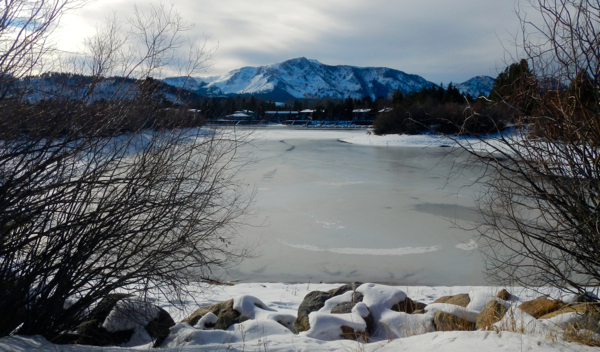
This lagoon at the Tahoe Keys will be filled in when the Upper Truckee Marsh is restored. Photo/Kathryn Reed

This lagoon at the Tahoe Keys will be filled in when the Upper Truckee Marsh is restored. Photo/Kathryn Reed

By Kathryn Reed

It’s possible kayakers using the Upper Truckee River may one day not be able to reach Lake Tahoe. And the landowners are OK with that.

The California Tahoe Conservancy board on Dec. 18 certified the environmental documents for the Upper Truckee River and Marsh restoration project and approved the preferred alternative. Tom Davis, South Lake Tahoe’s rep, was absent.

The soonest any change will come is in 2018. That’s dependent on state approvals and financing for what will be a multi-million dollar project.

Most of the work on this 600-acre swath of land in the middle of South Lake Tahoe will take place on the west side near Cove East. While boardwalks and other amenities had initially been planned for the Al Tahoe side, residents convinced the Conservancy that adding more people to this area would be detrimental for the marsh and the neighborhood.

This marsh is the most sensitive wetlands in the basin.

A big change will be how the river actually flows.

“We are letting the river go and see what happens. We want to see if the old braided channels reappear,” CTC Executive Director Patrick Wright told Lake Tahoe News.

Stu Roll with the Conservancy, said, “This is cutting edge for stream restoration.”

Most river projects in the basin have been massive undertakings to reroute channels, shore up banks and fill in old channels. This is more like a holistic approach to restoration. And, yet, it is still designed to restore the river to its natural meander before the Tahoe Keys was developed more than 50 years ago. At that time various fingers of the river reached the lake instead of one distinct outlet like there is today.

Conservancy staff realizes it may mean kayakers and others who float down the river will not end up at the lake or near an easy take-out location. Wright said a future project not associated with the restoration is being talked about that would provide a spot for non-motorized watercraft to easily get off the river.

Another major change will be getting rid of the lagoon that jets off from the channel that leads from the Tahoe Keys Marina to the lake. Much of the time this is stagnant water.

The path will be altered with this latest project, but it will still form a loop that takes walkers and cyclists out to the lake.

The Conservancy acquired the 22-acre Cove East parcel at the end of Venice Drive in a settlement agreement stemming from the Tahoe Keys development. In 2002, a $10.5 million restoration project was completed that brought back the wetlands that run between the walking path at the end of Venice and the river.



Climate experts say West Coast will see wet winter

By Kurtis Alexander, San Francisco Chronicle

The stormy weather expected to dampen California for the next several days — which holds promise of a wet and even white Christmas some places — is just the beginning of what promises to be a soggy winter ahead, federal climate experts said Thursday.

This week’s monthly report by the U.S. Climate Prediction Center remained bullish in its long-term outlook for precipitation along much of the West Coast, mostly due to the moist atmospheric conditions associated with El Niño.

Lake Tahoe and the northern Sierra, where the bulk of California’s water comes from, stands a 40 percent chance of getting significantly wetter weather. The Bay Area is pegged for a 50 percent chance of significantly wetter-than-average weather in January, February and March — defined as within the top one-third of the rainiest seasons on record.

Read the whole story


Study: Rising lake temps may worsen algae blooms

By John Flesher, AP


TRAVERSE CITY, Mich. — Some of the world’s biggest temperature jumps are happening in lakes — an ominous sign that suggests problems such as harmful algae blooms and low-oxygen zones hazardous to fish will get worse, says a scientific report.

An analysis of 235 lakes that together hold more than half the earth’s fresh surface water found they have warmed an average of 0.61 degrees Fahrenheit or 0.34 degrees Celsius per decade, the report said. While seemingly insignificant, the increase is bigger than those recorded in the oceans or the atmosphere.

Such rapid swings can affect aquatic ecosystems in profound ways, raising concerns about the quality of waters that people rely on for drinking supplies, crop irrigation and energy production.

A combination of satellite data and ground measurements, such as from instrumented buoys like this one in Lake Tahoe on the California/Nevada border, were used to provide a comprehensive view of changing lake temperatures worldwide. The buoy measures the water temperature from above and below. Photo/Limnotech

A combination of satellite data and ground measurements, such as from instrumented buoys like this one in Lake Tahoe, were used to provide a comprehensive view of changing lake temperatures worldwide. The buoy measures the water temperature from above and below. Photo/Limnotech

“The message we’re getting from our lakes is that they’re getting more and more stressed,” Catherine O’Reilly, an Illinois State University geologist who led the study, said Thursday. “With these rates of warming, the problems we’re seeing will become increasingly common.”

Dozens of scientists in six continents took part in the project, funded partly by NASA and the National Science Foundation. The results, made public this week during a meeting of the American Geophysical Union in San Francisco, were based on a first-of-its-kind combination of temperature data from satellites and ground measurements over 25 years. They are being published in the group’s journal, Geophysical Research Letters.

Lakes warming at the average worldwide rate or higher were widespread, including the Dead Sea, Lake Tahoe, Lake Baikal in Siberia and Lake Fracksjon in Sweden. But deep lakes in cold regions had the most rapid changes, said John Lenters of LimnoTech, a water science consulting firm in Ann Arbor, Mich.

They included four of the five U.S. Great Lakes — Superior, Huron, Michigan and Ontario. Only Lake Erie, the shallowest and warmest of the Great Lakes, was below average. Superior, the deepest and coldest, warmed three times faster than the global average.

In addition to rising air temperatures, factors causing lakes to warm vary among regions, scientists said. The Great Lakes and others in northern climates are losing winter ice earlier, and some areas are getting less cloud cover, exposing their surfaces to more sunlight.

Algae blooms flourish in warmer waters. The report predicted a 20 percent boost in lake algae over the next century, including a 5 percent increase in blooms that are toxic to fish and animals. An outbreak of toxic algae left more than 400,000 residents of Toledo, Ohio, and southeastern Michigan without usable tap water for two days in August 2014.

Such an increase would expand “dead zones” with so little oxygen that fish cannot survive, O’Reilly said. It also would boost emissions of methane, a greenhouse gas even more potent than carbon dioxide, the leading cause of climate change.

Warming causes a different problem for some lakes. In eastern Africa, Lake Tanganyika is less able to blend warm water near the surface with colder layers farther down, reducing distribution of nutrients for algae on which fish feed.

Donald Uzarski, director of the Institute for Great Lakes Research at Central Michigan University, who was not involved with the study, said its findings were consistent with other water temperature measurements in places such as the Great Lakes and Poyang Lake in China.

Other likely results of warmer lakes, he said, include lower lake levels, damaged coastal wetlands and exotic species invasions.

“What seems to be nothing more than a small change in water temperature produces a domino effect that drastically impacts the ecosystem,” Uzarski said.


Report: Lake Tahoe’s economy sputtering

By Kathryn Reed

Lake Tahoe’s economy is not thriving.

That was the message delivered this week by three members of the Tahoe Prosperity Center.

“We need to make it a less difficult place to make a living,” Heidi Hill Drum, executive director of TPC, told a group of near two dozen people at Lake Tahoe Community College on Dec. 16. She was joined on the panel by board members Jesse Walker and B Gorman. It was Gorman who spearheaded the TPC in 2011 as a way to have a single entity delving into the regional economic issues.

Earlier this fall the center released a report titled Measuring for Prosperity.

B Gorman, right, makes a point about Tahoe's economy as Heidi Hill Drum and Jesse Walker listen. Photo/LTN

B Gorman, right, makes a point about Tahoe’s economy as Heidi Hill Drum and Jesse Walker listen. Photo/LTN

Highlights include:

·       The Lake Tahoe Basin had a $4.7 billion economy in 2010, with tourism being responsible for two-thirds of that total.

·       Tourism-related jobs went from 50 percent of the overall work force in 2003 to 44 percent in 2013. This could in large part be a result in the dramatic decline in casino jobs.

·       2013 was the first time population in the basin increased in years. It’s too soon to know if this is a blip or a trend.

·       Hotel tax revenue is increasing in the basin, but not at the same pace as it is throughout California. With Monterey, Napa and Sonoma being Tahoe’s competitors, this is a concern that people in Northern California are choosing to vacation places other than Tahoe. However, with the tax rate being different in each locale, it’s not a true apples to apples comparison.

·       There has been a significant loss in the 25-44 age group.

·       Housing costs continue to outpace income levels.

·       Unemployment is above average compared to California and Nevada.

“Generally household incomes are low in the basin and they are continuing to decline,” Walker said. “They are not keeping up with inflation.”

A chart showed North Lake Tahoe incomes the highest in the basin – averaging more than $35,000 a year, while in South Lake Tahoe they are below $25,000.

“We’ve got problems that are exacerbated by the income trend going down and housing going up,” Walker said.

Carl Ribaudo with Strategy Marketing Group said it’s time to look at unconventional, smaller housing options such as cargo containers or two houses on one lot.

TPC’s next project in partnership with chambers of commerce on both ends of the lake is going to be looking at the work force. Gorman said having enough workers to fill jobs is going to be a critical issue in the coming decade. She mentioned how businesses in the area are already having a hard time finding qualified candidates for jobs that aren’t entry level, service industry positions.


Sierra snowpack trumping last winter

weather grafix

By National Weather Service

After four dry winters, the mountain snowpack is off to a great start in the Eastern Sierra and Western Nevada.

The peak of the snowpack is typically near April 1, and this is the date used to compare overall winter snowpack numbers.

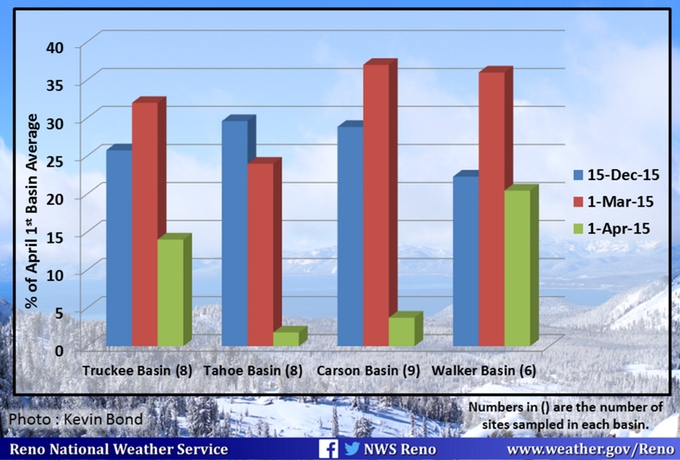
The winter of 2014-15 brought an abysmal snowpack to the region, with most basins only reporting 2 to 20 percent of average as of April 1, 2015. However, last year’s peak was also earlier in the winter, closer to March 1, and would be slightly higher than current conditions, as can be seen in the chart above.

So far, the winter of 2015-16 is already nearing the overall snowpack percentages of last winter.

Keep in mind, we are comparing the current snowpack to the April 1 averages, so the data set is not complete for this season. We are just trying to show that we are off to a great start this winter and the snow water equivalent numbers in the Truckee, Tahoe, Carson, and Walker River basins are slightly above average for this time of the year.

As a side note, snow water equivalent is the amount of liquid that would be produced if all the snow were melted instantaneously. The graphs in the first image are showing the same four river basins and comparing the percentage of average in the snowpack today based on March 1 and April 1 averages and what the percentage of average on April 1 of 2015 was. The number of sites sampled in each basin are in parenthesis, all data courtesy of NRCS.


Tahoe firm making gear for women who shred

By Benjamin Spillman, Reno Gazette-Journal

TAHOE CITY — To people who dedicate their lives to mountains and snow the statement from Jen Gurecki might have sounded blasphemous.

“I’m at a point in my life where I’ve had so many powder days I can’t even keep track of them,” Gurecki said before getting to the really shocking stuff. “There are bigger things to do in life than powder days.”

It was especially surprising coming from Gurecki, 39, who moved from Arizona to Lake Tahoe 15 years ago to spend more time on the snow. And last year she and Danielle Rees, 38, co-founded Coalition Snow, a startup that makes skis and snowboards.

But slowly, as Gurecki explained the idea behind Coalition, it became clear how her drive to build company could surpass even her passion for powder.

That’s because the mission behind Coalition — described as the only ski and snowboard maker founded by women and dedicated to having women design products for advanced female skiers and riders — is to do more than sell equipment to surging numbers of millennial-age female skiers and riders. It seeks to open doors for those same women in the male dominated snow sports industry, on the slopes and in the boardrooms.

Read the whole story


Massive undertaking to deliver holiday mail

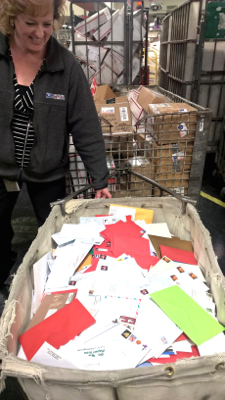
Letters and packages from Lake Tahoe all go through Reno. Photo/Linda Fine Conaboy

Letters and packages from Lake Tahoe all go through Reno. Photo/Linda Fine Conaboy

By Linda Fine Conaboy

RENO – It’s the busiest mailing day of the year and surprisingly this humming and thrumming place was occupied by seemingly happy people, masters of their powerful conveyors, sorters, forklifts, trucks, and bins and bins of mail, all awaiting their attention.

The Reno Main Post Office on Vassar Street is the U.S. Postal Service’s regional hub, where each and every letter, magazine and parcel from as far away as the Oregon border, Northern California, Winnemucca, Carson City, the entire Lake Tahoe region as well as Reno and Sparks is processed.

Overseeing this organized chaos is Michael Sralik II, plant manager, and Karen Little, post office supervisor. Sralik, most recently from Arizona, has been here about a year, while Little, who’s from Colorado, has been on the job two years—both started their careers as letter carriers.

Sralik, who knows each and every facet and cranny of the place, will work practically around the clock during the busy season, with breaks when he dashes home for a quick four-hour nap and returns.

Karen Little, post office supervisor, checking the days mail. Photo/Linda Fine Conaboy

Karen Little, Reno post office supervisor, checks the mail. Photo/Linda Fine Conaboy

He said he’s hardly ever in his fairly plush and spacious office. He prefers being on the floor where the action is. The action on Monday night included the processing of a record 420,000 letters and 100,000 packages; nationally, the post office anticipates 612 million packages will fly out the doors of a huge network of postal offices in December.

However, Sralik added, if you think Dec. 14 is busy, wait for Dec. 21, when the anticipated peak delivery crunch will occur. Nationally, the figure this year will soar to 30 million pieces on a single day.

He attributes this phenomenon partly to online services.

“More than 7 million people are expected to use USPS.com,” he told Lake Tahoe News, adding that events such as Cyber Monday can be extremely beneficial to the post office.

The other employees in Reno work various shifts to keep the 250,000 square foot plant running on a round-the-clock schedule, every day of the year.

To get the job done, across the nation, about 30,000 seasonal workers are hired, while at the Reno facility, 40 people were added to the staff.

At the rear of the facility lies the loading docks where huge 18-wheelers are serviced as well as smaller neighborhood delivery vehicles, all being loaded and unloaded.

In this area too, are numerous plus-sized bins of packages and letters ready to head out of town.

“We fly about 80 percent of our volume by commercial airline,” Little said. “We buy tickets for our mail, which is why we ask all of those questions about content when a customer drops off a package.”

Because most of the post offices around the lake are smaller and can’t accommodate big trucks at their docks multiple trips are made each day.

“For the last three Sundays, we’ve been transporting there early in the day. South Lake Tahoe got two trucks in two days,” he said.

All of this increased activity bodes well for the Postal Service, Little said. “We’ve seen a 20 to 30 percent increase in package delivery over last year. Maybe it’s the better economy. But we’ve done a good job, so people are coming back to us.”

Routing mail to the appropriate address is a massive undertaking. Photo/Linda Fine Conaboy

Routing mail to the appropriate address is an intricate process. Photo/Linda Fine Conaboy

In addition, Little said the “If it fits, it ships,” slogan advertising flat rate mail has been exceedingly helpful. “It’s a convenience to customers. The carrier gets a notification, knocks on the door or picks up the package off the porch. How much more convenient can that be?” she asked.

Not only does computer automation help the home customer or business, but it’s been a boon to the post office too. Unless they’re oversized and culled from the herd, letters and even parcels are all loaded on conveyor belts, sorted, bar coded and distributed to carriers, all in the blink of a computer’s eye. This process happens for incoming and outgoing mail and happens to each piece.

Still, there is a downside to post office operations. Enter David Rupert, a corporate communications specialist based in Denver. “We’ve been self-sufficient since 1972,” Rupert said. “Before that we were taxpayer-supported. Over time, we’ve been required by law to break even and we have, but the last few years, we’ve struggled.

“We’re still losing lots of money because first class mail is down 30 percent over the last six years. Parcels are on the increase, but not making up the difference yet. We welcome this, but we still struggle over decreasing volume. In part, it could be that many people are now paying their bills online,” he told Lake Tahoe News.

But even the battle to overcome a difficult past record can’t dampen the spirits of the crew at Vassar Street. Heck, you’d think that any minute Santa was going to pull up to the loading dock. This is one happy crew, eager to deliver good tidings.

“This is a very choreographed, organized process, believe it or not,” Stralik laughed.

—–

Notes:

Important mailing dates are fast approaching. For a stress-free season remember to mail first class letters by Dec. 19; priority parcels by Dec. 21; and express mail by Dec. 23.


Ballot measure could re-establish tiered water pricing

By Taylor Goldenstein, Los Angeles Times

A coalition of groups representing cities, counties and water agencies filed a proposed ballot measure Monday that would allow water providers to reestablish so-called tiered pricing as a means of encouraging conservation.

Backers submitted the California Water Conservation, Flood Control and Stormwater Management Act of 2016 to the attorney general’s office. The measure would appear on next November’s state ballot as a proposed constitutional amendment if enough signatures are collected.

The measure was crafted after a state appeals court ruled last spring that the tiered water rate structure used by the city of San Juan Capistrano was unconstitutional because it violated voter-approved Proposition 218, which prohibits government agencies from charging more for a service than it costs to provide it.

Read the whole story


White House pushes water conservation

By Carolyn Lochhead, San Francisco Chronicle

WASHINGTON — The White House followed Sunday’s landmark climate pact in Paris with a push Tuesday on water conservation and efficiency, as top administration officials warned that water shortages are among the biggest consequences of rising global temperatures.

White House science adviser John Holdren and Interior Secretary Sally Jewell said the plan is to find ways to squeeze more water from existing systems through new technologies.

Congress is no longer funding the giant dams like those built in the last century that led to the development of the West, Jewell said, while Holdren warned that climate change is reducing the available freshwater supply even as higher temperatures increase demand.

Read the whole story


Child safe after LTUSD bus driver ‘loses’ him

By Kathryn Reed

It was probably the longest hour of Libi and Jason Fenley’s life. Their son was missing. He didn’t get off the school bus at day care. And no one knew where he was.

Corben is a 6-year-old first-grader at Sierra House Elementary School in South Lake Tahoe. His teacher and principal confirmed he got on the bus at about 3:20pm last Friday.

Jason Corben got a call at approximately 4:10pm from the day care center saying the bus did not drop Corben off.

“We freaked out because we knew neither of us had him,” Libi Fenley told Lake Tahoe News. “I called the bus garage. They said he was not there.”

South Lake Tahoe Police Department received a call from the Fenleys at 4:34pm Dec. 11. In about five minutes officers were at the bus garage.

The bus driver, who is reportedly a veteran at her job – even a trainer, searched the bus three times. No Corben.

“The bus driver said he got off at the wrong stop,” Fenley said. She said this before film from the cameras was reviewed.

All LTUSD school buses have two cameras, some have three. They are there for safety and security.

There was quick talk among the Fenleys, officers and Lake Tahoe Unified School District transportation officials that a search should begin in the neighborhood where Corben may have gotten off. This was going on despite there being no proof he got off somewhere else.

Then suddenly there was banging on the bus garage door. It was Corben.

He had actually been on that bus that was supposedly searched by the driver. He had fallen asleep. It’s not the first time. And he’s not the first kid to do so.

“He was fine, he was scared. He woke up in the dark in a scary place,” Fenley said of her son.

But she’s not happy how the district handled things. When Corben got on the bus Monday the driver didn’t offer an apology. Fenley was flabbergasted Christy Blach, director of transportation, seemed to care more about her employee than Fenley’s son. She was miffed Superintendent Jim Tarwater had not responded to her email.

Blach was short with Lake Tahoe News on Dec. 15. “He was at the bus garage for maybe 10 minutes,” she said.

That might be true, but no knew it. Corben was found at 5:04pm that Friday.

Tarwater didn’t know about the incident until Lake Tahoe News called on Tuesday. He said that is not normal protocol.

“I would say they slipped up, didn’t they?” he said of not being told. “I can see why she would be upset,” Tarwater said of the distraught mother.

Fenley said, “If the driver is not going to be accountable, what procedures are going to be put in place other than flashlights will be used for looking for items (and people) on the bus?”

With neither the superintendent nor the board being told about the incident by staff, change couldn’t happen as fast as Fenley would have liked.