Little interest in Liberty wanting to raise rates


Source: Liberty Utilities

Source: Liberty Utilities

By Kathryn Reed

A proposed 17 percent rate increase by Liberty Utilities generated little interest from the public in the way of giving feedback to the California Public Utilities Commission.

The commissioners, who are responsible for granting or declining the hike, conducted four hearings last week – two in Kings Beach and two in South Lake Tahoe.

Combined, less than 30 people showed up for the meetings, and even fewer spoke.

Commissioners are expected to make a decision in late spring. Assuming an increase is approved, it will be retroactive to Jan. 1. Instead of one lump sum added to bills it would be spread out over a few months. A residential customer using 601.67 kilowatts per month would see an average monthly bill increase of $3.95 (or 4.37 percent), from $86.56 to $90.54.

Liberty provides electricity to about 49, 000 customers, with about 80 percent of them in the Lake Tahoe Basin on the California side.

Liberty first applied for the 17.34 increase in May. It is designed generate $13.57 million.

Ken Wittman with Liberty told the commission the actual increase may be scaled back because the cost of natural gas gone down since last spring.

General rate increase filings are required by the CPUC every three years. In 2012, rates went up nearly 5 percent. At that time the CPUC did not require the local public meetings.

“We welcome it. It’s an important part of the process,” Greg Sorensen, president of Liberty Utilities, told Lake Tahoe News.

Reasons for the increase include: vegetation management; drought-related fire prevention mandates; more energy efficiency programs/incentives; and the new solar incentive program.

Liberty also needs funds to pay for its multimillion-dollar upgrade to facilities on the North Shore and in the Truckee area. The Truckee to Northstar work was done last summer, with the Northstar to Kings Beach work to start after the snow melts in the spring.

“It helps with our reliability,” Sorensen said.

Normally peak usage is over the Christmas-New Year’s holidays, where the system is on the borderline of requiring customers to scale back use or the company will need to initiate brown outs. While consumption is always monitored, this year – even with so many people in the basin and resorts blowing snow – the usage didn’t reach the danger zone. The new line is credited with supplying enough power, Sorensen said.

—–

Notes:

·       The rate increase application is on Liberty’s website.



Analyst: Casino industry financial outlook looks stable

By Howard Stutz, Las Vegas Review-Journal

Count the analysts at Fitch Ratings Service as predicting 2016 to be a stable environment for most U.S. gaming operators.

Few casino openings are planned that could tip the scales in saturated gaming markets. Discretionary spending by consumers remains on an upswing. Companies saddled with a hefty long-term debt — this doesn’t include Caesars Entertainment Corp. — have taken necessary steps to address near-term maturities through refinancing efforts and other means.

That’s not to say, however, the casino business is back to the halcyon days of monthly double-digit gaming revenue increases.

Read the whole story


Calif. budget earmarks big money for disasters

By Christine Mai-Duc, Los Angeles Times

After one of the most destructive fire seasons in California history and with an eye toward the increased potential effects of climate change, Gov. Jerry Brown has proposed spending more on fighting wildfires than the state has in more than a decade.

Brown’s $170.7 billion budget proposal includes a $719 million one-time drought package, including an extra $215 million to the state’s emergency fund for battling big blazes.

The extra cash, along with increased funding for healthy forests and bolstering levies, takes into account the “new normal” as it relates to climate change and the state’s historic drought, officials say.

Read the whole story


Olympic champ embraces being free spirit

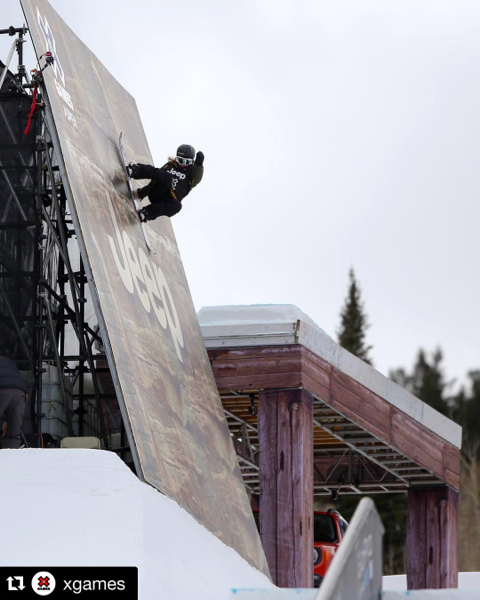
Jamie Anderson of Meyers hopes to be back competing this month after breaking her collar bone. Photo/Provided

Jamie Anderson hopes to be back competing this month after breaking her clavicle. Photo/Provided

By Jessie Marchesseau

Olympic snowboard gold medalist Jamie Anderson started the season with a clavicle broken in five places, her first surgery, one plate and eight screws.

Her collarbone now on the mend, Anderson is anxiously awaiting approval from her doctors to get back on the snow. When she does return to competition, she will be doing so without the U.S. Snowboard Team.

Anderson joined the team in 2014 when she was heading to the Olympics. However, she has otherwise opted to go it on her own when it comes to training and competing on the snowboard circuit.

“For me, snowboarding is just about fun! It’s not so much about the ‘serious training’ or team stuff,” Anderson said, “it’s just about being on the mountain with your friends and having fun doing whatever you want.”

Jamie Anderson's record proves doing her own thing is working. Photo/Provided

Jamie Anderson’s record proves doing her own thing is working. Photo/Provided

John Rice, general manager of Sierra-at-Tahoe the resort that sponsors Anderson, doesn’t see her decision to not be part of the team as having negative impacts on her riding or her sponsorship from Sierra.

“Everyone knows she’s the best female snowboarder in the world, so it’s not an issue at all,” he told Lake Tahoe News.

For athletes still working their way to the top, Rice said he believes being a member of the U.S. Team can offer big training advantages. But for Anderson, the advantages would be more for her teammates than for her.

“She’s a free spirit,” he said. “When she needs to be part of the team, she signs up and she’s a good member.”

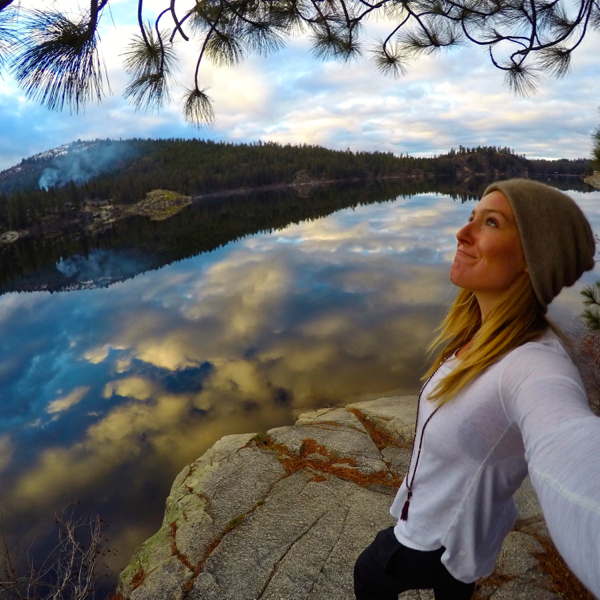
Enjoying the serenity of Tahoe is one Jamie Anderson's indulgences. Photo/Provided

Growing up in Meyers, Jamie Anderson is all about embracing the outdoors at Tahoe. Photo/Provided

Anderson is not the only pro snowboarder who has opted out of being on the team. Shaun White was rarely a member. Sage Kotsenburg who also won a gold medal in Sochi has chosen not to join this year. Two-time Olympian Elena Hight took a break from the team last year, but is back again this season.

Tricia Byrnes, snowboarding press officer for the U.S. Ski and Snowboard Association and a former professional snowboarder, said it’s not uncommon for snowboarders to go on and off the team or only join up around the Olympics.

Snowboarding is different than ski racing, she said. Snowboarders don’t necessarily want or need the structured training or team mentality that being part of the U.S. Ski Team brings. A lot of snowboard athletes want to do their own thing and work with their own coaches. Plus, many of them are juggling filming, photo shoots and other obligations which don’t really allow them to have structured schedules or make all of the competitions required of team members.

But just because Anderson isn’t officially on the team doesn’t mean she can’t take advantage of some of the benefits like coaches or training. Byrnes said anytime Anderson wants advice from a coach or trainer, all she has to do is ask. And if she wanted to join up mid-season, that option is there for her, too.

But for now, being on her own is working out just fine for Anderson. She follows her own off-the hill training regimen which includes a lot of yoga, acupuncture, working out with a personal trainer, and, recently, spending time in a hyperbaric oxygen chamber to speed her healing.

Repairing the broken clavicle was Jamie Anderson's first surgery. Photo/Provided

Repairing the broken clavicle was Jamie Anderson’s first surgery. Photo/Provided

“She can survive and thrive on her own program; not everyone can do that,” Byrnes told Lake Tahoe News. “She’s a total free spirit, and she knows what’s going to motivate her and rally her better than anyone.”

If you’re counting, that makes two people who called Anderson a free spirit so far, and Anderson herself makes three. She says being a “free spirit” and wanting to do her own thing is part of the reason she chose not to join the team.

“It’s a creative expression,” she told Lake Tahoe News of snowboarding, “and I just like to go with my own flow.”

Anderson missed out on the Dew Tour due to her injury, but she’s ready to get back on her board and is hoping to get the OK from her doctors before the LAAX Open in Switzerland Jan. 18.  U.S. Snowboard Team or not, fans can expect to see plenty more of Jamie Anderson flying through the air with her snowboard this season.


Education technology not limited to computers

By Ian Whitaker, Las Vegas Sun

Technology in the classroom has come a long way.

What started with a simple chalkboard has evolved into projectors, computers, tablets and now robots. If you go by what you see at CES, which kicked off Tuesday in convention centers on the Strip, the beeping, booping machines are the future of technology in the classroom.

It’s not a surprise that the programmable gizmos are taking center stage given the recent obsession with improving science, technology, engineering and mathematics education.

Read the whole story


El Niño expected to stay strong, finish wet

By Kathryn Reed

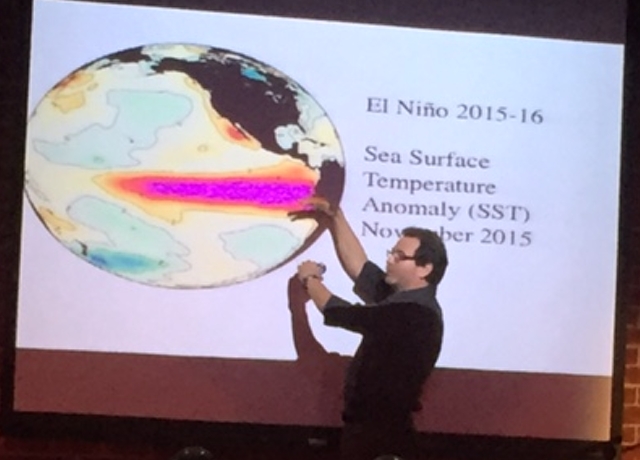
STATELINE – To the untrained eye the three images looked practically they same. They showed the El Niño pattern from 1982-83, 1997-98 and 2015-16.

The first two brought crazy weather to Northern California and Northern Nevada. It’s usually the first quarter of the year where the moisture really starts to fall.

“So far we’ve got out of this event exactly what we expected,” Sasha Gershunov, climate and meteorology researcher at Scripps Institute of Oceanography in San Diego, said of this winter’s weather phenomenon.

He was one of the speakers Jan. 8 at the annual Operation Sierra Storm conference, a gathering of television meteorologists hosted by Lake Tahoe Visitors Authority.

Sasha Gershunov points to the pink are that is El Niño. Photo/Kathryn Reed

Sasha Gershunov points to the pink area that is El Niño. Photo/LTN

A difference this go-round compared to the last two significant El Niños is that the world is a warmer place. This could make for a nasty situation if in March the moisture in the Sierra becomes rain on top of the snowpack. It could cause flooding as well wash away the white stuff that is needed to fill reservoirs downstream.

It’s especially concerning because the signals are for the snowy season to end on a particularly wet note, he said.

For now, the models point to this being one of the strongest El Niños on record, with no sign of slowing down any time soon.

Much of Gershunov’s talk focused on the formation of El Niños, which start off the coast of India. Warm ocean water is pushed toward Peru. He believes as long as the Earth has been in its current configuration there have been El Niños.

“It’s a dance between the atmosphere and the ocean,” he said. “Unless they act in unison, an El Niño cannot happen.”

They are cyclical, occurring about every two to seven years.

The warming of the Pacific Ocean near the equator is where an El Niño is strongest. California and Nevada are essentially experiencing the ripple effect.

“El Niño is just one thing that is going on in the atmosphere. There are several configurations a storm track can take,” Gershunov said.

When the 1982-83 El Niño hit it took weather and climate experts by surprise.

“We didn’t have the models or observations. People realized we better learn how to predict these things,” Gershunov said.

Fifteen years later the science and technology got it right, the same with this season’s El Niño.

While the science has improved through the years, there is room for improvement.

“Unless there is some sort of breakthrough, there is a prediction barrier in the spring,” Gershunov said. That’s why it isn’t until summer that meteorologists are able to forecast an El Niño for the coming winter.


Calif. budget has CTC looking for cash elsewhere

By Kathryn Reed

California’s nearly $700 million investment in Lake Tahoe is slowing down as evidenced by the governor’s proposed budget. The California Tahoe Conservancy is left out of any new funding.

“Overall, the state of California has been historically — and will continue to be — committed to the restoration of Lake Tahoe, including meeting our share of commitments to the Environmental Improvement Program,” Nancy Vogel, deputy secretary for communications for the California Natural Resources Agency, told Lake Tahoe News. “Specifically regarding the $475 million in the Proposition 1 Settlements Pot, the governor’s 2016-17 proposed state budget does not allocate additional funding for Lake Tahoe at this time since Lake Tahoe already benefits from other existing resources available in Proposition 1.”

Gov. Jerry Brown released his proposed budget this week. Haggling between those on the receiving end as well as lawmakers will occur between now and when the May revise comes out. The next fiscal year starts July 1 and requires the Legislature to approve the budget.

CTC officials were warned before the budget came out that it was being cut out of the $475 million pot it was supposed to share with four other entities. This money came from the November 2014 voter approved water bond called Proposition 1 that provides $7.5 billion for water quality, water storage, flood protection and watershed protection and restoration projects.

Brown allocated the California Natural Resources Agency funds to:

· Klamath River Agreement: $250 million

· Central Valley Project Improvement Act: $90 million

· San Joaquin River Settlements: $45 million

· Salton Sea Restoration: $80 million

· Tahoe Environmental Improvement Program: $0.

Funding for the Upper Truckee Marsh project in South Lake Tahoe is not included in the state's 2016-17 proposed budget. Photo/LTN

Funding for the Upper Truckee Marsh project in South Lake Tahoe is not included in the state’s 2016-17 proposed budget. Photo/LTN

While the Conservancy was shut out this round, it still has money – operating an annual budget of more than $20 million. It also has received Proposition 1 dollars at other times. In fact it has nearly $15 million to spend this spring. When the board meets in March it will be tasked with deciding how to spend that cash on the more than $30 million in proposals that were submitted. This money will be used to help partner agencies and won’t be money used on actual CTC property.

Chris Mertens with the CTC isn’t worried about the latest turn of events. He said there are other revenue sources for his agency – cap and trade dollars, Department of Fish and Wildlife, and CalFire to name a few.

CTC has received millions of dollars for planning and acquisitions through Propositions 12, 40 and 84, the Habitat Conservation Fund, Lake Tahoe Conservancy Account, Federal Trust Fund and  U.S. Bureau of Reclamation.

Mertens said this one source for dollars that has dried up would not mean any layoffs. He is also confident the agency will be able to secure funding for the Upper Truckee Marsh project, which is on the top of the list of needed environmental improvements.

Vogel with Natural Resources acknowledged this is a critical project, but said the Conservancy is bound to find money for it.

“The bottom line is the state has been a huge supporter of the lake and we are optimistic we will be competitive in the future,” Julie Regan with the Tahoe Regional Planning Agency told Lake Tahoe News.

Nevada a few years ago pledged $100 million for the EIP. The bond market has been such that it has not been able to sell much so those dollars have not come to fruition for the most part.

Since the EIP’s inception in 1997, about $1.8 billion has been invested in Tahoe in 450 projects:

·       $593 million from the federal government

·       $693 million from California

·       $118 million from Nevada

·       $77 million from local governments

·       $328 million from the private sector.

“It’s unfortunate that Lake Tahoe hasn’t been slated to receive funding in the governor’s proposed budget. It’s heartening to see that the proposed budget allocates $475 million to address good and vital work for the San Joaquin River, the Salton Sea, and the Klamath Basin, areas currently underfunded, but this news increases the importance of passing the Lake Tahoe Restoration Act and identifying other sustainable funding mechanisms for efforts critical to protecting and preserving Lake Tahoe,” Darcie Goodman Collins, executive director of the League to Save Lake Tahoe, told Lake Tahoe News.

One mechanism may be the federal Lake Tahoe Restoration Act. It has passed through a key House committee and now heads to a Senate committee. It would funnel $415 million to Tahoe for environmental programs.


Federal guidelines seek to curb sugar intake

By Tara Duggan, San Francisco Chronicle

For the first time, the federal government is recommending a specific limit on Americans’ sugar intake, making waves in the food industry and public health community with its 2015 Dietary Guidelines for Americans released Thursday.

Every five years, these federal guidelines impact spending on school lunch, military, food stamp and other government programs, so there’s money in the game — even though only 57 percent of Americans follow the recommendations.

The biggest change since 2010 is new specific guidance that added sugar — not the kind naturally found in food, but sugar added to foods during processing or at the table — be limited to 10 percent of calories. Other nutrient recommendations, such as a daily limit of 2,300 mg of sodium and keeping saturated fats at only 10 percent of calories, remained the same as in previous versions of the guidelines.

Read the whole story


Brown’s budget helps schools, poor; saves for rainy day

By John Myers , Melanie Mason and Christine Mai-Duc, Los Angeles Times

By now, it could easily be called Gov. Jerry Brown’s budget doctrine — an insistence on only modest expansions in state services but liberal payments for one-time expenses and accumulated government debt.

In his new $170.7-billion budget proposal to legislators, Brown is again staying consistent with his creed.

The plan provides a sizable boost to public education and only modest help to low-income families, but its most important component may be how much money would be stashed away for future budget deficits.

Brown proposes making an additional $2-billion payment into the state’s rainy-day fund, growing the size of the reserve account by next summer to almost two-thirds of its legally mandated goal. That would be significantly ahead of schedule, but a decision the governor insisted is essential.

Read the whole story


Greenway trail in South Lake to expand by 2020

By Kathryn Reed

Bridging the neighborhoods of South Lake Tahoe is one of the primary goals of the Greenway bike path.

By 2020 the residential areas of Bijou and Sierra Tract should be linked so the need to travel on Highway 50 or Pioneer Trail can be avoided.

“By minimizing the number of streets you cross it makes it easier to choose not to be in your car,” Sue Rae Irelan said Thursday night at an open house at Lake Tahoe Community College about the project.

Irelan, who works for the California Tahoe Conservancy, has been leading the charge on this multi-use trail that one day will go from Meyers to Stateline. For now, the project is approved from Sierra Tract to Van Sickle Bi-State Park.

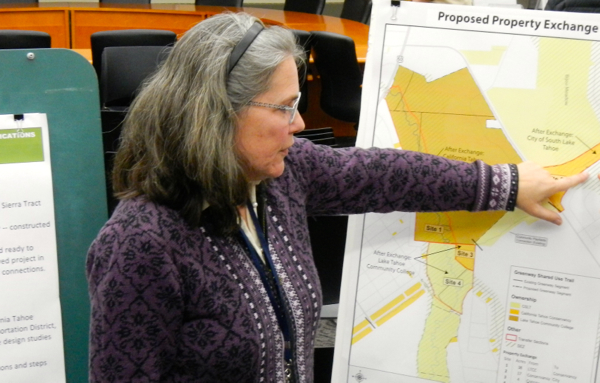
Sue Rae Irelan with the California Tahoe Conservancy talks about the next phase of the Greenway trail. Photo/Kathryn Reed

Sue Rae Irelan with the California Tahoe Conservancy talks Jan. 7 about the next phase of the Greenway trail. Photo/Kathryn Reed

“Winter access is really important in Tahoe,” Sue Rae Irelan said.


This year the Conservancy, South Lake Tahoe and Lake Tahoe Community College are expected to complete a land swap that will allow the next phase of the project to go forward. No money will be exchanged.

The next segment, which should break ground in 2019, will be one mile of trail that starts at Bijou Meadow and connects to Bijou Community Park, and crosses Al Tahoe Boulevard to connect to Lake Tahoe Community College and the community ball field.

The one mile that will be built in the next few years has a $4 million price tag.

Money for this phase comes from:

·      CTC — $1 million

·      LTCC Measure F — $700,000

·      Tahoe Transportation District — $400,000

·      State grant — $1.9 million.

“This is the most expensive part of the project because of the bridge,” Irelan said.

A 150- to 175-foot span will cross Trout Creek. Then boardwalk will be in the meadow to protect the sensitive terrain.

Much of the trail follows user created trails. The new trail is 10 feet wide, meets ADA requirements and is paved.

Flashing lights will be installed on Al Tahoe, and at Martin and Barbara avenues to make it safer for cyclists and pedestrians to cross those streets to continue on the path.

Winter use of the trail remains uncertain.

“The Conservancy doesn’t plow. We are actively talking to the city about how to cooperatively maintain all of the trails,” Irelan said. “Winter access is really important in Tahoe.”

The challenge is how to pay for it.

In 2015, 0.42 miles of the Greenway was built between Herbert Avenue and Glenwood Way.

Future sections include going from Herbert to Ski Run Boulevard, and then from Ski Run to Van Sickle. When those are completed the trail will be 3.86 miles long.

Funding is the obstacle that must be overcome in order for the next phases to commence.

Because there has been a change in the alignment since the project was initially approved there needs to be an amendment to the environmental documents. The revised CEQA document should be released this month for a 30-day public comment period.