Calif. water conservation rules may be loosened

By Matt Stevens, Los Angeles Times

Water providers that have struggled in recent months to meet conservation targets could soon get some relief under the modified drought rules unveiled Friday by state regulators.

The proposed changes to California’s emergency drought regulation reward water districts for investing in new local supplies and allow for adjustments to savings goals based on a district’s climate and population growth.

Friday’s proposal also allows water providers to reduce their “conservation standards” by as much as eight percentage points. A previous plan had said that a water district’s target should drop by no more than four percentage points.

Read the whole story


The other Kirkwood ski area going strong

Kirkwood cross country is expanding programs. Photos/Susan Wood

Kirkwood cross country is expanding programs. Photos/Susan Wood

By Susan Wood

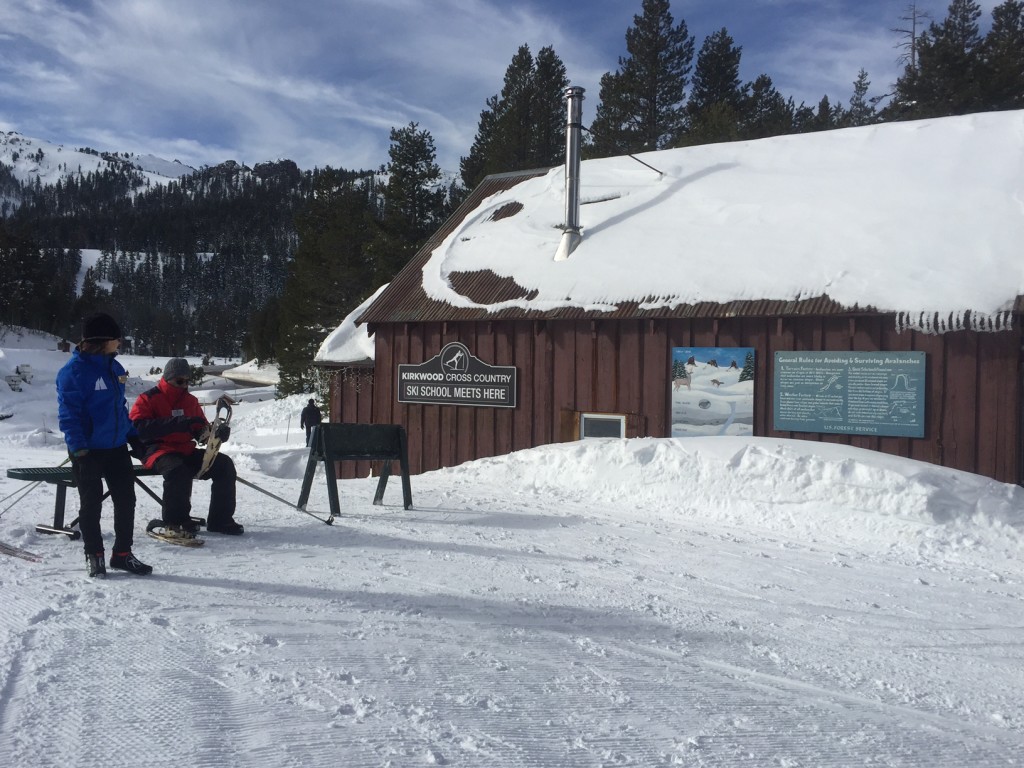
KIRKWOOD – Based on the reaction of skiers and snowshoers venturing this year to the land of deep snow and simple needs, it’s almost as if the one trail not open at the start of season at the Nordic center should have been.

Ecstasy, one of four black-diamond trails, is the operative word to describe how those who love the human-powered winter sports feel about the crisp, soft and plentiful snow conditions at the Kirkwood Cross Country and Snowshoe Center after the last few years of drought.

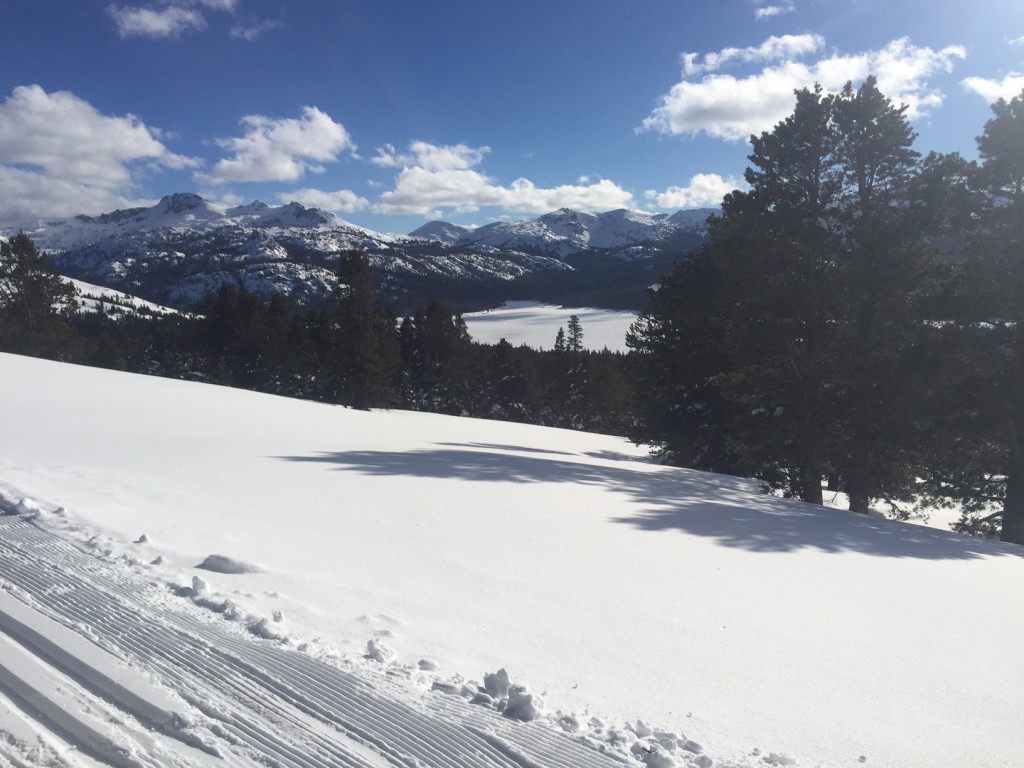
The 2,000-plus acre ski area, which started inconsistently in 1972 and full time about five years later,  looks a lot different this year compared to the last three winters. The snow completely covers the 24 trails and beyond, and the cats and groomers are out in full force – working eight to 10 hours on most days and 18 to 20 after snowstorms.
IMG_3455

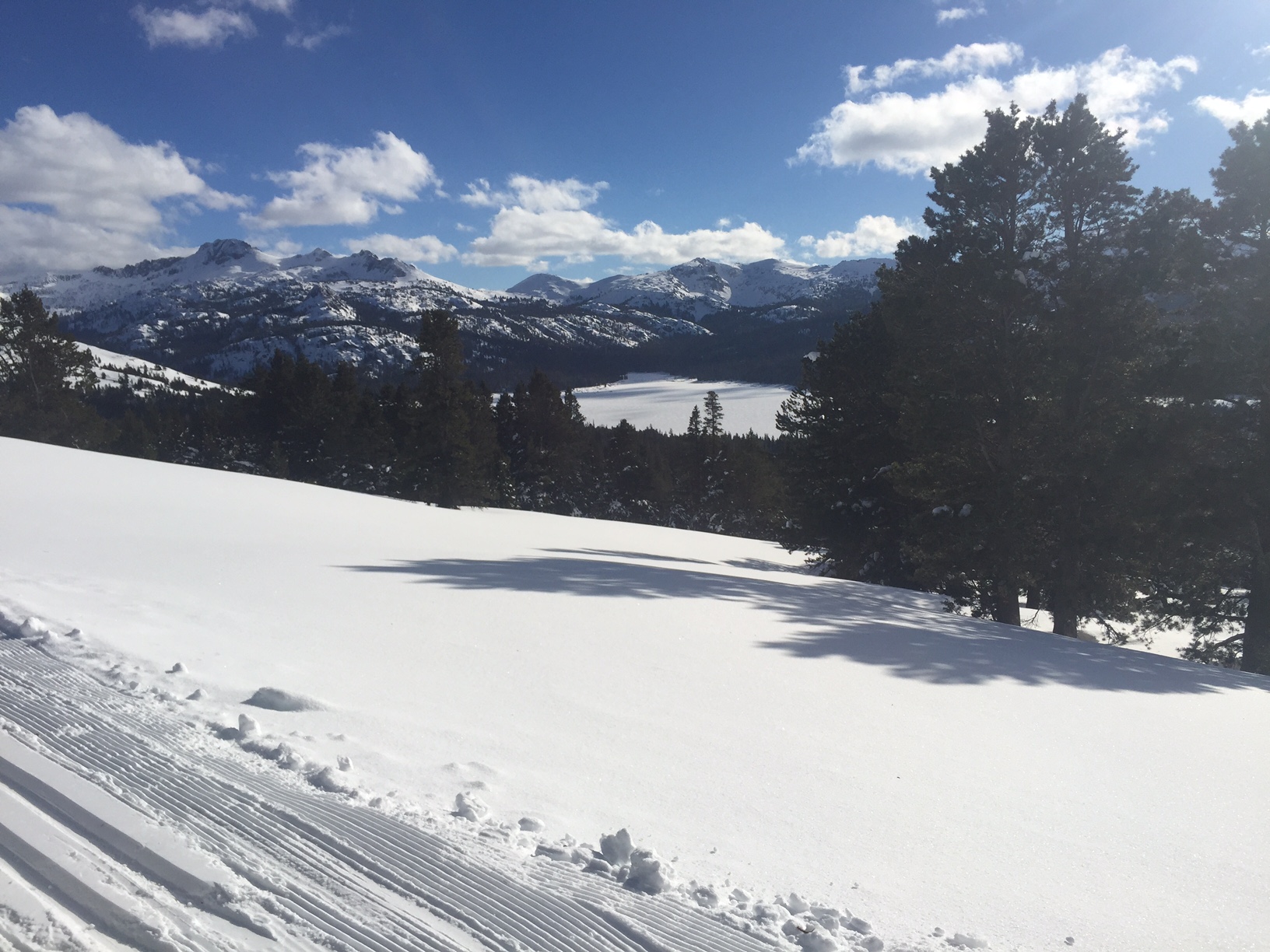
The Upper Kirkwood Outpost trail has magnificent views.

But even inside, one may gather it’s a new year just from going into the lodge to buy lift tickets and merchandise. The holidays were bustling with visitors and locals wanting an escape from downhill skiing and a look into nature’s back door. The Nordic center averages 20 guests a day and peaks at three times that when the place is hopping. Still, it’s easy to escape here.

With only the wind in the trees and the occasional bird chirping, it’s hard to imagine another world across Highway 88 where party music and riders whooping it up over the snow conditions represent the norm.

Albeit satisfied with recent conditions, Debbi Waldear — the Nordic center’s director and a champion racer — remained cautiously optimistic about the booming start of the winter season.

“Everybody’s pretty cautious how winter’s going to go,” she told Lake Tahoe News last month.
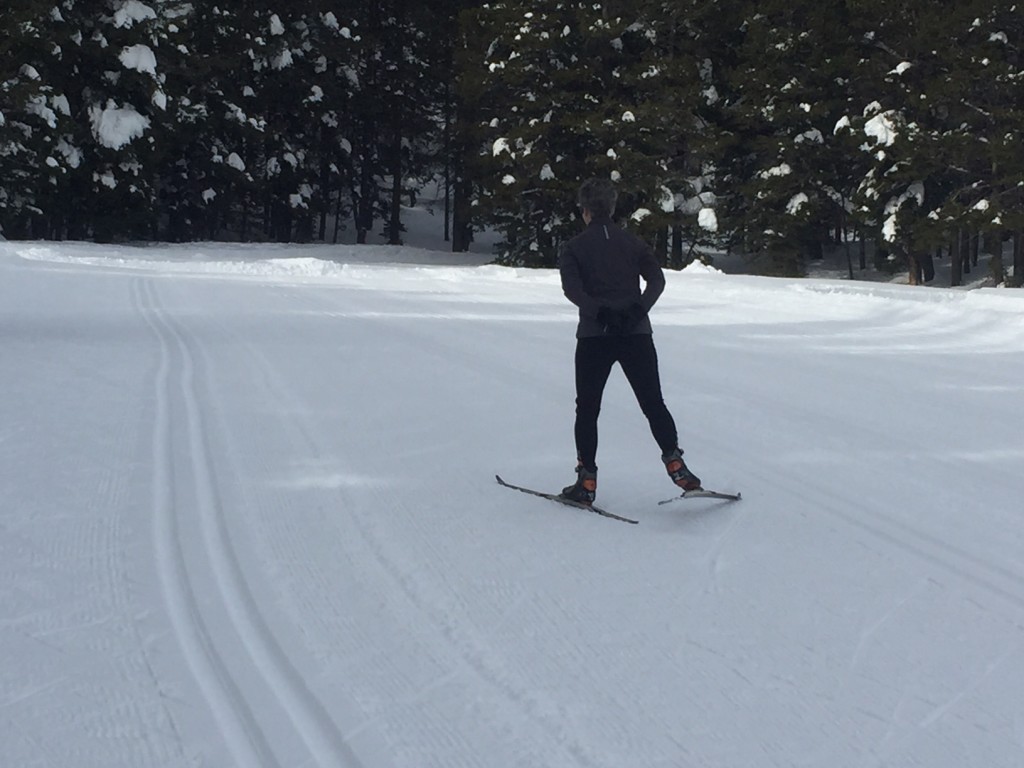
Laura Cabral makes skate skiing look effortless.

Laura Cabral makes skate skiing look effortless.

Most of the trails were set right at Christmas.

In her 35 years of working there (her tenure as old as today’s lodge), Waldear has seen it all. She recalled how in the prior year snow came early, then completely dried up. She referred to staying open last year as “miraculous,” with the meadow (one of two trails allowing canines) and one upper trail to offer her guests. In winter 2013-14 Kirkwood was only open between January and April.

And this is why the owner, Vail Resorts, diversifies the locations of its ski areas.

“When they have bad years, they have other resorts to rely on,” she said of the Colorado-based ski giant.

This season California is king.

And there are a few new features this year to make Nordic enthusiasts of all ages feel like a queen.

A “Kiddie Kilometer” is groomed for the youngsters.

“It’s pretty popular. We get a lot of people renting sleds and pulling their kids,” she said.
Debbie Waldear has been the face of Kirkwood's Nordic center for years.

Debbie Waldear has been the face of Kirkwood’s Nordic center for years.

Guests seeking a double reward of exercise and food can now partake in the “soup and shoe” – but not in that order. The $35 package, which is slated every Sunday afternoon, includes an easy-going snowshoe hike followed by hot soup at the Kirkwood Inn located next door.

“Snowshoeing is really taking off,” Waldear said, while watching customers filing out of the lodge and onto their skis and shoes. She estimated about 40 percent of the business involves walking with claws.

“We tell people you can be an expert in 10 steps,” she said of the ease in learning.

Waldear encourages her customers to enjoy the outdoors every step of the way, herself relishing her office per se because “not many people can say they manage a ski center” for a living.

“Where you headed?” Waldear asked Jaime Levy of Oakland at the trailhead.

Levy replied that she sought intermediate terrain, and Waldear urged her to check out Jobe’s Jaunt. The popular route is sprinkled with signs providing the history of Snowshoe “John” Thompson’s 20-year mail runs from Placerville to Genoa, which he started in 1856 carrying a 90-pound bag on 11-foot skis with a balancing pole. The 90-mile journey presumably took him through the Schneider Trail system of El Dorado County.
A special route has been created for youngsters.

A special route has been created for youngsters.

In the spirit of Thompson’s three-day solo journeys, Levy insisted she would find some peace and quiet.

“I like the idea of being by myself. I engage with people a lot (all other days),” she said.

Nordic Center employee David Wise can relate. The South Tahoe High School graduate and former ski team racer traded the cerebral for the physical, leaving an engineering degree from the concrete jungle at MIT for an escape back to Tahoe’s natural environment.

Wise, 23, is very encouraged by this year’s ski conditions and has noticed a surge in his age group taking up skiing.

All ages take the Bay Area ski bus up for the day at 4:30am for $85 and get dropped off at the Kirkwood Mountain Resort downhill area. From there, some cross country ski across the meadow to access the upper trails. Others take the shuttle hopper from one area to the other.

Mark Becksteadt, a Kirkwood second homeowner from Los Altos, is skipping the meadow this year. He noticed the flat area where many take their dogs skijoring was getting crowded. He brought his skate skis over to the main lodge to hit the Agony trail to skate ski.

Laura Cabral of Santa Clara was working on her skills on the learning track located at the bottom of the trailhead.

She cautiously worked on the smooth motions, enjoying having the track to herself. There’s definitely a learning curve with skate skiing, characterized by quad burns with short, skinny skis.
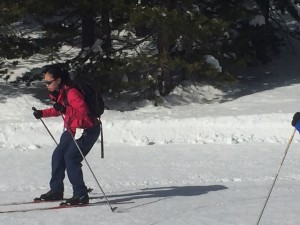
Veronica Tan of Singapore taking lesson.

Veronica Tan of Singapore taking lesson.

“I’m trying out my moves. I took a lesson six years ago and struggled,” Cabral said, adding how jealous she is of a friend who’s mastered the sport. “She skies in a jog bra.”

Veronica Tan of Singapore just wanted to get the hang of staying upright on skinny skis. She took a lesson offered by the Nordic center in the hopes of remembering her former snow days living and going to college in Minnesota.

The Kirkwood Cross Country and Snowshoe center offers beginning and skate lessons, as well as ski skills and tour packages for $58 a day. Equipment rentals cost $27, the going rate of the ski pass.

The ski area hosted a Winter Trails Day on Jan. 9 and has scheduled full moon snowshoe treks on Jan. 23 and Feb. 20. Sunset seekers can view the colors on guided hikes on March 5 and 12.

Tensions mount between Nev. ranchers, feds

By Molly Hennessy-Fiske, Los Angeles Times

Gerald “Jerry” Smith grew up in Nevada and went to work for the Bureau of Land Management right after college. As a local, he figured he was uniquely suited to work with the ranchers who have long resented the federal government’s role in land management here.

It didn’t quite work out that way.

Now retired from a job as district manager for the BLM, Smith knows all about the tensions that have long defined relations between ranchers in the rural West and the federal government, which manages much of the region’s land. Those tensions have boiled over in recent days at a wildlife refuge in Oregon and are at a perpetual simmer here.

Now it is Smith’s successor as district manager, Doug Furtado, who has become the enemy for many people in the region.

Although there have been no violence or threats here, the risk is real. Federal employees in Nevada have been attacked in the past over land-use disputes — shot at, their offices and cars bombed.

Read the whole story


Photos show casino life behind the scenes

By Jenny Kane, Reno Gazette-Journal

In the late 1970s and early 1980s, Jan Aphelin paid her way through college by working as a “camera girl” snapping commissioned photos of the high rolling gamblers and highfalutin clients of Reno’s swankiest casinos and clubs.

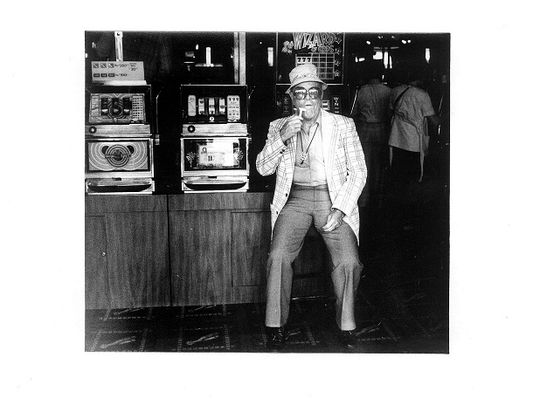
"All Nighter" is one of the Jan Aphelin's black and white photographs shown in her "Black and White Risk" exhibition at the Nevada Historical Society. (Photo: Courtesy of the Nevada Historical Society)

“All Nighter” is one of Jan Aphelin’s photographs being exhibited at the Nevada Historical Society. Photo/Courtesy of the Nevada Historical Society

She photographed the elite – some of them celebrities, including actress Debbie Reynolds and singer Tom Jones – gambling, drinking and hobnobbing. She earned a commission from her employer, a Las Vegas-based photography company, and charged the subjects $200 to $300 for a package of mostly posed glamour shots that took an hour to process and were delivered in a velvet folder.

But at the end of her shifts, she did not put away her cameras.

Read the whole story


State Parks, CTC exchanging land in Tahoe

By Kathryn Reed

MEYERS — State agencies are in the process of swapping land on the South Shore in an effort to be more efficient.

“Our hope is the pubic won’t notice anything,” Marilyn Linken, supervisor of the Sierra District of California State Parks, told Lake Tahoe News.

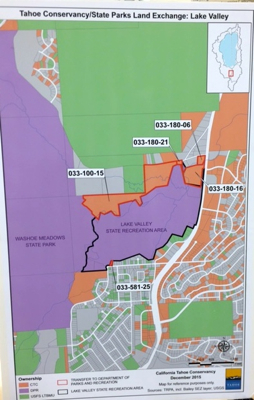
The California Tahoe Conservancy is giving nine parcels totaling about 79 acres to State Parks. Twenty-seven acres will become part of Washoe Meadows State Park and 52 acres will be added to Lake Valley State Recreation Area.

This land is in Meyers. The swap is expected to be finalized by fall 2016.

In a separate deal the Conservancy will be receiving parcels in the Rubicon area of the West Shore from State Parks. That should occur in the spring or summer.

No money is being exchanged.

land swap mapThe change in ownership is a result of the 2012 California Budget Act that tasked the CTC and State Parks with finding a way to better manage state land. By having each agency own parcels that are contiguous instead of randomly isolated, it makes things more efficient.

In the future the Conservancy intends to transfer its rights/ownership/responsibility of Van Sickle Bi-State Park near the state line to State Parks. However, just as when that park opened in 2011, State Parks is in no financial position to take over that South Shore park, even with Nevada State Parks’ help.

The other parcel State Parks will inherit from the CTC is the Cascade property near Emerald Bay. That, too, is being held up because of the Parks’ finances.

The property near Lake Tahoe Golf Course, which is part of the recreation area, was supposed to go to State Parks decades ago based on a settlement agreement from the mid-1980s. No one from either state agency could explain why it took so long for the exchange to come to fruition.

Linken said the acreage being absorbed by State Parks will be treated the same as the land already categorized recreation and parks.

Washoe Meadows still doesn’t have a master plan governing the uses there. Litigation is stalling that process.


History of Sierra alpine sports runs deep

By Jim Sloan, Tahoe In Depth

Many point to the 1960 Winter Olympics at Squaw Valley as the event that kickstarted skiing in the Sierra and the Tahoe region. The event, only the eighth Winter Games ever held, was the first Winter Olympics ever televised.

But the truth is that skiing had been an established, vibrant industry in the area for nearly 30 years before the Olympics arrived at Squaw Valley. There were mechanized rope tows, cutting edge ski lifts, professional ski instruction, innovative equipment designs, ski lodges, destination resorts, celebrity sightings and travel packages all along the snowy Highway 40 corridor from the western foothills to Tahoe and the eastern Sierra above Reno.

49ers raced on skis

But even before that Golden Age of T-bars and rope tows, California gold miners were strapping on boards – really long boards – for ski races in places like La Porte and Johnsville. They developed ski waxes, 12- to 15-foot skis, and a one-pole technique that had some of them reaching speeds of 100 mph. According to writer Patricia Fox, writing in a 2007 issue of Sierra Heritage magazine, the first organized ski race in the U.S. was held in La Porte, in the mountains west of present-day Graeagle, in February 1867, 14 years after informal racing had started in the town of 3,000 miners.

Of course, everyone’s heard of Snowshoe Thompson, who was not a snowshoer but actually a skier who traversed the snowy Sierra on skis for 15 years, bringing mail back and forth from Genoa to Placerville. Thompson gets a lot of credit for pioneering the sport of skiing in the Sierra, but the first ski resort didn’t open at Tahoe until the mid-1920s. Olympic Hill, it was called, and it was opened for guests of the Tahoe Tavern. Later, the ski area’s name was changed to Granlibakken.

Granlibakken joins sport

According to Jeffrey Weidel, a former newspaper reporter in Roseville who has been writing about Tahoe skiing for about 20 years, Granlibakken was the third ski resort to open in the U.S., behind Howelsen Hill in Steamboat, Colorado, and Eaglebrook School in Massachusetts. Soda Springs was the second California resort to open, hauling its first skier to the hills above Lake Van Orden in 1935.

What is now a road was once an actual ski run. Photo/Stephen Gennerich collection

What is now Ski Run Boulevard was once an actual ski run. Photo/Stephen Gennerich collection

Driving to ski

According to historian Mark McLaughlin, in his book “Skiing at Lake Tahoe,” the first ski lift in the United States was a “pullback lift” built in 1910 in the Hilltop area of Truckee (the present-day finish line for the annual Great Ski Race from Tahoe City to Truckee). According to McLaughlin, the lift was initially built for toboggan riders but skiers also used it.

McLaughlin says skiing was already popular in the California mountains in 1930, where the Rainbow Lodge on Highway 40 was a magnet for winter sports enthusiasts. By 1936, there were a handful of popular skiing and sledding areas between Cisco, where the Auburn Ski Club built a ski jump and winter park, and Donner Lake to the east. Skiers either drove into the mountains, strapping their skis and poles to the roofs of their cars, or they rode the train into the Sierra and took horse-drawn sleds from the railroad depot to ski lodges.

By 1940 the “ski business was booming” in the Donner Pass region. Rope tows had replaced the original practice of hiking to the top of mountains to ski down. Ski schools imported experts from Switzerland and Austria to introduce and teach the latest techniques and equipment. You could stay at the Soda Springs Hotel for a dollar a day, paying 25 cents to a $1 for a meal. Donner Ski Ranch opened up the road in 1937, and work began on Sugar Bowl across the highway a couple of years later. It opened with great fanfare — and a fantastic $39,000 ski lift that allowed skiers to ride to the top.

Galena Creek Ski Hut

About this same time, Galena Creek Ski Hut was being built near Mount Rose. According to the Nevada Historical Society, the ski hill at Galena Creek hosted an annual Intercollegiate Winter Sports Carnival where college teams came to compete against the hometown favorites at UNR. One of those UNR skiers was Wayne Poulsen, who would become a major landowner in Squaw Valley. One of the first significant resorts in Nevada was Sky Tavern, completed in 1945 near Mount Rose. Farther south, near Spooner Summit, the White Hills ski area opened in 1949 with a T-bar lift and a ski jump. The resort closed five years later after several dry winters.

At the south end of Lake Tahoe, highway crews rarely completely cleared snow from Highway 50 between Placerville and Lake Tahoe. One of the first rope tows was installed at Twin Bridges, where the snow removal usually stopped.

Edelweiss on Echo Summit

Then in 1941 Edelweiss resort opened near Echo Summit, according to “Skiing at Lake Tahoe.” The resort operated for about 20 years before closing. The nearby Sierra Ski Ranch opened five years after Edelweiss and continues to operate today as Sierra-at-Tahoe resort. During the 1940s, other family-owned resorts opened along Highway 50, including Echo Lakes, Nebel Horn, Echo Summit, and, in the lake basin itself, Bijou Skiway Park in 1947. The park would soon be sold and renamed Heavenly Valley.

Poulsen, meanwhile, was scouting Sierra terrain for a major new ski resort. He settled on Squaw Valley. Although he worked as an airline pilot half the year, he and his wife, Sandy, purchased 2,000 acres of Squaw Valley with an eye toward finding investors to help build a ski resort over the five peaks surrounding his land. The Poulsens eventually partnered with Alex Cushing, but the partnership was short-lived, and Cushing went on to develop the alpine resort on his own while the Poulsens developed their valley land.

The wildly successful 1960 Winter Olympics in Squaw Valley ushered in a new era of large ski area development, as Alpine Meadows, Kirkwood, Ski Incline (now called Diamond Peak) and Homewood all came online in succeeding years. Some smaller resorts also emerged, like the Powder Bowl ski area in Alpine Meadows, but smaller areas couldn’t compete with the new mega resorts and either closed or merged with a neighboring establishment. Sierra Ski Ranch, Heavenly and Mount Rose all underwent large expansions to accommodate more skiers and to open up more challenging terrain. Over time, many resorts began adding snow-making equipment so they could open during low-snow winters.

This story first appeared in Tahoe In Depth.


Foreclosure filings climbed in Nev., fell across U.S.

Nevada has been a leader in foreclosures for years. Photo/Brendel

Nevada has been a leader in foreclosures for years. Photo/Brendel

By Eli Segall, Las Vegas Sun

Nevada homeowners were slapped with a rising tally of foreclosure filings last year, bucking a nationwide drop as the state remained among the hardest hit in the country.

A total of 16,533 properties, or 1.4 percent of homes statewide, received a foreclosure-related filing in 2015. That’s up 6.6 percent from 2014’s tally, according to a new report from RealtyTrac.

The housing-data firm counts default notices, scheduled auctions and bank repossessions.

Read the whole story


Yosemite: Famed hotel name to change

By Scott Smith, AP

The names of iconic hotels and other landmarks in the world-famous Yosemite National Park will soon change in an ongoing battle over who owns the intellectual property, park officials said Thursday.

The luxurious Ahwahnee Hotel will become the Majestic Yosemite Hotel, and Curry Village will become Half Dome Village, said park spokesman Scott Gediman.

The move comes in an ongoing dispute with Delaware North, the company that recently lost a $2 billion bid — the National Park Services largest single contract — to run Yosemite’s hotels, restaurants and outdoor activities.

Delaware North demands to be paid $51 million for the names and other intellectual property. The New York-based firm filed a lawsuit last year, saying that when it won the contract in 1993, the park service required the company to buy the former concessionaire’s assets.

Park officials are making the name changes to avoid any disruptions to visitors with hotel reservations during the transition to a new concessionaire on March 1, when they go into effect, Gediman said. He said the park service is fighting for the rights to the original names.

“We’re clearly in disagreement with Delaware North,” he said. “We’re taking this action to ensure the seamless transition.”

The Yosemite Lodge at the Falls will turn into Yosemite Valley Lodge; Wawona Hotel will become Big Trees Lodge; and Badger Pass Ski Area will be called Yosemite Ski & Snowboard Area.

Yosemite National Park — another name which is also claimed by Delaware North and remains in dispute — will stay put, Gediman said.

National Park Service says the names and other intellectual property are worth about $3.5 million, according to the government’s response to a lawsuit that Delaware North filed with the U.S. Court of Federal Claims.

DNC Parks & Resorts at Yosemite Inc., a subsidiary of Delaware North, said in a written statement that it was “shocked and disappointed” that the park service is using the beloved names as a “bargaining chip.”

The company defended its demands, saying that it hopes Yosemite and the new concessionaire decide not to change the names. “All we want in this is fair and just treatment,” the company said.

Justice Department attorney John Robertson wrote in court papers that the company “wildly inflated” the value of the trademark names. He added that Delaware North has “breached its duty of good faith and fair dealing,” a claim the company denies.

The trademark dispute at Yosemite is similar to disputes at Hot Springs National Park in Arkansas and the Grand Canyon in Arizona and with other iconic pieces of Americana owned by the U.S. government, such the Space Shuttle Atlantis.

The park service says it belatedly learned of the trademark issue when it prepared to open bids for the concessionary operation. Yosemite awarded a 15-year contract to Aramark last year.

Delaware North also runs concessions at the Kennedy Space Center and has a trademark application for “Space Shuttle Atlantis,” government court papers say.

Delaware North “apparently embarked on a business model where by it collects trademarks to the names of iconic property owned by the United States,” Robertson wrote.

The name changes don’t sit well with park admirers like John Lenau, an amateur historian and president of the Conference of California Historical Societies.

Now 76, he’s visited Yosemite since childhood and says when somebody mentions Curry Village he can picture it in his head. That will be lost with the change, he said.

He also worries about stripping away the Native American heritage by turning the Ahwahnee to the Majestic Yosemite Hotel and the Wawona Hotel to Big Trees Lodge.

“I don’t see the advantage of dong that,” Lenau said, speaking for himself rather than the society. “I’m just a little bit against changing something that has been around for so many years.”


Truckee on road to enhanced revitalization

By Linda Fine Conaboy

TRUCKEE – It’s always better to deliver good tidings to an enthusiastic crowd, and judging from the attendance (standing room only) and the attitude of the recent Good Morning Truckee crowd, they were ready to hear what’s new in Truckee.

Rick Holliday, owner of Holliday Development headquartered in Emeryville, easily captured the positive vibe as he delivered the inside scoop on his company’s efforts to expand and streamline the historic downtown core with a project called the Truckee Railyard.

The Railyard will sit on the city’s historic but long-vacant railyard, a 75-acre site just east of downtown’s Commercial Row. It has been vacant since a lumber mill closed in the 1980s. In the works for a number of years, the project suffered a blow in 2010 when its redevelopment money became unavailable due Gov. Jerry Brown eliminating redevelopment agencies statewide.

Truckee is making a concerted effort to . Photo/Linda Fine Conaboy

Truckee is making a concerted effort to redevelop properties to enhance the experience for locals and visitor. Photo/Linda Fine Conaboy

Holliday said the project is back on track with secure infrastructure funding, which will allow an immediate construction start.

“The most important thing people told me is don’t leave the old town behind,” Holliday said.

Working in partnership with the railroad, plans are to change the traffic pattern, add a new maintenance facility and move the balloon track, among several other things.

Amid the many amenities to be included in the first phase of the project is a grocery store; in fact, Holliday reported, they recently signed a letter of intent with upscale Nugget Markets, a family-owned and operated grocery based in Northern California and named one of Fortune magazine’s top 100 companies to work for.

Additionally, there will be the Truckee Railhouse Theater, a mixed-development project to include a second-floor, six-screen movie theater, a performing arts space, 27 owner-occupied residential units and a ground floor retail area. The four-story building even calls for a dog wash.

“There won’t be zillions of square feet of retail,” Holliday said. “But enough to enhance downtown.”

And the 700 new parking spaces will go a long way toward alleviating Truckee’s parking woes. Holliday calls this “a huge reservoir of parking.”

Also slated for the first phase is rented, affordable housing, a roof deck, courtyard and brew pub coming late in 2016-17. Buildout, according to the master plan, should occur by the end of 2018, with three districts on tap. They are: the Downtown Extension District, Industrial Heritage District and Trout Creek District.

Cassie Hebel, the executive director of Truckee’s Downtown Merchants Association touted her organization’s past achievements and gave a brief overview of things to come in 2016.

She said there’s a big push now to increase the area’s visibility via social media with the goal being more pedestrian visits.

“We want to bring people downtown; we like foot traffic,” she said, citing a few of the special events that make Truckee a memorable experience for locals and tourists. Activities such as the Halloween Parade, Downtown Holiday Event and the Truckee Follies are must-attend, according to Hebel.

The railroad is an integral part of Truckee. Photo/Linda Fine Conaboy

The railroad is an integral part of Truckee. Photo/Linda Fine Conaboy

In summer 2016, the goal is to lure at least 30,000 folks to Truckee Thursdays.

Like any downtown, a zesty and flourishing core is a goal worth aiming for. And with this in mind, the third and last presenter on Jan. 12, Becky Bucor, Truckee’s engineering manager, discussed the work completed in the past as well as the ongoing efforts to make the west end of Truckee as vital as mid-town.

An all-out effort there, called Brickelltown, consumed many engineering and construction hours in 2015, resulting in new sidewalks connecting both town segments and eliminating the previous sea of asphalt and winter mud that could make the west-end trek uncomfortable.

In addition, a new intersection at Spring Street and Donner Pass Road enhances visual appeal.

Bucor said the goal of Phase 2 is to extend Brickelltown even farther west to what is known as the McIver Roundabout. Bike lanes, guardrails and retaining walls are in the offing, all to be constructed with as little traffic disruption as possible, while increasing customer visits to the western outpost.

“So far, so good,” said Jessica Thompson, senior engineer. “Seems like there are a lot more people in the west end of town, especially at the new intersection. We want to make downtown Truckee a much more pedestrian-friendly area,” she told Lake Tahoe News.


Visits, spending up at Vail Resorts’ ski areas

The addition is of Park City is helping Vail Resorts' bottom line. Photo/Kathryn Reed

The addition is of Park City is helping Vail Resorts’ bottom line. Photo/Kathryn Reed

By Jason Blevins, Denver Post

Vail Resorts on Wednesday reported climbing visits,and increased season pass sales and visitor spending at its resort network across Colorado, Utah and California.

North America’s largest resort operator said lift ticket revenue for the season through Jan. 10 — including season pass sales — was up 19.4 percent over the same period last season. The company said visitor spending at its eight ski areas was increasing as well, with dining revenue up 14.3 percent, ski school revenue up 6.7 percent and retail sales at its resort stores up 9.1 percent.

Vail Resorts chief Rob Katz said the big snow in Tahoe after three seasons of drought is fueling the bounce, alongside “solid revenue growth” in Colorado and “double-digit revenue growth at Park City.”

Read the whole story