Lake Tahoe bill clears key Senate committee

By Bill Theobald, USA Today

WASHINGTON — Democrats and Republicans found a rare subject they could agree on Wednesday: Lake Tahoe and surrounding land is worth improving and protecting.

The Senate Environment and Public Works Committee easily passed the Lake Tahoe Restoration Act of 2015 by voice vote and sent it to the full Senate.

The bill authorizes $415 million in federal funds over 10 years to improve the clarity of the lake, reduce the potential for severe forest fires on the surrounding land, and prevent the spread of invasive species.

Read the whole story


Pro skier JT Holmes survives avalanche burial

By Benjamin Spillman, Reno Gazette-Journal

Pro skier JT Holmes says he’s still shaken five days after being buried and going unconscious in an avalanche northwest of Lake Tahoe.

Holmes, who is known for pushing the boundaries of big mountain skiing and speed riding, said he was skiing with friends on Thursday near Truckee when the slide occurred during the group’s fourth run of the day.

JT Holmes

JT Holmes

Holmes said he was in a group of eight in the backcountry between Tinker Knob and Donner Lake, skiing a north or northeast aspect in complex terrain with trees, chutes and gullies and which he estimated was at about 7,400 feet in elevation.

“I got flushed through, went downhill with the avalanche,” Holmes said. “The second wave of the avalanche buried me.”

Read the whole story


S. Lake Tahoe says yes to using plastic bags

By Kathryn Reed

South Lake Tahoe has done a 180 on being an environmental leader, according to some people.

It all has to do with plastic bags.

The council on a 3-2 vote Jan. 19 said only grocery stores and food outlets must adhere to the plastic bag ban. Mayor Wendy David and Councilmember Austin Sass were in the minority.

There had been a misunderstanding by Councilmember Hal Cole at the original vote in 2014. He thought the council was going to discuss how things were going before the ban expanded instead of automatically encompassing other establishments a year later – which was in October 2015. That is why last fall he asked to revoke the ordinance beyond grocery stores and restaurants.

Cole is also concerned about the economic repercussions on businesses. He also pointed out that businesses could always voluntarily not use plastic bags.

But at no time when the revocation has been discussed has there been mention to assess how the bag ban is working. No business person has either come forward at a meeting or written a letter asking to retain the use of plastic bags.

Instead, the vote was based on personal preference and not facts based on zero evidence being presented at the meetings as to the ban being negative for businesses.

Sass asked if any businesses have complained about the ban. City Clerk Suzie Alessi said not to her knowledge.

Councilwoman JoAnn Conner said people are afraid to speak up for fear of retribution.

Sentiments from the public included:

·      Jerry Goodman: The council is not environmentally sensitive.

·      Joe Stanton: The real compromise would be to allow businesses to use their existing plastic bag supply before implementing the ban. People come to Tahoe because they see it as an environmental leader, but rescinding the bag ban delivers the opposite message.

·      Bruce Grego: There is no environmental impact by having a plastic bag ban. Paper bags aren’t as useful.

·      Pete Fink: It’s about bringing your own bag; plastic bags weren’t around when he was a kid; Europe is doing just fine without plastic and the U.S. could be in the same boat.

—–

In other news:

·      A taxi driver questioned why the city is allowing Uber to operate here. City Attorney Tom Watson said it’s a state issue and the city has no control.

·      Hilary Roverud is interim director Development Services because Shawna Brekke-Reid left earlier this month.

·      The city eliminated the following subcommittees: airport master plan, Lake Tahoe Unified-Lake Tahoe Community College memorandum of understanding (for the fields), parks and rec master plan, policy for giving to nonprofits, single room occupancy and warm room.

·      Subcommittees added include development services code (Sass-Cole) and Champions Plaza (David-Tom Davis).

·      Representation to the two chambers of commerce, lodging association and South Tahoe Public Utility District remain intact after being proposed for elimination.


LTCC president calling it quits

By Kathryn Reed

Unable to hold back the tears, Kindred Murillo has mixed emotions about having tendered her resignation as president of Lake Tahoe Community College.

While she will be leaving behind an extensive list of accomplishments, it is the people she will miss the most. She only had good things to say about the boards she has worked for since talking the helm in July 2011, the faculty and classified staff.

What comes next for the 61-year-old remains to be seen. Whatever it is, it will have to be in a region without pine trees or at least with more humidity. Murillo is allergic to pine trees, which leads to colds and respiratory issues. Throughout the meeting Tuesday night she was dabbing at her eyes and blowing her nose – which at that time wasn’t about the sadness of her impending departure.

“I can retire, but I really like what I do,” Murillo told Lake Tahoe News after the special closed session. “I may look at select opportunities. I had a great experience here.”

Kindred Murillo is Lake Tahoe Community College's fourth president, having been hired in 2011. Jim Duke served form 1974-90; Guy lease 1990-2007, and Paul Kilpatrick 2008-10.

Kindred Murillo is Lake Tahoe Community College’s fourth president, having been hired in 2011.
Jim Duke served from 1974-90; Guy lease 1990-2007, and Paul Killpatrick 2008-10.

She doesn’t have a solid end date, which gives the board flexibility and the potential for the college to transition from one president to the next with some overlap. At the earliest she will leave June 30, the latest is Feb. 1, 2017.

If the board doesn’t have someone on board by then, an interim president will be hired from outside the college, board President Fritz Wenck said.

The college board spent 90 minutes Jan. 19 discussing what happens next in finding the 42-year-old institution’s fifth president. A search firm will be hired and from there a nationwide search will begin.

What exactly the board wants in the next leader will be discussed in greater detail in closed session at the Jan. 26 meeting. The next president will oversee the spending of the bulk of the bond money that voters approved in 2014 as well as the upcoming accreditation process.

“We are buckling up to try to do the best we can with a situation that is very unhappy for us,” Wenck told Lake Tahoe News. “She is an outstanding president and none of us wants to see her go.” But he recognizes that her health must come first.

For Murillo, she is most proud of having brought the college to a point of fiscal solvency, with a plan for the college’s future. This includes having identified issues with the facilities, as well as technological shortfalls.

“My hallmark is the fiscal plan so the college is here for the community and the future,” Murillo said.

She spearheaded the $55 million facilities bond. Wenck gave her a ton of credit for that, admitting it’s something he didn’t think would come to fruition.

Murillo does have one major goal left – the one set for herself and the college at the onset of her tenure here – to have LTCC be a four-year college.

With local resident Lisa Maloff donating more than $5 million for a university center, Murillo’s goal is on the path to completion.

“To make sure there is four-year education in South Lake Tahoe is the last thing to complete,” Murillo said. She is working hard to have one or two universities lined up by the end of this fiscal year.


2015 wildfires burned a record 10.1 mil. acres

By Gloria Dickie, High Country News

The summer of 2015 was unlike anything most career firefighters had ever seen. Across the United States, fires erupted not only in dry woodlands, but also in grasslands, rainforests, and tundra, ignited by lightning strikes and careless campers.

Flames dripped from lichen-covered trees in the Pacific Northwest, and in Alaska, ate into permafrost. U.S. military personnel were called in to battle the ferocious blazes across the West — as were Canadians, Australians, and New Zealanders.

By year’s end, wildfires would consume more than 10.1 million acres of land in the U.S., destroying 4,500 homes and taking the lives of 13 wildland firefighters. Fighting the blazes cost an unprecedented $2.6 billion, the majority spent in the West.

“While the news that more than 10 million acres burned is terrible, it’s not shocking, and it is probable that records will continue to be broken,” said Secretary of Agriculture Tom Vilsack in a press release.

Read the whole story 


LT Hard Rock making inroads to be viable

Lake Tahoe Hard Rock introduced outdoor music on New Year's Eve. Photo/LTN

Lake Tahoe Hard Rock introduced outdoor music on New Year’s Eve. Photo/LTN

By Kathryn Reed

A year ago this time the hype surrounding the opening of Lake Tahoe Hard Rock was palpable. The chaos inside was under wraps. It was quite a feat to actually have the doors open to the public on Jan. 28. Finishing touches were still taking place right up until the last minute.

It certainly has not been the year owners Jon and David Park envisioned. The brothers borrowed $60 million to turn the dilapidated, outdated Horizon hotel-casino into what they believed would be the premier property in Stateline. They hired Warner Hospitality to handle the day-to-day operations, which included Don Marrandino as the general manager.

Marrandino was gone by early March and Warner was fired in October.

Lawsuits are lingering. One is between the Parks and SMC Contracting, the firm that did much of the remodel. The other is between the Parks and Warner.

The pool at the Hard Rock is an issue still to be resolved. Photo/LTN file

The pool at the Hard Rock is an issue still to be resolved. Photo/LTN file

It wasn’t long before the employees were jumping ship or being forced out. The property was in shambles last summer.

Fast-forward to today and things still aren’t perfect, but they are a lot better.

An employee who spoke with Lake Tahoe News last summer about how horrible the place was is still at Hard Rock. “Things are going much better,” he said, but he still wanted to remain anonymous. “We are transitioning. Warner leaving was a blessing. That is where I had most of my complaints and issues. Things didn’t get like this overnight. Warner dug quite a hole.”

Since October it has been up to casino veterans Jim Roets and Rick Stevens to provide stability, order and a sense of leadership. Their 90-day agreement is nearing the end.

What the future holds remains to be seen. Management companies have been on property assessing the Hard Rock. Paragon Gaming is believed to be at the top of the list of contenders. They, like Warner, are based in Las Vegas.

Hiring a general manager and human resources director were two of the things Roets and Stevens were tasked with. Originally the plan was to get a GM who understood the Tahoe market and not have an outside company like before. No one would speak to why there has been a change in philosophy.

The casino has been busier of late compared to August when this picture was taken at the height of the turmoil. Photo/LTN file

The casino has been busier of late compared to August when this picture was taken at the height of the turmoil. Photo/LTN file

An HR director has been hired as well as others for that department.

“They are handling all of human relations in a much more effective manner than ever before. We’ve augmented some of our food and beverage staff,” Roets told Lake Tahoe News. “I find in general the employees here are feeling good about being here and have some optimism that we are doing things right.”

A key position – director of non-gaming operations – is now vacant. Corinna Osborne has taken a job with Park Heritage, the parent company of the Park brothers based in Minden. She is vice president of business development and special projects.

Until her job is filled in Tahoe she will remain an integral part of the hotel-casino.

“When we made the shift back in October it was a positive move for the property and community,” Osborne told Lake Tahoe News. “I’m definitely not touting the company line. It’s something I believe.”

She noted, though, that it takes time to make all the necessary changes.

Some of those changes may not be able to be made soon because it is 50-year-old building. It has an old heating and air conditioning system. Employees and guests have noticed this. The casino floor often runs hot, though there was a short span when it was cold and employees wanted to be wearing more clothing, but were denied.

When rooms are warm this time of year it’s not possible to kick in the A/C.

There were issues over the holidays with the hot water in some rooms. Hotel officials believe that has been resolved permanently.

A good sign is weekend nights are filling up. And when the gaming numbers came out for November it was the first time in months that the Stateline casinos posted year-over-year gains. It’s too soon to know if this is a trend or an anomaly.

The ski season, Roets said, has been good for the hotel-casino. Hard Rock partnered with Powderhouse ski shop, which opened a retail location on property for hotel guests to easily access equipment.

On New Year’s Eve the casino had music out front, with crowds dancing to stay warm.

“People want and expect a countdown. We added that. It was received better than we could have imagined,” Roets said.


Working to lessen climate’s impact on mountain streams

By Krista Langlois, High Country News

If you’ve ever dreamed about fishing in the West, chances are you’ve pictured something like the South Fork of the Flathead, an achingly beautiful turquoise river tumbling over multicolored pebbles and wending through the deep forest of northwest Montana.

Wade Fredenberg is among the few lucky enough to have grown up fishing there, and his childhood recollections read like a passage from Norman Maclean’s legendary book “A River Runs Through It”. Fredenberg was a farm kid, and summer mornings, after rising at 4 a.m. to fix an irrigation pipe, he and his Uncle Art would sneak off in a robin’s-egg blue 1959 Chevy Apache to stalk bull trout in the deep pools of the Flathead. Later, stacking hay bales in the hot sun, Fredenberg would remember those moments, imagining that instead of stacking hay he was stacking bull trout as long as his arm, their flanks the color of the river.

Fredenberg is now a U.S. Fish and Wildlife biologist, and the gleaming 20-pound bull trout of his youth are increasingly rare. The trout have been devastated by mining pollution, agricultural runoff and non-native fish, and surviving populations are threatened by rising stream temperatures. Yet while their trajectory from abundance to scarcity is a story we know all too well, Fredenberg and his colleagues believe that new research can turn the narrative around — not just for bull trout, but for other cold-water fish species across the West as well.

Read the whole story


Civil Rights Museum captures MLK’s legacy

By Kathryn Reed

MEMPHIS — Get to the back of the bus. I thought the man was kidding, but he kept repeating this mantra. No one had ever told me to do this before. I was not about to budge.

I was getting mad. Mad that someone whose skin color was the same as mine could even think of saying such a thing. Mad at the stupidity of it all, mad that it had ever come to this, mad that everyone is not created equal in the minds of some people.

I looked to my right. The woman next to me was not about to get up and move either, though she had done so countless times before.

Across the aisle was a stone casting of Rosa Parks, the legendary Civil Rights pioneer who helped abolish segregation with her refusal to go to the back of the bus. The bus I had boarded is just one of the many exhibits at the National Civil Rights Museum in Memphis that brings to life the plight of blacks in the United States.

It was eerie to walk up to the Lorraine Motel. For a moment I felt like it was 1968. A couple of cars from that time are parked out front, just under the balcony where Martin Luther King Jr. was murdered. A wreath of flowers adorns the door of the room where he had been staying.

He was in town for a demonstration for striking sanitation workers. James Earl Ray made sure Memphis was King’s last stop on a promising trip through the South to awaken America to the injustice of segregation. His legacy of changing society through peaceful marches and words of enlightenment lives, but so does the prejudice he fought to abolish.

Having the Civil Rights Museum, which opened in 1991, incorporated into the infamous hotel adds a dimension of realism. For those of us who were too young to remember that fateful day and have only read about it, the site gives you a stark dose of reality.

It was time to go inside. To explore the 10,000 square feet of permanent exhibits that begin with black Africans being brought to the United States in barbaric conditions to be sold into slavery.

—–

Note: Since this was written the museum was renovated in 2014.


Climate change impacting Tahoe real estate

By Anne Knowles

While signs of climate change may be everywhere around Lake Tahoe in recent years — warmer days and low snowpack, exposed piers and dry trees — the effect on real estate values is hard to see.

But it’s not hard to imagine, based on studies demonstrating the probable impact of global warming on home prices.

While the basin is vulnerable to some of the worst effects such as wildfire and higher temperatures leading to a meltdown in winter tourism, it could also be buoyed by its stronger summer season, its limited inventory of property and its easy accessibility for well-heeled visitors and investors from California.
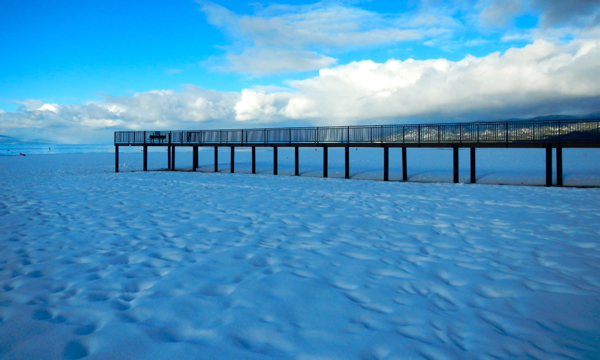
While piers are desirable to second homeowners, to day most at Lake Tahoe don't have water under them. Photo/Kathryn Reed

While piers are desirable to investors, today most at Lake Tahoe don’t have water under them. Photo/Kathryn Reed

“I’m not seeing any pushback from it yet,” said Deb Howard, owner of Deb Howard & Co. and 2014 director of the California Association of Realtors and a member of CAR’s committee on the environment. “But climate change and how we conserve and adapt is on the mind of the real estate industry.”

Currently, the market is still rebounding from the recession. Median home prices in South Lake Tahoe area, for example, have been rising for three years after six years of steady declines. In October 2015, the median sale price for a single family home was $360,000, almost exactly halfway between a recent low of $234,000 in August 2012 and the high of $489,000 in March 2006, according to the South Tahoe Association of Realtors.

In the condo market, new product is hitting the market for the first time in 30 years, including developments at Martis Camp, Tahoe Beach Club and Homewood Mountain Resort, said Sue Lowe, senior vice president and corporate broker for Chase International in Zephyr Cove and Incline Village.

“We’re overwhelmed with calls on Zalanta,” said Lowe. “We already have 18 reservations for 30 units and it’s been on the market for three weeks.”

Zalanta Resort at the Village is the rechristened Chateau at Heavenly Village project, the second phase of which will include 32 condos scheduled for completion next year.

“What drives the market now is people buying second homes,” said Carl Fair, broker-owner of Century 21 at Tahoe Paradise. “Everybody wants to buy rental properties.”

That trend, Fair told Lake Tahoe News, started with Home Away, an online rental site which now owns one-time competitor VRBO, and more recently by Airbnb, another increasingly popular vacation rental site.

In 2015, well over half the homes owned in Douglas, Washoe, Placer and El Dorado counties were second homes, according to a Tahoe Prosperity Center report called Measuring for Prosperity.

But real estate brokers say it’s higher than that.

Zalanta in South Lake Tahoe will be a hotel-condo project with 32 units coming online in 2017. Photo/Kathryn Reed

Zalanta in South Lake Tahoe will be a hotel-condo project with 32 units coming online in 2017. Photo/Kathryn Reed

“It’s more like 70 to 80 percent. In Glenbrook only 10 percent of the homes are primary residences,” Lowe told Lake Tahoe News.

Some brokers think that helps insulate Lake Tahoe.

“I believe that the appeal of the mountains, and in particular, of our gorgeous lake, will only be affected by the economy and not by drought or wildfire,” said Bonnie Gaines, chief operating officer and broker with Buckingham Vacation Rentals. “The wealth of the workers in the Bay Area and now the insurgence to the work force in Reno, can only make Lake Tahoe more desirable as a getaway place for city folks.”

That, of course, remains to be seen in light of climate change.

At the high end, lack of a pier or the ability to use an existing one can reduce the price tag on a home by up to $1 million, said Lowe.

“Lack of precipitation does affect the price because it restricts lakefront homeowners’ piers,” said Lowe. “And I’ve got clients who only want a home with a pier.”

Investors may be less easily deterred, but there are increasing risks under many climate change scenarios. Wildfires, for instance, are increasing throughout the west and the wildfire season is lasting longer.

A recent report by the U.S. Forest Service found that home prices drop about 10 percent after a single, close by wildfire and 23 percent after a second.

Investors may be less risk averse than homeowners who live there, but if fires routinely reduce visitor traffic, property becomes less appealing. Tuolumne County, for example, lost an estimated $300,000 in transient occupancy taxes from the 2013 Rim Fire in Yosemite National Park, according to the SMG Consulting 2015 Tourism Outlook.

In the long term, the biggest impact could come from reduced snowpack. Snow as a percent of total precipitation has declined from 51 percent in 1910 to 36 percent now and could go to 10 percent by the end of the century, according to a UC Davis report, Tahoe: The State of Climate Change.

Ellen Hanak, a senior fellow at the Public Policy Institute of California and director of its Water Policy Center, helped write a report for the Federal Reserve on the effect of climate change on housing prices near ski resorts, which looked at Colorado, and north and south Lake Tahoe.

The report found Lake Tahoe was more vulnerable because of its lower elevation with more days above freezing.

“What was key was the share of precipitation falling as rain. Rain is not only bad for winter sports, but it ruins what snow you have,” Hanak told Lake Tahoe News. “If you look at 2050, with average rises in temperature, housing prices will drop from between 30 to 49 percent based on this one issue alone.”

But that also means other things could boost the price, like low inventory or the summer season.




Barton on cutting edge with digital medicine

By Robert Glatter, Forbes

In a first, Barton Health will implement a unique digital medicine offering for treating hypertension, one of the most common chronic medical conditions in the U.S.

Referred to as Proteus Discover, the digital medicine offering incorporates an ingestible sensor – activated upon contact with stomach acid–which provides the information needed for patients and their physicians to partner on their health. This could include information related to a patient’s vital signs and the exact time the digital medicine offering was taken.

Proteus Discover, which utilizes FDA-approved technology incorporating ingestible digital sensors developed by Proteus Digital Health, represents the first commercial use of such technology after the recent success of initial clinical trials evaluating efficacy and reproducibility of the innovative monitoring technology.

Read the whole story