Opinion: The National Park Service’s importance
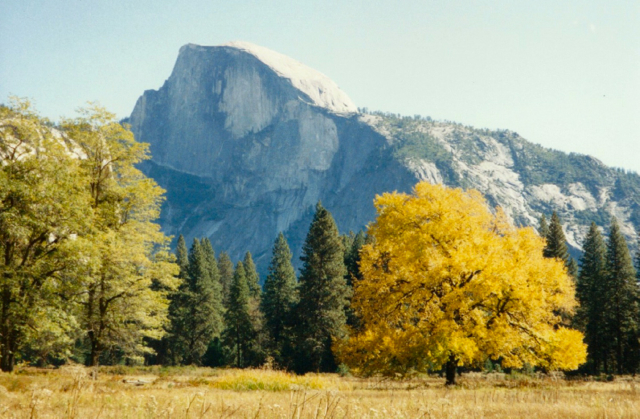
Half Dome is one of Yosemite's iconic features. The California treasure became a national park in 1890. Photo/LTN file

Half Dome is one of Yosemite’s iconic features. The California treasure became a national park in 1890. Photo/LTN file

Whether it’s the grandeur of Mother Nature, or history encapsulated in monuments and battlefields, or wildlife roaming free the National Park Service is there to remind us of our past and future.

It is easy to understand how the Park Service is about our past, especially when looking east toward the National Mall or south to battlefields or west to the USS Arizona.

Our future is reflected in the Park Service because how we treat these treasures says a lot about us as a citizenry. Do we sit by and let national treasures like the Ahwahnee Hotel and Curry Village in Yosemite National Park change names because of a poorly written contract or do we write our members of Congress to tell them we are disgusted by what is happening? Will our actions change the future even if they don’t alter the circumstances a couple hundred miles from here?

Do we say it’s OK for funding for the Park Service to continually be eroded or do we demand these treasures be preserved?

Do we support the Park Service by visiting some of the 409 areas it represents? Do we share memories to encourage others to visit these special places? Or perhaps we buy an annual pass even if we never visit a park.

This agency that turns 100 years old in August continues to evolve, grow and be part of all of our lives. The service is in every state, District of Columbia, American Samoa, Guam, Puerto Rico, and the Virgin Islands.

It’s not just about the 59 national parks. The agency encompasses monuments, battlefields, military parks, historical parks, historic sites, lakeshores, seashores, recreation areas, scenic rivers and trails, and the White House.

Fourteen national parks existed before the Park Service came into being. Yellowstone in 1872 became the first national park – not just in the United States, but also in the world. Twenty-one monuments also existed prior to 1916. President Woodrow Wilson signed the act creating the National Park Service, which to this day is overseen by the Interior Department.

Lake Tahoe News, starting Jan. 25, is going to take readers on a trek to a few of these wonders. Writers are embracing locales that have touched them in memorable ways. The first story is from Carolyn Wright who has visited 33 of the national parks. Hers is as much a photo essay as it is a travelogue about some of those parks.

We hope through our series of monthly stories we connect you to places that perhaps you’ve never been to or we trigger fond memories.

Enjoy the journey.

             — Kathryn Reed, LTN publisher


Massive cut in Calif. transit project funding

By Patrick McGreevy, Los Angeles Times

Faced with plummeting gasoline tax revenue, state transportation officials have announced plans to cut funding for road and transit projects by $754 million over the next five years, the greatest reduction in two decades.

The 38 percent decrease was approved by the California Transportation Commission on Thursday, the same day Gov. Jerry Brown used his State of the State address to call on the Legislature to end the gridlock in negotiations over new taxes and fees for transportation projects.

“What this means is that almost every county in California that relies on this source of funding for projects that improve traffic and air quality will have to cut or delay projects indefinitely,” said Lucy Dunn, chairwoman of the commission.

Read the whole story


Nev. officials push for statewide college registration

By Siobhan McAndrew, Reno Gazette-Journal

Nevada higher education officials voted Friday to move forward on creating a common registration system for the state’s seven public colleges.

The Nevada System of Higher Education, the governing body over the state’s public schools including UNR and Truckee Meadows Community College, want students from its campuses able to access classes at other institutions.

This means students enrolled at TMCC or UNR may soon be able to log on to a registration portal and see where classes including online are offered at other schools. It does not mean the system would have a common application system.

Read the whole story


Feinstein water plan would fund recycling, desalination and storage

By Sarah D. Wire, Los Angeles Times

California’s congressional delegation continued to wrangle over how to respond to the Golden State’s water crisis Thursday when Sen. Dianne Feinstein, D-Calif. , released what she called a “discussion draft” of proposed legislation.

Feinstein said in a statement that the bill addresses long-term and short-term water concerns.

“In my 23 years in the Senate, this has been the most difficult bill to put together. The maxim that whiskey’s for drinking and water’s for fighting is alive and well in California,” she said.

The bill does not mandate how much water should be pumped from the Central Valley Project or the State Water Project, which move water from Northern California to farms and cities to the south. Those decisions would be left in the hands of state and federal officials.

Read the whole story


Douglas creates Stateline redevelopment area

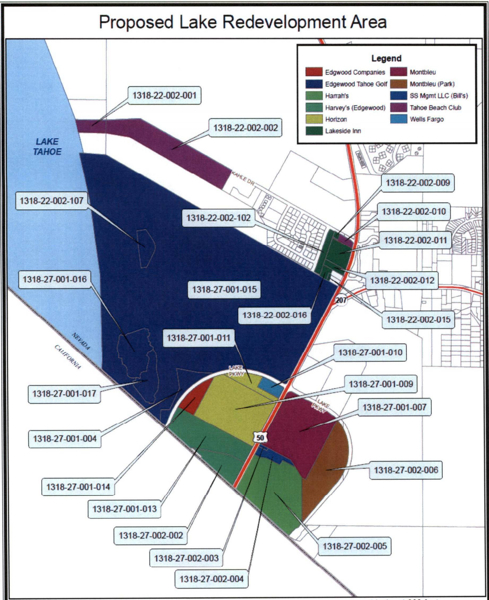
Source: Douglas County

Source: Douglas County

By Kathryn Reed

STATELINE – In an attempt to encourage investment in the Stateline area, Douglas County commissioners on Thursday unanimously agreed to create a redevelopment agency.

It essentially will encompass the casino core east to Kahle Drive. From Lake Park Way only the property on the north side of Highway 50 to Kahle is included.

Mike Bradford was the only person from the public to comment. Representing the South Tahoe Alliance of Resorts, he told the board the redevelopment agency will help with implementing aspects of the South Shore Vision Plan. In particular he mentioned the loop road and creation of a permanent entertainment venue.

Redevelopment agencies are a product of the state, with certain criteria needing to be met to create such an entity. One of those is determining that there is blight.

The main issue that was brought up at the Jan. 21 meeting was how tax increment can impact other entities that receive property tax distribution. Tahoe Douglas Fire Protection District was singled out.

Redevelopment agencies receive their funding from what is called tax increment. When the assessed value of a property goes up – aka tax increment – all that money stays with the redevelopment agency. This means public agencies will not get those dollars.

Bradford assured the board and fire district that “public safety will not be compromised.”

Estimates are the redevelopment agency through the tax increment would collect $47.2 million in 30 years.

The redevelopment agency, of which the commissioners are the board of directors, will also have the power of eminent domain.

The documents say, “The agency is authorized to demolish and clear buildings, structures and other improvements from any real property acquired in the redevelopment area as necessary to carry out the purposes of this plan.”

The second reading to create the agency will occur in February.

California did away with redevelopment agencies effective in 2012, which forced South Lake Tahoe to dissolve its agency and sell off property it owned.


Brown urges steps to end ‘zigzag of spend-cut-spend’

By John Myers, Los Angeles Times

In a short speech with a long view of California, Gov. Jerry Brown used his State of the State address to challenge lawmakers to better balance the cyclical nature of success and setback that has dominated state government for the better part of two decades.

“The challenge is to solve today’s problems without making those of tomorrow even worse,” the governor said in his annual speech delivered from the Assembly chamber Thursday.

Brown, interrupted by occasional applause from legislators, touched on themes that included California’s drought and the challenges of income inequality and terrorism.

Read the whole story


Sierra Colina project in Stateline resurrected

By Kathryn Reed

STATELINE – Similar, yet different. That’s one way to describe what the latest version of the Sierra Colina subdivision in Stateline looks like.

“The original Sierra Colina project was going to be the premier project in the entire Lake Tahoe Basin. It’s unfortunate it ended up in litigation. Everyone lost,” Douglas County Commissioner Nancy McDermid said.

She singled out how the previous project included nine moderate-income deed restricted single-family residences that would have been ideal for local workers.

The property borders Lake Village, Highway 50 and the commercial area with Sushi Pier and Azul restaurants. Today it is vacant land.

Commissioners on Jan. 21 unanimously agreed to subdivide the 18-acre parcel into 47 parcels on which 13 single-family residences and 34 duplexes will be built. They will be smaller units – the smallest being 1,546-square-feet – than what was proposed more than six years ago. All will be built to LEED standards. There will also be a homeowners’ recreation building and trails. The road through the development will be private.

“We are gratified with the votes cast by the Douglas County Board of Commissioners (Thursday) in support of the Sierra Colina project. Because the county approval process is still ongoing, out of respect for that process, we reserve further comment until it is completed,” Gail Jaquish told Lake Tahoe News.

Jaquish with her husband, Steve Kenninger, who live locally, acquired the property in 2005 in a foreclosure sale. Four years later they obtained approval from the Tahoe Regional Planning Agency to build 50 units.

Soon thereafter the League to Save Lake Tahoe filed a lawsuit that ultimately derailed the project. The appellate court in 2012 sided with the environmental group, which had challenged TRPA over the coverage issues for the Sierra Colina project. Coverage is a TRPA creation dictating how much land can be paved in order to contend with erosion issues.

Since that decision came out Jaquish and Kenninger have been deciding how to go forward. Neither attended this week’s meeting.

The six members of the public who spoke at Thursday’s meeting were all in favor of the project. Many pointed out how the couple has put more time and money into this project when someone less determined would have walked away.

The project will be built in four phases. The first will be to put the utilities underground.

Before the second phase begins improvements to the intersection of Lake Village Drive and Highway 50 will be made. These include left and right turn lanes onto the highway, and an accelerator lane on the highway for those turning left.


FAA approves ski-video drones at Tahoe

By Bart Jansen, USA Today

Commercial drones are about to get a lot closer to the action.

The drone startup Cape Productions follows skiers down the slopes with remote-controlled aircraft to record video of their runs. The San Francisco company announced Wednesday that the Federal Aviation Administration gave it approval to fly hundreds of feet closer to people than previously allowed.

The FAA typically requires commercial drones to stay at least 500 feet away from people who aren’t associated with the flight, as a safety precaution. The exception for years has been for aerial photography as part of a closed movie set because the participants are expected to know the risks.

The company will initially offer the service in the U.S. at Squaw Valley and Homewood Mountain Resort, where it has been testing its operation.

Read the whole story


Study: Snow soaks up toxic air pollutants

By Jacqueline Howard, Huffington Post

A team of scientists recently revealed that snow in urban areas can absorb the same toxic and carcinogenic pollutants that come from car exhaust. The interaction of pollutants with cold elements and freezing temperatures in snow might even cause the release of new compounds, according to Parisa Ariya, professor of chemistry and atmospheric sciences at McGill University in Canada, who led the research.

“Snow flakes are ice particles with various types of surfaces, including several active sites, that can absorb various gaseous or particulate pollutants,” she told the Huffington Post. “As a mother who is an atmospheric physical chemist, I definitely do not suggest my young kids to eat snow in urban areas in general.”

The researchers analyzed how snow interacts with exhaust-derived particles and pollutants by putting both snow and exhaust fumes in a chamber. After examining the chemical reactions that took place, the researchers discovered that snow was efficient at removing pollutant particles from the air.

Read the whole story


Tahoe Fund tasked with defining next generation of visitors’ centers

By Kathryn Reed

What will the visitors’ centers of the future look like and will they even exist?

Those questions are expected to be answered by next summer after the Tahoe Fund delves into what might suit Lake Tahoe’s needs the best.

There are various centers around the basin from chamber operated entities to U.S. Forest Service run outlets to municipality led enterprises like Explore Tahoe in South Lake Tahoe.

Visitors’ centers have been losing their appeal because these days people are more likely to look up information on a smart phone or tablet. But they still have a role to play because the brick and mortar location usually has someone who can answer questions in a way that a Google search might not be as responsive, and they have other resources to disseminate. Plus, they are often at a central location people want to explore.

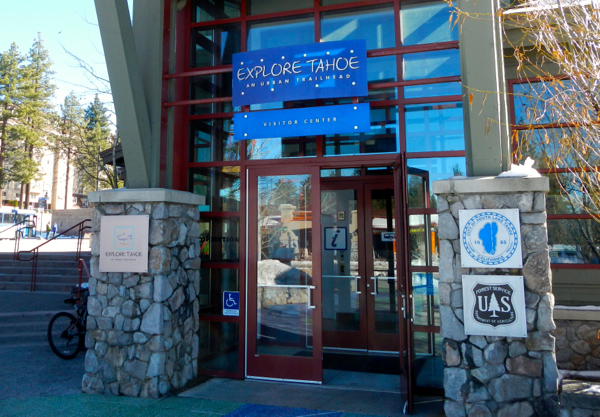
Explore Tahoe opened in 2007 Explore Tahoe, a collaborative effort between South Lake Tahoe, California Tahoe Conservancy, U.S. Forest Service and Tahoe Heritage Foundation. Photo/LTN

Explore Tahoe opened in 2007 as a collaborative effort between South Lake Tahoe, California Tahoe Conservancy, U.S. Forest Service and Tahoe Heritage Foundation. Photo/LTN

“The goal is to see what works best for Tahoe,” Patrick Wright, executive director of the California Tahoe Conservancy, told his board.

The board agreed to allocate $85,000 to the visitor information and environmental interpretation project. The nonprofit Tahoe Fund is putting in $10,000.

The idea has in large part morphed from Bonnie Turnbull’s idea of creating a discovery center on the South Shore. The South Lake Tahoe resident was at the CTC meeting last month and expressed her support for how things are evolving.

Jeff Marsolais, supervisor for the Lake Tahoe Basin Management Unit and non-voting member on the CTC board, welcomes the study, noting his agency will have a big stake in the outcome. He also expressed how expensive it is to maintain and operate visitors’ centers.

The staff report highlights how things got to this point: “… after an extensive series of discussions, the group concluded that they first needed a thorough assessment of the needs and desires of both residents and visitors for new or expanded facilities, and to explore alternative approaches to meeting those needs, given the enormous cost of building and maintaining educational and interpretive facilities.”

Wright pointed out how Tahoe is unique in that there is not one point of entry like most national parks. He said California State Parks is looking at creating mobile centers. There is also the option of pop up centers.

It will be up to the Tahoe Fund to reach consensus, if possible, on what is best for the basin. Initial planning will begin soon. Public workshops and vision planning are likely to occur in March. A design charrette and final report are expected in June.