Future of South Lake Tahoe’s roads, recreation facilities may end up in voters’ hands

By Kathryn Reed

South Lake Tahoe voters will likely be asked in November to raise taxes in order to pay for a laundry list of needs and wants that was discussed by the City Council on Tuesday.

“We need ongoing funding for long-term capital needs,” City Manager Nancy Kerry stressed.

As was pointed out in her presentation of the business plan, “Without a long-term funding strategy, the city will continue funding projects based on current needs and available resources.”

While the city under Kerry’s leadership has been able to balance the budget without dipping into reserves, the city hasn’t been able to get ahead on major capital improvements. The deferred maintenance on roads, facilities and vehicles continues to mount.

Jim Marino, South Lake Tahoe assistant public works director, outlines what needs fixing in the city. Photos/Kathryn Reed

Jim Marino, South Lake Tahoe assistant public works director, outlines what needs fixing in the city. Photos/Kathryn Reed

Financial options

Increasing the hotel tax by 2 percent, adding one-half cent to the sales tax and creating an amusement tax were all talked about at the Feb. 2 meeting.

Recreation and roads would probably be the two main beneficiaries of the influx of cash.

The finance subcommittee, which historically has been comprised of the mayor (Wendy David) and mayor pro tem (Austin Sass), is tasked with further investigating the options, reaching out to the potentially affected entities and bringing back a proposal to the entire council.

Jerry Bindel and Pat Ronan, both who work in the lodging industry and are on the South Lake Tahoe Lodging Association and Lake Tahoe Visitors Authority’s boards, spoke in favor of the three taxes, saying they should all be on the same ballot.

They believe if a 2 percent increase in the transient occupancy tax were to be agreed to, that all of the money should be devoted to recreation. Specifying the recreation complex, 56-acre project and Regan Beach would satisfy needing to narrow the use for the money. Ballot language could also dedicate revenue for operation and maintenance of the facilities.

Bindel and Ronan are of the mindset that improved recreation facilities will lead to more tournaments in a variety of athletic disciplines coming to town, which in turn puts heads in beds. They admitted the initial tax spike might deter some people, but ultimately the improvements would bring even more guests.

Tournaments tend to attract people who stay longer and aren’t just on the weekends, and can be in the shoulder seasons.

The current TOT is 10 percent throughout much of South Lake Tahoe, 12 percent in the redevelopment area. The former goes into the city’s general fund, the latter mostly to pay off the bond debt. The Tourism Improvement District, which was formed in 2006, tacks on another $3.50 or $4 per night. TID uses that money for marketing.

Raising taxes for a specified use would require a two-thirds approval. Bindel and Ronan believe that’s possible to achieve and pledged the lodging association’s backing. This came after City Councilman Tom Davis was adamant the only thing increased taxes should go toward is roads. Davis is on the lodging board representing his company, not the city. When it comes to a vote of the council regarding the TOT Davis will not be able to participate because he could benefit from it.

It’s also possible to ask voters to raise the TOT and not have the dollars earmarked for anything in particular. A second question could ask what they want the money to go to – recreation? roads? something else? That would be an advisory vote and not something any council would have to honor. However, City Manager Kerry pointed out not following the voters’ desires could derail their political careers.

One reason to not specify where the dollars would go is that this would only require a 50 percent plus one vote, which would be easier to accomplish than 66 percent. Also, more than one priority could be funded.

Another advantage to this scenario is that if the money initially went toward recreation, the presumed added revenue from those facilities could then go toward roads and/or some other project.

The gamble is if voters don’t set recreation as a priority for the TOT dollars.

The city briefly raised the hotel tax via Measure Z in November 2002. This added $1 to every hotel room. It was in place from Feb. 1, 2004, to Oct. 31, 2006. It brought in about $1.1 million a year.

Raising the sales tax was already done once. It went from 7.25 percent to 7.75 percent after voters gave the go-ahead in November 2004. All of this “extra” revenue goes right to South Lake Tahoe, whereas the bulk goes to the state.

An amusement tax could be assessed to ski and bike rental, scenic rides on Heavenly’s gondola and other items.
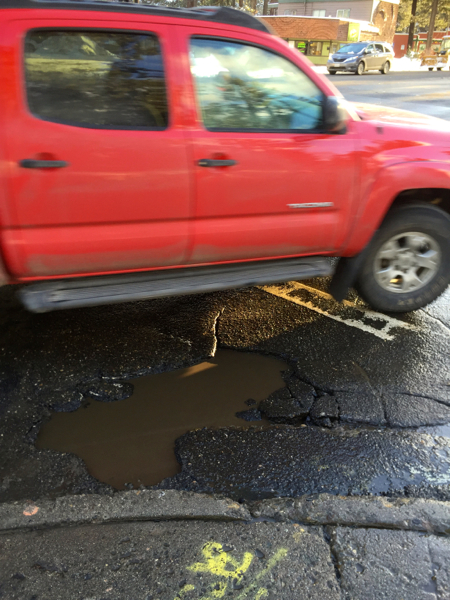
Dodging pot holes in South Lake Tahoe is getting more difficult.

Dodging pot holes in South Lake Tahoe is getting more difficult.

What needs fixing

Jim Marino, assistant public works director, spoke about the $35 million need in the next five years for capital replacement, the $50 million five-year community investment and the $24 million five-year environmental improvement list.

It’s estimated the rec center needs $13 million. It hasn’t been decided if it will be refurbished, overhauled or demolished and rebuilt.

Regan Beach improvements are expected to cost $9 million.

Nothing will happen to the 56-acre area until the city and county resolve ownership-lease issues there. The city is reluctant to invest sizably in a parcel it doesn’t own. If another lease is pursued, Kerry said she would like it to be for 99 years.

The campground that sits on those 56 acres is in need of some basic, albeit pricy, renovations like bathrooms.

Marino would like a minimum investment of $3 million a year for roads. In a 20-year span this would bring them to a level that he said would no longer be embarrassing.

He also stressed the importance of maintaining the roads that have been overhauled so they don’t get into such a state of disrepair that they cost the city more money in the long run.
Study: Drought could worsen fires, feed insects, spur plant die-offs

By Peter Fimrite, San Francisco Chronicle

Worsening drought conditions may be doing more damage to forests in California and throughout the West than their ecosystems can handle, causing a spiral of death that could have a devastating impact on land managers, a U.S. Forest Service study concludes.

The 300-page report issued Monday — “Effects of Drought on Forests and Rangelands in the United States” — outlines how hotter, drier and more extreme weather will spark massive insect outbreaks, tree and plant die-offs, bigger and more costly wildfires, and economic impacts to timber and rangeland habitat.

The study by 77 scientists from the Forest Service, universities, non-governmental organizations and national labs seeks to bring together years of peer-reviewed research and provide the best science to forest and rangeland managers as they grapple with the effects of climate change on the 193 million acres of national forest. There are 21 million acres in California’s 18 national forests.

Read the whole story


Storms significantly boosting Sierra snowpack

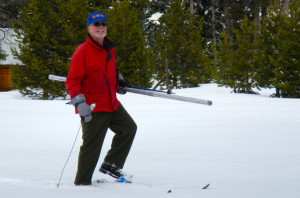
 Frank Gehrke is the state's official snow survey taker. Photo/LTN file

Frank Gehrke is the state’s official snow survey taker. Photo/LTN file

By Lake Tahoe News

It doesn’t matter that the water content of the snow near Echo Summit is 130 percent of average; officials aren’t about to say the drought is anywhere near over.

“While the recent rains and growing snowpack are wonderful to behold, we won’t know until spring what effect it will have on the bottom line for California’s unprecedented drought,” Felicia Marcus, chair of the State Water Resources Control Board, said in a statement. “Until we can tally that ledger, we have to keep conserving water every way we can. Every drop saved today is one that we may be very glad we have tomorrow.”

The manual reading was taken this morning in the snowfield near the entrance of Sierra-at-Tahoe. The snow depth was 76. 2 inches, with the water content at 25.4 inches.

Those numbers are significantly higher than a year ago and above normal for this time of year. In 2015, the water content was 2.5 inches. Water content has averaged 19.5 inches for the last 50 years.

The last time this area recorded these kinds of numbers was in 2005 – snow depth was 77.1 inches, water content 29.9 inches.

Statewide the water content is 20.4 inches, which is 114 percent of normal for Feb. 2.

Snow is so vital because in normal years it supplies about 30 percent of California’s drinking and irrigation water. Most reservoirs in the state remain below average for this time of year.


Loop road may cost STPUD customers $10 mil.

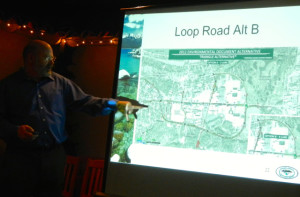
Shannon Cotulla, STPUD assistant general manager, talks about water-sewer lines in the loop road area. Photo/LTN

Shannon Cotulla, STPUD assistant general manager, talks about water-sewer lines in the loop road area. Photo/LTN

By Kathryn Reed

Ten million dollars. That’s what it could cost to move South Tahoe Public Utility District’s water and sewer lines if the loop road goes through.

“It could have devastating impacts for our utility,” Shannon Cotulla, STPUD assistant general manager, said of the relocations process.

Cotulla and General Manager Richard Solbrig explained at the Feb. 1 South Tahoe Chamber of Commerce meeting at the Cantina restaurant that while many questions remain to be answered, the easements are what are most important.

“If they give us the easements for the facilities, then it would be up to the developer to come up with the cost to relocate the lines,” Cotulla said.

The district has encroachment permits, but not the easements.

Solbrig put a preliminary estimated price tag of between $5 million and $10 million to move the water and sewer lines. Part has to do with whether the road would be lowered to mitigate noise issues. Digging down, like what the Nevada Department of Transportation is doing in Carson City, is a normal engineering tactic.

With STPUD having gravity lines in this area bordering Nevada, it would become more costly to have to put lines deeper than if they operated in a different manner.

Last week South Tahoe PUD finished mapping its assets in the proposed project area. An exact dollar figure is hard to pinpoint because it’s not known how far the lines would have to move. Just to plan such an endeavor costs about $300 per foot.

The district officials said a 30-year loan would likely be needed to foot the bill. This in turn would equate to about a 10 percent rate hike. Solbrig envisions that cost being spread out among all customers in the district.

It’s not just the water-sewer lines that would need to be relocated if Highway 50 were routed behind Harrah’s Lake Tahoe and MontBleu and the current highway becomes a city-county street through the Stateline casino corridor. Cable television, gas, electric and phone infrastructure would also need to be moved. And those rates would then likely spike.

—–

Notes:

·      There will be a meeting about the loop road on Feb. 10 from 4:30-7pm inside South Tahoe Middle School’s multipurpose room.


Nev.’s net metering rules may alter energy strategy

By Sean Whaley, Las Vegas Review-Journal 

CARSON CITY — Nevada government and business leaders may have to shift at least part of their established economic development focus from renewable energy to other opportunities if new net metering rules drive the rooftop-solar business out of Nevada as predicted by industry officials.

Rooftop solar was only very recently identified as a priority for Gov. Brian Sandoval’s Office of Energy. A rooftop-solar initiative implemented in 2012 had a goal of getting 5 percent of all single family homes and businesses in Nevada to use rooftop-solar systems. The office also had a goal of seeking to make solar electricity cost-competitive with other forms of energy.

The office received a $765,000 grant in 2011 for its Nevada Rooftop Solar Initiative from the U.S. Department of Energy.

Read the whole story


Tahoe Vista time-share project still alive

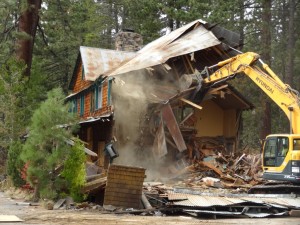
Spindleshanks comes down on Oct. 7, 2015. Photo/Ellie Waller

Spindleshanks comes down on Oct. 7, 2015. Photo/Ellie Waller

By Kathryn Reed

The much-maligned property in Tahoe Vista where Spindleshanks used to be might still be turned into 39 time-share units.

Tim Wilkens, who owns the 6-acre parcel, has been given an extension by the Tahoe Regional Planning Agency until May 1 to start the construction process.

“The determination was based on information that the permittee was unable to follow the approved construction schedule due to a requirement by Placer County in mid-2014 that the project be held until appropriate measures could be implemented to mitigate the presence of a protected bat species at the site,” Tom Lotshaw, spokesman for TRPA, told Lake Tahoe News.

If Wilkens does not get an approved updated construction schedule before May 1, the permit will expire.

The project was first proposed in 2006. Wilkens at that time with Joe Lanza and Rafe Miller had formed Lake Tahoe Partners. The plan was to develop 49 timeshares, with Wyndham to manage it. Wyndham is no longer involved, nor are Lanza and Miller.

A lawsuit was filed in 2008 by Friends of Tahoe Vista and the League to Save Lake Tahoe against Placer County and the Tahoe Regional Planning Agency. The plaintiffs’ contention was this was way too much density for the site.

The 2010 settlement called for reducing the plan to 39 units and having 50,000 square feet less coverage.

The land is practically in the middle of Tahoe Vista on the mountain said of this North Shore community.

The Spindleshanks building had to come down last fall because it could not be brought up to code. It was originally constructed in 1927 for what was known as the Sandy Beach Resort and campground. Its last incarnation was the Spindleshanks restaurant. The restaurant has since moved to the Brockway Golf Course.


Scientist reveals Mars’ secrets to Tahoe crowd

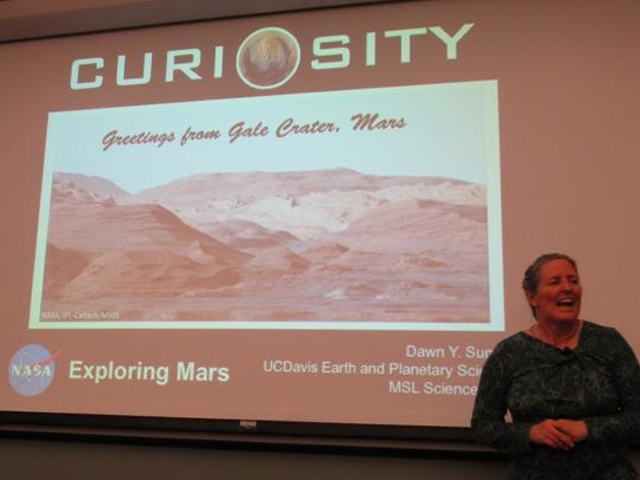
Dawn Sumner talks about Curiosity's mission on Mars. Photo/Denise Haerr

Dawn Sumner talks Jan. 28 about Curiosity’s mission on Mars. Photo/Denise Haerr

By Kathryn Reed

INCLINE VILLAGE – Looking a bit like the desert of southern Utah, the landscape seems familiar. But this is another world.

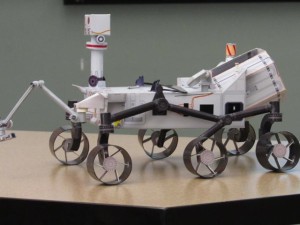
Curiosity, a six-wheeled robot about the size of a car, is providing scientists with new insight about the composition of Mars as well as photographs of Earth’s neighbor.

“There are layers of rock that are a lot like the Grand Canyon. We can read it like a history book of the environment,” Dawn Sumner explained during a talk at Sierra Nevada College on Jan. 28.

Sumner is a professor at UC Davis and a member of NASA’s Mars Science Laboratory. Her team is handling the rover named Curiosity that landed on Mars on Aug. 5, 2012, after being launched Nov. 26, 2011. It is estimated there is enough power to last another six years. The robot is 10-feet long, 9-feet wide and 7-feet tall. It weighs 1,982 pounds.

It is equipped with a ton of software that allows scientists to program various tests as new data is acquired. The robot is able to drill into rocks, vaporize them, siphon dirt, use a laser and travel across rugged terrain. The mineral composition, chemistry and isotopes are part of the data collection.

The main mission is to see if the planet can support small life forms and potentially humans.

Gale Crater near Mount Sharp is where Curiosity is spending its time.

A challenge for those on Earth – it is an international group working on Curiosity – is the time difference. Days on Mars are 39 minutes longer than on Earth, so that is a consideration for when work is done and data is transmitted.

A replica of the rover Curiosity that has been on Mars since 2012. Photo/Denise Haerr

A replica of the rover Curiosity. Photo/Denise Haerr

For now, scientists have seen no evidence of carbon.

Organics have been located in samples that Curiosity has collected. Round pebbles like what are found in a stream are a new discovery.

“The only way to get rounding is in a stream or waves washing on a beach,” Sumner explained. This is how scientists know there was once water on this planet.

An alluvial fan has been mapped, which also suggests water flowed there.

“It flowed from the rim of the crater to just east of our landing site,” Sumner said.

Identifying the various rocks is a goal of the mission. Gypsum is one identifiable mineral. Measuring the force that it takes to drill into the rocks is one way to tell how hard or soft the rock is.

Mars, which is known as the red planet, gets this coloring because of oxidation. Where there is oxidation organic compounds are not likely to be found. However, Curiosity has been able to brush away some of the dirt on rocks. A gray color is unveiled. This, according to Sumner, means it is not oxidized.

“There are some rocks that we think are part of a delta system,” Sumner said.

Right now Curiosity is on the edge of black sand dunes that are actively moving. Sumner described them as pristine.

This week the goal is to sample the mud next to the sand dunes.

Plenty of questions remain to be answered. Being able to study the matter in labs on Earth instead of having the rover run tests and send back data would be more ideal and precise.

More missions are planned for Mars, with a launch date set for 2018 for another rover to study earthquakes on this planet. In 2020 a rover will launch that is designed to bring back samples. The first trip to Mars was the Viking in 1976.


Nostalgia-craving baby boomers driving tourism

By Jon Marcus, Boston Globe

ALBUQUERQUE — If there’s a place that symbolizes pre-interstate America, it’s Route 66, built to connect Chicago with Los Angeles, which John Steinbeck dubbed “the mother road.”

From Depression-era migrants to returning GIs to family vacationers, motorists on Route 66 rolled past Vegas-style neon hovering over low-rise diners, motor courts, and gas stations in designs so distinctive they gave rise to the term “roadside architecture.” They’re also known as pueblo-deco, art nouveau lite, and, simply, kitsch.

Now these structures — many of them long vacant — are reopening as trendy hotels, restaurants, microbreweries, and bars along a part of Route 66 through Albuquerque called EDo, or East Downtown, that fill with patrons far too young to remember the onetime allure of the highway as a frontier of the freedom of the open road.

It’s a small but significant example of the way nostalgia increasingly is driving travel, as visitors seek to recapture their own childhoods — or at least a world they recall as, or assume to have been, simpler, safer, and an escape from the conformity of modern-day chain hotels and restaurants.

Read the whole story


Avalanche deaths soar in the West

By Doyle Rice, USA Today

Several “big and dangerous” avalanches took a toll on skiers, snowboarders and snowmobilers in the western USA this month, making January the deadliest month on the mountains since 2008.

January is typically the month with the most avalanche fatalities in the U.S., but this January proved worse than normal, with 11 people killed, according to the Colorado Avalanche Information Center, which tracks fatalities and accidents nationwide. Last weekend, avalanches killed four people. Overall, 14 people have died in snow slides this winter, all in the western U.S.

The 11 fatalities in this month is the largest number of deaths in January since 2008, when 19 people died in avalanches. Last year, one person died during a warm, practically snow-free January.

Read the whole story


No two hot cocoas the same in Lake Tahoe

Hot cocoa at Alpina in South Lake Tahoe comes with great flavor and a fun design. Photos/Kathryn Reed

Hot cocoa at Alpina Cafe in South Lake Tahoe comes with great flavor and a fun design. Photos/Kathryn Reed

By Kathryn Reed

Long before chocolate was routinely consumed as a solid form it was a beverage.

There was a time when chocolate was for the elite members of society. The chocolate tree’s scientific name is Theobroma cacao. In Greek it means food of the gods.

Dutch chemist Coenraad Jhannes van Houten is credited as being the first to separate the fat from the liquid. This was in 1828. The residual could be crushed to make cocoa powder. Thus began the realization it could be more than a drink.

Today, hot chocolate is a beverage the masses can afford to consume. But there is technically a difference between hot chocolate and hot cocoa. The former uses actual chocolate that is then melted in hot water or milk. Hot cocoa uses cocoa powder and is usually sweeter than hot chocolate.

Lake Tahoe News spent a few weeks sampling this popular winter beverage. Regional establishments have all sorts of ways to create the drink. For our purposes, we are interchanging hot cocoa and hot chocolate, and not adhering to old school definitions.

The whip cream at Bert's is a reason to order hot chocolate.

The whip cream at Bert’s is a reason to order hot chocolate.

Anne only has good things to say about the cocoa at Paul Schat’s Bakery in Carson City. A small at $2.95 was plenty big. It is made from Ghirardelli chocolate, according to the menu board. She said the best part is it is not too sweet. The bonus was having the whipped cream made as she waited.

Rude Brothers in South Lake Tahoe also uses Ghirardelli. Customers may choose the type of milk. I had nonfat. It’s whipped on the espresso machine, making it frothier and creamier; and no need for whipped cream. The medium at $3.25 seemed like a good price.

Blue Angel Café in South Lake also uses the barista method for hot cocoa. They use light and dark chocolate syrups from Guitars – one is more bitter, one more sweet – along with 2 percent milk.

“If you use the steam wand correctly, it makes the chocolate velvety,” owner Jeff Cowen explained. He wasn’t kidding. It’s worth the $3.50.

I preferred all of the hot chocolates made barista style with steamed milk. My favorite was at Alpina in South Lake Tahoe. They use a mocha powder they mix in the back. Then the customer has the choice of milk. I had the medium hazelnut hot cocoa with nonfat milk — $3.40. This was my first hazelnut cocoa – and it won’t be the last. It’s on the menu year-round along with the regular cocoa and white chocolate. During other times of the year there are specialty flavors like peppermint. Depending on the barista he might make a design, like a leaf, out of the foam on top. A nice added touch.

Blue Angel's cocoa is a reason to stop by this South Tahoe restaurant.

Blue Angel’s cocoa is a treat, especially because it is light.

The nonfat peppermint cocoa at Starbucks inside Harveys at Stateline tastes like it’s spiked. Presumably, it’s like having Schnapps without the calories or alcohol in the middle of a workday. The price, though, for a medium was $4.02. Anything over $4 seems pricy for hot chocolate.

Prices at the Starbucks inside the Safeway at the South Lake Tahoe are $2.85, $3.35, and $3.55. While it was good to be warmed up while shopping, the flavor was nothing to brag about. Clearly not all cocoa with steamed milk has a wow factor. The Peet’s inside Safeway in South Lake was lacking chocolate. Prices are $3, $3.30 and $3.60.

Hot chocolate comes out of a machine at Bert’s in South Lake Tahoe. It’s sweet (says Kae) and lacks a chocolatiness (says Sue). It tastes like any other machine processed hot chocolate. What is great is the value. The mug is big – cost is $2.50. The heap of canned whip cream made the presentation great.

The Lodge at Big Springs’ hot cocoa machine is self-serve. Instructions are to fill the cup so far and then let go. Either the instructions are wrong or the cups were too big at Northstar’s mid-mountain café. It required a few pushes to get a full cup. It was average at best.

At least one day at Sierra-at-Tahoe’s West Bowl they had to improvise because there was no hot water with which to fill the machine. The kitchen made the cocoa. It was sweet, but not as overbearing as machine-manufactured cocoa. A small is $3.76 and large is $4.20. The small was plenty big, and considering it was at a ski resort, definitely worth the price.

Machine ready cocoa is festive at Red Hut.

Machine ready cocoa is festive at Red Hut.

Red Hut on Ski Run in South Tahoe came out of a machine served in a coffee cup. The best part was the ample whipped cream with sprinkles on top. Cost — $2.19.

The Beacon restaurant’s cocoa – also out of a machine – is also average.

The best part of the hot cocoa at Artemis near the Y in South Tahoe is the cinnamon in the whipped cream. The cinnamon mixed in with the chocolate throughout. A powder is used with water. It’s not on the menu; cost is $3.

Also using a powder is Casey’s in Round Hill. It wasn’t too sweet, but could be chocolatier, according to me, Sue and Brenda. For $2.95, it was worth it. We got a tip in mixing the powder and water – start with the mix and a little water, stir with a fork to make sure there are no lumps, add more powder and water, mix more and then serve.