Study: Public land is good for rural areas

By Krista Langlois, High Country News

For many parts of the rural West — like Oregon’s Harney County, where timber jobs dropped 70 percent between 1998 and 2013 — large swaths of public land can feel like a burden. Counties rich in public land are often at the mercy of federal land managers, so when logging, mining or ranching dries up — either because of management decisions or shifts in the market — loggers, miners and ranchers can feel powerless. Watching young people flee to cities, it’s easy to conclude that federally managed lands impede economic growth.

A study by Montana nonprofit Headwaters Economics shows that’s not necessarily the case. Overall, rural Western counties with more federal land performed noticeably better by four key economic indicators than counties with less public land.

Though economic growth in rural areas is still far surpassed by urban growth, Western rural counties with the highest share of federal lands had on average faster population, employment, personal income and per capita income growth between 1970 and 2014 than those with less public land.

Read the whole story


Climate change making mountaineering more dangerous

By Devon O’Neil, Outside

In July 2011, Arnaud Temme and three friends were climbing the Rottalgrat, a tough route on the west side of the Jungfrau in Switzerland’s Bernese Oberland, when rocks began to rain down from above. Temme, an experienced alpine climber, took a rock to the shoulder and a handful more hit his helmet, but the team eventually completed the route unharmed.

That night, the climbers evaluated their experience in the warm comfort of the Mönchsjoch Hut. Their guidebook, which was a decade old, described the route as relatively safe with only minor rockfall danger. “But the more recent guidebook, which we didn’t have, said to stay away from this route because of very high rockfall danger,” Temme says.

The disparity struck Temme, a 37-year-old assistant professor at the Netherlands’ Wageningen University who is also an affiliate of the Institute for Arctic and Alpine Research (INSTAAR) at the University of Colorado at Boulder. How could two guidebooks describe the same route in such different ways when they were written less than a decade apart? That question served as the impetus for Temme’s three-year study into the effects of climate change on alpine climbing danger, the results of which were recently published in the international scientific journal Geografiska Annaler. Temme says the two are “very probably related.”

Read the whole story


Unknown source contaminating water in SLT

Danny and Jen Lukins listen to water officials talk about PCE in the groundwater near the Y in South Lake Tahoe. Photo/LT>

Danny and Jenn Lukins of Lukins Brothers Water Co. listen to water officials talk about PCE in the groundwater near the Y in South Lake Tahoe. Photo/LTN

By Kathryn Reed

Two underground plumes of a highly toxic chemical are inching their way toward Lake Tahoe. Even though tetrachloroethylene, or PCE, was first detected in South Lake Tahoe near the Y in 1989, the source of these plumes remains a mystery.

To no avail Lahontan Regional Water Quality Control Board through a $69,000 grant from the state tried to find the source. The results were released last week at a meeting hosted by Lahontan.

The area that was tested was between Patricia Lane on the north, Fifth Street on the east, Roger Avenue on the south and 11th Street on the west. This area was chosen because it is adjacent to the affected wells. The PCE was found in the Lukins’ wells in 2014.

“There is no connection between the two plumes. This tells us the source of the PCE is farther up gradient,” said Chani Hutto, with URS, the company that did the testing. “PCE could still be in the site boundary, but deeper.”

Lahontan plans to drill deeper the next go round. Last year the 22 borings went down between 22 and 40 feet.

“No new sources of contamination were determined. That is why we are going to go deeper,” Jenn Lukins, who runs Lukins Brothers Water Co., told Lake Tahoe News.

If the source is located, the responsible party will be liable for paying for the cleanup.

“This is a communitywide issue,” Lukins said. “The next step is to plan for remediation. We need to remediate the plume out of the aquifer.”

Lukins has had to shut two of its wells down because of the contamination. In the meantime, South Tahoe Public Utility District is supplying the private company with water to make up for what it can’t produce on its own.

A Tahoe Keys well is also affected by PCE.

Lukins and the Keys water systems are building filtration units to treat their water so the inactive wells can be put back into service. Lukins hopes to put in two 3,000-foot long granulated carbon filters this year. The proposal is before the California Public Utilities Commission.

Who will pay for this remains to be seen – local ratepayers or everyone via a state grant.

California in 2008 banned new PCE machines. And all such machines are to be out of commission by 2023. However, PCE will still be able to be used.

PCE was a commonly used chemical in dry cleaning and automotive businesses. Lake Tahoe Laundry Works used to be at Y in the Raley’s center. That is a known source for PCE contamination right there and had originally been thought to be the source of the plumes below TJ Maxx and Classic Cue. In 2010 company officials said it could clean up the groundwater in four years and then monitor the situation for one. That did not happen. And while there is improvement at that site, PCE is still detected there.

A draft remediation plan is out on the street for comment, with the deadline to do so being Feb. 11. The plan is expected to be adopted in April. An advisory team at Lahontan will decide what the next steps are for the former laundry facility.


Record $132.5M bet on Super Bowl in Nevada

By Scott Sonner, AP

So you thought the Panthers and Broncos would put up a lot more points in Super Bowl 50, that Carolina quarterback Cam Newton would score at least once and probably be named the game’s most valuable player?

So did a lot of people, and that had Nevada sportsbooks smiling a day after they took in a record $132.5 million in wagers on the big game.

“It was a very good day,” Johnny Avello, executive director of the sports book at Wynn Las Vegas, said Monday.

“A defensive battle was something we were rooting for and fortunately, that’s exactly what it was,” added Jay Kornegay, the odds maker at the Westgate Las Vegas Superbook.

A 5.5-point underdog at the casinos, Denver upset Carolina 24-10 — a total well below the over-under projection of between 44 and 45. Newton was the overwhelming favorite to win this year’s MVP, but he failed to score and watched Denver linebacker Vonn Miller take the honor at 12-1 odds.

Odds makers said gamblers bet heavily on the Panthers in the weeks ahead of the game.

“But over the last few days, the pendulum swung in Denver’s favor and really balanced a lot of things out,” Kornegay said. “Our best case scenario was for the Panthers to win the game, but not cover. So it wasn’t a best-case, but as long as we stayed under the total, we were in good shape.”

The Nevada Gaming Control Board said in its preliminary estimate Monday that Nevada’s 194 sports books kept about 10.1 percent of the $132.5 million in Super Bowl wagers, for a total win of $13.3 million.

The previous record of $119.4 million was set two years ago when Seattle beat Denver 43-8. The total win that year was the best recorded over the past 10 years, about 16.5 percent or $19.7 million. Wagers totaled just under $116 million last year, with a casino win of 2.8 percent.

The last time Nevada books lost money on the Super Bowl was 2008 when they paid out about $2.6 million more than they took in as the New York Giants beat New England, 17-14.

This year marked the first time Nevada sportsbooks could accept bets on the MVP. Traditionally, bets can be made only on things that happen during the game. But the Nevada Gaming Commission made the change after allowing bets on the Heisman Trophy for the first time last year.

“We were blown away by the wagering on the MVP,” said Michael Grodsky, director of marketing at the William Hill Race & Sports Book. “It was a very healthy handle on that, and Von Miller winning the MVP was a big winner for the public. Ten percent of all the tickets we wrote were on Von Miller.”

The odds makers said a low scoring Super Bowl usually translates into success for the house when it comes to the so-called prop bets — things like will so-and-so score more than so-many touchdowns, or will there be a safety, a 2-point conversion, or an overtime?

The betting public tends to bet “more overs and more yes than no” on those questions, Kornegay said.

“Cam not scoring a touchdown was a very good result for us so was Greg Olsen’s performance overall,” he said about the Panther tight end who was held to four catches for 41 yards. “(Carolina receiver) Ted Ginn not getting a rushing attempt was another one that went our way.”

Nevada sports books avoided the controversy that plagued some off-shore betting sites that had accepted bets on such things as how long it would take Lady Gaga to sing the national anthem. The actual ending point wasn’t clear when she repeated the final word of the phrase, “home of the brave.”

“That’s exactly why we don’t take wagers on that.” Kornegay said. “There’s no official result in a box score.”


Record heat expected in Lake Tahoe Basin


Mount Tallac at Fallen Leaf Lake will be a great place to bake in the sun. Photo/LTN

Fallen Leaf Lake will be a great place to bake in the sun. Photo/LTN

By Lake Tahoe News

Put away the fleece this week, a bit of a heat wave is going to hit the Lake Tahoe Basin.

Forecasters at the National Weather Service in Reno are predicting record highs may be broken, with Tuesday the mostly likely day for this to happen.

The record high for South Lake Tahoe on Feb. 9 is 55 degrees. It was set in 2012. The forecast is for the thermometer to hit 59.

Shane Snyder, meteorologist with the Weather Service, said his agency is likely to revise the forecasted highs for Wednesday and Thursday. As of Monday morning they were 56 and 55, respectively. He expects the actual numbers to be higher once the easterly flows move out on Tuesday.

The records for Feb. 10 and Feb. 11 for South Lake are 58 set in 1996 and 54 set in 2015.

“We should have not have a problem tomorrow beating the record,” Snyder told Lake Tahoe News.

He said the high pressure is just to the west of the basin, but will soon be directly overhead. This will mean warm temps and no moisture for the week.

Snyder added there is a minimal chance of precipitation on Saturday, but said the system is weak. Looking toward next week it also looks more like spring than winter.


Invasive species a constant threat in the West

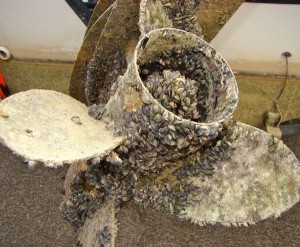
Quagga mussels like these on a boat prop leaving Lake Mead are what officials want to keep out of uncontaminated lakes. Photo/TRPA

Quagga mussels like these on a boat prop leaving Lake Mead are what officials want to keep out of uncontaminated lakes. Photo/TRPA

By Anne Knowles

Invasive species cost the country $3 billion every year and none more so than the fast-growing quagga mussel.

“The quagga mussel is the most costly invasive in U.S. history,” said Matt Morrison, chief executive officer of the Pacific Northwest Economic Region, during a webinar last week titled Critical Habitat and Invasive Species hosted by the Western Governors’ Association.

Morrison said the tiny, fingernail-sized mussels, which can reproduce up to a million offspring annually, are in everywhere except the Pacific Northwest.

They latch onto any hard surface and not only affect fish such as salmon, but agriculture and water infrastructure as well, including hydropower operations like the 60 located throughout the Pacific Northwest.

And once the mussels enter a system, they are there to stay.

“They’ve never been eradicated,” said Morrison. “That’s just not an option.”

That’s why agencies in Lake Tahoe do all they can to prevent the tiny mussels from ever entering its waterways.

Every boat entering Lake Tahoe is required to be inspected, unless it bears a Tahoe-only tag that certifies the lake is the only water the boat enters, said Chris Crookshanks, native aquatics staff specialist with the Nevada Department of Wildlife.

“As soon as the mussels were discovered in the lower Colorado (in Lake Mead) the Lake Tahoe basin spent a lot of money to implement measures to prevent them,” said Crookshanks.

Research done last year by UNR and the Desert Research Institute found that quagga mussels could thrive in Lake Tahoe despite the lake’s low calcium levels.

Crookshanks spends time on recovery of Lahontan cutthroat trout, which are threatened by nonnative fish species, including rainbow, brown and brook trout that were introduced into water bodies throughout the west, including Lake Tahoe.

Crookshanks said other threats to the native trout in Nevada are water diversions, feral horses, cattle, fire and drought.

He said the key to success in the trout’s recovery are cooperation between various entities such as the Bureau of Land Management, U.S. Forest Service, area Native America tribes and non-governmental organizations such as Trout Unlimited as well as private landowners through safe harbor agreements.

Those successes don’t include Lake Tahoe.

“It is so big we’ll never see recovery of Lahontan cutthroats there,” said Crookshanks. That has not stopped agencies on the California side, though, from trying to bring back the native species.

Technically, a useful method has been to start at the top of a water system, install temporary barriers, work to control nonnative fish populations, then remove the barriers and work on the next stretch of the system, said Crookshanks.

“That’s a great strategy, but there are some systems where the temporary barrier has to stay because the next piece can’t be done,” said David Sweet, Yellowstone Lake special project manager with Wyoming Trout Unlimited.

Sweet has worked for years on the effort to restore Yellowstone cutthroat trout, which are preyed upon by nonnative lake trout.

The U.S. Park Service, Yellowstone Park Foundation and NGOs spend about $2.3 million annually on the work, and in the last four years have been able to half the lake trout population and triple the number of Yellowstone cutthroat.

He said the primary methods are netting operations and telemetry to identify lake trout spawning areas and then do alternative suppression.

“Eradication is a term we rarely use, we use suppression,” said Sweet. “Eradication is impossible in a system like a lake or with something like mussels. We reduce the populations and give the cutthroat a chance to survive. … In the future we may be able to talk about eradication through genetic engineering.”


Personal-income recovery heats up in Nevada

By Jennifer Robison, Las Vegas Review-Journal

Nevada’s lukewarm income recovery turned hot in 2015.

After nearly a decade bringing up the nation’s rear in personal-income growth, the Silver State shot to No. 3 for gains in 2015, according to a new report from the Pew Charitable Trusts.

Personal income matters because federal agencies use the number to allocate funding for social services, while state governments check it to set budgets. But personal income is an important private-sector measure too: Growing incomes put more money into consumers’ pockets for spending that spurs the broader economy, Gordon said.

Read the whole story


Sales of life-saving backcountry gear lag

By Shay Castle, Denver Post

Get the gear. Get the training. Get the forecast.

That’s the mantra of the industry that’s built up around the rising popularity of back country sports — skiing, snowboarding, snowmobiling — undertaken outside the groomed boundaries of ski resorts.

But while more and more people are venturing out into the backcountry, sales of life-saving avalanche gear are not keeping pace.

National sales of all backcountry equipment (skis, boots, bindings, etc.) are down 12 percent over the past three seasons, despite an 18 percent increase in back country participation. Sales of avalanche safety equipment (probes, beacons and shovels) are down 16 percent over the same time.

Read the whole story


Opinion: Tahoe needs to find its authentic self

It's easy to walk up and down Main Street in Park City. Photos/Kathryn Reed

It’s easy to walk up and down Main Street in Park City. Photos/Kathryn Reed

Publisher’s note: This is one in a series of stories about Park City, Utah.

By Kathryn Reed

For years people have been saying Lake Tahoe – the South Shore in particular – is at a crossroads, at a tipping point. Many have predicted this region’s demise if change did not come – and come dramatically and quickly.

And, yet, here we are, still plugging along as the wheels of change turn slowly.

In many ways Mother Nature is as big a player in our future as anything we mortals might do.

Hotels are full this winter because there is plenty of snow to ski on. That is the key difference between today and a year ago today.

Park City's sprawl is easy to see from the slopes.

Park City’s sprawl is evident from the slopes.

But what is different this season compared to winter’s past is more people are coming on the weekends and fewer are here midweek. The traffic boondoggle last weekend involving people heading west on Highway 50 having to sit for hours just in the basin, let alone being able to inch their way over Echo Summit, is testament to an increase in vehicles on the roads. They all leave at the same time, but don’t all arrive at the same time – thus the reason there is chaos only upon departure.

We are not alone in having to balance the needs of locals and visitors. Congestion isn’t unique to Tahoe. But that doesn’t mean we should not be striving to find palatable solutions.

Some people are satisfied with the status quo. That’s too bad. I think we can do better – throughout the basin, but especially on the South Shore.

Park City understands the importance of having a true city hall as well as public art.

Park City understands the importance of having a true city hall as well as public art.

We can build pretty commercial structures, reroute highways and create environmental improvements to keep the lake clear. But can we provide jobs that pay enough for people to continue to live in the Lake Tahoe Basin and not have to drive over a mountain pass to get here? Can we give visitors an experience that has them immediately making their friends jealous with photos and descriptions on social media?

I’m fortunate that I get to live and work in the same town. I don’t commute. Sure, there are meetings and events to attend elsewhere, but that is the norm for most jobs, especially being a journalist.

People talk about affordable housing. I believe that is the wrong discussion. The topics should be jobs that pay enough to live here and employers paying a livable wage. The two are different issues.

Talking with people in Park City, Utah, last month it was hard to find anyone who lives in the city limits. They commute from 30 to 60 minutes away. Many don’t even come into town to shop or eat. It would be sad if Tahoe ever became like that.

Park City embraces its mining past, including a tour on the mountain about its history.

Park City embraces its mining past, including a tour on the mountain about its history.

Park City government officials declined to answer these questions:

·      What percentage of Park City workers lives in town?

·      Where do most live?

·      And how far away is that?

Park City has a cute, walkable downtown. There is a mix of shops and restaurants. Then there is sprawl. But it’s a much smaller town than South Lake Tahoe, let alone comparing it to the entire basin.

In 2013, there were almost 40,000 people in Summit County, in which Park City resides. In 2000, there were 30,000 people. Park City in 2013 had nearly 4,000 residents, which since 2000 has stayed fairly steady. By contrast, South Lake Tahoe’s population peaked in 2009 at 23,567, and in 2013 was at 21,387.

South Lake Tahoe will never truly be walkable – sections, yes, but never the entire city. Tahoe City, Kings Beach and Truckee are more do-able sans vehicle. That is why it’s imperative the South Shore create districts. Creative names – maybe something other than a street (think Ski Run and Harrison) – would be a start to getting people to gravitate to those areas. Obviously they need a mix of interesting things to attract people – a name alone won’t do it. Think about the Gaslamp District in San Diego or Rockridge in Oakland or Noe Valley in San Francisco. The changes South Lake Tahoe wants to make at the Y – and making a concerted effort to call it Tahoe Valley – gives me hope we are on the right path. And it’s even better that it is on the other side of town from where for many years the focus of progress has been concentrated.
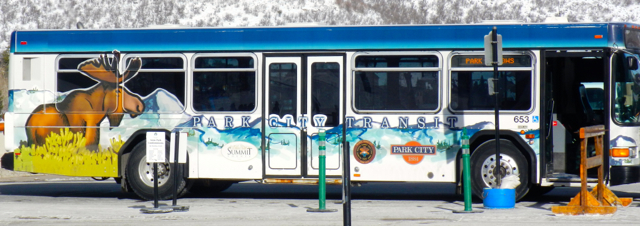
No need for money when riding the bus in Park City.

No need for money when riding the bus in Park City.

A great thing about Park City is the free bus service. The city operates the bus system, with Summit County contracting with Park City to operate the county portion of the bus service.

Sales tax dollars pay for the bulk of the system. Park City collects a 0.30 percent transit sales tax on all taxable goods and services, excluding unprepared food, as well as a 1.1 percent resort communities sales tax on all taxable goods and services, excluding unprepared food. One-quarter of the 1.1 percent goes to the bus system. Also contributing to the bus service is a portion of business license fees.

“The transit portion of sales tax collected covers more than 74 percent of the operating expenses of the bus system and business licenses make up 17.5 percent of the bus system expenses. The transit system also receives federal capital and operating assistance from the [Federal Trade Administration],” Nate Rockwood, Park City capital budget, debt, and grants manager, told Lake Tahoe News.

Park City voters have agreed to tax themselves in other ways as well.

There is a 1 percent tax on prepared food, also known as the restaurant tax. It brings in about $2.3 million a year. A committee decides how to allocate those funds based on tourism components, the ability to leverage more dollars, whether the application is promotion or an asset, and whether the application is a new or developing program.

“Lift ticket sales are considered taxable in Utah and fall under the state’s sales and use tax laws,” Rockwood explained. “Therefore, lift ticks are taxed at the sales tax rate in the sales district which they are located.”

Clearly, it takes taxes on what locals and visitors use to be able to provide certain amenities in Park City. Tahoe residents need to decide what they want and then how to pay for it. I’m all for user fees, that’s why I liked the paid parking concept. Only people parking there paid for it. I want a decent return on investment for whatever I’m paying, for the money to go for something tangible and for it not to go to any entity’s general fund. And it’s time to stop, at least for a few years, initiatives that raise property taxes.

Douglas County commissioners in December passed a gas tax that will in part fund improvements related to the loop road if that project goes forward. South Lake Tahoe is contemplating multiple taxes – hotel, sales, amusement – that could be put before voters in November. Recreation and roads are two of the likely beneficiaries of those dollars.

The U.S. Ski Team practices at Deer Valley in advance of this weekend's freestyle competition.

The U.S. Ski Team practices at Deer Valley in advance of this weekend’s freestyle competition.

Park City is also able to draw a large number of people through events. Tahoe knows this is also a way to drive heads into beds, but doesn’t capitalize on this in the winter in a significant way. Park City has global events in the winter. The biggest stop on the World Cup tour, the Visa Freestyle International was at Deer Valley for the last three days and the U.S. Grand Prix was at Park City ski resort. Utah will host the 2019 World Championships in freestyle, freeskiing and snowboarding, which are expected to bring more than 500 athletes from more than 50 nations to Park City and Deer Valley ski resorts. The Sundance Film Festival is an 11-day event that takes over Park City in late January.

Of course Park City was also darn near a co-host city in 2002 for the Salt Lake City Olympics. That is something people need to remember when comparing Park City to Lake Tahoe. Yes, Squaw Valley had the Games in 1960, but that was such a different time. Park City was able to benefit from an infusion of federal and international dollars to improve infrastructure that to this day is paying dividends.

It’s unfortunate the ski cross and snowboardcross World Cup events set for Squaw Valley last March had to be canceled because of lack of snow. Hopefully, the powers that be will recognize Tahoe is World Cup worthy again. Heavenly’s run – World Cup – hasn’t had such an event in decades.

Another major difference between Park City and Tahoe is the quality of lodging. It runs the gamut there, with no visible evidence of one star or less hotels on any of the main roads. The Park City Marriott was equivalent to South Lake Tahoe’s Lake Tahoe Resort Hotel. It was nice to have a mountain feel walking in and a certain coziness not often associated with a Marriott property. The shuttle service at the hotel was excellent, as were other guest services.

Stein Erikson Lodge and Goldener Hirsch are high-end properties. The level of service at these two, which are right at Deer Valley, outshine anything in the Tahoe area, even the Lake Tahoe Ritz-Carlton. The Ritz and Resort at Squaw Creek are the two real high-end properties in the area and neither is actually in the Lake Tahoe Basin. Time will tell if the Lodge at Edgewood will live up to the hype of being the high-class lodging that has always been lacking on the South Shore.

What I was left with after a week in Park City was that it is friendlier than Tahoe. Guest service was off the charts no matter the caliber of restaurant, no matter where we were. It made me want to go back just for that vibe, that positive energy – and it felt authentic. If Tahoe were to emulate Park City at all, it should be to capture that attitude. Maybe from there we could solve some of our other issues.


Super Bowl reflects rift between legal, illegal sports gambling

By Howard Stutz, Las Vegas Review-Journal

The Carolina Panthers didn’t exist and Peyton Manning was in high school when Congress halted expansion of legal sports wagering in the U.S. in 1992.

The Professional and Amateur Sports Protection Act allowed Nevada’s sports book industry to continue along with small stakes sports wagering in Oregon, Delaware and Montana.

As for stopping illegal sports betting, the 24-year-old law has been an abysmal failure. Unregulated sports gambling has grown, expanded and thrived.

The American Gaming Association estimates U.S. citizens illegally wagered $149 billion on sports last year through off-shore betting websites and illegal bookmakers.

Read the whole story