Ski helmets evolve, become common equipment

By Kathryn Reed

For athletes, equipment matters in terms of performance and safety.

While helmet use has increased from 25 percent of skiers-snowboarders wearing one in 2002-03 to 78 percent in 2014-15, according to the National Ski Area Association, consumers don’t always pay attention to the quality.

RUROC, which was formed 10 years ago in the United Kingdom, is the first company to create a fully integrated helmet, facemask and anti-fog goggle. For five years their helmets have been on the market, with the hopes of being in stores in the United States for next season. Right now they are available online.

Trevor Jacob of Mammoth Lakes wears the RUROC helmet. He finished fifth in the men’s snowboarder cross at the X Games in Colorado last month.

It’s a solid fitting helmet that is similar and snug like a motorcycle helmet. However, it’s not rated for motorized sports. Departments of transportation regulate helmets for snowmobiling and motorcycling. This is a direction the company wants to evolve into, as well as helmets for downhill mountain biking.

RUROC officials said their helmets pass two European and one United States standards for alpine sports safety.
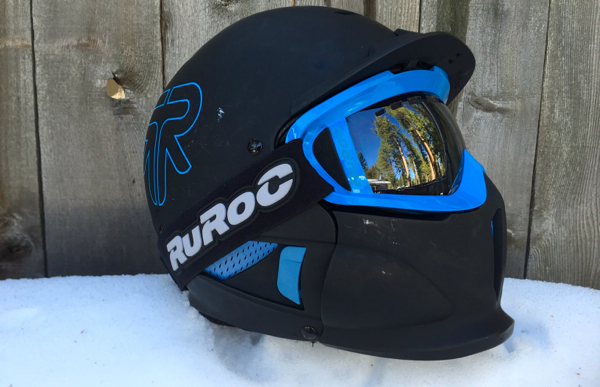
RUROC helmets are about safety and function with the goggles and facemask components. Photo/LTN

RUROC helmets are about safety and function with the integrated goggles and facemask. Photo/LTN

“The person just starting out doesn’t need a RUROC helmet instantly,” Dan Rees, managing director and CEO for RUROC, told Lake Tahoe News. “It is more for the extreme rider who is pushing themselves.” He noted how Jacob can hit 100 mph on his board.

But even this non-extreme skier feels more secure in it than other helmets. A good whack on the head on a recent Saturday unintentionally tested its protection – with positive results. The company also sees backcountry skiers gravitating toward their product.

The U.S. Ski and Snowboard Association has regulations about what type of helmets are allowed for juniors and adult competitors. Different entities have regulatory standards. There is the American Society for Testing and Materials; CE indicates a helmet meets the requirements of the European Economic Community Directive; and RS-98 is a certification mark of the Snell Memorial Foundation.

According to Snell Memorial Foundation’s website, the nonprofit has been dedicated exclusively to head protection since 1957 through scientific and medical research, standards development, helmet testing, and public education.

The foundation lists these elements as critical protective properties:

·      Impact management — how well the helmet protects against collisions with large objects.

·      Helmet positional stability — whether the helmet will be in place, on the head, when it’s needed.

·      Retention system strength — whether the chinstraps are sufficiently strong to hold the helmet throughout an incident involving head impact.

·      Extent of protection — the area of the head protected by the helmet.

In addition to the safety aspects, what makes the RUROC different is that the system integrates the goggles and the facemask. The mask, while an ideal added safety tool for those in terrain parks, serves as a great addition in cold, snowy conditions. The mask pops out fairly easily, so it doesn’t have to be worn the entire day.

The lenses are made in Italy and have an anti-fog coating.

“We wanted a complete closed system,” Rees explained. “With the goggles, it is seamless to the roof of the helmet. It creates a constant vacuum of air and prevents fog.”

Ski resorts are all over the board when it comes to rules about helmet use.

“We were among the first companies to require helmets on all employees and all children in ski school. If parents don’t want a helmet on their children, they have to proactively alert us and sign a waiver,” Russ Pecoraro with Vail Resorts told Lake Tahoe News. “I’m not aware of a preference in terms of helmets. Anecdotally, it’s hard to find people these days not wearing a helmet.”

The Broomfield-Colo.-based ski company owns Heavenly, Northstar and Kirkwood ski resorts in the Tahoe area.

Helmets are not mandatory for anyone at Sierra-at-Tahoe, though the resort offers employees a 30 percent discount on helmets to encourage them to buy and wear one.

“Lessons do not require a helmet, but are available for rental with all lessons,” Steve Hemphill with Sierra told Lake Tahoe News.

The resort also goes into schools in Lake Tahoe Unified School District to educate students on helmet and snow safety.

At Squaw Valley and Alpine ski resorts Giro is the official helmet.

“This program includes a generous allotment of complimentary helmets to our ski team coaches and members of our ski patrol as well as a 50-75 percent off purchase program for all resort employees,” Michael Radlick with Squaw-Alpine told Lake Tahoe News.

Helmets are no guarantee a person won’t be hurt, but for many impacts on the slopes they will lessen or curtail a severe injury.

“Helmets can help prevent injuries and, in many cases, an injury would have been worse without a helmet. I would also speculate that we do not see some patients because they fall and hit their head while wearing a helmet and the injury was not enough to require a trip to the hospital,” Lance Orr, medical director of Barton Memorial Hospital’s emergency department, told Lake Tahoe News. “If the person had not been wearing a helmet, it may have been a different scenario. An example of where a helmet may not help is if someone lands in a manner that puts direct force onto the spine.


Forest management integral to water issues

By David Benda, Record Searchlight

Two-thirds through Thursday’s talk on forests and water yields at the Sierra-Cascade Logging Conference, moderator Jim Ostrowski asked the audience about the governor’s mandate for a 25 percent statewide water use reduction.

“Maybe we need to tell the governor we got a better a deal,” Ostrowski said.

He was referring to the PowerPoint just given by Rob York, a UC Berkeley adjunct professor who for years has been studying the role of sustainable timber harvesting as way to reduce fire risk, restore the forest and increase water available for agriculture and residential users.

Reducing the forest canopy cover by 30 percent can mean an extra 6 inches of water, York said.

Read the whole story


Casinos woo millennials with tattoos, martial arts, poker

By Phillip Marcelo, AP

Casinos worried that millennials aren’t getting into traditional gambling like their parents and grandparents are bringing in tattoo studios, mixed martial arts competitions and other offbeat attractions to attract a younger clientele.

In New England, where a regional casino war is afoot, Connecticut’s Foxwoods is remaking one of its gambling floors — now christened “The Fox” — as a hip, fun scene in the sprawling 30-year-old casino complex.

The casino floor bar was redone in January to include a stage where a mostly female ensemble covers pop songs. Just off the gambling floor, a swank new tattoo studio-slash-fashion retailer opened in the fall, not far from where Shrine, the casino’s popular nightclub, is increasingly booking top electronic dance acts like DeadMau5 and Tiesto.

“It’s kind of like the party place,” says CEO Felix Rappaport. “It’s really energized the casino floor.”

In Rhode Island, the more modest-sized Twin River Casino removed 274 slot machines to make way for more poker and other table games favored by younger gamblers this past December. It’s also been hosting mixed martial arts competitions at its event center, a nod to its popularity among younger fight fans.

Casinos are making the right move to draw in millennials if they’re putting fewer slot machines on their floors in favor of table games, said Sunny Chopra, a 25-year-old from Falmouth, Massachusetts, as he considered betting at an electronic roulette wheel at Plainridge Park, a slots parlor and harness racing track in Plainville, Massachusetts.

“I’ve never played slot machines,” Chopra said. “I’m not that old.”

Casinos slow to pivot to millennials’ preferences do so at their own risk, warned Steven Norton, a casino consultant based in Illinois.

Older members of the demographic are in their 30s, meaning they’re entering their prime earning and spending years, he says. That’s critical for an industry whose customers have historically been in their 40s and over.

“You want to develop good customers now so that we don’t become the horse racing industry of the future, where all of our people have died off and we don’t have any new blood coming in,” Norton said.

It’s too soon to determine whether any of these efforts will translate to sustained success with millennials, casino operators said.

But market research suggests new thinking is necessary, said Michael Mathis, president of MGM Springfield, a $950 million resort casino expected to open in western Massachusetts in late 2018.

He pointed to a 2015 article by the Washington, D.C.-based Marketing Research Association suggesting current versions of slot machines are “widely viewed” by millennials as “antisocial, non-intuitive and generally boring.”

To address the slot machine apathy, casinos in past years updated machines with more pop culture references, like Star Wars themed gambling machines. They also introduced electronic version of popular table games.

The newest trend? Electronic table games that feature live dealers.

Casinos are betting the blend of live table game action, easy slot machine-style play and lower minimum bets will appeal to younger and novice gamblers, says Carrie Nork Minelli, spokeswoman at Parx Casino outside Philadelphia, which unveiled a Shaquille O’Neal-themed electronic blackjack game where players are arranged “stadium-style” around a live dealer in late 2015.

Casinos are also increasingly launching “social casinos” — websites where players can play free, online versions of their slot machine and table game offerings for virtual credits that can’t be converted to cash or redeemed.

The hope is that free online play generates paying customers at brick-and-mortar gambling halls, says Mario Maesano, senior vice president of marketing at Maryland Live, which launched a social casino just before Christmas.

At Connecticut’s Mohegan Sun, where millennial-friendly nightlife and entertainment options like Vegas-style pool parties and rooftop concerts emerged almost four years ago, general manager Ray Pineault cautions the need to address the younger generation has to be balanced.

“You can’t over emphasize millennials to the detriment of your other customers,” he said. “They’re still young and have less disposable income than their more established parents.”


SLT proposing significant project near Ski Run

The area in green represents the area South Lake Tahoe wants to acquire, while the gold are is the "southwest corner" property at Ski Run and Highway 50. Map/South Lake Tahoe

The triangle area in green represents the area South Lake Tahoe wants to acquire, while the gold section is the “southwest corner” property at Ski Run and Highway 50. The purple section is California Tahoe Conservancy land. Map provide by South Lake Tahoe

By Kathryn Reed

Bulldozing and starting over is what many people would like to do with a majority of parcels in South Lake Tahoe.

One-by-one the California Tahoe Conservancy is doing this. The board in March will have a say in whether that happens to the Knights Inn that fronts Highway 50 at the corner of Herbert Avenue.

First, though, it will be the South Lake Tahoe City Council deciding if it wants to buy the property. It is adjacent to what is loosely known as the “southwest corner” parcel at Highway 50 and Ski Run Boulevard.

The goal is to combine the two parcels, which together is about 6 acres, into one development plan.

The city owns the parcel at Ski Run, having bought it from the now defunct Redevelopment Agency for $800,000. It has been in escrow for more than a year with Halferty Development Company out of Sacramento for $1.3 million.

Knights Inn may be razed,  including Mo's Place. The recently paved sidewalks will stay intact. Photo/LTN

Knights Inn may be razed, including Mo’s Place. The recently paved sidewalks will stay intact. Photo/LTN

The hotel site, which also includes a conference center on Lloyd Avenue as well as owner Pradip Patel’s residence on that street, has been appraised at $4.5 million. On Feb. 16 the council will be asked to vote to buy it for $6 million. The added costs account for the value of the commodities, which include 110 hotel units (which bring in approximately $100,000 year in transit occupancy tax), about 5,000-square-feet of commercial floor area, and a substantial amount of coverage.

The bulk of the money to buy the property is projected to come from the CTC, with the city contributing the money from the sale of the southwest corner and probably a couple hundred thousand dollars. Which fund that comes out of the council will decide.

Assuming the CTC board green lights the idea, the city would spend the summer doing environmental analysis. The CTC board would then make the final decision at its October meeting. The developer and city would spend next fall-winter getting permits, and construction could begin in May 2017.

“If it all falls together, it will be a beautiful entryway. It will be remarkable,” City Councilman Austin Sass told Lake Tahoe News. “If it happens, it will be very exciting for our town.”

Sass with Councilman Hal Cole make up the city’s real property subcommittee, which has been negotiating the deal along with city staff.

While the specific tenants are not known, not even the types of businesses are being disclosed. What city officials would say is the retail won’t be T-shirt shops or a drug store. They said businesses not currently operating here are who the developer is wooing. The city as landowner has negotiated a deal so that it has final say over what type of business goes in.

It will be a mini-village of sorts with varied retail, that will be walkable, aesthetically appealing, and potentially have an educational component regarding the environment.

The "southwest corner" lot comes with 88 parking spaces in the adjacent garage that otherwise is controlled by Lake Tahoe Vacation Resort. Photo/LTN

The “southwest corner” lot comes with 88 parking spaces in the adjacent garage that otherwise is controlled by Lake Tahoe Vacation Resort. Photo/LTN

The developer already bought 12,000-square-feet of CFA from the city for the southwest corner. They will need more to do the project they have in mind. Between the two parcels three buildings may be constructed. Depending on the tenant(s) it could be a build-to-suit scenario. The southwest corner can have a maximum height of 56 feet, and the hotel property can go up to 44 feet.

It’s too soon to decide if a long-term lease will be entered into or if one day the city might sell the land to the developer or another entity.

The entrance Sass referenced would be at the corner of Ski Run and Highway 50. On the hotel property a water feature is planned to capture the natural flow of the runoff that comes down from the mountain side (and is the reason the hotel for years has had flooding issues), and then have it go under the highway to the lake. Right now it flows that way without ever being treated.

This area was once a stream environmental zone.

The Conservancy funds these sorts of endeavors when there is a significant environmental gain. City officials estimate 8,000 pounds of sediment could be prevented from reaching the lake with the proper erosion control measures put into place. This in turn would meet more than 20 percent of the city’s sediment reduction goals that Lahontan Water Quality Control Board has mandated for the five-year period starting this year.

—–

Notes:

  • The City Council meets Feb. 16 at 9am at Lake Tahoe Airport.


Nev. makes strides in reducing number of uninsured children

By Jackie Valley, Las Vegas Sun

The number of Nevada children without health insurance keeps dropping, especially among such historically hard-to-reach populations as minorities and lower-income residents, according to a Robert Wood Johnson Foundation study released Thursday.

The number of uninsured Nevada children dropped to 10 percent in 2014 from 14.4 percent in 2013 — the largest percentage decline among all states and the District of Columbia. That means 30,758 Nevada children gained health insurance during that one-year period.


While Nevada posted a number of significant gains, 10 percent of Nevada children remain uninsured — leading to a 48th ranking among all states and the District of Columbia. In 2013, Nevada had the highest rate of uninsured children in the nation.

Read the whole story


Being green at a ski resort isn’t a simple process

By Patrick Doyle, Mountain

When Squaw Valley installed electric vehicle charging stations back in 2013, the resort ran into an immediate problem: The electricity it received from its provider, Liberty Utilities, was dirty, generated in part by the burning of Rocky Mountain coal at the North Valmy Generation Station, a hulking power plant in Northern Nevada. North Valmy, according to the Sierra Club, spews the equivalent of 2.5 million metric tons of carbon dioxide into the atmosphere each year, a figure equal to the annual emissions of nearly half a million cars. It is the single largest greenhouse-gas emitter in the state of Nevada. Although well meaning, by choosing to power electric cars off that soiled wattage, Squaw would only be perpetuating climate change.*

Around this time, Chris Steinkamp, executive director of Protect Our Winters, reached out to Squaw CEO Andy Wirth. A California-based nonprofit started by pro snowboarder Jeremy Jones, POW has built powerful allies in the snowsports community by combating climate change, an enormous threat to the ski industry. After a handful of conversations on the best way to tackle the energy problem, POW and the Squaw executive team approached Liberty Utilities with a simple, yet powerful argument: We are some of your largest customers—running ski lifts and resort operations, after all, takes a good chunk of power—but coal and climate change are killing our industry. Can you find a cleaner source of energy to use instead?

Liberty Utilities was surprisingly open to the conversation. Nudged along by the ski industry partners as well as the Sierra Club of California and Nevada, Liberty announced in April 2015 that it was ending its contract with North Valmy. What’s more, Liberty proposed to build two solar plants near Hawthorne, Nevada, to boost its renewable portfolio.

Read the whole story


Public gets answers to loop road questions

By Kathryn Reed

By August the Tahoe Transportation District expects to have the necessary approvals from the various entities to go forward with the loop road on the South Shore.

What is expected to be a $75 million construction project would reroute Highway 50 at about Pioneer Trail on the east, go behind Harrah’s-MontBleu and come out at a roundabout at Lake Parkway. The current highway then becomes a street to be maintained by South Lake Tahoe and Douglas County.

About 80 people attended a meeting Feb. 10 at South Tahoe Middle School, with just about that many questions asked of the three-member panel. Answering the questions were Carl Hasty, district manager of the Tahoe Transportation District; Russ Nygaard with TTD; and Mark Rayback, project engineer with Wood Rodgers.

Some of the questions from the public and the answers:

Q: Where will the money come from to pay for the construction?

A: Mostly the federal government. It is too soon know what percentage will come from any one source. No construction dollars have been secured. The project, per federal law, cannot begin until it is fully funded.

Q: Where has the money to date come from?

A: Primarily the federal government, with some from Nevada Public Lands. About $3 million has been spent so far.

Q: Will South Lake Tahoe taxpayers foot any of the bills?

A: Not for the construction.

Q:  The millions of dollars the project is expected to cost — what will that buy? In other words, will it pay for all of the improvements presented in the pictures at the various meetings or will it just pay for land acquisition, relocation of residents/businesses, the highway and the overpass?

A: It pays for almost everything, including relocation of utilities if need be. There is some question as to whether South Tahoe Public Utility District’s $10 million price tag to do so was realistic. Landscaping – but not the maintenance of it – is covered, as is narrowing the current highway to one lane in each direction. It pays for the overpass, but not that maintenance. The structure will be Caltrans’ obligation, while snow removal could fall to State Parks.

Q: Why put in a roundabout instead of a light at the east side?

A: There will be better movement and lower speeds, plus it allows for creative landscaping.

Q: How much low-income housing will be built?

A: It depends on the alternative that is selected. Between 65 and 200 deed restricted units could be built. Where they are built is still to be decided. It does not have to be at that end of town. Between 47 and 90 residents could be displaced. (The discrepancy between numbers was not explained.) Anyone over age 18 is eligible for relocation assistance. The federal Uniform Act is what TTD must follow in regards to relocation assistance. It is estimated to cost $2 million for the relocation aspect of the project.

Q: Will there be a left turn lane out of Tahoe Meadows?

A: No, the project doesn’t go that far west.

Q: How many businesses will be impacted in South Lake Tahoe and Douglas County?

A: Three to six in the city, zero in the county.

Q: What is the current assessed value of the properties that will be affected?

A: The appraisal has not been done.

Q: How does the project affect the tax base?

A: More taxes should be collected based on the property values being higher.

Q: Caltrans stats show traffic has declined in the state line area in the last two decades, so why do this project?

A: Counts at Echo Summit are up, so the vehicles are here; they are just finding other routes near state line like Pioneer Trail. (This project will not enhance Pioneer Trail.)

Q: Could Caltrans use eminent domain and bypass the wishes of South Lake Tahoe?

A: Yes.

Q: What are the environmental concerns?

A: Noise is likely No. 1. All of the TRPA thresholds like air and water quality, scenic; plus green house gases are big for California. Noise could be mitigated with a sound wall, using a special pavement, or with open space and berms.

Q: How will the fire departments be impacted?

A: They won’t be.

Q: Will the public have a say in the design?

A: Yes.

Q: Why will there be a light behind Harrah’s and will this slow down traffic?

A: Future projections are that traffic flows warrant a light there; it will not impede flow.

Q: Why not make the entire casino corridor open only to pedestrians?

A: The city and county still could, but that suggestion never rose to the level to be studied in the environmental documents.

Q: Why not use Heavenly Way or go behind Harveys-Hard Rock?

A: Both are not feasible when it comes to design and rights-of-way, number of driveways, and because of existing stormwater detention basins.

Q: Why not take the project to the voters?

A: Not TTD’s decision; it would be highly unusual.

Q: Can the project go forward without South Lake Tahoe’s approval?

A: No.

Q: What about a tunnel?

A: It was looked at and is not feasible.

Q: What about snow removal?

A: It will likely be pushed farther west into a middle lane and then disposed of as it is today.

—–

     Notes:

·       The videotape of Wednesday’s meeting will be edited and then made available on the TTD’s website in what representatives hope will be no more than a week.

·       The environmental impact report will be released this quarter; with people having 60 days to comment on it. The final document will be out the second quarter of the year.

·       Agencies needing to sign off on either the environmental documents, permits, rights-of-way, and/or transfer of road ownership include: Tahoe Regional Planning Agency’s Advisory Planning Commission and Governing Board, Tahoe Transportation District board, South Lake Tahoe City Council, Douglas County Commission, Federal Highway Administration, Caltrans and Nevada Department of Transportation.


Nevada could lose its first-in-the-West caucus

By Seth A. Richardson, Reno Gazette-Journal

Nevada’s first-in-the-West status could be in jeopardy barring an abnormally high turnout compared with previous years, according to national reports and in-state experts.

Several reports have stated the theory recently, especially regarding the Republican caucus and a potential move to another state. Turnout for the Republican caucuses was below 45,000 in both 2008 and 2012 compared with about 120,000 for the Democrats in 2008, the last time they had a competitive race.

Republican National Committee spokeswoman Sara Sendek said any decision about the caucuses is far from finalized.

Read the whole story


Calif. drought adds $2 billion in electricity costs

By Dale Kasler, Sacramento Bee

It’s one of the lesser-known costs of California’s drought: the drying-up of the state’s normally abundant cheap hydroelectric power.

A hydro shortage has raised California’s electricity costs by a combined $2 billion the past four years, according to a report released Tuesday by the Pacific Institute, a water policy think tank based in Oakland. In addition, the institute said the drought has contributed to climate change: California’s fossil-fuel power plants have increased greenhouse gas emissions by 10 percent to make up for the hydro shortage.

The financial impact on individual consumers hasn’t been huge.

Read the whole story


TRPA attempting to get handle on commodities to foster redevelopment throughout basin

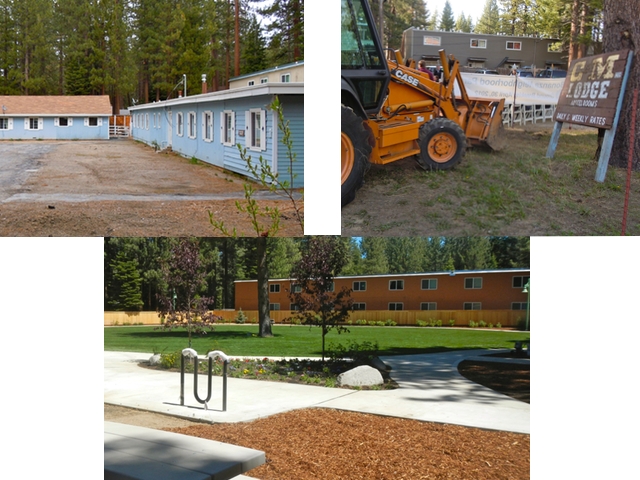
In order for the Edgewood Lodge to have enough tourist accommodation units the company bought an old hotel in South Lake Tahoe. A stipulation was for Edgewood Companies to turn the property into a park. Photos/LTN

In order for the Lodge at Edgewood to have enough tourist accommodation units the company bought an old hotel in South Lake Tahoe. A stipulation was for Edgewood Companies to turn the property into a park. Photos/LTN

By Kathryn Reed

A 30-year-old policy that is unique to Lake Tahoe is proving its ineffectiveness by having a pronounced detrimental impact in the basin.

The Tahoe Regional Planning Agency created a policy where commercial floor area (CFA) and tourist accommodation units (TAUs) have a value unto themselves. The purpose was to curtail development. It worked. Some might say a little too well because it also curbed redevelopment that might bring environmental and economic gains.

With hotel units essentially having a price tag, it means a lodging property owner wants more for the parcel than the appraised value. Perspective buyers aren’t likely going to pay that added cost. That leaves many dilapidated hotels scattered about the basin, but mostly in South Lake Tahoe. And with there being a limited number of TAUs allowed, it means places like Placer County that has so few hotels in the basin is scrambling to acquire them.

It would be up to the Governing Board to abolish this policy that stifles the free market, creates an inflated value for properties and doesn’t allow zoning to regulate development.

For now the bi-state regulatory agency is loosening the rules a bit by creating a three-year pilot program involving these commodities. The Regional Plan update that was adopted in December 2012 created bonus units based on certain criteria, mostly having to do with moving development out of sensitive areas like stream environmental zones and into town centers.

The pilot program has 80,000-square-feet of commercial floor area and 61 tourist bonus units. This means only a couple projects will likely come to fruition during the pilot. Interested parties have until March 28 to apply. The Governing Board will rank them and then decide who gets to participate in the pilot.

The program will be evaluated on an annual basis to assess its effectiveness.

“We plan to do quite a bit of monitoring to evaluate the program. We have a proposed monitoring plan that includes looking at how much SEZ is restored and how much coverage was reduced,” Jennifer Cannon, TRPA senior planner, told Lake Tahoe News. She said other criteria would also be used to assess the effectiveness of the pilot.

In 2008, the TRPA tried a different plan called the Community Enhancement Program to try to spur redevelopment. Nothing got built, though the Homewood Mountain Resort and Boulder Bay projects are still on the table. TRPA officials say the recession had a lot to do with the CEP’s not being effective. A difference with the pilot program is that there is an end date.

One of the agency’s strategic initiatives also involves looking at the commodities program to see if more substantive, long-term changes should be made.

Tom Lotshaw, spokesman for TRPA, said the initiative is designed to look at “what some of the strengths are and what some of the weaknesses are and how it can be improved so it protects the lake and facilitates the kind of redevelopment we need in our community.”

At today’s TRPA Advisory Planning Commission meeting a presentation will be made about what the findings have been from interviewing more than 50 stakeholders. The themes coming out of those discussions are: people don’t understand the system, the system needs reviewing, it doesn’t adequately support redevelopment, access to the commodities is constrained, and that it is impacting housing.

—–

Notes:

·      The APC meets Feb. 10 at 9:30am, 128 Market St., Stateline.