Studying the heart of El Niño

By Henry Fountain, New York Times

HONOLULU — A thousand miles south of Hawaii, the air at 45,000 feet above the equatorial Pacific was a shimmering gumbo of thick storm clouds and icy cirrus haze, all cooked up by the overheated waters below.

In a Gulfstream jet more accustomed to hunting hurricanes in the Atlantic, researchers with the National Oceanic and Atmospheric Administration were cruising this desolate stretch of tropical ocean where the northern and southern trade winds meet. It’s an area that becalmed sailors have long called the doldrums, but this year it is anything but quiet.

This is the heart of the strongest El Niño in a generation, one that is pumping moisture and energy into the atmosphere and, as a result, roiling weather worldwide.

The plane, with 11 people aboard including a journalist, made its way Friday on a long westward tack, steering clear of the worst of the disturbed air to the south. Every 10 minutes, on a countdown from Mike Holmes, one of two flight directors, technicians in the rear released an instrument package out through a narrow tube in the floor. Slowed by a small parachute, the devices, called dropsondes, fell toward the water, transmitting wind speed and direction, humidity and other atmospheric data back to the plane continuously on the way down.

Read the whole story


Loft-y endeavor a magical success in S. Tahoe

South Lake Tahoe friends Kelsey Adams, from left, Christina Wiseman and Christi Caden enjoy cocktails at The Loft. Photo Copyright 2016 Carolyn E. Wright

South Lake Tahoe friends Kelsey Adams, from left, Christina Wiseman and Christi Caden enjoy cocktails and conversation at The Loft.  Photo Copyright 2016 Carolyn E. Wright

By Kathryn Reed

Whatever your plans were for tonight, you need to change them. Go to The Loft. Drink, eat, see the show – do all three or any combination. It’s that good.

Owner Paul Reder has redefined what going out in South Lake Tahoe is all about. There is nothing else like it in town or even across the state line.

It’s part bar, part lounge, part restaurant, part show room.

Jim McGowan and Naomi Chianese of Napa enjoy a drink at the bar. Photo Copyright 2016 Carolyn E. Wright

Jim McGowan and Naomi Chianese of Napa enjoy a drink at the bar. Photo Copyright 2016 Carolyn E. Wright

Energy oozes from The Loft – it’s intoxicating without ever having taken a sip of alcohol. People are relaxed on the comfortable couches, enjoying one of the many specialty cocktails as an electronic beat vibrates through the room.

While the music is hard to miss, it’s not so pronounced that dinner conversation is a problem.

Steampunk, rustic, modern, industrial – all words people used to describe the South Shore’s newest venue. Red, black and wood dominate the décor.

Lighting doubles as artwork. Photo Copyright 2016 Carolyn E. Wright

Lighting doubles as artwork. Photo Copyright 2016 Carolyn E. Wright

It took about $1 million to transform the vacant area in the Heavenly Village into what has already become a destination for locals and tourists.

“It’s so different from any place in Tahoe,” Kelsey Adams said as she enjoyed drinks with two friends from South Lake Tahoe. This was her eighth time to The Loft – and it’s only been open since December. “It feels classy, but it’s very comfortable. You don’t feel like you are in South Lake Tahoe when you come here.”

“The ambiance is magnificent,” her friend Christina Wiseman added.

They were there for Lipstick Thursday. Wear lipstick – no matter your gender – and the discounts start adding up. Most days of the week there is a special that involves discounts on food and beverages.

A mix of seating choices makes The Loft inviting. Photo Copyright 2016 Carolyn E. Wright

A mix of seating choices makes The Loft inviting. Photo Copyright 2016 Carolyn E. Wright

Jim McGowan and Naomi Chianese came up from Napa to experience The Loft. Sitting at the bar the two enjoy a drink. They rave about the grilled cheese dippers on the appetizer menu.

The liquor bottles are backlit in a yellow-orange light that casts a glow onto the area that allows bartender Nicky Lipovsky to see what she is doing.

Chef Lisa Devincenzi-Miller, who owns Capice in Round Hill, has created a menu at The Loft that embraces her family’s roots that go back to northern Italy. The food is rich, with butter being a dominant ingredient. It’s served hot, seasoned perfectly and delivered with quality service not often found at Tahoe restaurants.

The ravioli sampler is a great start to a delicious dinner. Photo Copyright 2016 Carolyn E. Wright

The ravioli sampler is a great start to a delicious dinner. Photo Copyright 2016 Carolyn E. Wright

The menu is divided into Appetizers, Salad, Soup, Pasta, Risotto Bowls, and Kids. The ravioli sampler is worth splitting. It’s possible to get ones filled with cheese or sausage, then covered in butter and cheese, and/or marinara sauce. This sauce is better known as the chef’s prized gravy.

This gravy is what covered Bob’s lasagna.

“The pasta is perfect and that is hard to do. The chef knows what she is doing,” Bob said. Plus, he liked that it was not too cheesy and that there was plenty of meat.

The vegetable risotto is off-the-charts good, and definitely filling. Photo Copyright 2016 Carolyn E. Wright

The vegetable risotto is off-the-charts good, and definitely filling. Photo Copyright 2016 Carolyn E. Wright

This was one of the best risottos I’ve ever had. So often I’m left wondering where the vegetables are and if I just consumed a block of cheese. And while this was rich, there was also a lot to it. It would be easy to just order this and no starters and still be satisfied. A long grain is used, which is traditional for the region of Italy from which the chef hails.

The Bolognese came with the same spicy sausage that were in the ravioli, which Carolyn said was delicious.

Magician Joel Ward makes Ladonon's $100 bill disappear and then reappear. Photo Copyright 2016 Carolyn E. Wright

Magician Joel Ward makes Landon’s $100 bill disappear and then reappear. Photo Copyright 2016 Carolyn E. Wright

A little magic

Reder has been bringing Fusion magic shows to the South Shore since 2003. He and Tony Clark are the producers of Magic Fusion. Clark was the first to perform in the 107-seat showroom. Now a mix of magicians will dazzle patrons.

It was built specifically to showcase slight-of-hand magic. The only place like it is in Hollywood at Magic Castle.

Reder, though, also wants it to be a venue for artists to unplug – where he creates an intimate experience for performer and guest. On other nights disc jockeys might spin tunes after the magic is done for a little after hours fun.

Author James Van Praagh is booked for the summer to give a talk. The Kinsey Sicks will be in town in July. A local version of Ted Talks is also planned.

Kaitlyn's paper heart becomes a necklace at the hands of Joel Ward. Photo Copyright 2016 Carolyn E. Wright

Kaitlyn’s paper heart becomes a necklace at the hands of Joel Ward. Photo Copyright 2016 Carolyn E. Wright

On this particular night Joel Ward kept stunning the full house with trick after trick.

“When the magic is close, you feel more connected,” Ward tells Lake Tahoe News.

As a shy kid growing up in San Diego, magic was a way to interact with people. He kept practicing to the point it became a way to make a living.

To keep things fresh he is always trying new things so the material never gets stale. He admitted one of the bigger challenges to performing at Lake Tahoe is getting winded easily because of the elevation.

Magician Joel Ward is constantly entertaining the audience. Photo Copyright 2016 Carolyn E. Wright

Magician Joel Ward is constantly entertaining the audience. Photo Copyright 2016 Carolyn E. Wright

The show is thrilling for all ages.

Audience participation is huge for Ward. He brings down a slew of volunteers to the stage; all who return to their seats bewildered and perplexed by what just happened.

Ward starts by doing some old school magic with birds and ropes.

Then he does unfamiliar tricks, ones that are more complex, that seem to defy logic. One hundred dollar bills seemed to go up in smoke and then reappear; a paper heart became a pendant on a necklace.

Liz from Indian Lake, N.Y., cut a New York Times article at a spot of her choice. She was told to memorize the last word. A prediction by Ward had already been sealed in a container that was hovering above the walkway. But when the paper was pulled it wasn’t Liz’s word. Ward then unbuttoned his shirt to show WRONG written across his chest. That was Liz’s word.

Paul Reder is the brains and inspiration behind The Loft.  Photo Copyright 2016 Carolyn E. Wright

Paul Reder is the brains and inspiration behind The Loft. Photo Copyright 2016 Carolyn E. Wright

Carolyn from Zephyr Cove willingly gave her diamond-sapphire wedding ring to Ward. She signed a tennis ball like Ward asked her to do. To her it looked like any of the other balls she regularly plays with. It wasn’t long before the ring and ball went “missing”. Then Ward presented the signed ball to Carolyn to inspect. With a knife he slit it open and the ring was inside.

At one point Ward donned an astronaut suit – including helmet. He was doing card tricks. Somehow the card in question ended up inside the mask.

Heads shook. The audience was confused and amazed all at the same time. And it just kept going on all night. Ward left the patrons wondering what they just saw.

For those who don’t go see the Magic Fusion show, other magicians like Bobby Hall wander the restaurant and bar area performing card and coin tricks.

—–

Bobby Hall entertains Tristen Lowman, 8, and Kaly Lowman, 7, of San Antonio, Texas, before their dinner arrives. Photo Copyright 2016 Carolyn E. Wright

Bobby Hall entertains Tristen Lowman, 8, and Kaly Lowman, 7, of San Antonio, Texas, at their table before their dinner arrives.              Photo Copyright 2016 Carolyn E. Wright

Notes:

·      Open seven days a week from 4pm-2am.

·      Half price tickets are available to the Magic Fusion show for Lake Tahoe News readers. Details are online.

·      The Loft is located above the movie theater at Heavenly Village. It may be accessed from the third floor of the parking garage or on street level between the garage and movie theater.


Brown makes budget latest battleground on climate change

By Christine Mai-Duc, Los Angeles Times

Gov. Jerry Brown is looking to make good on a promise to curb California’s petroleum use by shifting away from new legislation and instead tucking his fuel-reduction goal inside the state budget.

Oil companies spent millions of dollars in 2015 to strip a controversial climate change bill of its provision slashing petroleum use in half by 2030. At the conclusion of that bruising fight, a defiant Brown stood before reporters in the Capitol and declared war.

The budget the governor submitted to the Legislature last month proposed spending a third of the state’s cap-and-trade funds, about $1 billion, on public transit, promoting electric vehicles and other programs, all with the explicit goal of cutting oil use by 50 percent by 2030. Those dollars were collected through the auction of pollution credits to companies that emit greenhouse gases.

Read the whole story


Presidential candidates rated for stances on gaming

By Megan Messerly, Las Vegas Sun

The American Gaming Association gave only two presidential candidates, former Secretary of State Hillary Clinton and retired neurosurgeon Ben Carson, a “green light” for their stances on gaming in its voter guide released last week.

Clinton received high marks for saying casinos spur economic development and praising Las Vegas gaming employees for their hard work — despite having opposed bringing casinos to Arkansas when she was the state’s first lady.

Carson was commended for saying that gaming issues should be left up to the states, his only apparent stance on gaming.

Read the whole story


Geological composition has Nev. on the move

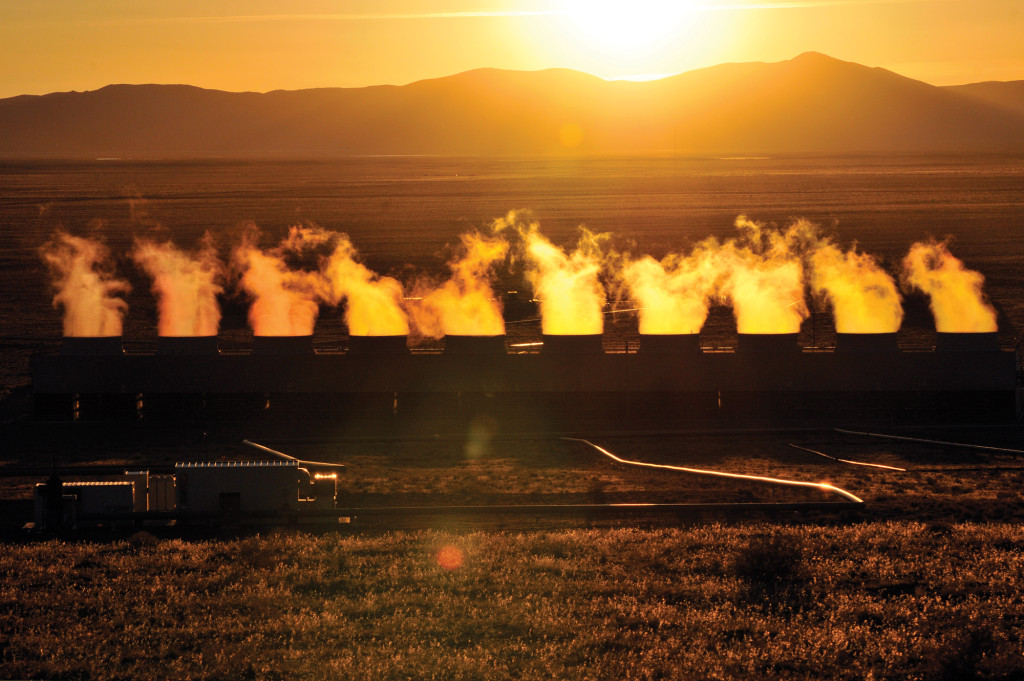
Blue Mountain geothermal taps Nevada's underground energy. Photo/Jack Hursh

Blue Mountain geothermal taps Nevada’s underground energy. Photo/Jack Hursh

By Linda Fine Conaboy

RENO – Nevada is the third most earthquake-prone state and is the fastest growing state, tectonically speaking, annually adding more area than the size of two basketball courts because of tectonic activity.

James Faulds, the state geologist for Nevada and director of the Nevada Bureaus of Mines and Geology at UNR, explained that Nevada has a greater number of mountain ranges, produces more gold, is volcanically active and has a vast supply of geothermal resources—more than any other state except for maybe Alaska.

According to Faulds, many of the state’s geothermal resources have yet to be discovered let alone mapped. This may explain, he said, why Nevada is always in hot water.

Earthquake faults, he said, allow hot water sitting deep in the earth to migrate to shallow levels, perhaps explaining why there are now close to 15 geothermal power plants in the state.

While their website states that Truckee Meadows Parks Foundation is in the business of transforming and maintaining the parks in Washoe County, the program they hosted in Reno last week went way beyond parks.

Three speakers covered all anyone needs to know about earthquakes, geothermal energy and volcanoes in Nevada. Though billed as a local event, all three speakers acknowledged that the Lake Tahoe Basin should be included in this mix, especially when the talk turns to earthquakes and volcanoes.

Although their intention was to inform and not to scare, many in the audience went away muttering about getting ahold of their agents pronto to chat about earthquake insurance. It was apparent that more than a handful were not aware that the Reno and Tahoe areas are seismically active and in fact, lie on some fairly large faults.

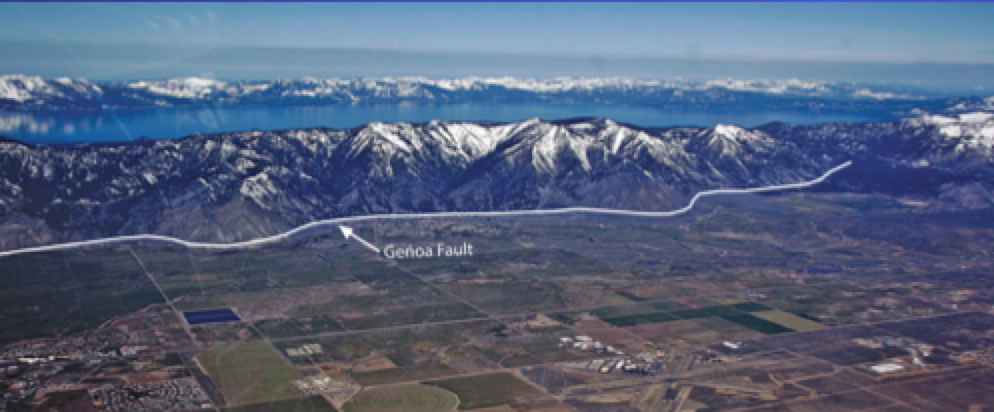
The Genoa fault is one of many near Lake Tahoe. Photo/Provided

The Genoa fault is one of many near Lake Tahoe. Photo/Provided

Geothermal energy is the only renewable energy that’s available 24/7, and the potential for large amounts of energy production in Nevada is eclipsed only by California’s generation rates, according to the Natural Resources Defense Council.

Annie Kell is the coordinator of education and outreach and a professor of seismology, among other duties, at UNR’s Mackay School of Earth Sciences and Engineering.

She said Reno averages at least six earthquakes of significant size about every 12 years.

“There are thousands of structures in Reno that would be damaged in an earthquake,” she said.

Generally, Kell said, anything built prior to 1974 is vulnerable. The average cost to upgrade the deficits in these buildings she estimates at less than $5,000.

Kell said there’s a significant fault in Incline Village, which about 500 years ago produced close to a magnitude 7 quake. She also mentioned the West Tahoe fault zone running from Meyers to Dollar Point and submerged from Emerald Bay to McKinney Bay. Another fault, she said, lies near Stateline Point laying below the Club Cal Neva, and the Genoa fault, one of the most active, could threaten the Reno-Carson urban corridor.

Most people have heard stories of a potential tsunami able to inflict huge amounts of destruction to the Lake Tahoe Basin—Kell doesn’t totally rule out the likelihood, nor does Faulds.

“A tsunami is definitely a possibility,” Faulds said. “Research shows that in the past there have been tsunami events at Lake Tahoe—probably within the last 10,000-12,000 years, which is fairly young in terms of scientific research.”

Kell strongly urged the audience to prepare now for the chance of some major earthquake damage to the entire region, saying earthquake insurance in this area of the country is definitely worth it.

She’s a proponent of being ready even though there is no evidence that an earthquake is imminent. “An emergency survival kit can be a lifesaver,” she said, suggesting it should include:

·      Food for three days

·      Pet food

·      Medical supplies

·      A power supply

·      Plan for evacuating the family

·      Securing tall and heavy items.

In case of an earthquake, Kell advised, you should always protect your head and neck. “Drop, cover and hold on,” she said. “Do not run outside, stand near windows, get on top of furniture, get out of bed, drive over bridges, light a flame or run to a doorway.”

She added that during an earthquake event, aftershocks are a real possibility.

While he’s a professional geologist, volcanoes are an area of expertise for Christopher Henry, a research geologist at the Nevada Bureau of Mines and Geology.

Henry suggested that geology doesn’t follow state boundaries, but he said good volcano sites that are not too far away and easily viewed are Lassen Peak, Sutter Buttes (on private property) and Long Valley, adjacent to Mammoth Mountain.

In addition, he said there are numerous volcano sites between Reno and Lake Tahoe, particularly north of Tahoe near Truckee. These include Mt. Disney, Squaw Peak, Martis Peak and Mt. Pluto. He added that at Dollar Point, if you look hard enough, you can find layered and ashy areas that might include volcanic bombs.

Going south, to Mammoth and Long Valley, there are huge volcanoes, what Henry called super volcanoes that created a caldera 20 miles across. He surmised this event happened about 760,000 years ago, leaving today’s Mammoth Mountain.

In the last 600,000 years, smaller eruptions have taken place and in their wake, various craters can be seen, one of which is Mono Crater. “There are all kinds of volcanic pieces to be found at the sites. But then, all rocks are pretty to me,” he grinned.

Despite what may be construed as continuous danger, scientists predict that the chance of a magnitude 7 quake under Lake Tahoe are slim—about 3 to 4 percent in the next 50 years, and actually posing less of a threat than the potential danger from forest fires or floods. However, all the experts advise to be prepared.


Former surgeon general calls for pot acceptance

By Peter Hecht, Sacramento Bee

Joycelyn Elders was never shy about speaking her mind as she consistently stirred public controversy while serving as surgeon general during her spirited – and short-lived – tenure with President Bill Clinton.

Now 82, Elders demurred just a bit when she was introduced Friday night at a reception at the International Cannabis Business Conference, a teeming marijuana politics and industry conference at the Hyatt Regency Hotel in San Francisco.

She built a reputation as a maverick on marijuana and other public health issues as she irked the Clinton Administration in publicly discussing legalizing drugs, and amid the depths of the AIDS crisis, considering marijuana as an effective medicinal relief.

On Saturday morning, Elders formally opened the weekend marijuana policy conference with a fiery condemnation of America’s drug enforcement policies.

Read the whole story


Ski industry vet embraces challenges in Utah

Bill Rock relishes his role of leading the largest ski resort in the United States. Photo/Provided

Bill Rock relishes his role of leading the largest ski resort in the United States. Photo/Provided

Publisher’s note: This is one in a series of stories about Park City, Utah.

By Kathryn Reed

Bill Rock is getting used to being the new guy, only this time it’s on a larger stage and in a much more public capacity.

He is the man Vail Resorts taps to be the leader when it acquires a significant property. In 2010 it was Northstar, and in 2014 Park City Mountain Resort and Canyons became his domain.

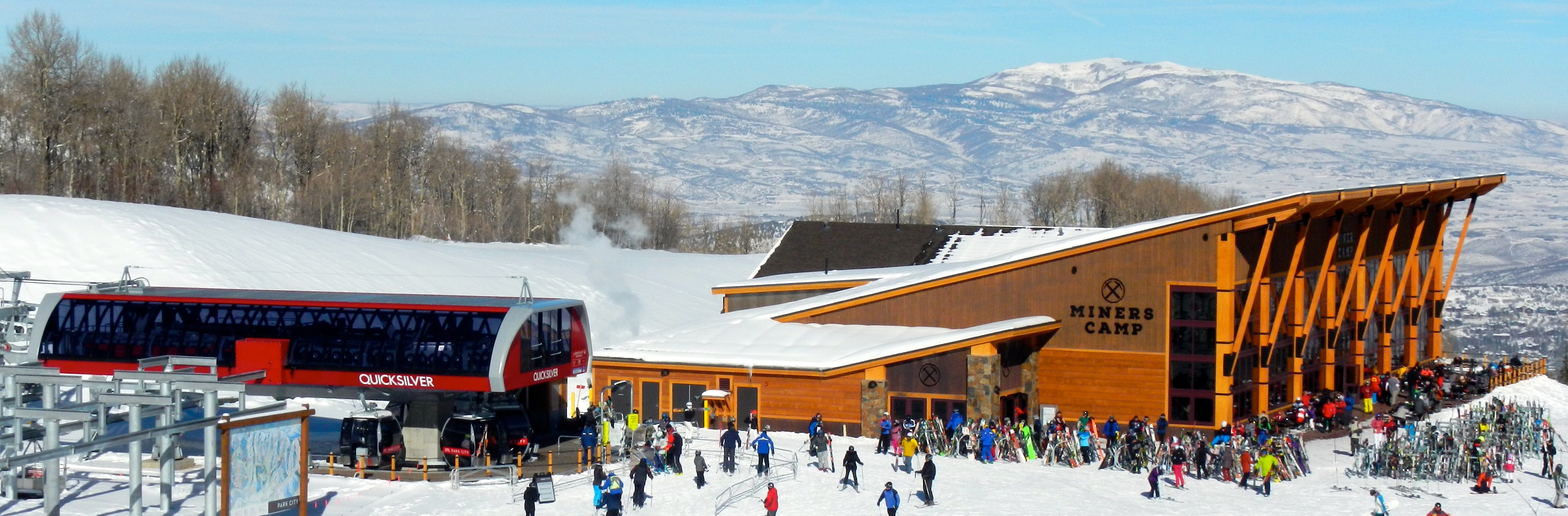
This, though, is the season where all eyes are on this Utah behemoth, which is now one resort known as Park City. With the Quicksilver gondola being launched in December, it links Park City with what was known as the Canyons. The Canyons was already part of the Broomfield, Colo.-based Vail Resorts’ portfolio before Park City was acquired.

At Northstar, Rock was overseeing a resort with 3,000 skiable acres. Park City has 7,300 acres.

The 47-year-old doesn’t like to talk about himself. But he’s a proven leader.

“Bill was instrumental in our integration of Northstar in 2010, including overseeing a $30 million capital program and building cultural and community engagement and alignment. He has an outstanding leadership track record and a deep understanding of how to elevate the guest experience in close collaboration with our employees that will benefit all of our stakeholders in the Park City community,” Rob Katz, CEO of Vail Resorts, said in a statement.

The gondola and mid-mountain lodge are new for the 2015-16 ski season. Photo/Kathryn Reed

The gondola and mid-mountain lodge are new for the 2015-16 ski season. Photo/Kathryn Reed

Rock has been in the ski industry for more than 20 years. Building relationships is one of his hallmarks – with the community the resort is in as well as with his staff. He is also a man who knows how to increase the bottom line.

His approach in Utah has been much the same as it has been other places.

“The No. 1 thing is information,” Rock told Lake Tahoe News. He made it a priority to let people know what was going to change and how. He said it’s the only way to build trust. “I spent a lot of time in the community and with employees explaining what the big plans are, painting a vision.

“With something as complicated as what we are trying to do, it takes time,” Rock said of convincing people Vail Resorts has the community’s best interest at heart.

Less than a handful of people were let go with the merging of the resorts. Not everyone has their same job; some were promoted to the corporate office.

One of the biggest differences between his job in Truckee when Vail took over Northstar from Booth Creek compared to Park City is the publicity. Northstar is a bit isolated and not an integral part of Truckee. While the acquisition made headlines with Vail expanding its footprint in California, having bought Heavenly Mountain Resort in 2002, it was not controversial.

Just the opposite was true with Vail buying Park City. Powdr Corp., Park City’s former owner, forgot to renew its lease. Vail swooped in. The courts got involved, but in the end Vail prevailed.

“Here, Park City is in the heart of the community. There is a passionate feeling about the resort. There was controversy leading up to us arriving,” Rock acknowledged. “The best thing is the community is rallying around our company, and the fact we are part of the community and being very public about that.”

In one year Vail pumped $50 million into its Utah property, created the country’s largest ski area and took control of one of the nation’s premier ski hills.

He’s not afraid of Vail Resorts homogenizing the ski industry with its improvements. Tamarack (Heavenly), Zephyr (Northstar) and Miners Camp (Park City) are all the same design.

“Even though it’s the same shell they present differently at each site. The building is just one aspect of the overall experience. What differentiates the resorts is the overall experience,” Rock said. He doesn’t anticipate half naked women dancing at his mid-mountain lodge for après ski fun like there is on the South Shore.

Plus, the menus – other than the Epic Burger – are also different. Still, Rock said he wouldn’t be surprised if the lodge design is used other places. Then it’s up to each resort to embrace it to be their own. He’s doing that in ways that go beyond one building.

“It feels like the first year of a brand new resort and no one in our generation in the ski industry gets to do that anymore,” Rock said of Park City. “I’m trying to seize the moment and enjoy it.”


An epic ski experience at Park City

Park City is now the country's largest ski resort. Photo/Kathryn Reed

Park City is now the country’s largest ski resort. Photo/Kathryn Reed

Publisher’s note: This is one in a series of stories about Park City, Utah.

By Susan Wood

PARK CITY, Utah – It’s a new PC world where “The Greatest Snow on Earth” meets the largest ski company in the United States.

Vail Resorts, which owns Northstar, Heavenly and Kirkwood mountain resorts, expanded its reach and portfolio by opening Park City with the advertising tagline: “There is only one.” The marketing reference signifies the Broomfield, Colo.-based ski company’s purchase of the Park City Mountain Resort in 2014 for $182.5 million upon Powdr Corp.’s miscalculation and coerced selling of the Wasatch Mountain flagship ski area next door to Vail’s formerly-named Canyons resort.

What was Powdr Corp.’s misfortune may turn out to represent a fortune for Vail.

Orange Bubble Express is a unique experience the cover. Photo/Kathryn Reed

Orange Bubble Express is a unique experience with the cover. Photo/Kathryn Reed

Vail being Vail – the ski company didn’t waste any time investing in the combined Park City-Canyons resort. A little less than half of Vail’s $50 million commitment went into the eight-person Quicksilver gondola at mid-mountain that combines the two ski areas. The linking lift, which opened in December, provides skiers with 300 trails served by 41 lifts on 7,300 skiable acres. The connection makes Park City the largest resort in the United States.

Take it from this reporter who through the years has spent five weeks skiing Utah – this is massive, exciting and full of potential.

Park City and Canyons have historically been different worlds. Now Vail has the best of both. Park City has runs like Widowmaker, which a skier and boarder can eye from the extremely convenient town lift, and Jupiter Bowl with Volkswagen-sized moguls that can humble an experienced skier. A few decades ago, tourists flocked to Park City because it was the “in” thing and the groomers had their way on powder days. The Canyons ski area has been known as Wolf Mountain and Park City West – where a relatively inexpensive ski experience awaited. If one wanted untouched powder on many runs, this is where you graced the slopes.

Then came a 180-degree turn. The atmosphere evolved under Vail’s wing when Canyons was bought in 2013. In a few years, Canyons became the swank skier experience, with a mini upscale village anchored by Grand Summit timeshare units at the base.

Aspects of Park City's mining history is scattered about the mountain. Photo/Kathryn Reed

Aspects of Park City’s mining history is scattered about the mountain. Photo/Kathryn Reed

While Canyons has catered to snow bunnies and Sundance types in recent years, Park City Mountain Resort managed to keep its just-here-to-ski-and-bask-in-Olympic-glory feel. The giant slalom and snowboard halfpipe events were staged there during the 2002 Salt Lake City Winter Olympics.

Now Vail hopes to extend its touch to the Park City side after Powdr Corp. forgot to renew its bargain-basement 20-year lease at $150,000 annually with Talisker Land Holdings, the Canadian corporation that owns the land upon which Park City operates. To illustrate the small world of the ski industry, Talisker bought the old Canyons resort from the New England-based American Skiing Company and brought on Powdr Corp. to manage it. ASC once owned Heavenly before its stock was delisted from the New York Stock Exchange.

The high finance, chess-type negotiations have some die-hard Park City old-time skiers either whole-heartedly enthusiastic or cautiously optimistic about the infrastructure possibilities and transformation.

Jim Hadden – a 44-year Park City resident – remains in a wait-and-see mode.

Miners Camp design is a replica of the lodges at Heavenly and Northstar in California. Photo/Kathryn Reed

Miners Camp’s design is a replica of the lodges at Heavenly and Northstar in California. Photo/Kathryn Reed

“I didn’t want Vail to come in (at first). I wanted to leave the mountain the way it was,” Hadden told Lake Tahoe News while riding the Crescent Express chairlift. The lift offers access to some sweeping views from the Wasatch looking toward town and on a weekday, wide-open black runs.

Now retired, Hadden showed up straight out of college as an authentic ski bum. He fondly remembers the days when “really good skiers” would cover the mountain.

“Now I’ve noticed more beginners with Epic,” Hadden said of Vail’s multi-resort pass. “The ski schools should be full,” mocking the inability of those who now ski at Park City.

He’s open to having more runs and lifts with Vail’s reputation of investing in its ski areas. But like old-timers in other ski areas, he’s concerned Park City will lose its unique character. What’s more, he’s adamant about not paying for parking.

To that, Chief Operating Officer Bill Rock – who ran Tahoe’s Northstar before being tapped by Vail corporate for this large assignment – told Lake Tahoe News no plans are in place to expand paid parking beyond its two paid lots at the Sundial resort at Canyons and the underground lot in Park City. Most of Vail’s resorts have some sort of exclusive paid parking for those who opt into it.

Hadden is not alone in the parking demand.

“They better keep it free,” Josh Salberg of Salt Lake City, who has been coming to the Canyons side for 20 years, said while buckling up his board at the top of the Saddleback Express chairlift. The high-speed quad is tucked away behind the front ridge and represents a best-kept secret on the Canyons side with the ever-lasting long Snow Dancer run off the high ground.

The mid-mountain gondola links Park City to what was Canyons. Photo/Kathryn Reed

The mid-mountain gondola links Park City to what was Canyons. Photo/Kathryn Reed

There are other best-kept secrets. Salberg takes the Cabriolet lift from the Canyons side lower parking lot to the mountain base. The unique, stand-up, flatbed lift is open at the top, offering 360-degree views.

To accommodate a perceived influx of skiers and boarders at the combined resort, Rock pointed to the efficient Park City transit system that with Vail encourages “people to not get in their vehicles, to park and take the shuttle from the (Salt Lake City) airport.”

“One thing as a local that bothers me with Vail is they’ve taken away the local discounts,” Salberg said. He used to enjoy getting free buddy tickets with a pass.

“Now they’re half off, which isn’t bad,” he said.

He also has a 5-year-old child and therefore wants Vail to bring back the kids’ ski free program.

To that, Rock told LTN that the Epic pass combining both resorts represents “a huge deal” with no need to now buy two passes at Park City and Canyons. Also in Utah, there’s a kindergarten-to-fifth-grade pass that provides five days of free skiing, one lesson and rental equipment.

“I love that they combined the mountain and upgraded,” Salberg said. But in the same breath, he admitted the jury is still out on how good Vail taking over the dual resort is if it means everything goes upscale, prices go up, tourists rule and many of the ski area workers he knows can’t afford to live in Park City.

The old Canyons side is much more developed than the Park City base. Photo/Kathryn Reed

The old Canyons side is much more developed than the Park City base. Photo/Kathryn Reed

The Cairns family from Australia offered a different perspective from the top of Tombstone Express. The high-speed six-pack offers an ideal middle ground for skiers and boarders wanting a connection between the steeps at Super Condor Express where an extreme rider may walk up Murdock Peak and the blue-run land near the new gondola.

Lisa Cairns said she likes being able to have family members use the Epic pass since Vail just bought the Perisher resort, which is within driving distance from their home in the Blue Mountains. And the Cairns feel at home in Park City. Father Hayden used to be a ski instructor at Deer Valley, and with that, 17-year-old Zac declared he was born in PC and agreed with mom that he likes “the Vail influence” despite initial reluctance.

“That means we can ski the Australian winter,” the family matriarch said of the opposite seasons from the States to the land Down Under. It’s summer there now.

“I can’t believe how many Australians are here,” she said.

Within minutes of the clan skiing off, another Aussie family skied by.

Jeff Throm of New Orleans got out of the Orange Bubble Express lift on the Canyons side ecstatic about the possibilities of where to go, insisting he had just scratched the surface one recent sunny Park City morning. The Orange Bubble high-speed quad comes equipped with an orange cover that shields riders from the elements.

“I like that they combined the resort, but I’d like to see more lifts for more connections,” he said.

Chairlifts cost a lot of money and can turn even the most tucked away ski area into a hot spot where overpriced food and lodging as well as paid parking may bring in more out-of-towners, but can scare away those who call the region home.

And once again, there lies the delicate balance between appeasing locals and increasing visitation.
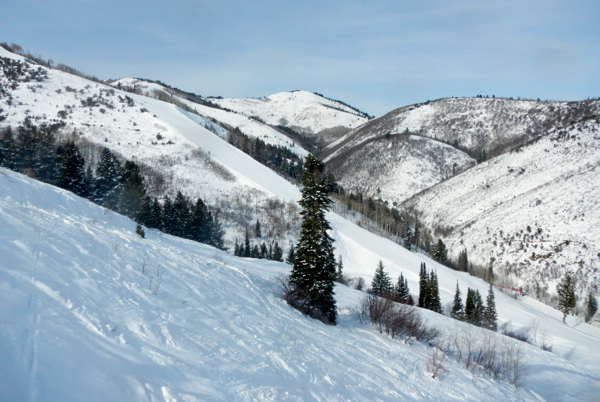
With the vast amount terrain, it would be hard to ski everything at Park City in one day. Photo/Kathryn Reed

With the vast amount terrain, it would be hard to ski everything at Park City in one day. Photo/Kathryn Reed

Ski areas are like people

How does a ski industry corporation raise or raze a resort that adapts to its ideals while embracing its unique fingerprint and footprint?

That appears to be the challenge. A Tahoe resident need only look at Vail’s Kirkwood and Heavenly to see the genuine differences.

A skier or boarder might ponder this as they visit Vail day-use lodges. Take Northstar’s Zephyr Lodge and Heavenly’s Tamarack Lodge. Both look strikingly similar to Park City’s brand-new Miners Camp. Miners Camp replaced a funky ski hut amid old mining shafts and aspen trees that dot the resort. Plus, the PC food offerings are vast with unique items such as vegetarian Moroccan stew and three-cheese potatoes, but one can still get a $7 beer there. Despite the homogenous architecture, Vail embraced the lodge’s past by mounting miner axes on the wall at the bar.

While Canyons has grown up on the newer side of the Park City region, the PC old-town side has the feel of an old ski town. Many of the historic landmarks exist, and the ski area has embraced the history with a tour designed to share it.

“I always like to learn,” skier and retired college Professor Jeanne Pankanin said while on the historic tour with guide Chic Carlucci. She enjoyed hearing about the history of the Olympics at the top of the Eagle lift where the giant slalom race was staged.

At the top of McConkey’s Express, the snow is as light as a feather and the bowls as treacherous as the waves at Mavericks. The tour group peered down on Soldier’s Hollow, the setting for the Games’ cross country ski events.

For the most part, Carlucci provided a wealth of background information on the history of Park City mining. More than 1,200 miles of tunnels with up to 1,700-foot drops connected to 70 mines represented a $450 million industry sparked in the 1800s. The resort has even maintained its ore bins for historic reasons, Carlucci said. In some cases, workers have had to prop up dilapidated buildings.

One 1,300 tunnel built to transport water was constructed so well a miner “could see the end of it,” Carlucci declared.

“They built the railroad in four months on just human labor. Normally that would take three years,” the New York guide said at the top of the Crescent chairlift.

Many who ski and board the Wasatch ski area seem hopeful Vail will make infrastructure improvements — especially when it comes to putting in connecting runs and lifts. Some who worked there have already seen the potential. At the top of the Bonanza Express six-pack, one can ski the long ridgetop Jonesy’s run and forget about the everyday working world.

Even Heavenly’s former COO, Blaise Carrig, – who ran Vail mountain resort operations before retiring – has a run named after him. Blaise’s Way runs adjacent to the new gondola at the mid-point stop, smack dab between the old Park City resort and the Canyons side, the ski area Carrig ran before he worked for Vail.

“It looks like the only way,” one skier said of Blaise’s Run, before heading down to the lower mountain from the gondola.

Perhaps the only way for Vail Resorts is progression and innovation. The challenge at Park City may involve harnessing that new growth and creativity without forgetting the ski area’s colorful past.


More rain, less snow for U.S. winters

By Brian Kahn, Climate Central

For most states in the U.S., winters without snow would be like a Super Bowl performance without Beyonce, Donald Trump without a combover or an overseas flight without a passport.

And yet that’s exactly what’s been happening. As the world warms, it’s changing the essence of winter. It’s not that less precipitation is falling (though that is happening in some areas). It’s that less winter precipitation is falling as snow, according to a new Climate Central analysis.

Not all winter precipitation is created equal. Less winter precipitation falling as snow is bad news for water supplies and wildfires out West and the financial fate of ski resorts across the country.

Read the whole story


Flu cases expected to increase

By Soumya Karlamangla, Los Angeles Times

More Californians are falling sick with the flu this month, but the season looks to be far less dangerous than those of past years.

As of the first week of February, 11 Californians under the age of 65 had died from the flu since the season began in October. At this time last year, there had been 25 flu deaths, and two years ago, there were 202.

Health officials say that could be because this year’s flu season may peak this month, while the last three seasons peaked in December. February is the most common peak for the flu season, which can continue all the way through May.

Read the whole story