SLT’s top cop blasts Calif. marijuana initiative

By Kathryn Reed

Control, Regulate and Tax Adult Use of Marijuana Act is a misnomer, according to South Lake Tahoe Police Chief Brian Uhler.

He believes proponents of this ballot measure came up with the name as a way to mislead people. Uhler contends the initiative does the opposite of what the title says.

It will likely be before California voters in November.

Uhler spoke March 1 to the South Lake Tahoe Drug Coalition about the proposed legislation. He had nothing positive to say about it.

It will allow anyone to grow marijuana at their residence without oversight from local government officials. Today, South Lake Tahoe has an ordinance allowing indoor grows, but they must be permitted which entails having the electrical and other safety issues be monitored. The act would negate the local regulations.

South Lake Tahoe Police Chief Brian Uhler on March 1 speaks about a marijuana initiative he wants defeated. Photo/LTN

South Lake Tahoe Police Chief Brian Uhler on March 1 speaks about a marijuana initiative he wants defeated. Photo/LTN

The act would also allow felons to get a marijuana business license. The proposal does not add dollars to the state’s general fund.

Proponents say the act will “legalize marijuana for those over 21 years old, protect children, and establish laws to regulate marijuana cultivation, distribution, sale and use, and will protect Californians and the environment from potential dangers. It establishes the Bureau of Marijuana Control within the Department of Consumer Affairs to regulate and license the marijuana industry.”

Uhler’s contention is that children will not be protected because marijuana businesses will be allowed near schools as long as they are at least 600 feet away. He also believes the language regarding advertising is a joke.

The initiative says, “Any advertising or marketing placed in broadcast, cable, radio, print and digital communications shall only be displayed where at least 71.6 percent of the audience is reasonably expected to be 21 years of age or older, as determined by reliable, up-to-date audience composition data.”

Uhler’s belief is that definition means plenty of children will still be hearing and seeing adds for marijuana, even possibly on billboards because more adults are on the roads than kids.

The new level of bureaucracy the act will create is where the bulk of the money will go. For 10 years $10 million will go to a public university to research and evaluate the effects of the act, for five years $10 million will go to the Governor’s Office of Business and Economic Development, $2 million annually is earmarked for UC San Diego for medicinal cannabis research, and $3 million for five years will be allocated to the California Highway Patrol to establish and adopt protocols to determine whether a person is driving while impaired.

A CHP officer at Tuesday’s meeting said the agency already has such a program and questions whether the money will actually be forthcoming.

If any money is left, it will be divided among youth education-prevention, environmental restoration, and local law enforcement.

Uhler stressed there is no money in the act for additional law enforcement officers on the street.

The UC San Francisco Center of Tobacco Control Research and Education said the act “is written primarily to create a new business and only include minimal protections for the pubic that are unlikely to prevent public health harms caused by the burgeoning marijuana industry.”

Members of the local drug coalition expressed a desire to educate the public about what the act really does, which the police chief stressed is the opposite of what the name implies.


Burning Man, Pershing County lawsuit settled

By Jenny Kane, Reno Gazette-Journal

While Burning Man and Pershing County officials settled a lawsuit over First Amendment rights and money three years ago, the matter finally and officially has been settled in a federal appellate court.

In the decision released by the Ninth Circuit Court of Appeals on Wednesday, Chief Judge Sidney Thomas struck down the previous 2014 ruling of District Court Judge Robert Jones, whom Thomas chastised for rejecting the parties’ settlement in the first place.

Jones called the settlement “illegal, unenforceable and absurd” at the time. He erred because the court’s jurisdiction had expired and because Jones ignored “the parties’ clear intentions to resolve the matter,” Thomas wrote in the decision.

Read the whole story


Critics: Consolidation of Nev. higher ed system a power grab

By Ian Whitaker, Las Vegas Sun

Late last year higher education officials controversially voted to merge campus police at two Reno colleges with the UNR police department.

Then, last month, administrators proposed centralizing the Nevada System of Higher Education’s registration system. At that same meeting, the Board of Regents reaffirmed their vision for a strong, single system to oversee higher education in Nevada.

Now, system officials are considering whether the UNLV police department should take over enforcement duties for the College of Southern Nevada and Nevada State College.

Read the whole story


Invasive species aren’t always unwanted

By Erica Goode, New York Times

Invasive species are bad news, or so goes the conventional wisdom, encouraged by persistent warnings from biologists about the dangers of foreign animals and plants moving into new territories.

Conservation organizations bill alien species as the foremost threat to native wildlife. Cities rip out exotic trees and shrubs in favor of indigenous varieties. And governments spend millions on efforts to head off or eradicate biological invaders.

“I think the dominant paradigm in the field is still a ‘when in doubt, kill them’ sort of attitude,” said Dov Sax, an associate professor of ecology and evolutionary biology at Brown University.

But a growing number of scientists are challenging this view, arguing that not all invasive species are destructive; some, they contend, are even beneficial. The assumption that what hails from elsewhere is inherently bad, these researchers say, rests more on xenophobia than on science.

Read the whole story


Harrison Ave. tenant, building changes coming

Property ownership change means tenants are moving on Harrison Avenue in South Lake Tahoe. Photo/LTN

Property ownership change means tenants on Harrison Avenue in South Lake Tahoe must move. Photo/LTN

By Kathryn Reed

Harrison Avenue in South Lake Tahoe is about to be transformed again.

This time it will be the building that houses South Tahoe Stand Up Paddle and Rude Brothers Bagels. Locals John Cefalu and Mike McKeen closed escrow on the property last month and are in the process of renovating the building.

Renovation also means displacing the tenants.

“Because of the requirements the city has and building codes we are going to have to go through with some extensive demolition,” Cefalu told Lake Tahoe News. Plus, the building will need sprinklers put in.

All of this work can’t be done while tenants are in the building.

Rude Brothers got the news last week and has until the end of the month to move out. The paddleboard company is moving to the back of the building on a month-to-month lease that is valid through the summer season.

Lisa and Jim Gosh have owned the bagel shop for more than a dozen years, while the business has been in that location for more than 20. (Steve Rude started the business.)

“Right now Jim and Lisa are looking for a new location,” shop manager Andrea Reber told Lake Tahoe News. “We need a lot of room.”

She said with all of the equipment it will be hard to find the right place. Large mixers are in the back for making the bagels every day, even the cream cheese is made on location.

Chris Brackett, owner of the SUP shop, had hoped to purchase the property, but he said he lost the bidding war.

Bob Koser was Brackett’s original landlord. He passed away in November 2014. They had known each other since Brackett was a kid. For six years he managed the property for Koser.

Koser left the building to Small Victories Ministries in Illinois with the idea the organization would have sustained income through the rents, Brackett said. That clearly didn’t happen. The group instead sold the property to the highest bidder – the Cefalu-McKeen partnership.

“We will make it work. We will just have to,” Brackett said of working out of the smaller space in the back and not having a street front location. Long-term, though, he is considering all of his options.

Cefalu said he isn’t sure if the current tenants would be asked back. It depends on what the exact designs are. Dave Goldman has been hired as the architect.

The building is so old is must go through the historic site review as mandated by the Tahoe Regional Planning Agency.

Cefalu described it as more like blight than historic. He remembers the front of the building being here when he came to the lake in 1957. The back was added on since then.

The apartment on the second floor has been demolished.

“I did verify that a demolition permit has been issued but it is only for interior demo work. We do not have any submittals that indicate how the space will be reconditioned or what it will be. We also do not have any applications for exterior changes,” Hilary Roverud, deputy director of development services with the city, told Lake Tahoe News.

Cefalu said the goal is to begin the substantive work on April 1 and be done by Aug. 1.

“We hope it will be an amenity and improve the appearance of the whole area with what I’ve done and what we intend to do,” Cefalu said. “There is still a lot more work to be done with other properties. I hope it becomes contagious with the other properties nearby that need improvement.”

Cefalu owns the Globin Building with the laundry facilities out front. McKeen owns the building occupied by Pinnacle realty.


Residents or tourists: Who are Nevada’s medical marijuana laws really intended for?

By Chris Kudialis, Las Vegas Sun

Reclining leather seats, a 42-inch television screen and stencils of bright red marijuana leaves illuminate the back of 420 Tours’ sport utility vehicle. The SUV, along with a 30-foot bus, are used by Nevada’s first cannabis tour company, which takes people looking for a medical marijuana card and legal pot from street corner to dispensary in less than an hour.

Using the app EaseMD, 420 Tours founder Drew Gennuso connects pre-screened passengers who have a California ID or U.S. passport with a California doctor, live over video chat, in the back seat of the “Cannabus” SUV. The patients, frequently picked up on the Strip, describe their symptoms, receive a doctor’s recommendation printed on the spot and are taken to a Las Vegas dispensary of their choice.


Nearly three years after landmark legislation legalized medical marijuana dispensaries in Nevada, patients and licensed business owners remain trapped in a grueling application process that keeps legal pot unattainable to many in the state.

And while Nevada patients and retailers stumble through the state’s red tape, entrepreneurs are cashing in on Nevada’s reciprocity laws, which allow out-of-state patients to play here by their own states’ more lenient rules.

Read the whole story


SLT parade discussion becomes circus event

By Kathryn Reed

While the discussion was about a parade policy, the spectacle was more like a middle school play yard filled with prepubescent teens squabbling over something so inane that no rational adult would understand the significance of the banter.

And, yet, the people doing the bickering were the five elected members of the South Lake Tahoe City Council and the city manager, with the city attorney seeming to be the reluctant referee.

South Lake Tahoe City Councilwoman JoAnn Conner asked for the parade policy to be on the agenda. She organizes parades through her business Golden Bear Events.

In the city’s 50-year history, there has never been the need for a parade policy. No one, according to city staff, has wanted such a policy except for Conner. Staff said no one has complained that there isn’t one, nor has anyone filed any sort of grievance about how things have been handled, nor have they required clarification regarding the permit that must be obtained to put on a parade.

A handful of parades go through the city each year – the homecoming parade for South Tahoe High School, Slow Rollers bike parade, Conner has put on a Fourth of July parade since 2012 and she does one for Christmas Cheer, and there are random other ones such as the Olympic celebration and Jaycee Lee Dugard’s return.

Conner has wanted city resources – like police and fire – to be in her parade, as well as officers to provide an escort.

Police Chief Brian Uhler explained that several factors are considered when deciding if a police escort is required. The size of the parade is one, as is the route, time of day, day of week and other criteria. He said the limited number of vehicles Conner had last July 4 did not warrant an escort.

City Manager Nancy Kerry, when not being interrupted, tried to explain that no city resources could be in a parade organized by a city council member.

Conner vehemently and repeatedly insisted she makes no money from the parades, but instead produces them as a fundraiser either for veterans or Christmas Cheer. She claims the Fair Political Practices Commission has ruled there is no conflict because there is no financial benefit to her. She said the letter is in her file. The city told Lake Tahoe News it does not keep files on council members.

While Conner’s bank account may not have a positive cash flow from the parades, she is collecting money from participants. She is then able to write a check from her business to the designated charities; the tax write-off would be a benefit. She can also curry political favor such as votes by putting on these parades with city resources. That is the rub, and the type of conflict that the FPPC has not weighed in on. She also has her business name on all promotional material.

It is highly unusual for an elected official to even be participating in a discussion about the business they are in when it is an agenda item. For example, Councilman Tom Davis recuses himself on a regular basis regarding vacation rentals because of his stake in Tahoe Keys Resort.

Councilman Hal Cole took issue with the year then-Councilwomen Brooke Laine and Angela Swanson were not invited to be in the Fourth of July parade. Conner blamed it on the veterans not wanting them. Davis said he spoke with board members of the American Legion and they had no idea what Conner was talking about.

At the end of the meeting March 1, the motion was made to adopt the policy as presented and for the city to put on a Fourth of July parade. This passed with a 4-1 vote; Conner in the minority.

She nearly went ballistic when Davis proposed the idea of the city putting on the parade. But it was his idea long before she started putting on her parade. Those two went at it verbally.

Conner was adamant the action was all about taking work away from a local business. Cole reminded Conner that she said she doesn’t make money off the events, and therefore said it wasn’t taking business away.

Conner said in a good year she makes $200 to $300 for the veterans. Cole and Davis said they would ensure the veterans are compensated, and would help them raise money.

Councilman Austin Sass said there is nothing stopping Conner or anyone else from putting on a parade in addition to the city’s.


Calif. on course for another drought year

The water level of Lake Tahoe is rising. The photo on the left was take Nov. 9,  2015, and the one on the right on March 1, 2016. Photos/LTN

Lake Tahoe is rising. The photo on the left was taken Nov. 9, 2015, and the one on the right on March 1, 2016. Photos/LTN

By Kathryn Reed

Even though the region is going into a wet cycle, that news isn’t enough to lift California out of its four-year drought.

While the snow survey at Phillips Station today was the best March reading since 2011, statewide the water content is below average.

At the field adjacent to the road leading to Sierra-at-Tahoe the snow depth on March 1 was 58.3 inches, water content 27.1 inches, which is 105 percent of the long-term average. Statewide the snowpack is 83 percent of average.

Frank Gehrke, who takes the measurements near the top of Echo Summit, said even though conditions are better than a year ago, what is on the ground is not enough for officials to say the state is out of danger.

Historically, half of the state’s annual water comes as rain or snow during December, January and February. The importance of this is that the Sierra snowpack provides the water downstream for about one-third of California.

It will take a “March miracle” like 1991 and 1995 to lift the state out of the drought. The forecast for now at least looks like this month will be wetter than February, but only time will tell if a miracle is brewing.

“We are looking to enter a very active pattern this weekend and into next week,” Tony Fuentes, meteorologist with the National Weather Service in Reno, told Lake Tahoe News.

It’s too soon to forecast what the moisture totals will be, but he said to expect rain at lake level to begin with and then snow. Snow levels will start at about 7,000 feet. The rain is expected to start Thursday night in the basin.

The moisture this winter has caused the lake to rise. The natural rim is at 6,223 feet. As of March 1, Lake Tahoe’s level was at 6,222.25 feet.

“That is a huge volume of water to make up that 1 foot,” Fuentes said.

On March 22, 2015, the lake was at 6,222.83 feet. When it fell below the rim in October 2014, this was the first time in five years. Other times it was below the rim were 1977-78, 1961-62 and 1930-36. The record low of 6,220.25 feet was set in 1992. (Records have been kept since 1900.)


Ski-town weed: Deterrent or draw?

By Trevor Hughes, USA Today

BRECKENRIDGE, Colo. — Chicago-based travel agent and mother-of-four Lynn Farrell represents a kind of worst-case scenario for Colorado’s ski towns and resorts.

“Who really wants to ski where everybody’s stoned?,” asks Farrell, president of Windy City Travel. “It is a concern.”

It’s the second full ski season since Colorado legalized recreational marijuana sales, and the cannabis culture — or at the very least, concerns about the cannabis culture — remains very much top of mind for many out-of-state visitors. Talk to East Coasters, particularly, and you hear worries about pot smokers lighting up in the lift lines or filling gondola cars with pungent smoke, an image at odds with Colorado’s carefully crafted and otherwise well-deserved image as a clean-living destination for families.

And while most Colorado residents would tell you very little has changed since marijuana sales began, the perception this is the Wild West of Weed persists.

Read the whole story


Sierra’s rental boss more than one of the guys

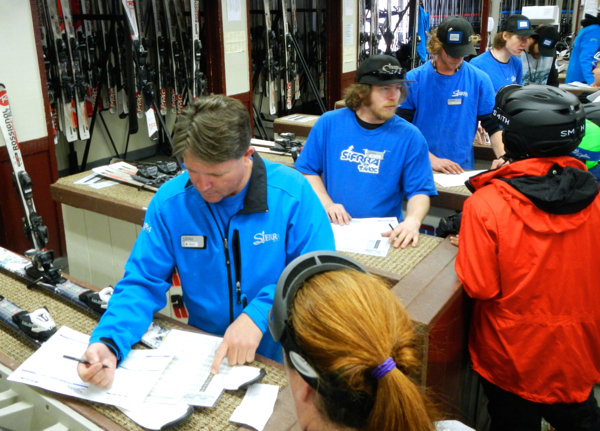
Mark Reeves, front, likes working along side his staff in the ski rental shop at Sierra-at-Tahoe. Photo/Kathryn Reed

Mark Reeves, front, likes working along side his staff in the ski rental shop at Sierra-at-Tahoe. Photo/Kathryn Reed

By Kathryn Reed

TWIN BRIDGES – Controlled chaos. That’s what the rental shop at Sierra-at-Tahoe looks like on a busy Saturday.

Workers stand out because of their royal blue shirt or jacket. They are surrounded by a sea of people trying on boots, having bindings worked on and getting sized for skis and poles. And while they are all eager to hit the slopes, there is a sense of calmness – no yelling, no whiny kids, no sense of distress.

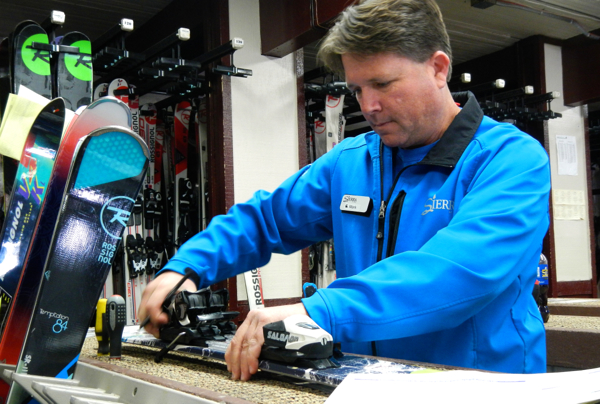
It’s hard to know Mark Reeves is the boss. He looks like one of the guys, maybe a tad older than the average worker. He’s sliding skis across the waxer, then snagging poles for people. Later he has a screwdriver in his hand as he adjusts bindings and then makes sure they release properly.

“My favorite part is still adjusting ski bindings because you get to talk to them. You are helping them to have fun,” Reeves told Lake Tahoe News as he took a quick break from the floor.

He has been working for Sierra since 1989 – always in the rental shop. Only now the 52-year-old is the boss. He oversees about 50 employees between the ski, snowboard and repair shops.

“It’s really important to the employees that you are working next to them and not just sitting in your office all day doing paperwork. That’s the last place I want to be,” Reeves said.

What has kept Reeves at the job all these years is that it isn’t a desk job, it’s physical. Much of the day is spent on his feet – sometimes 12 hours a day, six days a week. The interaction with customers is what is most fun, and meeting people from all over the world.

While some businesses in the basin say it’s hard to retain good employees, Reeves said that isn’t a problem at Sierra.

“It’s up to you to train and teach employees. If they don’t understand guest services, you have to train them,” Reeves said. “It’s more the culture of the company, than the pool of people.”

He also only had good things to say about his bosses.

Reeves’ only complaint is that he knows plenty of people who don’t work at a ski resort who get in more days on the mountain than he does.

Looking at the number of people lined up, this is going to be another non-ski day for Reeves.

And while it appears to be a jumbled mess, there is sense of organization to the process. It’s all about the flow, Reeves said. It’s also about keeping it cool in the rental shop because people are dressed for the outdoors. This little trick helps calm any potentially frayed nerves. The idea is to get people in and out as fast as possible, but the reality is that it takes time to rent boots, skis and poles, and then pay for them.

Mark Reeves is all about being a hand's on boss at Sierra-at-Tahoe. Photo/Kathryn Reed

Mark Reeves is all about being a hand’s on boss at Sierra-at-Tahoe. Photo/Kathryn Reed

It’s not just first-timers or newbies to the sport who are in the shop. Sierra has a program where skiers and snowboarders (snowboard rentals are in a different location) may rent basic, performance or demo gear for the season. It means not having to schlep equipment from home to the resort every day, and it allows people to try different skis.

This is one of the biggest changes Reeves has seen during his tenure. “Fewer people have their own equipment these days than in the past.”

There are all mountain skis, ones for carving and those designed for powder. Snowboards also have become specialized.

Demo and high performance skis turn over every year. The basic skis are replaced about every three years; it all depends on their use.

“They got destroyed last year. There were rocks everywhere,” Reeves said. The 2014-15 season was sketchy at best at most Tahoe area resorts, with Sierra having its earliest closing date on record.

“A lot of stuff ends up in the repair shop. We are constantly tuning and filling,” Reeves said.

It’s already time to figure out what the inventory will be for next ski season. Two weeks ago Reeves was at a trade show in Mammoth riding equipment. On March 3 he will be at a Reno trade show making the final decision about what gets purchased for the 2015-16 season. During the summer the manufacturers create the product.

Before the resort opens in late fall Reeves is getting the equipment ready.

“Every binding has to be tested. It takes up to two months to do that,” Reeves said of the 1,500 pairs of skis. The heel and toe are checked multiple times. (They are routinely tested during the season, too.)

While it’s all about having fun for the customers, for those working in the rental and repair shops at Sierra, safety comes first.