Push to raise Nev. minimum wage halted

By Megan Messerly, Las Vegas Sun

Amid the fervor of caucus season — the day that Democratic presidential candidates Hillary Clinton and Bernie Sanders visited union workers on a picket line outside of Sunrise Hospital, the day that they addressed Nevada issues at a town hall in front of a national audience on television, and two days before the Nevada Democratic caucuses — the minimum wage ballot initiative was quietly withdrawn.

The initiative, first put forward in November, would have gradually raised the minimum wage in Nevada to $13 an hour by 2024 from its current level, $8.25. The group backing the initiative, the Committee to Raise the Minimum Wage, would have needed to gather more than 55,000 signatures of registered voters by June 21 to get it on the ballot.

But a couple of weeks before the caucuses, the initiative’s supporters decided to withdraw the petition, said Laura Martin, associate director for the Progressive Leadership Alliance of Nevada, known as PLAN, one of the main advocates of the initiative.

Read the whole story


Voting rights group threatens Nevada with possible DMV lawsuit

By Sean Whaley, Las Vegas Review-Journal

CARSON CITY — Voting rights advocates said Monday they have sent a pre-litigation notice letter to Nevada officials, warning that the Nevada Department of Motor Vehicles is failing to meet its federally mandated voter registration obligations.

Attorneys representing Mi Familia Vota Education Fund and Nevada resident Eleanor Newell sent the letter to Nevada Secretary of State Barbara Cegavske and Terri L. Albertson, director of the DMV.

The attorneys are threatening litigation if the state does not comply with the law.

Read the whole story


Ritz building Tahoe beach house for guests

The Ritz-Carlton Lakeside is expected to be built this summer.

The Ritz-Carlton Lakeside is expected to be built this summer.

By Kathryn Reed

A private beach for Lake Tahoe Ritz-Carlton guests is close to becoming a reality.

The resort has secured the property in Tahoe Vista on which it plans to build a clubhouse of sorts this summer that would be available only for guests of the Truckee hotel.

“It is something we have been talking about for some time,” Giles Priestland, Ritz spokesman, told Lake Tahoe News. “It would be a wonderful way to have a direct connection to the lake for our guests.”

Kennedy Wilson, an international real estate investment and service firm, and its partners own the Lake Tahoe Ritz. It is KW-Northstar Ventures which has secured the Tahoe Regional Planning Agency permit and approvals from the Placer County.

KW owns what had been the Shore House bed and breakfast. That building will be demolished and a new 2,965-square-foot, two-story structure put in its place.

Paul Thompson with Placer County’s planning department said the design site approval has been issued. Now the applicant must apply for a building permit and have the improvement plans for the site approved. The latter pertains to the parking lot, landscaping and retaining wall.

A rendering of the beach house from Highway 28.

A rendering of the beach house from Highway 28.

According to TRPA, the project will help with water quality and will have improved scenic aspects. The new structure will be situated so the lake is visible when driving by on Highway 28. That is not the case with the current building.

The structure will have a changing area for guests, as well as a kitchen. It is being called a beach pavilion, with the name Ritz-Carlton Lakeside.

Only registered guests of the Ritz will be allowed to use it; not any of their friends staying elsewhere. When the bed and breakfast was in operation, the beach area was also limited to those guests.

The Ritz estimates between 20 and 30 percent of its guests go to the lake. That percentage is expected to increase to 40 with the beach house. It’s projected about 22 people on average will be there on any given summer day, with 31 people at peak periods.

While there will be parking on-site, the Ritz intends to provide a shuttle for guests and the handful of employees who will work there.

The nine tourist accommodation units and one residential unit will remain associated with the property. Any transfer of those would require TRPA approval.


Execs: Regulation could kill fantasy-sports innovation

By Richard N. Velotta, Las Vegas Review-Journal

The Governor’s Gaming Policy Committee is on course to recommend some form of regulation for daily fantasy sports wagering, but don’t count on the leading companies in the industry to line up for licensing.

Executives of Draft Kings and FanDuel, the two largest daily fantasy sports industry players, told the 12-member committee on Monday that regulation could kill the innovation the technology of daily fantasy sports brings to its millions of players.

The committee, comprised of gaming industry leaders, state legislators and former and present industry regulators, made it clear that the state wants fantasy sports to be a part of Nevada’s wagering offerings, but members also said they view it as gambling that must be regulated to protect consumers.

Gov. Brian Sandoval, who chaired the meeting, convened the committee to address daily fantasy sports, innovative gaming devices, skill-based games and other innovations in the rapidly evolving industry.

Read the whole story


Collection showcases Reagan-Laxalt friendship

Ronald Reagan materials found in the Paul Laxalt U.S. Senatorial Papers, housed in Special Collections & University Archives at the University of Nevada, Reno Libraries, showcase the friendship between the two politicians. “Paul Laxalt’s Reagan Years: Campaigns, Elections and the Road to the White House” is now open for use.

Ronald Reagan materials found in the Paul Laxalt U.S. Senatorial Papers, housed in Special Collections & University Archives at the UNR Library, showcase the friendship between the two politicians.

By Sandra Chereb, Las Vegas Review-Journal

CARSON CITY — Newly released mementos from revered native Nevada son Paul Laxalt offers a glimpse into presidential politics of a bygone era and the close bond the former governor and U.S. senator forged with former President Ronald Reagan.

A collection of letters, handwritten notes, photographs, audio/visual resources and scrapbooks were made available last week to the public through the University of Nevada, Reno’s Special Collections and Archives.

The collection, called “ ‘The First Friend’ of Ronald Reagan,” is an extraction of personal materials donated by Laxalt to the university. The snippets span the years from 1975 through 1987, a time when Laxalt, the son of an immigrant Basque sheepherder, was national chairman of Reagan’s 1976, 1980 and 1984 presidential campaigns.

Jacquelyn Sundstrand, special collections manuscript and archives librarian, said the materials are a time capsule into the politics and issues of the day.

Read the whole story


STR recyclables take a hit as oil prices drop

By Kathryn Reed

South Tahoe Refuse is stockpiling some of its recyclables in hopes the market changes so the value for them goes up.

Large bales of plastic are worth about $112, while a year ago they went for $230.

“The price we are receiving (for plastic) has significantly dropped – over 50 percent in the last year,” John Marchini with STR told Lake Tahoe News. “How it relates to oil is very specific to plastic. Instead of large companies using pellets from plastic bottles it is cheaper to use oil because crude is low.”

In other words, food products, including bottled water, are being packaged in plastic made without recycled material.

While many consumers are thrilled with the price of oil going down, when it does so it takes the value of plastics with it. After all, plastic is a byproduct of petroleum.

Recycling is a commodities business, and as such is subject to the whims of the market. It’s not just plastic that is fetching a low price, Marchini said it’s pretty much across the board.

“We absolutely hold on to the more valuable material and play the market. It’s similar to someone who plays the stock market,” Marchini said. Aluminum and PET plastic No. 1 are the most valuable.

He said when such fluctuations occur – and they are cyclical, though this is admittedly a huge downward swing – the recycling focus is adjusted. Something like film plastic, which includes the actual blue bag STR customers use for recycling, green-black bags for yard waste, and grocery store plastic bags, become less of a priority.

South Tahoe Refuse has an assembly line for its garbage, with workers plucking recyclables from the debris. When the blue bags are emptied onto conveyor belt all of those goods are recycled.

“The downturn in the economy in China is also affecting our recycling markets because they are the primary buyer for a lot of our materials. All of our junk mail, mixed paper goes to China,” Marchini said.

Less income from recycling inevitably affects STR’s bottom line.

“What happens with recycling revenues is that it all goes back into the operating budget to help eliminate or minimize rate increases,” Marchini said.

The largest recycler in California – rePlanet – had to close 191 recycling centers in the state, including in Placer County. In turn, nearly 300 people lost their jobs.

No jobs at STR have been lost because of the downturn. This is because the company has the same recycling goals to meet. California mandates refuse companies recycle 50 percent of the trash that is collected.

The state is upping that goal to 75 percent in 2020. STR is at about 64 percent diversion rate.

According to the Environmental Protection Agency, 34 percent of waste in the United States was recycled in 2013. This compares to 1990 when 19 percent was recycled.


Storms filling up waterways throughout Calif.

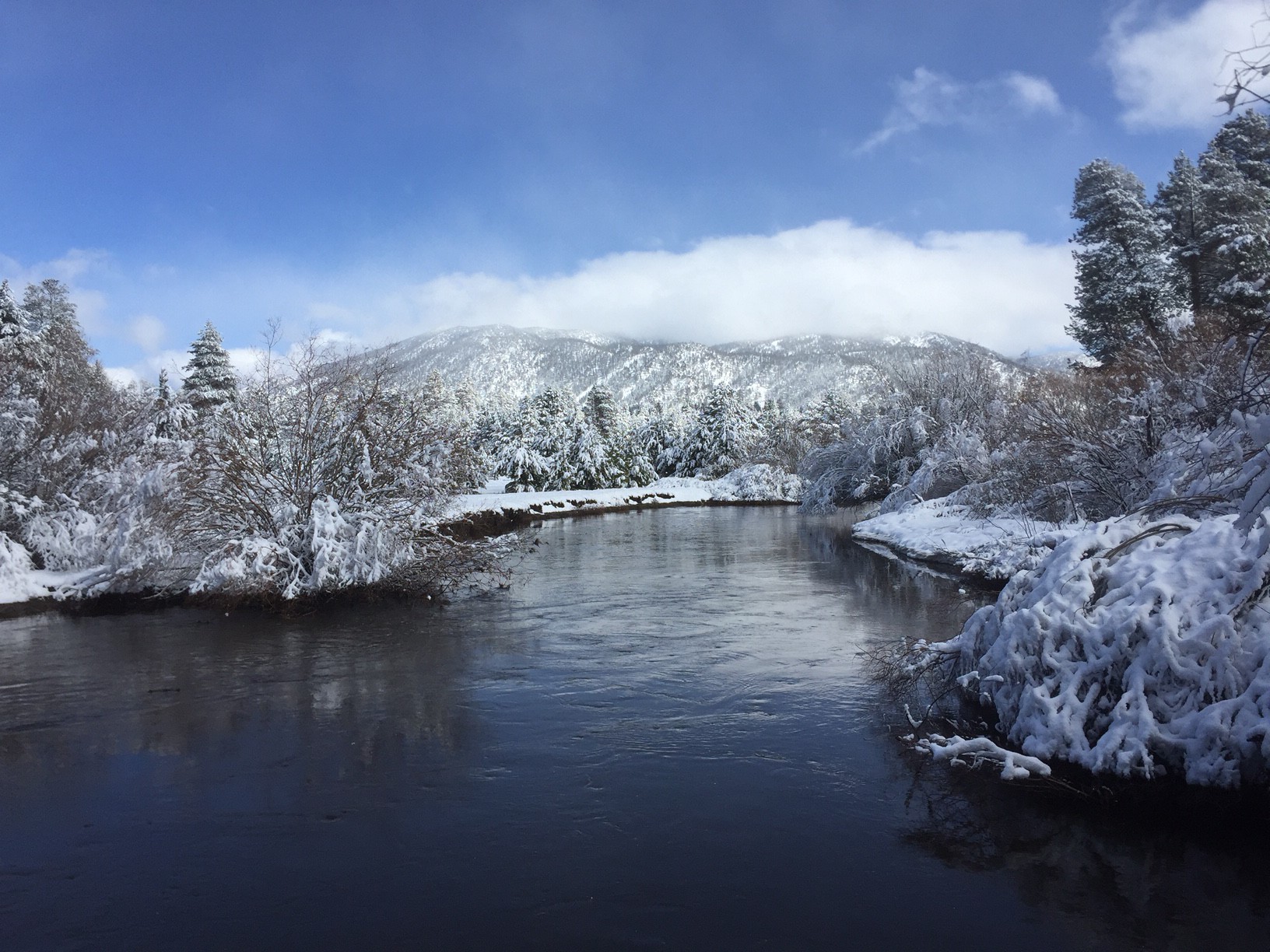
The Upper Truckee River on March 6 is higher than is has been in years. Photo/Kathryn Reed

The Upper Truckee River on March 6 is nearly full. Photo/Kathryn Reed

By Paul Rogers

This weekend’s soaking rains delivered just what drought-weary Northern California needed: billions of gallons of water pouring into the state’s major reservoirs — and more predicted for later this week.

With rain totals reaching 10 inches or more in some mountain areas, 46 of the largest reservoirs in California, closely tracked by the state Department of Water Resources, collectively added 391 billion gallons of water between Friday and Monday morning — enough for the needs of 6 million people for a year.

The reservoir list, which includes such massive lakes as Shasta, Oroville, Folsom, San Luis and New Melones, jumped in storage by 10 percent to 13.2 million acre-feet, as powerful storms pouring off the Pacific sent torrents of water surging down creeks, rivers and hillsides.

Even with that increase, however, the 46 reservoirs bumped up from 66 percent of their historic average on Friday to just 72 percent now. Like somebody with a badly overdrawn checking account, California’s lakes need a continued infusion to get back to normal.

Read the whole story


Waiting patiently — dogs find forever homes

Photos/Provided

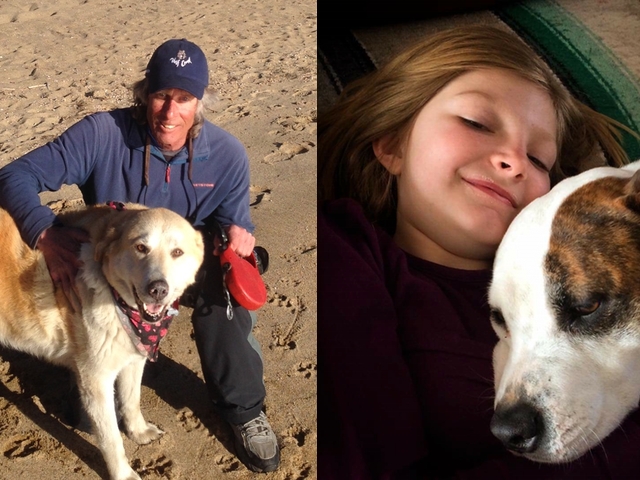
Aggy and Olivia have found new forever homes after their previous owner died. Photos/Provided

By Kyla Long

What started out as tragedy has turned into love and joy. You may have heard the story of the woman who tragically died in a fire on Kingsbury grade in the ponderosa Mobil home park.

On Nov. 16, Tahoe Tails and Trails agreed to care for her dogs who survived the fire, Aggy and Olivia. The girls were very sad and mourning the loss of their human. They were brought to us by Debbie and Ray Winters, who found them wandering on Kingsbury Grade. Aunt Debbie is what we would call her from then on. The Winters’ were really the dog’s saving grace. Debbie took them to get vaccinated and microchipped, Tahoe Tails and Trails groomed them and got them looking good.

At first, the girls were very sad and not really wanting to do anything other than sleep, so we let them.

We decided to let them open up to us when they were ready, and they sure did. Once they started opening up and loving us we had so much fun with them. They are hilarious, very playful, sloppy kissers, sweet girls with very waggy tails. I decided to let them stay with me at Tahoe Tails and Trails until they found their forever homes as there was no next of kin and no one to take over their care.

So they stayed with us and became part of our family at Tails and Trails. Daily forest walks, lots of love and attention, and slowly came out of their mourning and into living. Aunt Debbie and Uncle Ray came weekly, sometimes more to visit the girls, bring treats, food and take them for a walk. It was good for the girls to have them visit, they knew them in their previous life and I think it brought them comfort.

Olivia’s connection with me and Aunt Debbie was growing stronger by the day. We were concerned that she would struggle adapting to another new home. But through this experience, we have all learned with a little love, anything is possible.

Both Aggy and Olivia went on a couple overnight visits with potential forever families, but it was not the right fit, and they let me know. So we just kept being patient and reminding ourselves that the right person will come along, and so they did.

Adam Marshall contacted me with an interest in Olivia, but it was Aggy who fell in love with him. The connection was immediate and perfect. The way she looked at him was so sweet. Not wanting to separate the girls, we both had to take some time to think about separating them. I decided to take a chance and see how they would do without each other. My heart told me if they both had loving homes they would be OK, and I knew Adam and his family would be a great start for Aggy. So she went on an overnight to meet the family. The way she walked out of Tahoe Tails and Trails made my heart
melt. Head held high, tail up and wagging looking up at Adam with love and admiration. She was saying “let’s go Dad, I am ready!”

Aggy settled into her new home very quickly. She has kids to play with, a loving home with — all attention on her. I would say she is stoked! Aggy has a knee injury and needs ACL surgery. She has been doing very good for two years, but being only three she needs to get it repaired. Ironically, Adam has some knee issues himself and is willing to help her through the
recovery. He is such a patient person, with a huge heart. Adam is a dog lover and has been missing his companion for a long time. When his last dog passed it was very hard to replace him, but Aggy sparked a fire that had been put out for a long time. They both have a long story and have the rest of their lives to tell the next chapter together.

With Aggy happy in her new home, all focus was on Olivia. She was doing just fine at Tails and Trails because she had all her doggy friends, endless amounts of love and exercise. We knew it was going to take a special person for Olivia to open her heart, but she did.

About a week and a half after Aggy left, Ron Hallaway came into Olivia’s life, thanks to Lisa Pinto. Ron had lost his beloved Turbo at 15 years old and was waiting for the right dog. When Olivia and Ron met each other it was love at first sight ‐‐ just like Aggy and Adam. I had never seen Olivia take to anyone that quickly. She knew he was there to take her to a great home with her own beach. She proudly jumped into the back of his truck and looked at me with eyes of content. Lisa went to visit
that day and both she and Ron sent pictures of her on her new beach. She looked so happy.

Aunt Debbie and I went to visit a couple days later and much to our surprise, she had already attached herself to Ron and vice versa. Olivia is his new sidekick, skiing, biking, beach days, oh yeah, and as a carpenter she will be a great dog to keep him company on the job site. I am pretty sure Olivia knew Ron needed her, and he knew she needed him.

When I told Adam about Olivia’s new home, he was thrilled because he knows Ron. What a small world and so perfect that Adam and Ron know each other. Even though we could not keep them together, they will be able to see each other and have great new homes right here in Tahoe. They were both so patient in waiting for their new forever homes and honestly I could not think of a better situation for either of them.

All of us at Tahoe Tails and Trails are so happy we could help these wonderful dogs find homes. We are not a rescue organization, but we strive to help in situations like this. We have actually placed 11 dogs in the past 6½ years. I am very thankful for my amazing staff and support of the community.

Special thanks to the people that helped with Aggy and Olivia. Debbie and Ray Winters, Sandy Shields, Lisa Pinto, Linda, Susan Glascow, Carrie Turner and of course Adam Marshall and Ron Hallaway.

If you are interested in contributing to help with Aggy’s knee surgery, please contact me  at Tahoe Tails and Trails. I will be setting up a Go Fund me account on her behalf.

Love is powerful. If you open your heart, it will find you. Always choose rescue. There are so many wonderful dogs with similar stories.

Kyla Long is the owner of Tahoe Tails ad Trails in Stateline.


Burning Man a test for medical personnel

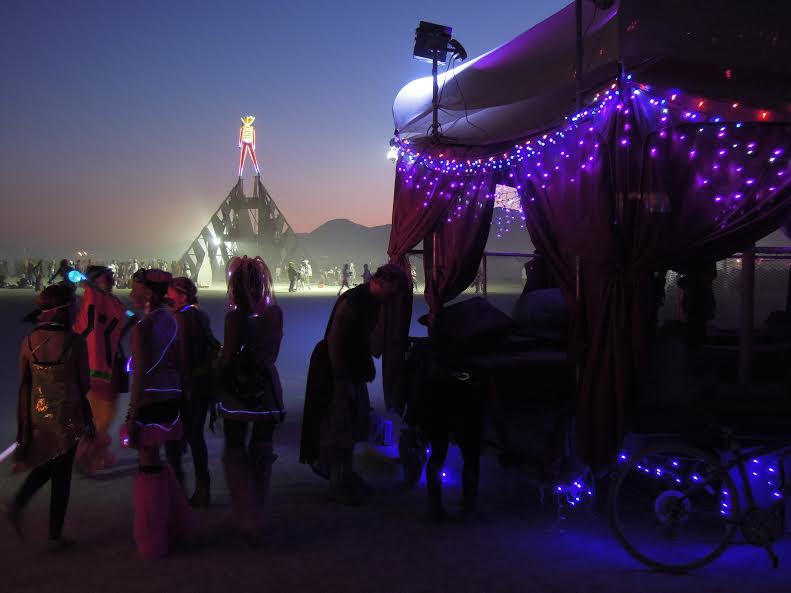
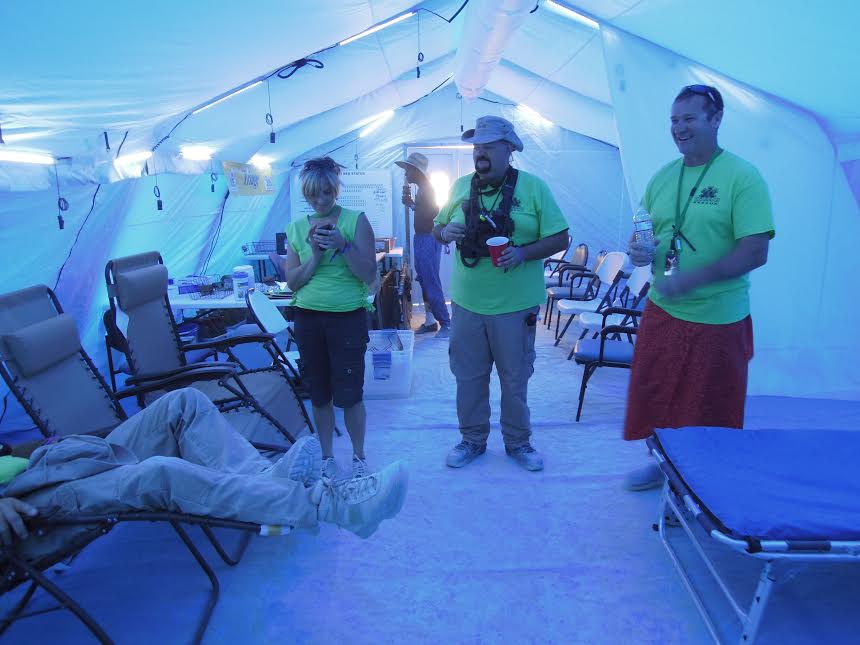
Medical staff at Burning Man contend with a variety of conditions. Photos/Gary Johnson

Medical staff at Burning Man contend with a variety of conditions. Photos/Gary Johnson

By Linda Fine Conaboy

RENO – Burning Man can be the best and the worst experience of your life — “you can die out there.”

Although Gary Johnson, an assistant professor and practicing doctor at UNR Medical School, said this with a bit of a tongue-in-cheek attitude, the doctor in him took over as he listed some of the maladies that have become familiar to the medical team he heads up.

Five years ago, the medical school asked him to become officially involved in Burning Man by providing care administered by UNR medical students; hence his nickname, G-Man or the Dusty Doctor. G-Man refers to his first name.

Even though all of the medical services are free, a trip in a helicopter provided by CareFlight can run as much as $25,000. In the hospital tent, seven doctors are on staff at all times, with nine ambulances at the ready. In 2010, they treated 4,700 people with a few of those triaged to outside medical facilities.

Some of the unique medical problems include what Johnson calls playa foot, a condition that can eat away the skin of the foot, caused by alkali dust. The remedy, he said, is easy and includes washing the feet in vinegar and water followed by lots of lotion.

Tents temporarily secured by metal rebar tend to fly away in the wind leaving the unforgiving rebar exposed. Because of this, many people each year are treated in the medical tents for wounds caused by tripping over it. It’s an easy problem to fix, Johnson said, recommending using tennis balls to cover and mark the exposed menace.

Drugs, especially ecstasy, are wildly available and can cause numerous problems. Burning Man may not be the best place for a first experience with LSD, he added.

The dust, although a vital part of the experience, must be reckoned with. You have to prepare for it, Johnson said, adding that asthmatics are particularly vulnerable in the dust. He recommends ski goggles, masks and even bandanas worn over the face.

Burning Man has become more regulated through the years.

Burning Man has become more regulated through the years.

In his humorous yet serious way, Johnson listed some basic survival tips including good hydration, lubrication and salinization. Wear your vinegar, he said, indicating the importance of the stuff. Stay off trampolines unless you’re 10; bring your own prescription drugs; avoid helicopters; and recreate within your comfort zone.

Surprisingly, despite the news stories that filter out of Burning Man each year, substance abuse-related accidents are much lower than expected—generally only about 2.5 percent of those treated.

With four satellite first aid stations, climate-controlled MASH tents, rehydration stations, X-ray, suturing and casting facilities, a limited formulary pharmacy, a basic lab and even a sanctuary where overwhelmed folks can come to talk out their problems, Johnson said Burning Man is now safer than ever.

For the newcomers, he has a few wise words: Don’t get overly ambitious with your camp; go with experienced people in an established camp for your first time out and perhaps most important, don’t stay too long.

Johnson discovered Burning Man by accident in 1992 when he and some of his Fernley High School friends decided to spend a few days camping on the playa outside of Gerlach.

“It sounded like some satanic thing in the dessert,” he laughed during his recent presentation at Mathewson-IGT Knowledge Center on the UNR campus. But satanic or not, he was intrigued enough to return the following year and said he was “totally welcome.”

Although the history of the massive event has been fairly well told, Johnson succinctly recapped its evolution, which began on Baker Beach in San Francisco in 1986, moved to Nevada in 1990, and each year becomes the state’s fourth or fifth largest city for a few days.

“It was a surreal experience then,” Johnson said. “There were no police. Those were the good old days. Burning Man is not the same as it was.” He said there was lots of sex, even more drugs and the area abounded with an ample supply of explosives.

The population on the playa doubled each year with, in Johnson’s words, weird tents and cars driving everywhere. “Thousands of people were going to the dessert. Lots of problems developed in the early days.”

Perhaps because of a freak accident in the early days—two people were run over in their tent—nowadays, the only motorized vehicles allowed to traverse the area are service vehicles or “substantially modified vehicles with interactive art,” and then, they can only drive 5 mph.

To make getting around in the huge, temporary city easier, a grid pattern was developed and street signs erected. Even with these precautions, Johnson said getting lost amid the dust and total nighttime darkness at Black Rock City is easy. For this reason he recommends carrying a GPS and a flashlight, especially at night.

The place is patrolled day and night by fire and police units. “They’re very serious out there now,” Johnson said. “Now it’s an organized city with an infrastructure and it’s become much more family friendly.”

In 2010, there were 600 registered art cars and 700 officially registered theme camps and villages. All individual camps are encouraged to be visually interesting and interactive; those offering food must be cleared by the health department, and if there’s liquor involved, camp hosts are required to card anyone partaking.

People are dressed up 24/7, although it’s considered tacky for a man to wear a shirt and no pants, he chuckled. Even though all food must be approved by the Pershing County Health Department, gifting is a good thing, he said.

The best part of Burning Man for Johnson is the art. “But the friendly, warm attitude of the people is overwhelming—it’s good. I enjoy the melting pot aspect with so many people from many different countries. It’s truly an international audience, especially among South Africans.”

After all the Burners are finally able to make their way out of the huge traffic jams created by the mass migration of campers heading home, the clean-up crew takes over, sweeping and cleaning the site meticulously. Because there are no trash cans, it’s important to take everything out.

Johnson said for him Burning Man gets better each year. “The early years were a little scary. I loved the freedom, but now, I like the organization.”



​Anticipating the next mega-quake

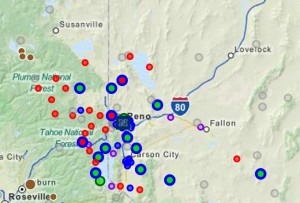
Seismic activity is normal throughout the Sierra. Map/UNR Seismology Lab

Seismic activity is normal throughout the Sierra. Map/UNR Seismology Lab

By CBS News

In March 2011 the world watched in awe and horror as a colossal tsunami ravaged eastern Japan — the result of a 9.0 magnitude earthquake.

Entire cities were washed away; millions were stranded without power or water; 15,000 died.

It was an otherworldy event that happened thousands of miles away. Thank goodness, many Americans thought, it couldn’t happen here. But it could happen here.

In fact, scientists say it’s a question of when — not if — a devastating earthquake, followed by a huge tsunami, strikes the continental United States, right in the Pacific Northwest.

“This would be like five or six Katrinas all at once, up and down from California to Canada, would be the closest thing I can think of,” said Chris Goldfinger, a paleo-seismologist at Oregon State University.

Read the whole story