Reliance on technology makes backcountry more dangerous

By J.R. Sullivan, Outside

In July 2013, 66-year-old Geraldine Largay was hiking in western Maine, nearing the end of a three-month, northbound solo journey on the Appalachian Trail. She’d logged more than 950 miles and traveled through ten states, sending regular texts to her husband, George, who was pacing her by car and meeting up with her from town to town with fresh supplies. On the morning of July 22, the two arranged via text to meet at a nearby trailhead the next day. George arrived on time and waited, but Largay never showed up.

George phoned authorities, and a search party combed the wilderness near Largay’s last known location on the trail, but found nothing. Then, last October, more than two years since Largay vanished, foresters surveying a U.S. Navy facility near Mount Redington found Largay’s remains and some of her belongings near a stream about two miles from the AT, not far from where she was last seen, the Morning Sentinel reported. According to the coroner’s report, released in January, Largay died inside her tent, zipped in her sleeping bag. The official cause of death: inanition—the effects of dehydration and starvation—from prolonged environmental exposure.

It’s unclear what exactly happened to Largay, but wilderness experts familiar with the AT point out that a potential factor in her death reflects a major problem among hikers: an over-reliance on technology to navigate and call for help in times of distress.

“One of the worst trends we’ve seen in the past 20 years is the proliferation of cell phones and technology in the backcountry,” says Tim Smith, a registered Master Maine Guide and the founder of the Jack Mountain Bushcraft School, which instructs students in brush living, guide skills, and long-term winter survival.

Read the whole story


Grassroots effort under way to change SLT

By Kathryn Reed

Creating a voice for the 80 percent in the middle, not the fringe on either side. That was the impetus to bring together a group of about 50 people on Tuesday. The discussion was all about how to make South Lake Tahoe better.

While Jamie and David Orr of Tahoe Mountain Lab facilitated the meeting, they didn’t take ownership of it per se. Their goal was to get people to discuss issues in a positive way that leads to action. It’s not that the group as a whole will do something – or it might. Talking about change and how to make it happen was the bulk of the discussion.

“This meeting is to build trust in the community,” David Orr said to the packed group at the American Legion on March 23.

Building trust started with listening and sharing.

It was a diverse group who came out, with most admitting they met new people that night, and learned a thing or two.

Jamie Orr, standing, listens as people discuss what they want for the future of the South Shore community. Photo/LTN

Jamie Orr, standing, listens as people discuss what they want for the future of the South Shore community. Photo/LTN

Everyone was asked to name one local issue they care about. The answers included: education, poverty, economic development/sustainability, recreation, affordable housing, divisiveness in the community, environment, strong community, homeless veterans, broadband Internet, pet welfare, climate change, clean energy, children, blight, the number of voters – or lack thereof, bear boxes, natural resources, higher education, and health care.

Seven smaller groups were formed – with the goal of people splitting up from friends – and they were to address two questions:

·       How can I as a person make an impact on the community?

·       How can this group make an impact on the community?

It was a collegial gathering, with some people leaving eager and inspired to bring about the change they envision, while others looked at things a bit more skeptically.

City Councilman Austin Sass told his group and the larger one it’s great people want the council to do X, Y and Z, but at most he receives three emails a week from people about an issue. So, while people might want change, they aren’t talking to the people who can help make it happen.

At the end of the night individually people were asked to either talk about what they heard that they like that was not their idea/concern or what they will commit to do going forward.

Answers included: people in El Dorado County want better ways to impact city issues, getting people to vote, create a publication for new residents, paying more attention, finding two people to run for City Council, getting friends involved, helping groups to collaborate — building trust and bridges, accountability, communication, political action, reach out to the City Council, and get Latinos involved.

The consensus was to meet again. Next time it will be a different organizer.

“It’s time to get to work,” Jamie Orr said as the meeting ended.


Timeshare hard sell comes roaring back

By Gretchen Morgenson, New York Times

For more than 25 years, Mary Ann Gutierrez, 77, has spent several weeks a year in South Lake Tahoe, often playing host to her children and grandchildren at one of two timeshare units she owns.

When she checked into one of the properties last year, she was stopped at the front desk. A $100 gift card would be hers if she attended a presentation by Diamond Resorts International, the company that owns the resort. But first she had to fill out some papers and supply her credit card information.

The gift card came with a cost, as Gutierrez soon learned. For five hours, she said, Diamond representatives pushed her to give up both of her timeshare deeds, including one at the nearby Tahoe Beach & Ski Club, a resort that Diamond does not own. With the upgrade and membership in Diamond’s ownership points system, they said, she would keep her maintenance costs low and could use her points at other resorts in the company’s network. It would cost just $30,000 upfront, they said.

Even when representatives suggested her maintenance fees would rise if she didn’t switch, Gutierrez kept declining, saying that the cost was too high. Undeterred, the Diamond representatives suggested that she ask her children to pay for the upgrade. She continued to say no and, at last, they let her go.

“They weren’t going to let me out that door,” Ms. Gutierrez said. “I was shaking, I was so nervous.”

The feeling turned to shock, however, when a Diamond representative handed her a record of a voided charge in the amount of $4,840 on her credit card. The representatives had been so certain that she would agree to the offer that they had charged her card for the down payment — even though she had not given approval.

Read the whole story


Spring break profitable for Tahoe vacation rentals

By Emily Starbuck Crone, NerdWallet

Move over, Marriott. Hotels were once the default lodging option for travelers, but in recent years, demand has boomed for vacation rentals in private homes. And travelers aren’t the only ones who stand to benefit from this trend; homeowners who rent out their house can turn a handsome profit, especially during peak times like spring break.

Just how much can homeowners pocket in popular areas? To find out, NerdWallet askedHomeAway, one of the largest facilitators of private for-rent properties, to provide data for its most in-demand U.S. spring break destinations, along with nightly rates during that time and year-round. A NerdWallet analysis found that in some spring break hot spots, homeowners can pay off between three and four months of their mortgage by simply renting out their home for two weeks in March — a common spring break period and one when many homeowners are quite possibly traveling themselves.

In many other top spring break destinations, homeowners can pay more than three months of homeownership costs from just two weeks of renting in March. After Breckenridge, the top spot is Miami, then Las Vegas, followed by South Lake Tahoe.

Read the whole story


Junior Giants taking a swing at SLT youth


Junior Giants is making its South Lake Tahoe debut this year. Photo/Provided

Junior Giants is making its South Lake Tahoe debut this year. Photo/Provided

By Jessie Marchesseau

This summer, South Lake Tahoe youth will have the opportunity to participate in a new, free, non-competitive baseball program.

The city has been chosen to host one of nearly a hundred Junior Giants baseball leagues across Northern California, Nevada and Oregon. The program, designed to provide a safe and positive outdoor activity for children, is fully funded by the Giants Community Fund with San Francisco Giants catcher Buster Posey serving as the program’s commissioner.

However, this is not your average baseball league. The Junior Giants program focuses just as much, if not more, on building character as it does on playing baseball.

There will be skills, drills and baseball fundamentals, but each week of the eight-week season will also have another theme, one focused on important life lessons. Players will learn about topics such as leadership, confidence, teamwork, bullying, reading and healthy lifestyles. They will complete take-home projects and have the opportunity to earn prizes and Giants swag. Families will even have opportunities to attend San Francisco Giants games at AT&T Park.

The Giants Community Fund ensures the program is free for each and every child by providing all the necessary equipment for the league, from pitching machines and bases, to gloves, hats and T-shirts. In addition, they provide books and materials for the weekly programs as well as prizes and incentives such as school supplies, backpacks, water bottles and Giants bobble heads.

There is more to the youth program than playing baseball. Photo/Provided

There is more to the youth program than playing baseball. Photo/Provided

The non-competitive aspect also makes Junior Giants different from most baseball leagues. Games will have no umpires, no score-keeping and no winners or losers. Every child will get to hit, everyone will get to field. The goal is to take the stress out of the game, creating a more positive and fun experience.

“The main thing is we want every kid to have the opportunity to play regardless of their income level or skill level,” Junior Giants coordinator Bailey West said.

West has been working closely with Lauren Thomaselli, recreation manager for the city and the South Lake Tahoe commissioner for the Junior Giants, in getting the program set up. South Lake Tahoe is one of only four communities chosen to join the program this year. West said the Junior Giants try to choose new communities where they find a strong parks and recreation partner, but also where they see a population of kids who wouldn’t otherwise have an opportunity to participate.

Practices will be once a week after 5:30pm and games will be on Saturdays. This schedule is designed to make it easier for working parents to shuttle their kids to and from events, and to participate themselves.

Since the program is so reliant on adult volunteers to coach, assist and act as team parents, West said they try to offer plenty of services and incentives to them as well. The Giants Community Fund provides free training, supplies and regional coaching clinics for adults willing to serve as coaches. There is even a day at AT&T Park where the San Francisco Giants honor the Junior Giants coaches.

Thomaselli estimates they will need 10 to 12 adult coaches willing to dedicate two to three hours per week to their teams. The number of kids is only limited by the number of coaches available.

“It is free, it is fun, it’s a great way to get your kids outdoors and surrounded by a positive message and learn the fun game of baseball,” Thomaselli said.

The program targets youth who may not otherwise have a chance to play baseball. Photo/Provided

The program targets youth who may not otherwise have a chance to play baseball. Photo/Provided

The Junior Giants is open to boys and girls ages 5-13 and will have both t-ball and baseball teams. The season will run from June 15 to Aug. 6, culminating in a season finale celebration with a family barbecue, baseball games and awards ceremony.

Players, coaches and volunteers may register online or in person at the following locations:

·       South Lake Tahoe Recreation & Swim Complex, 1180 Rufus Allen Blvd.
Until June 1, Monday-Saturday, 8am-6pm

·       Boys and Girls Club, 1100 Lyons Ave.
March 23 and April 6, 4-5:30pm

·       Boys and Girls Club, Bijou School, 3501 Spruce Ave.
March 31 and April 28, 4-5:30pm.


Nev. nonpartisan voters growing in importance

By Megan Messerly, Las Vegas Sun

Going into the Nevada caucuses, 49-year-old Catana Barnes wanted to help Vermont Sen. Bernie Sanders win the state.

But that’s not what happened.

The Sanders campaign and the state’s Democratic Party had spent weeks reminding nonpartisan voters, like Barnes, that they could register to vote as Democrats in order to participate in the state’s closed Democratic caucuses on Feb. 20. They could even show up on caucus day and register to vote.


In Nevada, one in five voters identifies as nonpartisan. With third-party voters added in, that number jumps to one in four Nevadans who do not identify with one of the major two political parties. They’re a critical segment of the voting population — they can be the make-or-break group in the general election — but due to the state’s closed caucus and closed primary systems, don’t participate in deciding who makes it to the November ballot.

Read the whole story


Hotel transformed from old Tahoe into new

The lobby is also known as the living room. Photo/Matt Bolt

The lobby is also known as the living room. Photo/Matt Bolt

By Kathryn Reed

Modern and minimalist intersect with high quality and relaxed at one of South Lake Tahoe’s newest motels.

The Green Lantern is now the Coachman Hotel.

Justin Watzka has taken what was a rundown hotel in the Stateline area that looked like it hadn’t been renovated since it opened in the 1960s and has turned it into a three-star hotel that is already attracting guests even though construction is not done.

Last weekend 15 rooms were rented. The grand opening is slated for June. To date 30 of the 42 rooms have been renovated. There are 15 layouts. Depending on the time of year, rooms are likely to run between $125 and $220 a night.

In the 1980s the Green Lantern and Royal Coachman became one hotel. Watzka in naming his venture kept some of that history. While the property has driveways on Pine Boulevard and Manzanita Avenue, Pine is the main entrance.

Rooms are the Coachman  Hotel come with king or queen beds. Photo/Matt Bol

Rooms at the Coachman Hotel come with king or queen beds. Photo/Matt Bolt

Watzka bought the 1.1 acres last April for $1.3 million. Since that time he infused “multiple millions” of dollars to transform the property.

“I want to do more projects in the future, so this has to last,” Watzka told Lake Tahoe News while on a tour of the site. He’s here for the long haul, not to just sell the hotel once it’s truly launched.

His background is in the lodging industry, having worked for Marriott Vacation Club for a number of years. He recently earned his MBA. In August, he moved to South Lake Tahoe full time.

Watzka has relied on his dad, Peter, for some expertise. The elder Watzka has spent his entire career in the hospitality business. Brother Garrett, who owns Duvin Design clothing company, has been tasked with creating apparel for the hotel to sell to guests.

The guest experience is what Watzka is focused on. He believes 20- to 50-year-olds from the Bay Area and Sacramento will be his market. It will be people who like to play outdoors. Heavenly Mountain Resort and Lakeside Beach are within walking distance. So are the Stateline casinos.

The lobby, which also is a bit like a living room where guests can relax in a variety of seating areas while enjoying a coffee, beer or wine, is where a garage used to be. Baristas use Stumptown coffee from Portland. Beers go for $5 – with Great Basin, Sierra Nevada, Kona and Stella available. The wines have not been selected yet, but Watzka wants them to come from innovative, young vintners.

Instead of a separate check-in area, it is combined with where people can purchase those hot and cold drinks.

The alder counter has been stained to look like it is walnut. Wood is a common theme throughout the property.

Adjacent to the lobby-living room is the breakfast area. A continental breakfast, including a waffle station, is complimentary.

Outside the shared space is a tiered seating area with large gas fire pits. On top of the lobby-living room is a roof deck that in nicer weather will have seating. The original pool will be overhauled and ready for summer. A new hot tub is already operational.

Concrete floors are throughout the property – even in the rooms. A rubber flooring is on top of this in the rooms, which is ideal for when people haul in their ski gear or sand from the beach.

Instead of closets, a bar is in the vanity area of the bathroom where clothes could be hung. There’s also a rack for skis that could double to hang wet jackets or swim suits.

The old hotel lobby, which had a manager’s unit behind it, is now a spacious three-bedroom family unit that can sleep 11.
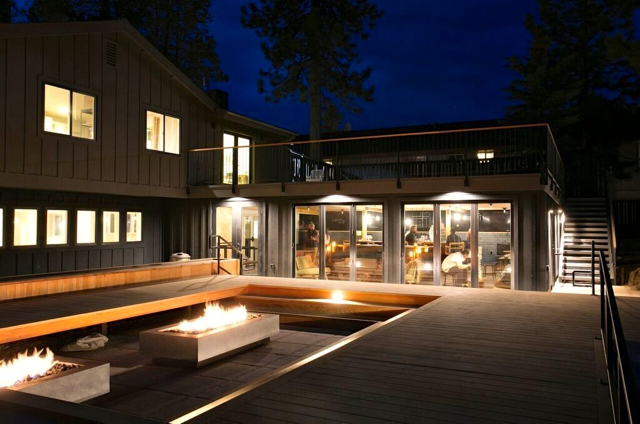
The fire pits are just outside the "living room" at the Coachman. Photo/Matt Bolt

The fire pits are just outside the “living room” at the Coachman. Photo/Matt Bolt

Sierra Sustainable Builders is the general contractor. Workers essentially took the innards down to the studs. New electrical is throughout, with plenty of outlets for people’s gadgets.

The bathrooms are small, but the showers are decent size. They are about the length of a bathtub – and there are no tubs. Shampoo, soap and conditioner are in bulk dispensers, which Watzka said allows for a higher quality product – Malin+Goetz – to be used.

A touch not often found even at high-end hotels is heated toilet seats.

That is all part of Watzka’s desires to not be ordinary, have little upgrades and still be affordable.

The rooms, some as small as 200-square-feet, are functional and cozy. Beds are either queens or kings. Apple TVs are in each room – another one of those upgrades Watzka wants to be known for.

“The guests’ comfort is No. 1,” Watzka said.



Nevada’s high-tech twist on adventure tourism

By Benjamin Spillman, Reno Gazette-Journal

As co-founder of the social media photo competition Reno InstaGrammys, Natalie Handler is used to toting a camera everywhere she goes.

But one of her latest projects was unusual: The camera wasn’t in her mobile phone; it was a 40-pound behemoth she hoisted onto her back. The 15-lens camera designed to capture 360-degree images was part of the Google Trekker project, which collects Google Street View-style images for places cars can’t drive.

Handler was hauling it through the International Car Forest art installation near Goldfield as part of a partnership between Google and the Nevada Division of Tourism. Travel Nevada, the colloquial name for the division, is scheduled to announce the launch of the Trekker program on Tuesday.

The mission was a chance for Handler to do more of what she loves, exploring the dusty corners of Nevada and sharing them with others. It was also a modern update in the efforts to promote adventure travel throughout Nevada.

The Nevada Division of Tourism will post online unique footage generated by the Trekker at the car forest and about 20 other destinations and distribute the content to a social media audience that’s been steadily building for the past three years.

Since summer of 2013, when the division launched the “A world within, a state apart,” campaign, the Travel Nevada Instagram account has grown from 362 to about 15,500 followers.

On Facebook in the past month, Travel Nevada has reached more than 1.7 million people in the United States alone – almost all of them in the attractive 18-34 demographic, and many in the key markets of Los Angeles, Phoenix, Sacramento, San Francisco and Salt Lake City.

Read the whole story


Summer is the new winter at ski resorts

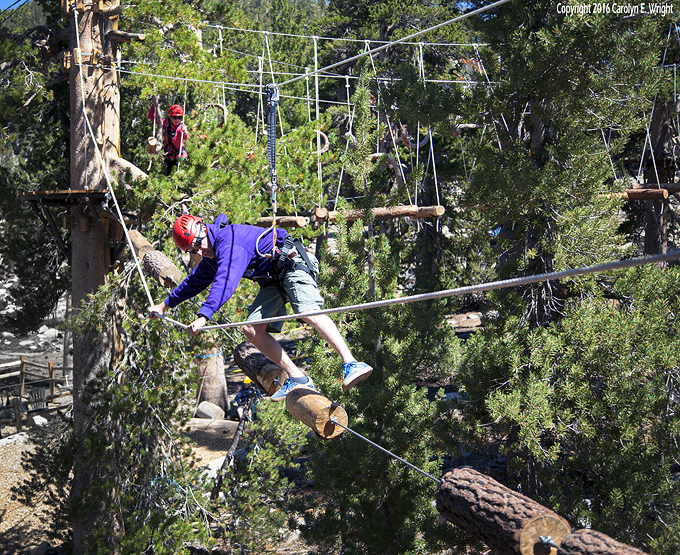
Heavenly will be expanding its summer specific activities this year. Photo Copyright 2016 Carolyn E. Wright

Heavenly will be expanding its summer specific activities this year. Photo Copyright 2016 Carolyn E. Wright

By Megan Michelson, Outdoor

With shrinking visitor numbers and low-snow seasons afflicting ski areas around the West, resort owners are realizing that attracting wintertime guests alone isn’t enough to survive.

The impetus for the change came in 2011, when President Obama signed a bill, sponsored by then Colorado Sen. Mark Udall, which amended a previous law from the 1980s that restricted ski areas on Forest Service land from offering any recreation besides skiing. The amendment, called the Ski Area Recreational Opportunity Enhancement Act, allowed resorts to provide summer activities like zip lines, mountain bike parks, Frisbee golf, and ropes courses, so long as they were in harmony with the natural environment. (Water slides, big roller coasters, and golf courses are still prohibited.)

A series of dismal winters followed, and resorts once known as snowy epicenters rapidly started changing their business plans. Squaw Valley has proposed building an indoor-outdoor recreation center, complete with climbing walls and ziplines, that would turn its winter village into a year-round destination.

Vail Ski Resort has operated at a loss during the summer months, according to its fiscal documents, but it has a new strategy to close that gap: this summer, it’s launching a program dubbed Epic Discovery that will boost summer offerings like ropes courses, an alpine coaster on elevated rails, and hiking trails with educational signage. The program will also debut at other Vail Resorts properties, including Heavenly Mountain Resort this summer and Breckenridge Ski Resort in 2017.

Read the whole story


LTVA ad campaign to focus on the water

By Kathryn Reed

Is it all that tap water? Or maybe being immersed in the lake – even if it’s only ankle deep? Perhaps just being near it? Whatever it is, people who come to Tahoe seem to be transformed into another being – someone more fun, adventurous and outdoorsy.

That’s the message behind the Lake Tahoe Visitors Authority’s new ad campaign called – There Must be Something in the Water.

While the final ads have not been devised, the concept is showing someone in their normal, every day work life, perhaps sitting in a cubicle and then seeing them playing in Tahoe. From ordinary and mundane to fun and vibrant – all because of the waters of Lake Tahoe.

“This doesn’t have any animation. It has outdoor scenery or indoor entertainment,” Carol Chaplin, LTVA executive director, told Lake Tahoe News. “It won’t have that fanciful imagery (of the last campaign). It is much more straightforward.”

Still, it is designed to be a bit humorous and quirky.

The board approved the concept last month, with the nearly $900,000 contract with Duncan/Channon of San Francisco OK’d this month.

Paddle boarding at Lake Tahoe will be featured in summer ads for the South Shore. Photo/LTN file

Paddle boarding at Lake Tahoe will be featured in summer ads for the South Shore. Photo/LTN file

Summer shots will include people paddle boarding, parasailing, biking and ziplining. Nightlife will also be included, and is something that can be used year-round. Skiing, a family playing in the snow, and potentially dog sledding will be used next winter.

This will be the second year the South Shore tourism bureau will focus on San Diego in addition to the traditional Bay Area-Sacramento market. One reason for San Diego is half those people tend to drive here and then they stay longer than those who can make it here in four hours or less.

Ads will run online where they can be targeted to people interested in Tahoe and what it has to offer, during select Giants and A’s baseball games on Comcast, radio and on billboards.

There had been criticism of the previous campaign that used animated characters and no actual pictures of Lake Tahoe. Some of the board members said it was time to change the visuals, the ad agency agreed and that’s how the There Must be Something in the Water campaign came about.

The LTVA is cognizant there may be concern using the tagline in light of the turmoil in Flint, Mich. Still, considering the purity of Tahoe’s water and this being a gambling destination, the powers that be are confident the message will resonate with potential visitors.

While LTVA tends to support events more than stage them, the agency is involved in some of the bigger undertakings. The fireworks will be back on Fourth of July and the Sunday of Labor Day weekend. A vendor is being sought now.

Promoters hope Amgen cyclists won't be able to have a snowball fight like they did in 2011, where snow canceled the local leg. Photo/Lisa J. Tolda

Promoters hope Amgen cyclists won’t be able to have a snowball fight like they did in 2011, when snow canceled the local leg. Photo/Lisa J. Tolda

A huge chunk of time of being devoted to the Amgen Tour of California bike race that features the women starting and ending the first leg at Heavenly’s California Lodge and the men ending stage 4 at the lodge. Both will be May 19. The women’s can be seen online and the men’s will be televised.

Much like the American Century Championship celebrity golf tournament in July, both cycling events will be opportunities to showcase the lake, especially with the women riding the 72 miles around it.

For viewers – in person or on a screen – it will also be a chance to see athletes who may be competing this summer in the Olympics.

The LTVA is also an integral part of the annual golf tournament at Edgewood Tahoe. Another seven-year contract was signed last year, so American Century and NBC are on board at least through 2022.

Something new this year that LTVA will be involved in is the restaurant week in September. Sample the Sierra, an event run by the Lake Tahoe South Shore Chamber of Commerce, is moving from Labor Day to mid-month and will now include a restaurant week.

While locally there has been a restaurant week in January to tie in with what California tourism officials do, it has not taken off. In large part this is because it’s already a busy time of year.

“We felt that putting it with Sample the Sierra, it might help both of those events and create some synergy,” Chaplin said.

A public relations campaign by Stateline’s Weidinger Public Relations will complement the ads in trying to get media to write about the area and the events. Their efforts have also been focused on a renaissance theme for the area – how the economy is improving and new venues are opening.