Minor league park a treat for baseball fans

The River Cats know how to entertain a crowd with baseball and gimmicks in between innings. Photo/Kathryn Reed

By Kathryn Reed

WEST SACRAMENTO – The crack of the bat, the roar of the crowd – those are the same at any ball field. It’s the antics between innings and the grass beyond right field that makes this park a little different.

While the game is the same, there is something special about a minor league stadium. It’s intimate, much like being at spring training.

The River Cats have been playing at Raley Field in West Sacramento since 2000. In 2015, they became the triple-A affiliate for the San Francisco Giants.

A fan in hopes of catching a foul ball. Photo/Kathryn Reed

Not a bad seat in the house. It’s all field level seating, with the second tier being the suites.

Plus, it’s much more affordable than going to a Big League game. It was comical seeing people with armloads of hot dogs. On Tuesdays they are only a buck, with 10 being the max one could buy.

On Wednesdays dogs are welcome in the grass area.

Based on the attire, most people were Giants fans. Still, many were there as fans of the sport – not necessarily the River Cats or visiting Aces from Reno, which is an Arizona Diamondbacks affiliate.

Food goes well beyond the ordinary hot dog. Photo/Kathryn Reed

The quality of ball is sporadic, but then the same could be said of the Giants at this stage of the season.

This is where those who are on the edge of making it to the show are honing their skills, while those whose glory days are in the rearview mirror are hanging on to a fading dream. As a Giants fan, it was great to see Hector Sanchez behind the plate. Mac Williamson, who was called up last season, is back in right field for the River Cats.

Opening night last week was my first time to visit to this ball park. I’ll be back.


Lahontan cutthroat trout rediscovered in Utah creek

Fisheries biologist Corene Luton measures a Lahontan cutthroat trout as it moves through the fish passage facility at Marble Bluff Dam, Nevada. Photo/Jeannie Stafford/U.S. Fish and Wildlife Service

By Lauren Bain, Nevada Today

The Lahontan cutthroat trout was rediscovered in a “dinky” stream near the Nevada-Utah border. Genetic testing by Associate Professor of Biology Mary Peacock led to the rediscovery of an iconic Nevada fish.

“Even though they were in that tiny, dinky stream on the edge of Utah for close to 100 years, they had maintained that capacity to grow into this big fish,” Peacock said. “People just went completely wild; it’s like the big boys are back.”

Peacock became involved with the research and recovery of the Lahontan cutthroat trout in the early 2000s. She began working on ways to perform genetic testing to determine if the small trout discovered in the Pilot Peak streams were the original species of the Truckee River watershed.

Read the whole story


Opinion: SLT needs to stop breaking the law

By Brooke Laine

I am providing the following information because I can no longer be a party to the violations of law, secrecy, manipulation, lies, and power struggles that are rampant at the city today.  

There appears to be a complete disregard on the part of politicians and appointed officials for state law, transparency, and honesty to the public. The interim city attorney has admitted to many that a recent contract she oversaw violated the Brown Act – think Mary Egan contract. To this day, that contract has never been addressed, corrected, or publicly acknowledged.

Brooke Laine

Multiple violations of law have occurred in closed session, often relating to discussions involving personal attacks on non-agenda issues. The interim city attorney and the politicians engaged in the violations refused to cease the unlawful discussions, even when asked to do so to avoid continuing the unlawful conduct.

In addition, the minutes of the March 20, 2018, meeting seriously misstated the facts by asserting an action occurred at a prior meeting, but the council never took that action. The law requires the city to tell the public the truth, follow the law explicitly, and provide accurate public records. This absolute failure at the very top is a violation of law, injures the public’s trust, and is currently crippling the city.

Secrecy has no place in local government. If one councilmember is not privy to the same information as other councilmembers, the question is “why?” If one, two, or worse, three councilmembers discussing information the others don’t have, not only is that also a violation of the Brown Act, it creates distrust. It results in decision-making taking place outside of the public’s view (another violation of law) and it literally has no place in our city. The only purpose of such secrecy is to shift the balance of power from the council as a whole to a few electeds and appointed staff. Worse yet, blindsiding some people through this type of manipulation, fuels the public’s distrust of process, transparency, and government in general.

Power struggles, when the struggle for power is not for the benefit of public policy, but rather for personal gain, are selfish, create hostility, and purposely keep many in the dark. The public is a witness to this, which creates confusion and increases distrust. Further, the media that buys into the incomplete and inaccurate information they are fed, unwittingly become tactical participants in this sport to gain personal power. Most important, the public’s business is not a priority. 

I care deeply about this community. I always endeavor to hold myself to strong ethical and moral standards, as I feel every elected official should. I respect and hold in high regard the law that dictates how we as local leaders are to govern. It is my belief that the only way to address these serious violations, which illustrates a fundamental and complete breakdown of legal process, is to bring this information to the attention of the community. I can no longer be a party to this unethical, hostile, distrustful environment that currently exists. I have opposed these tactics both publicly and privately, and tried to stand against the illegal and improper actions I have witnessed. However, this burden has become so heavy.

Today, I am choosing to shine light where it is necessary because I believe our community deserves better. Together, we can do better.

Brooke Laine is a South Lake Tahoe City Council member.


EDC taking its time to revamp VHR ordinance

Supervisors Mike Ranalli and Sue Novasel, standing, talk VHRs on April 12. Photo/Kathryn Reed

By Kathryn Reed

MEYERS – At the rate El Dorado County supervisors are dealing with vacation home rentals, it’s possible some of them won’t even be in office before a full ordinance comes up for a vote.

It was more of the same at the most recent meeting on April 12. Supervisors Sue Novasel and Mike Ranalli, who make up the VHR ad hoc committee, and county staff talked and talked; then there were sheets of white paper for the public comment; then those who were still left sitting in the magnet school’s multipurpose room were able to ask questions and express the same concerns they voice every meeting.

Those who are subjected to unruly tourists are fed up and want action now. Those who advocate for these types of rentals worry about what some consider Draconian regulations.

The county has been gathering information about other jurisdictions. Issues being studied include whether events are allowed, quiet hours, limiting overnight guests, having a local contract, fines for owners and renters, and notifying neighbors about a VHR.

The county has an ordinance for short-term rentals for the unincorporated area of the Tahoe basin, but is looking to expand it to the West Slope. The Camino area, which is home to Apple Hill, is the main area with similar issues to Tahoe.

What was disclosed Thursday is the number of permits countywide:

·      November 2017 – 727 active permits, 29 in the process

·      March 2018 – 766 active, 46 in process

·      April 12 – 822 active, 18 in process.

It was noted that whatever changes take place, like the potential of having inspections, this will pertain to future and existing rentals. Having everyone follow the same rules means there is no getting in now to avoid new regulations.

For now, the county is not talking about a moratorium, but it isn’t completely off the table.

According the presentation this week, the goal is to develop a “set of modernized policies and enforcement methods that retain the benefits of VHRs, prevents or mitigates the impact on neighborhoods, and minimizes their impact on public services.” The objectives are to “improve neighborhood compatibility and avoid overconcentration of VHRs and commercialization of neighborhoods.”

What was stressed by the electeds is that enforcement is the critical piece. They don’t want to approve regulations that cannot be enforced.

From July 1, 2017, through March 5, 2018, the county assessed 154 penalties countywide for VHR and transient occupancy tax violations. The cash collected was approximately $37,000, which includes interest.

Increased penalties and fees are something the county is considering. Today the application fee for a VHR permit is $89. This compares to South Lake Tahoe where the fee is more than $400, with an inspection fee close to $150.

The county is looking to have fire districts do the inspections, not building inspectors.

“We have to talk about how we would pay for it,” Lake Valley Fire Chief Tim Alameda told Lake Tahoe News. He attended the latter portion of Thursday’s meeting. He added, “We did a dry run with a couple properties.” His people were looking for “health and life safety types of things.”

The county has had an online survey out for a while asking a variety of questions regarding vacation rentals.

Sue Hennike with the County Administrative Office went over some of the results. Noise was the biggest complaint, with the problem time from 10pm to 2am. However, 40 percent of respondents said noise is never an issue.

—–

Notes:

·      This is the existing ordinance which only pertains to the unincorporated area of the Lake Tahoe Basin.

·      Ad hoc committee meetings:

o   April 23 – meeting in Placerville from 5:30-7:30pm to discuss expanding rules to West Slope.

o   May 9 – meeting in Tahoe from 5:30-7:30pm to talk about parking, traffic and other issues.

o   June 11 – Placerville meeting from 5:30-7:30pm.

o   July 26 – Tahoe meeting from 5:30-7:30pm.

·      Full board of supes to meet in Tahoe on May 2, 6pm at South Tahoe Middle School. VHRs will be the sole topic. Eight recommended changes to the VHR ordinance will be considered then.



Plan to split Calif. into 3 states may qualify for ballot

By Eric Ting, San Francisco Chronicle
 
Californians may get to vote on a plan to split the state into three smaller states this November.

Venture capitalist Tim Draper, who previously pushed a proposal that would split California into six states, says that his three-state proposal has enough signatures to qualify for the November ballot.

On Thursday, Draper said in a statement that the “CAL 3” initiative has collected over 600,000 signatures from Californians who would like to see the state split into three. An initiative needs 366,000 signatures to appear on the ballot.

Read the whole story


Resorts place greater emphasis on snowmaking

By Danny King, Travel Weekly
 
For most of the history of snowmaking technology, the ski industry has viewed it as a plan B effort: filling in bare spots on an occasional warm, dry day in the mountains, especially late in the season. But global warming has changed that view. Increasingly, snowmaking is becoming a ubiquitous component of the ski experience at U.S. resorts large and small.

In announcing its first capital improvement budget since its founding last year, Alterra Mountain Co. made sure to earmark a sizeable part of that budget for snowmaking equipment designed to pick up where Mother Nature leaves off — or has already left off.

Alterra, which owns Squaw Valley and Alpine Meadows, declined to say exactly how much of the $555 million it has budgeted for its dozen North American resorts within the next five years will be dedicated to upgrading the snowmaking systems.

As of today, snowmaking machines can cover about 22 percent of the acreage at U.S. ski resorts, according to the 2016-17 Kottke National End of Season Survey released by the National Ski Areas Association (NSAA).

Read the whole story


Expert: Hotel occupancy at record high

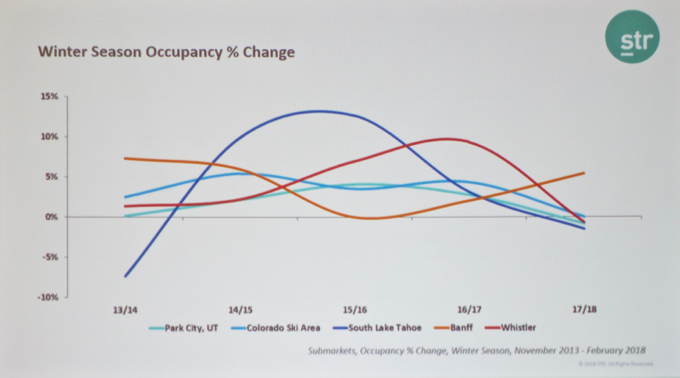
Data from STR analytics firm shows hotel occupancy changes for five winter destinations. Photo/LTN

By Kathryn Reed

STATELINE – Hotel occupancy in the United States is at the highest level it has ever achieved – 66 percent.

Ali Hoyt, senior director of consulting analytics for Denver based STR, was one of the presenters this week at the annual Mountain Travel Symposium. She provided a wealth of information about the hotel industry in the U.S., while briefly touching on metrics for ski towns. The firm studies 647 markets in the U.S., with properties divided into different classes. STR covers more than 70 percent of the hotels in the country, which is about 5 million rooms.

The symposium, now in its 43rd year, is the largest trade show of its kind. This is the first time the South Shore has hosted the weeklong event. It has been on the North Shore before and will return to Squaw Valley in 2020.

Hotel occupancy records have been breaking since 2016, with 2018 continuing in that direction.

“Demand is still outpacing supply. We expect that to level off,” Hoyt said during her April 12 talk.

The growth rate is about 2 percent year-over-year, which is about half of what it was in 2014 and 2015.

What her company does not track is vacation rentals. STR is only collecting data on hotels.

The hotel industry has experienced eight consecutive years of revPAR growth. This is the revenue per available room. Hotels will multiply their average daily rate by the occupancy rate to get the revPAR number.

What Hoyt and her colleagues are finding is the revPAR growth will be driven by rate growth.

The lackluster snowfall this winter has caused the local revPAR and occupancy numbers to be all over the map.

While it’s obvious the only way hotels will make money is if heads are in beds, it also matters what price they get per night. Much like the airline industry, it’s not a consistent price. The same bed on the same floor of a hotel could have a different price based on when it was booked and where it was booked. And it could be more expensive based on the day of week, events going on as well as holidays.

The money collected then has a huge impact on the city or county it resides because of the hotel taxes that are levied. The transient occupancy tax in a tourist area like Lake Tahoe is a huge revenue source for the city and counties in the basin.

When comparing the South Shore to Park City, Utah, Colorado ski areas, and the Canadian towns of Banff and Whistler, locally the occupancy rate had the wildest swing from 2013 to now.

While the whole Lake Tahoe basin, including Truckee, is busier in summer than winter, that is not true of most ski towns.

Hoyt’s data, though, is showing occupancy rates are growing in other destinations. Average daily rates and revPAR are going up, but it’s a bit of a roller coaster for all locations. Still, she sees summer bookings as an opportunity for  hotels in terms of increasing occupancy and revenue.


Understanding the ‘new normal’ for water in the West

By Tara Lohan, Water Deeply
 
April is often a time of abundance in the mountains of the American West, when snowpack is at or near its peak, and forecasters work to determine how much runoff will course through our rivers and fill reservoirs later in the season.

This year, across much of the West, particularly the Southwest, there’s little in the way of abundance. At Lake Powell, the second-largest reservoir in the West, runoff is predicted to be only 43 percent of average. Arizona is looking at one of its lowest runoff years in history. And in New Mexico, stretches of the Rio Grande have already run dry, months ahead of normal.

The only consolation is that last year was a wet year and reservoirs received a boost. While it’s typical in the West to have big swings in precipitation from year to year, what has concerned scientists lately is that even good years are no longer producing the kind of runoff seen historically.

Read the whole story


Opinion: Cold Truckee, hot development

By Joe Mathews

One of California’s hottest development projects can be found in one of its coldest towns.        

In an era of neighbor-bites-neighbor fights against big developments, perhaps it’s fitting that one antidote should emerge from the Donner Pass. Tiny Truckee—a snowy municipality of 16,300—is doubling the size of its downtown.

Joe Mathews

The Railyard Project—it’s a converted railyard—shows that communities can overcome NIMBYism, environmental litigation, and all the usual California obstacles in pursuit of transformational development. The project also shows just how difficult such transformations have become in a state once famous for dramatic change.

Truckee’s ambition is startling. First, it’s starting with affordable housing—often the last type of housing to be added to a project, given the political and financial challenges. Second, it’s exactly the sort of dense, urban development that draws fierce opposition in the state’s biggest cities.

While the project has gotten little notice outside the Sierra, that seems likely to change as construction continues. The project has used innovative financing mechanisms, including dollars from the state’s cap-and-trade program. It is likely to employ factory-made housing as a way of reducing the sky-high costs of construction. And gubernatorial frontrunner Gavin Newsom has praised Truckee for supporting smart development.

For Truckee, the project is a culmination of a quarter-century journey. While the town dates to the 1870s, it only incorporated in 1993, because residents of the 34-square-mile town wanted control over land-use planning after years of new house-building on its outskirts by Bay Area vacationers. The final straw was the county’s imposition of a K-Mart outside downtown, despite objections to the traffic it would create.

The new town embarked on a general plan for Truckee. And after being asked for ideas, Truckee’s people seized on a vision of smart growth, with a bigger downtown offering more for year-round residents.

The obvious place for expansion was a Union Pacific railyard next to downtown. The town used a state grant to create a master plan for the railyard, then spent years convincing Union Pacific to sell the property. The town also collaborated with a patient Bay Area developer with ties to Truckee, Rick Holliday.         

Over the past decade, the plan has survived blows that have killed other projects. A CEQA lawsuit against the plan—litigation that routinely blocks approval of developments around the state—failed. The Great Recession put the project on ice. Then, in 2011, Gov. Jerry Brown and the courts killed the redevelopment program that Truckee was intending to use to finance the project.

Instead, Holliday secured more than $12 million in cap-and-trade dollars—on the basis that the railyard would be the sort of affordable, infill, higher-density development that means people drive less, and produce fewer greenhouse gases. With other cap-and-trade funds going to projects in more coastal and populated places, Truckee offered the possibility of a rural showcase.

The plan has been tweaked and updated repeatedly, in response to constant input by residents, many of whom have lived there since before incorporation and feel deeply invested in the project.

The operations of the railroad have been relocated, and roads, water and sewers have been put in. Construction on the affordable housing begins this summer.

“This is the most strongly supported project that I’ve ever seen in this community,” said Tony Lashbrook, the longtime town manager who retired last year.

As it goes forward, the project faces questions that could resonate across the whole state. Can California communities really pull off a modern development next to a historic downtown and make it seamless, adding value to both? How well does cap-and-trade perform as a financing mechanism? And will people really gravitate to more urban housing types in places that don’t meet the usual definition of urban?

If the project succeeds, it could be a signal moment for California’s mountain communities, as they struggle to keep and attract new generations of residents. When your thin-blooded Angeleno columnist visited freezing Truckee last December, I was struck by the community enthusiasm, including from millennials who moved to Truckee because they like the outdoors and because their employers let them work remotely. “Isn’t it great that we’re in charge and getting what we want?” one local asked rhetorically.

But others wondered whether people will have second thoughts when they see the four story-affordable housing building—tall for Truckee—go up. More recently, a grocery store that was supposed to be part of the railyard project pulled out after the town council approved a Raley’s outside downtown.

Still, it’s a good bet that the railyard will eventually put Truckee on the map for reasons beyond tourism and snow.

Joe Mathews writes the Connecting California column for Zócalo Public Square.


Wirth out as president of Squaw-Alpine resorts

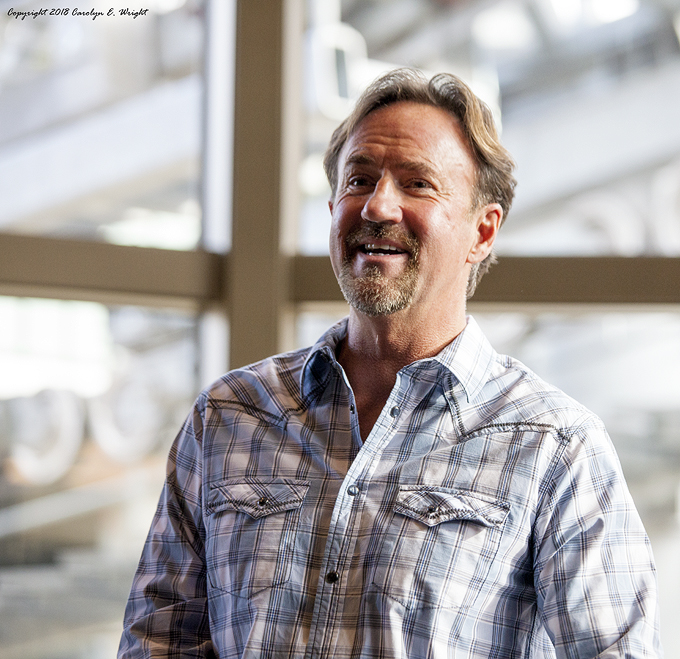
Andy Wirth’s tenure as president of Squaw Valley-Alpine Meadow is over. Photo Copyright 2018 Carolyn E. Wright

By Kathryn Reed

Andy Wirth is no longer at the helm of Squaw Valley and Alpine Meadows ski resorts.

Wirth has been a polarizing figure in the Olympic Valley and greater Lake Tahoe-Truckee areas.

Why exactly the 54-year-old abruptly left has not been disclosed. A statement by Wirth issued by the resort called it a retirement. “It is after careful consideration and reflection that I have made this decision. My retirement will allow me to not only spend more time with my family, but focus on some of my passions, including the active support of wounded warriors and environmental causes – advocacy and action.”

Wirth did not return Lake Tahoe News’ phone call.

He could have easily decided to step away after nearly dying in an October 2013 skydiving accident that ripped off most of his right arm, causing extensive bleeding.

Wirth has been leading Squaw since August 2010, when he was appointed to be president after Nancy Cushing stepped down from that role. She had been president since 1994, but was running the entire resort after her husband, Alex, died in 2006. It was Alex Cushing who brought the Winter Olympics to the resort in 1960.

KSL Capital Partners of Colorado bought Squaw in November 2010 and kept Wirth on board. Since then, Alpine Meadows has come under the same ownership umbrella.

In April 2017, KSL partnered with Aspen Skiing to buy Intrawest Resort Holdings’ six resorts, and then went on a buying spree that included Deer Valley in Utah and Mammoth in California. The new company, named Alterra Mountain Company, kept Wirth on as the leader of Squaw-Alpine.

While Wirth described himself as an environmentalist, environmental groups saw him as the enemy. This largely has to do with him being the mouthpiece for KSL’s plans to spend $1 billion over 25 years to build more than 1,000 residential units, hotels, retail, restaurants and bars, and an indoor adventure center.

Lawsuits have been filed regarding that project.

Then there is the controversial proposal to build a gondola that would link Squaw and Alpine on the outskirts of Granite Chief Wilderness Area.

Deaths and accidents, while part of the reality of the ski industry, have also plagued the resort during Wirth’s tenure, with some questioning safety and how incidents are handled.

Wirth has also overseen millions of dollars in improvements, mostly at Squaw. His leadership has also brought in a more customer service oriented approach to dealing with guests. He was also instrumental in bringing the World Cup back to Squaw in 2017.

In the interim, Ron Cohen, Alterra’s deputy general counsel, will serve as president and COO in Wirth’s place. David Perry, Alterra’s president and COO, will also be having more of a say regarding Squaw-Alpine until someone is hired to run the Tahoe resorts.