Cave Rock project to tie up traffic all summer
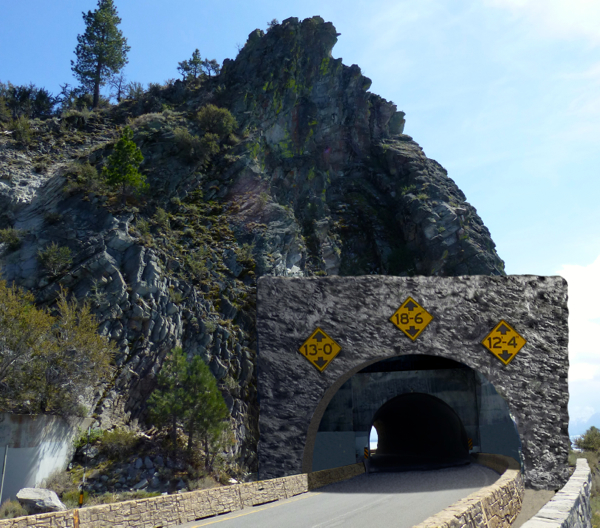
This is a rendering of what Cave Rock will look like when the work is completed. Photo/NDOT

This is a rendering of what Cave Rock will look like when the work is completed. Photo/NDOT

By Kathryn Reed

Highway 50 near Cave Rock will be reduced to one lane in each direction six days a week, including holidays, and around the clock beginning as soon as possible and lasting until the work is done in the fall.

It’s mostly about safety and a little about lake clarity.

“We are calling it a tunnel extension for simplicity. It’s almost like a bridge we are building,” Devin Cartwright, Nevada Department of Transportation engineer, told Lake Tahoe News.

He is in charge of the $5 million project that is designed to keep rocks from falling from Cave Rock onto the highway, as well as the water quality improvements taking place east of the tunnel.

Most likely the work will begin in May per Tahoe Regional Planning Agency rules, though if April is projected to be dry, exemptions could be made.

This isn’t any ordinary rock formation. For the Washoe people it is one of their most sacred places.

“NDOT invited the tribe to come up to meet with the project construction crew when they come up with a date for the start time so the tribe can talk to them to explain how it is a sacred site and not just another job,” Darrel Cruz with the tribe told Lake Tahoe News.

Cave Rock has been used by medicine men and there are other stories associated with it, Cruz said. For some people, they won’t go near the rock because of the power it holds.

The Washoe and NDOT have been meeting regularly. And while the Washoe would prefer no one touches the site, they are resigned to the fact that safety issues are a necessary reality.
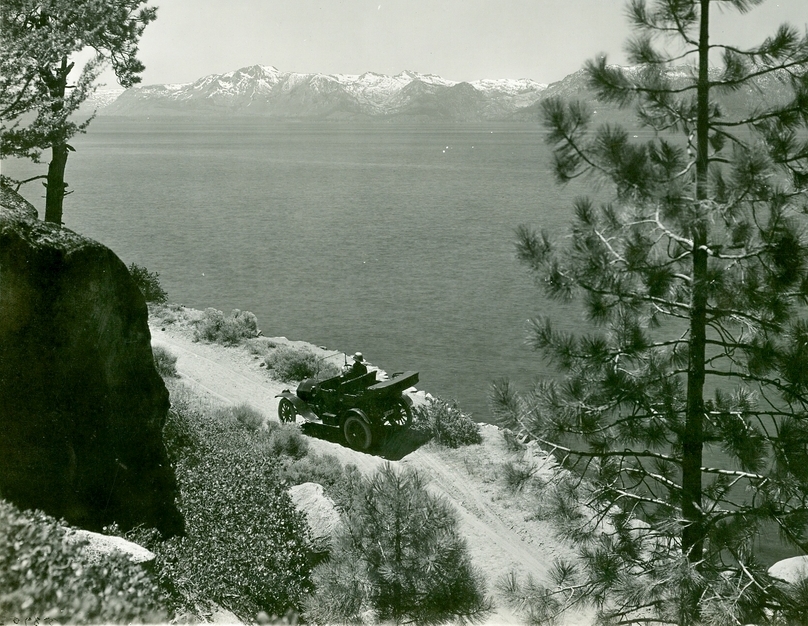
People used to drive around Cave Rock. Photo/Lake Tahoe Historical Society

People used to drive around Cave Rock. Photo/Lake Tahoe Historical Society

Sizable rocks have fallen the past couple winters that have damaged vehicles and the roadway. This project is designed to keep those rocks from reaching the road.

Temporary steel netting has been erected until the more robust solution is in place. The added benefit is that the net will act as a safety measure for workers this summer.

Cartwright said the inconsistent moisture levels because of the drought have caused more rocks to become loose and fall.

“Rapid expansion of soil causes new cracks or old ones to get bigger and things to fall,” he explained.

NDOT is also working with the state Historic Preservation Office to ensure the work is done with care.

“The exterior will be such that it blends into Cave Rock. You will see something that looks like granite or Cave Rock to the best of its ability, but it will still be square,” Cartwright said. “It will have a false surface on it made of concrete and steel so it will a have depth and texture to it like the surrounding rock.”

The tunnel will receive a face-lift of sorts. The exterior color will be closer to the natural rock. The white that has covered up graffiti will be eliminated. The goal is to make all the improvements appear as close to being original as possible, including color, patterns and texture.

The inside will be like a box. On top of it will be concrete and steel girders.

“If you imagine a set of ribs, they will run transverse to the road,” Cartwright explained. “One will be spaced about every 10 feet longitudinally. On top of there, 1 foot of concrete reinforced deck, on top of that 3 feet of pea gravel, so when rocks fall on the pea it stays loose.”

The technology comes from Japan, which has a ton of rock fall issues because of seismic activity. NDOT looked at various methods to contain the rocks, with this design seeming to be the most effective for the site and coming with the ability to be completed in one season.

The existing tunnel is 165-feet long. Sixty-two feet will be added to it.

It was in 1931 that crews first blasted through the granite monolith. It used to be one lane. Eastbound traffic went through the tunnel, while those headed west went on the outside of the tunnel by the lake. That route was eliminated after the second bore was completed in 1957.
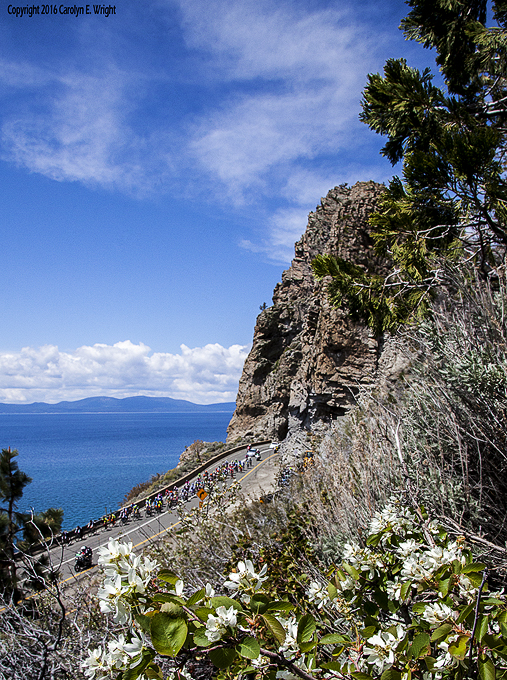
Cyclists in the Tour of California will again ride through Cave Rock in May. Photo Copyright 2016 Carolyn E. Wright

Cyclists in the Tour of California will again ride through Cave Rock in May. Photo Copyright 2015 Carolyn E. Wright

With the tunnel being 23-feet at the narrowest, there is no room to add a bike lane. However, part of the project includes improvements for cyclists.

There is a button cyclists can hit to initiate a warning to drivers. But cyclists seldom take the time to use them. The buttons will remain as a back up, but radar will be installed so the message board is automatically triggered. NDOT will be putting in changing message signs that are similar to the ones near Lakeside Inn and Kingsbury Grade.

The existing signs for cyclists and the ones warning about ice will be removed.

“When there are no bikes or ice, it will be a black sign. It won’t add clutter. When a bike rides by it, it will light up,” Cartwright said.

Temperature sensors will be installed inside the pavement on each side of the tunnel so when it gets close to freezing it will say there is ice in the tunnel. This change will mean the warning would be legitimate instead of ongoing when the threat isn’t valid.

NDOT is adding a white surface to the ground as drivers approach the tunnel and silhouettes of bikes will be stenciled in as a warning.

The tunnel will be lighted. The roadway inside the tunnel will be repaved, as will the westbound lanes of Highway 50 and the roadway median between Cave Rock and the Cave Rock State Park boat launch entrance.

During construction the work zone speed limit will be 25 mph. This will start about one-half mile before the project area. Nevada Highway Patrol will be on site to enforce people comply. People traveling east will be in a construction zone for longer because of the water quality project.

Roadside drainage inlets and sediment filtration systems will be installed along the highway for approximately one mile that starts four miles east of Cave Rock.

Noise constraints are part of the contract. If the contractor violates them, the project could be shut down.

While the work will be ongoing all except Sundays, the contractor has the authorization to work seven days. NDOT is aware there will be nine significant events such as annual cycling and running races that will be impacted. Cartwright said the size of the event would dictate whether special traffic controls would be implemented to accommodate participants.

—–

Notes:

  • NDOT is having an informational meeting about the project on April 14 from 4-7pm at Zephyr Cove Elementary School’s multipurpose room, 226 Warrior Way, Zephyr Cove. There will be a formal presentation at 5:30pm, followed by a short question and answer session. This will be an open house format meeting.
Sierra snowpack below normal; better than ’15

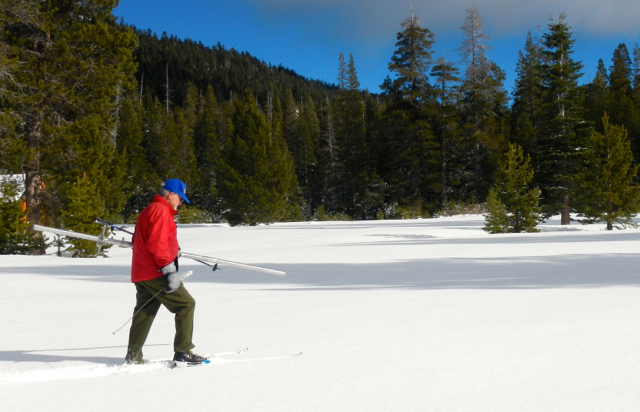
Snow has been on the ground for each of this season's snow surveys. Photo/LTN file

Snow has been on the ground for each of this season’s snow surveys. Photo/LTN file

By Lake Tahoe News

Even though there was white stuff to walk on during the final snow survey of the season today, the lack of water content will likely mean California is headed for a fifth year of drought.

The snow depth in the field by the entrance of Sierra-at-Tahoe on March 30 was 58.4 inches, with a water content of 26 inches. That amounts to 97 percent of average. Statewide the water content is at 80 percent.

While this is a dramatic difference than a year ago when Gov. Jerry Brown stood in a dirt field at Phillips Station, the odds of much more moisture adding to the snowpack are not good.

A year ago, the snowpack was 5 percent of average. This led to the governor to institute dramatic water cutbacks in an effort to conserve. Those rules remain in effect even though some areas believe the rules should be loosened because of the amount of rain that fallen in the winter and filled the reservoirs.

With longer and warmer days, the snow will begin to melt faster. Peak runoff is usually in May. Temps are supposed to be in the 50s the rest of the week, reaching nearly 60 by the end of week.

The importance of the snow lasting as long as possible is that then there is more to fill the reservoirs downstream. In normal years the snowpack accounts for about 30 percent of California’s water needs.


Climate forecast: Warmer, less reliable Truckee River

By Benjamin Spillman, Reno Gazette-Journal

An updated report on climate change that forecasts less snow in the Sierra Nevada and warmer temperatures across the Great Basin doesn’t bode well for fishing and water sports in the Truckee River.

And while average to above average mountain snow in winter 2015-16 has provided a welcome reprieve from five years of drought conditions, the long-term forecast for the remainder of the century is a different story.

The latest version of the Bureau of Reclamation’s SECURE Water Act Report forecasts a continued warming trend that threatens to undermine environmental features that make the Truckee River a vibrant place for fishing and other water sports.

The report, which has segments for several major Western river basins, says the mean annual temperature in the Truckee River Basin, an area that includes Reno, Carson City and Lake Tahoe, is expected to increase 5 to 6 degrees Fahrenheit during the 21st century.

Read the whole story


Outdoor recreationists compete for USFS attention

Winter recreation enthusiasts are interested in the Forest Service's plans. Photo/Susan Wood

Winter recreation enthusiasts are interested in the Forest Service’s plans. Photo/Susan Wood

By Susan Wood

How can Lake Tahoe Basin residents and nature stakeholders deal with the inevitable power struggles that go with sharing open space in winter – whether that power is driven by human or machine?

That’s the pervasive question the Lake Tahoe Basin Management Unit team is asking as it starts the long, laborious process of coming up with a winter recreation plan that serves the needs of those who play and live in the snow. The plan is expected to be completed next year.

And as longtime Tahoe park ranger icon Don Lane puts it: “How tolerant are you of what others do in this special place we call Tahoe?”

Leaning against the table in the LTBMU conference room Tuesday night in its first open house on the subject, Lane was gesturing while pointing out to Fallen Leaf Lake resident Peggy Laughlin during their debate over the history of Tahoe that many people experience this beautiful winter recreation paradise in different ways.

And therein lies a balancing act as delicate as protecting the lake itself.

Some people cross country skiing in the basin like to stop to close their eyes and not hear any noise. Snowshoers often enjoy opening their eyes to see virgin snow with no tracks in sight. Snowmobilers relish the thrill of manipulating a sled in a mighty hairpin turn through powder. Fat tire mountain bike riders may want to hear the crack of the crust. And now there’s a cross between a snowmobile and bike to plow through the white stuff.

Whatever floats the boat of the winter recreational enthusiast, sharing the land has its challenges. But in this case, the plan dictating the guidelines is long overdue.

The last time the Forest Service developed a plan here in the basin was 1975.

The federal land use agency was given the directive to revisit the “Snowmobile Guide” while the overall Forest Service general plan was being adopted because many winter enthusiasts were commenting on this type of recreation. The Forest Service’s general plan is due to be signed at any time by the regional office in Vallejo.

In the meantime, LTBMU agreed to host open houses to receive input. The next one is slated for April 5 from 5-7pm at the North Tahoe Event Center, 8318 North Lake Tahoe Blvd. in Kings Beach. The third is scheduled in Sparks on April 19 at the same time in the Humboldt-Toiyabe office at 1200 Franklin Way.

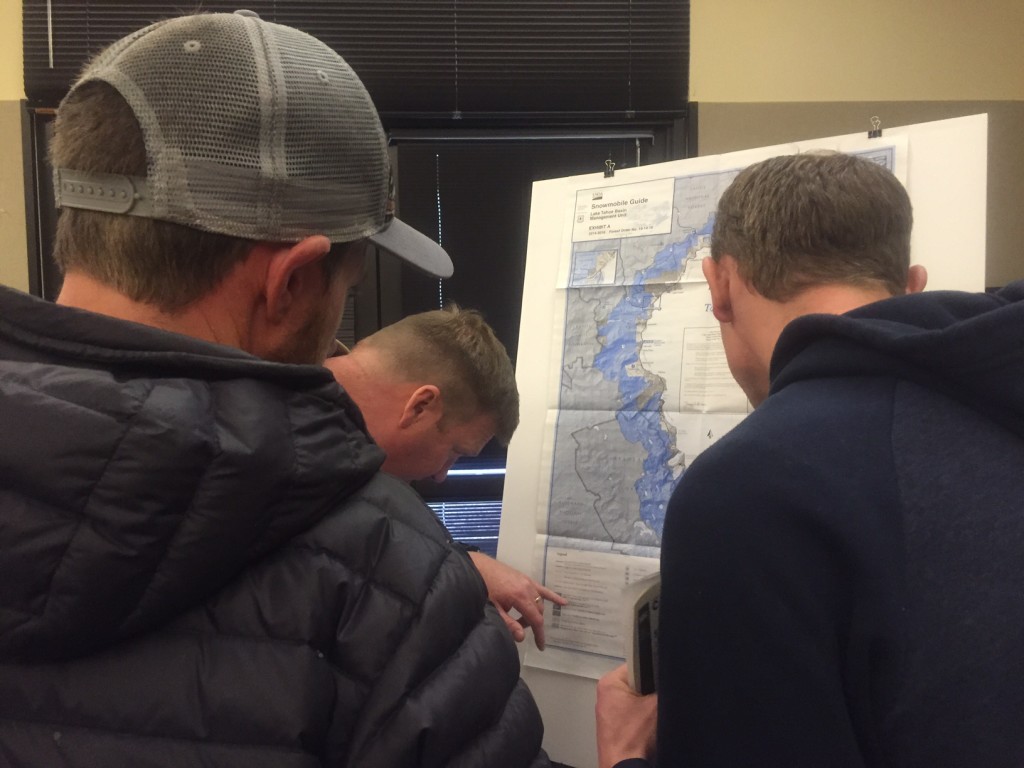
More than 50 people showed up for the South Shore’s March 29 meeting, filling the room with varied opinions. A comment box was placed on a table, along with questionnaires situated near a handful of Snowmobile Guide maps placed on easels around the room. Many gathered around them, pointing to different areas they ski in or ride a snowmobile in.

To help spur the process, the Forest Service asked:

·      “What do you value about your winter recreation experience and opportunity?

·      What conditions or circumstances detract from a high quality experience for you, and how could those be improved through different LTBMU management?

·      What is working well with the current Snowmobile Guide regulations and with current conditions regarding winter recreation opportunities, access and experience?

·      What kinds of partnerships or strategies might the LTBMU explore to provide improved winter recreation access and opportunity as well as improved resource stewardship?

·      What other information or input might help the LTBMU develop a comprehensive proposed action for winter recreation?”

The questionnaire instructed the participant to submit the form to an LTBMU employee, the front desk or electronically to comments-pacificsouthwest-ltbmu@fs.fed.us.

Phil Brand, who has lived in South Lake Tahoe for 53 years, told Lake Tahoe News he would take his home to work on.

Brand owns two snowmobiles and likes to ride up Oneidas Street to Armstrong Pass in the South Shore and in Blackwood Canyon and the Rubicon Trail on the west side where more unrestricted region exists. He recalls the days in the 1960s when “you could go almost any place” on the South Shore.

“Over the years it’s gotten where more and more areas are closed off. It’s harder to find places to go,” he said, adding that a segment of people “don’t want us there.”

He says that with a degree of understanding. Brand is also a cross country skier and occasionally pulls the snowshoes out.

When comparing this area to Mammoth, Brand contends those residents live in more harmony than Tahoe. He’d like to see more areas open up to snowmobilers, but that’s not his expectation.

“The way things are going, I’d settle for not less,” he said.

Longtime Tahoe environmental activist Laurel Ames said she wants the same – only for cross country skiers. Ames would like to see High Meadows east of the Black Bart region stay off limits to the snowmobilers because it’s “a special place for skiing” and represents an environmentally sensitive region.

“I want to see places quiet. (Snowmobilers) have a lot of places to go,” she declared.

Currently, the Snowmobile Guide outlines closed off zones in Desolation Wilderness, High Meadows and the Meiss Meadows region on the South Shore; Granite Chief Wilderness, Sugar Pine Point and Burton Creek state parks on the West Shore; East Shore beaches at Secret Harbor, Spooner and Lake Tahoe Nevada state parks on the east side; and the North Shore’s Tahoe Meadows, which LTBMU Recreation Supervisor Gina Thompson calls the most contentious area.

Thompson hopes that by having open houses where stakeholders may share their points of view they’ll come to a better understanding and therefore consensus on how to share the space.

Even the collaborative team of citizens assembled a few years ago didn’t come to that, so the Forest Service took back its own project.

“The collaborative focused on open and closed areas. There were other things to focus on,” Thompson explained.

For example, the issue of where to park came up repeatedly. Most snowmobilers place their sleds on big trailers. While skiers simply want to get off the road when they leave their vehicles for hours.

“The challenge becomes who’s going to plow and who’s going to pay for that,” Thompson said.

Keep in mind the Forest Service spent half its budget on fighting fires this year.

Thompson also realizes many users would like to see more signs.

Either way, it’s a long road ahead.

LTBMU hopes to return in the fall with a proposal from the comments, a submitted NEPA document and a call for another meeting.

“It’s really hard to give everyone their own little piece (of Tahoe), but we’ve got to be respectful,” she said.


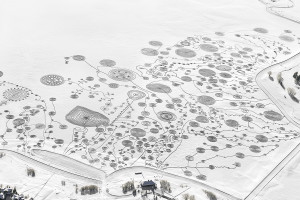
Artist creates snow drawings in the Sierra

Creating art on snow can be a fleeting endeavor. Photo/Sonja Hinrichsen

Creating art on snow can be a fleeting endeavor. Photo/Sonja Hinrichsen

By Lori Halloran, KQED-TV

For the past seven years Sonja Hinrichsen has made snow drawings all over the world. Over time she’s come to terms with the completely unpredictable nature of her work.

Though she spends months planning her projects, she can never be sure if the weather will cooperate, until the appointed day arrived. If there’s no snow, there’s no canvas. If the snow is falling, she has to wait out the storm.

Even when conditions are perfect and her creation is complete, it’s a race against time to photograph the work before the next snowfall covers it up or it simply melts away.

Read the whole story


Alcohol distribution in Nev. signals economic recovery

By Adelaide Chen, Las Vegas Review-Journal

Credit tourism — more alcohol is flowing across Nevada.

Compared with five years ago, distribution of wines increased 18.2 percent, spirits went up 14.8 percent and draft beer 10 percent, all in gallons, according to the state’s taxation department.

“I can guarantee you anytime you see big swings like that, very rarely is it occurring by local consumption. People don’t just change their drinking habits that dramatically,” said David Ozgo, senior vice president of economic and strategic analysis for the Distilled Spirits Council of the United States.

Statewide, an average of 7.6 million gallons of alcohol per month were distributed in 2015 – the best so far in the years following the recession – but fell 164,000 gallons short of the pre-recession peak in 2007, based on state taxation figures.

Read the whole story


Deaf cook lets food speak for him

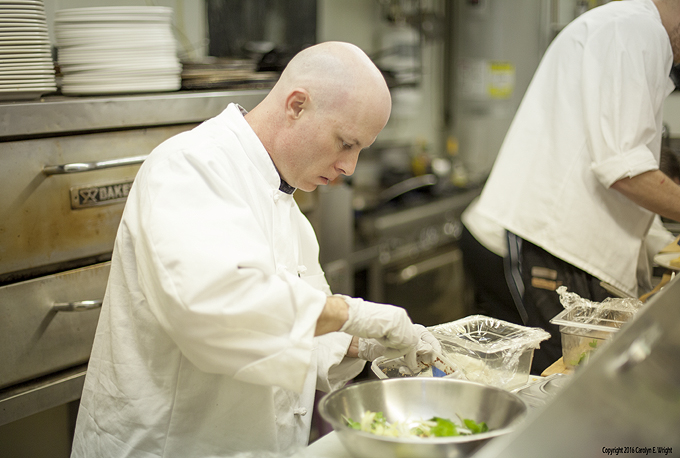
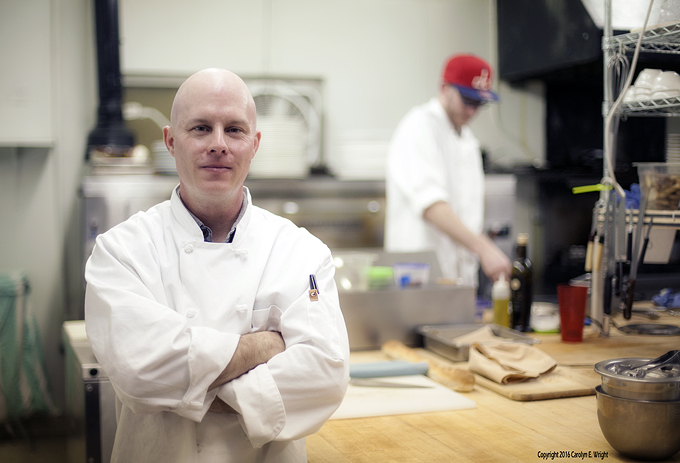
Charlie Somers doesn't let his disability of being deaf slow him down in the kitchen. Photo Copyright 2016 Carolyn E. Wright

Charlie Somers enjoys learning the inner workings of a professional kitchen. Photo Copyright 2016 Carolyn E. Wright

By Kathryn Reed

STATELINE – Only one ingredient is missing from the kitchen at Mirabelle – the chatter among the staff.

Well, there’s chatter, it’s just not audible.

With the hiring of Charlie Somers, owner-chef Kenn Druley has had to rethink how he communicates with staff. Somers is deaf. Druley isn’t proficient in sign language, nor is anyone else who works at the Stateline restaurant.

It can be a challenge at times because the work of a chef involves having one’s head down nearly all the time cutting, chopping and stirring. It can be fast moving as well.

“It’s kind of like with any new language or any new guy in the kitchen, there are always things to adjust to. It’s just a different way to communicate,” Druley told Lake Tahoe News. “I see it as more of a positive challenge for the kitchen; for myself and Charlie as well. It’s a verbal occupation and you are constantly working with your hands and talking. So when Charlie needs some instruction or directions I have to stop and put things down.”

Photo Copyright 2016 Carolyn E. Wright

Charlie Somers doesn’t let his disability of being deaf slow him down in the kitchen. Photo Copyright 2016 Carolyn E. Wright

Despite what could be perceived as a language barrier, Somers, through interpreter Karla Johnston, told Lake Tahoe News that the “joking, teasing and camaraderie” are the best parts of the job.

Right behind that is learning to cook French cuisine – not something he does at home. Burgers and fries are his specialty when not at work.

He said there are few chefs in the United States who are deaf. The challenges, he assumes, would be the same whether it’s a small kitchen like Mirabelle or a larger one.

Mozzeria, a pizza place in San Francisco, is one place Somers believes would be interesting to work because it is owned and operated by deaf people.

Somers is cognizant that his disability can be more of a challenge to others than it is to him.

“I’m used to working with it, others aren’t,” he said. “I adapt pretty well.”

Everyone at Mirabelle has learned a little sign language.

Salads are one of Charlie Somers' responsibilities. Charlie Somers doesn't let his disability of being deaf slow him down in the kitchen. Photo Copyright 2016 Carolyn E. Wright

Salads are one of Charlie Somers’ responsibilities. Photo Copyright 2016 Carolyn E. Wright

“He has to learn to work within this environment and how to teach other people how to work with him. It’s not a one-way street at all. It is a two-way street. Teaching is going on both ways all the time, every day,” Druley said.

Somers took a break from whipping the chocolate mousse into the perfect consistency to chat about how at age 43 he got into this profession. He credits his three children.

About five years ago they were all watching the movie “Ratatouille” and from there Somers got the idea that working as a chef would be interesting and rewarding. He was fairly proficient at barbecuing, but the intricacies of the kitchen – especially a commercial one – were foreign to him. That led him to Lake Tahoe Community College.

Somers now has a certificate in culinary arts. Last fall he answered an ad from Druley on Craigslist that led to him to Mirabelle. He started just before Thanksgiving.

“The ad didn’t say anything about hiring deaf guys only. It said it was open to anyone with a passion for cooking who wants to learn, would be here every day and had a great attitude. Charlie showed up and fit the bill. He was exactly what I was looking for,” Druley said.

Normally Somers works four days a week. A regular shift includes preparing the salads, then dessert, onion tart, bacon, chopping onions, doing dishes, taking out the trash and helping Druley and the line cook with whatever they need.

For Somers, the onion tart is one of his favorite items on the menu. He describes it as being like a French pizza. For now, it’s all about following the chef’s recipes and becoming proficient in various techniques.

Prior to putting on a chef’s jacket, Somers had been working in data entry before going to LTCC. His time in a kitchen had been at Bread & Broth and Little Philly Cheesesteak.

As for his future, he’s not sure. Owning a restaurant seems daunting to him. For now, though, he’s perfectly content to learn all that Druley has to teach.

Druley gives Somers high praise for how far he has come in these four months.

“He is anticipating what the line needs during service. He is learning how to be a good cook, what good cooks do and how they work,” Druley said.


Tahoe resorts eye longest ski season in decade

Heavenly and all Tahoe area resorts are having their best season in years.  Photo Copyright 2016 Carolyn E. Wright

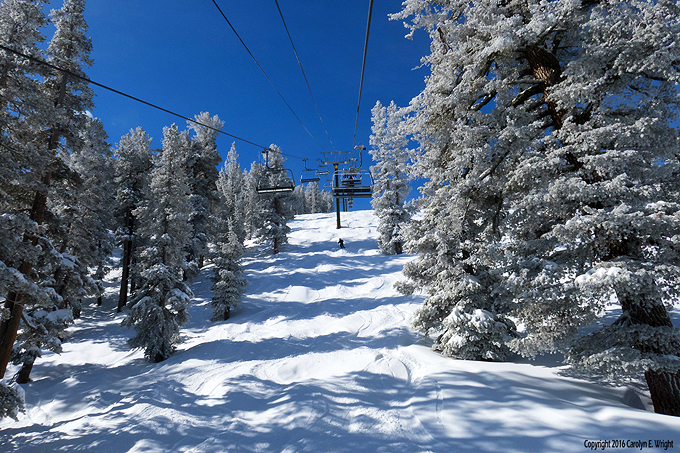
Heavenly Mountain Resort and all Tahoe ski areas are having their best season in years. Photo Copyright 2016 Carolyn E. Wright

By Benjamin Spillman, Reno Gazette-Journal

Don’t give up on that season ski pass just yet, Tahoe locals.

The Monday morning powder dump that disrupted commutes in Reno served as an exclamation point for the 2015-16 season which is likely to be the longest in more than a decade.

So far Mt. Rose Ski Tahoe and Squaw Alpine resorts have announced plans to continue spinning lifts well into May. Although whether it actually happens still depends on the weather in coming weeks.

If Mt. Rose makes it’s anticipated closing date of May 8 it will mark 185 days of skiing at the resort, it’s longest season since at least winter 2005-06. Mt. Rose opened the 2015-16 season on Nov. 6. Squaw-Alpine officials have only stated they plan to offer skiing “into May as long as weather and conditions permit.”

Read the whole story


Groundwater law triggers aquifer-recharge experiments

By Emily Benson, Mercury News

WATSONVILLE — A historic 2014 law requiring water agencies across California to replenish the state’s imperiled aquifers created a new problem: Many local officials just weren’t sure how to do it.

But this winter’s abundant rains are triggering a flood of experiments that have turned the state’s agricultural regions into aquifer-recharge laboratories.

Farmers in Modesto inundated an almond orchard with the city’s stormwater. Water managers in and around Fresno have more than 20 new groundwater recharge projects in the works. On the Central Coast, researchers in the Pajaro Valley are carefully designing percolation basins to capture rainfall before it gushes out into the Pacific.

For decades, water has been sucked from aquifers faster than nature can replenish it — and the drought has only intensified the thirst for groundwater. Scientists agree that it will be decades before a future governor can declare California’s groundwater problems solved.

Read the whole story


Dual enrollment between LTCC-STHS grows

By Kathryn Reed

By the time students in the class of 2019 graduate from South Tahoe High School they may have earned 9½ units from Lake Tahoe Community College.

Even more are possible, and it’s not just freshmen who are eligible.

The first block is available through the Get Focused, Stay Focused program that was introduced this year. It is a program designed to get students to think about their lives for the next 10 years. At each grade level it will be revised.

Three main questions are addressed:

·      Who am I? – This is supposed to become a personal mission statement.

·      What do I want in life? – Work, family, and standard of living are addressed.

·      How do I get there? – Education, training and income level are part of the answer.

“It’s about self-discovery and making it happen,” Virginia Berry, LTCC dean of Career Tech Education, said.

She was part of group that gave the college and Lake Tahoe Unified School District boards an update on the program as well as what is going on with the broader dual-enrollment initiative. The two boards had a joint meeting on March 22.

Lake Tahoe Community College and Lake Tahoe Unified School District boards meet March 22. Photo/LTN

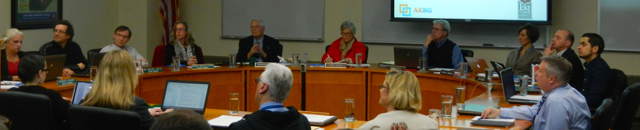
Lake Tahoe Community College and Lake Tahoe Unified School District boards meet March 22. Photo/LTN

The Get Focused, Stay Focused program is expanding to adult education, foster youth, and tribal education in Douglas County.

“It’s highly researched based. When they finish they have an education plan online,” Bob Grant with LTUSD said. “Counselors can look at it and direct students toward certain classes.”

The first dual enrollment class being offered outside of Get Focused, Stay Focused is in the digital media arts sector.

Dual enrollment means STHS students are getting LTCC credit for a class they take at the high school. It means the curriculum at the high school is equivalent to the college’s, and that LTCC students may take a similar class at their school.

The goal is to expand the dual enrollment offerings into culinary arts, sports medicine and dental hygiene. These are all disciplines both institutions currently offer.

The benefit to students is they will enter college with credits and therefore likely to be able to take more advanced classes from the get-go and then they can possibly graduate in four years. It also allows LTCC to count these students as though they were on campus, which helps the college to get state funding.

While dual enrollment is available where applicable to all STHS students, not all take advantage of the opportunity. In large part this has to do with LTCC having to ask residency questions and LTUSD does not.

“I’m impressed with the dual enrollment. It’s doing the right thing for the kids,” Barbara Bannar, LTUSD board president, said.