SLT council ‘on air’ no matter the topic

By Kathryn Reed

The brouhaha created at the April 5 South Lake Tahoe City Council meeting regarding televising public comments about non-agenda items was quelled this week when the electeds unanimously agreed to keep the camera rolling.

While legally the council has no obligation to televise any portion of its meeting, filming has occurred since 1998. The meetings are now available online – live and after the meeting – and on the cable public access channel. Audio recordings are also available, as are the minutes.

The abrupt stoppage of the airing of non-agenda item comments created a flurry of emails to the council and staff. There was outrage over it not being discussed or voted on by the entire council.

The original decision came about because some members of the public are slanderous with their comments. It’s also an opportunity for people to get on a soapbox about an issue or cause.

Between the city manager, city attorney and city clerk the electeds got a refresher April 19 about the Brown Act, California’s open meeting law. What was drilled into them is that they can shut down abusive language and content. The right to speak is one thing, while the actual words are another.

“There is no safe harbor for slander,” City Attorney Tom Watson said.

With that, he cautioned that if someone were to make a slanderous statement, the city could be held liable by broadcasting it.

That is in large part why previous councils from June 2003 to February 2011 did not air comments about items not on the agenda. A resident went off on his ex-employer at a meeting that was broadcast and the business owner was livid with the city.

The current council, though, believes the public’s right to hear what others are saying outweighs the threat of recrimination.

Per the Brown Act the council could never take away these non-agenda item comments entirely, only the airing of them. Creators of the Brown Act saw the need for the public to be able to have interaction with electeds without having to go through staff, which is why the comment period is mandatory for all legislative bodies in the state.

Watson also talked about how the council may respond to these comments in a limited manner, especially if it means to correct misinformation. There just can’t be lengthy dialog pertaining to non-agenda items otherwise that would be a Brown Act violation.

Bill Crawford, who was on the council for two terms, reminded the mayor that she has the power of the gavel, and if things really get out of hand the sergeant at arms – aka police chief – has the authority to remove someone from the podium and/or room.

Resident Ed Mosur said he wants to retain his right to criticize staff and not be told what he can or cannot say.

A change in policy going forward is people will have four minutes to make comments about non-agenda items instead of three.


Lake Tahoe’s clarity declines by 4.8 feet

By Lake Tahoe News

Lake Tahoe is getting warmer and that is not a good a thing for its clarity.

In 2015 the pristine waters got a little less so in summer and winter, according to data released April 19 by the UC Davis Tahoe Environmental Research Center and the Tahoe Regional Planning Agency. The average clarity last year was 73.1 feet; 4.8 feet less than 2014.

“It is commonly believed that drought years produce clearer water conditions, but the reality is more complicated than that,” Geoff Schladow, TERC director, said in a statement.

With more runoff this year compared to the last few springs, the summer 2016 reading could bring even more bad news.

Lake clarity is measured with a Secchi disk, which looks like a white dinner plate. The measurement is based on how far someone can clearly see it from the deck of a boat, with multiple readings taken throughout the lake.

Researchers say the clarity loss is not a long-term trend, but instead can be attributed to year-to-year variability based on the conditions in the lake.

“In 2015, the runoff water into the lake was warmer than the previous year on account of the low snow-to-rain ratio,” Schladow said. “As a consequence, fine particles flowed in closer to the surface, where they impacted clarity, rather than plunging to the deeper parts of the lake.”

Summer clarity averaged 73 feet, a 3.7-foot decline over the preceding year. Winter clarity last year declined by 7.6 feet to 71.6 feet.

During most years, clarity is worse in summer than winter. Schladow said 2015 was an exception because the lack of deep mixing during the winter resulted in little of the pristine, deep water being brought up to the lake surface to dilute the clarity-reducing contaminants. Even so, researchers said long-term decline in summer conditions is still a major concern.


Eastern Sierra overdue for large earthquake

By Scott Sonner, AP

Scientists say the Sierra’s eastern front is long overdue for a large earthquake along the California-Nevada line, where a magnitude-7 event expected on average every 30 years hasn’t occurred in six decades.

Nevada Seismology Laboratory Director Graham Kent says the region’s earthquake “drought” is likely one of the sources of a public misconception that it is at a low risk of experiencing a serious earthquake.

He planned to discuss details about the latest research today during an Earthquake Economic Resiliency Forum ahead of the Seismological Society of America’s annual meeting running Wednesday to Friday in Reno.

Kent said a magnitude-6 earthquake or larger typically strikes every 10 years or so along the Sierra Nevada frontal fault system running from south of Yosemite National Park to north of Reno and Lake Tahoe. There were seven magnitude-6.5 or larger in the region from 1915 to 1954, but none since, he said. The last magnitude-6 was 22 years ago in the Carson Valley south of Carson City.

The Federal Emergency Management Agency estimates a 6-magnitude quake could cause up to $1.9 billion in damage in the Reno-Sparks area and $590 million in the populated area of South Lake Tahoe, Kent said.

“Let’s take advantage of this extraordinary quiescent period in our earthquake history,” Kent said. “We have a great opportunity to bring experts together with our community — those who need to put plans in place not only for disaster response but, just importantly, a plan for quick economic recovery.”

The experts are gathering in Nevada days after powerful earthquakes killed hundreds of people in Ecuador (magnitude-7.8) and killed dozens and wounded thousands in Japan (magnitude-7.1). Scheduled speakers include Dick McCarthy, executive director of the California Seismic Safety Commission, and Cory Lyman, director of the Salt Lake City Emergency Management’s “Fix the Bricks” program.

The largest earthquake ever recorded in the Sierra fault system was a magnitude-7.4 in 1872 in Owens Valley south of Yosemite National Park. It’s still the third largest in California history, behind the magnitude-7.9 at Fort Tejon in 1857 and the 7.8-magnitude in San Francisco in 1906. More recent studies of the fault lines and damage suggest the Owens Valley quake was probably bigger than the one in San Francisco, Kent said.

The Seismology Laboratory at UNR chronicled the event in its March newsletter with historical excerpts from naturalist John Muir, who wrote about the violent shaking while at Yosemite.

“I ran out of my cabin near the Sentinel rock, both glad and frightened, shouting, ‘A noble earthquake!'” Muir wrote. “The shocks were so violent and varied and succeeded one another so closely, one had to balance in walking as if on the deck of a ship among the waves.”


Novasel talks roads, other EDC topics

By Kathryn Reed

Road projects dominated the conversation Monday night between El Dorado County Supervisor Sue Novasel and those at the South Tahoe Chamber of Commerce meeting.

“In concept I think it’s wonderful. I see it as an economic driver,” Novasel said of the proposed loop road near the state line.

The county won’t have a say on the project. However, Novasel is on the Tahoe Transportation District board, and it’s that agency which is spearheading the Highway 50 realignment. She is also the county’s rep on the Tahoe Regional Planning Agency Governing Board, which will have a say regarding some aspects of the project.

Her biggest concern with the loop road is parking.

Supervisor Sue Novasel on April 18 talks at the Cantina about an array of El Dorado County issues. Photo/LTN

Supervisor Sue Novasel on April 18 talks at the Cantina to chamber members about an array of El Dorado County issues. Photo/LTN

Carl Hasty, who heads the TTD, last week said the project is not designed to deal with parking.

Novasel likes the idea of a more walkable-bikeable area.

At the other edge of her district that is part of the Lake Tahoe Basin, the proposed roundabout at highways 50 and 89 generated much discussion.

Angie Olson, a Meyers resident, said, “Every morning I smell hot brakes. How are trucks going to slow down for the roundabout?”

Novasel said she has the same concern, as does the California Highway Patrol. It has been brought up with Caltrans, which is the state agency that desires the roundabout. A final decision has not been made to build this. A four-way stop and traffic signals are also possible.

The supervisor said she is lobbying for a designated chain control area. She has also asked Caltrans to create a computer-generated model to simulate what the traffic pattern could be like.

She said Caltrans plans to host a meeting in May about the roundabout, but no date has been set.

Novasel is also encouraging the transportation department to build the roundabout – assuming that is the desired fix for the intersection – at the same time the Echo Summit bridge is rebuilt. Construction is likely to occur in two to three years.

            Other items touched on at the meeting:

·      Tahoe Paradise Park will allow dogs on leashes starting May 5.

·      At today’s Board of Supervisors meeting changes to the vacation home rental ordinance are expected to be approved. They include mandating owners have a business license and endorsing the Good Neighbor policy.

·      Novasel believes hiring a public information officer will help the county to better get its message out.

·      Regarding the senior center, the supervisors have asked for the property to be assessed, as well as an analysis of financial value of the whole area. She said she’d like to write in a deed restriction so certain services would always be provided, like meals for seniors, which is a county program.

·      She defended her Feb. 23 vote not to allocate more money for roads, saying, “It was not a vote against roads, it was a vote against the process.”

·      Novasel said she wants to get money from Red Hawk Casino’s deal with the county so money comes to the basin to deal with roads. “It’s almost an act of God to get that contract changed,” she said. However, when the county in 2012 revised the 2006 agreement Tahoe was not and has never been a beneficiary of the tribe’s money.

·      When budget hearings begin later this spring for the fiscal year that begins July 1, money is expected to be allocated so the Meyers Area Plan can go through California Environmental Quality Act environmental review.


Nevada’s rooftop solar battle heats up

By Las Vegas Review-Journal

The future of a November ballot referendum seeking to return Nevada’s rooftop solar program to its original, more favorable rates for homeowners remains uncertain, but that hasn’t stopped the opposition from starting its campaign.

Citizens for Solar and Energy Fairness, a coalition including NV Energy that wants the new net metering rates approved by state regulators to remain in effect, is running a television ad and has a new website to educate voters on its opposition to the proposed referendum.

The coalition, which says it wants “affordable energy for all ratepayers,” states that the referendum to restore Nevada’s net metering program, should it qualify for the November ballot, would subsidize rooftop solar customers through those who do not have the systems.

Read the whole story


DRI officials fear university takeover

By Associated Press

Members of one of Nevada’s top environmental research organizations fear that the pending exit of its president will lead to a takeover by the state’s largest universities.

Longtime Desert Research Institute President Stephen Wells will leave this summer for another job in New Mexico. Organization officials say they are concerned state leaders will try to fold the institute’s resources into one or both of Nevada’s universities, the Las Vegas Review-Journal reported.

“Our faculty are nervous,” Wells said. “I’ve encouraged them to be very candid about what their feelings are, and I would say most people want to stay as an independent institution.”

Nevada System of Higher Education Chancellor Dan Klaich said there are no plans at this time to overhaul the institute. Klaich did question the potential merits of a takeover during a faculty meeting, but he said that those were theoretical.

“Change makes folks nervous — especially change in leadership,” Klaich wrote in an email Friday. “At an institution like DRI where there has not been a change in almost twenty years and where reorganization was discussed during the budget cuts, it is natural that some are concerned.”

DRI Faculty Senate Chair Dana Trimble wrote in a March 23 email addressed to Klaich and Board of Regents Chair Rick Trachok that the senate would like to formally end talks of mergers, even In the abstract.

“It’s always something on the table — the merger discussion is always happening,” Trimble said. “We worry about it because we’re a very small institution and we feel very vulnerable.”

DRI supporters said the presidential search should be top priority and that questions about the institute’s future can wait.

UNR officials said Friday that the school is not involved in any discussions about a merger.

“DRI is a valued partner in research and graduate education,” UNR President Marc Johnson said in an emailed statement. “The productive collaboration between DRI and UNR has extended over many, many years.”

UNLV officials did not respond to requests for comment.


Tahoe social issues top EDC official’s talk

By Kathryn Reed

STATELINE – While many people believe their job runs the gamut, Don Ashton’s literally goes from A to Z – animal control to Zika virus.

Ashton is the director of Health and Human Services for El Dorado County. It’s the largest department in the county, with about 550 employees. Countywide there are approximately 1,800 workers.

Mental health, homelessness and human trafficking are three of the big issues his department contends with in Tahoe.

Ashton spoke last week at the Soroptimist International of South Lake Tahoe meeting, of which Supervisor Sue Novasel is a member.

Don Ashton with El Dorado County talks about issues pertaining to Lake Tahoe. Photo/LTN

Don Ashton with El Dorado County talks about issues pertaining to Tahoe. Photo/LTN

“With mental health, we are seeing more of a need in Tahoe,” Ashton said. He mentioned El Dorado County’s suicide rate is higher than the state average.

Transitional houses – T houses for short – have been established in the basin to help those with mental issues. Twelve beds are available at the lake; on average 10 are full each night.

“T houses use the treatment model. They have to agree to treatment. It’s not just housing,” Ashton explained.

It’s less expensive for the county to pay $500 in rent a month to sleep six than it is to send the person to a board and care facility in Sacramento at a rate of $15,000 per person.

The beds in Tahoe have only been available since last year. Countywide there are 33 such beds, double the number from two years ago.

“Seventy percent of the people in jail or prison have a mental illness,” Ashton said. When they get out they are in the community, often times without the resources to cope.

One of the positives about Tahoe is the community has come together to try to address some of these needs. He mentioned how CASA is working with Live Violence Free to build a program regarding mental health that will likely be brought to the supervisors. The electeds can then decide about going after grant money to fund the program.

Ashton said the county is moving toward creating a “system of care” so people don’t fall through the cracks. He hopes to have it part of the next budget cycle, which the supervisors will be getting under way this spring. The problem now is things are fractionalized and don’t come under one umbrella.

For instance, programs for kids and adults are separate, which doesn’t help families. The other aspect is the broader community that needs his department’s resources. The goal is to make the agency user-friendlier.

What wasn’t brought up at the meeting is how Ashton is being endorsed by various entities to be the next chief administrative officer for the county. This is the highest position. Several electeds wrote a letter to the Board of Supervisors earlier this month saying as much.

Last week El Dorado County Superior Court judges Suzanne Kingsbury, Steve Bailey, Keith Brooks, Ken Melikian and Dylan Sullivan sent a similar letter to the board, as did the Taxpayers Association of El Dorado County.

The county has an interim CAO, Larry Combs, whose ability to understand the budget and make good hiring decisions has been questioned by many in the county, and yet he is the one the supervisors put in charge of hiring the next CAO.


Calif. Fish and Wildlife changes anger hunters

By Patrick McGreevy, Los Angeles Times

The number of Californians who hunt has dwindled to less than 1 percent of the population, but some who still carry rifles outdoors complain the state commission overseeing them has become too cozy with the animal rights movement.

Now Gov. Jerry Brown is facing pressure from outdoor enthusiasts to fill two vacancies on the five-person Fish and Game Commission with people who understand hunters and anglers and their role in conservation.

“The commission has shifted from a philosophy of conservation to one of preservation, meaning its direction has gone to where fishing and hunting are more and more limited and very difficult,” said Marko Mlikotin, executive director of the California Sportfishing League.

Read the whole story


What happens when books go to war

By Molly Guptill Manning

In January 1942, thousands of New Yorkers gathered on the steps of the legendary New York Public Library at 5th Avenue and 42nd Street wearing their Sunday best and warmest coats.  When standing room became scarce, crowds formed across the street. Nearly everyone had at least one book in hand. These were not overdue, nor did they need to be returned to the library; instead they were “Victory Books,” bound for soldiers overseas.

It may be difficult to appreciate the significance of a book drive held nearly 75 years ago. But this was no ordinary campaign. At the time, books—vehicles for new ideas—were being banned and burned in Europe by the German army. As the Nazis swept through Europe—occupying Poland, France, Czechoslovakia, Austria, Norway, Belgium, the Netherlands, and Denmark—restrictions were placed on the authors and titles that could be read in these conquered territories; books by American, British, and Jewish authors were outlawed. The most severe penalty for being caught with such contraband was death. This threatened punishment produced Germany’s desired effect: Strict compliance with the book bans was the norm.

With this threat across the Atlantic, Americans felt an urgent need to preserve books and all they symbolized. To spread this message, Hollywood celebrities, popular musicians, politicians, and military officials visited the New York Public Library in January 1942 to give speeches and performances that were broadcast nationwide over the radio. Katharine Hepburn, Chico Marx, Benny Goodman, Mayor Fiorello LaGuardia, Wendell Willkie, and Danny Kaye were among the famous who visited the library. They stressed that the best defense against Germany’s war on books was to do the opposite: read and spread information. And so books became a sort of weapon in the war—fighting ignorance, censorship, and boredom.

The Victory Book Campaigns of 1942 and 1943 enlisted ordinary Americans and their favorite books. Librarians across the United States scattered giant bins in stores, movie theaters, train stations, schools, and other public spaces to collect “Victory Books” for those serving in the Army and Navy. In 1942, 10 million books were collected by the Victory Book Campaign, making it the largest book drive in the world. Another 8 million books were collected the following year.

Most of the donations were hardcover books, a reflection of the American book industry at the time. The majority of American publishers refused to enter the paperback trade, fearful that 25- cent softcovers would ruin the handsome profit margins they earned from hardcover sales. The donated hardcovers were fine for stationary Army camps in the United States and aboard Naval ships, where soldiers did not need to carry all of their belongings on long marches or into battle.  When Americans shipped out to North Africa in 1942, they brought Victory Books to pass the long weeks spent sailing to their destination. Lacking any other entertainment, most tucked books into their packs and carried them into the invasion and beyond. But long marches with aching backs and blistered feet caused many to whittle down the possessions they carried; heavy hardcovers were reluctantly tossed.

American publishers heard of the insatiable demand for books overseas and the plight of the ill-suited hardcovers. They banded together to create books specially designed for American sailors and troops. Scrapping the hardcover, using lightweight paper akin to newsprint, reducing page margins, eliminating blank pages, and shrinking the size of books to as small as 3½  by 5½  inches, publishers created volumes sized to fit the pockets of uniforms. These miniature paperbacks were called “Armed Services Editions,” and were sold to the military at cost; they were distributed free of charge to Americans serving overseas. Westerns, sports stories, histories, bestsellers, fiction, nonfiction, short stories, books of humor, and poetry—the range of subjects ran the gamut. Soldiers devoured them. Creased covers, loose pages, taped bindings, and dog-eared pages were evidence of their popularity. No matter how worn, the books were passed from one GI to the next. According to one soldier, “To heave one in the garbage is tantamount to striking your grandmother.”

Homesick and lonesome soldiers found solace in books. Surprisingly, Betty Smith’s “A Tree Grows in Brooklyn” was the most popular of them all, despite being a coming-of-age tale from the perspective of Francie Nolan, a young girl. Troops related to Francie’s difficult upbringing, her discovery of comfort and escape in books, and her resolve to beat the odds and achieve her dream of going to college. Smith received over 10,000 letters of gratitude from Americans in uniform. In one letter, a marine described watching his friend’s final moments of life and said a part of him died with his friend. However, two years later, Smith’s book transformed him and his heart “turned over and became alive again.” Another man wrote Smith that her book inspired him during difficult battles, and that he and his wife vowed to name their first-born daughter “Betty Smith,” to honor the author who helped him survive war.

Other books were appreciated for their ability to amuse. Leo Rosten, author of “The Education of Hyman Kaplan”, received a letter of praise from a unit stationed in the Persian Gulf, whose only other entertainment was “a ping-pong set—with one paddle only.” Rosten’s humorous tales became the hottest commodity on the post; the men assembled each night by campfire and “roared” with laughter as they read one Kaplan story per day—it was their “ration on pleasure.”

Publishers received letters suggesting future titles to be printed. One man explained that the books that were in the highest demand had “at least an essence of—to put it bluntly—sex and a lot of it.” He asked for “Forever Amber, Strange Fruit”, and Tiffany Thayer’s “The Three Musketeers”, as they were all endowed with that quality. One man wrote: “For days, I’ve been hunting through our service club, bothering the Red Cross, scanning our library shelves and hunting unrelentlessly through the barracks—for what????” He desperately wanted a copy of H. Allen Smith’s “Low Man on a Totem Pole”, a popular book of humor. Another soldier summed up the success of the publishers’ Armed Services Editions: “You have no idea how many hours of pleasure your books give to us.”

The German army, by V-E Day, had burned an estimated 100 million books and destroyed hundreds of libraries, institutes, and rare book collections across Europe. By contrast, American librarians and publishers distributed over 140 million Victory Books and Armed Services Editions to those serving in the U.S. Army and Navy. These books made a lasting impact on the Americans who read them. Thanks to the Armed Services Editions, 12 million veterans returned home with an insatiable appetite for paperbacks. Demand was so high that publishers could not ignore this new market. A scant 200,000 paperbacks were printed in the United States in 1939; a staggering 95 million paperbacks were printed in 1947. Publishers realized they could earn a profit off paperbacks after all. In doing so, they printed books that attracted a larger audience of book readers than expensive hardcovers could.

Besides revolutionizing the book industry, the provision of books to those in the armed forces also changed attitudes toward higher education. Before the war, most Americans did not dream of going to college; expensive tuition made it a financial impossibility. However, the passage of the GI Bill, which promised a free education on the government’s dime, coupled with a newfound interest in books and learning led many veterans to consider returning to school. After all, they had proven to themselves that they enjoyed the scholarly activity of reading even under the stresses of war. Over 2 million Americans pursued an education under the GI Bill.

The next time you see a tattered paperback, think of the millions of Americans in uniform who cherished them while at war. These Americans not only fought and won a military victory against the Axis powers; the reading habit they gained led to the democratization of higher education and access to books at home.

Molly Guptill Manning is author of the New York Times best seller “When Books Went to War: The Stories that Helped Us Win World War II”. With a master’s degree in American History from the University at Albany and a law degree from the Cardozo School of Law, she is currently a staff attorney at the U.S. Court of Appeals for the Second Circuit.


Financial workings of South Tahoe unveiled

By Kathryn Reed

It is up to the finance department of most agencies to have the pulse of the organization. South Lake Tahoe is no different.

“We try to remain emotionally detached,” Mark Carlson, assistant city manager and director of Financial Services said.

He admits the council has made decisions he disagrees with. All he can do is keep them informed of the consequences of those actions.

Everything that goes on in the city touches the finance department because those employees are the keepers of money.

Carlson, along with Maryann Brandt, who is the manager of the department, delved into the city’s finances with this year’s Citizens Academy students.

The free seven-week course is designed to give residents a better understanding about how the city works as well as an opportunity to ask questions of staff. (This reporter is part of the current class.) The first session was an overview about the city, the incorporation and basic functions.

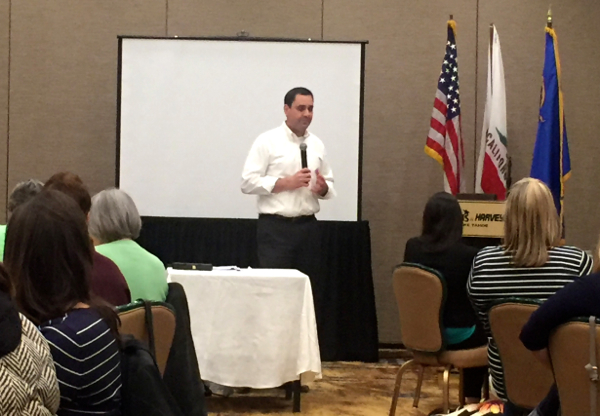
Members of South Lake Tahoe's Citizens Academy learn about financial dealings of the city. Photo/LTN

Members of South Lake Tahoe’s Citizens Academy learn about financial dealings of the city. Photo/LTN

Also part of the April 14 session was a lesson about the airport by Sherry Miller, who oversees that facility. The city is actually a tenant of the airport’s, paying $1.45 per square foot. That will go up to $1.50 a square foot in June per the council’s approval earlier this year. That is the same rate all tenants pay.

The finance gurus touched on how the city has $160 million in debt, with the bulk of it – $90 million – being for the construction of Heavenly Village. That total, though, does not include pension debt for the California Public Employee Retirement System. A change in how the state wants financial documents recorded will put that $19 million liability on the ledger in a more visible manner. Carlson stressed how the city has no ability to change PERS.

The debt would be substantially higher if the city had not changed its health care plan.

Carlson explained how public safety employees are the most expensive because of their training, equipment and pension costs.

Carlson also stressed how there is no denying South Lake Tahoe is a tourism-based economy.

“We live and die by the tourists who come to town,” he said. He mentioned how the city is considering raising the hotel tax by 2 percentage points, which could be on November’s ballot.

The next academy group will be hearing about the financial part of the city from other workers. This is because Carlson is leaving at the end of the month to take a job in Union City and Brandt is retiring in late summer.

The airport used to be a much larger financial drain on the city’s coffers. Seven years ago $630,000 came from the General Fund for the facility, while today it is $106,000.

Any money that is made at the airport – including the vending machine – must be reinvested in the airport per Federal Aviation Administration rules.

The FAA has tremendous say over what goes on at Lake Tahoe Airport. The city even looked into closing the facility and the feds said no way. It’s deemed too valuable for the region.

It’s the FAA that wants more trees cut down because they are deemed an obstruction. Miller has a meeting scheduled for Monday to talk to various agencies about which ones will come down. It’s a careful balance between negotiating for safety (trees aren’t why planes go down here) and keeping the natural surroundings as they are.

While the South Lake Tahoe airport has not had commercial air service since 2001, it has some of the infrastructure from those days. A tunnel on the runway level runs the length of the upstairs entrance and council chambers. This is where the baggage would come in. A spot on the ceiling is obvious where the conveyor belt would have come down to carry bags to the carousel that was in what is now the empty entrance way. Today the tunnel is used for storage.

Even without commercial service, the airport is busy. Caesars flies in guests at least once day, sometimes five times. There are 23,000 takeoffs and landings a year. Helicopter tours are given, a flight school operates there and the medical helicopter CalStar is stationed at the airport. The busiest time is during the July celebrity golf tournament.

Miller is a one-person department. New to her plate is having to deal with drone activity.

“They are starting to fly in the same airspace as the big airplanes,” Miller said.
“They can be just as dangerous or more so than birds. It would only take one to be ingested into an engine or fly into a cockpit window.”