Cops use taxpayer resources for photo op outside SLT

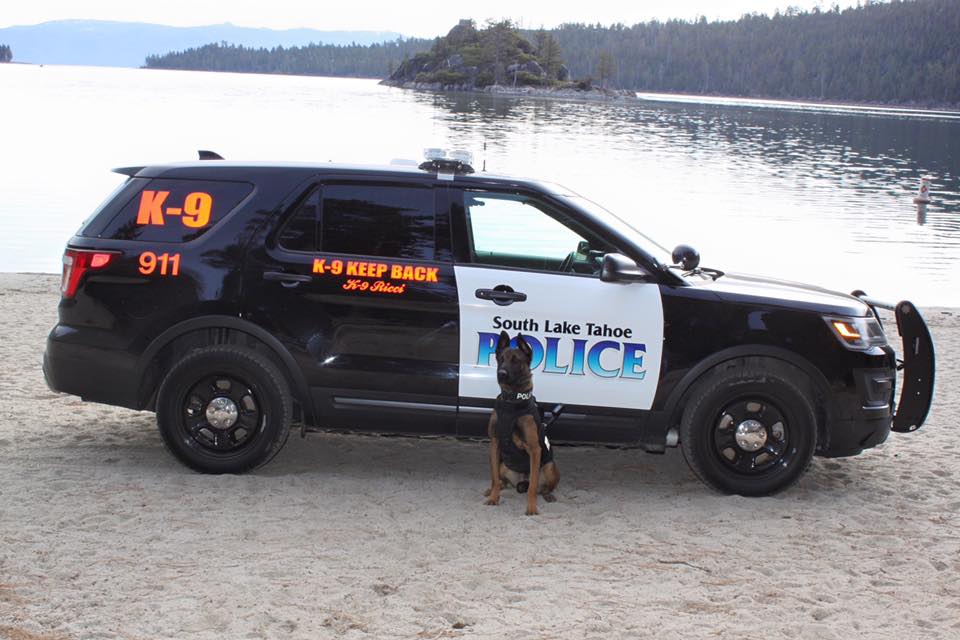
Ricci by his handler's vehicle at Emerald Bay. Photo/SLTPD

Ricci by his handler’s vehicle at Emerald Bay. Photo/SLTPD

By Kathryn Reed

Instead of patrolling the streets of South Lake Tahoe an officer drove out to Emerald Bay and onto the sands in front of Vikingsholm for a photo shoot.

The reason, according to Police Chief Brian Uhler, “To provide a nice photo to Ms. [Lisa] Maloff who donated over $100,000 to the police K-9 program.”

Officer Scott Crivelli’s dog Ricci is sitting next to the police vehicle with Emerald Bay in the background. A non-sworn member of the police department took the photo.

Emerald Bay is not in the city limits. This is also State Parks property. Uhler did not explain why the photo shoot wasn’t done in South Lake Tahoe.

Ricci was authorized to do this by “ranking staff”, which Uhler said he considered “justified”.

When asked if the officer was on overtime, Uhler told Lake Tahoe News, “It was justified, so no answer required for your question.”

Marilyn Linkem, head of the Sierra District for California State Parks, did not return a call or email.

“TRPA code generally does not allow vehicle use on beaches or off-road in stream environment zones,” Tom Lotshaw with the Tahoe Regional Planning Agency told Lake Tahoe News. “That said, there have been exceptions allowed in the past for non-environmentally harmful vehicle-use and equipment on beaches on a limited case-by-case basis.”

Uhler said a park ranger unlocked the gate for the officer to get to the beach.

Uhler said this use of city resources – personnel and vehicles – was a good idea because: “It’s good to promote our organization in a positive way. Community outreach is vital to any police organization.”


Calif. rethinks approach to conserving water in drought

By Scott Smith, AP

Water providers throughout California said Wednesday they want to decide how much water their customers need to conserve during the ongoing drought rather than take orders from the state.

Californians remain under strict state conservation orders that have caused many residents to take shorter showers and let their lawns turn brown even as drought conditions ease.

The State Water Resources Control Board had an informational workshop in Sacramento to chart the future of urban water conservation measures. Regulators are considering if they should toss out the restrictions or dramatically change them.

“It’s our responsibility to be sure we have available supplies to meet demands,” Fiona Sanchez of the Irvine Ranch Water District in Southern California told water regulators at the workshop.

Felicia Marcus, chair of the State Water Board, said she would like to allow local control but fears not all local water officials would provide realistic assessments of their water supplies, leading to the possibility of serious shortages.

Nearly a year ago, Gov. Jerry Brown ordered California’s residents and businesses to conserve water during the state’s driest four-year period on record.

Residents statewide used 23.9 percent less water over the nine months ending in February while under orders to use 25 percent less water compared to the same months in 2013.

Residents are now under orders to cut back through October by at least 20 percent.

Several other districts — particularly in Northern California — propose that the state should toss out or significantly relax emergency conservation orders.

Strict orders remain in place, despite significantly more rain and snow this winter flowing into California reservoirs, water officials say.

Continuing to ask Californians to sustain “heroic water conservation efforts” that don’t reflect healthier water supplies today could erode the officials’ credibility with residents when they’re called upon next time to make sacrifices, David Bolland, special projects manager for the Association of California Water Agencies says in a letter to water regulators.

“It is time to end the State Water Board’s mandatory water use restrictions statewide,” says Bolland, who represents hundreds of urban, commercial and agricultural water districts.

Two Sierra Nevada reservoirs that supply about 31,000 residents in Tuolumne County are expected to overflow, making the emergency regulations there unnecessary, Thomas Haglund, general manager of the Tuolumne Utilities District, wrote to the board.

In a letter submitted by several environmental organizations, Tracy Quinn, a senior policy analyst for the Natural Resources Defense Council, cautioned against abandoning conservation measures in response to outcry from water districts.

There is no certainty of another wet winter and much of the state remains in drought conditions, Quinn said. She added that some adjustment to the drought orders are warranted, but conservation should be a way of life for California.

“California’s water challenges are immense and extend far beyond the current drought,” Quinn wrote.
The board is expected to adopt California’s new conservation method in May.


SLT councilwoman blurs elected, personal lines

By Kathryn Reed

South Lake Tahoe City Councilwoman JoAnn Conner sat in her official chair on Tuesday lobbying for special favors for her business, though she denied that is what she was doing.

Conner, who owns Golden Bear Events, is putting on an event at the South Lake Tahoe Recreation Center this weekend. She went through the normal permitting process – sort of.

The gym, meeting rooms and kitchen each have an hourly rate.

Her permit does not include the kitchen.

At one point Conner seemed flustered, not even sure that the kitchen rental was even a separate item. Coincidentally, on that day’s agenda was an item to finalize the master fee schedule for all city property. City Attorney Tom Watson showed her how the kitchen is separate.

Yet, Conner had been having correspondence with staff for weeks about the kitchen rental.

JoAnn Conner during the April 19 council meeting claims her issue with kitchen rental the rec center is not personal.

JoAnn Conner during the April 19 council meeting claims her issue with the kitchen rental at the rec center is not personal.

In a March 30 email to Lauren Thomaselli, who oversees the rec center, Conner wrote, “I received the contract for the facility rental for the Home and Garden Show, but there is an error. We do not rent the kitchen for this show as the food vendors have their own set up.”

Five hours later, Conner received an email from City Manager Nancy Kerry stating, “JoAnn, Lauren has revised the contract to reflect the change as you have described, no rental of the kitchen.”

The two engaged in another exchange of emails on April 13 regarding access to the kitchen.

Kerry wrote, “In regards to the rental and use of the kitchen, your application indicated Golden Bear Events does not want or need to rent the kitchen, which is why the [facilities use permit] was revised and sent to you without the rental of the kitchen. [On April 12], we heard very clearly from the court that it is very important to you and to the court to be treated the same as every other business and not receive any adverse impacts, as well as any advantage or favor. Any other business or person who uses the kitchen must pay the rental fee. The city’s permit is with [Gold Bear Events] and you requested the application be amended without the kitchen, which results in the kitchen being locked.”

Conner, after the contract was signed, asked for the kitchen to be open without expecting to have to pay for it. At first she claimed it was only to get water to make coffee.

“I just want to clarify the issue of accessing the kitchen just for water has nothing to do with my business. I just want someone to draw that line,” Conner said at the April 19 council meeting. She called the Humane Society a separate entity and said the nonprofit only needed the water for coffee.

The Humane Society actually needs hot and cold running water because it is selling food, and will need to wash utensils. The county Health Department requires access to the water. If it were only a case of potable water, it would be cheaper to bring in gallon jugs than to rent the kitchen at $25 per hour. (Nonprofits receive a 25 percent discount on rentals.)

Conner claims it is all about a vendor needing access – not her. However, all the vendors are working under Conner’s business license and permit. Vendors pay her as the producer of the event to have access to things like running water, electrical outlets, chairs and tables. (However, the Humane Society has been given a free booth.)

The rec center does not charge renters extra for tables and chairs, though event promoters may tell vendors there is a special fee for those things.

Instead of footing the bill for the kitchen, Conner said the Humane Society would have to pay for it.

On April 13, Niki Congero, who heads the Humane Society, emailed Thomaselli, regarding the kitchen: “I think it might be best if we, the Lake Tahoe Humane Society, rent it then as we are the ones using it. When would be a good time for me to pop in and take care of details/contract and whatever you need?”

In the end, an anonymous donor paid for the kitchen rental on the Humane Society’s behalf.

If Conner were to be seen doing something special for anyone because of her real or perceived pull with city staff because of her elected position – like getting fees waived, this would be currying political favor and is unethical at a minimum, and would be potentially illegal. She could have made her points from the public podium and not her council seat to have ethically avoided the conflict of interest.


Study: Climate change will bring worse weather

By Sean Greene, Los Angeles Times
 
Since Americans first heard the term global warming in the 1970s, the weather has actually improved for most people living in the U.S. But it won’t always be that way, according to a study.

Research shows Americans typically — and perhaps unsurprisingly — like warmer winters and dislike hot, humid summers. And they reveal their weather preferences by moving to areas with conditions they like best.

A study in the journal Nature has found that 80 percent of the U.S. population lives in counties experiencing more pleasant weather than they did 40 years ago.

Read the whole story


Dems line up behind McClintock challenger

By Susan Wood

More than 60 people packed a Lake Tahoe Community College room Thursday night to hear Bob Derlet, a Democrat running for the 4th Congressional district, provide a better prescription for government.

He’s running against Rep. Tom McClintock, an Elk Grove Republican who’s been in the seat since 2008 and logged 22 years in the California Legislature before that, having started at age 26 in the Assembly.

When asked by Lake Tahoe News how he plans to unseat an entrenched McClintock when others like retired military officer Charlie Brown failed, Derlet amped up his tone.

“I think people are tired of McClintock. It’s time for a change. This is going to be the most dramatic election we’ll remember in a lifetime, and we’re gonna do it,” Derlet, 66, of El Dorado Hills said as if he’s part of a Democratic movement as a whole.

This race in particular may be difficult. The 4th District is large, encompassing the Sierra Nevada from Truckee to the Sequoia National Forest including Alpine, Amador, Calaveras, El Dorado, Mariposa and Tuolumne, with portions of Fresno, Madera, Nevada and Placer counties. The sprawling region can be a bit overwhelming to a Democrat because it’s half Republican voters, 35 percent Democrat and 15 percent declined to state.

“We’ve got to go after that 15 percent,” Derlet said.
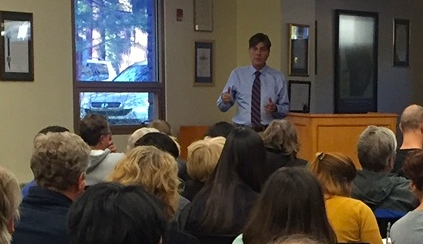
Bob Derlet wants to be the next congressman to represent the California side of Lake Tahoe. Photo/Susan Wood

Bob Derlet wants to represent the California side of Lake Tahoe in Congress. Photo/Susan Wood

There may be a light at the end of the tunnel. The June 7 primary is non-partisan in California, so the two top vote-getters will move on to the Nov. 8 general election – and that will be the real race, Derlet contends. The only other opponent in the primary is Democrat Sean White.

Statistics aside, South Lake Tahoe resident and environmental advocate John Friedrich told Derlet he believes it is “unconscionable” Lake Tahoe, Yosemite and other areas of the Sierra Nevada Mountain Range are represented in the federal government by “a Grade A climate change denier.”

To that, Derlet pledged the global warming phenomenon as a larger priority, joining education, wage equity, consumer rights, Social Security protection, women’s issues and especially health care as other focuses. On the latter, the long time physician admitted to Lake Tahoe News after the April 21 meeting that more work needs to be done on the Affordable Care Act with a monetary shift from administrative to care, but having millions insured when they weren’t before is testimony in itself to good federal policy.

But he spoke to the core of the Tahoe audience when he lauded climate change as “up there” in priorities.

“If global warming is not a priority, what’s the alternative?” he asked.

The South Tahoe Chapter of the Citizens’ Climate Lobby, Tahoe Area Sierra Club and LTCC Ecology Club sponsored the town hall meeting.

Derlet’s occasional declaration brought out cheers and applause from the issues-friendly audience. The cheerleading session made up for the lack in substance in how to address the change that he believes needs to occur.

Some attendees echoed the passion, with one man suggesting using McClintock’s failed natural resources management policies to edge out the career politician.

Another appeared concerned about the Democratic Party, believing it’s divided.

“I think after the conventions, people will come together,” Derlet insisted.

Albeit friendly to his cause, the audience came across more informed than most and at times pressed Derlet to step up the campaign. One person reminded Derlet afterward that he should have asked for money.

In recognizing he’s a little-known candidate, Derlet told Lake Tahoe News his campaign will ramp up soon with signs, more gatherings such as this one and messages in the media.

At age 8, Derlet’s first job involved selling newspapers at the very busy corner of Santa Monica and Vine boulevards in Hollywood. Later in life, he became a physician, eventually leading him to the Me-Wuk Indian Health Center in Tuolumne City. It was there he heard the plights of his patients that prompted him to get into politics.

“I care about people. They need to be protected,” he said.

Derlet comes across with a pleasant, mild-mannered approach. Some would like to see him become a little more aggressive.

“I think he needs to go after McClintock,” resident Kim Carr said after the meeting.

She’s worried about the traditionally low losing rate of incumbents.

“He’s going to have to work hard to get his name out. That’s the dilemma we’re in,” she said.

But there is a bright side.

“I think people are tired of do nothing politics. I think the fact the Republican Party is having a hard time getting behind its candidates with so many factions helps (Derlet’s run),” she added.

Most concurred it’s an interesting time for politics.

“I think the entire election system could be thrown in the air, and anything could happen,” longtime local Laurel Ames said.



Cameras around Tahoe change fight against wildfires

By Scott Sonner, AP

A growing network of cameras trained on the mountains around Lake Tahoe is changing the way crews fight Western wildfires by allowing early detection that triggers quicker, cheaper, more tactical suppression than traditional war-like operations, experts said Wednesday.

The high-definition cameras can be operated remotely to pan, tilt and zoom in the search for the first wisps of smoke in remote areas, said Graham Kent, director of the Nevada Seismological Laboratory.

Equipped with real-time and time-lapse imagery, the cameras piggyback on an existing network that detects earthquakes, Kent told the annual meeting of the Seismological Society of America in Reno.

Last summer, a half-dozen of the hazard cameras at Tahoe were credited with the discovery of six fires and provided early intelligence on more than 25, Kent said.

“The old style of firefighting is like storming the beach at Normandy, but if you can get on a fire early, with special tools, then it becomes more like a special forces situation,” Kent said. “Firefighting is going to become much more tactical.”

He said he’s currently working with firefighters in Idaho and Montana to develop similar networks.

Frank Vernon, a research geophysicist at the Scripps Institution of Oceanography at UC San Diego, began developing the “virtual fire lookout towers” in 2002 when he and others built a large-scale, wireless network in Southern California.

It now includes more than 64 fixed mountaintop cameras in 16 remote locations across San Diego, Riverside and Imperial counties.

“Working with partners to provide this technology to the community is vitally important as extreme drought conditions, warmer weather and more frequent Santa Ana wind events have all contributed to increased wildfire activity and longer fire seasons each year in Southern California,” Vernon said.

The multi-hazard function of the cameras is especially valuable to communities such as Lake Tahoe and Reno that border wildlands,

“The big three for us are floods, fires and earthquakes,” said Kyle West, safety and training manager in Reno. The city is located in Washoe County, where officials recently updated their hazard mitigation plan.

Kent said officials hope to have more than 20 of the cameras up and operating by the end of this year.

“The notion of fire cameras has been out there for 20 years. But they were mostly closed circuit, analogue systems with poor resolution,” Kent said.

The video feeds are available to state, local and federal firefighters and can be viewed by the public on the AlertTahoe website.

UNR scientists are working on technology to use “machine vision — to teach computers to spot the fires without humans,” Kent said.

“We’re sort of crowd-sourcing lookout towers,” he said. “Anybody in this room, if they are feeling anxious or just have a premonition, they can go onto AlertTahoe, right click on the camera pane and see the time lapse. We could have hundreds of people searching for fires at any one time — people who are just basically concerned.”


Wildfires no longer confined to one season

By New York Times

The first Alaska wildfire of 2016 broke out in late February, followed by a second there just eight days later.

New Mexico has had 140 fires this year, double the number in the same period last year, fueled by one of the warmest, driest winters on record.

And on the border of Arizona and California this month, helicopters dumped water on flames so intense that they jumped the Colorado River, forcing the evacuation of two recreational-vehicle parks.

Fires, once largely confined to a single season, have become a continual threat in some places, burning earlier and later in the year, in the United States and abroad. They have ignited in the West during the winter and well into the fall, have arrived earlier than ever in Canada, and have burned without interruption in Australia for almost 12 months.

Read the whole story


Cadre of people working to keep Tahoe clean

By Kathryn Reed

A whole lot of trash talk was going on Wednesday afternoon in South Lake Tahoe.

Those tasked with cleaning up after the rest of us spoke about how the plastic bag ban in the city is working, trash left out for animals to rummage through is still a problem, and that Tahoe does have a bit of a garbage problem.

South Tahoe Refuse in 2014 took in 10 tons of film plastic – the category plastic bags fall into. In 2015, that number fell to 6.6 tons.

While the South Shore garbage company is seeing fewer grocery store bags since the city implemented the ban, there has been an increase in reusable plastic bags – the thicker ones. The value of them is next to nothing when it comes to STR recycling them. Some stores have gone to paper only, like BevMo and Ross.

An advantage to paper is that it breaks down and the money is slightly better as a commodity.

Jeanne Lear with STR explained that to reuse plastic the original item must be shredded, washed, dried, made into pellets and then repurposed.

She said Coca-Cola is developing plant-based bottle to try to get away from using fossil fuels.

Marilee Movius with the League to Save Lake Tahoe touched on the five large masses of plastic floating in the oceans, with the biggest being off the Pacific Coast. Plastic isn’t biodegradable. It just breaks apart into tiny pieces that animals can ingest, and litters the land and waterways.

Her mantra is to not only reduce, reuse and recycle, but to also redesign and refuse. The latter means bringing a bottle, bag, utensils and other items so they are used multiple times instead of being discarded after one use.

The League has also been instrumental in hosting cleanup days throughout the basin – mainly at beaches.

Also at the April 20 talk at Lake Tahoe Community College were reps from Clean Tahoe and Tahoe Regional Planning Agency.

Catherine Cecchi of Clean Tahoe, a nonprofit operating on the California side of the South Shore, last year collected 490 cubic yards of litter that had been illegally dumped. Her crews pick up trash in neighborhoods and along the roads. Mattresses and appliances are often abandoned.

In 2015, Clean Tahoe dealt with more than 600 animal–trash incidents.

“It’s a major problem,” Cecchi said. It’s locals, tourists, owners and renters, single family and multi-family, as well as commercial entities that are putting out trash before pick up day or having dumpsters overflow.

Devin Middlebrook with TRPA spoke about the collaborative effort under way called Take Care. It’s aimed at those who don’t have common sense manners – the ones leaving trash behind, throwing cigarette butts off ski lifts or grinding them into the sand and leaving them on the beach, and not picking up after their dogs. The messages are clever, like “Nobody wants to see your dirty butt” and “If it’s your dog, then it’s your doody”.

—–

Notes:

·      Earth Day is being celebrated April 23 at Bijou Community Park in South Lake Tahoe from 10am-3pm.

·      Dump Day is June 4. For $5, people may unload a pickup worth of trash at South Tahoe Refuse.

·      Report litter issues to Clean Tahoe online.

·      More info about the Take Care campaign is online.

·      The League to Save Lake Tahoe is having a community cleanup day near Heavenly Village on April 22. Go online for details and to sign up.


Squaw faces community opposition to expansion

By Brad Branan, Sacramento Bee

Squaw Valley CEO Andy Wirth knows how to stay calm under pressure.


Since coming to Squaw in 2010 to lead the resort in its “next phase of growth,” Wirth made the decision to buy Alpine Meadows, the ski resort just south of Squaw. He introduced a plan to link the resorts with a gondola next to the federally protected Granite Chief Wilderness. Wirth’s plans for Squaw Valley include a substantial increase in residential and overnight housing, new bars and restaurants and a 108-feet-tall, 90,000-square-foot “mountain adventure center.”

Costs are difficult to estimate because the project will be built over 25 years by developers who will buy rights to the land from Squaw, Wirth said. Squaw Valley’s goal is to bring more skiers to the mountain, not make money from real estate, he added.

More than 300 people and several agencies commented on an environmental review of the project, and most were critical, said Tom Mooers, executive director of Sierra Watch, a nonprofit that has been a leading critic of Wirth and the project. The Placer County Board of Supervisors will eventually be asked to sign off on the project.

Read the whole story


Snow gods are not fair

By Megan Michelson, Powder

In terms of snow, this winter brought the best of times and the worst of times, depending on which coast you’re talking about.

On the West Coast, a much-welcomed El Niño delivered ample snowfall to help ski resorts in California and Nevada recover from the last four years of lackluster winters and drought conditions. Those storms also brought a boost to the economy, with skier visits and ticket sales up and money trickling down to local businesses like hotels and restaurants.

Snowfall data for California hit about average for this season—with resorts like Squaw Valley scoring the most in the Tahoe area with 463 inches, just above the resort’s annual average of 450 inches (last year, by comparison, Squaw got just 223 inches). Mammoth Mountain collected 342 inches of snow, just below their 400-inch average, while Heavenly got 341 inches for the season, hovering around their 360-inch average.

Most snow science experts say that while this year’s average snowpack in the Sierra will certainly help California’s water shortage, it’s not enough to end the drought.

Read the whole story