Bill would benefit U.S. wine industry

By Bill Swindell, Santa Rosa Press Democrat

North Coast Rep. Mike Thompson proposed a series of federal tax breaks Monday for the U.S. wine industry, including a proposal to slash a tax on sparkling wine that has lingered since the aftermath of Prohibition.

The St. Helena Democrat, who owns a vineyard in Lake County, teamed up with Rep. Dave Reichert, R-Wash., to propose a sweeping overhaul of the laws that brought in $1.07 billion in federal excise taxes from the U.S. wine industry during the last fiscal year.

Thompson and Reichert contend the bipartisan legislation will help spur new and innovative products by modernizing federal excise taxes on wine. While the cost of their bill has not yet been calculated, it would provide a major benefit for the North Coast wine industry, which harvested $1.1 billion in wine grapes for the 2015 vintage.

Read the whole story


Snowpack melting fast despite April storms

By Paige Blankenbuehler, High Country News

Throughout late March and into April, much of the West experienced unseasonably warm days. Then, in late April, temperatures plummeted in Southwest Colorado’s San Juan Mountains and more than 2 feet of wet, heavy spring snow fell. Suddenly, ski boots were out again and for a day or two, it felt like winter was back.

But those storms have only helped a small fraction of the West, with much of the moisture buoying snowpack levels along the Eastern Rockies in Colorado and Wyoming. Meanwhile, the rest of the region is on the opposite trajectory, losing snowpack at record-breaking rates.

At the beginning of April, snowpack levels across the region were “near normal,” says Cara McCarthy, deputy director for the National Water and Climate Center in Portland, under the Natural Resource Conservation Service.

But in just the few short weeks since, that snow is melting faster than climate hydrologists have seen in nearly four decades, bringing the snowpack far below normal in most states in the West.

For California, in its fifth year of drought, this season has been a bit of a roller coaster. In January, snowpack readings increased to 127 percent of normal (up from 90 percent in December) — good news for a state where 30 percent of the water supply is dependent on snow.

Read the whole story


Author: Vigorous climate change fight needed

By Linda Fine Conaboy

RENO – Climate change isn’t new news, but it is big news now and its effects are becoming increasingly obvious in the forms of horrendous wildfires, extreme weather conditions and the slow strangulation of some of the ocean’s most beautiful fields of coral.

In the words of journalist, syndicated columnist and best-selling author Naomi Klein, climate change is an unfolding disaster.

Naomi Klein

Naomi Klein

Klein forcefully and without hesitation spoke last week to a large crowd at the University of Nevada’s 2016 Forum for Excellence. This group didn’t have to be persuaded that Klein’s topic is a life-changing consequence of man’s greed and that it isn’t a problem to be dealt with in the future. It’s here and the fallout of climate impacts everyone on the planet.

She opened her talk discussing the December 2015 meeting of world leaders at the Paris Climate Summit, where an agreement was forged to maintain the increase in the average global temperature warming at or below 1.5 degrees Celsius, or 2.7 degrees Fahrenheit. The agreement was formally signed at the United Nations on April 22, leaving many observers scratching their heads, wondering how this aggressive stance will be obtained and then maintained given the world’s continuing dependence on fossil fuels.

According to a press release from 350.org, a group of global activists who have come together to battle climate change, the signing is purely ceremonial until at least 55 countries representing 55 percent of global emissions have ratified it.

Klein calls the Paris Agreements “a concrete plan for disaster. We know what we need to do to stay strong and safe, but we’re only willing to do half of it. What happened in Paris is the best our governments have been able to come up with, but we still have an ecological disaster.”

She said the targets reached in Paris are not binding and there are no repercussions built into the agreement. “The same leaders who set the noble goal of 1.5 Celsius are not really willing to go along with it.

“It was a real fight in Paris to keep climate change below 1.5 degrees Celsius,” she said. “But in Bolivia people depend on glaciers for water. If we allow the climate to warm, many cities will drown.”

Klein said that if we stay on the road we’re now traveling, a temperature increase of 6 degrees Celsius is possible, an untenable figure. “We’re headed there now. Pakistan suffered a heat wave where thousands died and no one even reported on it. India and Pakistan are now in the early stages of a heat wave with another coming next month.”

There was no dodging the fact that Klein is not a fan of the Paris agreement. “The Paris accords are a fake,” she said. “They are just words. Political reality does not match up with reality. We are in such contradiction—our political leaders are not willing to take the needed steps.”

She said she came upon the climate issue later in life—she’s 45 now—describing her previous state as one of “soft denial.” Her wakeup call came 10 years ago when she saw what she called the “tragedy of Katrina” in New Orleans.

“Katrina was ferocious and we’re going to see more Katrina’s as the Earth warms.” She described the dilapidated state of the levees, pre-Katrina, followed by apathy after the heavy weather slammed into the area.

“There was no evacuation plan. If you had money, you could get away; if you were poor, you were abandoned. FEMA couldn’t find New Orleans. This was a case of institutionalized racism,” she said.

Climate change, Klein said, is an accelerant to everything else, making some things uglier and meaner. “Each shock [similar to climate change] will create deeper divisions. Think Flint, Michigan. What makes this possible is perpetual crisis.

“Transition is inevitable, justice is not,” Klein said. “We have to see how the issues are connected.”

According to Klein, we are stuck when it comes to climate change. She calls it a “really bad case of historic timing.”

However, she said that climate change is not a new concept—it’s been acknowledged for decades. She pointed out that as long ago as 1988, Earth was Time’s “Man of the Year”, appearing on the magazine’s cover. That was also the year the first climate change meeting occurred.

But the 1980s were years of many changes such as the fall of the Berlin Wall and NAFTA (North American Free Trade Agreement). These events, according to Klein, meant that capitalism could be brought to the entire world and at the heart of this revolution is privatization.

“It’s hard to regulate privatized entities like railroads and public transit. Climate change is a huge political challenge,” she said.

At this point in her talk, she referenced the challenge faced by those in Nevada who invested in solar energy. “In Nevada,” she said, “the Public Utilities Commission did the bidding of NV Energy, destroying an industry. People are being penalized for doing the right things. Corporate money is corrosive,” she said.

Klein opined that it is difficult for politicians to stand up and take courageous positions, but she mentioned President Obama’s stand on the Keystone XL pipeline, when he cited climate change for the first time. “More victories like this are now being won,” she said.

“We have a lot of no’s when it comes to climate change,” she said. “But we need the yes’s too. If the climate movement is to expand, the movement must articulate what the positive side is.”

She named undertakings like “Black Lives Matter,” where people are refusing to be treated as if they are disposable; fewer fossil fuel projects; women and indigenous people on the front lines; and the BLM’s thwarted push to open public lands for gas and oil drilling as just a few of the positives coming out of the climate change movement.

Fossil fuels, she said, need to stay in the ground. “Small steps won’t help this problem, it’s time for big steps. The time to start is now, but at this late hour, now is not the time for small steps.”

Klein is the author of several books, including her latest bestseller “This Changes Everything; Capitalism vs. the Climate.”



More questions than answers in EDC budget

By Kathryn Reed

El Dorado County has substantial money issues with no obvious solutions.

The Board of Supervisors on Tuesday begins the process to come up with a budget for 2016-17. The fiscal year begins July 1. By law the budget has to be balanced.

The staff report says the county will be nearly $5 million in the hole in 2018-19 if things don’t change. The structural deficit will be part of the discussion April 26.

Even though CAO Larry Combs says the budget is balanced, that’s a bit of misnomer and not everything department heads or electeds want is getting funded.

Combs, in his report, does not suggest any ideas of how to come up with more revenue or to cut expenses. Combs, who is the interim CAO, only works a few hours a week. (One of his other primary jobs is to find a permanent leader for the county.) In the past the CAO has been proactive with the budget, even starting in the fall.

All he offered in his report was, “For any items that the board wishes to add to the budget, something must come out of the budget or a new funding source must be identified.”

The staff report for Tuesday’s session also says, “Use of one-time revenue or one-time savings to fund ongoing operational expenses will not help future year deficit, but will only buy time.”

As with most organizations, salaries and benefits are the biggest drain on the General Fund.

However, the CAO has been driving up those costs. And in doing so he keeps violating board policy when it comes to hires. Anyone hired at step 4 or 5, the latter being the highest, must have this run by the supervisors. Combs hired his friends for the assistant CAO and risk manager positions at the higher levels. The recently appointed chief counsel is also at a higher step. The board has not been brought into the loop on these decisions.

Various county departments put in requests that totaled $7 million more than revenues. There is another nearly $25 million that is also not accounted for and some of those are ongoing expenses.

“Department requests exceed our available revenues by $7 million. If we maintained our ‘status quo’, in other words, no new positions or other appropriations increases and no decreases to department revenues, the budget would be balanced. Requests came in $7 million higher than status quo,” Laura Schwartz, chief budget officer, told Lake Tahoe News.

The job of the electeds is to prioritize spending. There will be several budget hearings in May, with approval set for June.

Schwartz in an email that Combs was copied on did not explain why General Fund money is not being used for road maintenance when this has been the norm for years. This $3 million line item is part of the nearly $25 million that isn’t being funded.

Also not in the budget is the $2.2 million needed to pay the debt on the new sheriff’s headquarters.

“We have purchased the property for the new public safety facility, but we are still researching financing options,” Schwartz said. “You are correct. Currently we do not have funding to build the facility allocated.”

The unfunded list also contains $1 million for land use litigation. In other words, there is no money budgeted to fight the lawsuit challenging the General Plan. Neither Schwartz nor Combs explained how the lawyers would get paid.

One item the five all agreed to was approved last week when they allocated $256,651 in property taxes – annually – to El Dorado County Hills Fire Department. This is the richest fire district in the county.

They went against Auditor-Controller Joe Harn’s recommendation. He told them in writing, “I believe that it will be a major challenge to continue to provide existing services at current levels in future years.”

This is also the same fire district from which Supervisor Brian Veerkamp receives an annual pension of approximately $200,000 from having been the fire chief. He voted for the allocation, even made the motion, without anyone stating this is a conflict of interest.


Sierra trees getting cut to prepare for summer

By Marc Benjamin, Fresno Bee

Once bathed in deep green, the forests in the foothills and Sierra east of the San Joaquin Valley are increasingly turning reddish-brown as drought- and beetle-weary trees die by the month.

It is a somber warning of a potentially dangerous summer.


A study next month examining trees from the air is expected to report a near doubling of the 29 million trees already reportedly dead or dying. In 2014, it was already a crisis when 3.3 million trees had fallen prey to the infestation, said Daniel Berlant, communications director for CalFire.

“From the top of Kern (County) to Tuolumne County is the hardest hit,” Berlant said. “But we are seeing tree mortality moving farther north into the Placer County area at the top of Lake Tahoe.”

Read the whole story


Grandeur of Denali doesn’t disappoint

Publisher’s note: This is one in a series of stories about the National Park Service, which is celebrating its 100th anniversary in 2016.

The road to Denali. Photo/Jacob W. Frank/NPS

The road to Denali leads to a world of outdoor wonder. Photo/Jacob W. Frank/NPS

By Kim Wyatt

DENALI NATIONAL PARK & PRESERVE – After almost four hours on the bus, the driver pulled to the side of the road and opened the door.

“Little Stony Creek.”

We heaved our backpacks over our shoulders and stepped off. The bus receded in the distance. We stood in a massive valley, surrounded by broad-shouldered peaks, rolling tundra and absolute silence.

All my problems rolled away with the bus. Across the valley floor, I saw two boulders tumbling down a green slope. I pulled out my binoculars: They weren’t boulders; they were baby grizzly bears, playing. In one swift motion mama bear stood, growing twice in size, nose in air.

S hit,” I said. “We’ve got to go.”

My hiking companion and I headed up a creek bed and were soon in a small canyon, out of any range I hoped the adult grizzly would find threatening. The hike itself was typical of my experience in Alaska: periods of tundra and rocky streambeds punctuated by river crossings and something I rarely encountered in Tahoe, fear. Of animals, wet feet, the elements. Even in mid-summer, the weather was ever-changing—it looked as if the turbulent sky might rupture any minute. And around seemingly every corner were enormous piles of what looked like regurgitated berry pie: grizzly scat. So we’d sing louder to keep them away, maybe every song I remember from the ’70s. By the time we reached camp I had just exhausted my Tony Orlando and Dawn repertoire.

I rarely thought about dying when backpacking in Yosemite or Desolation Wilderness. But I did in Alaska.

It’s the scope of Denali National Park & Preserve that gets you. At 6 million acres, it’s the third largest national park in the U.S. (the top two are also in Alaska). It contains the highest portion of the magnificent Alaska Range, glaciers and massive rivers spilling into grand valleys. Conservationist Charles Sheldon and dog musher Harry Karstens first wintered in Denali in 1907. Deeply moved by their experience, they lobbied Congress to establish Denali as a national park to conserve wildlife. In 1917, Mount McKinley National Park was created; the park name was changed in 1980 to include the native Athabaskan word “Denali,” meaning “the high one.” I wanted my whole life to see this massive peak, but clouds had obscured previous attempts. At 20,310 feet, Denali creates its own weather, and doesn’t show itself easily.

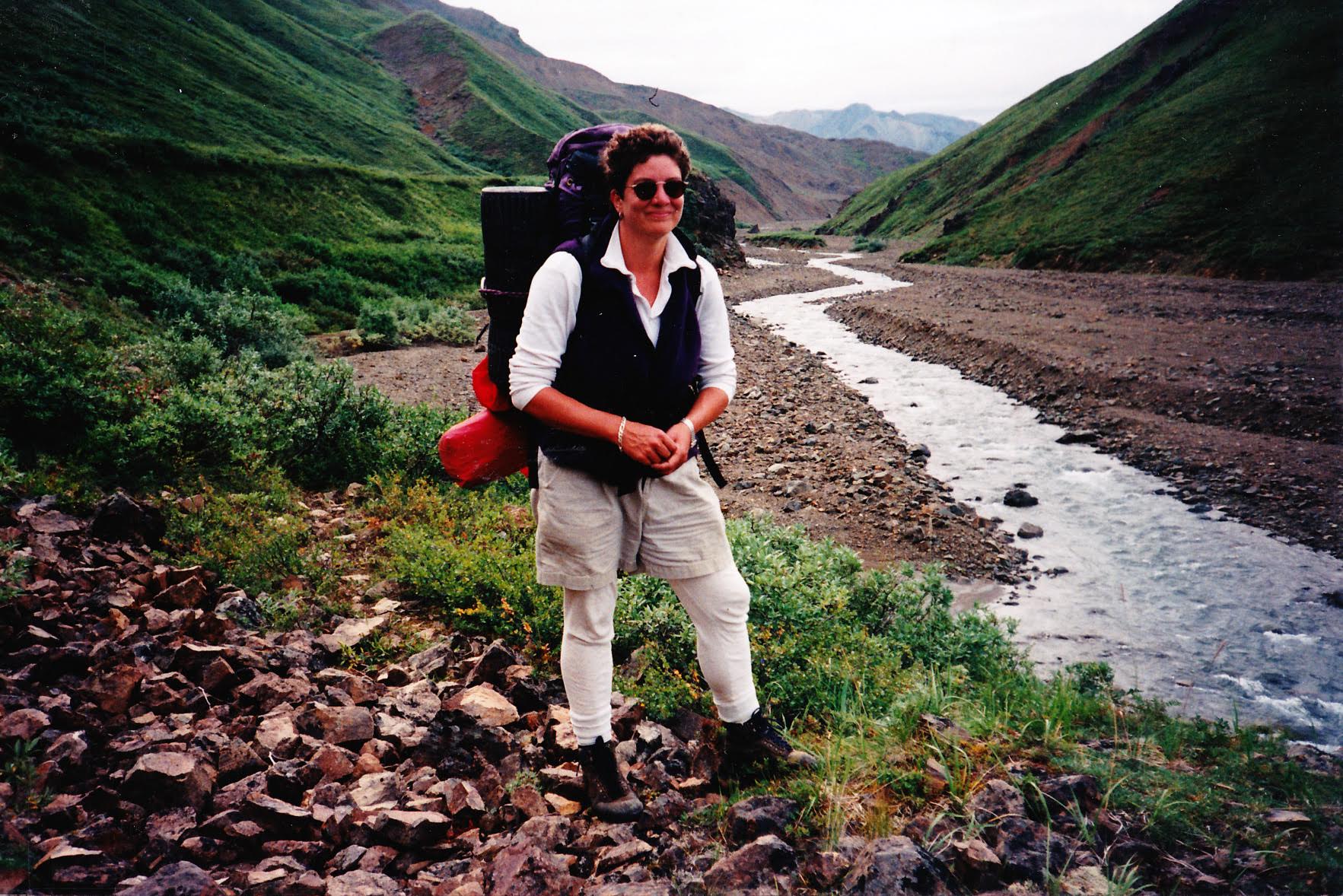
Kim Wyatt backpacks through the wilderness of Denali National Park & Preserve. Photo/Provided

Kim Wyatt backpacks through the wilderness of Denali National Park & Preserve. Photo/Provided

Except for a lottery held twice a year, cars are not allowed on the road inside the park. If you plan to backpack, before being issued a permit you must watch a video on Denali’s humbling weather, the Golden Triangle—your tent, cooking area and bear canister must be at least 100 yards from each other—how to cross a wide, braided river and, finally, advice on bear, wolf and moose encounters. (For example, never run from a grizzly or a wolf. But if charged by a moose in open terrain, run in a zigzag pattern. It’s a lot to remember, how to run/not run.)

Then you can apply for your permit. Denali National Park & Preserve is made up of 87 units, and you have to choose your unit before you apply. There are quotas and limits to the number of people allowed in each one to avoid the kind of scene you have at popular trails in other parks. And then you take a converted school bus to the trailhead. When you’re done hiking, you come out and wait for the bus.

Only four people were allowed in our unit. We never saw the other two.

You must apply for your permit in person. Because Denali is not exactly on the beaten path–it’s about a five-hour drive from Anchorage, where I lived—you should be ready to roll. We’d been warned to have three or four options, as the most popular hikes might already be at their limit. All of our choices were booked, so we took a ranger’s recommendation of Stony Creek, one of her favorites, a hike with varied scenery, and if we were lucky, a superlative view of Denali on a rare clear day. (Weather is something else you need to worry about in Denali. Cloud cover necessitates knowing how to use a map and compass.)

I’d lived and worked in Yosemite for a decade before I moved to Alaska and I felt confident about my trail skills. The problem—or the beauty—in Denali is once you get off the bus, there are no trails. There are no signs. The rivers are wider than highways and there are grizzly bears and wolves and moose that you should run/not run from. And walking on taiga and tundra, rather than granite, is not as easy as it sounds. Alpine tundra is low and scrubby, but brushy tundra is soft: two steps forward, one step back.

After dinner, the clouds hunkered down and we lost any view we might have had, so we retreated to the tent. A few hours later, I woke to the sound of footsteps in front of the tent. My heart seized: Would I stupidly die in grizzly country? But the steps were light, and multiplied until they sounded like castanets. Rain on rocks, perhaps. I peered out the tent’s avalanche chute to see caribou, one after another, walking single file past the tent in twilight. It turned out that we were sleeping on a caribou migration route. I opened the tent door and watched them pass until falling back to sleep.

In the morning, the tent glowed bright yellow. The sun was out! I jumped from my bag and hopped outside and there was Denali in all its glory. My jaw dropped.

An ecstatic current ran through me. While the world around me awoke, the massif held my gaze—a form of communication beyond the corporeal plane. The intimacies of the park were more captivating than its scope: Up close with grizzlies and caribou. Birds and berries. Just me and a grand slam view of Denali in full sun. Places like this change you; they settle your soul.

Why is it important to preserve these wild spaces? Although conservation of species and habitat is crucial, humans need these wild spaces, too. We need the places where we can escape from the pressures of modern life and reconnect to our best selves. Writer Wallace Stegner had it right when he said, “National parks are the best idea we ever had. Absolutely American, absolutely democratic, they reflect us at our best rather than our worst.”

A few years ago, a close friend with cancer asked me to take her to Yosemite National Park before she died. Walking near the Ahwahnee Meadow, she said incredulously, “This belongs to all of us.” I’d never thought of it that way, but, yes, it does. And the more time we spend in our parks, the more likely we are to care for them. Saving our wild landscapes is saving ourselves.

Kim Wyatt is the publisher of the independent press Bona Fide Books, which published “Permanent Vacation: Twenty Writers on Work and Life in Our National Parks”. She worked in Yosemite National Park for 13 years.

Note: Information on backpacking in Denali National Park & Preserve may be found here.


Calif. jurors misusing Internet could face fines

By Sudhin Thanawala, AP

Jurors who threaten to derail trials by researching them on Google or posting comments about them on Twitter are often dismissed with nothing more than a tongue-lashing from a judge.

But that may soon change in California. Legislation supported by state court officials would authorize judges in some counties to fine jurors up to $1,500 for social media and Internet use violations, which have led to mistrials and overturned convictions around the country.

As jurors and judges have become more technology savvy in recent years, the perils of jurors playing around with their smartphones have become a mounting concern, particularly in technology-rich California. A 2011 state law made improper electronic or wireless communication or research by a juror punishable by contempt.

Supporters of the latest California measure say a potential fine would give teeth to existing prohibitions against social media and Internet use and simplify the process for holding wayward jurors accountable.

“It’s disruptive of the judicial process, and there ought to be a fairly simple and convenient way for a judge to sanction a juror based on the order that the judge has given,” said Assemblyman Rich Gordon, D-Menlo Park, who authored the legislation.

But critics question whether it will have any practical effect on jurors who are constantly on sites such as Facebook and Twitter and suggest judges vet the social media activity of potential jurors before seating them.

“If you have an Internet addict who just can’t psychologically stop, you may want to excuse that person,” said Paula Hannaford-Agor, who studies juries at the National Center for State Courts.

Brian Walsh, a judge in the Silicon Valley county of Santa Clara, said a fine could also change the dynamic between judges and juries.

“You want to present the jurors’ obligations to serve as an inviting opportunity to participate in the democratic process,” he said. “One could consider it counterproductive to be laying out all the penalties a juror can incur if they blow it.”

It is not clear exactly how many times juror social media or Internet use has affected trials. But anecdotal evidence suggests it is more than sporadic.

Eric Robinson, co-director of the Press Law and Democracy Project at Louisiana State University, said he used to track cases of juror social media or Internet misconduct using news accounts and other sources, but there were so many “it got to be more trouble than it was worth.”

“Those are the ones we hear about,” he said. “I’m sure it happens a lot more.”

An Arkansas court in 2011 threw out a death row inmate’s murder conviction in part because of Tweets. One said “Choices to be made. Hearts to be broken.” Another said “It’s over” less than hour before the jury announced its verdict.

A New Jersey appeals court in 2014 tossed the heroin possession conviction of two men after a juror was accused of searching the defendants’ names online and finding information about their criminal records.

A California appeals court in January cited juror Internet research in throwing out a fraud conviction against an investment firm CEO. The juror looked up a case involving an accountant the defendant blamed for the fraud.

Judges warn jurors against using social media and the Internet, and have the power to hold them in contempt if they violate those rules.

Greg Hurley, a lawyer who studies juries at the National Center for State Courts, said he is unaware of any state that fines jurors outside the contempt process.

California judges say the contempt process can be time consuming and is rarely invoked. A juror facing contempt has a right to an attorney, and the court could get bogged down in a lengthy formal hearing. So judges often opt to replace a wayward juror with an alternate to keep the proceedings moving.

“Historically, contempt has been something judges are told, ‘Don’t do,'” said J. Richard Couzens, a retired judge from California’s Placer County who now rotates through courts around the state. “You have to follow so many rules to institute a contempt process.”

Couzens, a member of the judicial committee that recommended the fines legislation, said he dismissed a juror years ago in a theft case for using a cellphone to figure out the value of a stolen item.

The fine would be similar to a traffic citation, making it relatively easy to dispense, Couzens said.

Judges could mention it when warning jurors against Internet and social media use, said Steve Austin, presiding judge in California’s Contra Costa County.

“At the very least with the sanction, it would be a good thing you’d be able to tell the jurors,” he added.

The legislation initially called for giving all state judges the power to fine wayward jurors. But it was scaled back after legislators expressed concern that it could dissuade potential jurors from serving.

The bill now authorizes the judiciary to select some county courts for a five-year pilot program, which a legislative analysis said could save participating courts money. It is before the full assembly.


Ballot measure would end NV Energy monopoly

By Michelle Rindels, AP

A proposed ballot measure called the Energy Choice Initiative aims to deregulate electrical service in Nevada, opening up the market to providers other than NV Energy — the sole provider in most parts of the state. Here’s how it came about and what it could mean for consumers.

Nevada laws allow investor-owned utility companies to be monopolies in their service territories. The governor-appointed members of the Nevada Public Utilities Commission act as a substitute for the competitive forces of the market, approving or rejecting rate changes so companies like NV Energy can make a reasonable profit but aren’t gouging customers.

The regulated monopoly model has emerged over the past century as the state sought to make it worth companies’ while to bring expensive electrical infrastructure to Nevada, but critics say the model is outdated as it becomes cheaper to generate energy and as renewable energy sources become more mainstream.

The initiative petition would enshrine in the Nevada Constitution the right for customers to choose their energy provider and to produce their own power to sell to others. It directs the Nevada Legislature to pass laws authorizing an open, competitive electricity market by mid-2023.

The proposed constitutional amendment notes that lawmakers don’t need to deregulate electricity transmission or distribution. That means businesses and homes might buy electricity from different providers, but a single company could control all of the power lines in a given service territory.

Several major Nevada companies have tried to leave NV Energy’s network in recent years and make or find their own power. They include Wynn Resorts, MGM Resorts and Las Vegas Sands, which consume massive amounts of electricity at their 24/7 casinos and might be able buy cheaper power on wholesale markets.

The Public Utilities Commission allows the companies to leave the grid but is charging them one-time “exit fees” of $86.9 million for MGM, $15.7 million for Wynn and $23.9 million for Sands, with the potential of additional fees in the future.

Regulators say big companies’ departures could leave the broader customer base stuck with the bill for infrastructure that takes decades to pay off, and was built assuming big companies — which account for 7 percent of the utility’s customer base — would keep paying into the system.

The companies have challenged the fees but so far haven’t prevailed.

A PAC called Nevadans for Affordable, Clean Energy Choices filed the initiative petition in February, but the group has not identified its backers and isn’t required to disclose its donors until May 24. Among the companies who have recently pushed to leave the monopoly, MGM Resorts officials say they are not associated with the initiative, while Wynn Resorts officials say the company hasn’t taken a position on the measure or contributed to the PAC.

Representatives for the Las Vegas Sands declined to comment when asked whether they supported the ballot measure or donated to the affiliated PAC.

Electric carmaker Tesla and data storage company Switch have publicly supported the measure, saying it fits in line with their company values and would create opportunities in renewable energy.

NV Energy is not fighting the measure. CEO Paul Caudill says the company wants what’s best for Nevada and is willing to “work in a constructive fashion” on the issue of deregulation.

Lawmakers laid the groundwork to deregulate Nevada’s electrical utilities in the late 1990s and early 2000s.

But as Nevada worked toward that goal, instability emerged in neighboring California’s newly deregulated electrical markets. Electrical bills spiked and power shortages led to rolling blackouts during the energy crisis in 2000 and 2001.

Amid fears deregulation was too risky, then-Gov. Kenny Guinn halted the project in Nevada.

Petition supporters need to gather about 55,000 valid signatures from Nevada voters to qualify the measure for the November ballot. The deadline to submit the signatures to the counties for verification is June 21.

If the measure meets the signature threshold, it must prevail on the 2016 and 2018 ballots before it becomes part of the state constitution.

PAC lawyer Matt Griffin says the petition has been well-received, but couldn’t say how many signatures it’s gathered yet.

The measure comes at a time when Nevada consumers are especially tuned in to energy issues. Regulators approved higher rates last year for customers with rooftop solar panels, and solar companies that laid off workers because of the change are supporting a separate, widely publicized ballot measure to reverse the rate change.

Deregulation has taken different forms in the numerous states that have pursued it, and experts say it can be a good or a bad thing for consumers depending on how it’s executed. Opening up an electricity market can drive competition and lower prices, or it can come with new problems, such as exposing customers more directly to rate hikes and enabling the rise and ultimate collapse of companies, like that of energy giant Enron.

The proposed constitutional amendment is vague and gives the Legislature wide latitude on how it develops a deregulated structure.

Rebecca Wagner, an energy consultant and former member of the Public Utilities Commission, says she would like proponents to offer more specifics about how they’d go about deregulation before she could say whether it’s the right way to go.


SLT Public Works — the backbone of the city

Azril Kalik with South Lake Tahoe explains snowplow operations. Photo/Kathryn Reed

Azril Kalik with South Lake Tahoe explains snowplow operations. Photo/Kathryn Reed

By Kathryn Reed

South Lake Tahoe would not function without the Public Works Department. Employees do the little things like change light bulbs, the medium work such as maintaining the parks, and the big stuff – snow removal, fleet maintenance and erosion control.

In terms of staff, it is the largest in the city.

Some of the department’s responsibilities include:

·      Maintaining and plowing 258 miles of roads

·      115 lane miles of curbs and gutters

·      29 miles of storm drain pipe

·      13 miles of drainage channel

·      1,800 drainage structures and basins

·      More than 7,000 signs/stakes

·      125,519 feet of bike paths/shared use trails

·      35 acres of landscaping

·      Interior/exterior of 33 buildings, equaling 226,000 square feet

·      348 acres at Lake Tahoe Airport

·      Entire fleet – nearly 250 vehicles.

Managers from the various sectors of Public Works gave an overview last week to members of the Citizens Academy. The free seven-week course is designed to give residents a better understanding about how the city works as well as an opportunity to ask questions of staff. (This reporter is part of the current class.)

“We don’t really repair anything, we restore stuff,” Alan Johnson, maintenance manager for facilities said. This goes for the buildings – some are older than the city, which turned 50 last year.

The same could be said of the aging fleet of vehicles, especially the snow removal equipment. The oldest is from 1970. Even so, the goal still remains to clear every street within 24 hours of a storm.

“There’s a misconception that the gate stops the berms,” Azril Kalik, who manages streets and snow, said. “We work 12-hour shifts until the snow is gone.”

The city’s fleet includes:

·       Airport – 19 vehicles, average age 21 years

·       Parks and Recreation – 43 vehicles, average age 18 years

·       Public Works – 97 vehicles, average age 17 years

·       Fire – 19 vehicles, average age 12 years

·       Other/admin – 11 vehicles, average age 11 years

·       Police – 60 vehicles, average age 9 years.

The department is also the lead on many projects in the city ranging from Bijou Bike Park to Lakeview Commons to stormwater installations.

“A lot of what we do is invisible,” explained Jason Burke, who heads the stormwater division.

This is because so many of the vaults collecting sediment are underground. These are in place so the water reaching Lake Tahoe is as clean as possible.

What gets built though – whether it’s with local, state or federal dollars – eventually is the city’s responsibility to maintain it. That is a key factor officials have to ponder before accepting grant funding – will the city be able to afford the maintenance and operation?

In listening to the general public’s needs, the department launched a work order request form on the city’s website so people can ask for a pothole or something else to be fixed. This is intended to be more convenient and efficient for everyone.

In the last year the department has gone through a reorganization that has employees being cross trained and a succession plan created so as upper managers leave-retire the younger staff will be able to apply for those jobs. Seasonal employees have been hired full time to make all of this work more efficiently in terms of time and money.


2016 on path to be hottest on record

By Tom Randall, Bloomberg

The Earth is warming so fast that it’s surprising even the climate scientists who predicted this was coming.

Last month was the hottest March in 137 years of record keeping, according to data released by the National Oceanic and Atmospheric Administration. It’s the 11th consecutive month to set a new record, and it puts 2016 on course to set a third straight annual record.

Now, it might seem premature to talk about setting a new yearly record after just three months of data, but these months have been such an extreme departure from the norm that Gavin Schmidt, who directs NASA’s Goddard Institute for Space Studies, has already made the call.

Read the whole story