Tahoe Keys struggles to manage invasive weeds
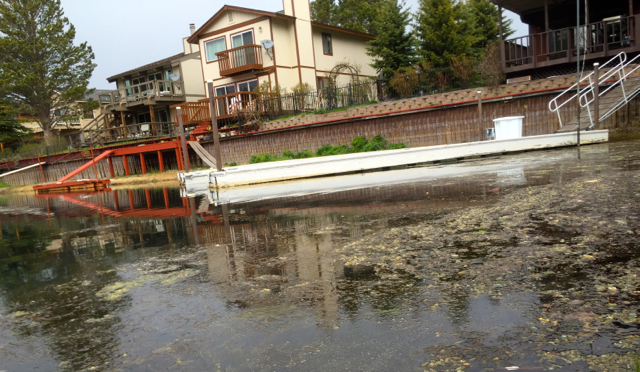
Milfoil was first discovered in the Tahoe Keys in the 1980s and curly pondweed in 2003. Photo/LTN

Milfoil was first discovered in the Tahoe Keys in the 1980s and curlyleaf pondweed in 2003. Photo/LTN

By Kathryn Reed

STATELINE – In less than a year, the Tahoe Keys Property Owners Association has started to backpedal when it comes to being adamant herbicides are the only way to rid the South Lake Tahoe canals of invasive weeds.

At the Tahoe Regional Planning Agency Governing Board meeting this week representatives of the housing development shared that field demonstrations will be conducted this summer with the goal of having a long-term solution in place for 2017. The TKPOA board two weeks ago allocated $250,000 for this summer’s work.

The Keys is the No. 1 source for invasive weeds, with Eurasian milfoil, curlyleaf pondweed and coontail being the most predominant. The weeds affect 90 percent of the lagoons.

At a meeting last August the solution was herbicides.

What has slowed down that potential reality is the number of comments to the draft Integrated Management Plan for Aquatic Invasive Weeds. Many people want other alternatives to be investigated. And while killing the weeds with ultraviolet light was pooh-poohed by authorities at last summer’s meeting, that is no longer the case.

John J. Paoluccio, president of Inventive Resources Inc., was in town last fall to demonstrate how UV light works. People were impressed. So much so that either the Keys or Lakeside Marina is likely to be a testing ground this year.

The Keys also plans to use herbicides in a test situation in isolated tanks on land. This will show how the plants respond to different chemicals.

Before any herbicide could be used in the lake the Lahontan Regional Water Quality Control Board would need to sign off on it. That board has already said the idea of limited use of herbicides on a case-by-case basis would be taken under consideration.

There are 10-deadend lagoons. Those would likely be the first to receive herbicide.

Dye is going to be put into the mouth of the Keys’ two entrance points to see where the current takes it and how fast. This relates to what would happen if an herbicide were used. Dye was used farther back in the canals last year as a test, with the colored water not moving far.

One Governing Board member asked if native species would be harmed. The answer – they shouldn’t be.

While harvesting the weeds is considered a nuisance in some ways because particles are spread and it never solves the problem, tweaking the process may have different results. A fragment capture boat will be deployed to scoop up the remnants. GPS tracking and paying better attention to the wind are other changes.

A water circulation mechanism was installed when the Keys was built in the late 1960s. It has not been used for a couple decades. TKPOA is going to see what it would take to get it operational again.

Another board member asked about the possibility of closing off the two main channels to be able to isolate the Keys in order to deal with the weed problem. While tidal gates exist, a big problem is there is boat traffic year-round. A bigger problem is that the three owners involved with the waterways in the Keys are not all on the same page.

TKPOA and Beach and Harbor Association are in agreement about things that need to be done. The owners of the marina are not cooperating, according to TKPOA and TRPA officials. Because the marina has a different type of permit than the homeowners, there is only so much pressure that can be applied.



Calif. gun-control bill headed for fall ballot

By Christopher Cadelago, Sacramento Bee

Lt. Gov. Gavin Newsom, the architect of an omnibus gun-control initiative to require background checks for ammunition, said Thursday that the campaign has collected enough signatures to qualify for the fall ballot.

Newsom planned to submit roughly 600,000 signatures for his “Safety for All,” initiative on Friday, far more than the required 365,000.

“I feel resolved to move forward. The voters I think are ahead of a lot of elected officials of all political stripes,” Newsom said of taking the issue to the ballot. “We have a chance to do something that’s permanent, that can’t be watered down, and send a very potent and powerful message to the National Rifle Association that we think will resonate across the country.”

Read the whole story


North Tahoe tax revenues continue to climb

By Lake Tahoe News

Even though the number of permanent residents is declining in North Lake Tahoe, second home ownership and tourism is increasing.

Placer County Deputy Chief Executive Officer Jennifer Merchant gave supervisors an update this week on services, programs, and projects delivered to citizens in the eastern part of the county. Part of the presentation highlighted the growing economic divide.

North Lake Tahoe area property taxes saw a 9 percent increase since last fiscal year. This is being attributed to the growth in second homes.

The hotel tax is also on the rise, in large part because tourism is growing. The North Lake Tahoe region had 822,000 visitors in 2002, while 10 years later that number had grown to 1,037,000.

The transient occupancy revenue was more than $12 million in 2014-15. Sixty percent of that goes back into the community to provide marketing services, increased transit services and visitor related capital projects such as bike trails and beach maintenance.

Merchant told the electeds that in the last 10 years more than $32 million in TOT funding has leveraged $235 million in private, local, state and federal funding sources to enable Placer County to complete nearly 100 Tahoe area projects such as the Kings Beach Commercial Core Improvement Project, Tahoe City Transit Center, Commons Beach Restoration and bike trail expansion and improvement.

While tourists are spending money, not all locals are doing well. This is evidenced by the number of people applying to the CalFresh (aka food stamps) program. The number of applications more than doubled over a five-year period in eastern Placer County with 2,020 applications in 2010 growing to 4,430 applications in 2015. That number is expected to grow this year.

“The increase in permanent residents needing social services is very concerning,” Supervisor Jennifer Montgomery. “We need to understand how to address this in eastern Placer County and understand how it relates to a lack of affordable housing and economic opportunities.”


Tourism experts: Experience trumps product

By Kathryn Reed

A pretty lake and casinos. That combo is no longer enough. That is why Lake Tahoe needs to up its game if it’s going to keep attracting tourists.

That was an overriding message delivered this week by those in the industry.

Lynn Carpenter, vice president of marketing for Visit California – the state tourism agency, said her people are focused on showing the California experience. It’s sharing the California lifestyle, a place where visitors can have an emotional connection to wherever they are visiting.

California has lost a segment of the tourism market in the last few years. It used to be that 52 percent of travelers came to the state; it’s now 45 percent.

One thing helping the overall state effort is that the marketing budget has grown from $6 million in 2006 to $150 million today. Promotional material includes television ads, online pieces, written propaganda, and offices in foreign countries. There is information on the state website that can also be used by local tourism agencies as well as individual businesses.

Marketing material from Visit California. Photo/LTN

Marketing material from Visit California. Photo/LTN

Carpenter along with Carl Ribaudo of South Lake Tahoe based SMG Consulting spoke April 26 at the annual tourism conference put on by Lake Tahoe Visitors Authority and Lake Tahoe South Shore Chamber of Commerce.

“It’s not just the thing you have in your destination. It’s about how interesting you are and the connections that people make,” Ribaudo said.

The whole point is that the product is different than the experience. Old school is to have focused on the product. Memories have always been what people take away from a vacation. Tapping into that in a deeper way is what the experts say needs to happen.

“We talk about lifestyle. They want to live like a Californian,” Carpenter explained.

The marketing zeroes in on the outdoors, culinary, entertainment, culture and luxury.

This was the first winter for Catch the Winter Wave — outdoor fun in California  in winter. Crews will be in Mammoth next week filming snowboarding sensation Chloe Kim at her home resort. That footage will be used for next year’s campaign.

“We love talking about the snow product when we’re overseas,” Carpenter said. This is because so many foreigners equate the state with just beaches and Disneyland.

Family travel is also big, capturing 42 percent of the market. That is one reason the state has come up with a second video targeting kids. It will be called Welcome to Kidifornia. Carpenter wouldn’t divulge any specifics.

Tourism is big business in the Golden State, accounting for $121 billion in revenues in 2015 and more than 1 million jobs.

Visit California divides the state into 12 regions, with Tahoe being in the High Sierra. In 2014, $2.6 billion in direct spending is attributed to tourism in this region, there were 28,000 jobs, and local tax dollars totaled $98 million.

Statewide, Canada, China, United Kingdom, Australia and Japan account for the most international visitors. For the South Shore, it’s Germany, Canada, United Kingdom, Australia and China. The High Sierra is the only region where Germans are the No. 1 visitor. This is attributed to their love of the outdoors.

Ribaudo is a believer that arts and culture need to be a larger component of what the South Shore offers because those are things people connect to. He wonders why all the art created at the three-day SnowGlobe music festival isn’t out in the community.

He also doesn’t believe the area tells its history in a compelling manner, if at all.

“We need to make every part of the South Shore interesting,” he said. “It’s the little things that matter.” This includes right down to the bike racks. For what is supposed to be bike friendly town it’s hard to know cyclists are welcome if they have no place to park.

He showed pictures of other locales that are doing things better – like Oceanside with its abundance of bike racks, public art in obscure towns, and funky restaurants that are destinations unto themselves.

“What will keep people coming here is if we are real and authentic,” Ribaudo said.


Calif. bill would allow landlords to ban pot

By Alexei Koseff, Sacramento Bee

With legalization looming on the horizon, California lawmakers are already grappling over how to treat marijuana in a state with some of the strictest tobacco regulations in the country.

A bill from Assemblyman Jim Wood, D-Healdsburg, would extend to medical marijuana a 2011 law that permitted landlords to prohibit the smoking of cigarettes and other tobacco products on their rental properties. If voters pass a November ballot measure legalizing recreational use, it would apply to all marijuana.


California law already prohibits smoking medical marijuana anywhere tobacco is banned, which includes most public places. But the bill sponsor, the California Apartment Association, said it is important to give landlords explicit authority to forbid pot smoke on their properties, since it can create tension among tenants.

Read the whole story


Tahoe boat inspections keeping invasives out

By Kathryn Reed

STATELINE —  It’s working.

That was the message Dennis Zabaglo, Tahoe Regional Planning Agency’s aquatic resources program manager, delivered to the Governing Board on April 27 about the boat inspection program.

The program started eight years ago without everyone being on board. Since then, though, other lakes have started inspection programs, boaters have learned the importance of having a clean boat and invasive mussels have not reached Lake Tahoe.

In 2015, there were 6,800 local inspections, 2,300 decontaminations and 40 boats with invasives intercepted. These numbers are similar to 2014, but less than previous years. This is attributed to the low lake level keeping people away.

Zabaglo said the decrease in decontaminations is also attributable to boaters understanding the “clean, drain, dry” philosophy so invasives are not transported from one water body to another. Boats are the No. 1 way aquatic invasive species enter a lake.

Lake Tahoe is home to clams, weeds and fish that are invasive. To date, though, the more dangerous quagga and zebra mussels have been kept at bay. Last year investigators stopped one boat with an invasive mussel. In prior years about a dozen came through the inspection line. Most of those were from the Great Lakes area.

With Nevada officials implementing a screening of all boats leaving Lake Mead, that, too, is curtailing the spread of the mussels.

The mussels can ruin water supplies, filtration systems, the ecosystem, watercraft and potentially the economy.

TRPA is continuing to work with Truckee on inspections in waterways just outside the basin like Donner Lake.

Zabaglo said the five- and 10-year goals include creating more enhanced, permanent inspection facilities, which in turn would pay for themselves. Some could be like mini visitors centers. A grant is being applied for that would fund these.

The boat inspections resume May 1 from 8:30am-5:30pm.

They are located at:

• Meyers: The junction of highway 50 and 89, seven days.

• Spooner Summit: Junction of highways 50 and 28, seven days.

• Alpine Meadows: Highway 89, off Alpine Meadows Road north of Tahoe City, Thursday-Sunday.

• Truckee-Tahoe: Highway 267, off Truckee Airport Road, Thursday-Sunday, opens May 19.

Fees are staying the same. They have not changed since 2014. Boats only accessing Tahoe pay $30, while boats coming in and out of Tahoe pay based on the length of the vessel, with the most common price being $86.

Inspections also are necessary for Fallen Leaf and Echo lakes users. Boaters need to get inspected and decontaminated prior to going to those ramps, with Meyers being the closest loction. Neither of those lakes has any invasives.

The inspection program costs about $1.5 million a year. Half of that comes from the inspection fees, the other half is divided equally between California and Nevada. This is the first year the states have funded the inspections. Prior to that more than half came from the feds via the Southern Nevada Public Lands Management Act.

One board member asked if it’s possible for boaters to sneak in when inspectors are not on site.

“Boaters are compliant. They understand,” Zabaglo said.

TRPA also did a “secret shopper” scenario last year with an outside agency to test inspectors. They all passed. That type of oversight will continue.


Opinion: An officer and a friend

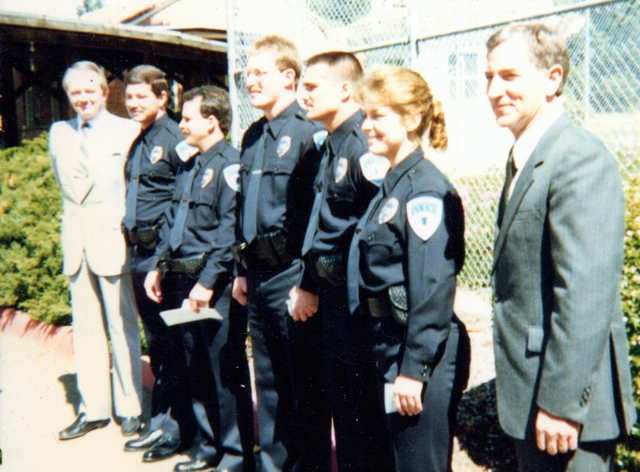
Donna Kingman, second from right, retires today after spending her entire career with the South Lake Tahoe Police Department. Photo/Bill Kingman

Donna Kingman, second from right, retires today after spending her entire career with the South Lake Tahoe Police Department. Photo/Bill Kingman

By Kathryn Reed

In retrospect, having your roommate clean her service revolver when your date is coming over for the first time might not be the best idea. It did, however, keep what’s his name in line. I just don’t remember a second date.

Today is South Lake Tahoe police Officer Donna Kingman’s last day on the job. She is retiring after having started with the department in December 1987.

Hers is a storied career in many ways. When she was 8-years-old with her family on vacation in Southern California there was some police incident that she recalls being the coolest thing – she just doesn’t remember exactly what it was. That led her to want to be an officer. She begged and begged her dad to buy her a pair of handcuffs. He finally did.

Through her youth her desire to be an officer never wavered. Kingman went to CSU Sacramento where she majored in criminal justice. The South Lake Tahoe native knew she wanted to work for her hometown department. While she tested with others, she was one of five who was hired that December. About 600 had applied.

In her tenure she has worked for six full-time chiefs and two interims. She’s been part of some of the biggest cases – like the murder at Campground by the Lake in 2001. Kingman was working in detectives at the time. (In 2003, Lisa Platz was found guilty of the murder of her 9-year-old daughter, Rebbeca Aramburo. The child was found with her throat slashed inside a tent at the campground. Platz was sentenced to life in prison. Her boyfriend James Csucsai hanged himself in jail.)

I met Kingman in September 1988 when I first moved here. She lived in the apartment below me on 13th Street. Being the same age and single it led to many nights out at the Cantina, which we could walk to, and to Lily’s to dance. It was inside High Sierra, which is now the Hard Rock. It seemed like a weekend ritual with us.

Unfortunately, Kingman remembers the night she dragged me out of there and I all I could say was something about my shoe.

“I don’t know whatever happened to that shoe,” she laughed. I don’t either. “You had to hang your head out of my car because it was new.” I don’t remember enough to argue with her memory. We both agree I didn’t get sick.

Kingman had a Camaro and as two women in our early 20s we thought we were pretty cool cruising around in it. The heater would be on and the sunroof open. They were fun, carefree days – and nights, and really early mornings.

I was covering cops for the Tribune at the time. My boss thought this would provide with me intel. Wrong. Her boss was worried. No need to be. To this day Kingman has always been loyal to the department. I’ve also never asked for anything that would compromise our friendship.

During that stint at the Trib I thought it would make a great story to try out for the department, but not let the higher ups know. This was when SLTPD had an obstacle course. That was first test; the written, psych evaluation and other stuff came later.

I ran into a 6-foot wall. Literally. More than once. Kingman was in charge of that particular obstacle. She told me to place my foot on the wall, jump, grab the top and haul myself over. This was a slick, wood wall. I thought her instructions were stupid until they worked.

“I remember at the end of that you were like ‘oh, my god’. I think about two hours later you were on the couch and you didn’t want to move,” Kingman said. My selective memory has no recollection other than I completed the course and gained a tremendous amount of respect for those carrying a badge.

By then we were roommates; renting a house on South Shore Drive. Eventually another officer, Lori Scott, joined us. This was before she married her current husband.

Oh, the fun we had.

I left Tahoe for bigger papers, but Kingman and I stayed in touch. I came back for her wedding that was in town, with the reception at the Ridge. Then our calls and letters dwindled, before becoming non-existent. (This was pre-texting and emails.)

When I came back in 2002 I learned she was still at the department. By then she had a son – who is now 19. Our lives were different. I was managing editor at the Trib then. We were friends, but not. We didn’t – and still don’t – socialize. We’ve never been to each other’s house. And, yet, I still consider her a friend. We wave when we see each other. She picked me up in her patrol car when I was on foot because my car was in the shop. (I figure she can’t get in trouble for that now.) Ironically, it’s her dad, Bill Kingman, who does the “Then and now” articles for Lake Tahoe News who I am better friends with.

Oh, the laughs Donna and I have had in the last few weeks reminiscing about life in our 20s. Now we’re both 50.

She always seemed to be in the thick of things. A pursuit she was on not long after being hired remains the longest in the department’s history. She followed the suspect from here to Sacramento – making it there in 32 minutes. The dude wasn’t happy a woman caught him.

At times there were three women patrol officers on one shift, plus the sergeant. Suspects thought a guy should be called. Even if there were one to call, one wasn’t needed.

“Most people who did wrong know they did wrong. I try to treat people decently so I am not adding to their issues,” Kingman said.

But she is also guarded about her personal life. Retribution is a real part of being a cop – even in South Lake Tahoe. Someone once broke into her home and killed her dog. That’s not the only incident.

She’s had to pull her gun many times, but never fired it. However, she has been there when her colleagues pulled the trigger. Taser – that was more her instrument of choice.

Some cases have stuck with her more than others. The near fatal slashing of Susie Rizk Laney is one of those. It was a case that necessitated the department to bring in a psychologist for officers to talk to.

There’s the Adam Rose case. He was on his bike when a drunken driver hit him. From there the two formed a bond.

“Adam Rose is up and walking around and doing his thing,” Kingman said with a softness that speaks to their friendship that formed after the incident.

Then there was the juvenile rape victim whose case she handled while in detectives.

“We had a connection and have a friendship as a result of that to this day,” Kingman said. “When she comes in to see me she is so successful today. It is so awesome to see through the darkest time there is this shining star living her life.”

Like anyone, there are things she would do differently, what with hindsight being 20-20. But she would not choose a different career or another town.

Thanks for the memories, my friend. Good luck in retirement. Go see the redwoods, the cherry blossoms, sleep in and please give me the exclusive when you find Bigfoot.


Sandoval may sue if BLM won’t pony up for mustang roundups

By Scott Sonner, AP

RENO – Nevada Gov. Brian Sandoval is considering legal action to force the U.S. Bureau of Land Management to pony up some money to pay for roundups of wild horses in the state that have been put on hold because of federal budgetary constraints.

BLM State Director John Ruhs asked agency leaders in Washington, D.C., earlier this month to approve funding for a series of gathers in northeast Nevada’s Elko County where ranchers are being asked to curtail livestock grazing due to lingering drought.

The federal agency currently plans no large-scale roundups in Nevada this year because of budget shortfalls driven largely by the cost of housing more than 45,000 mustangs now in government holding facilities across the country.

Sandoval says if BLM’s parent Interior Department refuses to provide the necessary funding, he’ll “pursue all legal options” to protect Nevada’s ranchers and rural communities.

The Republican governor in a statement Tuesday said the BLM has “underfunded the wild horse program for years.”

“For too long, Nevada has been forced to compensate for the federal government’s inability to manage these growing populations without the appropriate resources,” Sandoval said.

Nevada is home to nearly 28,000 wild horses — more than half of the 47,000 estimated in 10 western states, including Arizona, California, Colorado, Idaho, Montana, New Mexico, Oregon, Utah and Wyoming.

BLM argues the range can sustain less than half that many — about 12,000 in Nevada and 26,000 nationally.

Sandoval said BLM’s latest estimates indicate there are more than 5,000 wild horses in a series of herd management areas in southern Elko County alone — three times more than BLM maintains is appropriate for that region.

Nevada Department of Agriculture Director Jim Barbee said ranchers could face anywhere from a 25 percent reduction to elimination of grazing altogether on federal lands in Elko County where they have permits to graze their cattle through the end of the year. He said those restrictions could have as much as a $1.8 million negative impact on Elko County’s economy.

Nevada Department of Wildlife Director Tony Wasley said many of the areas with the horses contain habitat critical to the greater sage grouse at risk of being degraded.

Deniz Bolbol of the American Wild Horse Preservation Campaign said private livestock grazing on public land far outweighs the negative impacts mustangs have on sage grouse habitat.


World would be out of water if everyone ate like Americans

By Nathan Halverson, Reveal

If the rest of the world ate like Americans, the planet would have run out of freshwater 15 years ago, according to the world’s largest food company.

In private, Nestle executives told U.S. officials that the world is on a collision course with doom because Americans eat too much meat, and now, other countries are following suit, according to a secret U.S. report titled “Tour D’Horizon with Nestle: Forget the Global Financial Crisis, the World Is Running Out of Fresh Water.”

Producing a pound of meat requires a tremendous amount of water because farmers use tons of crops such as corn and soy to feed each animal, which require tens of thousands of gallons of water to grow. It is far more efficient when people eat the corn or soy directly.

The planet is a on a “potentially catastrophic” course as billions of people in countries such as India and China begin eating more beef, chicken and pork like their counterparts in Western countries, according to the 2009 report released by WikiLeaks and first reported by Reveal at the Center for Investigative Reporting in a cache of water-related classified documents. The Chinese now eat about half as much meat as Americans, Australians and Europeans, a figure that continues to rapidly rise as more Chinese are lifted out of poverty and into the middle class.

And Nestle – which makes Gerber baby food, Nescafe, Hot Pockets, DiGiorno pizza, Lean Cuisine, Stouffer’s, Nestea, Dreyer’s and Haagen-Dazs ice cream– is deeply concerned.

Here are some of the takeaways, with key quotes from the secret report:

Global water shortages are just around the corner.

“Nestle thinks one-third of the world’s population will be affected by fresh water scarcity by 2025, with the situation only becoming more dire thereafter and potentially catastrophic by 2050.”

Major regions, including in the United States, are being drained of their underground aquifers.

“Problems with be severest in the Middle East, northern India, northern China, and the western United States.”

Excessive meat-eating is driving water depletion.

“Nestle starts by pointing out that a calorie of meat requires 10 times as much water to produce as a calorie of food crops. As the world’s growing middle classes eat more meat, the earth’s water resources will be dangerously squeezed.”

There’s plenty of water to feed everyone a diet that’s not so meat-centric.

“Nestle reckons that the Earth’s maximum sustainable freshwater withdrawals are about 12,500 cubic kilometers per year. In 2008, global freshwater withdrawals reached 6,000 cubic kilometers, or almost half of the potentially available supply. This was sufficient to provide an average 2500 calories per day to the world’s 6.7 billion people, with little per capita meat consumption.”

The American diet is eating the world dry.

“The current U.S. diet provides about 3600 calories per day with substantial meat consumption. If the whole world were to move to this standard, global fresh water resources would be exhausted at a population level of 6 billion, which the world reached in the year 2000.”

This is an even bigger problem now that other countries are eating like America and the global population’s set to grow by 2 billion by 2050.

“There is not nearly enough fresh water available to provide this standard to a global population expected to exceed 9 billion by mid-century.”

So what’s Nestle’s prediction for the future? Think “Mad Max” …

“It is clear that current developed country meat-based diets and patterns of water usage do not provide a blueprint for the planet’s future. Based on present trends, Nestle believes that the world will face a cereals shortfall of as much as 30 percent by 2025. (Nestle) stated it will take a combination of strategies to avert a crisis.”

Why is this the first time you’re hearing this from the world’s largest food company?

“Sensitive to its public image, Nestle has maintained a low profile in discussing solutions and tries not to preach … the firm scrupulously avoids confrontation and polemics, preferring to influence its audience discretely by example.”


Millennials redefining travel marketing

By Kathryn Reed

Millennials are not something to be feared, laughed at or ignored. They are merely the next generation.

These 18- to 34-year-olds are here and they aren’t going anywhere. What they are doing, though, is changing how those in the tourism industry think. And if people aren’t changing their thinking, they are bound to lose out on this burgeoning segment of the population that is hitting the road.

That was part of the message delivered to a packed room at Lake Tahoe Resort Hotel on April 26. Lake Tahoe Visitors Authority and Lake Tahoe South Shore Chamber of Commerce put on the annual three-hour tourism confab.

Millennials are all about the experience and then sharing it – usually via a mobile device on social media. They want authenticity.

“A connected village is the heart of the new economy,” Jason Broadwater said. “The defining characteristic of millennials is digital and social connectivity. Millennials are digital natives. They don’t know a world without it.”

Broadwater is founder and president of the Internet marketing company RevenFlo, which is based in Rock Hill, S.C. He spoke Tuesday about millennials and the new economy.

He said this generation’s priorities when traveling are:

·      Experiencing new culture – 86 percent

·      Local food – 69 percent

·      Partying – 44 percent

·      Shopping – 28 percent.

About 72.2 million millennials live in the United States. California is home to 6 million of them, while baby boomers account for 4 million. California is the No. 1 state for millennials to visit.

Their adolescence has also been extended, with 36 percent of them still living at home. What is different compared to prior generations, according to Broadwater, is that this is not seen as a social failure.

Often their parents are baby boomers. This extension of the familial circle means that generation is redefining what it means to be older.

Millennials also see themselves as being part of a local culture and a global citizen at the same time. They are collaborators who share information and resources. They don’t buy into institutionalized hierarchy.

This also ties into their work lives where many are entrepreneurs and not part of the traditional 9 to 5, Monday-Friday world.

Connectivity is their motto – in terms of work, play and travel.

“They are less territorial. They share everything,” Broadwater said.

To attract them to the South Shore, Broadwater said, “Let the locals tell their stories in an authentic conversational platform.”