Beetle infestation poses fire risk in California

By Amy Graff, San Francisco Chronicle

A determined beetle the size of a rice grain is drilling into California’s trees, turning the lush forest blanketing the Golden State into a sea of dead wood that’s highly flammable.

The most recent data from 2015 estimates bark beetles have killed over 29 million trees, and Cal Fire Education Officer Amy Head said that number is now higher, increasing the fire risk even more.

“They’re this itty bitty bug that can do an enormous amount of damage,” Head said. “This bug is literally changing the face of our state.”

Head is encouraging homeowners who live in urban interface areas to clear dead trees from their yards in preparation for the fire season.

Read the whole story


DRI seeds clouds using unmanned aircraft

Drone America's Todd Richman, pilot, and Kyle Pruett, engineer and pilot, prepare to test fly the Savant sUAS with cloud seeding flares at the Hawthorne Industrial Airport in Hawthorne, Nev. on Friday, April 29, 2016. The Savant flew to 400 feet and was successful in igniting two silver-iodide cloud seeding flares. CREDIT Kevin Clifford, Drone America

Drone America’s Todd Richman and Kyle Pruett prepare to test fly the Savant sUAS with cloud seeding flares at the Hawthorne Industrial Airport on April 29. Photo/Kevin Clifford, Drone America

By Sean Whaley, Las Vegas Review-Journal

For the first time in aviation history, a fixed-wing unmanned aircraft has successfully tested a cloud-seeding payload during an experimental flight in Nevada.

Flown at Hawthorne Industrial Airport under the state’s Federal Aviation Administration Unmanned Aircraft Systems Test Site designation, the Drone America Savant aircraft reached an altitude of 400 feet and flew for about 18 minutes Friday.

The drone — named the “Sandoval Silver State Seeder” in honor of Gov. Brian Sandoval’s support for the state’s drone industry — deployed two silver-iodide flares, successfully testing and demonstrating its ability to perform unmanned aerial cloud seeding operations.

Read the whole story


Lab expands shared work space concept in SLT

Mountain Lab in South Lake Tahoe is bringing different businesses under one roof. Photo/LTN

Mountain Lab in South Lake Tahoe is bringing different businesses under one roof. Photo/LTN

By Kathryn Reed

Working in isolation is not always an ideal situation. But renting office space in a prime location is expensive. Then there are all the other costs – utilities, snow removal, signage. And on the South Shore parking can be a problem.

Mountain Lab is the answer. (They’ve let the Tahoe in the name go to give them marketing opportunities in other locations in the future.)

Ginger Nicolay-Davis of Help U-Sell Real Estate is already in her space, as is the Tahoe Daily Tribune.

“I love the Mountain Lab concept. I am so excited to go to work in a place surrounded by like-minded professionals,” Nicolay-Davis told Lake Tahoe News. “I truly feel energy begets energy and I think the Mountain Lab is going to be the business center of the community.”

 Companies renting space at Mountain Lab: Admios  Aliens From the Future BL Friedman Creative CB Umbrella Group Century 21, Tahoe Paradise Climate Parents Code for America, Tahoe chapter Cooperative Tahoe Inc. Darke Marketing Enovity Filament Gringos Handelin Law Help U Sell Lake Tahoe Inka Direct Lake Tahoe South Shore Chamber of Commerce, Tactical Team  Lara Miller PR Level Frames RO Anderson Sage Engineering Satin Legal SMG Tahoe Daily Tribune Tahoe Heritage Foundation TCS Digital Marketing Waddell & Reed Wells Fargo Wildscape Engineering. Source: Mountain Lab

Companies renting space at Mountain Lab:
Admios
Aliens From the Future
BL Friedman Creative
CB Umbrella Group
Century 21, Tahoe Paradise
Climate Parents
Code for America, Tahoe chapter
Cooperative Tahoe Inc.
Darke Marketing
Enovity
Filament
Gringos
Handelin Law
Help U Sell Lake Tahoe
Inka Direct
Lake Tahoe South Shore Chamber of Commerce’s Tactical Team
Lara Miller PR
Level Frames
RO Anderson
Sage Engineering
Satin Legal
SMG
Tahoe Daily Tribune
Tahoe Heritage Foundation
TCS Digital Marketing
Waddell & Reed
Wells Fargo
Wildscape Engineering.
                                       Source: Mountain Lab

Nineteen of the 24 private office spaces have been rented.

David and Jamie Orr are relocating the Ski Run business they opened a couple years ago to the old Tahoe Daily Tribune building that they bought. It will officially open May 15.

They have partnered with Bernard and Cristi Creegan. Bernard Creegan is the general contractor. It will be Cristi Creegan and David Orr running the day-to-day-operations.

For anyone who has been in the building that fronts Highway 50 and Harrison Avenue they won’t recognize the inside. The main entrance is to the left of the building when facing it, at the back end of the city owned parking lot. David Orr admits the parking lot – which the Lab’s clientele may use – was a huge draw.

The old front entrance leads to where the shared work areas are. This is for regulars and drop-ins. About 30 percent of the Lab’s business on Ski Run had been people working there on an irregular basis – people on vacation, here seasonally, or needing a place to bring clients/customers.

The old back entrance on the right that the editorial staff used will be how people enter to get to the 49-person conference room. This can be used by those already in the building or rented by an outside entity.

The façade has been overhauled. The old Tribune sign will be going to the Lake Tahoe Historical Society. The morgue – newspaper speak for where archives are kept – had been in a dingy upstairs location. Much of the material is with the historical society. The space no longer exists, instead there are high ceilings. Some of the infrastructure of the building will remain exposed.

This old building had been renovated a few times – at least in the late 1980s and 2003. It still needed help.

Insulation has been added, more windows installed and single pane ones replaced with double pane. Large ceiling fans are on a sensor to push the warm air down. Lights are new, too. The hope is the energy efficiency will drop utility bills in half.

The drywall is quiet rock, which is designed to control sound. Floors are stained concrete.

Included in a business’ rent are utilities and Internet. It’s up to them to pay for a landline.

Individual offices range from 93- to 230-square-feet. The Tribune takes about 2,500-square-feet. That is about what the total space of the Ski Run location had. This building is about four times the size of that one.

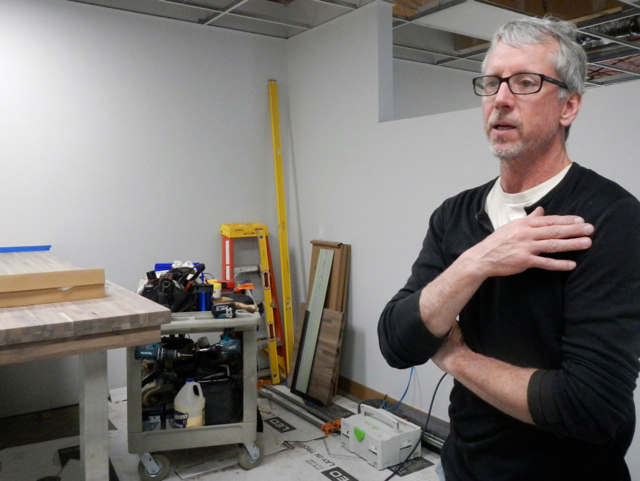
Bernard Creegan is one of the four owners of Mountain Lab as well as the contractor on the renovation. Photo/LTN

Bernard Creegan is one of the four owners of Mountain Lab as well as the contractor on the renovation. Photo/LTN

Brenda Knox with Waddell & Reed Financial Advisors said the space and location will be great for clients. She is also “looking forward to the energy of working in a collaborative space with other business people.”

Everyone has access to shared areas. The break room, so to speak, is what the general public enters through first. The south facing entrance is bright and airy with plenty of natural sunlight. Old books from Ken Smith, one of the first doctors on the South Shore, fill one section. Wall art is more than just something to look it. It is made out of recycled cotton, which absorbs sound instead of merely deflecting it.

One thing the Orrs learned from the Ski Run site is there has to be a separation between work and social spaces.

Jose Ribera-Quinonez, Rafael Ayon-Meza and Ceja Gonzalo create a new look for an old building. Photo/LTN

Jose Ribera-Quinonez, Rafael Ayon-Meza and Ceja Gonzalo create a new look for an old building. Photo/LTN

When people walk through the doors toward what used to be the front of the building, it is considered a quiet zone. This doesn’t mean it will be library quiet, but there will be a sense of respect that work is taking place, people are on the phone, clients may be in the building and professionalism should be the norm.

There are shared spaces in the work area too. A hallway will have white boards on it; a setting for impromptu brainstorming sessions.

Another thing the Orrs learned is people want a shower at work. This is because so many of these workers are living the Tahoe lifestyle – meaning they may bike to work, ski part of the day or play outside midday. But they want to be clean at work.

“The Mountain Lab is about selling a lifestyle and community in many ways,” Orr said.

Community is a big part of the concept – with people mentoring each other, helping and collaborating. Many also socialize together.


Drought-stricken Calif. boosts conservation

By Scott Smith, AP

Residents of drought-stricken California doubled their water conservation efforts in March compared with the month before by turning off their sprinklers when the rain fell and changing habits, officials said Tuesday.

Cities and businesses used 24.3 percent less water compared with the same time in 2013. That’s twice the saving from the dry month of February, when the savings hit an all-time low of 12 percent, water regulators announced at a meeting in Sacramento.

“This is the most welcomed news I’ve had in a long time,” said Felicia Marcus, chair of the State Water Resources Control Board. “In the rain, people know to turn off their sprinklers.”

March was a cooler and wetter month, and officials also credited Californians with changing their habits, especially when it comes to watering their outdoor landscaping, which consumes half of a home’s water use.

Conservation since mandatory cutbacks began in June 2015 has saved enough water to serve 6.5 million people for one year, or 17 percent of the state’s population, officials reported.

March is the first month under relaxed conservation requirements. Californians are expected to use at least 20 percent less water, a break from the previous nine months ending in February when Californians were under stricter orders to conserve by 25 percent.

A nearly average amount of rain and snow this winter has eased California’s dry spell, filling key reservoirs in Northern California. Officials warned, however, that the state remains in a drought.

This month state regulators in Sacramento are busy writing a new method for conservation in the five-year drought that will be implemented in June. They have said requirements could be reduced in some areas and maintained in others.

The easing drought has prompted many local water districts to say they want to set their own conservation targets. Other water districts say the state should completely drop the drought emergency because key reservoirs in Northern California are nearly full.

New regulations, however, with likely keep in place some level of conservation requirements, officials said.

“Californians have risen to the occasion and acquired habits and skills to conserve,” said Jelena Hartman, a state water board senior scientist for climate change. “I believe this is showing the commitment Californians have for conservation.”


Tahoe water district sues Douglas County

By Kathryn Reed

Water customers at the lake say they are suing Douglas County because they are being forced to subsidize another water company, which is against state law, and therefore they are being discriminated against.

“If the county means what it says and every water system must stand on its own, then they need to split Uppaway from Cave Rock,” Brett Tibbetts told Lake Tahoe News. “We are subsidizing their $1 million tank and their operation system. That is illegal under Nevada law.”

Tibbetts is one of 50 people named in the lawsuit. He and the others are customers of the Cave Rock/Skyland Water System, but make payments into the Cave Rock/Uppaway Enterprise Fund.

Douglas County District Attorney Doug Ritchie did not return multiple calls.

In 2010 the county was looking at consolidating all the public water districts, but opted not to because of perceived inequities. Four years later the thinking changed to having the lake consolidate without the valley. It progressed to the point where twice the commissioners approved such a deal.

The final vote, though, had them reversing course and that is where things stand today – fractured.

“Despite the county’s adopting a policy of each community’s standing on its own to pay for its water system, the county continues to lump together a select portion of the ratepayers in the Cave Rock/Skyland System (i.e., those ratepayers in the disadvantaged communities) in a manner in which these selected ratepayers subsidize the Uppaway System since it has such a small base of ratepayers,” the court filing says. “This is in direct violation of the county’s policy that each community water system must stand on its own. And it is discriminatory against the ratepayers in the disadvantaged communities since ratepayers in the Skyland System and ZWUD [enterprise funds] have no similar responsibility to subsidize the Uppaway System.”

There are four public water entities in the county at Lake Tahoe – Cave Rock, Zephyr Woods Utility District (ZWUD), Skyland and Uppaway. But they aren’t completely separate. Cave Rock and Skyland are one operating system, meaning they use the same pipes and intake systems from the lake, as well have a shared water filtration-purification plant.

Rates are a different matter. Per a county decision, Cave Rock and Uppaway customers are together in an enterprise fund, meaning they share expenses/revenues. These water customers pay $195 per month, which is one of the highest rates in the basin.

(Cave Rock Water System includes residents from Cave Rock Estates, Hidden Woods, Lakeridge, Lincoln Park, Bedell-Lyons, as well as a few others.)

Uppaway has 31 customers who use groundwater. Physically, there is no connection between this water system and Cave Rock. Cave Rock/Skyland has 516 customers who get their water from the lake.

“We are not trying to come down on Uppaway. We would have been fine with consolidation,” Tibbetts said. “We are saying the way it stands today is unfair and illegal.

“We think they have been hypocrites,” he said of the county commissioners.

The crux of the matter is the plaintiffs want to be treated fairly and for the county to follow the law.

“We are open to any number of ways to solve it. We just don’t want to be the only ones at the lake that are discriminated against when it comes to subsidizing another water company,” Tibbetts said.


EDC sheriff told to slash budget by $4 mil.

Dwindling ammunition supplies at EDSO could affect training. Photo/LTN file

Dwindling ammunition supplies at El Dorado Sheriff’s Office could affect training. Photo/LTN file

By Kathryn Reed

El Dorado County supervisors appear to be putting the hiring of a public information officer and swimming pool over fully funding the sheriff’s department.

There is a $7 million budget deficit for the fiscal year that starts July 1. Instead of recommending cuts, the board last week told acting CEO Larry Combs what to spend money on that is not currently in the budget.

On April 26 the electeds agreed they want a PIO, road maintenance and to pay the debt for the new public safety facility, along with money for Placerville’s pool and other items.

It’s Combs’ job to appease the electeds.

But at no time during that meeting was the possibility of slashing the sheriff’s budget by $4 million brought up. In fact, Combs still has not spoken directly with Sheriff John D’Agostini, even though the sheriff has requested a meeting. It was an analyst in the CAO’s office who told the finance guy in the sheriff’s department about the cuts.

“We have not increased anything in the six years I’ve been here,” D’Agostini told Lake Tahoe News. “It seems every time there is a shortfall, they ask for the money from us. I am tired of being the Bank of El Dorado County.”

Combs also isn’t returning Lake Tahoe News’ call. And without information from that office it’s unknown how the entire deficit will be erased, let alone money found for what the supervisors want to fund. (Legally, the county has to have a balanced budget. Using reserves is not a sustainable, long-term solution.)

“I’m hoping the CAO’s office gives me a call and we can work this out instead of them digging their heels in,” D’Agostini said.

Supervisor Sue Novasel also didn’t respond to an inquiry from LTN about the sheriff’s budget and what her priorities are for the overall budget.

Cutting positions would be one option for the sheriff. Each position, on average, is about $125,000/year. This includes all benefits. This coming year he wanted to hire a detective, technicians and deputies to the tune of $1.6 million. Not funding those still leaves a $2.4 million hole.

The sheriff’s department had to make cuts for this fiscal year. Ammunition is one thing that is not fully funded, so the sheriff no longer has the supply on hand that he prefers. Regular trainings and certifications require the officers fire their weapons.

Part of his request for the upcoming fiscal year was funding to get the stock of bullets back to a level he deems responsible.

“I’m frustrated right now,” D’Agostini said.

Most years the budget is being worked on almost year-round. Not so this year. Department heads are usually notified at the beginning of the year about potential cuts. This gives enough time for thoughtful decision-making. Combs didn’t employ this strategy. It doesn’t help that Combs works part time, lives in Auburn and is essentially a temp worker.


Tourists spending big bucks in California

Tourists gather around the fire pit this winter at the Ritz-Carlton, Lake Tahoe. Photo Copyright 2016 Carolyn E. Wright

Tourists gather around the fire pit this winter at the Ritz-Carlton, Lake Tahoe. Photo Copyright 2016 Carolyn E. Wright

By Kathryn Reed

California’s tourism industry is coming off its sixth consecutive record year, and South Lake Tahoe is part of that trend.

“We are looking at an industry that is about 2.5 percent of the state’s economy,” Caroline Beteta, Visit California president and CEO, said during a conference call this week. “This tremendous growth indicates that growth in the industry will continue through 2016 and beyond.”

She was lauding the stats from the annual tourism report that came out this week with numbers from 2015.

Total direct travel spending in California was $122.5 billion in 2015, which is a 3.4 percent increase over 2014.

“That could cover the state’s general fund for a year,” Beteta said.

The document includes South Lake Tahoe’s uptick in hotel taxes. In 2006, $11.932 million was collected; with 2015 being the first year since then to top that figure. 2015 transient occupancy tax collections were $12.708 million. In 2009, it dropped to an 11-year low of $8.271 million.

More money was spent on domestic air travel — $34.3 million, reflecting a 3.4 increase from 2014.

However, the international market remains a mainstay for California, especially Chinese travelers.

“That’s the fastest growing market I’ve seen in my career,” Beteta said. “When we entered that market we saw 899 percent growth in 10 years, and between 2014 and 2018 we’re looking at 65 to 70 percent growth. There’s about $2.6 billion in overall spending coming out of that country.”

Sixty percent of the tourism dollars spent in the Golden State comes from other states or countries.

One thing state officials are worried about is currency fluctuations.

The report states, “The recent decline in the value of other currencies in relation to the dollar has reduced the growth of spending by international visitors.”

The tourism sector accounts for more than 1 million jobs. This is a spike of 3.7 percent compared to the prior year.

“That’s $41.3 million directly into the pockets of employees,” she said.

When asked whether these jobs are primarily low-end entry level, Beteta said that’s not the case across the board.

“This is becoming more and more a career choice. That’s reflected in that more and more higher education institutions are offering programs and certificates in travel and hospitality,” she said.

Beteta also touched on how tourism jobs attract all ages, ethnicities and genders.


7 units lost in South Lake Tahoe fire


Fire destroys seven condos in Tahoe Keys on May 3. Photo/Kathryn Reed

Fire destroys seven condos in Tahoe Keys on May 3. Photo/Kathryn Reed

By Kathryn Reed

Old construction is one of the main reasons so many units in a Tahoe Keys condo complex were destroyed on Tuesday.

“The fire was hidden in a bunch of void spaces due to construction. Once it was in the common attic it was really hard to cut off. That is why it spread to the top of the units,” Karl Koeppen, shift commander with South Lake Tahoe Fire Department, told Lake Tahoe News.

Current building codes necessitate separate attic spaces with fire blocks.

The fire on Ala Wai was reported just before 2pm May 3 by a neighbor. The fire was contained at 4:10pm, with crews on scene until 9pm.

Seven of the nine units will have to be rebuilt because of fire, water and/or smoke damage. The two end units are still being assessed as to whether they will be habitable.

A handful of people were displaced. Some were assisted by the Red Cross, while others went to stay with friends.

Only smoke was visible when crews first arrived; from the originating unit and the eaves of neighboring ones.

Two holes were sawed into the roof to create a draft to help find the fire. Simultaneously firefighters were on each of the two floors looking for it. It had been spreading through the walls for about 90 minutes before firefighters arrived.

The unit where the fire started was having work done so it could be rented.

“With a torch, I took the fitting off,” contractor John Dean told Lake Tahoe News. “It hit insulation. I put water on it. When I left there was no indication of flames.”

When he came back smoke was everywhere.

Because there were no injuries no criminal charges are likely to be filed. The rough damage estimate is at $3 million.


McClintock faces hostile crowd in South Tahoe

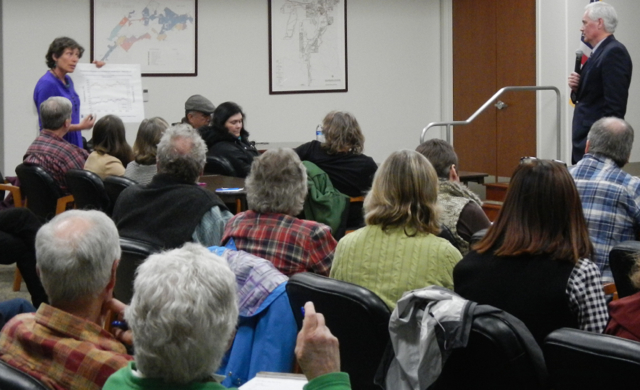
South Tahoe resident Bonnie Turnbull, left, spars with Rep. Tom McClintock over climate change. Photo/Kathryn reed

South Lake Tahoe resident Bonnie Turnbull, left, spars with Rep. Tom McClintock over climate change. Photo/Kathryn reed

By Kathryn Reed

Audience question: What causes climate change?

Rep. Tom McClintock’s answer: “It’s a natural phenomenon. It has more to do with solar cycles than human activity.”

To this, most of the 50 people in attendance at the May 3 town hall at South Tahoe Public Utility District’s board room erupted in disbelief. Based on reactions to and interactions with the congressman, it’s unlikely most of the attendees will be voting for the Republican this year.

McClintock is making the rounds of his district, spelling out what he has done back in Washington, D.C., and what he hopes to do going forward.

Climate change was an overriding theme at Tuesday’s gathering. Several people tried to engage McClintock in a debate, that at times escalated into a near shouting match.

Many were armed with facts. Local resident Bonnie Turnbull even had a chart to add to her concerns. John Friedrich, who was in Paris during the climate summit last year, read information from his tablet.

McClintock all the while stuck to his talking points – the climate has been changing for 4 billion years.

One person shouted, “Your naiveté is absolutely stunning.”

McClintock claims this is the first such meeting where the crowd wouldn’t let him finish his sentence. What they were upset with were the rehearsed answers that were not based on science. At no time did McClintock cite sources for his beliefs/facts.

Several asked how he can dispute the facts when 97 percent of the scientific community says climate change is real and human caused. McClintock’s assertion was that the data is nearly 20 years old. It’s actually a figure from 2013. This is when the congressman did what he accused the audience of — not listening.

Before opening the floor to questions, the congressman talked about if mandatory spending – like Medicare and Social Security – were under the discretionary column, that the budget would be easier to balance.

Forest health is another concern of his. Something he often says at these meetings is that the timber will come out one way or another – either harvested or via fire. He wants to allow trees to be felled for profit. That is not allowed in the basin anymore.

“The forests are dying because we’ve allowed them to be catastrophically overgrown,” McClintock said.

Part of his bill that is a scaled down version of the Senate’s Lake Tahoe Restoration Act calls for more forest thinning. It has passed out of committee.

He is also working to get more funding to fight fires, including having forest fires be listed as a natural disaster so they quality for federal aide in the same manner as earthquakes and hurricanes.

McClintock’s answer to dealing with drought was to create more storage. But in order to build more dams in California, he said, environmental regulations need to change.

An attendee brought up subsidies for oil companies.

“I’m against all subsidies. Period. People deserve honest pricing,” McClintock said.

Another person spoke about being against trade agreements, saying the United States usually comes out on the losing end.

McClintock disagreed, touted the merits of NAFTA, adding, “Generally speaking I support free trade.”

Jude Wood, executive director of the local Boys & Girls Club, asked McClintock what he is doing to help families and touched on immigration.

The congressman said he won’t help those who are here illegally, even if it were their parents who brought them here. He said a path to citizenship exists and that everyone should follow it.

As for families, he’d like to raise the child deduction when it comes to filing taxes.


Historic Tahoe boathouse’s transformation into idyllic theater a test in patience and love

Lake Tahoe is the backdrop from the Boathouse Theatre. Photo/Provided

Lake Tahoe is the backdrop from the Boathouse Theatre. Photo/Provided

By Kathryn Reed

A woman named Spain and a man known as Dr. Love, along with a cadre of other devoted arts aficionados, are responsible for transforming what was a dilapidated boathouse into an iconic theater.

This summer the Boathouse Theatre at Valhalla is celebrating its 20th anniversary. The Tahoe Tallac Association, now known at Valhalla Tahoe, celebrated its 30th anniversary in 2009.

There was a time when the boathouse was slated for demolition.

“We looked at the two big boathouses. The architectural historian said you could take one down if you retain one,” Bill Morgan told Lake Tahoe News. He was forest supervisor of Lake Tahoe Basin Management Unit from 1975-85. Both still exist today, but it was the one that is now a theater that was eyed for demolition.

When Morgan came on board the plans on the books were to raze most of the buildings at the site.

Carol Spain and others challenged that thinking when they proposed creating an arts and cultural center out of what had been estates owned by wealthy San Franciscans.

To do so would take money and hours of volunteer time. Musicians and other artists donated their time. But the group needed more money. A friend of Spain’s introduced her to Barbara Vucanovich, a Nevada congresswoman at the time.
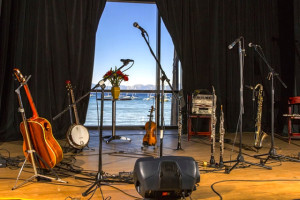
Valhalla Boathouse Theatre 20th anniversary fundraiser - Lucky Baldwin Poker Promenade and Concert featuring Radoslav Lorkovic. June 25 at 6pm. Lucky Baldwin, Claire Heller, George Pope and other historic characters will be at various stations between Valhalla and the Baldwin Museum.  Various stations around the Tallac Historic Site will offer food and drinks, and interpretive history. The concert will follow the poker run. Cost is $75. Tickets are available online. https://valhallatahoe.showare.com/orderticketsarea.asp?p=92&a=7&backurl=default.asp
Valhalla Boathouse Theatre 20th anniversary fundraiser – Lucky Baldwin Poker Promenade and Concert featuring Radoslav Lorkovic is June 25 at 6pm. Lucky Baldwin, Claire Heller, George Pope and other historic characters will be at various stations between Valhalla and the Baldwin Museum. Various stations around the Tallac Historic Site will offer food and drinks, and interpretive history. The concert will follow the poker run. Cost is $75. Tickets are available online

“She said come see me,” Spain recalled. “She introduced me to some people; that started the whole ball rolling seeking federal money.” That was the first of many visits where the purpose was to get money from the feds. After all, the land to this day is still owned by the U.S. Forest Service.

Dave Kurtzman was along for three of the excursions. Those turned out be more about relationship building than check writing.

It was a meeting in Tahoe that really got the purse strings to loosen up. Sen. Harry Reid, D-Nev., was speaking at a local Rotary meeting that Kurtzman and Spain decided to attend. They prearranged for a private meeting with the senator that included Dennis Crabb, who was then city attorney of South Lake Tahoe, along with some of Reid’s aides.

“We got a quarter million dollars,” Kurtzman told Lake Tahoe News. “I think the Forest Service was ticked off because the quarter million just got moved from other funds.”

That was the seed money needed to make their dream a reality. And it sealed the deal with the reluctant USFS office that the arts festival was staying.

Spain left Tahoe – and therefore the Tallac Association – in 2002. She plans to come back next month for the anniversary celebration.

Leo Buscaglia’s influence

Leo Buscaglia – aka Dr. Love – first became acquainted with the Tallac Association after he attended one of the Starlight Jazz concerts at the Forest Service amphitheater. Through a mutual friend Spain secured tickets for him to the sold-out show. Spain was reluctant to do so at first; she didn’t know who Buscaglia was and such favors were met with caution.

“Leo came up to me and said this was the most wonderful experience under the stars and the great music. He said if I if ever need any help, just get in touch with him. That was the wrong thing to say,” Spain said with laughter.

Buscaglia had been a professor at USC, and in the 1960s taught a class called Love. Through that course, his books and lectures he became known as Dr. Love.

He moved to Glenbrook permanently in 1989. He died nine years later from a heart attack. By the time of his death he had sold more than 11 million books.

Spain soon figured out who Buscaglia was and decided to tap him to help raise money for the boathouse renovation. Harveys had a speakers series at the time, which Buscaglia headlined a few times. He arranged for most of the proceeds to go to the boathouse renovation.

Before the boathouse was renovated, the Grand Hall at Valhalla is where performances were staged. Buscaglia would bring his books, sign them and then give the boathouse the proceeds.

When Buscaglia died his estate gave $40,000 to the boathouse.
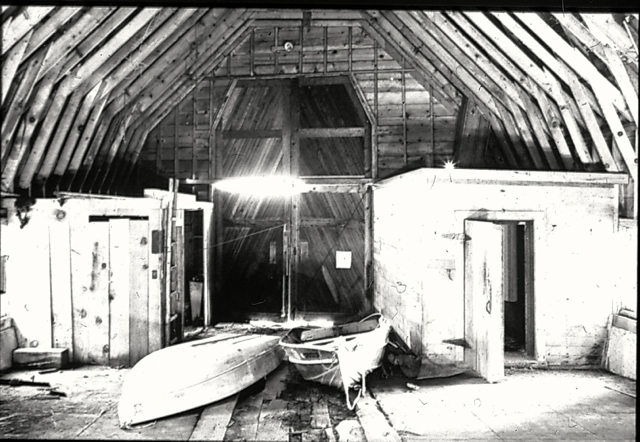
The boathouse was neglected for years before the arts community took over. Photo/USFS

The boathouse was neglected for years before the arts community took over. Photo/USFS

A bit of history

William Tevis as part of his 75-acre estate built the boathouse in the late 1800s.

He later sold the parcel to George Pope Sr. of the Pope & Talbot Lumber and Shipping Company. Pope’s boat, The Sheik, was stored in the boathouse that is now the theater. At the time it was the biggest and fastest boat on the lake.

Pope in 1924 sold 3.3 acres to San Francisco financier Walter Heller, with the boathouse being part of that transaction.

The boathouse at one time had four bedrooms and a bathroom on the second level.

The Forest Service acquired the estates between 1965 and 1971. In total the area is 74 acres.

Before the arts group took over the boathouse it had fallen into disrepair and was being used for storage.

It was the late Bob Harris who as the forest supervisor green lighted the renovation of the boathouse.

The transformation

“I was always borrowing stuff from the casinos … pianos, speaker systems, you name it,” Spain said. “They were tearing up the Harrah’s stage and replacing it. Supposedly it was cherry wood and many famous people danced on it. They trucked it out to the empty boathouse. The carpenters looked at it and said you can’t use it.”

That example spoke to the generosity of the community and the stumbling blocks to get the work done.

The Stateline casinos were huge supporters of what was going on on the other side of the South Shore. Lights and sound systems were donated. Workers gave their time.

Ken Kurtzman was the architect on the project. (He, too, plans to be at the party in June.)

Everything had to be photographed before work could begin because of the historical nature of the building. Interviews with anyone who might have a speck of information about the old days were conducted, including with members of the Washoe tribe.

An apartment used to be upstairs where the bathrooms and sound system are today. Originally the second floor was going to have balcony seating, but because there was no way of working the bathrooms into the first floor design, they went upstairs instead of the added chairs.

The floor was naturally sloped, which made it ideal for a theater. The old tracks for the boats were covered. Outside, though, they are still prominent. The seats came from an old theater in Colorado.

“The exterior is pretty much exactly how it was,” Dave Kurtzman told Lake Tahoe News.

That’s true in terms of aesthetics.

“When I started working out at Valhalla with the Forest Service in the ’70s at that time the only thing holding up the boathouse was the big tree next to it. It was really rickety,” Steve Yonker with Yonker Construction told Lake Tahoe News. “To begin with there were cables inside holding things to together. We replaced those with cross members. There was quite a bit of engineering in there.”

Yonker was one of few contractors to work on the renovation. He built the stage and installed insulation.

“We had to deal with the big doors on back so they could be opened up with a view right to the lake,” Yonker said.

The roof, siding and single-pane windows were replaced.

Jail inmates provided some of the labor.

For actors, though, there are still constraints. There are no dressing rooms. The back is tiny.

“The boathouse when you saw it, it was in a rough state. It was kind of just a wild dream that came true,” Spain said. “To have those doors open, to have the glass wall and pianist on stage in front of it … it is just a lovely, lovely experience. So, when it all came together, it was better than the dream.”
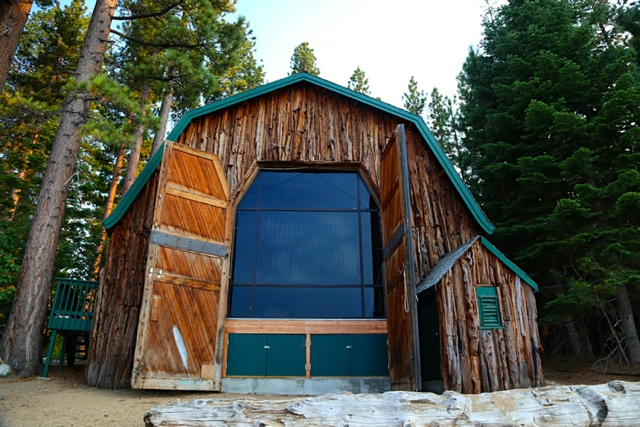
The exterior of the boathouse looks much like it did when it was used to store watercraft. Photo/Provided

The exterior of the boathouse looks much like it did when it was used to store watercraft. Photo/Provided

Modern day

While a variety of musical and theatrical performances have graced the stage of the boathouse in the last 20 years, the facility is still in need of upgrades.

The curtains came down earlier this spring for cleaning and all festival director Evangeline Elston could think about was what if they fell apart.

“The boathouse really needs a lot of TLC,” she told Lake Tahoe News.

A fundraiser on June 25 is designed to be part celebration of the theater’s milestone anniversary, an opportunity to recognize those who made it a reality and for the public to learn that more needs to be done.

“I would like to completely revamp the technology – the lighting, sound system. I would like to do interior stuff that would not be invasive to the look and feel, but might improve how it works, like lighting in the back of the house,” Elston said. And replacing the curtains is also on the to-do list.

Changing the lights to LED will cost a minimum of $15,000. Besides being more energy efficient, the threat of fire would be greatly diminished.

Every time the building is closed up for the night the circuit breakers are flipped so the lights can’t just come on because if they did, the fear is that a fire would start based on how hot the lights are and that the building is old wood.

The association plans to do an in depth needs assessment so by the end of the season the board of this nonprofit has a better idea of the costs associated with doing all the wanted upgrades.

The boathouse fundraiser is June 25, three days after the season opens.