Failed deadline may cost EDC taxpayers millions

By Kathryn Reed

Even though the funding for El Dorado County’s new public safety headquarters in Placerville has not been secured, the price has escalated by millions of dollars, all because of inaction by the chief administrative officer.

Supervisor Shiva Frentzen wrote a letter to her colleagues and then read it into the record at the May 10 board meeting. In part it talks about how she requested an agenda item for that day’s meeting about the debt service on the facility.

“This request was to address Sheriff [John] D’Agostini’s concern about the $2.2 million annual debt service for the public safety facility based on the 2.875 percent APR. The verbal update that I received from assistant CAO stated that the county will miss the deadline to lock in at rate of 2.875 percent APR resulting in a possible rate of 3.5 percent APR. Failure to lock in at 2.875 percent APR could cost the El Dorado County taxpayers an additional $10 million over the next three to four decades,” Frantzen said.

She wanted time to discuss this revelation. She was denied the opportunity to do so in a formal manner, and the other board members had little to say after she read the letter.

Frantzen, before Tuesday, even suggested a special meeting should be called just to discuss this issue. It never happened.

CAO Larry Combs, who is an interim leader working part time, sent a letter May 9 to the board and sheriff saying a comprehensive presentation about the facility is set for June 14. That discussion, he said, will include “construction plan including possible phasing, updated costs, likely financing terms within the USDA loan, and related repayment/budgeting options.”

(Combs didn’t check D’Agostini’s availability for that date. The sheriff will be out of town regarding a federal subpoena.)

The discrepancy in interest rates is because the county is unable to make a June 1 deadline to seek federal financing.

Combs’ letter goes on to say, “Staff convened a meeting of the Facility Finance Committee on March 30, 2016, to seek a recommendation, for board approval, to proceed with the USDA financing option. At that time it was believed that there was a possibility that, if all components of the application came together in time, the county may be able to meet the USDA’s June 1, 2016, deadline to receive the second quarter interest rate of 2.875 percent. However, upon subsequent discussions with USDA representatives in April, a number of actions were identified as needing to occur prior to final application submittal, which precluded staff from being able to submit a complete application by June 1. The current 2.875 percent interest rate expires June 30, 2016. A new interest rate will be announced at that time. Given the current market, it is unlikely that the quoted interest rate will vary significantly.”

No matter the interest rate, the 2016-17 budget presented by Combs to the supervisors does not include the debt service for the facility. Combs has said, “Current debt payment estimates for a loan of $50 million and a term of 40 years equal approximately $2.2 million per year.”

D’Agostini took issue with Combs’ letter, firing back a response to the Auburn resident as well as to the supervisors.

“The $2-plus million to purchase the property was monies from the sheriff’s office’s prior year fund balance that was specifically set aside for such purpose,” the sheriff wrote. “Arch Nexus (the design firm) and the sheriff’s office will have the necessary information for the loan application ready by the deadline.”

He disagreed with the CAO’s assessment that the architect had a role in delaying the process.

D’Agostini stressed the need for time lines and more factual information from the CAO’s office.


EDC judicial race a heated political battle

Roland Tiemann, left, and Nelson Brooks are battling to be El Dorado County Superior Court judge.

Roland Tiemann, left, and Nelson Brooks are battling to be El Dorado County Superior Court judge.

By Kathryn Reed

El Dorado County’s lone contested judicial race on the June 7 ballot is turning ugly, with the challenger accusing the incumbent of misleading the public about political contributions.

Ashlee Titus, an attorney with a law firm out of Sacramento, on May 10 filed a complaint with the Fair Political Practices Commission on behalf of Roland Tiemann who wants to unseat Nelson Brooks. The document alleges Brooks did not file the proper financial paper work in a timely manner.

“Mr. Tiemann is grasping at straws because he is behind in the campaign,” El Dorado County Superior Court Judge Brooks told Lake Tahoe News. “There is no truth to any of the allegations.”

District Attorney Vern Pierson told Lake Tahoe News, “It appears to be a pathetic attempt to resurrect a failing campaign.”

When told about the FPPC complaint by LTN on May 12, Brooks spent that night reviewing his paperwork with his campaign treasurer who is a certified public accountant. Brooks said a document might have been filed a couple days late, to which he would not be surprised if he were fined. That would be the normal protocol.

Brent Lowder, a political consultant acting as Tiemann’s spokesman, told Lake Tahoe News, voters should be concerned with “how sloppy they have been with their filings.”

Lowder went on to say, “Someone running to be or continuing to be county judge should be expected to follow the law if they expect county voters to support them to enforce the law.”

Most of Brooks’ campaign has been self-financed – to the tune of $300,000 from he and his wife. Small contributions add up to less than $15,000.

It can be a big deal if contributors’ names come out after votes are cast because some voters are swayed – more often away from a candidate – if a controversial donor surfaces. Early voting started May 9 in El Dorado County and vote-by-mail ballots were sent this week.

Asked why he believes Tiemann is running, Brooks said, “I think he has been put up to it by a judge who wants to be presiding judge and he knows he doesn’t have the votes for that with the current makeup of the bench. He wants to pack the court.”

The judge Brooks is referencing is Steve Bailey. Bailey has made it clear he wants to replace Judge Suzanne Kingsbury as the presiding judge.

The El Dorado County bench is a bit divided among those who support each candidate. On Brooks’ side are Kingsbury, Kenneth Melikian, Vicki Ashworth, and Jim Wagoner. Supporting Tiemann are Dylan Sullivan and Warren Stracener.

Sullivan, who was endorsed by Kingsbury when she ran a couple years ago, lost her original assignment last summer.  Kingsbury made that decision. There has been a rift between the two since then.

Neither Sullivan nor Bailey could be reached for comment.

Brooks was first appointed to the bench in 2009 by then Gov. Arnold Schwarzenegger. He won the current six-year term a year later. Prior to that he had been an attorney for more than 25 years.

Tiemann has been an attorney for 10 years, the minimum required to be a judge in California.

Tiemann has appeared before Brooks a few times. Since the campaign started the judge has recused himself.


Calif.’s shoddy roads won’t get fixed any time soon

By Liam Dillon, Los Angeles Times

Over the last few months, Gov. Jerry Brown and legislators have reached major deals to increase taxes on healthcare plans and boost the state’s minimum wage. But as Brown prepares to release his revised budget on Friday, one big issue appears to be far from a resolution: California’s shoddy roads.

Brown, Assemblyman Jim Frazier, D-Oakley, and state Sen. James Beall Jr., D-San Jose, have all pitched plans to chip away at the more than $130-billion backlog in state and local road repairs, plus the billions more in annual transportation budget deficits. The plans emerged after Brown called a special session last summer to focus legislators’ attention on the dire problem.

All three proposals rely on hiking up the state’s beleaguered gas and diesel taxes along with levying new annual fees on car owners. These revenue increases require the support of two-thirds of the Legislature, including the backing of traditionally tax-averse GOP lawmakers.

Read the whole story


Nev. court deals setback to commerce tax repeal effort

By Michelle Rindels, AP

An effort to repeal the state’s new commerce tax suffered a likely fatal setback on Wednesday after the Nevada Supreme Court ruled a petition that’s been circulating for several months isn’t fit for the ballot.

Justices said in their order that the summary of the measure’s effect, which appears on the signature-gathering material, is inadequate because it doesn’t tell voters that the measure could unbalance the state budget by tens of millions of dollars. They ordered that signatures collected so far are invalid.

“By ignoring the significant effect the referendum would have on the balanced budget mandate, the description of effect suggests that no such effect exists and is thus materially misleading,” Justice Nancy Saitta wrote in concurring with the full court’s ruling. “The petition’s signers have been both deceived and misled.”

The ruling is a major setback for the RIP Commerce Tax group led by Republican Controller Ron Knecht, even though justices sided with his group on some arguments. RIP Commerce Tax had gathered about 20,000 signatures as of early May, and would have to start over again to collect the more than 55,000 signatures needed by June 21 to qualify the referendum for the ballot.

Knecht said he disagreed with the court’s assessment that the repeal would unbalance the state budget. He said the Legislature will pass a budget late next spring that can account for the estimated $60 million that the state wouldn’t collect next summer.

“With all due respect, we believe the Nevada Supreme Court’s decision reflects a misunderstanding of the facts about the effect of a commerce tax repeal,” he said in a statement. “We are evaluating our options for clarifying these matters, resolving the court case and getting the required signatures.”

Defenders of the tax said they were pleased with the decision.

“We’ve argued all along that the RIP Commerce Tax petition would have grave and lasting consequences to the State of Nevada,” said Matt Griffin, an attorney for the Coalition for Nevada’s Future, a group funded by casinos and other business groups. “Nevada’s parents and school children can celebrate today’s decision.”

The commerce tax, which applies to businesses that make more than $4 million each year in Nevada revenue, passed last year as a way to pay for new education initiatives. Opponents said it was a betrayal after voters in 2014 overwhelmingly rejected a margins tax on businesses.

Supporters of the commerce tax were trying to stop the measure before it qualifies for the ballot because it would have consequences whether or not voters pass it. If voters approved the referendum, the tax would be abolished. But if they rejected it, the tax would be frozen in statute until another statewide vote on it.

Commerce tax proponents said that prevents the Legislature from fixing flaws and adjusting rates. Commerce tax foes contend that’s a good thing and would prevent lawmakers from expanding the tax to smaller businesses.


Health issues require more LTUSD nurses

The need for school nurses is growing in LTUSD. Photo/Provided

The need for school nurses is growing in LTUSD. Photo/Provided

By Kathryn Reed

Twenty-four students with seizures, nine with Type 1 diabetes, two with Type 2, 112 with asthma, 21 with cardiac conditions, 136 with food allergies and of those 45 require epi-pens. Those are some of the issues nurses in Lake Tahoe Unified School District are dealing with on a daily basis.

They handle feeding tubes, catheterization, suctioning, oxygen, AED, nebulizer, diastat (rectal valium), and blood glucose-insulin.

On a recent school day in a matter of an hour a nurse was dealing with a growth on a student’s leg that a teacher had noticed (turned out to be benign) and a teacher having a heart attack (that person is fine, had a stent put in).

Just putting a Band-Aid on a scrape would likely be a welcome distraction from the more serious medical conditions.

Margaret McKean, head nurse with the district, on Tuesday told the school board how her staff is seeing an increase in chronic illnesses, as well as social and emotional conditions.

It’s impacting what is going on in the classroom.

“It’s harder for the teachers to do their jobs,” McKean said. That is why the nurses are brought into the fold to help with overall needs assessments for students.

The nursing staff has slowly been increasing to handle the rise in health issues.

The board on May 10 agreed to hire the equivalent of 1.24 full time nurses. This will bring the staff to five. Working with McKean now are Karen Tucker, Jen Drennan and Morgan Kiskinen. They are dispersed throughout the district, though not every school has a nurse on site each day.

To be a school nurse requires having a bachelor’s of science in nursing, being a registered nurse and having a school health credential.

Not every child has access to health care outside of what is provided by the school district.

“We are the front line,” McKean told Lake Tahoe News. “Parents say go see the school nurse.”

This is her 34th year in the district, with next year possibly being her last. McKean is at the high school where she says the stress level is higher, but it pays off just being able to help students.

As for why there has been an increase in health issues, McKean said, “It used to be the fetus was the only pure environment. Now there are so many chemicals that it is affecting the auto-immune system.”

Better diagnosis also ups the numbers.

There are also the routine issues the nurses have to deal with, like checking on immunizations. Seventh grade is a critical year to ensure everyone is up-to-date. Only 38 percent of the sixth-graders are immunized, so the nurses have a lot of work to do before now and the start of next school year in August.

Nurses also administer hearing and vision screenings. This year 1,353 students had hearing tests, with 15 students not passing. Of the 1,450 eye tests, 335 kids were referred for follow-up checks.

—–

In other board action:

·      South Tahoe High School students Annika Johnson and Sydney Morris were recognized for their winning photographs in the California Streaming Photo contest.

·      The board authorized hiring personnel to handle the growing two-way immersion program throughout the district. It will be expanding to STHS in the fall.


Study: No scientific basis for laws on marijuana and driving

By Joan Lowy, AP

Six states, including Nevada, that allow marijuana use legal tests to determine driving while impaired by the drug that have no scientific basis, according to a study by the nation’s largest automobile club that calls for scrapping those laws.

The study commissioned by AAA’s safety foundation said it’s not possible to set a blood-test threshold for THC, the chemical in marijuana that makes people high, that can reliably determine impairment. Yet the laws in five of the six states automatically presume a driver guilty if that person tests higher than the limit, and not guilty if it’s lower.

As a result, drivers who are unsafe may be going free while others may be wrongly convicted, the foundation said.

The foundation recommends replacing the laws with ones that rely on specially trained police officers to determine if a driver is impaired, backed up by a test for the presence of THC rather than a specific threshold. The officers are supposed to screen for dozens of indicators of drug use, from pupil dilation and tongue color to behavior.

The foundation’s recommendation to scrap the laws in Colorado, Montana, Nevada, Ohio, Pennsylvania and Washington comes as legislatures in several more states consider adopting similar laws.

At least three states, and possibly as many as eleven, will vote this fall on ballot measures to legalize marijuana for either recreational or medicinal use, or both. Several legislatures are also considering legalization bills.

“There is understandably a strong desire by both lawmakers and the public to create legal limits for marijuana impairment in the same manner we do alcohol,” said Marshall Doney, AAA’s president and CEO. “In the case of marijuana, this approach is flawed and not supported by scientific research.”

Determining whether someone is impaired by marijuana, as opposed to having simply used the drug at some time, is far more complex than the simple and reliable tests that have been developed for alcohol impairment.

There’s no science that shows drivers become impaired at a specific level of THC in the blood. A lot depends upon the individual. Drivers with relatively high levels of THC in their systems might not be impaired, especially if they are regular users, while others with relatively low levels may be unsafe behind the wheel.

Some drivers may be impaired when they are stopped by police, but by the time their blood is tested they have fallen below the legal threshold because active THC dissipates rapidly. The average time to collect blood from a suspected driver is often more than two hours because taking a blood sample typically requires a warrant and transport to a police station or hospital, the foundation said.

In addition, frequent users of the drug can exhibit persistent levels of the drug long after use, while THC levels can decline more rapidly among occasional users. Nine states, including some that have legalized marijuana for medicinal use, have zero-tolerance laws for driving and marijuana that make not only the presence of THC in a driver’s blood illegal, but also the presence of its metabolites, which can linger for weeks after use.

That makes no sense, said Mark A. R. Kleiman, a New York University professor specializing in issues involving drugs and criminal policy. “A law against driving with THC in your bloodstream is not a law you can know you are obeying except by never smoking marijuana or never driving,” he said.

He said rather than switching to a new kind of law as AAA recommends, states should consider simply making it a traffic violation.

Studies show that using marijuana and driving roughly doubles the risk of a crash, Kleiman said. By comparison, talking on a hands-free cellphone while driving — legal in all states — quadruples crash risk, he said. A blood alcohol content of .12, which is about the median amount in drunken driving cases, increases crash risk by about 15 times, he said.

Driving with “a noisy child in the back of the car” is about as dangerous as using marijuana and driving, Kleiman said.

The exception is when a driver has both been using marijuana and drinking alcohol because the two substances together greatly heighten impairment, he said.

The foundation also released a second study that found the share of drivers in fatal crashes who had recently used marijuana doubled in Washington after the state legalized it for recreational use in December 2012. From 2013 to 2014, the share of drivers who had recently used marijuana rose from 8 percent to 17 percent.

While it stopped short of blaming the crashes on that increase, AAA traffic safety director Jake Nelson said traffic fatalities went up 6 percent in Washington during that same while the fatalities nationally declined.


Warming-fueled wildfires are increasing

By Seth Borenstein, AP

Alberta’s unusually early and large fire is just the latest of many gargantuan fires on an Earth that’s grown hotter with more extreme weather.

Earlier this year, large wildfires hit spots on opposite ends of the world — Tasmania and Oklahoma-Kansas. Last year, Alaska and California pushed the U.S. to a record 10 million acres burned. Massive fires hit Siberia, Mongolia and China last year and Brazil’s fire season has increased by a month over the past three decades.

It got so bad that in 2009, Australia added a bright red “catastrophic” to its fire warning index.

“The warmer it is, the more fires we get,” said Mike Flannigan, a professor of wildland fire at the University of Alberta.

Last week, temperatures pushed past 90 degrees Fahrenheit in Alberta, which is unusual for May in northern Canada.

It’s not quite so simple though. Many factors contribute to the complex increase in big fires, Flannigan and several experts said. They include climate change, the way people use land and firefighting methods that leave more fuel — trees and brush — to burn.

But the temperature one stands out, Flannigan said.

“The Alberta wildfires are an excellent example of what we’re seeing more and more of: warming means snow melts earlier, soils and vegetation dries out earlier, and the fire season starts earlier. It’s a train wreck,” University of Arizona climate scientist Jonathan Overpeck wrote in an email.

Worldwide, the length of Earth’s fire season increased nearly 19 percent from 1979 to 2013, according to a study by Mark Cochrane, a professor of fire ecology at South Dakota State University.

Fires had steadily been increasing, but then in the late 1990s and early 2000s, “we’ve suddenly been hit with lots of these large fires we can’t control,” Cochrane said.

In terms of acreage burned, the worldwide total may be dropping because of better firefighting, but in North America and Siberia “fires have grown quite a bit due to warming,” Columbia University climate and ecology scientist Park Williams wrote in an email. “My estimate is that global warming has been responsible for about half of this increase.”

For the entire U.S., the 10-year average number of acres burned in wildfires has more than doubled from about 3 million acres in the mid-1980s to 7 million acres now, according to an analysis of government data by the Associated Press.

Twelve years before the Fort McMurray fire set northern Alberta ablaze, a study by Flannigan and University of Victoria climate scientist Andrew Weaver found that “human-induced climate change has had a detectable influence” on a dramatic increase in wildfires in Canada. Flannigan said the area burned in Canada has doubled since the 1970s “and we think that’s due to climate change.”

“Globally we are seeing more fires, bigger fires, more severe fires,” said Kevin Ryan, a retired U.S. Forest Service scientist who is now a fire consultant, with a recent stint in Indonesia, where fires were big last year.

Fires in some places, such as Indonesia and Canada, are bad when there’s an El Nino — a warming of parts of the Pacific that changes weather worldwide — because it triggers drought in those regions, Ryan said. In Indonesia, changes in land use are a bigger factor than climate, Ryan said.

But elsewhere, it’s temperature and moisture, too much of one and not enough of the other, scientists said. As the air warms, it gets “more efficient at sucking the moisture out of the fuels” which makes them more prone to burn, Flannigan said. Then add in lightning. A study found that lightning increases 12 percent with every degree Celsius and that can trigger more fires. Flannigan said there’s evidence of fire-triggered clouds in Alberta causing at least two more fires because of lightning.

The U.S. National Academy of Sciences earlier this year in a study determined that “climate warming has resulted in longer fire seasons.” But other factors, such as the way fires are fought and land use, make it difficult to scientifically attribute individual fires and regional fires to climate change, the report and other scientists said.

“This is absolutely a harbinger of things to come,” said Canadian climate scientist Weaver, now a Green party legislator in the British Columbia parliament.


Squaw-Alpine gondola project raises questions

By Kathryn Reed

OLYMPIC VALLEY – Planners and landowners must balance recreation, economic development and protection of natural resources as they consider whether to allow the proposed gondola that would link Squaw Valley and Alpine Meadows ski resorts.

Eight members of the public voiced their concerns Monday at the initial scoping meeting for the environmental documents.

Resort owners want to build a gondola that would go from the base of Alpine, have two midstations, and end at the base of Squaw.

(KSL Capital Partners bought Squaw in November 2010. JMA Ventures bought Alpine in 2007. Squaw Valley Ski Holdings Inc. was created in September 2011 to operate both resorts.)

For decades there has been talk of combining the resorts. One of the main stumbling blocks has always been the private landholding. An agreement was reached with Tony Caldwell in April 2015 to have the towers erected on his land near the Granite Chief Wilderness Area.

Building anything so close to a wilderness area is one of the more controversial aspects of the project. While the gondola is designed to only operate during the winter, the towers would always be there. The eight-person cars would be detachable.

Already portions of the two resorts are visible while hiking in the area.

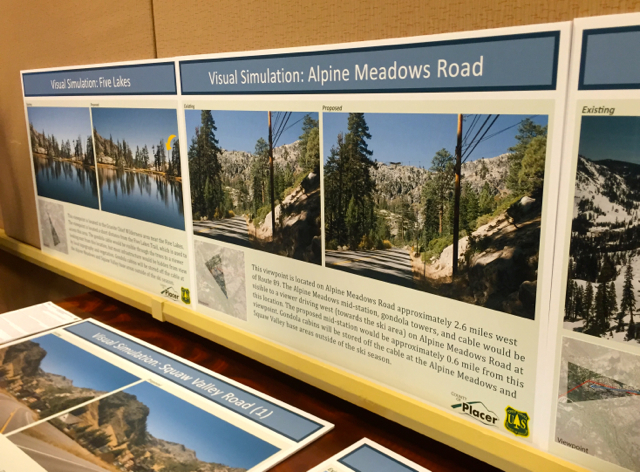
Proponents have images of what the visual impacts may be if the gondola between  Squaw and Alpine were built. Photo/LTN

Proponents have images of what the visual impacts may be if the gondola between Squaw and Alpine were built. Photo/LTN

Judy Bruner, who lives part time in Alpine Meadows, questioned the permanent loss of wilderness area if the gondola goes in. Caldwell’s property is technically in the wilderness area, but he was there first. If he were to sell the land and the gondola is there, it could never be wilderness area again.

“I believe the visual quality will forever be impaired,” Bruner said at the May 9 meeting at the Resort at Squaw Creek. Eleven of the 37 towers are slated to be on Forest Service land.

She would like the project proponents to create state-of-the-art modeling to better visualize the impacts.

For Dan Heagerty of the Granite Chief Wilderness Protection League, he worries Placer County will be as receptive to concerns of locals as the agency has been to the Squaw Valley base plan – which in his estimation has been silence.

Resort officials say the gondola will reduce by 100 the number of vehicles on the road between the resorts.

Heagerty challenged that assertion, saying, “This $35 million project is clearly designed to induce visitor visits to both resorts.”

He also brought up the proposed chairlifts in the Alpine master plan and Caldwell’s desires.

Heagerty and others want the gondola project not to be studied in isolation, but with consideration of projects already in the pipeline as well as those being bandied about.

Isaac Silverman, attorney with Sierra Watch, contends some of the lift proposals would not get built without the gondola because the midway station would provide access to them.

Joe Flannery with the Forest Service told people during the breakout session that the assumption is skiers-snowboarders will be able to get off at the midstations. This means new terrain would be accessible via the gondola.

One person asked why a joint EIR-EIS wasn’t being created. No answer was given. The speaker said having to review two documents was more cumbersome for the average person.

Placer County will be dealing with the environmental impact report and California Environmental Quality Act issues. The USFS will handle the environmental impact statement and National Environmental Policy Act requirements.

Comments must be made to both organizations. The feds hope to have the draft EIS done by the end of the year or early 2017, while the county wants the EIR completed sooner.

—–

Notes:

·      The project overview is online.

·      Comments to Placer County may be emailed to cdraecs@placer.ca.gov. The deadline is May 23.

·      Comments to the U.S. Forest Service may be emailed to scoping_comments@squawalpinegondola-eis.com; deadline is May 31.


Report: 1 in 5 plant species face extinction

By Ben Guarino, Washington Post

Plants pervade almost every part of human life — not only do we eat them and wear them, we use plants for fuel, medicine, building materials, poisons and intoxicants.

To limit the world’s plants to those that meet a human need, however, would be doing the leafy kingdom a disservice. In fact, according to a report from the Royal Botanic Gardens at Kew, in the United Kingdom, only a slice of plant life is “useful” to humans. In what Kew is calling the first comprehensive assessment of plant life —  the first annual “State of the World’s Plants” — researchers determined that some 30,000 plant species had a documented use.

As many as one in five plants may be at risk of extinction, the scientists say, due to invasive species, disease and changing landscapes.

Read the whole story


Brown orders long-term conservation measures

By Matt Stevens and Bettina Boxall, Los Angeles Times

Gov. Jerry Brown issued a sweeping executive order Monday that permanently prohibits certain forms of water waste and makes monthly water-use reporting an ongoing requirement.

The order comes as some urban water suppliers have suggested the drought is over and called for the state’s drought rules to be weakened or eliminated. Brown’s order, though, rebuffs the notion that California can ever fully escape from drought.

“Californians stepped up during this drought and saved more water than ever before,” Brown said in a statement. “But now we know that drought is becoming a regular occurrence and water conservation must be a part of our everyday life.”

Read the whole story