Panel calls for more research into medical marijuana

By Chris Kudialis, Las Vegas Sun

A panel of medical marijuana advocates is calling for more research into how the plant works in treating various diseases and conditions.

“Hundreds of thousands of people medicate every day using marijuana,” Brookings Institution scholar John Hudak said Wednesday during a symposium at UNLV’s Hank Greenspun School of Journalism and Media Studies auditorium.

More than 165 million Americans live in states where medical marijuana is legally available, Hudak said. But with so little research on marijuana’s potential medical benefits, even doctors are “left in the dark” in assessing which strain of marijuana best suits a patient’s needs.

Read the whole story


Stalled property tax growth a problem in Nev.

By Anjeanette Damon, Reno Gazette-Journal

Because of a little noticed quirk in a decade-old state law, property tax revenue relied upon by local governments can’t grow along with the economy, a leading tax revenue analyst said Wednesday.

The problem means the state’s largest and most stable tax revenue is not recovering along with the economy, putting continued stress on government services already scrambling to meet the needs of a growing population.


School districts are hit particularly hard because 40 percent of property tax revenue funds schools in Nevada.

Read the whole story


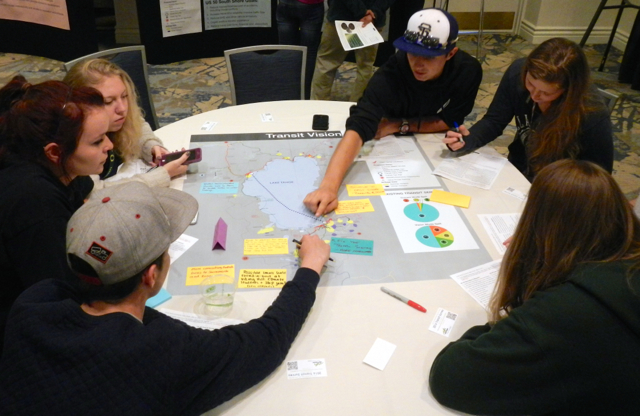
Residents map transit plans for Tahoe basin

South Tahoe High School students talk about how to improve transportation on the South Shore. Photo/Kathryn Reed

South Tahoe High School students talk about how to improve transportation on the South Shore. Photo/Kathryn Reed

By Kathryn Reed

Traffic isn’t a problem on the South Shore – at least not compared to what it was like years ago.

Tim Fajen has been a valet since 1972, working most of the Stateline casinos in the last 40-plus years. In the 1970s there could be 700 cars a day to park at what was the Sahara. On Tuesday there were about 30 at the Hard Rock, he said.

The South Lake Tahoe resident was one of several dozen to attend a transportation meeting May 24 hosted by the Tahoe Regional Planning Agency and Tahoe Transportation District at Lake Tahoe Resort Hotel. The agencies had a similar open house on the North Shore last week.

When he saw the placard stating there will be a 20 percent increase in visitors in the next 20 years, he shook his head, questioning where this number came from and why its validity should be believed.

TTD used the numbers supplied by Airsage Analytics and modeling done by TRPA.

Fajen has only seen the number of visitors drop since 1990, so he wonders what in the next 20 years will make more people come to Lake Tahoe. That question was not part of the discussion Tuesday night.

The goal that night was to obtain input from residents about what they want transit and transportation to look like in the basin going forward. TRPA is updating its 20-year Regional Transportation Plan, which it does every four years to keep the document current and relevant. It should be done by the end of the year.

TTD was seeking input about its plans for the various corridors around the lake:

·      Highways 89 and 28 in California

·      Highway 28 in Nevada

·      Highway 50 on the East Shore

·      Highway 50 on the South Shore

·      Meyers/Y in South Lake Tahoe

·      Recreation along Highway 89.

A handful of South Tahoe High School students took the time to attend and give their input. (Plus, it meant extra credit for their environmental science class.) With a map of the lake on the table, they wrote ideas on sticky notes and filled out a survey.

Maia Smith, a junior, wants someone to deal with the congestion at Lake Tahoe Boulevard and Viking Way at the base of STHS.

“The four-way stop is really useless,” she told Lake Tahoe News. She said there have been a lot of car crashes and that inexperienced drivers don’t understand how a four-way stop works.

For senior Kylee Lyons she would like planners to address the backup in Camp Richardson along Highway 89.

“My idea is to put a skywalk in to cross above the traffic,” she said.

The problem, she and her classmates said, is that people jaywalk everywhere, thus bringing traffic to a standstill.

Karen Fink, TRPA transportation expert, told Lake Tahoe News an idea for Camp Rich is to have a bus lane to get tourists in particular to their destination faster. This would mean holding cars back to make this happen.

She said a bigger picture topic is looking at how visitors get to Tahoe and whether transit would be an option for them. She admitted this is only viable if there is a functioning transit system once they get to Tahoe, meaning it would be easier for them to not get in their personal vehicle.

On the North Shore officials are looking at increasing transit frequency, potentially having free bus service by 2020, completing the bike trail network and being a hub for waterborne transit.

The survey people were given in South Lake Tahoe asked:

1.     If it were your responsibility to decide how to invest in our transportation system over the next 20 years, in what order would you prioritize these tools?

·      Bike, pedestrian paths

·      Transit (more frequent and free)

·      Parking (to encourage transit)

·      Ferry (fast North to South shore)

·      Seasonal water taxi (connecting lake communities)

2.     Of the strategies listed below by corridor, which are the top 10 that you would like to see happen on the South Shore?

The answers late in evening revealed the following top 5 responses:

·      Expand bike trails

·      Cross lake ferry

·      Loop road

·      BlueGo enhancements

·      Transit oriented development at the Y.


Nev. lawmakers discuss potential rules for the road

By Art Marroquin, Las Vegas Review-Journal

Making room for bicyclists, the potential impact of recreational marijuana and cellphone use while driving are among hot-button transportation topics that could be discussed when the Legislature meets in February, several Nevada lawmakers said Tuesday.

The aim, they said, is to create laws that will bring the 326 fatalities reported last year on Nevada’s roads down to zero.

Lawmakers may consider whether to increase fines for all drivers who hold their phone during calls and texts. For now, scofflaws pay $50 for a first offense, $100 for a second offense and $250 for a third offense, according to the Department of Motor Vehicles.

Marijuana was legalized for medical purposes in 2000, but voters will decide in November whether to legalize it for recreational use.

Read the whole story


Study: Vegetation moving to adapt to climate

By Lake Tahoe News

Trees once found at lower elevations are moving higher in an attempt to adapt to climate change.

These are the findings of a study done by researchers at UC Davis.

The report was published this week in the “California Fish and Game” 2016 winter issue.

Signature tree species in the high Sierra Nevada forests – including mountain hemlock, red fir and western white pine – are shifting toward higher, cooler elevations, according to researchers.

They say the study foreshadows how climate warming may significantly alter entire habitats for multiple species. It will affect food supplies as well as forest soil.

The study says by the end of the century 16 of 29 vegetation communities in California, such as Pacific Coast salt marsh and high mountain conifer forest, are expected to be challenged by climate change.

Researchers at UC Davis completed the climate vulnerability study with funding from CDFW.


Pinnacles Park — A peak experience

Publisher’s note: This is one in a series of stories about the National Park Service, which is celebrating its 100th anniversary in 2016.
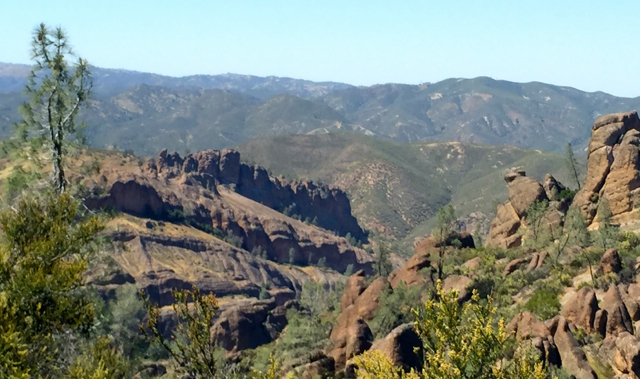
Pinnacles National Park is a geological wonder. Photo/Susan Wood

Pinnacles National Park is a geological wonder. Photo/Susan Wood

By Susan Wood

PINNACLES NATIONAL PARK — Whatever your penchant for an ideal national park, Pinnacles ranks as the most recently inducted. It was established as a national monument by President Theodore Roosevelt in 1908, and 105 years later, President Obama signed it into law as a park.

“Where?” people ask.

What Pinnacles lacks in fame, it makes up for in grand-scale features.
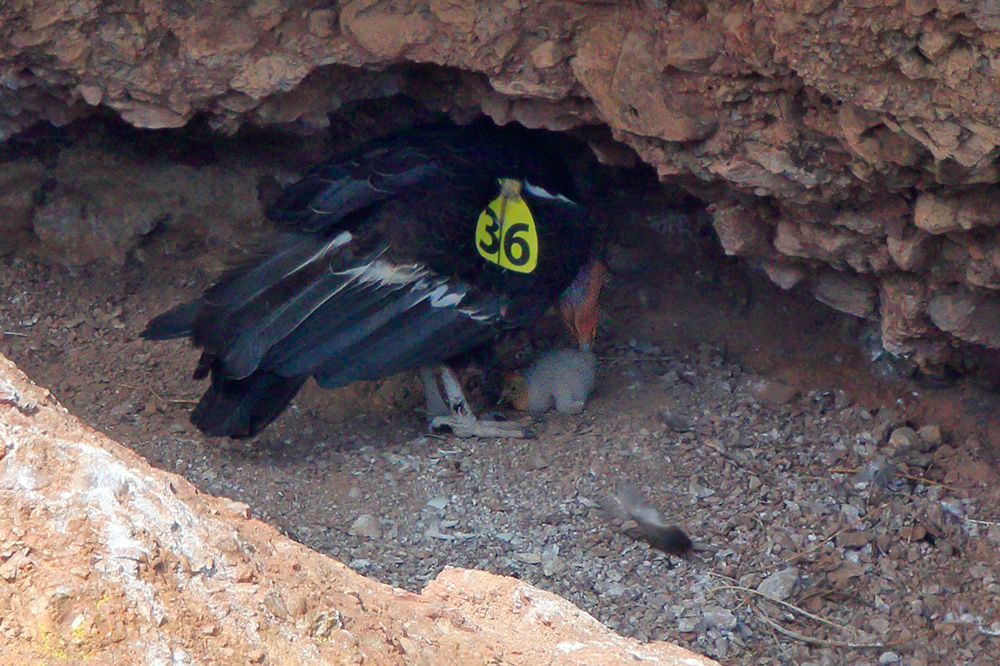
Condors are gradually becoming more prominent in the park. Photo/National Park Service

Condors are gradually becoming more prominent in the park. Photo/National Park Service

A bird’s-eye view

First, it might be a blessing it isn’t well known considering the endangered California condor calls it home. The nesting grounds represent one of a few release sites in the United States and Mexico. Loss of habitat, shootings and poisoning from lead bullets almost did them in when they made the list in 1967. The population has dwindled down to 435 – make that 436 as No. 828 was born in the last few weeks – with 167 in captivity.

The condor is one of the largest birds in North America, with a wingspan of 9½ feet. It soars on thermal updrafts at 55 mph, at altitudes of 15,000 feet. When you see one, it is a spectacle to behold.

The Park Service has established an aggressive program to monitor their progress.

Winter rains bring spring flowers. Photo/Susan Wood

Winter rains bring spring flowers. Photo/Susan Wood

“We want to get a general sense of where the birds are,” program park worker Arianna said, while holding a transmitter at a picnic table stationed at the Bear Gulch day use area. Bear Gulch is ground zero for condors, as the social birds can often be spotted in the afternoon flying over High Peaks and swooping down into the valley. The park workers set up a spyglass station to help spot them between the campground and Bench trailhead.

The birds wear radio transmitters that workers track a few times a day. If a bird doesn’t move after eight hours, workers know to go find it because something’s wrong.

This is not an easy task. They tend to fly in remote areas and weigh 20 pounds, making it a challenge to carry them out. They nest at night and feed on dead carcasses during the day.

It’s a big deal when a new chick enters the flock. Park workers even announced No. 828 on a sandwich board sign at the general store.

That’s not all to announce. Pinnacles’ terrain, wildlife and lack of light at night make programs unique. There’s stargazing, life with bats – which hang out in the Balconies Cave – and in spring, wildflowers that pop out of the ground as far as the eye can see. There are larkspur, mariposa lilies and poppies everywhere.
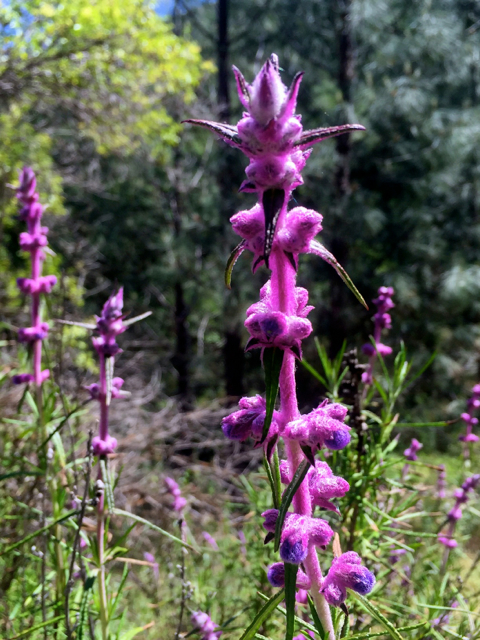
An array of wildflowers fill the landscape. Photo/Susan Wood

An array of wildflowers fill the landscape. Photo/Susan Wood

This is especially true this year, as park workers celebrate Mother Nature bestowing a lot of water last winter that fell on the 26,606-acre park that is split between San Benito and Monterey counties.

Sunset magazine rated Pinnacles Campground – which used to be private before it melded into the national park — one of the top 50 in the West. Large meadows give the appearance of a wide-open expanse and plenty of shade from trees form canopies to provide relief from the sun. Many songbirds find refuge in these trees. It’s highly recommended to close one’s eyes and allow for a pure sensory experience as the birds compete with the gentle winds. For a more stark auditory experience, wild turkeys that roam the land can be heard at all hours.

It’s hard to imagine what would happen if they tangled with the also-roaming javelinas.

Granted, it’s easy to just hang out at the campground to see how the day unfolds. But there are rewards for hikers wanting to venture out.

At ground level

The terrain at Pinnacles National Park represents a magnificent landscape of rock formations.

The Earth has moved in this region, creating a moving experience for those who take in its beauty. After all, the park is situated very close to the long San Andreas Fault that slices through 600 miles of California. Millions of years ago fault lines divided volcanic and sedimentary rocks that developed an uplifting of land forming steep cliffs. Signs along the Bench Trail from the campground to Bear Gulch highlight the extraordinary geology.
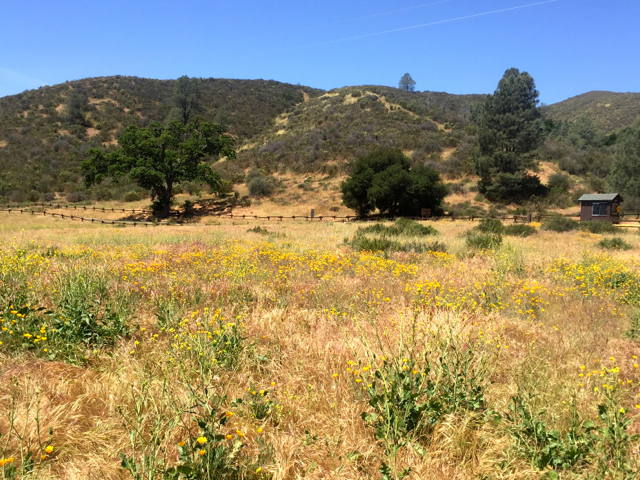
Spring is an ideal time to visit -- before it gets too hot. Photo/Susan Wood

Spring is an ideal time to visit — before it gets too hot. Photo/Susan Wood

Erosion from water and wind make the spires and towers seen today. The High Peaks loop from the Bear Gulch area was calculated at only 5 miles, but the spires appear from the parking lot to be a two-day backpack away.

The trek is well worth the effort. Views dominant the hike, with a short scamper on the top of the ridge to the tippy-top of Hawkins Peak at 2,720 feet, providing that top-of-the-world experience.

The return from the Condor Gulch Trail may not be for the faint of heart, but it’s definitely suggested for the adventurous spirit. There’s a reason this place is a rock climber’s paradise. Hiking becomes more like bouldering – with the safety of iron bars and chopped out steps to keep the trekker balanced in some precarious spots.

The scenery is more spectacular at every turn.

—–

Notes:

·       Pinnacles National Park is located in the Central Valley off Highway 25, 35 miles from Hollister.

·      Camping is $23 for tent sites, $36 for RV sites with electrical hookups. Reserve online.


El Dorado County hires CAO from within

By Kathryn Reed

El Dorado County will have a new chief administrative officer beginning at 8am May 25.

At today’s Board of Supervisors meeting Don Ashton was unanimously hired.

Don Ashton

Don Ashton

He knows what he is getting into, the systemic dysfunction, the questionable hires from predecessors and a budget process that is a mess.

The 45-year-old is currently the director of the county’s largest department, Health and Human Services.

Ashton told Lake Tahoe News his top three priorities are:

1.     “The budget and the budget process overall, not just the current year, but establishing a more timely budget process moving forward.”

2.     “Our culture … (creating) one of collaboration and trust based on following the county’s strategic plan.”

3.     “Looking at the organizational structure of the county, making sure people are in the right spots and moving them to where they would be most effective.”

Ashton has been with the county for a little more than five years, including working for the sheriff’s department. He moved here from Los Angeles County to be near to his fiancé, who is now his wife.

He knew after about two years of working for El Dorado County that he would like to be CAO. The timing, he said, was right for it to happen now. Ashton will be making nearly $215,000 year, plus benefits.

“Right now we have an outstanding board that is committed to changing the culture,” Ashton said. “No doubt it is going to be a lot of work.”

The county has gone through a handful of CAOs in the last few years who have had a penchant for hiring their friends and spending money on personnel instead of the basic needs of residents – like roads and other infrastructure.

Larry Combs has been the acting CAO for nearly a year, working part time and living in Auburn.

Ashton has the support of other elected officials in the county – all who wrote a letter in April to the board backing him.

He knows the days ahead won’t be easy, especially with budget hearing coming next month. Still, Ashton said he looks forward to the challenge.

“The way I’m going to go about it is to be as transparent and open as possible,” Ashton said. “I’m going to try to get the trust of the community, the board and other department heads.”


Drought parched Nev. warms up for fire season

By Benjamin Spillman, Reno Gazette-Journal

Nevada’s wildland firefighters are readying themselves for a treacherous fire season in months ahead.

That’s because a multi-year drought interrupted by El Nino moisture created conditions that cranked up the risk of wildfire in the Sierra Nevada and Great Basin.

The ramped up risk factors as well as measures fire officials will take to protect people and property were the topic of a briefing Monday for Gov. Brian Sandoval.

Read the whole story


Stormwater collection in Tahoe keeps evolving

This storm drain and debris at El Dorado Beach were improved as part of the Lakeview Commons makeover in South Lake Tahoe. Photo/LTN file

This storm drain and debris at El Dorado Beach were improved as part of the Lakeview Commons makeover in South Lake Tahoe. Photo/LTN file

By Kathryn Reed

Those tasked with keeping gritty stormwater from reaching Lake Tahoe are looking into whether the roads are actually a problem.

“Pavement wear” is what Russ Wigart, with El Dorado County, called it.

“We completely annihilate our roads on an annual basis,” Wigart said. “Fifteen to 25 percent of fine sediment is from pavement. Maybe we could resurface our roads and call them water quality projects.”

Wigart, along with Jason Burke of South Lake Tahoe and Andrea Buxton of Tahoe Resource Conservation District, all stormwater coordinators, gave a presentation last week at Lake Tahoe Community College about what is going on with runoff in the basin.

Several years ago scientists determined that fine sediment is the main culprit for the diminishing clarity of Lake Tahoe. Much of this comes from runoff from roads, and some from tributaries carrying silt into the larger water body.

With so many roads throughout the Lake Tahoe Basin being categorized as near failing, it stands to reason that ground-up asphalt could be a problem.

The volatile suspendable solids found in the runoff are believed to be the road, Wigart said.

TRCD for three yeas has been monitoring eight catchments around the basin that deliver treated runoff into the lake. More oversight would be ideal, but funding is an issue.

The idea is that with more years of analysis true trends will be able to be established. This will prove if the various treatment systems are working.

TRCD staff sends samples to labs for analysis, monitors the amount of rain/snow that falls, assesses the turbidity (cloudiness), and measures the continuous flow during storms.

The varied erosion control measures that the large landowners are putting in cost millions of dollars. South Lake Tahoe spent $10 million at Sierra Tract and $7 million at Harrison Avenue.

Burke pointed out how retrofitting the city – and any location — after the fact is a more costly endeavor. Ideally, infrastructure like storm drains is put in when a jurisdiction is built. Plus, doing it all after the fact presents contractors with unknowns. When the improvements went in at Harrison a couple years ago five underground fuel tanks were discovered, with two of them being full.


The importance of free play for kids

By Katie Arnold, Outside

The other morning after breakfast, my 5-year-old daughter whined, “I’m bored!” Few words have the power to rankle parents more than these two (except maybe “When are we gonna be there?”). It was Saturday and the whole day stretched luxuriously before us. We didn’t have to hustle off to school or pack lunches or fly off in four different directions. We could simply hang around and do nothing.

Therein lay the problem.

I told my daughter what my mother had told me when I was a girl: that being bored meant I just hadn’t thought of something clever to do. Boredom reflected poorly on me, not my circumstances. Then I shooed her and her 7-year-old sister out to the arroyo to play.

The arroyo is a dry, sandy wash that runs a few hundred feet below our house. We’ve found piles of rusty tin cans there, traces of a makeshift homeless camp (long abandoned), and other random cast-offs. Mostly, though, it’s wild little corridor between steep hillsides, lined with piñon and juniper trees and bound by sandy cliffs that are perfect for scooting down on your bottom—a narrow slice of nature a few blocks from downtown Santa Fe.


Child development experts call these kinds of spontaneous, child-directed activities “free play.” A generation ago, when kids were far more likely to wander out the door and goof off in the yard or ride bikes with their friends, this didn’t need special terminology. It was just called play. A seminal 1997 study from the University of Michigan determined that the amount of spare time kids in the U.S. had to play dropped by 25 percent since 1981, and Boston University psychologist Peter Gray has found that it has been declining ever since. In a 2007 report, the American Academy of Pediatrics found that “much of parent-child time is spent arranging special activities or transporting children between those activities… Many parents seem to feel as though they are running on a treadmill to keep up yet dare not slow their pace for fear their children will fall behind.”

Read the whole story