Drought sparks larger wildfires throughout Calif.

By Veronica Rocha, Los Angeles Times

Firefighters are tackling larger and more aggressive wildfires as drought conditions continue for a fifth year in California, drying out swaths of forest land.

Raging wildfires in Northern and Southern California kept firefighters busy over the weekend, pushing the number of acres burned so far this year to well over 20,000.

“Now already this year, crews have responded to 1,562 wildfires that have burned nearly 28,000 acres,” said Daniel Berlant, spokesman for the California Department of Forestry and Fire Protection.

That’s twice as many acres burned for the first six months this year than in 2015, he said. According to CalFire, 11,353 acres burned for the same period in 2015.

Read the whole story


LTUSD students eager to make biking the norm

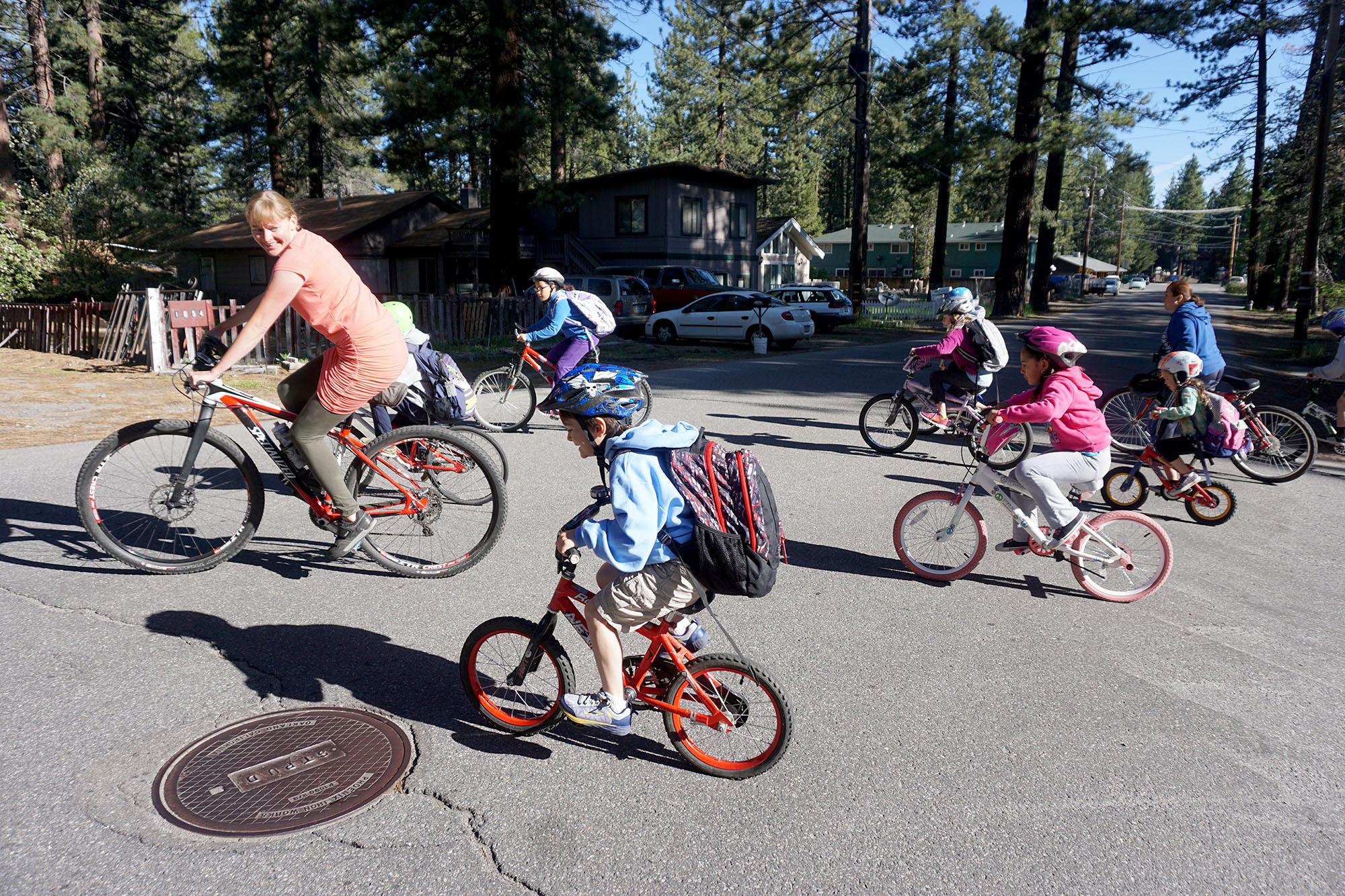
Some Bijou students came from as fas as the Tahoe Keys. Photos/Provided

Some Bijou students came from as fas as the Tahoe Keys. Photos/Provided

By Rebecca Bryson

Although this was the first year for South Tahoe Middle School to participate in Bike to School, they hit it out of the park.

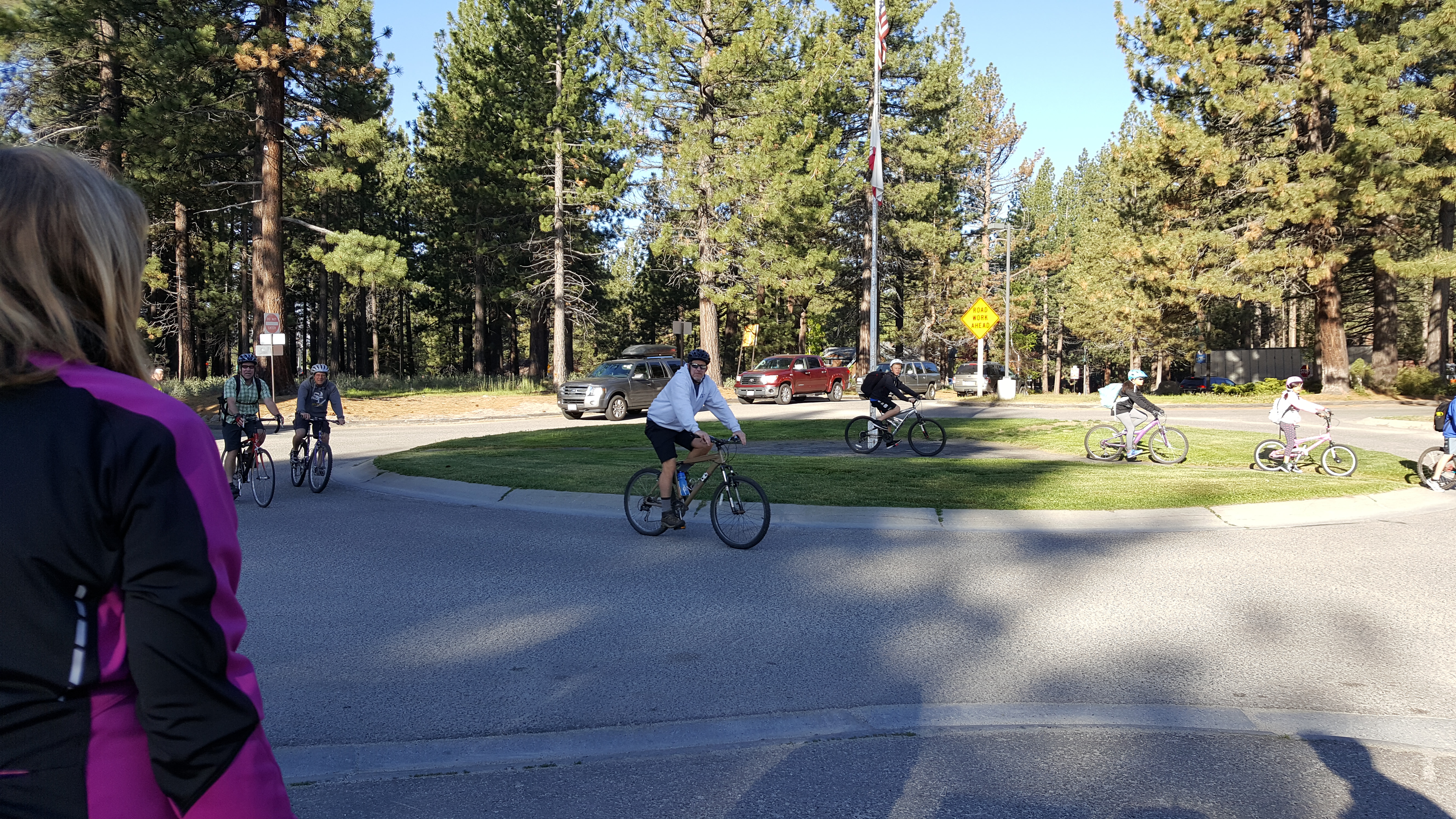
Kathleen Whatford, the school’s PE teacher, along with Principal John Simons and Assistant Principal KarenHolmes, spearheaded a major initiative with “biking school buses” coming from all over town. Students met each morning at designated spots. Then a teacher or parent would lead them to school, picking up more kids along the way.

It was a major coordination effort, involving teachers, parents, students and the Lake Tahoe Bicycle Coalition. And as a result of this big push, there were 85, 120 and 150 bikes at the STMS last Wednesday through Friday (as opposed to the usual 5-15).

There were so many bikes that Simons opened up the tennis courts to lock the bikes there.

Students and adults use pedal power to get to STMS.

Students and adults use pedal power to get to STMS.

Andre Albanese, a sixth-grader who biked 9 miles each way from North Upper Truckee every morning said, “It gave me a real sense of independence. I realized how beautiful Tahoe is and hope to keep doing it some other mornings as well.”

And the good news is that the kids keep coming. There were still at least 50 bikes at the middle school again this Monday — despite the fact that the official Bike to School event ended last week.

Parents and teachers at Bijou and Sierra House elementary schools also set up designated routes this year for the first time. At Sierra House, Principal Ryan Galles led a group from the Bijou Bike Park to the school each morning. Sierra House and Tahoe Valley are at a disadvantage from being located on busy streets, but that didn’t stop the kids from coming.

Jamie Lowe, first-grader at Sierra House, exclaimed that it was so fun and special to ride to school every morning with her daddy.

Kids at Tahoe Valley were fired up for Bike to School week as they had just had a Bike Rodeo the previous Tuesday where California Highway Patrol officers taught bike safety skills to all third-, fourth- and fifth-graders. Arial Carreau, third-grader at Tahoe Valley, declared that “biking to school makes me stronger. My family will keep biking and walking to school until the end of the year.”

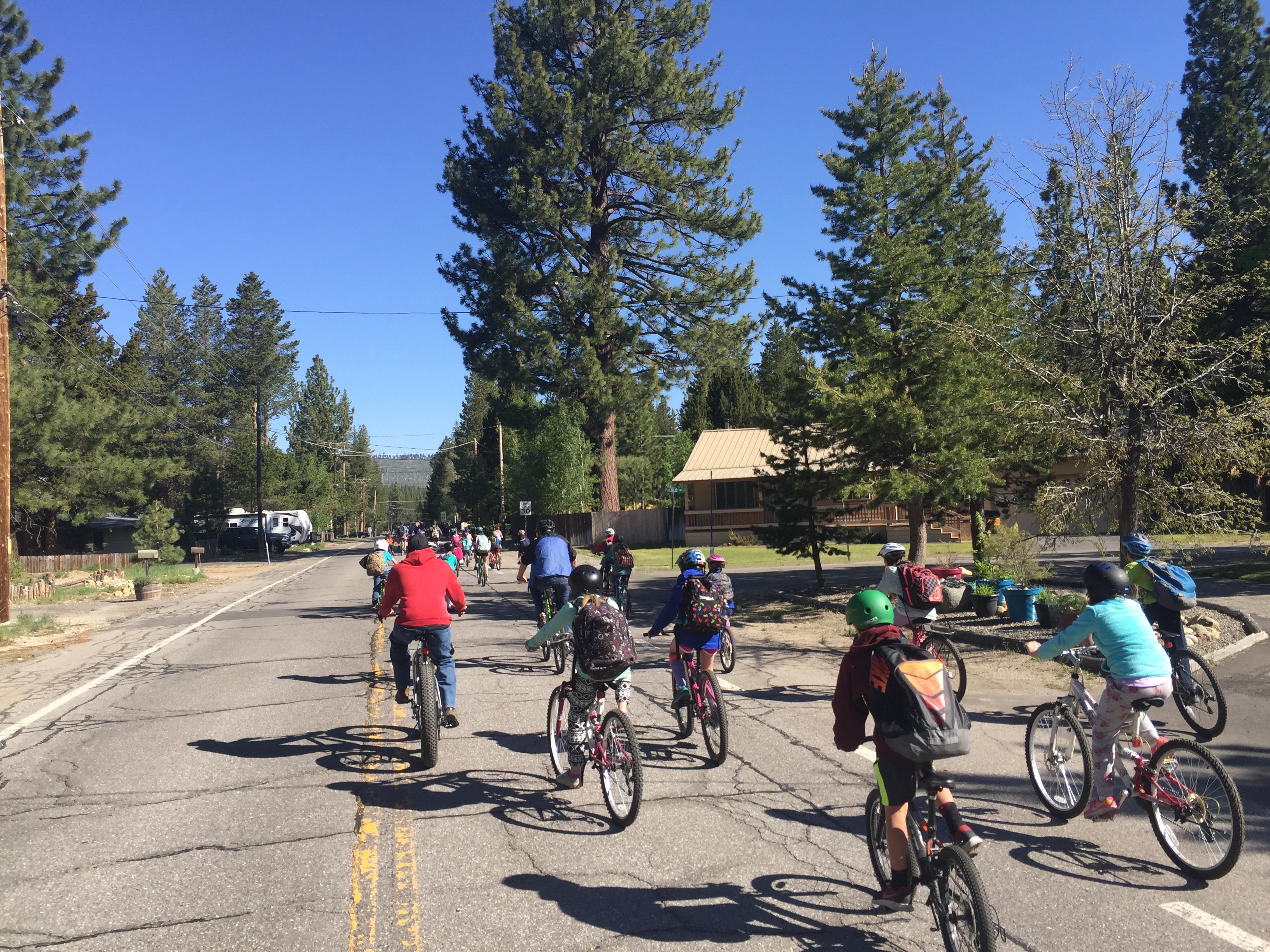
Magnet school students ride down Apache to their school.

Magnet school students ride down Apache to their school.

At Bijou there were six designated routes assigned for June 1, but the momentum kept going the other two days as well. When Lizbet Cedeno (second grade) arrived by bike at Bijou last Wednesday morning, she immediately asked the organizers, “We are going to do this again tomorrow and the next day, right?” Dulce Zepeda, a first grader, was part of a walking group, but she declared that she definitely wanted to get a bike so that she could ride to school next time.

By the end of the week, students and families were organizing their own routes. A group of more than 15 came all the way from Tahoe Keys. Joel Bingham, a Bijou parent, lead a group of 10-15 every morning from his house near the meadow. The kids saw coyotes, birds and wildflowers along the way. The kids on his team declared that it was a very special way to get to school. They plan to keep going as many days as possible.

The Environmental Magnet School’s big day was Friday. For the second straight year, teachers and parents led kids to school from all along North and South Upper Truckee as well as along the new Saw Mill Road bike path from the Y area. At 8:50am, they all convened at the Meyers Post Office to ride down Apache en masse. This year, kid bikes alone were estimated at 165 — certainly surpassing last year’s numbers.

A very big thank you all the teachers, parents, and Bike Coalition members who participated and led kids to school. And, a big congratulations all the student bikers. Keep those wheels rolling!

Rebecca Bryson is co-chair of the Community Mobility Work Group and co-founder of Small World Parent Network.


Judge Brooks wins; EDC growth measures split

By Kathryn Reed

El Dorado County voters put Judge Nelson Brooks back on the bench, but were divided over what to do with growth initiatives.

Brooks was first appointed to the bench by Gov. Arnold Schwarzenegger in 2009, and was elected a year later to a six-year term with more than 75 percent of the vote. This go-round he came in with 58.53 percent, or 25,568 votes, while his opponent Roland Thiemann had 41.16 percent, 17,982 votes.

Their race was bitter, contentious and turned heads throughout judicial circles in the state. This is because it is almost unheard of for a sitting judge’s colleagues to support a challenger.

El Dorado County Superior Court is split, though most are in Brooks’ corner, which is led by presiding Judge Suzanne Kingsbury. On the opposite side is Judge Steve Bailey who wants Kingsbury’s title. He put Thiemann up against Brooks.

“It’s really too bad that happened,” Brooks told Lake Tahoe News of the divisiveness. “I will do anything I can to heal any rifts there might be and getting people to work together instead of at cross purposes.”

It was a slow, steady stream of voters on June 7 at Lake Tahoe Airport. Photo/LTN

It was a slow, steady stream of voters on June 7 at Lake Tahoe Airport. Photo/LTN

Measure E and G pertain to growth initiatives for the county. A yes vote limits growth, a no doesn’t. The no position was heavily funded, with Parker Development writing most of the checks. Some expect the “no” side to have spent $1 million to defeat the measures. The television ad buys in the final weeks leading up to the June 7 primary were impressive.

“They are two different measures. The more important one is E,” Sue Taylor, community activist, told Lake Tahoe News. “That is what we have had since 1998 to keep it a slow growth county. It will be harder for developers because of the gridlock on the freeways that need to get mitigated.”

Developers will have to address the road concerns before they can build.

Measure E passed with 51.81 percent; 1,701 votes separate the yes votes from the no.

Measure G was defeated by 1,168 votes. No – 51.24 percent, yes – 48.76 percent.

A new supervisor is going to occupy District 1 because Ron Mikulaco decided to vacate his seat. He instead ran for state Assembly because incumbent Beth Gaines is being termed out. She in turn was running for his supervisor seat.

Mikulaco, a Republican, came in second in El Dorado County in this race, but didn’t fare as well with voters throughout the 6th District. Democrat Brian Caples and Republican Andy Pugno will be on the November ballot.

Gaines was the top vote getter with 25.58 percent, and John Hidahl a close second with 23.17 percent. More than 200 votes separate them.

Brian Veerkamp will retain his seat for District 3, and Shiva Frentzen for District 2.

Placer County voters kept its incumbents, with Supervisors Jennifer Montgomery, Kirk Uhler and Jim Holmes decisively winning re-election.

Statewide seats have the top two vote getters squaring off in November, no matter the party affiliation.

State Sen. Ted Gaines handedly took top honors in the 1st Senate District.

“While it is early, I am pleased by (Tuesday’s) election results. It proves that my positive message of stopping tax increases and limiting government spending resonated with voters across the North State. I look forward to continuing this work on behalf of the people of El Dorado and Placer counties,” Gaines told Lake Tahoe News.

The Republican will face Democrat Rob Rowen in five months.

While some areas of the state experienced reporting glitches, El Dorado County had no problems, according to elections officials.

“With everything going on out in the media, we expect the turnout in the 60 percent area. That is still to be seen,” Linda Webster, EDC elections worker, told Lake Tahoe News. She said previous presidential primaries had turnouts between 40 and 60 percent.

Winners in other El Dorado County races:

·       5th Assembly District – Republican Frank Bigelow, incumbent.

·       4th Congressional District – Republican Tom McClintock, incumbent.

Placer County winners:

·       1st Congressional District – Incumbent Doug La Malfa (R) and Jim Reed (D) will meet in November.

·       4th Congressional District – McClintock.

·       1st Assembly District – Brian Dahle, had no challenger.

·       5th Assembly District – Bigelow.


SLT council revises VHR rules –again

By Kathryn Reed

The South Lake Tahoe City Council did a 180 Tuesday regarding regulating multifamily properties as vacation rentals, while at the same time mandating those renting a room on a short-term basis have a permit to do so.

For now, at least, these nearly 60 multifamily parcels may still use their parcels as tourist accommodation units. This was the recommendation of Councilmembers Wendy David and Austin Sass, who comprise the vacation home rental subcommittee.

David said the reason for the change is having gathered more input from people who would be affected and realizing it would not solve the greater housing issue for locals.

Following the council’s decision in May, many of the multifamily owners who are using at least some of their units as a VHR formed a coalition to protect their rights and interests. Now other VHR owners are part of the group. Their goal is to be a buffer between homeowners and the council-staff.

After the first two people spoke June 7, Councilman Hal Cole decided to recuse himself because he owns duplexes. And while they are not now used as VHRs, the option is open to him and therefore he could be financially impacted by the decision. Councilman Tom Davis already recused himself because of being in the VHR business.

Many of the 17 who spoke at the council meeting said they use the residence as income and/or for retirement. Some also live onsite, especially those in duplexes. Most said they are not rich land barons, but instead have worked hard to acquire income property and need to keep it to pay their bills.

One reason the council originally wanted to limit multifamily VHRs was to provide more long-term housing for permanent residents.

It was pointed out how there is a larger affordable housing problem in town. Most agreed it would not be solved by banning VHRs at multifamily units.

Sass pointed out how in most ski towns employees live elsewhere and commute to their jobs.

Councilwoman JoAnn Conner said if housing is not available for the average worker, then they will be living off the hill, taking their disposable income with them as well as their kids out of local schools.

While multifamily units are still allowed to be rented to tourists today, the council did not promise that this is a long-term decision. Instead, David-Sass-Conner said they want to revisit the issue again – and soon – as well as have a larger discussion about housing for residents.

As of May 5, there were 1,862 VHR permits in South Lake Tahoe. Total permits as of: January 2015 – 1,549; October 2015 – 1,906; and January 2016 – 1,874. Since Oct. 1, 2015, there have been 106 new VHR permits approved by the zoning administrator.

The ordinance takes effect in 30 days. Also at that time anyone using any part of his or her residence as a vacation rental must collect transient occupancy tax.

At the June 21 meeting the council will review the submitted bids for an economic study about vacation rentals.


Calif. beats water conservation targets in April

By Associated Press 

SAN FRANCISCO — Californians once again beat the state’s drought-time order for water savings in April — one of the last months before officials transition from a statewide conservation order to more localized targets, a state agency said Monday.

The average Californian used 77 gallons of water a day in April, down 26.1 percent from 104 gallons in April 2013, the state Water Resources Control Board said.

The agency has been the top conservation monitor and enforcer during California’s five years of drought.

California in April marked its 11th month of mandatory water conservation of up to 25 percent for cities and towns.

El Nino storms this winter brought near-normal rain and snow to Northern California but not the southern part of the state.

Starting this month, California will switch to a system that will let local water agencies lift conservation requirements if they can prove they have enough water to get through three more years of possible drought.

State water board chairwoman Felicia Marcus called the localized conservation orders the “show-me-the-water model.”

“I do want to be clear if this approach doesn’t work we are prepared to call folks on it,” Marcus told reporters.

Under the new system, water districts unable to show they have enough water for three more years’ of drought must conserve by a corresponding amount.

Water agencies that are 20 percent short on water, for example, would be told to keep their water use 20 percent below pre-drought levels.

After 11 months of conservation, Californians have saved enough water to supply 18 percent of the state’s nearly 40 million people for a year.


Condos proposed near Van Sickle Park

By Kathryn Reed

What was going to be a hotel project at the edge of Van Sickle Bi-State Park in South Lake Tahoe is now going to be 22 condominiums.

The South Lake Tahoe Planning Commission on June 9 at 3pm will have a public hearing about the project. The meeting is at Lake Tahoe Airport.

Commissioners will be considering a negative declaration addendum and a request to grant a variance from the front yard setback standard and trash enclosure requirement.

Lucky Look LLC is the owner and applicant. The Washington state-based corporation is a partnership of Michael E. Pegram and Robert S. Over. Pegram is a partner in the Carson Valley Inn in Minden and Bodines casino in Carson. The company’s name is a play off of a horse Pegram owned — Lookin at Lucky — the 2010 Preakness Stakes winner. Neither man was available for comment.

They acquired the property in foreclosure.

Sloan Gordon of Gordon Consulting in Stateline told Lake Tahoe News, “I work for the owner. I’m not going to make any comment.” According to his website, he was a principle planner for Lake Tahoe Development Company. That is the Randy Lane-owned firm that created the Ta-hole – aka failed convention center project.

Lane has been brought in as a consultant for the condo project because at one time he was going to build what was known as the Gondola Vista Boutique Hotel. This was going to be a time-share. Those permits have expired.

When the permitting agencies approved the old project time-shares were an allowed use and whole ownership condos were not. The Tourist Area Plan that was approved in the last couple years now allows condos there. (Time-shares are also still permissible.)

“They called me because I have knowledge of the process. Beyond that I don’t have any involvement,” Lane told Lake Tahoe News.

Attorney Lew Feldman will be representing the project applicants at Thursday’s meeting.

The current project is called Gondola Vista Estates, which will be at 20, 30, 40 Lake Parkway. The units are each two-story and 2,670 square feet.

“The applicant will develop the site using existing residential units of use that are being transferred from the old Colony Inn site,” John Hitchcock, planning manager with South Lake Tahoe, told Lake Tahoe News.

The parcel can be located by going into the state park and taking the access road near the gondola.

“We have different alternative designs. They are going to have to figure out ingress/egress to the loop road if it ever gets built,” Hitchcock said.

(The loop road is a proposal to bring Highway 50 behind Harrah’s-Mont Bleu and in front of the park. Carl Hasty with the Tahoe Transportation District, which is the lead agency on the loop road, did not respond to LTN’s inquiries.)

TRPA has sent a notice to neighbors asking for comments.

“The notice will only ask for comments and does not include a public hearing date because if there are no substantial comments submitted, we can approve at staff level since it is re-permitting a project that was previously approved several years ago,” Tom Lotshaw, TRPA spokesman, told Lake Tahoe News. “The new permit does not have to be issued to the previous applicant/owner.”


Planned Placerville courthouse move rattles town

By Hudson Sangree, Sacramento Bee

El Dorado County courts have called the stocky white courthouse in downtown Placerville home for over 100 years – and for nearly half that time residents have argued about whether the historic courthouse has outlived its usefulness.

The debate riled the Gold Rush-era town in the 1960s and resulted in a makeover that covered the neoclassic courthouse’s interior with dark wood paneling and swapped chandeliers for florescent lights.

Today, plans call for a new courthouse to be built in a parking lot behind the El Dorado County jail, in a wooded area on the western edge of the community of 10,000 in the Sierra Nevada foothills.

“It is a building that has outlived its usefulness as a courthouse,” said Suzanne Kingsbury, presiding judge of the El Dorado Superior Court.

Others think the move is misguided. The courthouse has anchored downtown Placerville since it was built in 1912, and it reliably infuses Main Street with dozens of jurors, lawyers and court employees who keep downtown restaurants and shops busy on weekdays. Tourists generally don’t show up until the weekends.

Critics of the move contend there is ample room to build a modern courthouse annex with a much-needed parking garage, while rehabilitating the historic courthouse.

Kirk Smith, a downtown property owner whose family has been in the Placerville area since the 1840s, has led the fight against moving the court.

“It has to do with pride. That’s our heritage. It’s part of our DNA,” Smith said. “People come to Placerville because of what’s old, not what’s new.”

In 1965, grand jurors recommended replacing the old courthouse because of seismic instability, he said. That caused a public outcry and resulted in the courthouse being renovated.

This time, the plan to move the court hasn’t caused such a stir, but there are those who think it’s a bad idea and would siphon dollars that keep downtown’s restaurants and shops afloat.

Main Street business owners say a significant portion of their sales, up to 30 percent in some cases, come from customers who work in the courthouse or residents who are called for jury duty. During the court’s long lunch break, they eat, shop and stroll Main Street, often coming back on the weekend with friends, they said.
Albert Fausel co-owns Placerville Hardware, billed as the oldest operating hardware store west of the Mississipi and one of the longest-operating businesses in California. He and other merchants said they felt excluded from the debate over the courthouse’s fate by public officials intent on a new building despite public sentiment.

Fausel said an addition to the existing courthouse would have been a better option.

“They’re spending so much money (to build a new courthouse),” he said. “I think they could spend the money down here and help the merchants. I don’t know why they’re taking it away from us.”

Preservationists have sued the state Judicial Council to stop the project, saying a legally mandated environmental analysis overlooked the potential for urban blight if the courthouse moves.

“The (environmental impact report) failed to adequately disclose, analyze and/or mitigate the Project’s economic impacts to the businesses in historic Placerville on Main Street that will lead to urban decay,” says the complaint by the Placerville Historic Preservation League.

The case, brought under the California Environmental Quality Act, is pending in San Francisco Superior Court and could be decided soon. Courthouse construction, which was scheduled to start next year, is on hold pending the outcome.

In a legal brief filed by the Judicial Council and El Dorado County, lawyers argued that there is no real evidence that the court’s relocation would lead to blight. Plans call for the 1912 courthouse to be left standing and reused in a way that will enhance the local economy and draw people downtown, the attorneys said.

At the same time, construction of a new 88,000-square-foot courthouse will improve the county’s criminal justice system by providing modern facilities with holding cells, jury-assembly rooms and ample security, the lawyers said. Its location next to the jail will make bringing defendants to court much easier and save money, the lawyers wrote.

Placerville City Councilwoman Wendy Thomas said she understands the concerns of business owners but is certain the ornate white courthouse needs replacing.

“She’s a shining jewel in the center of our city and she’s a mess inside,” Thomas said.

The court’s move should be looked at as an opportunity to reuse the old building in a way that would draw visitors to Placerville on weekdays and at night, Thomas said. She suggested it might be turned into a boutique hotel with a restaurant or a performing arts center.

One expert suggested the move might not have the long-term benefits that advocates envision, however.

Ray McDevitt, a retired lawyer who wrote the book “Courthouses of California: An Illustrated History,” said courthouses such as Placerville’s were traditionally the center of small towns, and not just for symbolic reasons.

“It was an economically sensible decision,” McDevitt said. Lawyers and others using the courthouse had offices downtown, as they still do. Hotels and other prominent public and commercial buildings often shared a square with the courthouse. Centralizing functions made sense.

These days counties around the state are building new justice facilities on the outskirts of towns, including in Auburn, Roseville and San Andreas, the county seat of Calaveras County.

New suburban courthouses might seem logical in the short run by providing ample space and easy access to the county jail, McDevitt said, but he doesn’t think they’ll last 100 years.

“Land at the fringe of a community is cheaper and you can have a huge parking lot,” said McDevitt, who practiced local government law in San Francisco for decades.

The trend, however, is oddly retrogressive, like building shopping centers in the 1950s and 1960s on the edges of cities, he said. The current return to city centers and away from car-based culture is more economically and environmentally feasible going forward, he said.

“The flight to the suburbs is sort of over, I think, as an urban design formula,” McDevitt said. “A lot of places are spending time and energy to revitalize the cores of their communities. So to take a functioning governmental institution and remove it from a place where it’s visible, understandable and accessible seems going against the grain.”

“I think that in another 30 years,” he said, “the decision to remove courthouses to remote locations will be looked at as errors.”

Hudson Sangree: 916-321-1191, @hudson_sangree

reprints
LOCAL
by Taboola Sponsored Links YOU MAY LIKE
This Site Will Change The Way You Shop Online
FreeShipping.com
Jose Canseco’s daughter Josie is Playboy’s Miss June
SportsChatter
Police track down wanted vegan restaurant owner after she ordered a Domino’s pizza with her credit card
OddChatter
Study shows half of misogynistic tweets are sent by women
OddChatter
COMMENTS
Sign In Using The Social Network of Your Choice to Comment

To learn more about comments, please see the Comments FAQ.
TermsPrivacy Policy Social by Gigya
We thank you for respecting the community’s complete guidelines.

4 Comments
SubscribeRSS
16 hours ago
Kirk Smith
A number of local politicians pushed closure of our historic courthouse with outrageous claims like councilmember Wendy Thomas telling folks that the state wanted to move our courthouse to Rancho Cordova and that if local government did not support this project now, our courts would lose $90 million and would no longer be high on the list for new construction. But court authorities have said those statements are absolutely false, but neither Thomas nor any of the rest have shown the personal integrity required to correct those and a series of other lies.
ReplyShare10
16 hours ago
Kirk Smith
There were no public hearings this time, no public input, just the usual backroom deals where politically connected people are slanted to make huge sums if their scheme to build on property near the jail goes through. Instead they could do what has been done in California and throughout the nation to save old courthouses, expand older courthouses with an annex as would work here since the adjoining public property could allow for increasing court space by at least three times.
ReplyShare10
1 day ago
William Howard
Many of these old courthouses were built at the sites where public executions took place before the state took over that task from the counties. An example is the beautiful old courthouse in Placer County that you can see as you drive through Auburn on I-80. It was built at the site of the gallows used for the first three legal public executions in Placer County. The three murderers were buried under the gallows after their executions. I have always wondered if they moved the graves to a cemetery before they built that courthouse or if their bodies are still moldering beneath it.
ReplyShare10
1 day ago
William Howard
It seems to me that a compromise could be reached that would make both sides happy. Keep the old courthouse for civil actions and maybe traffic tickets and build a new courthouse for the criminal actions.

ReplyShare10

SPONSORED CONTENT
Why Are the Students of ICEF Vista Academy Making the Grade?
ICEF Vista Academy has an ambitious agenda. Check out how they are making it happening.
By CA Lottery

VIDEOS

E-bikes offer alternative transportation option
E-bikes offer alternative transportation option 02:28
E-bikes offer alternative transportation option
Fallen rock climber airlifted near Donner Summit 00:43
Fallen rock climber airlifted near Donner Summit
Wood ducks are counted at Colusa County’s Murdock Gun Club by California Waterfowl Association 01:12
Wood ducks are counted at Colusa County’s Murdock Gun Club by California Waterfowl Association
VIEW MORE VIDEO
LOCAL
Planned move for Placerville courthouse rattles Gold Rush town
Woman pedestrian killed Friday during busy day for Sacramento police
Woman killed, child injured after car flips off I-5 in Woodland
Mermaids plan to make a splash in Old Sac
Sacramento Police release sketch of sexual assault suspect

EDITOR’S CHOICE VIDEOS

Trump Praises to ‘My African American’ Supporter
AP
Colombia hands U.S. 2-0 loss in Copa opener
Yahoo

Muhammad Ali Dead at 74
AP
Trump Praises to ‘My African American’ Supporter
AP
Colombia hands U.S. 2-0 loss in Copa opener
Yahoo
More videos:

Colombia hands U.S. 2-0 loss in Copa opener

Muhammad Ali Dead at 74

Trump Praises to ‘My African American’ Supporter

Colombia hands U.S. 2-0 loss in Copa opener

Muhammad Ali Dead at 74

Trump Praises to ‘My African American’ Supporter

Colombia hands U.S. 2-0 loss in Copa opener

Muhammad Ali Dead at 74

Trump Praises to ‘My African American’ Supporter
Read more here: http://www.sacbee.com/news/local/article81711792.html#storylink=cpy

Battle royal for open Senate seat in Nevada

By Erica Werner, AP

In a state where the politics can be as raucous as the casinos, the race for U.S. Senate in Nevada is shaping up as a battle royal.

Senate Democratic leader Harry Reid’s retirement after three decades has created a rare open seat that offers Republicans their one real shot at winning a state now held by the Democrats. With their slim Senate majority under siege around the country, Republicans are determined to replace Reid with one of their own, Rep. Joe Heck, a wonkish and hard-working Army reservist.

But the canny Reid is just as intent on installing a Democrat to replace him. He recruited a former state attorney general, Catherine Cortez Masto, who would be the first Latina ever to serve in the U.S. Senate. Her candidacy is giving the state’s increasingly powerful and overwhelmingly Democratic Latino voting bloc an opportunity to send a message to GOP presidential candidate Donald Trump, who is sowing fear and anger in their community with his threats to build a wall with Mexico and deport more than 11 million immigrants who are in the country illegally.

With special interest money already gushing into the race, the dynamics make for a super-charged throw-down in this state of bright lights and wild contradictions.

“It’s not lost on either side of the aisle that the Senate majority in 2017 could very well come down to this race,” Heck said in an interview in his clean and orderly campaign office. As volunteers worked the phones, Heck professed confidence, saying he has won three competitive races for his Southern Nevada House seat and insisted he would do it again for Senate.

“After eight years of Barack Obama and 30 years of Harry Reid people are truly ready for a change, especially in a place like Nevada where we’re still bouncing along the bottom in economic recovery,” Heck said.

Campaigning at El Tarasco Mexican restaurant, where colorful offerings included rose petal ice cream, Cortez Masto played up a different kind of change. She emphasized her Mexican roots, reminding supporters her grandfather emigrated from Chihuahua and she and her sister were the first in their family to graduate from college. In an interview, she was quick to link Heck to Trump.

“It is crazy to me that in this day and age we’re having this discussion about electing somebody who is full of hate and discrimination,” Cortez Masto said. “I have an opponent I’m running against, Congressman Heck, who is supporting him.”

It’s a line of attack that figures to be a staple of Democratic Senate campaigns around the country this year. In Nevada, Democrats are sending two people in parrot costumes and Trump hats to follow Heck around, intending to suggest he parrots Trump’s views. Despite blistering heat topping 100 degrees, the parrots jumped up and down outside a Hyundai dealership where Heck was campaigning one recent afternoon, before getting escorted off the lot.

Heck insisted such attacks won’t work.

“People know who Joe Heck is,” he said. “This idea of identity politics or guilt by association, I think the electorate is smarter than that.”

If Heck faces a challenge in being linked to Trump, Cortez Masto is confronting something similar in her connections to Reid, who is closely involved in her campaign and has put his still-formidable political machine behind her. Reid, 76, is a polarizing figure in the state, beloved by many Democrats but loathed by Republicans.

Cortez Masto, a cautious campaigner who has not previously faced a highly competitive race, is quick to change the topic when asked about him.

“Sen. Reid’s not on the ballot, and to me this is a race I’m focused on about the issues that people in my state, where I was born and raised, care about, because I will be representing them in Washington, not Sen. Reid,” Cortez Masto said.

Yet for both candidates in Nevada, as in other states with competitive Senate races, the outcome will depend partly on something they can’t control: how the presidential race plays out between Trump and the likely Democratic nominee, Hillary Clinton.

Republicans are optimistic Trump could win Nevada, but the state has gone Democratic in the past two presidential elections. Registered Democrats outnumber Republicans by some 65,000 voters, a figure Democrats and labor unions are working hard to increase even more.

With Trump as their nominee, Republicans face the prospect of record Latino turnout. Activists point to increased voter registrations and citizenship applications as evidence Latinos are lining up to prevent Trump from becoming president.

“Heck is doomed,” Reid himself predicted when asked about the impact of the Latino vote.

After greeting supporters at El Tarasco restaurant on a recent afternoon, Cortez Masto headed across the street to an early-voting site where a life-size Elvis Presley cutout beckoned voters to the polls ahead of the state’s June 14 congressional primary.

Neither Cortez Masto nor Heck faces serious opposition in the primary, though in a taste of Nevada’s colorful politics one of Heck’s opponents is a hard-core conservative named Sharron Angle. She lost a winnable Senate race against Reid six years ago after a series of gaffes, including telling Latino school-children they looked like Asians. Angle doesn’t appear to have much money or support this time around, but she recently produced an ad depicting herself as a tiger and Heck as a bunny rabbit, and showing herself gripping Trump’s hand.


Search crews a safety net for recreationists

By Kathryn Reed

STATELINE – Weekend warriors may not be prepared for the elements, but a cadre of volunteers has their backs.

Those volunteers come with varied backgrounds. Often their day job has nothing in common with rappelling down a slab of granite to find a hiker, or jumping into rushing water to save a capsized kayaker, or performing first aide on an injured outdoor enthusiast.

Ryder Evans and Chris Kozlowski with El Dorado County’s Search and Rescue spoke last week at the Soroptimist International of South Lake Tahoe meeting at Harrah’s Lake Tahoe about what they encounter on assignments.

While they work with El Dorado County Sheriff’s Department, they are not employees, they buy their own gear, they are not compensated, they work at all hours of the day and night, and what they do is risky.

The night before the Tahoe group – of which there about 35 members – had been called out to Gilmore Lake in Desolation Wilderness to find a couple hikers who got nervous because they didn’t think they could get out before darkness set in.  They were in shorts, had no water and were above the tree line. The crew found them and everyone walked out.

Evans said using a cell phone to contact SAR is ideal – assuming it’s a true emergency – because cell phone pings often are within 300 meters of the person. It can be as much as 1,000 meters, and that can be problematic.

“We’ll spend a lot of time trying to figure out where you are,” Ryder said.

Sometimes SAR gains access to phone records to know the last text sent or call made. They look for vehicles.

Dogs are a big part of crews, especially for El Dorado County, which has three. Kozlowski is one of those handlers. She has Mika.

It was a colleague of hers who found Carson May, the Sugar Bowl ski instructor, who went missing in January because a presumed avalanche swept him to his death.

“It’s finding what shouldn’t be there,” Kozlowski said of what the dogs look for.

People are out of place in the wilderness. It could also be a cell phone or other object a dog homes in on. A dog’s keen sense of smell is what makes them so valuable. They can find people buried 6-feet deep in an avalanche, or circle above water with a person 30-feet deep in water.

It’s best if they can get an object with the missing person’s scent. This could be a swab taken from the vehicle. Kozlowski joked that people should leave a pair of dirty socks in a bag at home – just in case you go missing.

Of course telling someone your plans is another good idea so crews will have a better ideal where to search.

The top reasons why SAR is called out:

·      Lights went out – (AKA – darkness) This is more common in winter when days are shorter.

·      Lost the trail.

·      Parties split up.

·      Maleitist – especially for guys between 20 and 34.

·      Bad choices.

·      Poor job of calculating distance and time.

·      Lower leg injuries.

·      Poor communication.

·      People afraid of animals.

·      Mechanical failures.

·      It’s easy to call 911. “A lot of times we say if you didn’t have 911, you wouldn’t call us,” Ryder said.

—–

Note:

·       There will be a fundraiser for El Dorado County Search and Rescue’s Tahoe unit on June 22 at 7pm at Riva Grill in South Lake Tahoe. Cost is $22, which includes a buffet and live music.


Beat the crowds with Tahoe Beaches app

By Benjamin Spillman, Reno Gazette-Journal

The idea of nabbing a good spot on a Lake Tahoe beach at the height of summer can seem a little daunting for people who have to drive from Reno.

They’re competing for parking and beach space with thousands of Tahoe residents and tourists who can roll out of bed and down to the shore without taking 30 to 45 minutes to drive to the lake.

The result? A frustrating day of anxious beachgoers spending as much time looking for parking and beach space than they do having fun at the lake.

It’s a situation promoters of the recently updated Tahoe Beaches app want to help people avoid.

Read the whole story