SLT creating welcome center at airport

By Kathryn Reed

What does the lobby of Lake Tahoe Airport, aka South Lake Tahoe City Hall, say?

The answer, according to Councilmembers Wendy David, Austin Sass and Hal Cole, is that it’s shabby and there is so much potential. They voted Tuesday to spend hundreds of thousands dollars to renovate the space and transform it into a welcoming venue for locals and tourists. After all, the main offices for the city of South Lake Tahoe are expected to be located there for the unforeseeable future.

Councilmembers Tom Davis and JoAnn Conner are all for spending the money to upgrade the infrastructure and make it comply with the Americans with Disabilities Act. However, neither wants to do more than the minimum.

The council on a 3-2 vote agreed to pay more than $600,000 to renovate the facility, with the goal of having it completed by the end of September. About half of the money is for needed upgrades like plumbing, electrical, heating and air conditioning. The other half is “extras” to create a visitors center of sorts, as well as upgrade council chambers and the lower lobby area.

It is not possible to divide the work into “necessary” and “extra” because that would most likely require going out to bid again. Plus, some of the improvements are intertwined.

Much of the money to do so comes from Barton Health having bought coverage from the city. The banked asset comes from the airport so the money has to be spent at that facility.
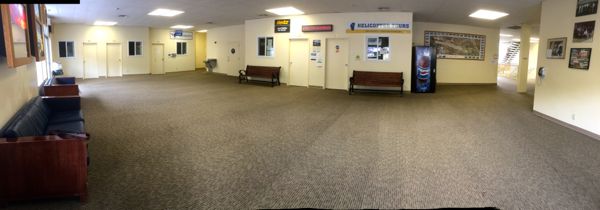
Lake Tahoe Airport's lobby doubles as the entrance to South Lake Tahoe's city offices. Photo/LTN file

Lake Tahoe Airport’s lobby doubles as the entrance to South Lake Tahoe’s city offices. Photo/LTN file

Signs will be placed on Highway 50 directing people to the visitors center.

The city has already talked to Lake Tahoe Visitors Authority about helping with what should be included in the display. It won’t be a staffed facility. It will, though, be interactive. For those wanting to talk to someone, there is the receptionist for the city and phone lines will go directly to the LTVA.

With the restaurant at the airport being overhauled, it may also become more of a destination for locals. The new owners have already said the stack of brochures for tourist-type business will no longer be in there.

One of the major sticking points for Davis and Conner is the gas fireplace that will be installed. Plus, they don’t think this is the best use of city dollars. Conner also advocated for moving City Hall someplace closer to the heart of town so it would be easier to get to. However, she didn’t have any ideas for where the millions of dollars to do this would come from.

Davis has never supported the renovation idea.

Cole believes the upgrades will be beneficial no matter what the use of the facility is in the future, and that they are long overdue. Plus, he believes the design will be a showcase of alpine architecture with wood and rock that the electeds say they want others to incorporate when doing any future construction.

At the June 21 meeting the contract was awarded to DML Construction. The firm plans to use six local subcontractors.

In other action:

·      The council unanimously agreed to make the next franchise agreement with Southwest Gas be 10 years. And the electeds want all future franchise agreements to be 10 years. Some have been for 30 or 50 years.

·      The council at a future meeting will be discussing the rental car surcharge imposed by Tahoe Regional Planning Agency. This was implemented when the airport had commercial air service.


Study: Calif. years from drought recovery

By Scott Smith, AP

It could take California four years to recover from the most severe drought on record, even if the next several winters bring above-normal snowfall to the Sierra Nevada, researchers said Tuesday.

One winter of El Nino storms that delivered a near-normal snowfall wasn’t enough to make up for the deficit from four consecutive dry years in the Sierra, a critical water supply statewide, the study says.

The lack of snow forces water suppliers and farmers to draw heavily on reservoirs, groundwater and other sources, said Steve Margulis, a civil and environmental engineering professor at the UCLA who led the study.

“The deficit we have is so large it is very, very unlikely to recover in one year,” he said.

Snow typically falls each winter in the Sierra and melts during the warm months, rushing down streams and rivers into reservoirs. It provides critical water supplies to millions of residents and vast farmland in the nation’s leading agricultural state.

Consecutive dry years are common in California, but this drought — now entering a fifth year — is the most severe in the last 1,200 years, according to studies cited in the research.

California recovered in as little as one year from past droughts, such as one in 1977, but this one is exceptional, said Margulis, publishing the findings in the Geophysical Research Letters, a journal of the American Geophysical Union.

In the study, researchers combined three decades of NASA satellite imagery taken of the Sierra snowpack with state snowpack measurements collected since 1951.

Today, California’s snowpack is at 8 percent of normal for this time of year, according to the state Department of Water Resources figures.

The study is designed to help leaders chart water policy. Last year, state regulators imposed historic cutbacks on farms and cities. Restrictions on residents were recently relaxed, allowing local water districts to set their own conservation efforts.

“It is critical for regions like California, that rely on their regional snowpack for water supply, to understand the dynamics of the system,” Margulis said.


Opinion: Wounded Knee — forgotten lesson

Wounded Knee is stark reminder of the U.S. government's mistreatment of Indians. Photo/Kathryn Reed

Wounded Knee is stark reminder of the U.S. government’s mistreatment of Indians. Photo/Kathryn Reed

By Kathryn Reed

PINE RIDE INDIAN RESERVATION, S.D. – A week ago today I was at the site of the worst massacre in U.S. history. I wasn’t in Florida. I was in South Dakota.

I was on the Pine Ridge Indian Reservation, home of Wounded Knee. This is where 146 Lakota Sioux were killed on Dec. 29, 1890. Most were women and children. In subsequent days the death toll exceeded 300.

This was not a battle as some revisionist accounts of history would lead one to believe.

John Miller, South Dakota State University (Brookings) history professor emeritus, said in the November-December 2015 issue of South Dakota magazine, “Native Americans in this state have assumed a role similar to other ethnic or racial minorities in the nation as a whole. We continue to try to solve these problems, but they’re very hard to reconcile.”

In the week since 49 people were murdered at a gay nightclub in Orlando there have been articles written about whether this shooting was the worst in U.S. history.

NPR interviewed Grant Duwe, the director of research and evaluation at the Minnesota Department of Corrections. According to NPR, “He says he sees two distinctions between mass murders that occurred before and after the 20th century. Before 1900, most mass murders were perpetrated by the ‘haves’ against the ‘have nots.’ After 1900, mass murders began being perpetrated by the ‘have nots’ against the ‘haves.’ Another difference is that before the 20th century, few mass murders were perpetrated by a single person.”

Now some news outlets have gone to calling Orlando the worst U.S. shooting in “modern day history”.

The gunman in Orlando would not have been able to obtain the weapon he did had a bill like what was proposed on Monday been in effect. That bill said anyone in a five-year period who had been investigated for terrorist ties could be denied the ability to immediately purchase a gun. On June 20 the Senate voted down a bill that would have blocked suspected terrorists from being able to purchase a gun.

Guns are just part of the problem. But it is one area in which our elected officials seem so inept at being able to come to consensus.

Yes, he could have gotten a gun any number of ways, but making it difficult to acquire assault rifles is a no brainer. It has nothing to do with infringing on Second Amendment rights. I’m all for being able to possess guns for protection, hunting, other recreation. But it’s time to throw up roadblocks to obtaining them – even for legitimate purposes. There is something wrong if someone is in a rush to purchase a gun – any gun. Substantive background checks – again, should be a no brainer.

We have banned substances that kill humans – think DDT in the United States. Would it be such a stretch to ban a weapon that has no purpose other than mass destruction?

Obviously, the case of Wounded Knee proves that “antique” weaponry can be destructive when the intended target does not have the same artillery or manpower. Still, that is not a reason to say yes to assault rifles. There was so much more to Wounded Knee than manpower and guns.

The “so much more” should not be lost. Like the university professor said, hatred toward those who are “different” is still alive today just as it was 125 years ago at Wounded Knee.

Banning guns is not enough to curtail senseless killings. At some point we need to address the hatred that seems to be getting more rampant in this country. I’m all for people being different. Why can’t we embrace our differences (or at least accept them), instead of wanting to eliminate those who are different than us?

And why can’t we apologize for our wrongs? Etched in my mind is Wounded Knee with its old chain link fence around the gravesite. A monument is there with only a few of the names of those who died. It was soldiers who dug the mass grave atop the hill. They threw the bodies on top of each other with no idea who was who.

Wounded Knee is a depressing memorial with a message that resonates as a symbol for what is so wrong with how those with power treat those who are oppressed.

The white men who did the killing were the savages.

Maybe it’s time we all smoked a peace pipe and learned to accept our differences. How many more people have to die simply because the shooter doesn’t agree with someone’s sexual preference, gender, religion, color, ethnicity or some arbitrary difference?


Designer leaves impression on Tahoe homes

Jessie Marchesseau is adept at working in small spaces to create functional, pleasing looking interiors. Photo/Revive Interior Design

Jessie Marchesseau is adept at working in small spaces to create functional, pleasing interiors. Photo/Revive Interior Design

By Terra Breeden

Red-checked plaid, embroidered moose and heavy pine furniture is a common theme in the interior design of Lake Tahoe homes. The “rustic cabin” look is so repetitive it has an almost kitschy feel and let’s be honest, there are no moose in Tahoe. But Jessie Marchesseau of newly opened Revive Interior Design is revamping Lake Tahoe homes with a modern approach that’s focused on brightness, functionality and the outdoor lifestyle.

“No one wants their home to look just like their neighbor’s home,” Marchesseau said. “A lot of people want that traditional style because it’s their mountain getaway, and we can do that, but in a more classy and creative way.”

Marchesseau recently founded Revive Interior Design. A longtime Tahoe local and self-proclaimed ski bum, she graduated from UNR with dual degrees in interior design and journalism in 2009. Since then, Marchesseau has worked as a reporter for Lake Tahoe News, in local real estate, and opened Revive Interior Design, which is based out of Meyers.

“I like to do different things. When you’re stuck doing one thing all of the time you get bored. Journalism and interior design are both things I really like to do, so I thought, why do I have to pick? I can do both,” Marchesseau said.

At Revive Interior Design, Marchesseau specializes in transforming homes into modern, comfortable abodes that reflect the joys of outdoor living. Her designs and handpicked furnishings cater to people who want their home to be stylish and functional.

“In Lake Tahoe people are so active. Whether they’re skiing, rock climbing, or headed to the beach, almost everyone is out enjoying our wonderful surroundings all the time,” Marchesseau said. “People need their homes to accommodate that lifestyle.”

Jessie Marchesseau is founder of Meyers-based Revive Interior Design. Photo/Revive Interior Design

Jessie Marchesseau is founder of Meyers-based Revive Interior Design. Photo/Revive Interior Design

Marchesseau has designed the interiors of as many garages and mudrooms, installing shelving, hooks and storage for outdoor gear, as she has living rooms and kitchens in Lake Tahoe. Her approach to personalized interior design is knowing her client and renovating the home’s interior to reflect their taste and lifestyle.

“I want to know, for every room I do, who uses that room and what it’s for,” Marchesseau said. “I want it to be functional. So you can have that party every once in a while, but I want to focus on what the room is used for every day.”

Marchesseau has transformed a shabby Kirkwood condo into a modern skier’s getaway, personalized a Tahoe cabin by mixing antiques with modern furnishings, and revitalized an empty Heavenly ski condo. She also specializes in home-staging, which is the process of refurnishing homes that are on the market.

“Home-staging brings an empty house to life,” Marchesseau said. “If you put in some furniture and give it the décor of a home, it’s easier for people to envision what it would be like to live there.”

In 2009, Joyce Blackstone, who has been working as an interior designer in South Lake Tahoe for 37 years, employed Marchesseau as an intern. Blackstone was impressed with Marchesseau’s unique approach to interior design.

“She has a very good eye for design and is good at putting things together,” Blackstone said. “She’s also a good listener, which is important in interior design.”

Luxurious interiors at Lake Tahoe can also be welcoming. Photo/Revive Interior Design

Luxurious interiors at Lake Tahoe can also be warm and welcoming. Photo/Revive Interior Design

Marchesseau uses modern technology like apps and social media to help people visualize what the home will look like when it’s finished. And by working closely with clients, she chooses furnishings and accessories that are custom and affordable.

“I try to be really open about what I do and how much it will cost. All of the prices are listed on my website,” Marchesseau said. “In interior design you don’t find that very often.”

Besides being an interior designer and journalist, Marchesseau embraces the Tahoe lifestyle. She likes to spend time mountain biking, skiing, walking her three dogs and refurbishing old furniture as a hobby. However, Marchesseau anticipates that Revive Interior Design will be keeping her very busy this summer.

“It’s a new business and I’m looking forward to more projects,” Marchesseau said. “I’ve done interior design over the years and I love it. I’m really excited to make it my full-time project.”


Immigration court ruling could affect Nevada

By Alexander S. Corey, Las Vegas Review-Journal

The U.S. Supreme Court could soon rule in a case involving the legality of President Barack Obama’s 2014 immigration plan to protect millions of undocumented immigrants from deportation.

The decision could affect thousands of people in Nevada, where 8 percent of the population is undocumented —the highest percentage in the country — according to Pew Research Center.

Francisca Sanchez, 41, knows firsthand how the program could benefit her family. At a park near her home, with her daughter in tow, Sanchez described the day a few years ago when her husband left for work, but didn’t come home for nearly a month after U.S. Immigration and Customs Enforcement detained him.

Read the whole story


Sierra streams take dangerous turn

By Benjamin Spillman, Reno Gazette-Journal

Charles Williams’ hike went from sunny to scary in an instant.

He had been hiking all day on the Pacific Crest Trail when he reached the south fork of the Kings River near Mather Pass, south of Bishop.

Williams, 46, of Quincy is an avid hiker with high-altitude experience and while the stream looked daunting he thought finding the right location would allow him to cross without incident.

So he hiked along the river until he found a spot where two islands divided the stream into smaller channels and started to cross.

Then, almost as quickly as he got swept away, the river spit him out of the current and close to some overhanging brush.

Read the whole story


Search crews may add drones to tool box

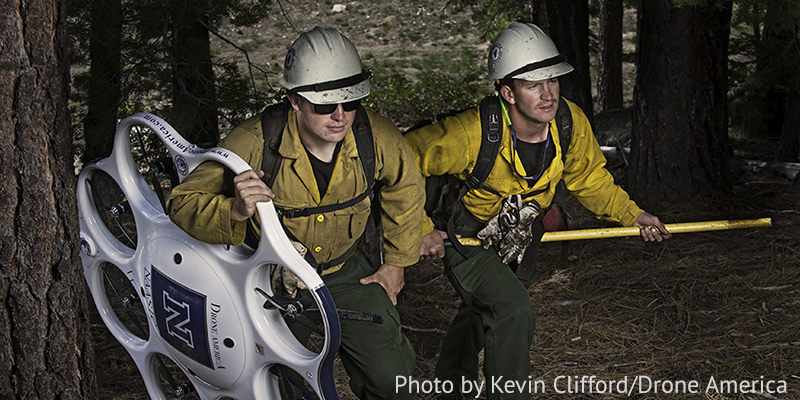
Wildland Fire crews with Drone America's DAx8 in Lake Tahoe. Photo/Kevin Clifford/Drone America

Wildland Fire crews with Drone America’s DAx8 in Lake Tahoe.
Photo/Kevin Clifford/Drone America

By Jessie Marchesseau

If you happen to get lost in the wilderness and need to call search and rescue sometime in the future, it’s possible you may spot a drone overhead looking for you.

As unmanned aerial systems, also known as drones, become more commonplace, the various uses for them are quickly multiplying. From monitoring wildlife populations to taking photos of available real estate, there seems to be no shortage of uses for these lightweight flying devices.

Even in an industry such as search and rescue which relies mainly on manpower to complete its missions, UAS may be able provide useful insights, adding another layer to rescue efforts.

In fact, in July 2015, El Dorado County SAR was able to use a National Guard drone for the first time in a search and rescue mission. The search was for a missing motorcyclist in the northern part of El Dorado County. Deputy Greg Almos, assigned officer to emergency services and search and rescue for El Dorado County, said that while the drone did not locate the subject, it did give them clues regarding where to look.

“In every search and rescue, the use of human beings, equipment or technology is really just a clue-finder that leads to finding an individual,” he told Lake Tahoe News.

That search proved to be a unique situation where the UAS was available and there was an urgent need in the particular situation. The opportunity to use a drone for aiding a search in El Dorado County has not come up since. Almos said it would not be ideal for all situations, but he could see a UAS being useful for future searches in areas such as Horsetail Falls and Eagle Falls, both popular hiking areas in the summer months.

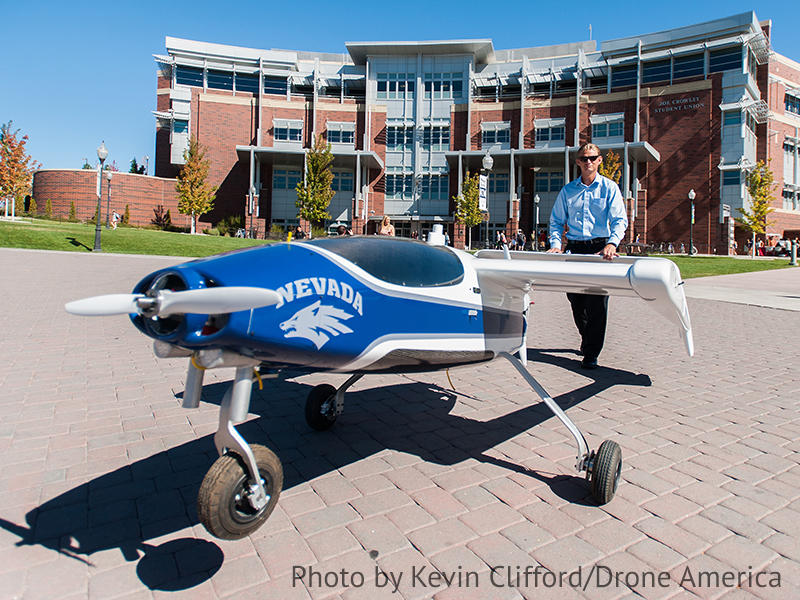
Drone America and their Phoebus Mk.III at UNR.  Photo/Kevin Clifford/Drone America *This image is limited to the NAASIC website ONLY. Other uses are prohibited unless strict permission from Drone America.*

Drone America and their Phoebus Mk.III at UNR.
Photo/Kevin Clifford/Drone America

Carol Caman, a rescue member of the Douglas County Search and Rescue, recalled one rescue effort in particular where she believes a drone would have been helpful. When an aircraft went down in Lyon County a few years ago, it took SAR volunteers and helicopters three days to locate the wreckage, partly due to a winter storm moving through. A drone, she said, would have been able to fly lower and slower than the helicopters and do it in the storm with less danger to humans, possibly locating the downed plane much sooner.

In April, Caman attended the first annual UAS Search and Rescue Symposium in Reno hosted by the UNR’s Nevada Advanced Autonomous Systems Innovation Center.

Warren Rapp, business development director for NAASIC, said they decided to put on the symposium because the center is constantly being contacted by search and rescue organizations with questions about UAS.

The symposium was free to SAR volunteers and covered a number of topics including FAA regulations.

The FAA has allowed limited use of UAS for public missions such as firefighting, disaster relief and search and rescue since 1990. Recently, drones were used during the Texas and Louisiana floods to locate stranded individuals and to distribute essential supplies such as water to those people.

Rapp suggested that such delivery of supplies is another way drones could aid search and rescue operations. The larger fixed-wing drones would be able to carry much-needed first aid kits, small heaters or water to someone in the wilderness quicker than a team could reach them on foot, in some cases alleviating the need for a rescue party altogether.

However, he and Caman stressed that UAS would not in any way replace the humans of search and rescue operations. Rather, they would act as another tool to help people in need.

“It will save you man hours,” Rapp told Lake Tahoe News. “If your crew is only seven and you have a thousand acres to search, a drone may help you funnel people to a certain area with clues.”

Caman compared it to another recent technological advancement: cell phone forensics. Lost or stranded individuals can now often be located via the GPS in their cell phones. This technology has only been available to SAR teams for a few years, but has become an integral part of their search operations. Many subjects are now located very quickly thanks to this technology.

“I think it’s a good idea to get the best tools you can to help people out,” Caman told LTN.

The Douglas County SAR is currently discussing the possibility of getting a UAS or acquiring one in conjunction with another nearby SAR, however they are still in the early stages of the process. There are a lot of questions to answer and hurdles to overcome in order to make that happen, Caman said.

One is financing. Drones cost anywhere from a couple hundred dollars to more than a hundred thousand depending on type and what it needs to be equipped with.

This raises the question, which kind is right for the varied terrain of Douglas County? Some have infrared cameras, heat-sensing cameras, or high-def cameras. There are quad-copters and fixed wing. Some are good for flying in tight areas like along cliffs and down ravines. Other fly best low and flat. Once a style and price is in sight, they must decide if the cost is worth the benefit gained from it.

There is also the question of manpower to use it, necessary training, and the issue of FAA rules for UAS being currently up in the air.

While no one interviewed reported having experienced resistance to the use of drones within the search and rescue community, they do still see a lot of unknowns. El Dorado County SAR has discussed the prospect of acquiring a drone, but is not moving forward with anything at the moment, choosing to wait until some of these questions are answered. And though Douglas County is moving forward with their discussions, they are doing so slowly.

“We want to make sure we buy the right equipment for here in Douglas County and that we incorporate it into our team rather than make it the focus of our team,” Caman said.

So while you may not see a fleet of search and rescue drones buzzing around Lake Tahoe in the very near future, it is on the horizon.


Calif. sets aside $270M to upgrade county jails

By Don Thompson, AP

Counties will get another $270 million for jail construction under the budget approved by California lawmakers this week, even though opponents say the money could be better spent on rehabilitation programs.

The state has provided $2.2 billion to build jails since 2007, including $1 billion since California began keeping lower-level offenders in county lockups instead of state prisons in 2011.

Gov. Jerry Brown’s proposal for an additional quarter-billion dollars this year was rejected by Assembly and Senate budget committees and the Legislative Analyst’s Office, which said the Democratic governor failed to show the need for more construction money.

“There’s gonna be an end to the jail construction binge and we ought to look at more cost-effective ways of reducing recidivism and reducing crime,” said Sen. Jim Beall, D-San Jose, who voted to remove the funding.

But it’s back in the final budget at the insistence of the governor and county governments that say they need the construction money to update antiquated jails.

The need has grown, they said, since the state began sending more serious, long-term and mentally ill inmates to local jails instead of state prisons.

The competitive grants will be available to 20 of the state’s 58 counties that received only partial funding in previous years or never had state help in replacing or renovating jails.

“The need is clear, that there are counties that have applied for prior rounds and have been unsuccessful or have not applied in the past and still have needs, and this gives them another chance to make the appropriate upgrades that will provide needed space for programming, education, treatment and rehabilitation,” said California State Sheriffs’ Association spokesman Cory Salzillo.

The budget also includes $20 million earmarked for Napa County’s jail, which was damaged in a 2014 earthquake.

“It’s just really shocking that after both subcommittees rejected the jail construction funds that it would come back in this way,” said Lizzie Buchen, co-coordinator of Californians United for a Responsible Budget, which opposes prison and jail spending.

The budget does include $67.5 million for grants to counties that prefer not to build new jails and want to offer more mental health and addiction treatment facilities.

“Not every county wants to build jails,” said Sen. Mark Leno, D-San Francisco, chairman of the Senate budget committee. “There are some that want to address similar populations in a different way.”

A year ago, the state Senate similarly objected to $500 million for jail construction money only to see it revived in the final budget agreement.

The legislative analyst earlier this year said the additional money might not be needed in part because of a 2014 ballot initiative that lowered penalties for certain drug and property crimes. The state’s jail population dropped by 10,000 inmates after voters approved Proposition 47.

Salzillo said money is needed if sheriffs are to provide the sorts of rehabilitation programs that lawmakers and voters envisioned when they approved legal changes in recent years.

The budget also includes another $28 million on top of nearly $40 million that Brown previously set aside for mental health and substance abuse treatment, crime victims and school truancy programs under Proposition 47.

The legislative analyst has projected that about $130 million would be saved in the first year by reducing the prison population through lesser penalties.

“This budget reflects increasing support for smart approaches to safety and justice,” John Bauters, policy director for Proposition 47 proponent Californians for Safety and Justice, said in a statement.

The state budget was approved by the Assembly and Senate. Brown is expected to sign it into law.


Climate change damaging national parks

By Darlene Superville, AP

YOSEMITE NATIONAL PARK — President Obama said Saturday that climate change is already damaging America’s national parks, with rising temperatures causing Yosemite’s meadows to dry out and raising the prospect of a glacier preserve without its glaciers someday.

“Make no mistake. Climate change is no longer just a threat. It’s already a reality,” Obama said from a podium, with Yosemite Falls, one of the world’s tallest at 2,425 feet, as a backdrop.

At the California park, where Obama was spending the weekend with his wife, Michelle, and daughters Malia and Sasha, the president also talked about how a rabbit-like animal known as a pika is being forced farther upslope at Yosemite to escape the heat.

“Rising temperatures could mean no more glaciers at Glacier National Park. No more Joshua trees at Joshua Tree National Park,” he said, adding that a changing climate could destroy vital ecosystems in the Everglades and threaten such landmarks as Ellis Island and the Statue of Liberty.

Obama spoke near Yosemite’s Sentinel Bridge, where views of Half Dome, a well-known rock formation in the park, and Yosemite Falls created a picturesque background behind him under a sunny, blue sky.

After a night with his family in a rented cabin in the popular park, Obama stuck to his usual routine by rising early Saturday and heading to a recreation center on the grounds for his daily gym workout.

Obama’s weekend in the great outdoors was planned to encourage more people to appreciate and visit many of the nation’s parks. The National Park Services manages more than 400 sites around the country and celebrates its centennial in August.


Northstar golf — more than a walk in the woods

Adam Rahilly of Truckee takes full advantage of his season pass at Northstar's golf course. Photo Copyright 2016 Carolyn E. Wright

Adam Rahilly of Truckee takes full advantage of his season pass at Northstar’s golf course. Photo Copyright 2016 Carolyn E. Wright

By Kathryn Reed

TRUCKEE – Adam Rahilly and his friends don’t need anyone to tell them the golf course at Northstar is a bargain.

Still, the 18-hole, par-72 course was rated the best course for value in the Sierra Nevada by California Golf and Travel magazine.

“It’s nice, cheap and affordable,” Rahilly told Lake Tahoe News on a recent Thursday as he and four buddies finished up hole 11.

On this hole they had to launch their balls over a wide expanse to get to the green. A few holes have “forced carry” features.

The Truckee residents try to play here three times a week, preferring the back nine because it is more challenging.

Marcie Bradley doesn't let the snow-covered runs at Lookout Mountain distract her. Photo Copyright 2016 Carolyn E. Wright

Marcie Bradley doesn’t let the snow-covered runs at Lookout Mountain distract her. Photo Copyright 2016 Carolyn E. Wright

The back nine is more wooded and closed in. It’s a definite mountain feel, with thick Aspen groves and Martis Creek flowing in some areas.

The views on the front nine captivate Taylor Kramer. His foursome from Michigan is in town for a wedding.

“The scenery is great. And it’s not too crowded,” Kramer told Lake Tahoe News as he waited his turn.

The Martis Valley is what dominates the landscape on the front nine. It’s wide-open terrain, with partially snow-covered ski runs still visible.

Rich Aprile in his first year at Northstar is tasked with upgrading the level of instruction. Photo Copyright 2016 Carolyn E. Wright

Rich Aprile in his first year at Northstar is tasked with upgrading the level of instruction. Photo Copyright 2016 Carolyn E. Wright

In many ways Northstar feels like two distinct courses. In part, this is because of the terrain, but it also has to do with the links being built at different times. Robert Muir Graves designed the course.

Northstar is beefing up its offerings this season with the addition of Rich Aprile, who was hired to be director of instruction. He and head pro Pete Smith are certified by the PGA as instructors.

While Aprile has everyone fill out a questionnaire to gather their past experiences and future goals, ultimately he said it’s all about having fun.

“Ninety-five percent of all golf rounds are never going to break 100,” he said.

Sometimes it’s little tweaks like following through, hitting down on the ball to get lift, or up on the ball when driving off a tee that will improve one’s game.

“What golf is really all about is being consistent,” Aprile told Lake Tahoe News.

Taylor Kramer of Michigan hits out of the rough on his inaugural round at Northstar. Photo Copyright 2016 Carolyn E. Wright

Taylor Kramer of Michigan hits out of the rough on his inaugural round at Northstar. Photo Copyright 2016 Carolyn E. Wright

At the recreational level he said it’s not that important to have a variety of shots.

Instead of practice swings, he calls them rehearsal swings – as in, a person is rehearsing what they want to do. Ball placement is another key factor.

Putt whenever possible is Aprile’s philosophy.

“It’s the most accurate club in the bag,” he said. Chipping can come later.

He’s also a proponent of losing the terms “men’s” and “women’s” tees because there are reasons one gender might prefer to start closer or farther away. Aprile prefers calling them first or second tees.

—–

  Notes:

·      A variety of season passes are available starting at $379, with single rounds ranging from $40 to $90.

·      For more info about Northstar’s golf course, go online.