Path to paradise is paddle-powered

By Tom Stienstra, San Francisco Chronicle

The summer horror story is a getaway or camping vacation that is overrun with crowds. The vision is fed by year-round traffic nightmares in the Bay Area, Sacramento and other cities, where people jammed shoulder to shoulder can start to feel like an omnipresent condition you can’t escape.

Yet with one small change in your life, you can find redemption.

It starts in a boat. Of the dozens of styles available, the cheapest, fastest and easiest boat that provides a gateway to freedom is a flat-water kayak.

With just a few strokes, you propel yourself to escape from every worry. That’s the thing about boats. No traffic jams. No red lights. Just open water in every direction.

Read the whole story


Deadlock on immigration may boost Nev. Latino vote

By Alexander S. Corey and Ben Botkin, Las Vegas Review-Journal

The U.S. Supreme Court’s deadlock in a major immigration case Thursday adds another dimension to an already hot election cycle.

The question: Will the court’s nondecision — which continues to prohibit thousands of undocumented Nevadans from receiving work permits — galvanize Latino voters angered by it?

Some believe that the Supreme Court tie — coupled with presumptive Republican presidential nominee Donald Trump’s controversial statements on Mexican immigrants — could boost Latino turnout rates in the general election.

Read the whole story


Motorized vehicles damaging USFS land

By Kathryn Reed

Saying you didn’t know the rules isn’t good enough.

“They don’t understand if takes time and effort to rehabilitate the damage and it is taxpayer dollars that go toward that,” Frank Machler with the U.S. Forest Service said.

He’s talking about damage to forestland by motor vehicles.

Machler is a law enforcement officer in the Lake Tahoe Basin. He spent part of last weekend investigating damage done by motorcyclists near Griff Creek above Kings Beach.

It’s not severely rutted, but it is noticeable and undeniably a violation of the motorize vehicle regulations. Proving resource damage is more difficult, Machler said. For example, driving over alders actually helps them to propagate.

“We do get lot of motor vehicle violations, but rarely do we see bad resource damage in the basin,” Machler told Lake Tahoe News.

Motorcycles are allowed on 250 miles of roads in the Lake Tahoe Basin. Photo/LTN file

Motorcycles are allowed on 250 miles of roads in the Lake Tahoe Basin. Photo/LTN file

Even though there may not be signs in a given area saying motorized vehicles are not allowed, it is up to the user to know the rules of the land they are riding on.

The culprits in the Kings Beach incident have not been caught. If an LEO catches someone riding where they aren’t supposed to, at a minimum a $150 citation can be issued. If it goes to court, a judge has the authority to issue a fine up to $5,000 and six months in jail.

“The court has said recreation users need to know the rules of the land they are traveling on,” Machler said. “I’m not sure people are talking the time to find out who owns the property they are recreating on and what the rules are. People are not taking the time to read the signs that are in place. They walk past bulletin boards.”

To catch more of the scofflaws takes the public’s help because the number of LEOs and rangers in the woods is finite. Machler said there are ways to protect reporting parties.

One good thing about a more normal winter this year is people were not able to violate the motorized rules as blatantly as they did in drier years. Snow prevented a person from driving around the gates – which was happening in the last few years.

The basin has 250 miles of roads where motorized vehicles may travel. This is a small number compared to some forests, but the Lake Tahoe Basin Management Unit it also on the small side.

The USFS provides free motor vehicle use maps at its offices as well as online.


Feds to sterilize mustangs to slow growth

By Scott Sonner, AP

A federal agency is on a path to sterilize wild horses on U.S. rangeland to slow the growth of herds — a new approach condemned by mustang advocates across the West.

The U.S. Bureau of Land Management also continues to resist calls from ranchers and western Republicans to euthanize or sell for slaughter the animals overflowing holding pens so as to clear the way for more roundups.

Bureau of Land Management Deputy Director Steve Ellis delivered those messages at an emotional congressional hearing last week. He offered a glimpse of the challenges facing the agency that has been struggling for decades with what it describes as a $1 billion problem.

Highlights of the hearing included Nevada’s state veterinarian calling for the round-up and surgical sterilization of virtually every mustang in overpopulated herds, a protester who briefly interrupted with shouts denouncing “welfare ranchers” turning public lands into “feedlots,” and an Arkansas congressman whose puppy is about to get neutered.

Rep. Tom McClintock, chairman of the House Natural Resources subcommittee on public lands, took aim at those who object to euthanizing mustangs “and yet seem perfectly willing to watch them succumb to excruciating death by starvation, dehydration and disease.”

“That is the future we condemn these animals to if we don’t intervene now,” said the California Republican who represents Lake Tahoe.

Rep. Cynthia Lummis, R-Wyoming, emphasized the 1971 law protecting mustangs allows for their destruction if they go unadopted. But since 2012, Congress has required horse purchasers to sign documents promising not to resell them for slaughter, and the Bureau of Land Management opposes lifting those restrictions.

Ellis said the estimated 67,000 wild horses and burros on federal land in 10 states is 2.5 times more than the range can support. However, there’s no more room in government corals and leased pastures, where 47,000 horses cost taxpayers about $50,000 per head over the course of their lifetime.

“Quite frankly, we can’t afford to feed any more unadopted horses,” Ellis said. “I understand your frustration. We are frustrated too.”

Ellis said the agency’s “roadmap to the future” includes use of temporary contraceptive vaccines as well as sterilization.

“We feel that before we can implement a spay-neuter program on the range, we’ve got to do the research to make sure we can do it efficiently and safely,” he said. “It is going to take a little time to do that.”

Rep. Rod Bishop, R-Utah, chairman of the Natural Resources Committee, said it’s time to have “that real tough conversation about something more permanent.”

Other Republicans turned on the lone horse advocate called to testify — Ginger Kathrens, founder of The Cloud Foundation based in Colorado Springs, Colorado and member of the Bureau of Land Management’s wild horse advisory committee.

But Kathrens said most Americans want to see mustangs “roam freely on their native home ranges as intended.”

“Castration, sterilization and long-term confinement of horses in holding facilities … is unnecessary, cruel, unhealthy and fiscally irresponsible,” she said.

Rep. Bruce Westerman, R-Arkansas, noted, however, that “thousands of domesticated animals are spayed and neutered every day.”

“I’ve got a new puppy and he’s got his day coming soon,” he said.

That prompted an outburst from Edita Birnkrant, campaigns director for Friends of Animals.

“They are wild animals. They are not cats and dogs,” she shouted as McClintock banged the gavel and called for Capitol Police. “The solution is getting welfare ranchers off of our public lands, which have been turned into feedlots.”

J.J. Goicoechea, the Nevada Department of Agriculture’s veterinarian and longtime rancher, urged the gathering of “as close to 100 percent of horses as we can” in overpopulated herds for surgical sterilization before returning some to the range.

“Those of us who truly make a living caring for animals … have a moral obligation to manage populations in balance with natural resources,” he said.


Drone exploring what’s beneath Lake Tahoe

By John Markoff, New York Times

GLENBROOK — A vast, largely unexplored world is being opened by hobbyists piloting robotic submarines capable of traveling hundreds of feet below the surface of lakes, rivers and oceans.

Styling themselves as citizen scientists, two young engineers, Eric Stackpole and David Lang, have created OpenROV, a small start-up based in Berkeley that builds submarine drone kits. They hope to create a mirror image of the airborne drone craze.

This month, the OpenROV researchers took over a vacation home here and turned it into a command center for the maiden dive of a prototype of the next version of their Trident submarine. The sub explored the wreck of the Tahoe, a turn-of-the-last-century steamer that now lies less than a half-mile offshore in depths up to almost 500 feet below the surface of Lake Tahoe.

OpenROV has sold more than 3,000 of a first-generation submarine, which is able to navigate below the surface, connected by a thin cable and controlled by software running on a tablet or smartphone.

Read the whole story


Changes in South Shore ambulance service

By Kathryn Reed

El Dorado County is hedging its bets when it comes to whether the ambulance service on the South Shore will keep operating as of Friday. Supervisors on Tuesday will be asked to bring in another company to take over the service if the Tahoe group can’t make it work by the end of the week.

“It’s specifically for standby services and a safety net so to speak in the event the JPA is unable to provide the services,” CAO Don Ashton told Lake Tahoe News.

The county per state law is required to provide ambulance services. El Dorado has a contract with the Cal-Tahoe Joint Powers Authority, which is comprised of South Lake Tahoe and Lake Valley fire departments. Two elected officials from the member agencies make up the Cal-Tahoe board, with Ryan Wagoner the executive director of the JPA.

The city and Lake Valley for years have been trying to come up with a different scenario either for fire services – there had been talk of a merger/acquisition; or ambulance staffing; and then the city threatened earlier this year to pull out of the JPA.

That threat prompted the county this spring to enter into a contract with Downey Brand LLP out of Sacramento as outside legal counsel. With the city staying in the JPA and a compromise being worked out, the threat of litigation by the county against the city and /or JPA is not imminent.

South Lake Tahoe initiated an emergency medical services-based service late last year, while Lake Valley continues to staff ambulances with firefighter-paramedics. Each believes their way of doing business is a more cost-effective model and provides better service for residents.

A few weeks ago the board voted 3-1 (Dave Huber of Lake Valley was the dissenter) to have the JPA take on the city EMTs as employees. This is to be in effect as of July 1.

The reason to do so now is that those city employees are temps and if they are to work more than six months, they then become eligible for Public Employee Retirement System benefits. That would be another expense the city does not want to take on.

The JPA is not a PERS agency.

The 12 city ambulance workers are now in the process of reapplying for their jobs with Wagoner. They will receive similar pay, health benefits and a 401(k), Wagoner said. Three of them just graduated from the Lake Tahoe Fire Academy this weekend. Keeping them in Tahoe will give them a better chance to get hired on by one of the local agencies as a firefighter.

An on call list will be developed to help with busy times – like the upcoming Fourth of July period, and to deal with vacations, sick time and when people leave.

Wagoner is hiring a firm that will handle the payroll and human resources aspect of the job. An operations person will also be brought in. There are a lot of pieces to the puzzle to get this off the ground. He was given 30 days to do so, when a few months would be the norm. The lack of time is the JPA’s fault because the city for months has been telling everyone what its plans were.

The Department of Motor Vehicles, workers comp, and a slew of state certificates are needed to make the transition. Some of this is just so a bank account can be opened.

Dave Olivo, who is the city’s elected treasurer, is now treasurer of the JPA. He is not a voting member and does not write the budget. Wagoner had the treasurer duties since he started in May 2014. State law dictates how the accounting and auditing oversight is to be handled.

Questions have been raised as to whether it is a conflict of interest for Olivo to represent the JPA when he works for one of the member agencies.

“I know (South Lake Tahoe City Attorney) Tom Watson was aware of this appointment because he was at the JPA meeting two weeks ago when the JPA board appointed Dave Olivo. This was actually suggested by (county Auditor-Controller) Joe Harn because Dave has experience,” Wagoner told Lake Tahoe News.

The JPA board meets this week to finalize everything. But just in case it doesn’t, the county – assuming supervisors OK the contract Tuesday – will have Regional Emergency Medical Services Authority on board to take over – even if it’s just for a short time. REMSA would come with its own equipment and workers.

As for the JPA vehicles, the city will allow the ambulances to remain at Station 2 through the end of the JPA contract with the county in August 2019.

Other items on the June 28 Board of Supervisors’ agenda regarding the JPA include authorizing the purchase of an ambulance for $160,000 and increasing the dispatch service fee to a maximum of $66,000/year until the contract expires on Aug. 31, 2019.


Sandoval against recreational marijuana

By Cy Ryan, Las Vegas Sun

CARSON CITY — Gov. Brian Sandoval said he has never smoked marijuana and is against making recreational use legal in Nevada, citing concerns about its impact on young people.

Sandoval said that as a former federal judge, he saw how marijuana use led young people to trouble with the law, and he is opposed to a ballot initiative to legalize recreational marijuana.

Asked if he had ever used marijuana, he answered, “No.”

Read the whole story


Calif.’s skyrocketing costs prompt exodus of residents

By George Avalos, San Jose Mercury News

Living in San Jose, Kathleen Eaton seemingly had it all: a well-paying job, a home in a gated community, even the Bay Area’s temperate weather.

But enduring a daily grind that made her feel like a “gerbil on a wheel,” Eaton reached her limit.

Skyrocketing costs for housing, food and gasoline, along with the area’s insufferable gridlock, prompted the four-decade Bay Area resident to seek greener pastures — 2,000 miles away in Ohio.

Eaton is far from alone. During the 12 months ending June 30, the number of people leaving California for another state exceeded by 61,100 the number who moved here from elsewhere in the U.S., according to state Finance Department statistics. The so-called “net outward migration” was the largest since 2011, when 63,300 more people fled California than entered.

Read the whole story


Tahoe Douglas fire chief to make last call

By Susan Wood

STATELINE – The longtime firefighter/paramedic remembers the day as if you had asked him where he was during 9/11.

It was June 24, 2007.

After 31 years, Tahoe Douglas Fire Chief Ben Sharit will retire at the end of the month, capping off countless memories of his time spent rescuing people and property. One of those times is the Angora Fire nine years ago.

Sharit was returning to the basin from vacation, crested Brockway Summit and noticed the strong winds.

“This was a big concern,” he said.

As a battalion chief at the time, he knew his forestlands were dry, and the combination seemed dangerous.

“I sent the whole department,” the 54-year-old told Lake Tahoe News. That’s 15 firefighters on a given shift. Within 45 minutes, the agency was backfilled from other agency firefighters in three out of four stations.

“I’ll never forget it,” he added solemnly.
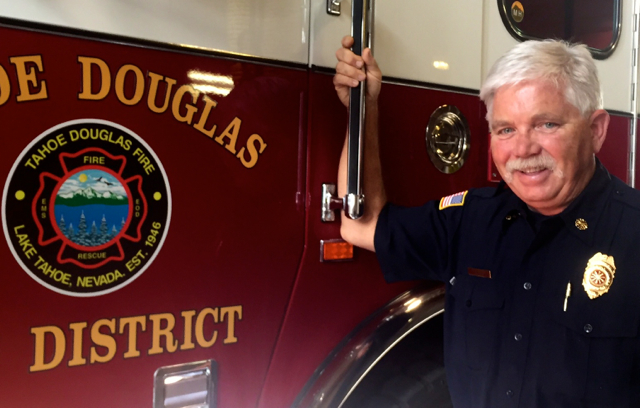
Tahoe Douglas Fire Chief Ben Sharit retires on June 30. Photo/Susan Wood

Tahoe Douglas Fire Chief Ben Sharit retires on June 30. Photo/Susan Wood

It wouldn’t be the first time Sharit had come to the rescue, in particular on behalf of the Tahoe Douglas Fire Protection District.

Two years later, the Nevada fire agency was taxed yet again with more of a long-haul challenge by enduring and surviving the recession. Tahoe Douglas Fire’s budget was cut by $1.6 million. He found a way to whittle expenses through the normal attrition of staff leaving – without laying off firefighters. The Zephyr Cove station that was reduced to an ambulance is now fire-staffed through grant funding that Sharit secured.

It’s times like these that show why Sharit has gained widespread respect among his underlings, peers and community members like those he knows in the Tahoe Rotary Club.

Since “Ben knows everybody,” according to fellow Rotarian Erik Watada, there’s even a “Ben” burger at Watada’s Neighborhood Burgers on Kingsbury Grade.

Sharit’s even-keel demeanor has served him well in his career.

After “being around a lot of firefighters” as a child, his best friend who worked for CalFire introduced him to the adrenaline-induced world in his younger years. Sharit started out as a paramedic, logging five years in busy Oakland, where he admits to seeing it all. The stories are so abundant it was hard to single one out. He studied fire science in the East Bay.

Once he discovered the natural beauty of Lake Tahoe, Sharit knew he was destined to come and stay here.

“I wanted to live in the mountains and get out of the busy city,” he said. He developed an inner peace that made him feel at home with staying calm in stressful situations.

Enduring the multi-year drought could put grey hairs on any firefighter’s head in the Sierra Nevada Mountain Range.


He’s responded to his fair share of structure fires, vehicle extrications and lived through tragic losses on the job. He’s also delivered a number of babies in cars, homes and restrooms. And the thought of operating the district’s bomb squad robot put a gleam in his eye.

“You can’t get riled up,” he said, while chatting at his Round Hill station desk. Although he has just a few days left to work, his desk is still covered with papers. Awards and other recognition-type décor line his shelves, Tahoe photographs adorn the walls and a marker board posted in his office indicates things to do. Items such as “engineer test” and “audit” have been checked off, leaving the unchecked “retire” on the bottom of the list.

At home, the chief holds a long list of “honey dos,” quests to “see the world” and visits in waiting to spend time with his three children and four grandchildren.

“It’s been a great career, a great ride. I tell my guys it’s not a job. It’s a lifestyle, and you’re on duty all the time,” he said.

This lifestyle includes acting as a family in active summers and long winters.

And to top it off, the job comes with a long list of criteria of characteristics – intelligence, physical fitness, dedication, commitment and the need to help others. Oh, and incidentally, a candidate can’t be afraid of heights or be claustrophobic.

The fire chief’s biggest concern as he leaves is of course altruistic – “the safety and welfare of the firefighters and the people they serve.” If that’s not the sign of a good steward, it’s hard to imagine what is because Sharit is dead serious when he insists what means the most to him.

And what will he miss most?

“The people – that’ll be tough (to leave). You give so much after a long period. But now it’s time to see my (grandkids’) baseball games,” he said, albeit admitting to projecting a possible temptation to respond to public safety calls while in retirement.

Nonetheless, Sharit plans to back up and relax from feeling like he needs to solve a problem in two minutes. And he’ll enjoy sleeping normally again.

“You always sleep with one eye open,” he said of being a firefighter.

Before he became chief, he quipped with friends and family members that he would call them during the night to see if they could be cognizant waking up from a hard sleep. He wanted them to know what the job was like. First and foremost, Sharit likes to share with the people around him. Those who work with him inside and out of the district appreciate the candor.

“You always know what to expect with him,” Tahoe Douglas fire Capt. Kevin Green said, while pulling the engine into the Round Hill fire station.

Douglas County Sheriff Ron Pierini goes back decades with Sharit, and the two chiefs have crossed paths often to positive results.

“I found him to be an outstanding employee. He’s a very ethical person – someone I can trust,” Pierini said. “I’m going to miss him. I’m sorry he’s leaving, but people move on, and I understand that.”

The community is invited to Sharit’s retirement party, slated at Harveys from 4-6pm on his last day – June 30.

The following day, Assistant Fire Chief Scott Baker will take over.



Calif. proposes $3 bil. bond measure for parks

By Associated Press

California lawmakers are proposing a nearly $3 billion November bond measure to pay for improvements at state and local parks.

Supporters say many local agencies cannot afford to maintain their outdoor spaces.

The Assembly approved the measure Thursday on a 55-14 vote, with six Republicans joining Democrats in favor. The Senate must also approve it before June 30 for it to appear on the statewide ballot.

It would join a crowded ballot that is expected to include dozens of measures.

The state Department of Parks and Recreation would oversee nearly $2 billion of the fund. The department came under fire in 2012 for hiding nearly $54 million during a budget crisis that threatened to close parks.

Democratic Assemblyman Eduardo Garcia of Coachella says he’s confident in the changes made since then.