SnowGlobe promoter wants $3M 10-year deal

By Kathryn Reed

SnowGlobe promoter Chad Donnelly wants South Lake Tahoe to pay him $3 million over 10 years to keep bringing the three-day music festival to town.

For about a year he has been talking to staff about a long-term contract. The current three-year agreement ends after this year’s event in December. Just prior to the June 21 council meeting he let staff know the particulars he’d like in the contract.

City Manager Nancy Kerry revealed some of the specifics at the meeting. It was councilmembers Tom Davis and JoAnn Conner who gave the OK to have the item placed on a future agenda. They are two of the more fiscally conservative members.

“I want to review the contract. Not sure I want to sign a contract for 10 years. I want to see the details. Also would like to know the economic impact on our community. I still support SnowGlobe, but need additional information,” Davis told Lake Tahoe News.

Conner told LTN, “SnowGlobe has a huge impact on our community. I believe the constituents should have an opportunity to give input; the council should not make this decision on its own.”

SnowGlobe promoters want to secure a long-term contract with South Lake Tahoe. Photo Copyright 2016 Carolyn E. Wright

SnowGlobe promoters want to secure a long-term contract with South Lake Tahoe. Photo Copyright 2016 Carolyn E. Wright

Some of what Donnelly wants:

·       10-year contract

·       3 additional events, presumably in the summer

·       $30,000 in cash – just for SnowGlobe

·       $45,000 in in-kind contributions are that hard costs like transportation, garbage and security

·       $90,000 a year contribution to his management company.

The total comes to about $300,000 a year, according to city staff – or nearly $3 million over the course of a 10-year contract.

Under the current contract Donnelly receives $25,000 in cash and about another $25,000 in services.

Donnelly did not return multiple calls.

An issue for the city to consider is after this year the concerts will be on a brand new grass field. Construction of that field is under way near the current community ball field at Lake Tahoe Community College. It will be dirt for this year’s SnowGlobe – or snow on dirt. Grass will be planted next spring.

“That is why I would not recommend a 10-year contract. We would want to wait until after the first year or even second to see how the field responds to such large impacts of people and equipment,” City Manager Nancy Kerry told Lake Tahoe News. “We will likely require a larger deposit on the real grass. If they get a contract extension, they will be responsible to restore the grass to the same condition. We will be able to tell if there are divots or any real depressions.”

Big trucks would not be allowed on the turf. Platforms are put down on the synthetic field and would be on the grass, too, to prevent wear and tear from smaller vehicles.

The event brings about 15,000 people to town, many who attend all three nights. Donnelly in the past has said SnowGlobe brings between $6 million and $10 million to the local economy. That includes both sides of the state line.

What the council will have to decide is if the return on investment is worth it. And then the electeds must also decide if they want to rely on Donnelly’s numbers to make that decision or if they would find another source.


Nev. tourism officials funding special events

By Richard N. Velotta, Las Vegas Review-Journal

The Nevada Division of Tourism will spend $200,000 to sponsor six events — four in Northern Nevada and two in Southern Nevada — to generate tourism in the state.

The Nevada Commission on Tourism voted unanimously Wednesday to spend $50,000 each to assist the National Championship Air Races near Reno; the Sierra Ski Marketing Council to publicize skiing in the Lake Tahoe area; and the Reno Air Service Corp. to enhance the efforts of public and private partners to recruit air service to Reno-Tahoe International Airport.

A fourth Northern Nevada entity, the Great Reno Balloon Race, will receive a $15,000 sponsorship.

Read the whole story


Bridging Tahoe’s bear selfie problem

By Benjamin Spillman, Reno Gazette-Journal

It’s about to get more difficult for careless Lake Tahoe selfie-seekers to strike a pose with their second favorite subjects.

That’s because a private, non-profit organization is raising cash to upgrade a South Shore boardwalk that’s seen a swarm of selfie-shooters seeking shots with local bears.

The Tahoe Fund, an organization that raises money for conservation, recreation and education causes around Lake Tahoe, is seeking to raise $28,000 for the project at the Taylor Creek Visitor Center.

The money would pay to raise, widen and add railings to a boardwalk that overlooks Taylor Creek.

Read the whole story


Loneliest road in America comes of age

By Marilyn Newton, Nevada 

The view of Highway 50 looking west toward the waning sun gives insight into why AAA once warned motorists “not to drive there unless they’re confident of their survival skills.” Photo by: David Braun
It was 30 years ago, in July 1986, that Life magazine used the term “The Loneliest Road in America” to describe the stretch of Highway 50—more commonly known as Highway 50—from Fernley to Ely across central Nevada. AAA even advised against traveling the highway, claiming there was nothing to see. For those who were crazy enough to travel that lonely road anyway, they were advised to carry survival gear such as water and cold-weather clothes.

Is the Loneliest Road in America really as bad as Life magazine claimed?

The moniker could easily have been a slap in face, but savvy state officials adopted the phrase and turned it into something positive. The state created a survival passport that same year, which travelers could get stamped at locations along Highway 50 and redeem for a certificate.

Suddenly, the loneliest road wasn’t so lonely as people sought bragging rights to “I Survived the Loneliest Road in America.”

Tourism numbers began to climb and are continuing to do so, and the passport program continues to this day. The state’s response became a help to the economy of the towns along Highway 50.

Read the whole story


Douglas County on stable financial ground

dc budetBy Susan Wood

GARDNERVILLE – Douglas County appears in adequate shape according to those who man the coffers, but it has a long way to go in returning to the pre-recession banner years in which revenues were more vertical.

That said, diversity may be just what the Nevada county surrounding highways 395 and 50 needs to surpass a marginal 2 percent growth officials project it will experience in at least the year going forward.

Friday begins a new fiscal year for Douglas County; a jurisdiction characterized by the geo diversity of sprawling Carson Valley farms and towering Lake Tahoe casinos.

With a population of 47,710 (as of July 2015) over 738 square miles, Douglas County on June 28 discussed the 2016-17 $175.3 million budget – roughly $7 million more than the prior year.

Douglas officials work with a five-year plan as a “priority-based budget,” the first county to do so in the United States.

Priorities include improving cost effectiveness, pursuing alternative service providers, having regional collaboration, and investing resources based on the critical areas.

To accomplish this, county officials sought well-rounded, all-inclusive assistance to come up with a list of goals and must-dos.

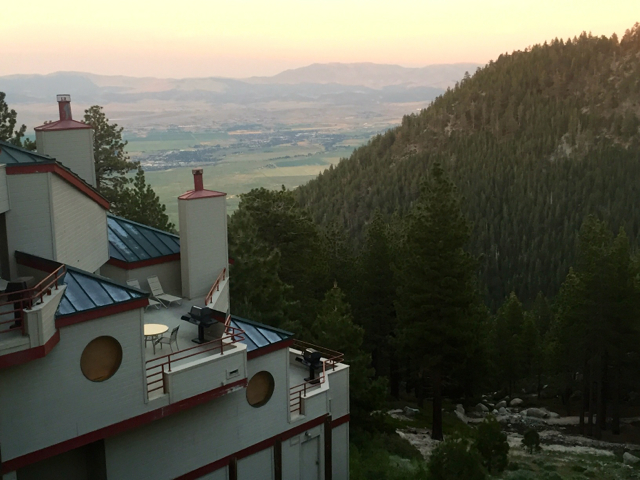
The Ridge Tahoe

The Ridge Tahoe was singled out by Douglas County officials June 28. Photos/Susan Wood

“We needed to engage policymakers, employees and the community,” said Assistant County Manager Christine Vuletich, who made the budget presentation to about 50 people at the Carson Valley Inn on June 28.

“The county is in good economic health, but that doesn’t mean we can rest on our laurels,” she summarized “We have challenges, but we also have opportunities.”

Back in 2009, county leaders knew it had mountains to climb in terms of overcoming weak economic growth, a drop in building permits, baby boomers retiring but spending less, and skyrocketing unemployment that peaked in 2010 at 14 percent. In comparison, it was 4.3 percent in 2005. This year, it came in at 6.2 percent.

Part of this Nevada unemployment had to come from Douglas County’s own labor force, which was reduced by 80 staffers between 2010-12 to sustain financial stability.

After all, the major portion of a county’s General Fund expense is personnel at 71 percent, which dwarfs other costs.

Public safety makes up the largest chunk of resources spent for county services at 30 percent, followed by culture and recreation consuming half that.

On the other side of the coin, General Fund revenue for the county is dominated by property tax at 45 percent. And the housing market also experienced a crunch in recent years.

As for other challenges, many local governments struggle with keeping afloat with rising costs from retiring personnel.

When asked how the county plans to balance those increasing expenses, Vuletich responded after the meeting: “We planned for that.”

Nonetheless, the county’s chief financial officer called the latest numbers highlighting more Nevadans entering or re-entering the workforce after a long-fought battle with the jobs market as “one bright spot” that the local economy is pulling itself by its bootstraps.

“Douglas County continues to make great progress despite the financial and infrastructure challenges we face,” interim County Manager Larry Werner said in a statement. “We must focus on capital improvement and asset projects and continue to invest in our greatest asset – a high performing workforce.”

More jobs in transportation, trade, construction and education mark a path to prosperity. These are things the task force hoped for when creating the county’s Economic Vitality Plan in 2010. They are keeping an eye out for possible trends, possibilities and opportunities to further nurture.

Other areas of potential revenue revolve around aviation, with the Minden Tahoe Airport being home to 20 businesses.

In the past, the economic drivers were limited to tourism and construction – but both industries plummeted in the recession. Now diversity is the key. And whereas tourism will always have a place in helping to boost revenue, the county is seeking and encouraging businesses that offer other options. This may mean tourism-oriented businesses reinventing themselves.

If the county’s “Spotlight” awards of businesses of the year are any indication, then entrepreneurs may be responding to the call. They were honored Tuesday night. Two are based at Lake Tahoe – one new, one seasoned.

·      Round Hill Pines Beach Resort received the award in the Sports and Recreation category

·      Ridge Tahoe received the award in the Tourism and Hospitality category

·      Continuum Packing Solutions received the award in the Manufacturing and Production Category

·      Battle Born Wine received the award in the Retail category

·      Jacobs Family Berry Farm received the award in the Entrepreneur category

·      Valley Eyecare and Eyewear Gallery received the award in the Business and Professional Services category

·      The Pink House received the award in the Restaurant category.

Lisa Granahan, the county’s economic vitality manager, highlighted a few points of interest driving the county economic engine that appear to echo some of the award winners.

“We have a real opportunity in the manufacturing sector, showing an 11 percent growth in the last few year,” she said, adding the industry has become a focus given its association with better incomes for county workers.

What tops the list?

Granahan cited outdoor, recreation and lifestyle.

Pertaining to the lake, the econ manager believes recreation and entertainment represent the keys to prosperity.

“Gaming is part of the economy, but it’s not the driver,” she said.

What is an area to improve on?

“Transit,” Granahan responded, without batting an eyelash. “Look at Park City,” she said of a successful example. “We leave a huge amount of money on the table from (transit).”


Study: Calif. has more water than some think

By Shelby Grad, Los Angeles Times

Drought-stricken California might have a hidden water bonanza.

A Stanford University study released Monday said the state has three times more groundwater located in deep aquifers than earlier estimated.

According to a Stanford news release, the water is 1,000 to 3,000 feet underground. Until recently it was considered difficult to retrieve water from that depth. The quality of the water is questionable, researchers said, noting that desalination might be required.

Read the whole story


Renown, Stanford deal ‘a game changer’

By Jason Hidalgo, Reno Gazette-Journal

In a move that a Renown Health executive described as a “game changer” for the community, the Reno-based healthcare network announced a partnership with several Stanford University health entities on Tuesday.

The deal with Stanford Health Care, Stanford Children’s Health and Stanford Medicine expands the specialty services available to Renown patients, who will now have access to the advanced care available in Stanford’s network.

Examples include services for children with conditions such as cancer or brain tumors that require treatment not available in the area, said Tony Slonim, Renown Health president and CEO.

Read the whole story


Fourth of July travel set to break record

By Associated Press

It’s going to be a busy holiday weekend on the nation’s highways.

A record 43 million Americans are expected to travel this Independence Day weekend, with the overwhelming majority driving, according to AAA, a car lobbying group and one of the nation’s largest travel agencies. This tops the joint record set last year and in 2007.

Lower gas prices, strong consumer confidence and a generally healthy domestic economy have led more families to take trips this summer.

AAA estimates that U.S. drivers have saved $20 billion on gasoline so far this year compared to the same period last year. Gas prices as of June 20 were 46 cents per gallon below prices from a year ago.

“We are well on our way for 2016 to be a record-breaking year for summertime travel,” said AAA President and CEO Marshall Doney.

Ahead of last year’s holiday, AAA predicted that 41.9 million people would travel 50 miles or more from home during the weekend. AAA has since revised that number to say that 42.3 million people actually traveled. This year’s estimate — the highest since AAA started tracking in 2001 — is for 42.9 million travelers with 84 percent of them driving.

The holiday travel period is defined as June 30 to July 4.

The number of travelers is estimated to be 10.7 percent higher than the average number during the past 15 years.


Loop road question to be put before voters

By Kathryn Reed

Voters on the California side of the South Shore have yet another decision to make in November – an initiative regarding the loop road.

The measure brought forward by a group of locals has the requisite number of signatures to place on the ballot. At the July 19 South Lake Tahoe City Council meeting the electeds can enact what the petitioners want or put it on the ballot. The latter is the likely course of action based on stances and comments they’ve made in the past.

“This particular initiative is saying the city of South Lake Tahoe shall not approve or support the realignment of Highway 50, commonly known as the loop road, unless it gets the support of voters for a specific proposal,” Bruce Grego told Lake Tahoe News. He is one of the main backers of the proposal and has long been an opponent of the loop road. “This particular initiative provides a choice … that the city cannot approve a realignment without voters’ approval.”

A simple 50 percent majority is needed for it to pass.

“If this passes, then the city will have to put on a future ballot a specific realignment,” Grego said.

The Tahoe Transportation District, which is the lead agency for the project, is in the process of developing environmental documents. From those a preferred alternative will come forth. It is that alternative that voters would weigh in on via a second ballot measure down the road – assuming the first ballot measure passes.

City Attorney Tom Watson told Lake Tahoe News, “Even if the vote is overwhelmingly against the project, the city can’t do anything to prevent it because it is not the city’s project. The City Council doesn’t have any decision-making that impacts that project.”

TTD does not have condemnation power, though. If eminent domain were needed to acquire property, the city or Caltrans would have to invoke it. The city today has a policy not to use eminent domain. That can be reversed if four out of the five electeds choose to do so.

If the measure passes, there is talk that a lawsuit would be filed challenging the legality of it. It’s not possible to challenge it prior to the vote.

El Dorado County Elections Department could not tell Lake Tahoe News what it will cost the city to place the measure on the ballot.

Also on the Nov. 8 ballot will be two tax measures the city wants voters to approve. One would raise the hotel tax and the other the sales tax. Raising the current TOT by 2 percent is projected to generate $2 million annually. Upping the sales tax by one-half percent to 8.25 percent would likely bring in $2.5 million each year.

The current transient occupancy tax is 10 percent throughout much of South Lake Tahoe, 12 percent in the redevelopment area. The former goes into the city’s General Fund, the latter mostly to pay off the bond debt. The Tourism Improvement District, which was formed in 2006, tacks on another $3.50 or $4 per night. TID uses that money for marketing.

South Shore residents will also be voting on:

·      City Council (two seats)

·      Lake Tahoe Community College (two seats)

·      Lake Tahoe Unified School District (three)

·      South Tahoe Public Utility District (two)

·      Lake Valley Fire Protection District (three).

The filing period is July 18-Aug. 12. If an incumbent does not file, the deadline is extended to Aug. 17.


South Lake Tahoe wins VHR lawsuit

By Kathryn Reed

South Lake Tahoe is justified in charging the fees it imposes on vacation rental owners, according to a court decision.

El Dorado County Superior Court Judge Steve Bailey on June 28 released his decision regarding the lawsuit that was filed in June 2015 by Jim Morris, owner of Lake Tahoe Accommodations.

“We are delighted with the results. It fully justifies what the council has said all along and that they have acted appropriately in setting the fees for vacation home rentals,” Tom Watson, city attorney, told Lake Tahoe News. “It is clear vindication for the city in this situation.”

The opposing parties had spent four hours in court in late April arguing their respective opinions.

Morris’ company manages more than 200 rentals on the South Shore. He filed the suit under the parent company of his business – Lake Tahoe Properties. His contention a year ago was “they violated the law in how they passed the ordinance. And they didn’t justify the money and how it is generated.”

Morris was unavailable for comment. However, his Sacramento-based attorney, Brigit Barnes, said, “I do not agree with the court that the city ever established a revised fee structure that matched what their anticipated costs were. And that was the basis of our case.”

The city has been tweaking the VHR ordinance almost since its inception, and even since the lawsuit was filed. Part has had to do with fees, and part with appeasing permanent residents.

In the court ruling Bailey said, “After reviewing and considering the administrative record, there is nothing in the record to suggest the City Council acted arbitrarily, or that its decision is devoid of evidentiary support. Instead, the record demonstrates that in adopting the VHR ordinance and resolution, the City Council exercised its best judgment based upon the evidence presented to them.”

Another part of the case is still to be decided. According to Barnes, this has to do with if it’s constitutionally allowable for VHR owners to be saddled with the fees as a penalty, so to speak, when VHRs are only responsible for 27 percent of the complaints.

Watson believes based on how Bailey has ruled so far that the city will prevail going forward.

Barnes had not spoken to her client as of Tuesday afternoon, so Morris’ exact course of action going forward is unknown. He could appeal.