Mountain Brews bringing small batch beer to Tahoe
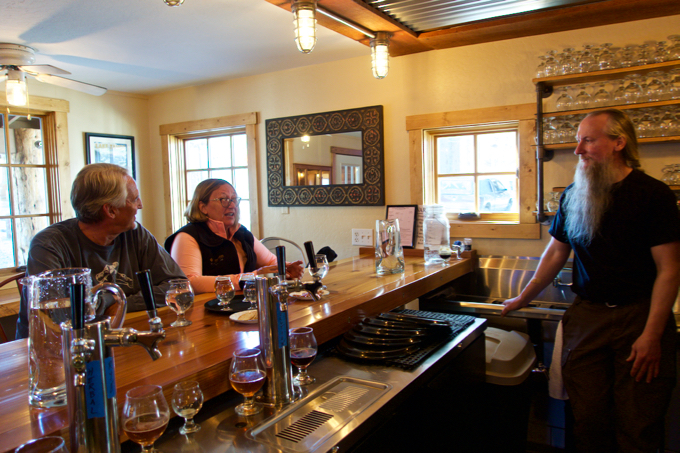
Ron Buck talks beer with Larry Armstrong and Joan Bigelow at Mountain Brews. Photo/Kathryn Reed

By Kathryn Reed

Subtle, powerful, full bodied, visually appealing – and, well, delicious. And that, after all, is what really matters – the taste.

Lake Tahoe Mountain Brews, better known just as Mountain Brews, is the latest brewery to open in South Lake Tahoe.

“We can’t do quantity, so we are focusing on quality,” brewmaster Ron Buck told Lake Tahoe News.

Five incredibly different beers fill the tray. And much like a wine tasting, there is an order they are to be consumed.

A flight of beers is worth sharing. Photo/Kathryn Reed

“These recipes are so full bodied that the alcohol is masked,” Buck explains.

That could by why after finishing the Imperial Rye (12 percent alcohol) it was necessary to slow down a bit. Note taking got sketchy with my three favorites having the most alcohol – Belgian Festival (9.3 percent) and Porter (9.8 percent) being the other two.

This flight of five 4-ounce beers ($15) is too much for this taster to finish, but it would be great to share. My least favorites are left behind – Evolution Ale and Herbal IPA. Even so, it’s not that there is anything wrong with them, it’s just a preference thing.
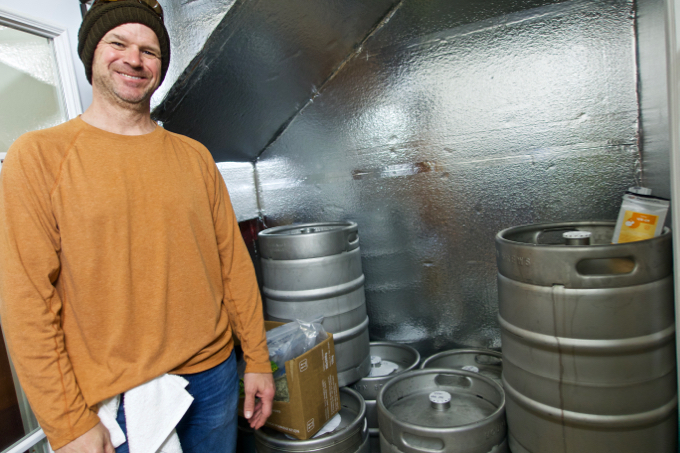
Taylor Flynn designed the cold storage facility in what used to be a closet. Photo/Kathryn Reed

Taylor Flynn, owner of the monthly Mountain News, has transformed the bottom floor of the newspaper office into a brewery. Upstairs is still home to the paper.

It looks nothing like it once did, when a desk greeted those who entered the office and a couch was near the fire place. It was dark and uninviting – which could have been done on purpose.

Today it’s a combination of woodsy mountain meets industrial décor. The bar is a 12-foot slab of redwood. Wood floors have lightened the room up. Vapor lights and the corrugated metal at the bar, along with the metal pipes that hide the wires balance the wood. The varied metal chairs and wine barrel tables, along with the brick at the fireplace and behind the bar tie it all together.

Above the fireplace is a screen showing pictures of Tahoe taken by Buck. With Flynn being an accomplished photographer, it’s likely his photos will be part of the rotation at some point. Music comes on when the doors open to the public. It’s possible some sporting event will be on that will be muted, but this isn’t a sports bar.

This is a place for beer aficionados.

“There will be new recipes each season,” Buck said. The beers being served now were made in January.

Stainless steel vats fill one of the back rooms of Mountain Brews. Photo/Kathryn Reed

For now, there are no plans to extend the hours or days of week. It’s Buck and Flynn who are behind the bar pouring the beers. They are able to explain to patrons exactly what’s in them, the process and what’s to come.

Buck honed his skills at the former Mt. Tallac Brewery and Cold Water Brewery, as well as being a home brewer.

His binder of recipes looks more like a chemistry manual. Software can help make subtle changes. Then there is the ability to age or condition the beer on oak, vanilla bean, lemon grass, sage, and various hops.

“More ingredients are available to brews because of the process. You can layer in the flavors,” Buck said.

The three-barrel system is the equivalent of six kegs per batch.

Flynn had the idea of opening the brewery about five years ago. Originally he bought the building with the idea of hiring a staff to make the paper a weekly. Personal issues put the kibosh on those plans, so Plan B was concocted. He’s happy the nano-brewery is what came to fruition.

Food might be offered in the future, but that will take some doing with government agencies. For now, crackers and pretzels are available.

Bottling and growlers would be the more immediate additions.
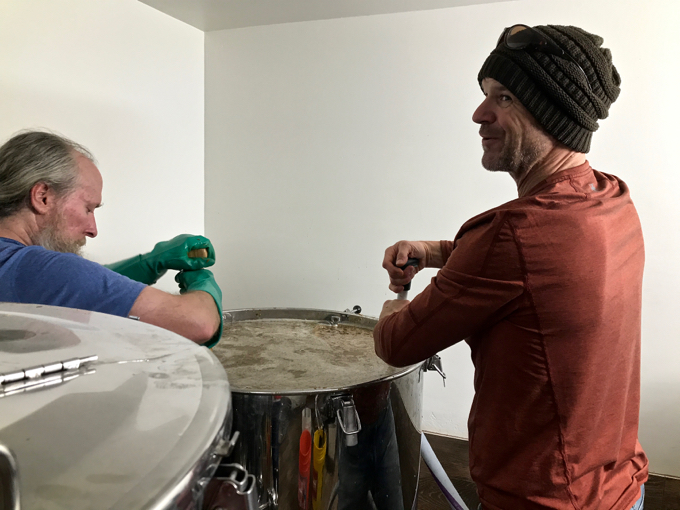
Ron Buck and Taylor Flynn in January put some muscle into beer making. Photo/Kathryn Reed

—–

Notes:

·      Address – 963 Third St., South Lake Tahoe.

·      Hours – Friday and Saturday, 4-10pm.

·      Prices — $6 to $8 per glass

·      Alcohol content – 6.3 to 12 percent

·      Current selection – Evolution Ale, Herbal IPA, Imperial Rye, Porter, Belgian Festival.


California state worker pensions are safe, for now

By Adam Ashton, Sacramento Bee
 
Future state workers, your pension cost-of-living adjustments are safe, and you won’t get to choose between a CalPERS pension and a 401(k) plan anytime soon.

Both proposals were shot down on Monday by a Senate committee that rejected a pack of bills aimed at reducing the risk taxpayers face if an economic crisis cripples the state’s public pension funds.

Most of the bills came from Republican Sen. John Moorlach of Costa Mesa and Democratic Sen. Steve Glazer of Orinda, who argue that the rising cost of public pensions could drive local governments into bankruptcy when the next recession hits.

Read the whole story


How the USFS grows millions of seedlings each year

By Greg M. Peters, Forests

Tucked into the Douglas fir and ponderosa pine forests of Northern Idaho sits the quaint lakeside town of Coeur d’Alene. The former lumber town is now a popular tourist destination drawing families from across the Pacific Northwest and beyond. Gone are the pounding mills, replaced with fancy lakefront hotels and bustling shopping centers.

But it’s not hard to find relics of the region’s once-thriving industry: Huge logs chained together to form breakwaters protect marinas and lakeside restaurants scattered around Lake Coeur d’Alene—the region’s main tourist draw. In the sprawling Idaho Panhandle National Forest that nearly surrounds the town, century-old stumps the size of boulders rot beneath a canopy of trees that themselves seem a hundred or more years old.

Both the stumps and the forest’s now abundant trees provide clear evidence of a century of forest management that has played out in this quiet corner of America.

Read the whole story


Students spearhead plastic straw ban in Lake Tahoe

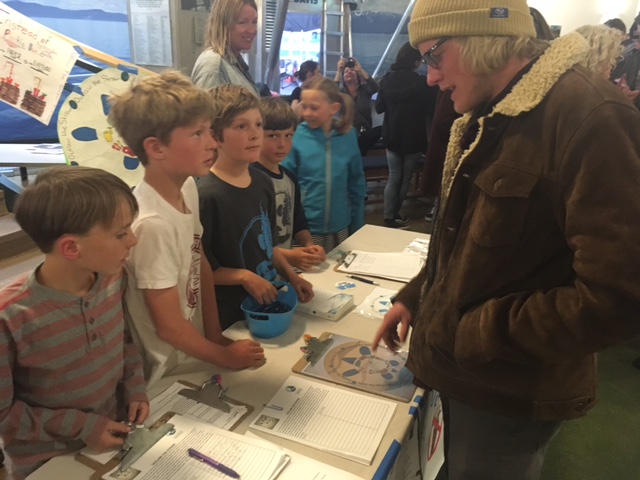
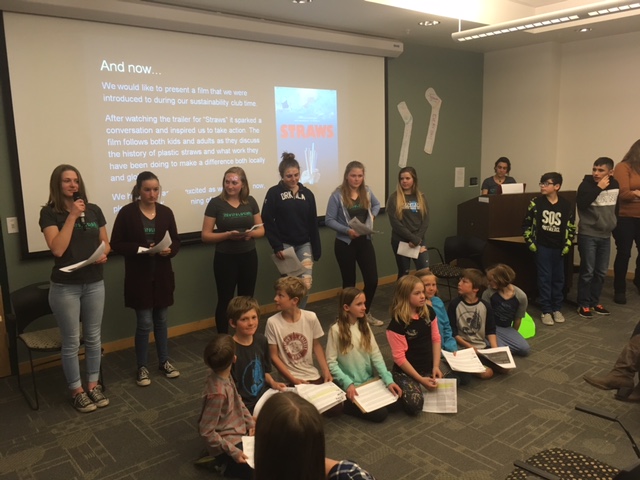
Students explain why plastic straws are bad for the environment. Photo/Terra Breeden

By Terra Breeden

INCLINE VILLAGE – It is estimated that more than 500 million single-use plastic straws are used and thrown away in the United States every day. That’s enough straws to wrap around the Earth 2.5 times.

Single-use plastic straws are cheap and easy to produce, but they are a menace to the environment. Billions of the seemingly insignificant, plastic tubes are buried in landfills and tossed in the ocean annually. Scientists predict that by 2050 there will be more pieces of plastic in the ocean than fish.

Lake Tahoe youths are mobilizing to cut down on plastic consumption. Students from a variety of schools and programs have united to spearhead the movement to raise plastic-straw-awareness and ban the use of other single-use plastics like Styrofoam containers and shopping bags at restaurants and other businesses around Lake Tahoe.

“There are so many people supporting this communitywide movement,” director of SWEP Ashley Phillips said. “But students are smart, creative, and they problem-solve in ways adults don’t. They have powerful voices to use.”

At Sierra Nevada College on April 19, students from the Sierra Watershed Education Partnership (SWEP), SOS Outreach program, and Sierra Expeditionary Learning School (SELS) united with Incline Village General Improvement District, League to Save Lake Tahoe and UC Davis TERC in an event called The Last Straw. The goal was to create plastic-straw-awareness in Lake Tahoe. The event highlighted the student’s work in the community and featured a documentary film on the history of plastic straws.

Youngsters educate adults about plastic. Photo/Terra Breeden

“We were all working on this single-use plastic awareness event in our communities and decided to combine forces. I love giving the kids the ability to showcase their work,” IVGID Resource Conservationist Madonna Dunbar told Lake Tahoe News.

The Lake Tahoe youths have done a lot of legwork to further their cause. Students from each of the programs formed coalitions to teach the community about the danger of single-use plastics, going to restaurants and businesses in South Lake Tahoe, Incline Village, Tahoe City, Kings Beach, and Truckee. They went to restaurants throughout the basin with proposal letters and created slogans and logos for their anti-straw campaign. Their goal was to persuade Lake Tahoe restaurants to stop using plastic straws, or at least make them available for guests upon request only.

“The kids did the work. They went out into the community and gave the presentations. They learned how to go from a concept to implementation and have touched all corners of the Lake Tahoe community,” Dunbar said.

Their movement has been a success. Over the past three months, SOS Outreach students have reached out to 45 restaurants in South Lake Tahoe and 12 restaurants in Kings Beach and Incline Village. The SOS Outreach students were inspired by the SWEP youths, who had already taken action by contacting 25 restaurants in Truckee and Tahoe City. Together, students from each of the programs have touched almost the entire Lake Tahoe community.

So far, due to their efforts, Northstar and Mountain Slice Café have agreed to go completely straw-free. Many other restaurants from around the lake have decided to make single-use plastic straws available to guests by request only.

Part of South Lake Tahoe’s Polystyrene ban that the City Council approved this year includes restaurants having to ask people if they want a straw – not having it be automatic.

When 4th- and 5th-graders from SELS heard about the other students’ campaign, they started their own Outlaw the Straw movement and gave a presentation at the Lodge at Tahoe Donner. The 9- to-11-year-olds’ next goal is to attend a Truckee community meeting and get a ban on single-use plastics made into law.

“We believe this is the next step for our eco-conscious town,” 10-yearr-old SELS student Ben Martin said. “Our blue planet is unique and special.”

The event last week was attended by about 100 people. The League to Save Lake Tahoe even provided reusable bamboo straws and water-bottles that were labeled with the logo Drink Tahoe Tap.

The film “The History of Straws” was shown and then students from each of the programs stood up and presented their work. At the end of the event, students asked if the audience would “agree to go straw free,” and as attendees rose from their seats and joined the Outlaw the Straw movement it appeared as if every seat in the room was empty.

The communitywide anti-straw movement continues to grow and reach others. Take Care Tahoe has commissioned for stickers and artwork to be made with slogans like “Straws Don’t Suck,” and “Drink Like a Fish.” Businesses that join the movement to ban straws will be publicized and given stickers to display in their windows that show they are a part of the effort to ban plastic straws in Lake Tahoe.

“Single-use plastics and not drinking bottled water is where this all started for us and it’s growing,” Dunbar told Lake Tahoe News. “Now we have the momentum and we have to keep that momentum going and capitalize on the gains we’ve made.”


California to spend billions on reservoirs

By Dale Kasler, Sacramento Bee

California took a big step Friday toward launching a new multibillion-dollar wave of reservoir construction.

After being accused of being overly tightfisted with taxpayer dollars, the California Water Commission released updated plans for allocating nearly $2.6 billion in bond funds approved by voters during the depths of the drought. The money will help fund eight reservoirs and other water-storage projects, including the sprawling Sites Reservoir in the Sacramento Valley and a small groundwater “bank” in south Sacramento County.

In its new blueprint, which remains tentative, the Water Commission nearly triples the amount of money it will spend compared to a preliminary allocation it put out in February.

Read the whole story


Migratory bird policy undermines century of conservation

By Amanda Rodewald, The Conversation

The Trump administration has announced a position on protecting migratory birds that is a drastic pullback from policies in force for the past 100 years.

In 1916, amid the chaos of World War I, President Woodrow Wilson and King George V of Great Britain signed the Migratory Bird Treaty. The Migratory Bird Treaty Act (MBTA) wrote the treaty into U.S. law two years later. These measures protected more than 1,100 migratory bird species by making it illegal to pursue, hunt, take, capture, kill or sell live or dead birds, feathers, eggs and nests, except as allowed by permit or regulated hunting.

This bold move was prompted by the decimation of bird populations across North America. About 5 million birds, especially waterbirds like egrets and herons, were dying yearly to provide feathers to adorn hats, and the passenger pigeon had just gone extinct. Fearing that other species would meet the same fate, national leaders took action.

Now the Interior Department has issued a legal opinion that reinterprets the act and excludes “incidental take” – activities that are not intended to harm birds, but do so directly in ways that could have been foreseen, such as filling in wetlands where migrating birds rest and feed. Why? For fear of “unlimited potential for criminal prosecution.” As the argument goes, cat owners whose pets attack migratory birds or drivers who accidentally strike birds with their cars might be charged with crimes.

But the MBTA has not been enforced this way. It is applied to cases of gross negligence where potential harm should have been anticipated and avoided, such as discharging water contaminated with toxic pesticides into a pond used by migratory birds. This new reading of the law means that companies will escape legal responsibility and liability for actions that kill millions of birds every year.

Pollution, development and habitat loss kill birds

Purposeful killing is only one of many threats to migratory birds. Habitat loss, invasive species, pollution and collisions with buildings take heavy tolls on many species. According to the U.S. Fish and Wildlife Service, every year more than 40 million birds are killed by industrial activities or structures such as power lines, oil pits, communication towers and wind turbines. The 2010 Deepwater Horizon oil spill in the Gulf of Mexico killed more than 1 million birds in a single event.

Seventeen former Interior Department officials representing every presidential administration from Nixon through Obama have written a memo expressing deep concern about the new policy. As they explain, the MBTA has given industries a strong and effective incentive to work with government agencies to anticipate, avoid and mitigate foreseeable death or injury to birds.

For example, it prompted energy companies to install nets above pits where they store waste fluids from oil drilling. Because these pits look like water sources, birds often land on them and can become trapped and die. Installing nets over the pits has cut annual bird deaths from roughly two million birds yearly to between 500,000 and 1 million. Not perfect, but a meaningful improvement.

Global citizens, global consequences

Because migratory birds don’t recognize international boundaries, the consequences of reinterpreting the MBTA may be felt across borders. In one year, an individual warbler may spend 80 days in Canada’s boreal forests, 30 days in the United States at resting and refueling sites during migration, and over 200 days in Central America.

At the Cornell Lab of Ornithology, we have constructed maps and animations using data collected by volunteers for eBird, the world’s fastest-growing biodiversity database. These references illustrate how migratory birds connect countries. Many spend the year in locations that span the Western Hemisphere.

The eastern-breeding magnolia warbler, for example, spends winters in areas in the Yucatan Peninsula and Central America that are fractions of the size of its breeding range. Seeing how densely these birds are clustered in their winter habitat shows us that each acre of that territory is important to their survival.

Similarly, most populations of the western-breeding western tanager overwinter in Mexico. By identifying where bird populations winter in this way, we can better target conservation actions to protect species throughout their annual cycles.

Still at risk

Today we know much more than early conservationists did about the value of birds. Healthy bird populations pollinate crops and help plants grow by dispersing seeds and preying on insects. Migratory birds also contribute billions of dollars to economies through recreational activities like hunting and birdwatching. And they connect us with nature, especially through the dazzling spectacle of migration.

Conserving migratory birds requires effective protection both in the United States and through international agreements and partnerships. The most important threats are loss and degradation of habitat, which can be caused by land conversion – for example, clearing forests for farming – or by climate change.

In the 2016 State of North American Birds report, an international team of scientists assessed the conservation status of 1,154 birds across Canada, the United States and Mexico. They found that over one-third of all North American bird species are at risk of extinction without meaningful conservation action.

Birds associated with oceans and tropical and subtropical forests year-round are in the most dire straits. More than half of North American seabirds are declining due to pollution, unsustainable fishing, energy extraction, pressure from invasive species and climate change. Birds that rely on coasts, arid lands and grasslands also are in serious decline.

There are no easy solutions, but new science is supporting responses. Transformational citizen science projects like eBird are developing vast data sets to help pinpoint where conservation action should focus. Bird conservation groups and government agencies have formed international teams to eradicate invasive predators on islands that are critical to breeding seabirds and drafted multinational agreements to clean up large floating mats of garbage in our seas that can choke, trap or poison seabirds and other animals.

Birds are a shared resource among nations. Where governments have acted, they have successfully protected migratory birds and the habitat they depend on. In my view, the Trump administration’s shift would abdicate U.S. leadership on migratory bird conservation and undermine public good for private profit.

Amanda Rodewald is a professor and director of conservation science at Cornell Lab of Ornithology, Cornell University.


Alcohol sales to be allowed at Lakeview Commons

By Kathryn Reed

Alcohol will be allowed on a regular basis at Lakeview Commons starting in May.

This is a big departure from South Lake Tahoe’s rules that have been on the books for years that banned alcohol sales or consumption at city parks except under special occasions, like the Thursday Live at Lakeview events.

A glitch of sorts is what has led to the change in policy.

When the request for proposals for a concessionaire at Lakeview Commons were sent out they said alcohol was allowable. Sierra-at-Tahoe, the winning bidder, budgeted for the sale of beer and wine.

Attorney Sergio Rudin with the law firm of Burke, Williams and Sorensen at the April 17 City Council meeting said there are three general exceptions to the city’s alcohol ban, of which it would be possible for Sierra to qualify under at least one.

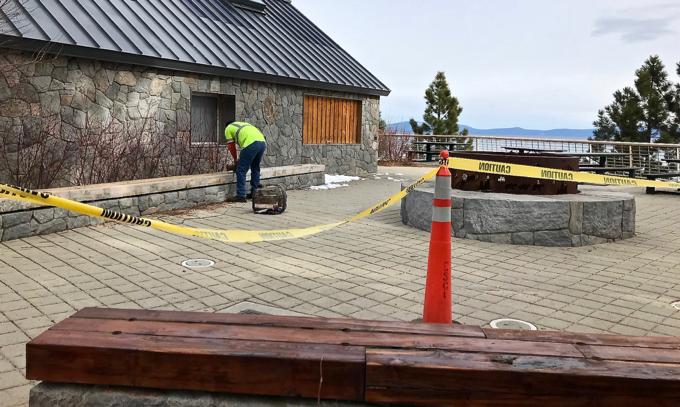
A South Lake Tahoe employee works to get Lakeview Commons spruced up for the summer season. Photo/Kathryn Reed

The council and staff ultimately allowed the deal to go through, with Rudin acknowledging a code amendment may be needed to make everything legit. He also said the RFP was never reviewed by his office.

Lauren Thomaselli said the original RFP sent out five years ago mentioned alcohol as a possibility, but staff didn’t allow it. It’s not known why it was left in the document or who was responsible.

This time the winning bidder, though, had those sales as part of their proposal and no one brought it up as an issue until last week when the contract was about to be signed.

“We are not looking to put alcohol on the beach. It’s a little footprint outside the building,” John Rice, general manager for Sierra, told the council.

He explained how he would have staff on site to ensure people limited their consumption to a cordoned off area.

Rice also said, “If they bought beer from us, we are responsible for that person. We are exposed for our liquor license and liability as well.”

Another concern of council was the possibility of Sierra’s beer sales negatively impacting the beer garden during Live at Lakeview during the summer. Rice said he and that promoter have an existing relationship, and that they will depend on each other to be successful, as opposed to being competitors.

Sierra hopes to open the food stand in mid-May and run through at least Labor Day.

Scott Justice, who runs the resort’s food and beverage operation, plans to bring the same high quality fare skiers are used to to the lakefront setting.

A main goal is not to replicate what is already offered in the Harrison Avenue area. Tortas will be a main feature. Vegetarian options will be available. Common staples people expect at a venue like this will be available – like nachos, hot dogs and pizza.

Something different will be Taiwan ice, which Justice described as being between shaved ice and ice cream.

“We also want to do catering there, so guests at Lakeview have a catered meal” Justice said.

He envisions providing a meal with wine or beer, with a view of the lake.

“That’s a pretty rare opportunity, especially for someone camping across the street. It will be a value for those folks,” Justice told Lake Tahoe News.

The goal, he said, is to be nimble and adjust as necessary with offerings as the season progresses.


Tahoe City Golf Course celebrating 100 years

By Kurt Althof

Tahoe City Golf Course, the oldest course at Lake Tahoe, will celebrate its centennial anniversary during the 2018 season with a variety of events and specials. 

Designed by May “Queenie” Dunn-Webb, golf pro and course manager in 1918, this year’s celebrations pay tribute to female athletes, pioneers and North Lake Tahoe History.

To kick off the special season, May 11-13 green fees for 9 holes will be 50 cents, a typical rate for golf after the turn of 20th century. 

On June 8, the course will host putting and driving contests for all ages using hickory stick putters and throwback equipment. Following the contests, Tahoe historian Mark McLaughlin will deliver a historical presentation on the Tahoe City Golf Course. Admission is free and subject to space available. 

On June 9, the course will host the Two Bills Heritage Golf Tournament with proceeds benefiting the Red Cross and the Tahoe City Recreation Association.  

On Aug. 19, in a nod to female-influenced beginnings, the greatest female golfer of this generation, Annika Sorenstam, will provide a junior golf clinic and demonstration followed by a Q&A and photo session. 

Following the demonstration, the course will host its inaugural family golf tournament encouraging generations to come together and form teams for this special community event. 

Throughout the season, every Tuesday (excluding July 3) will be May Dunn Day, offering a 9-hole lady’s rate of $19.18. Similarly, every Thursday (excluding July 5) is Throwback Thursday with 9-hole pricing of $19.18 all day for all golfers.

In addition to specials, the course will be the temporary home to a portion of golf historian Rick Lund’s extensive collection of historical golf equipment and memorabilia. The exhibit’s centerpiece will be a junior golf club made by and carrying the May Dunn-Webb name.   

Tahoe City Golf Course, originally the Tahoe Tavern Links, has a rich history in the Sierra. At the turn of the century, a railroad spur line brought guests to the Tahoe Tavern in Tahoe City. As the Tavern and the sport of golf gained in popularity a portion of the Tavern’s extensive holdings were set aside for a golf course.  The Tahoe Tavern commissioned the course in 1917, designed and built by May “Queenie” Dunn-Webb of the infamous Scottish golf family, the Dunns. First built as a 6-hole course with sand greens, the Tavern Links became 9 holes and 2,765 yards in 1921. The 9-hole tract has remained ever since, although the actual layout was altered in the 1940s.

The Tahoe City Golf Course was host to big money games in the 1950s, with players such as Bing Crosby, Bob Hope, the Mills Brothers, Ken Venturi, Harvey Ward, Frank Sinatra, Dean Martin, Sammy Davis Jr. and Andy Williams. 

For 100 years the course has provided a fantastic golf experience for everyone, from the rich and famous to aspiring junior golfers. The course has also given back to the community since its inception, hosting numerous charity events, including the first ever fundraising tournament benefiting the Red Cross in August 1918.   

Through several sales of the Tahoe Tavern, its outlying and separately deeded parcels were divvied up among the partners. Through this process the golf course became the property of Gordon and Pat Hyde in 1946. Just two years later, in 1948, the Hyde’s sold to Carl Bechdolt Jr. and wife Elsie. The course remained with the Bechdolt family until February 2012 when a consortium of public agencies led by the Tahoe City Public Utility District purchased the course, converting it into a public municipal course for the enjoyment of the community and its visitors.

Kurt Althof works for the Tahoe City Public Utility District.


Sierra mountaintop lab tracks some of the worst weather in U.S.

By Mike Wolterbeek

Winds that tear weather gauges from their mountings and blizzards that bury chairlifts – this is the kind of weather that hits Donner Summit, and holds great interest to climatologists, meteorologists, hydrologists and water supply managers as well as creates one of the best regions for skiing in the world.

While this winter has been mild in comparison, strong winter storms like the 10 atmospheric river events that moved through the Northern Sierra Nevada region during the 2016-17 winter season are not uncommon. Those systems regularly generated 173-mile per hour winds and delivered more than 700-inches of snowfall, with the snowpack reaching depths of more than 20 feet. The extreme weather was recorded in part by new instruments and technologies placed on a mountaintop in a collaboration between the UNR’s Nevada State Climatologist’s Office and Sugar Bowl Resort.

Scientists at the College of Science and officials at the Lake Tahoe area ski resort partnered to study regional weather and the impacts of climate change in the Northern Sierra by way of installation of three weather stations at the resort. The installation collects and provides important weather-related information that can be viewed by the public, updated every 10 minutes, and is shared with the National Weather Service, U.S. Forest Service and Sierra Avalanche Center daily. It can be viewed online.

In addition, the data collected provides Sugar Bowl Resort with important details relevant to their avalanche control and slope grooming operations.

“Less than an hour from the university’s campus in Reno, the nearly 8,400-foot summit of Mt. Lincoln is an ideal location for high-elevation climate observations,” said Douglas Boyle, associate professor in the Department of Geography in the College of Science and director of the Nevada State Climate Office.

“The university is interested in long-term monitoring of the weather and climate variables with the primary goal of observing changes in atmospheric winds, the associated high-elevation orographic-based precipitation, and the snowpack; the primary source of water for rivers, reservoirs, aquifers, agriculture, and millions of people in northern California and the east side of the Sierra Nevada.”

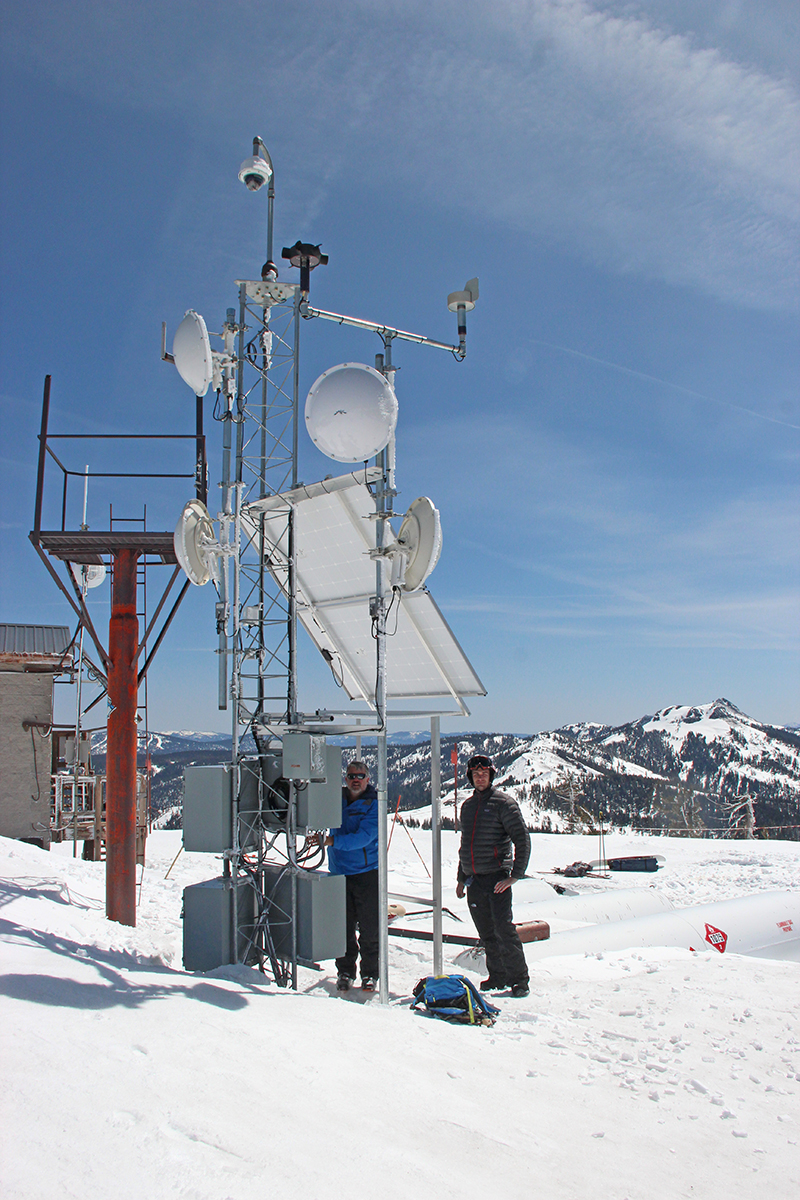
Nevada State Climatologist and Associate Professor Doug Boyle, and graduate student Paul Fremeau inspect one of three extreme weather stations at the crest of the Sierra Nevada at Sugar Bowl. Photo/UNR

The Donner Summit area, where Sugar Bowl is located, has climate records that go back to the late 1800s and there are twice-daily records at the Sugar Bowl Ski Resort that go back for decades. It is one of the longest continuous ski resort snow-recording sites in the country, and the ski resort continues the record keeping.

The new weather stations are operated by an internet-based system that uses the university’s AlertTahoe private high-speed microwave linked system that transmits real-time data, photos and video to scientists, public safety officials and Sugar Bowl’s professional ski patrol. The high-definition cameras have been installed at all three weather station locations at the resort. The mid-mountain station is at 7,558 feet and the base station is at 6,978 feet. These locations were selected in coordination with the Sugar Bowl Ski Patrol to best represent areas with snow across the entire resort to assist in decision-making for avalanche control and forecasting throughout the region.

“Sugar Bowl benefits from this partnership by gaining access to accurate real-time observations of weather and snow conditions that can assist with our operational decision-making and communications to our guests,” Greg Dallas, president and CEO of Sugar Bowl Resort, said. “Science-based snow reporting also offers the most consistent and authentic data available. We intend to use it to be even more transparent as it relates to our daily snow reporting. We also appreciate the value it brings to our entire region as the university team and other organizations receiving this data study the impacts of climate change in the Sierra.”

The partnership between the university and Sugar Bowl dates back to May 2014 when the university’s climate office was granted a 10-year permit to conduct high-altitude climate monitoring within the privately held property of the Sugar Bowl Corporation along the Sierra Crest near Donner Summit. Part of the 10-year permit includes the opportunity for university faculty to take advantage of this high-elevation climate observation network for educational purposes.

“This project has, and will, continue to serve as an excellent outdoor laboratory for studying mountain weather and climate,” Boyle said. “Since 2014, dozens of undergraduate and graduate students from the University have had the opportunity to visit and work with our weather sites at Sugar Bowl to learn about monitoring extreme weather and climate conditions. Feedback from students has been overwhelmingly positive.”

Since October 2016, the science team has been observing and recording air temperature, relative humidity, wind speed, wind direction, barometric pressure, precipitation, snow depth, water content and snow surface temperature automatically at the three Sugar Bowl Resort sites. Automated precipitation sensors were installed this year and the installation of automated water content, snow depth, and net solar radiation sensors will be installed early this summer.

“Sugar Bowl has been an amazing partner and collaborator on this project,” Boyle said. “Together, we have already learned a lot about the challenges associated with keeping these real-time observations available during extreme weather conditions, including transmitting microwave signals through 30- to 40-foot snow drifts, AC power outages, and heavy ice riming issues on the mountaintop equipment.

In spring 2016, the climate office partnered with Graham Kent, a geosciences professor and the Nevada State Seismologist at UNR, to include these weather/climate sites at Sugar Bowl Resort in the Nevada Seismological Laboratory’s multi-hazard monitoring and communications network that includes earthquakes, wildfire and extreme weather observations.

The state-of-the-art camera system, part of the AlertTahoe fire camera network, also provides real-time data, photos and video to first responders, scientists, public safety officials and other interested parties, and offers the ski area access to weather-related data that assists with their avalanche forecasting and mitigation, and snow reporting accuracy. UNR’s Climate Office installed, maintains and operates the equipment.

The wilderness internet network includes 25 fire cameras along the Sierra crest as far south as Mammoth Lakes and BLM lands in Northern Nevada. Another 10 cameras have already been funded and slated for installation this spring and summer. The addition of the extreme weather observations in the network will provide much needed real-time weather information to better understand avalanche conditions in the Sierra, snow levels over mountain passes, and aviation conditions in the region.

Mike Wolterbeek works for UNR.


Waterfall season at Tahoe a roaring sensation

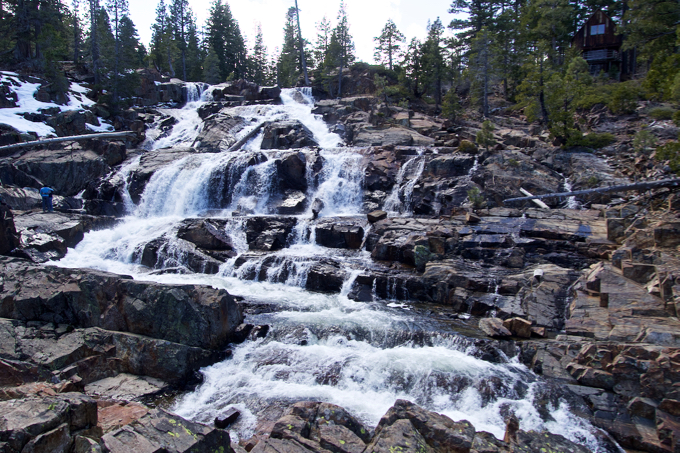
Glen Alpine Falls is at the far end of Fallen Leaf Lake. Photo/Kathryn Reed

By Kathryn Reed

With the burst of moisture in March and April, it is making waterfall season rather glorious right now.

The peak runoff usually doesn’t hit until later in May in the Sierra, so the rush of water should be flowing strong for several weeks, if not well into June. Plus, the temperature is supposed to be in the high 60s this week, which will just make the snow melt all that much faster. That’s a good thing for waterfall enthusiasts.

On the South Shore there are several waterfalls worth seeing. And not all of them require putting on a pair of hiking boots.

Glen Alpine Falls is raging. The multiple strands of water tumble down in ribbons across a wide swath of granite.


To get there, take the bumpy Fallen Leaf Lake Road until the falls come into view. Last weekend it was passable without four-wheel drive, but the El Dorado County maintained road is in horrible condition. Lots of other people last Saturday had the same idea, so it was a bit crowded at this gateway to Desolation Wilderness.

Up the road on Highway 89 is Eagles Falls. The lower falls are just off the road and descend into Emerald Bay. The upper falls are on the other side of the highway and require walking.

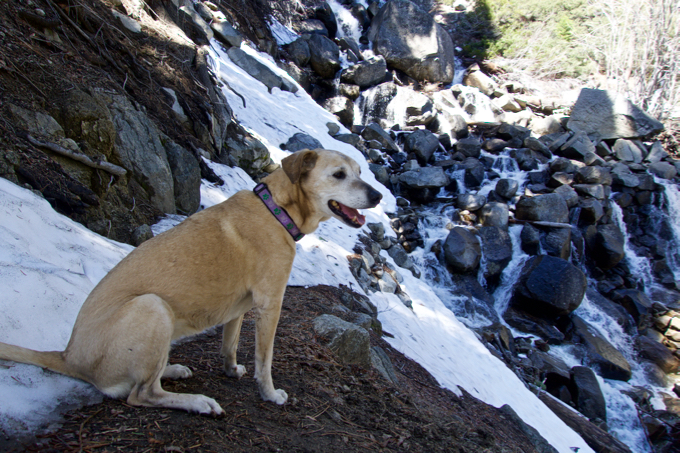
AJ runs out of trail at Hawley Grade Falls. Photo/Kathryn Reed

With this being the off season, it was surprising to see all the vehicles parked in the provided parking, along the highway and in ways that could have kept tow trucks busy.

Another fall that is worthy of a short hike is Hawley Grade Falls. It, though, also requires going down a poorly maintained county road in Meyers. Take South Upper Truckee Road almost to the end. There’s parking on the right.

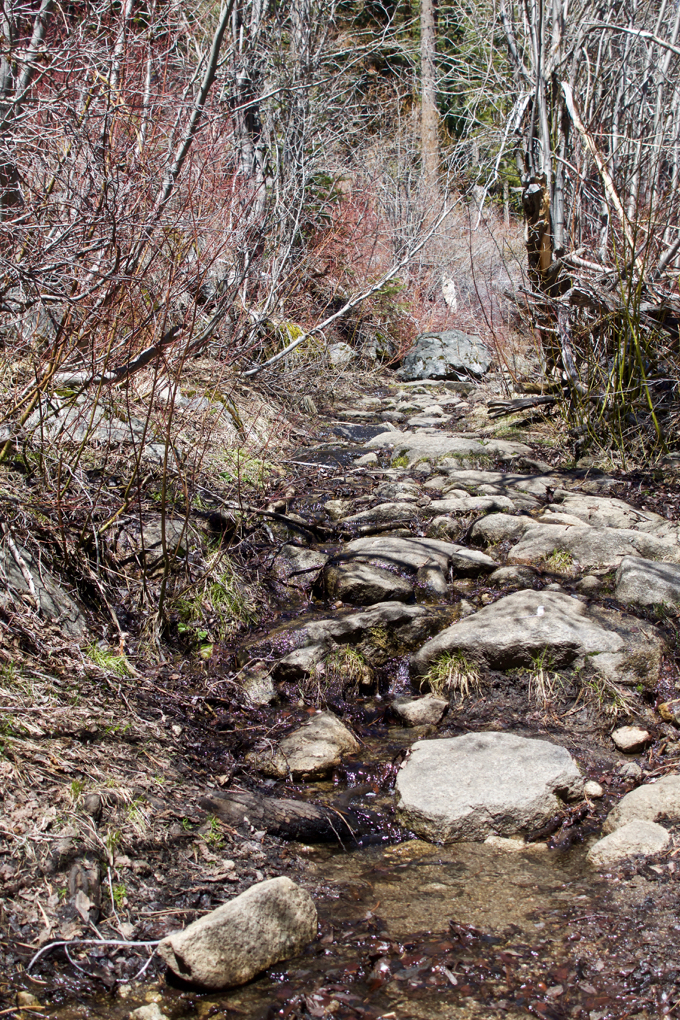
Don’t let the mild river coming down the trail deter you. The reward at the end is well worth the climb – about a 900-foot elevation gain. Plus, it’s not that far. The few patches of snow are easy to traipse over with trail shoes.

The water is coming from Echo Lake, crossing under Highway 50. It empties into the Upper Truckee River, which in parts was raging a week ago.

The Hawley Grade trail is wet in many parts, with the red manzanita branches adding color. Photo/Kathryn Reed

It looks like it will be a while before mountain bikers can safely cross Hawley Grade Falls to get to the other side. In summer, this is a popular trek.

The Hawley Grade was part of the Pony Express Trail in 1860. A granite plaque at the start of the trail explains some of this history.

For those who want easy drive-by falls, there are two along Highway 50 through the American River Canyon. One is Bridal Veil Falls. People often can be seen there taking pictures as well as filling up on water. Horsetail Falls is visible while driving west. This body of water comes from Aloha Lake and looks like a horse’s tail.