Bay Area seashore exudes national treasure

Publisher’s note: This is one in a series of stories about the National Park Service, which is celebrating its 100th anniversary in 2016. All articles may be found via the Home Page, select Special Projects, then National Park Service 100th.

Northern elephant seals sun themselves on the beach near Chimney Rock. Photo/Jessie Marchesseau

Northern elephant seals sun themselves on the beach near Chimney Rock. Photo/Jessie Marchesseau

By Jessie Marchesseau

POINT REYES NATIONAL SEASHORE – As a native Montanan, I grew up nowhere near a seashore. I was a teenager before ever even laying eyes on the ocean. Though I have since visited it numerous times, I don’t think it will ever cease to be a wonder to me: how so much beauty, life, power and even destruction can be combined into this one body, living, yet not living.

This summer, in observance of the 100th anniversary of our National Parks System, my husband and I decided to seize the opportunity of a recent three-day weekend to explore one of our nearby, and perhaps lesser-known, national treasures.

Just a few hours’ drive from Lake Tahoe we took in the sandy beaches, beautiful yet violent ocean waves, rolling coastal prairies and diverse wildlife of Point Reyes National Seashore.

One of just 10 national seashores within the National Parks System, Point Reyes is the only national seashore in California. In fact, it’s the only one on the West Coast, the other nine lying along the Atlantic and Gulf coasts.

The dairy building on the Historic Pierce Point Ranch was once the center of a thriving dairy business. It remains preserved within the Tule Elk Reserve at Point Reyes National Seashore. Photo/Jessie Marchesseau

The dairy building on the Historic Pierce Point Ranch was once the center of a thriving dairy business. It remains preserved within the Tule Elk Reserve at Point Reyes National Seashore. Photo/Jessie Marchesseau

These seaside preserves comprise a relatively small portion of the more than 400 sites which make up the National Parks System. And at just 70,000 acres, Point Reyes may seem almost tiny next to a 750,000 acre park like Yosemite. But the 80 miles of undeveloped coastline encompassed by Point Reyes National Seashore offers visitors an experience every bit as intriguing, delightful and awe-inspiring as one would expect from a national park.

Whitewater waves more than 6-feet high crashed onto the shores at Point Reyes Beach while we enjoyed a picnic lunch on the sand, onshore winds ruffling our hair. A washed up log was a makeshift picnic table as our niece and nephew crawled in and out of a driftwood “fort,” our three dogs digging holes in the sand and hunting for crab carcasses at our feet.

As dog owners, we always enjoy our adventures a little bit more with furry family members at our sides, and Point Reyes proved to be pleasantly dog-friendly, at least as far as national parks are concerned. It offers three dog-friendly beaches accessible by car or foot, even more if you choose to boat in. Printable maps clearly depicting dog-friendly locations are available online, and the park ranger I chatted with at the Bear Mountain Visitor Center was more than happy to highlight the locations on my free park map where I could explore with my four-legged friends. They do ask you to keep dogs on leashes, clean up after them and stick to the designated areas. But with miles of seashore designated dog-friendly, we had plenty of room.
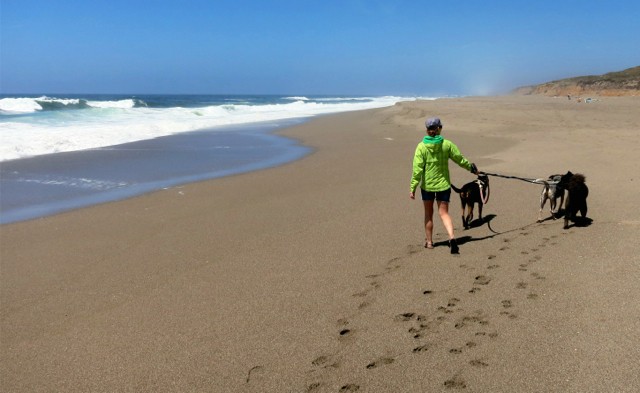
Point Reyes Beach is just one of the beaches in Point Reyes National Seashore which allows dogs. Photo/Jessie Marchesseau

Point Reyes Beach is just one of the beaches in Point Reyes National Seashore which allows dogs. Photo/Jessie Marchesseau

Most of the beaches at Point Reyes are not swimming beaches. Dangerous, often pounding surf and rip currents deem much of the water unsafe for venturing in. Moderate temperatures and steady winds typical of Northern California beaches don’t exactly beckon for bikinis and board shorts anyhow. But the sand is soft, and the views outstanding.

Piling back in the car, our next stop was Elephant Seal Outlook. The northern elephant seal is perhaps the most iconic of the 80 species of mammals known to reside within the boundaries of the national seashore, which also includes the water and land a quarter mile off shore. From the outlook, we peered down on two dozen elephant seals sunning themselves on the beach below and even a few pups frolicking in the water. The cooler temperatures and gusty winds were clearly not affecting their afternoon.

The following day we ventured to the north end of the park in search of the only animal which may rival the seal in its iconic status within Point Reyes: the tule elk. Once nearly extinct, tule elk at Point Reyes now number more than 400. At the far northern end of Point Reyes National Seashore, spanning a small peninsula called Tomales Point, is the Tule Elk Reserve.

Growing up in the Rocky Mountains, I know elk can be somewhat elusive animals, but upon reaching the reserve, we spotted three bull elk and one cow almost immediately. Continuing on to the designated parking area, we set out on a short hike in search of more. This proved not only a welcome opportunity to stretch our legs, but a chance to stroll through fields of wildflowers, pink, purple, yellow and white, and admire the picturesque coastline below, passing birds, butterflies and caterpillars along the way.

We were soon rewarded with the view of a small herd of elk, stopping to quietly observe as the majestic animals grazed contentedly on a grassy hillside. Returning, we had thought our luck pretty good on the day’s elk-viewing excursion. But driving out of the reserve we came upon yet another herd, this time all cows and calves, dozens of them so near to the road I felt I could walk out among them without an elk so much as noticing. I did not, however, and only invaded their privacy with my camera lens.

Our weekend coastal adventure was rounded out with a stop at pet-friendly Kehoe Beach and visits to a few historical locations within the park including the Historic Lifeboat Station, Point Reyes Lighthouse and the Historic Pierce Point Ranch, all glimpses into the colorful past life of Point Reyes.

In the end, I was glad we chose this as our national park trip of the summer. To have a place like Point Reyes National Seashore celebrating and preserving this awe-inspiring aspect of our earth right out our back doors is an amenity well worth taking advantage of. The size and location perfect for a quick weekend trip, the overall experience both relaxing and invigorating. Perhaps my favorite part though, was being able to enjoy it with family, both two-legged, and four.




Lawsuit threatens tribe’s West Slope expansion

By Joann Eisenbrandt

PLACERVILLE – A lawsuit filed last week is designed to keep the Miwok Indians from developing land on the West Slope even though grading has already begun on Phase I.

On Friday the El Dorado Council filed a lawsuit against the county-approved encroachment permit for the Shingle Springs Village Project being developed by the Shingle Springs Band of Miwok Indians. The writ asks that the initial study and mitigated negative declaration approved by the El Dorado County Board of Supervisors for this project located on Shingle Springs Drive at Highway 50 be set aside.

This is a two-phase project, with Phase I being construction of a gas station, convenience store and car wash. Phase II would include a restaurant, retail and office space, an entertainment venue and an 80-room hotel and conference center.

While the land on which the project will be located is property held in trust for the Shingle Springs Band of Miwok Indians by the Bureau of Indian Affairs — “sovereign land”—removed from county tax rolls and outside most county land use jurisdiction, the county does have control over encroachments from that property onto county lands and roadways. The tribe has already prepared and circulated the needed federal environmental assessment under National Environmental Policy Act for the project itself situated on their land.

At its June 28 meeting, the El Dorado County Board of Supervisors approved the mitigated negative declaration for their encroachment permit part of the project. This was part of a limited review conducted by the county under California Environmental Quality Act. A mitigated negative declaration is at the low end of the totem pole of review options under CEQA and says in effect that the project will have impacts, but all of them can be mitigated to less than significant.

El Dorado Council strongly disagrees. This nonprofit has been following the issue of the relationship between the tribe and county residents for some time. Carol Louis, co-founder and spokesperson for the group, told , “We spent the last year and a half investigating all the Shingle Springs land issues and we found that the county has not represented the taxpaying citizens of El Dorado County in these matters. EDCI has diligently tried to work with the board on the Shingle Springs Village project and before that on the gun range and motocross issues, but the board has not cooperated with us at all. They are more afraid of losing money (through the county’s funding MOU with the tribe) than in working with the community.”

Recent significant increases in the amount of private lands purchased then put into trust by native American tribes and the consequent financial and environmental impacts on local jurisdictions has become an issue not just in El Dorado County, but throughout the country.

The writ filed by the Donald Mooney law firm in Davis on behalf of EDCI names El Dorado County, the Board of Supervisors, and the Shingle Springs Band of Miwok Indians and their development corporation as “real parties in interest.” It asserts that the county, as the lead agency, violated CEQA when it adopted a mitigated negative declaration instead of requiring a full environmental impact report. It also states that the board’s action violates the county’s General Plan as recently amended by the adoption of Measure E by voters in the June 7 primary election.

“Respondents have abused their discretion,” the writ contends, “and failed to act in the manner required under CEQA with respect to the project because they have failed to provide an adequate, stable project description, failed to adequately analyze the project’s environmental impacts, failed to identify necessary and feasible mitigation measures, and impermissibly ‘piecemealed’ the environmental review for the project … substantial evidence in the administrative record supports a ‘fair argument’ that the respondents’ approval of the project may result in a significant impact to the environment.”

Evidence supporting a public agency’s “abuse of discretion” and a clear showing that there is a “fair argument” to support significant environmental impacts that were not fully analyzed or mitigated are key components considered by the court in deciding whether or not to approve a CEQA-based Writ such as this one.

Although the Shingle Springs Village Project will be constructed in two phases, EDCI contends the county only analyzed the impacts of Phase I, the smaller part of the project, deferring consideration of the impacts of Phase II for a later time. This, they say, is a violation of CEQA.  The county’s staff report for the project states, “The improvements are limited to the water, sewer, and driveway access needed to serve the tribe’s proposed Phase I commercial development. The analysis concludes that the improvements are consistent with the applicable policies of the General Plan, provisions of the county codes, and poses less than significant environmental impacts with mitigation measures.”

Also missing, the writ contends, is an analysis of the cumulative impacts of past, present and future projects. While the Writ expresses concern for impacts related to noise, aesthetics, air quality and greenhouse gas emissions and hazards and hazardous materials, the traffic impacts of the entire project is the central issue.

The Traffic Impact Analysis prepared by KD Anderson & Associates gives projections of traffic impacts for roadways and intersections in the project area for both Phase I and Phase II. The Analysis addresses the Phase II buildout, but adds, “It is important to note, however, that a project specific traffic analysis will be required by El Dorado County when the balance of the project proceeds to identify the actual mitigation requirements for the build out condition.”

These are the deferred mitigation measures that EDCI says are not allowed under CEQA. The Traffic Impact Analysis found that implementation of Phase I of the Project would generate 807 new daily trips, but that Phase II of the Project would generate 8,549 new daily trips. “This tenfold increase,” the Writ tells the court, “will result in devastating traffic impacts that will not likely be possible to fully mitigate. Thus, the traffic impacts for Phase II are entirely foreseeable, and the County chose to ignore them in its review of the Project because a full Environmental Impact Report would obviously have been required ….”

This is where Measure E comes into play. It requires that developers of projects that could create LOS F on adjacent roadways would have to build the needed infrastructure to support that increased traffic before they could receive discretionary approval. LOS (Level of Service) F is the highest congestion level on the traffic flow designation scale and is generally described as “gridlock.” Measure E also removed the Board of Supervisors’ ability to override this requirement for a specific development project by a four-fifths vote of the board.

The Traffic Impact Analysis indicates that LOS F will occur at a number of roadway locations and intersections at project build out. This impact is compounded by the proposed development of 1,041+ homes on 645 acres by San Stino’s pending Mill Creek residential project in this immediate area.  EDCI believes the county’s approval of the encroachment permit for the Tribe’s project did not follow the Measure E guidelines and is therefore inconsistent with the county’s General Plan.

Sue Taylor of Save Our County, who was the proponent of Measure E, told Lake Tahoe News, “The voters passed Measure E to give the board yet another tool to protect the communities throughout El Dorado County from congestion due to over-development. The project being pushed by the Tribe is another example of the Board ignoring the desire of the communities they serve.  This project will forever change the rural nature of Shingle Springs. It is nice that other community groups are willing to hold our Board of Supervisors’ feet to the fire when it comes to the promises they have made to protect the County’s rural character. “

The county’s staff report for the project says it would, “allow the Shingle Springs Band of Miwok Indians to provide the population in the surrounding community with a fueling station/car wash/convenience store.” Members of EDCI, other Shingle Springs-area residents and business owners have made it clear both verbally at Board meetings and in written comments that they do not want to be provided with any of these services in their presently-rural neighborhood.

In the county’s Initial Study Environmental Checklist the surrounding land use types and settings are detailed. The site owned by the Tribe as well as properties in all four directions from the Project site are zoned Estate Residential 5-acre. The uses include rural residences, the California Montessori Project school, a church and Buckeye Elementary School.

When the project’s land was originally put from fee into trust, the tribe stated in their application to the Bureau of Indian Affairs that it was to be used for tribal housing. However, the tribe is not precluded from changing the use of the land as stated on their original fee-to-trust application as long as all needed environmental documents are completed for the revised use(s) and all applicable laws complied with.

A written comment submitted for the June 28, Board of Supervisors meeting from Sally and Jim Traub sums up area residents’ objections to this changed use. ”We write this letter from the viewpoint of 44-year residents of El Dorado County who are also parents, grandparents, a business owner, and a longtime educator . . . This would have a negative impact on so many things we hold dear in this county—increase in traffic, encroachment on rural lands, and more importantly put dubious businesses in close proximity to two elementary schools  . . . This is a rural, family area that should in no way be open to more commercial pursuits. Again this tribe is proposing something that is so far from the best interest of the community as a whole.”

The writ contends the county ignored such community input during the project approval process. Once all “administrative remedies” had been exhausted, the Writ says, the only option remaining for EDCI was to sue.

Pointing to the county’s failure to meet CEQA requirements and the project’s violation of the county’s General Plan guidelines, EDCI is asking the court for, “a stay and preliminary and permanent injunction restraining County and its agents, employees, officers and representatives from undertaking any activity to implement the Project in any way pending full compliance with CEQA, the CEQA Guidelines, and the state Planning and Zoning Law.”


Mulder wins second straight celeb golf tourney

Mark Mulder had plenty to smile about throughout this year's American Century Championship. Photo/Kathryn Reed

Mark Mulder had plenty to smile about throughout this year’s American Century Championship. Photo/Kathryn Reed

By Kathryn Reed

Putting was the talk of the three-day American Century Championship, so it comes as no surprise it was Mark Mulder’s short game that helped propel him to a second straight title.

The former Major League pitcher topped the leader board with a total of 74 points. Mardy Fish, who retired from tennis nearly one year ago, was second with 69 points and actor-singer Jack Wagner came in third with 67 points.

The 27-year-old celebrity golf tournament at Edgewood Tahoe uses a Stableford scoring system instead of how the pros do it.

Mulder will take home $125,000 for his win, Fish $60,000 and Wagner $35,000. The total prize pool was $600,000.

Mulder had four birdies on the last four holes on the front nine Sunday.

“I knew going into today I needed to make a bunch of birdies, and I didn’t make many putts the last few days. Today is one of those days I knew I had to. Luckily they started rolling in, and you start getting that — there’s kind of a vibe out there. It’s kind of a feeling at times,” Mulder said at the press conference.

Like last year, Mulder came into the final round five points behind the leader.

Being confident, he said, is the key. He couldn’t say his experience as a pitcher coming from behind had much to with his success on the links.

“Pitching and golf are about the only two things in sports — and maybe serving a tennis ball, where nothing can happen until you do it,” Mulder said. “You still have to hit the golf shot.”

He was four points shy of tying the tournament record of 33 for a single round on July 24.

The Harrah’s and Harveys Race & Sports Book odds makers were spot on with Mulder and Fish favored 3-1 to win the tournament.

“The greens were fantastic. I asked Notah Begay today, he said they have probably 20 percent of their tournaments as fast as that, otherwise the PGA Tour has the rest of them are a bit slower,” Fish said.

Many of players throughout the week commented about how fast and firm the greens were, instead of being spongy like years past.


McGraw connects with fans on a deeper level

Tim McGraw on July 23 entertains a full house at Harveys in Stateline. Photo/Kathryn Reed

Tim McGraw on July 23 entertains a full house at Harveys in Stateline. Photos/Kathryn Reed

By Kathryn Reed

STATELINE — With an arsenal of hit songs to draw from, Tim McGraw wouldn’t ever have to put out another album. But that’s not how he does things.

His 14th studio album “Damn Country Music” came out last year and it’s still getting a ton of airtime. It’s hard to listen to country radio and not hear “Humble and Kind” at least once a day. For many, that is not often enough.

But it’s even better in person, though the video is even more compelling.

The song is simple – it’s about what it means to be humble and kind; and asks us all to be a little more of each. Perhaps it hits a cord more now because of the cacophony heard on the campaign trail – and even in our local city hall.

Or maybe it’s that his words are re-emphasizing the good my parents tried to instill me.

McGraw is a veteran of this venue, having been a part of the Harvey’s Outdoor Concert Series in 2002, 2010 and 2013. Mom and I saw him here three years ago – a great memory.

Tim McGraw stats: •	Sold more than 40 million records worldwide •	36 No. 1 singles •	3 Grammy’s •	16 Academy of Country Music Awards •	14 Country Music Association Awards •	10 American Music Awards •	3 People's Choice Awards
Tim McGraw stats:
• Sold more than 40 million records worldwide
• 36 No. 1 singles
• 3 Grammy’s
• 16 Academy of Country Music Awards
• 14 Country Music Association Awards
• 10 American Music Awards
• 3 People’s Choice Awards      

He wasn’t needed for many of the songs as the audience knew the words well beyond the chorus.

Good music has a way of connecting the listener on an emotional level. McGraw is a master at this.

He joked Friday night, saying how he was supposed to be done by 10pm (such are the noise regulations), but that wasn’t going to be enough time to get through 27 years’ worth of hits. And he was right.

In the 16-song set, plus three encores on July 23, McGraw was able to touch on several of his albums such as:

·      1995 “I Like It, I Love It” from the album “All I Want”

·      1997 “Just to See You Smile – album “Everywhere”

·      2002 “Red Rag Top” – album “Tim McGraw and the Dancehall Doctors”

·      2014 “Shotgun Rider” – album “Sundown Heaven Town”.

The night came to a close with “Live Like You are Dyin” from his 2004 album by the same name. Twelve years later and the words still resonate:

“I loved deeper, 
“And I spoke sweeter, 
“And I gave forgiveness I’ve been denying, 
“And he said someday I hope you get the chance,
“To live like you were dyin’.”


Women descend upon Northstar’s bike park

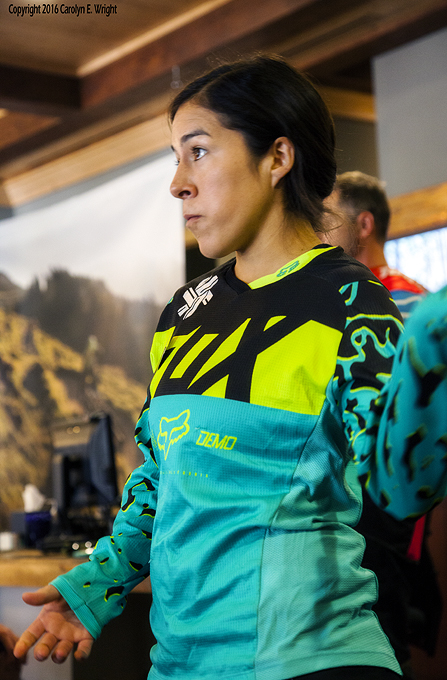
Northstar mountain bike instructor Kristen Martin Del Campo makes sure riders are comfortable on the terrain. Photo Copyright 2016 Carolyn E. Wright

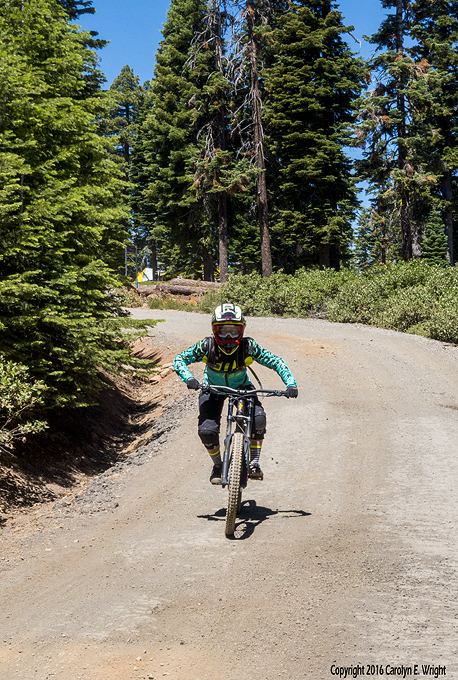
Instructor Kristen Martin Del Campo leads riders down Northstar’s bike park. Photo Copyright 2016 Carolyn E. Wright

By Kathryn Reed

TRUCKEE – Take another look, that gnarly dude on the mountain bike might just be a dudette. It’s hard to tell with all that gear that makes riders look like Ninja warriors.

It’s not just the hardcore riders who are decked out in this garb. So are newbies and the less experienced cyclists. It’s all about safety.

Northstar’s mountain bike park is attracting more women these days, and all levels of riders. The added enthusiasm has a lot to do with a weekly program called Pumps on Pedals. It’s all about getting women to feel comfortable downhill mountain bike riding.

“You progress on the terrain you are comfortable on,” Kristen Martin Del Campo told Lake Tahoe News.

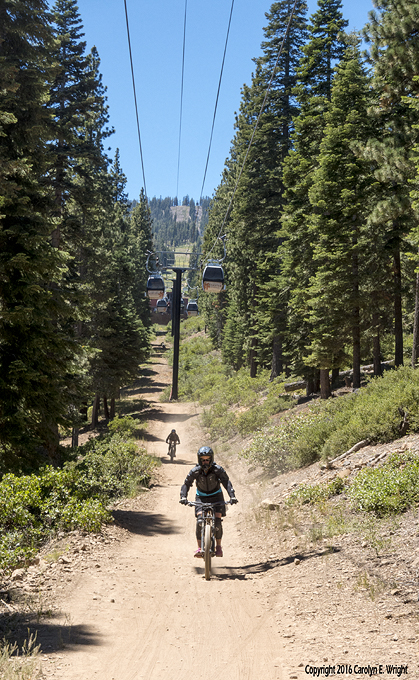
Lift access speeds up the learning curve by not having to pedal up the mountain. Photo Copyright 2016 Carolyn E. Wright

Lift access speeds up the learning curve by not having to pedal up the mountain. Photo Copyright 2016 Carolyn E. Wright

She is one of the instructors for the Friday night rides. Del Campo has been certified by the International Mountain Biking Association to teach.

Her style is laid back and encouraging, making it comfortable to get outside your comfort zone.

First-timers go through a skills clinic that includes taking the gondola to the Zephyr Express and riding down to the village. It sounds simple until Del Campo has us leaning one way and the bike the other as we turn. It’s all about keeping as much tread on the ground as possible. Skidding, we’re told, is more dangerous than going fast.

Then people are divvied up in groups based on skill level. The mountain’s routes are divided into green (easy), blue (intermediate) and black (advanced) just like ski runs.

Northstar has a variety of terrain -- easy to double black diamond. Photo Copyright 2016 Carolyn E. Wright

Northstar has a variety of terrain — easy to double black diamond. Photo Copyright 2016 Carolyn E. Wright

“Mountain biking is relative to where you live,” Del Campo said. “Here it’s dry and loose. People’s mountain biking definition is different.”

That’s why they like to see what a rider is comfortable with before assigning her to a group for the free ride experience.

Standing is the norm. Getting used to riding over natural features – aka rocks embedded in the ground – is part of the experience.

While the fire road intuitively seems easier and safer than the single track with banked turns, Del Campo is quick to dispel that belief.

“The flat, loose corner is more technical than the berm,” Del Campo said. “On the flat you have to be more active and balanced on the bike.”

Instructor Kristen Martin Del Campo is also a mountain bike racer. Photo Copyright 2016 Carolyn E. Wright

Instructor Kristen Martin Del Campo is also a mountain bike racer. Photo Copyright 2016 Carolyn E. Wright

There are bikes designed just for downhill. Others are good for climbing. Some are all around. Tires are getting fatter. Components more light weight. Hydraulic brakes allow for one-finger breaking – also meaning more fingers are on the handlebars to control the bike. It’s easy to spend $5,000 on a new mountain bike.

This is the first year for Northstar’s Specialized Academy. The bikes are in the village, whereas in the past they were mid-mountain. The thinking behind the academy approach is to brand the program much like they’ve done with the Burton Snowboard Academy. People will know what to expect and have a consistent experience.

A great thing about Specialized is that it is one of the few companies making mountain bikes specifically for women. The frames and other components are better designed for a women’s physique.

Riders, though, may use their own equipment for the Friday rides — or anytime at Northstar. It’s about the camaraderie and the riding.

—–

Kristen Martin Del Campo demonstrates how to lean when turning. Photo Copyright 2016 Carolyn E. Wright

Kristen Martin Del Campo demonstrates how to lean when turning. Photo Copyright 2016 Carolyn E. Wright

Notes:

·      Aug. 6-7, women’s only mountain bike weekend at Northstar. Details are online.

·      Pumps on Pedals – Every Friday through Sept. 2. Check-in by 4:45pm in front of the Big Springs Gondola. Lift tickets are $28. Bikes and all necessary equipment are available to rent for $28.


Record crowds witness stars battle for ACC lead

Mardy Fish was in the hunt last year at ACC, and goes into the final round July 24 as the man to beat. Photo Copyright 2016 Carolyn E. Wright

Mardy Fish was in the hunt last year at the ACC, and goes into the final round this year as the man to beat. Photo Copyright 2016 Carolyn E. Wright

By Susan Wood

STATELINE – This time it was the swing of a golf club that pushed retired tennis great Mardy Fish to the lead on the second day of the American Century Championship at Edgewood Tahoe Golf Course.

The three-day celebrity golf tournament wraps up Sunday.

The sports celebrities were out in rare form with swarms of fans, many of whom followed Warriors guard Steph Curry among others.

Fish is in the lead going into Sunday, scoring 50 points, with longtime player and actor Jack Wagner just behind with 48 points. Mike Modano is tied at 45 with pitcher Mark Mulder, who won the tournament last year. Chicago Bears linebacker Brian Urlacher is in fifth at 41.

Retired basebll pitcher Derek Lowe gladly quenches his thirst with an adult beverage provided by fans. Photo/Susan Wood

Retired basebll pitcher Derek Lowe gladly quenches his thirst with an adult beverage provided by fans. Photo/Susan Wood

All the players seems to be in good spirits at the end of their rounds, with compliments to their fellow competitors, a genuine happiness about being there with the fan support, and some with gratefulness their families could cheer them on.

“Daddy, daddy,” Fish’s 2-year-old son called out as the tennis pro made his rounds. At one point, the youngster was holding a golf club.

“He’s pretty good at his swing. It’s been great having (the family) here. He was able to walk a few holes with me. And we’ve got another one on the way,” a beaming Fish told Lake Tahoe News when asked if the family support helps the game given Mulder’s family presence was strong last year. “This is a great family atmosphere.”

There must be something to that. Mulder’s children were seated in the front row of their father’s press conference.

2015 ACC champion Mark Mulder is in the hunt for the lead this year. Photo/Susan Wood

2015 ACC champion Mark Mulder is in the hunt for the lead this year. Photo/Susan Wood

Whether it’s using family support, fans cheering or a mechanism to calm nerves, the sports celebrities try to pull out all the stops they can to win on the 18-hole course.

For Mulder, he told Lake Tahoe News during his press conference that he still trains in high altitude.

For hockey greats Mike Modano and Jeremy Roenick, it’s a “bro-mance” of sorts since they played together Saturday, according to Modano. Both men had major compliments for each other, despite Roenick allegedly giving Modano a concussion when they played hockey against each other.

For ex-soap opera star Wagner – a crowd favorite over many years – it’s knowing that in his competitive nature he can be grace under pressure when the bright sun hits him like the bright illumination of a studio light.

This could be especially put to the test Sunday when he, Modano and Mulder will need to fight off Fish. Fish and Mulder are lefties, even though Fish played tennis right-handed.

“We’re all hitting the ball pretty well,” Wagner said, while complimenting Fish. Fish places fourth last year. But at the end of the day, the actor made it clear he’s been there before and plans to play for the title on Sunday.

Wagner characterized the competition as “eat or be eaten.”

All the competitors appear to realize the big stage they’re on, with Mulder telling Lake Tahoe News that he thinks “these are the biggest crowds ever seen at this tournament.”

Record crowds have been descending upon Edgewood Tahoe for the 27th annual celebrity golf tournament. Photo/Susan Wood

Record crowds have been descending upon Edgewood Tahoe for the 27th annual celebrity golf tournament. Photo/Susan Wood

The moments are priceless and lasting. Mulder shook his head when also telling LTN he was excited to see Heather LeMaster come out and make the record 336-yard drive this week. LeMaster is a long-drive golf pro.

“That’s so impressive to see something like that,” he said. “But that’s what this event has come to.”

Tickets sales are up 66 percent and concessions increased 40 percent from last year. Many of the “concessions” were cold alcoholic beverages to balance the near record heat on a beautiful picturesque Lake Tahoe day.

Some of the celebrities even stopped to partake in the beverages with fans hugging the ropes. Baseball pitcher Derek Lowe, who played on the Boston Red Sox World Series team, rushed up to get his own cup of vodka lemonade from a large group of Stockton fans.

When asked by Lake Tahoe News what he thought of David “Big Papi” Ortiz retiring this year, he said: “He shouldn’t.”

There were good spirits throughout the grounds.

Jordyn Bsharah of Reno was speechless when she got Green Bay Packer quarterback Aaron Rodgers to sign the Packers golf bag she bought at Edgewood.

“I bought it for him, but it’s really for me,” she said, turning to friend Patrick Mahoney, while jumping up and down.

The biggest fan draw was Curry, who seemed to prompt a cheer every time he drove or putt the ball. When the ball didn’t cooperate on the 12th, he acted like he wanted to elbow it in. The crowd erupted.


Study: Managed aquifer recharge a drought buster

By Rob Jordan, Stanford

Strained by drought in recent years, California desperately needs more resilient water supplies. An affordable solution that provides a wide range of benefits is within reach, according to a Stanford study.

Published in San Francisco Estuary & Watershed, the study reveals the costs and benefits of using groundwater recharge and storage across the state. This process, known as “managed aquifer recharge,” or MAR, can incorporate co-benefits such as flood control, improved water quality and wetland habitat protection. The study found the median cost of MAR projects is $410 per acre-foot (the amount of water required to cover an acre of level land at a depth of 1 foot) per year. By comparison, the median cost of surface water projects is five times more expensive – $2,100 per acre-foot.

Managed aquifer recharge allows for local water storage, access and management to a much greater extent than large surface water reservoirs, which are often managed by state and federal entities. Although excess surface water can be limited in some regions of California, treated wastewater and urban stormwater offer sources for MAR that aren’t fully utilized by centralized surface water storage infrastructure.

Read the whole story


Function, looks part of Meyers road plans

erry Champa, traffic safety liaison & engineer for Caltrans discusses the possible Pioneer Trail roundabout with Meyers residents at the meeting. Photo/ Jessie Marchesseau

Jerry Champa, Caltrans traffic safety liaison and engineer, discusses the possible Pioneer Trail roundabout with Meyers residents on July 21. Photo/ Jessie Marchesseau

By Jessie Marchesseau

MEYERS – A roundabout at the Pioneer Trail intersection, another one at the Highway 89 intersection, frontage roads flanking Highway 50 in between, and sidewalks and a bike path all the way down Apache Avenue. These are a few of the ideas planners had on display at Thursday’s Meyers Corridor Project public meeting.

On July 21, planners from El Dorado County, Tahoe Regional Planning Agency and Caltrans hosted the meeting at the California Conservation Corps building to present and gather input on preliminary concepts for improving the main transportation corridors through Meyers.

The goal of the project is to improve vehicle circulation on the roads, improve pedestrian and bicycle safety, manage traffic during peak times, create a Main Street concept and enhance operations such as snow removal.

For the sake of this project, Meyers is being loosely defined as the area between Pioneer Trail and the intersection of Highway 89. As such, planners have identified three main areas as the focus for major improvements: the intersection at Pioneer Trail, the intersection at Highway 89, and Apache Avenue.

Planning for this project began when TRPA awarded El Dorado County an On Our Way grant to improve pedestrian and bicycle alternatives, the streetscape and water quality along the Highway 50 corridor through Meyers.

For Thursday’s meeting, John Kahling, deputy director of El Dorado County Community Development Agency and Transportation Division, and Brendan Ferry, principal planner with El Dorado County, spoke briefly about the project before opening up the room for attendees to mingle about viewing schematics and talking with planners one-on-one. The two-hour meeting concluded with an open question and answer session.

Four stations were set up where attendees could interact directly with planners and view computer-generated pictures depicting what areas would look like if the proposed plans were put into place. The stations were for the Pioneer intersection, the Highway 89 intersection, Apache Avenue from Highway 50 to San Bernardino Avenue and the overall Highway 50 corridor, which displayed three options.

Planners stressed that the project is still in the early stages of planning and these are just preliminary ideas. However, they wanted to gauge how residents are feeling about their ideas so far and obtain feedback.

Kahling said the reactions he has received at this and other recent public presentations has been mixed, but overall seems pretty positive.

“People are generally receptive to the idea of improving Highway 50 through Meyers,” he said.

He has heard comments and concerns regarding drainage, private property and traffic spilling over onto the residential streets.

One Meyers resident expressed concern the project might be focused more on making the streets look pretty than helping traffic. She would rather see the residential streets fixed. However, a FAQ flyer available at the front door addressed the second part of her concern, explaining how the residential streets are maintained and funded by a different entity, and this project would not take any manpower or funds away from those projects.

John Garofalos, who lives on Apache Avenue, said he has no objections to improvements happening on his street. However, he believes the current plan may be a little short sighted and could be designed better. He would also rather see three timed stoplights installed instead of roundabouts; one each at Highway 89, Apache and Pioneer Trail. This was not one of the proposed options.

Presenters announced Meyers resident David Reichel is acting as the Meyers community representative for the project, offering local insight to planners. It was explained that this is not a political position, nor does he have authority to make decisions or design any plans. However, one attendee still expressed concern that Reichel had not been elected to the position.

In all, about 30 residents attended the meeting, and numerous questions and concerns were discussed. The overall impression seemed to be a positive one with residents embracing the idea of improving their small community.

“Like all of human nature, every person likes certain things,” Ferry said. “So, what we’re trying to do is find what is best overall for the community.”


As summer heats up, gas prices stay cool

By Eli Blumenthal, USA Today

Even with the peak travel season in full swing, gasoline prices are stuck in reverse.

Gas prices have plunged to their lowest July level in 12 years, according to AAA, even as Americans are racking up more miles.

In fact, gas prices have dropped in 39 out of the last 40 days, lopping 20 cents a gallon off in total during that span, according to AAA.

Read the whole story


Report: Calif. least business-friendly state

By Kevin Smith, San Gabriel Valley Tribune

If you think California is a tough place to do business, you’re not alone.

A report from CNBC confirms what scores of companies have long suspected — California is the least business-friendly state in the nation.

CNBC’s 10th annual America’s Top States for Business study places the Golden State at the bottom of the list for 2016. California was also found to be one of the costliest places to do business, with a favorability ranking of 49 out of 50.

California’s educational system also ranked low on the scale, landing at 38, and the state’s network of roads and bridges, waterways, rail lines and other infrastructure was ranked the 33rd worst in the nation.

Read the whole story