SLT altering VHR, massage, cab ordinances

By Kathryn Reed

Tweaking ordinances will be the order of the day for the South Lake Tahoe City Council on Aug. 2

The second readings of the vacation home rental, massage and taxi ordinances are on the agenda.

The changes passed unanimously at the first reading last month, with Councilman Tom Davis recusing himself from the VHR discussion because of his affiliation with the Tahoe Keys rental agency.

After getting an earful from owners of multifamily dwellings who are using some or all of the units as vacation rentals, the city back-pedaled with its desire to ban them. Instead, the council will allow the existing units to carry on indefinitely assuming they meet the criteria.

What changes is that no new multifamily parcels may join the vacation home rental market.

Changes to the massage ordinance came about because people suspect some of the $35/hour establishments have hired people who are not licensed to do the work.

While Police Chief Brian Uhler says there is evidence of human trafficking at these places, no proof has been provided by the department.

Massage therapists will have to fill out an application with the police department. All therapists already had to have a city business license, so now there is redundancy and more paperwork for all involved. Uhler told Lake Tahoe News there is not an additional fee for this application process. However, the staff report from the July 19 meeting says, “The city will recoup the costs of licensing through license application fees.”

Therapists must also be licensed through the state. The state mandates therapists have 500 hours of training.

The initial proposal was to give people several months to comply. But after some discussion, including input from massage therapists, that idea was abandoned.

“Either they have a license or they don’t,” Davis said. “This will bring about the legitimacy we are looking for.”

When it came to the taxi ordinance the goal was to put that industry on a level field with the likes of Uber and Lyft. The problem is the city can’t regulate those ride share businesses because it is the state Public Utilities Commission that has that obligation.

The only way the city can regulate the ride share drivers is by demanding they have a business license.

The council opted to relax rules pertaining to taxis in town as a way to make the work environment fairer.

The city will no longer:

·      Inspect all cabs on an annual basis;

·      Manage the operator license process;

·      Conduct background checks on drivers.

These services brought in $17,000 to city coffers.


Stateline casino win down for fiscal year

By Sean Whaley, Las Vegas Review-Journal

CARSON CITY — Nevada casinos posted a strong 6.8 percent gaming win in June, helping the state’s major industry eke out a tiny 0.66 percent gain for the fiscal year that ended June 30, the state Gaming Control Board reported Friday.

One of the two down markets was the Strip, which is influenced strongly by baccarat play. If baccarat was excluded from the Strip numbers, the market would have been up 1 percent in fiscal 2016, he said.

The other down market for the year was Stateline at minus 3.8 percent.

Read the whole story


Reid betting big on Nev. for Democratic Senate majority

By Paul Kane, Washington Post

LAS VEGAS — The formidable political machine Harry M. Reid built in Nevada will face its most difficult task to date when it tries to hold on to the Senate seat being vacated by the retiring minority leader next year.

After getting crushed in the 2014 midterm elections, Senate Democrats have a chance to win back the majority a year from now. If successful, they would set the chamber’s agenda and, more important in the short run, control the nomination process for the next president’s Cabinet. That would require a four-seat gain if the Democratic candidate wins the presidency or a five-seat gain if the GOP retakes the White House.

With Reid’s retirement, Nevada has the only Democratic-held seat in jeopardy in 2016, and if Democrats can retain it, a lot of pressure would be placed on the five freshman Republicans who are seeking re-election in states that President Obama won twice: Illinois, New Hampshire, Ohio, Pennsylvania and Wisconsin.

Read the whole story


Heavenly redefines summer fun in the forest

The coaster winds through the forest at Heavenly Mountain Resort. Photo Copyright 2016 Carolyn E. Wright

Looking back toward the start, the coaster winds through the forest at Heavenly. Photo Copyright 2016 Carolyn E. Wright

By Kathryn Reed

Knees against the metal, hands on the cables, helmet securely fastened, nervous chit-chatter – and then screams of fun.

This is the ritual at the Hot Shot Zipline at Heavenly Mountain Resort as four people at once fly through the air at at least 30 mph.

For Kiana Gamble, this was the perfect way to spend her 11th birthday – with her parents and 14-year-old brother playing on the mountain that is better known for winter fun. The foursome came from Virginia City for the day.

The coaster ride is what the birthday girl was most excited about. And with good reason.
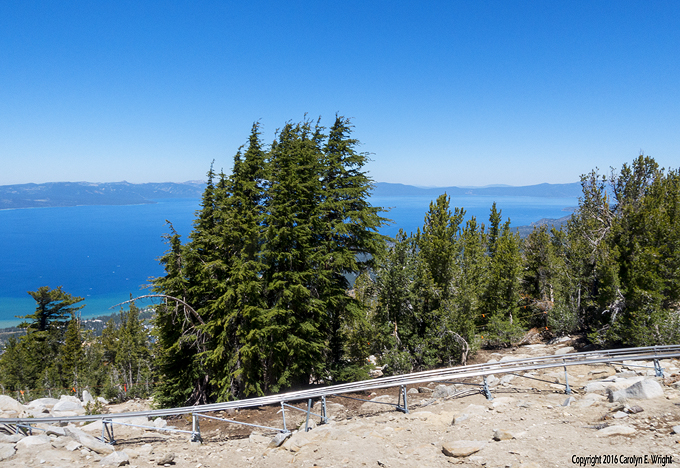
Lake Tahoe is hard to miss from the coaster. Photo Copyright 2016 Carolyn E. Wright

Lake Tahoe is hard to miss from the coaster. Photo Copyright 2016 Carolyn E. Wright

While the coaster only goes 25 mph, that was fast enough for two in our group to not even notice Lake Tahoe whizzing by in the distance. We went up again – and again – and then they saw it.

It’s one of those rides where once is definitely not enough.

It starts off with a slow, straight ascent up the mountain into terrain that was never a groomed ski hill. The metal maze of the course crosses overhead, with the spiral loop-de-loop to the side. People are whooping it up as they zip by.

Then there’s a shack at the top and the worker signals now is the time to thrust the handles forward – leaving them up is the same as breaking.
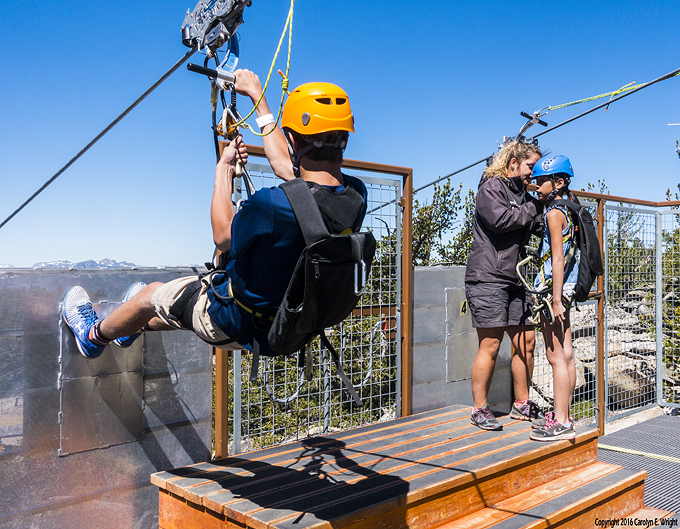
Siobhan Stack fastens Kiana Gamble to the zipline rig, while Aiden Gamble waits for the gate to open. Photo Copyright 2016 Carolyn E. Wright

Siobhan Stack fastens Kiana Gamble to the zipline rig, while Aiden Gamble waits for the gate to open. Photo Copyright 2016 Carolyn E. Wright

It’s this first curve where the lake comes into view. And from there on it’s all about whizzing through the forest. This coaster is considered a bit more advanced than Vail Resorts’ other ones – and of course it’s the only one with a view of that alpine lake.

For anyone who likes rollercoasters, this is a must-do. But Heavenly officials stress it is not a rollercoaster – and it’s technically not, but it sure has the fun factor of one.

The whole ride is 3,000-feet long, with a descent of 300 feet. It’s actually one of the least active attractions, making it good for all ages and ability levels.

Every 10 minutes four people fly on the Hot Shot Zipline. Photo Copyright 2016 Carolyn E. Wright

Every 10 minutes four people fly on the Hot Shot Zipline. Photo Copyright 2016 Carolyn E. Wright

This play land is part of Heavenly’s expanded summer offerings. Epic Discovery is available at Vail Resorts’ Colorado properties in Vail and Breckenridge as well. The Broomfield, Colo.-based resort owner has invested $25 million on Epic Discovery so far, though the breakdown at each resort has not been provided.

While the company has said it plans to spend as much as $100 million on summer programs across its eight major U.S. resorts, Pete Sonntag, COO of Heavenly, told Lake Tahoe News there are no immediate plans to expand operations at Northstar or Kirkwood.

Some of the attractions at Heavenly are not new. The longer zipline has been operational on and off for more than eight years. The ropes courses opened in 2014. Hiking and tubing have been around since at least 2011.
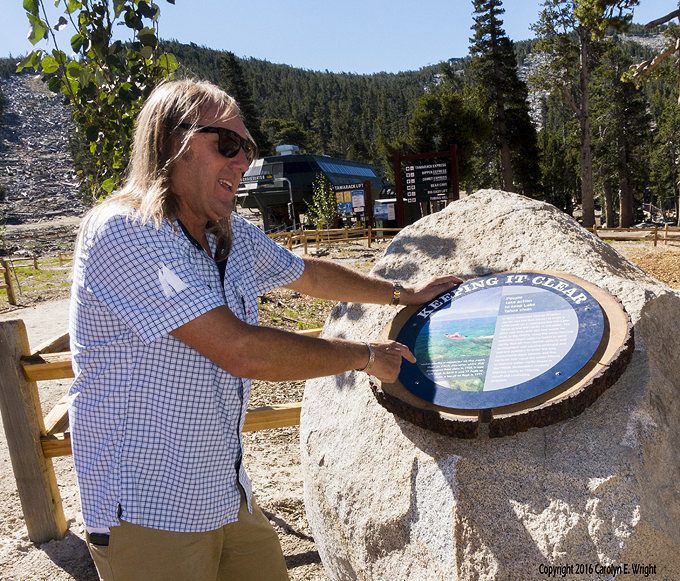
Coop Cooper of Heavenly explains some of the educational features of Epic Discovery. Photo Copyright 2016 Carolyn E. Wright

Coop Cooper of Heavenly explains educational features of Epic Discovery. Photo Copyright 2016 Carolyn E. Wright

The 2011 Ski Area Recreational Opportunity Enhancement Act allowed the U.S. Forest Service, which owns most of the land ski reports operate on, to permit summer activities.

The longer zipline wasn’t open when the four of us went up there earlier this month. Staffing has been an issue – as it is at a lot of Tahoe businesses. (Companies can’t find reliable help.) Nonetheless, the two of us who have been on both ziplines believe the smaller one is actually more fun and seemed to go faster. Pyramid Peak is in the far distance, while it looks like the roof of Tamarack Lodge could be the landing spot.

A drawback, though, to the Hot Shot Zipline is carrying the 20-pound apparatus on the incredibly slow Easy Rider chairlift and then walking up stairs to the launch pad. This is going to be a problem for some people.
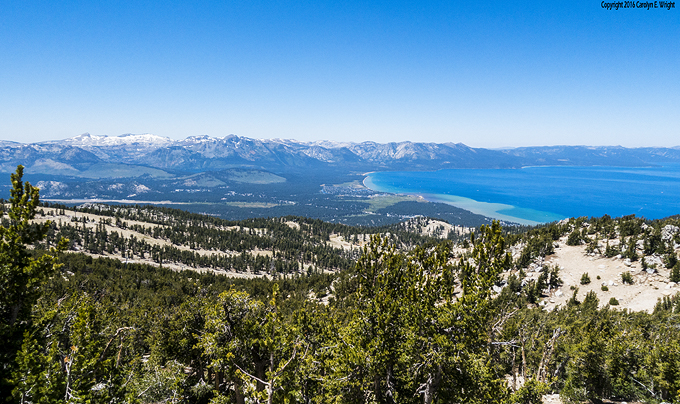
Views of Lake Tahoe are prominent along the 4x4 guided ride. Photo Copyright 2016 Carolyn E. Wright

Views of Lake Tahoe are prominent along the 4×4 guided ride. Photo Copyright 2016 Carolyn E. Wright

Right next to the zipline is the tubing hill. It’s possible to link tubes together or have the workers to spin the rider for a more exhilarating ride down. The coaster is next to the tubing hill.

All of the attractions are accessed from the top of the gondola. An information station is at the bottom of the stairs to point people where to go. To the right is a loop trail that is accessible to the disabled. Heavenly even has wheelchairs with super fat tires to accommodate people.

While there is plenty of physical stuff to do, there is also an educational component. The dozen pathway stones talk about lake clarity, animals in the forest and other pertinent information involving the environment.

USFS rangers also lead tours of the mountain. They may also be enlisted to help with crowd control. This is a work in progress for the mountain as it copes with growing pains in this first summer with so many activities. Rangers may pull people out of line to give them a tour, while their spot is reserved in line.
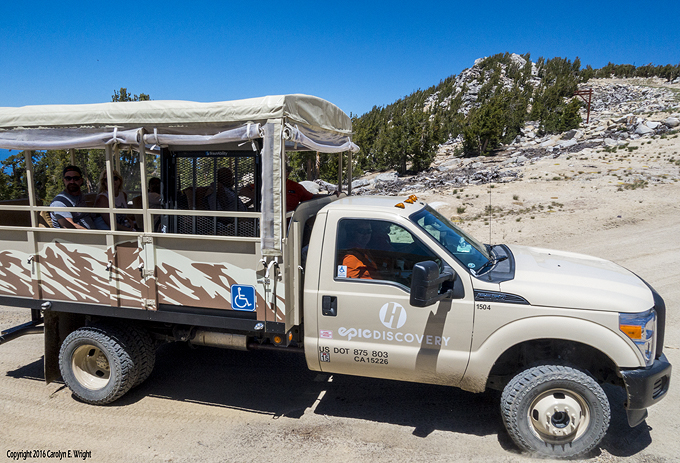
The 4-wheel drive excursion takes people to an elevation of 10,000 feet. Photo Copyright 2016 Carolyn E. Wright

The 4-wheel drive excursion takes people to an elevation of 10,000 feet. Photo Copyright 2016 Carolyn E. Wright

A four-wheel drive tour is an ideal way to see the mountain without exerting energy. It is a bit bumpy, so people with bad backs might want to think twice. The 10-seater vehicle is not likely to be a hit with those who ski or hike the area, but it will be ideal for everyone else. A guide who talked less (and didn’t share personal medical stories) would make for a more pleasant excursion. There needs to be time to let guests absorb the serenity of the scenery.

Plan to spend the day on the mountain and not just a few hours. The ropes courses can take 2½ hours, canopy tour 3 hours, and expedition tour 1½ hours. Plus, Tamarack Lodge is open offering a full complement of food and beverages.

Heavenly isn’t done with creating summer fun. The bike park is still a few years off. It will be more of a trail system and not the downhill adventure that Northstar has. Next summer a fire lookout will be at East Peak to teach people about fire in the backcountry. There will also be fishing available on that side of the mountain.
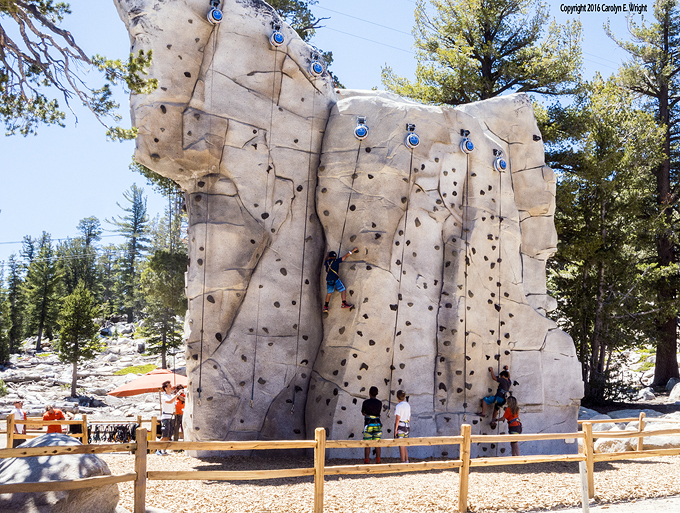
Various pitches on the climbing wall cater to different skill levels. Photo Copyright 2016 Carolyn E. Wright

Various pitches on the climbing wall cater to different skill levels. Photo Copyright 2016 Carolyn E. Wright

—–

Notes:

·       For $89/adults, $49/kids: Gondola, Ridge Rider Mountain Coaster, Hot Shot Zipline, Granite Peak Climbing Wall, tubing, three adventure ropes courses.

·       Additional costs: Skyway Canopy Tour $189, Blue Streak Zipline $68, Summit Expedition tour $37.

·       The resort is still assessing whether any of the summer attractions will be available in the winter.

·       A closing date for the activities this season has not been set.

·       Some attractions have age, height and health limits.

·       Epic Discovery is open 10am-4:30pm.


Blazes in the West reveal historic artifacts

By Jim Carlton, Wall Street Journal

SEQUOIA NATIONAL FOREST — Wildfires scorching the West are revealing an unexpected bounty: newly uncovered historic artifacts, some dating back thousands of years.

Looters and government archaeologists are scouring charred earth for the new archaeological treasures—sometimes even before all the embers are out.

Last summer, a fire that blackened about 150,000 acres in the mountains here above Fresno uncovered remnants of a 19th-century logging railroad that had been partially hidden by vegetation. Among the exposed artifacts: battered pails, rusted tin cans, and other vestiges of life from an abandoned logging camp.

“Camp dumps are cool because you can see what people were eating and drinking,” said Alex Verdugo of the U.S. Forest Service, as he recently picked through debris he estimates was discarded as long as 100 years ago.

Read the whole story


Climate change fingerprints all over Calif. wildfires

By Bobby Magill, Scientific American

Reports this week from the front lines of the Sand Fire in Southern California painted the scene as apocalyptic. The drought-fueled blaze was explosive, fast-moving and devastating, burning through 38,000 acres in the Santa Clarita Valley and forcing the evacuation of more than 10,000 homes.

If the state’s wildfire season holds true to forecasts, the Sand Fire will be one of many catastrophic wildfires to scorch drought-stricken forests and shrublands across California this year. So far, only one wildfire has been larger — the 48,019-acre Erskine Fire, which started in June in the Sierra Nevada Mountains and destroyed 250 homes and buildings.

None of the fires haa been among the worst or largest wildfires the state has seen in recent years, but they’re part of a dire global warming-fueled trend toward larger, more frequent and intense wildfires. The number of blazes on public lands across the West has increased 500 percent since the late 1970s, said LeRoy Westerling, a professor studying climate and wildfire at UC Merced.

The outlook this summer is sobering: Wildland fire potential for most of coastal California and the Sierra Nevada Mountains is above normal and is expected to remain that way through October, according to the National Interagency Fire Center.

Read the whole story


Tahoe’s rising water temp concerns scientists

By Linda Fine Conaboy

INCLINE VILLAGE – It’s been said that Lake Tahoe is a complex body that man may never understand. That is true; however, UC Davis and Geoff Schladow, the director of the UC Davis Tahoe Environmental Research Center housed at Sierra Nevada College, are doing their best to prove that statement wrong—well, maybe, just a little bit wrong.

It seems that when experts think they’ve finally arrived at data that absolutely cannot be questioned, that same data is put into conflict with the patterns of human action and natural forces. In fact, a document provided by UC Davis, states that, “These patterns make clear that Lake Tahoe is a complex ecosystem, behaving in ways we don’t always expect.”

Unfortunately, despite all human effort to the contrary, 2015 was the warmest year ever recorded. In fact, 15 of the 16 warmest years have occurred since 2001, Schadlow told his audience at the annual State of the Lake briefing on July 28.

“Climate change is affecting a lot of processes,” Schladow said. But how, is the big question.

While Lake Tahoe may look pristine, clarity is getting worse. Photo/Linda Fine Conaboy

While Lake Tahoe may look pristine, clarity is getting worse. Photo/Linda Fine Conaboy

The answer lies in addressing numerous factors that influence the clarity and ecology of the lake. Such as night time air temperatures, which, according the Schladow, are drastically decreasing. In 1910, 80 days were below freezing; in 2015, only 24 days hit that mark.

Precipitation has remained fairly constant since 1910, Schladow said, but unfortunately, in 2015, only 6.5 percent of it fell as snow—this is the lowest number ever recorded. When precipitation comes from mostly rain, it is warmer and as it flows into the lake it brings with it silt and other detritus not conducive to a pristine body of water.

Schladow said that precipitation amounts in 2015 were devastatingly low leading to a dramatic 9-inch reduction in lake level. “Water normally fluctuates between a maximum level and the lake’s natural rim,” he said. “At the end of 2015, levels were well below that and are now just creeping above the natural rim.”

Research shows that the current drought is not really a long one, based on the study of trees still standing well below the surface of the Tahoe’s deep waters. However, Schladow cautioned, this could be the beginning of a 100-year drought.

As if these facts are not startling enough, there’s more to consider. Lake temperature continues to rise at the fastest rate ever. In 1970, the water averaged 42 degrees Fahrenheit; in 2015, it rose to 42.5 degrees. While this may not seem startling, Schladow said it takes a lot of energy to raise water temperatures even one-half degree. “That’s 15 times greater than long-term normal,” he said.

In addition, winter is now coming later in the year and spring is arriving sooner. Perhaps this is the reason that in the winter of 1975 colder water mixed all the way to the bottom of the lake; in 2015, the mix occurred at only a depth of 215 feet. Considering that at its deepest Lake Tahoe is 1,645 feet deep, this is alarming to scientists.

There is even more disquieting data regarding the state of the lake.

Consider that in 1965, a Secchi disk, a white, round object mounted on a pole or line lowered into the water and used to measure clarity, could be seen at a depth of more than 104 feet. In 2015, that distance had diminished to no more than 69 feet.

Think about the fact that there are no more Lahontan cutthroat trout in Lake Tahoe; the water’s too warm now.

Periphyton grows here now (white algae that coats rock around the shore). In the early days, the rocks were always clean. However, in 2015, there was not much periphyton growth, but Schladow holds little hope that this trend will continue.

Invasive species have made their way to Tahoe in the form of certain types of destructive shell fish and fast-growing non-native plants.

It is proven that the lake is definitely heating up and due to these warmer temperatures, in 2015 its waters did not mix to maximum depth—for the fourth year running. This lack of deep mixing accounts for the highest nitrogen-nitrate levels on record.

While the details are dismal, Schladow smiled as he related details of a partnership between UC Davis and the Desert Research Institute in Reno, a project that hopefully will reveal valuable information to researchers and enable them to begin to chip away at the negative processes affecting Lake Tahoe.

The Nearshore Network represents the initial collaborative step between the science community and the resource management agencies, aimed at developing a comprehensive approach for assessing and managing the nearshore ecology and aesthetics of Lake Tahoe. In lay-person’s lingo, that means that the environment of the shallower parts of the lake reveal myriad important data that are helpful to solving the evolving environmental quagmire facing all of us.

With seven water quality instruments strategically located around the lake, the hope is to obtain a more comprehensive look at the causes of Tahoe’s degradation and perhaps enough information to guide experts in the restoration of Lake Tahoe.

Unlike the deep part of the lake, the nearshore is the area in which lots of people recreate and it is subject to sudden changes in water quality because of storms, inflows from streams (which can have huge impacts on the turbidity of the water), storm drains and erosion.

“We need to know if it’s getting better or worse,” Schadlow said. “With these sensitive instruments, we can measure temperature, clarity, turbidity, wave height, wind speed and a host of other factors. We are monitoring trends. We know if it’s getting better or worse, but we also need to know why—hence the nearshore monitoring.”

As he closed his talk, Schladow said, “We may have reached the point where climate induced effects are similar in magnitude to the traditional effects from land use change and urbanization.”


Area plan maps Placer County’s future at Tahoe

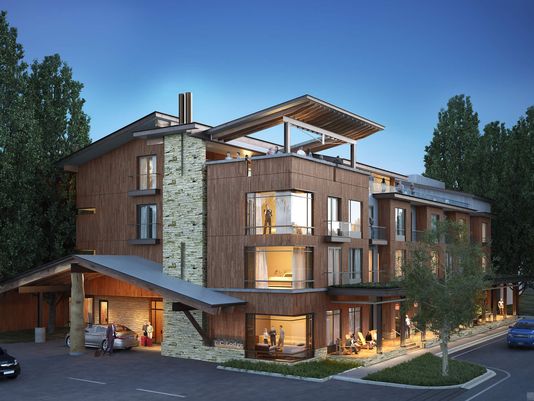
An artist's rendering of the proposed Tahoe City Lodge.

An artist’s rendering of the proposed Tahoe City Lodge.

By Kathryn Reed

If the preferred alternative is not selected, the developer of the Tahoe City Lodge said he would abandon the project.

Samir Tuma spoke before the Tahoe Regional Planning Agency Governing Board on Wednesday about the hotel he wants to build near the lake. This would be the first new lodging facility in Tahoe City in decades.

Tuma wants to build 40 traditional hotel rooms. An additional 31 one-bedroom and 47 two-bedroom suites are planned. The suites would be sold; with the idea most of the time owners would have them in the rental pool for tourists. They would be deed restricted.

Tuma estimates $43 million will be pumped into the economy during construction, with another $8.6 million annual contribution to Tahoe City-Placer County.

He owns 1.4 acres, which was the old Hendriksen site. The project, though, encompasses 3 acres. An agreement between Tahoe City Golf Course, which is owned by Tahoe City PUD, Placer County and Truckee Tahoe Airport, will need to be solidified to make the hotel come to fruition.

“I say we own the ugliest shopping center in Lake Tahoe and we would very much like to change that,” Tuma told the board July 27.

The meeting in Kings Beach was an opportunity for the board to hear from the public about what it thinks of the draft environmental documents for the Placer County Tahoe Basin Area Plan and Tahoe City Lodge project. Written comments will be taken until mid-August.

Of the 24 people who spoke Wednesday, there was not consensus about the documents. Some people are still upset a project is being tied into the area plan documents because there is a sense the plan is written to accommodate the hotel.

Tahoe Marina Lakefront homeowners are upset about a bike-pedestrian path going steps from their property. The condo owners are worried about safety, trespassing and vandalism, as well as losing privacy.

Some question the true environmental impacts, such as whether stream environmental zones will really be improved.

Placer County and TRPA staff acknowledged traffic would get worse.

The area plan encompasses all of Placer County’s acreage in the basin.

It allows for a second unit to be built on certain properties. There had been talk of deed restricting it for workforce housing and saying it could not be a vacation rental. Board member Shelly Aldean told staff she was disappointed this use for those units was removed from the preferred alternative. The Truckee-Tahoe Contractors Association is also an advocate for the secondary dwelling being deed restricted.

Many see the lodge being a welcome addition to town, especially with the upgrades to Tahoe City Golf Course. A partnership with Tahoe City PUD would mean a new clubhouse that would also be available to the hotel to use as meeting space.

—–

            Notes:

·      The deadline to comment is Aug. 15.

·      Final environmental documents should be out in the fall.

·      The TRPA Governing Board is expected to vote on it in January.


Nev. hearings on school choice likely to resonate nationwide

By Neal Morton, Las Vegas Review-Journal

If there’s anything supporters and critics of school choice can agree on, it’s the likelihood that a pair of state Supreme Court hearings today will have an impact on public education beyond Nevada’s borders.

That’s where the agreement seems to end, with parents, politicians and education policy experts widely divided on the constitutionality of Senate Bill 302.

The legislation, which Gov. Brian Sandoval signed into law last year, created what many consider the most expansive school choice program in the U.S. It allows parents who pull their children out of public school to sign up for an education savings account and tap about $5,100 in state per-pupil funding to help pay for private school tuition or home-school, tutoring and other educational services.

Read the whole story


Urban a legend to country fans in Tahoe

Keith Urban is a master on guitar. Photo/Kathryn Reed

Keith Urban is a master on guitar. Photo/Kathryn Reed

By Susan Wood

STATELINE – Country superstar Keith Urban rocked the Harveys Lake Tahoe outdoor concert arena Wednesday night with a show of shows from an amazingly personable, highly talented artist.

Urban, 48, brought a mix of hits spanning his quarter-century career such as “Days Go By” and “Long Hot Summer” as well as new songs on tour off his 10th album “Ripcord,” including the sensational duet with Carrie Underwood “The Fighter.” (Note: A cute version in the car with his wife and actress Nicole Kidman posted on Facebook received millions of views.)

The Aussie entertainer delved deep into the latest album, performing the driving tune “Sun Don’t Let Me Down,” bluesy “Blue Ain’t Your Color,” sway-induced “Gettin’ In the Way,” banjo-picking “Wasted Time” and beat-heavy “John Cougar, John Deere, John 3:16.”

Much to the delight of screaming, mostly-standing fans, the guitar-player extraordinaire even tuned up hits from other artists such as the likes of John Cougar Mellancamp and Bob Marley. With the latter, the stage screens lit up in reggae colors green, red and yellow.

In his signature playful, boyish style, Urban engaged the audience often – addressing it as a collective “Tahoe,” which he acknowledged was good to return to.

“Love you Tahoe. You might not know the words, but you give it a shot,” he bellowed.

The feeling was mutual at the concert that doubled like a love fest.

“I love him,” one woman dancing in Section 17 said with a serious deep adoration.

What she was about to learn about three-quarters of the way through the show is that Urban was about to move his road show down the aisle to a mini stage feet away from her seat near the back of the arena. (Urban did the same thing at the giant Sleep Train Arena years ago in Sacramento, appearing in the middle of a mob that flanked him from all sides.)

Keith Urban has no problem connecting with his appreciative fans. Photo/Kathryn Reed

Keith Urban has no problem connecting with his appreciative fans. Photo/Kathryn Reed

In Tahoe, adoring fans soon crushed in the empty space close to the mini stage, where Urban launched into his rhythmic, No. 1 2002 hit “Somebody Like You” while facing the back bleachers. He enlisted the help of one of his opening acts Brett Eldridge, a rising country singer with a personable style. The whole place erupted in cheers, singing and dancing.

At one point in the show, Urban also brought up to sing with him his other opening artist, Maren Morris, who had performed her smash hit “My Church” earlier that evening.

But July 27 at Harveys was more like Urban’s church, where thousands seemed to worship his brand of performance known for total play and an equally fun, guitar-heavy back-up band. Urban plays the electric guitar – and sometimes the bass and acoustical version – like it’s a part of his body.

Often arching his back and practically kissing the microphone, Urban looks to be the epitome of a blissful man and high-energy fun on stage. And during that relationship, the audience reciprocated to the glow of a huge lights display and precise audio music engineering.

The artist who essentially launched his career out of Nashville, never slowed up; delivering two encores – his 2006 chart-topping “Stupid Boy” and another No. 1 blockbuster “Raise ’Em Up” from 2015. It’s like the audience was not about to let him go down off the stage.

“God bless you,” he said to the persistent clapping.

Urban extended a heartfelt thank you to the crowd before walking off into the evening. The performer has another show scheduled for tonight, which may have residual, day-of tickets remaining.

Other outdoor summer concerts scheduled at the Harveys arena include: pop artist Lionel Ritchie on Aug. 13; rock group Steve Miller Band on Aug. 18; red rocker Sammy Hagar on Aug. 26; alternative rock band The Killers on Aug. 31; and soul singer/keyboardist Stevie Wonder on Sept. 2.