Wise demands Congress act on global warming

By Roxanna Scott, USA Today

Olympic gold medalist David Wise stepped out of his comfort zone this week and delivered a message to members of Congress.

The Reno skier was one of five Olympic athletes who spoke about climate change on behalf of Protect Our Winters at a briefing to Congress on Wednesday. He was joined by Olympic champion cross-country skier Jessie Diggins, Alpine skier Stacey Cook, Olympic bronze-medal winning snowboarder Arielle Gold and biathlete Maddie Phaneuf.

He shared how as a skier, he’s seen the effects of climate change up close.

Read the whole story


Short-term lodging, and who is renting them

By Sage Sauerbrey, Moonshine Ink

Short-term rentals have rapidly become a polarizing topic. While property rights advocates argue for the freedom to utilize their homes as assets and housing advocates point to a decline in long term rental inventory being a result, the local jurisdictions are caught in the crossfire and have thus far been treading carefully and cautiously.

It’s a heated discussion, and in fact multiple sources requested not to be named in this story for that very reason. But, people are speaking up, and it appears that action to find a balance between these two schools of thought may be on the horizon.

The short-term rental market has skyrocketed locally and nationally in a few short years. In Truckee, the number of Airbnb units is currently growing at 65 percent a year, according to AirDNA. Strict rental ordinances recently were put in place nearby in South Lake Tahoe, and across the country, sister mountain hamlets have approached the pros and cons associated with the house sharing economy in diverse ways. All of these factors have thrown the issue into sharper focus as communities scramble to address the issue.

Read the whole story


A different ski experience after Tahoe resorts close

By Benjamin Spillman, Reno Gazette-Journal

There are two ways to think about ski resorts closing when there’s still plenty of snow on the ground.

One way is to consider it a problem or unfortunate turn of events.

People who choose this route will shrug, hang up their skis in the garage and maybe even leave a frowny face emoticon on the resort’s social media page.

The other way to think about it is to consider it an opportunity.

People who choose to do this can be rewarded with some of the best skiing of the year.

Read the whole story


What snowpack says about the water year

By Ian Evans, Water Deeply

The most significant reservoirs in the West are not stored behind concrete dams, but on top of mountains as snowpack. This year, however, snowpack has been alarmingly low throughout most of the West.

“If you look at the overall flow of the Colorado River – at Lake Powell, the main measurement point for the entire Colorado River Basin, it’s less than half of normal,” said John Fleck, director of water resources at the University of New Mexico.

That low flow impacts cities, agriculture and Western ecosystems for the rest of the year, if not longer. Already the Rio Grande River is so low that researchers are rescuing stranded fish by carrying them to wetter parts of the river. In California, instead of snow, the state experienced record-breaking wildfires and floods. Throughout most of the winter rainy season the state looked like it was headed for another devastating drought after only one year of relief.

Read the whole story


Animal masks another tool on South Shore fire rigs

By Kathryn Reed

Proper tools can save lives – even those of four legged creatures.

South Shore fire departments are now equipped with kits that have seven different masks; some deliver oxygen, some force air when an animal is unconscious. The duffle bags come with tubing and other necessities.

“A lot of pets go hide and get injured, or have smoke inhalation,” South Lake Tahoe fire engineer-paramedic Mike Mileski told Lake Tahoe News. “The masks are reusable. We’ll have these for many years.”

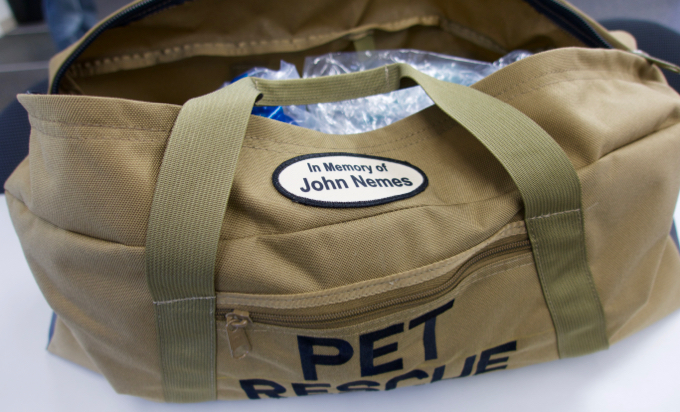
Mileski was the liaison between the South Lake Tahoe Fire Department and the donor who wants to remain anonymous. They were donated in memory of John Nemes, a longtime elementary teacher with Lake Tahoe Unified School District. Nemes was a lover of animals.

Nine pet rescue bags were donated to four South Shore fire departments in the name of John Nemes. Photo/Kathryn Reed

Each kit has a patch saying “In memory of John Nemes.” SLTFD has two kits, Lake Valley Fire two, Fallen Leaf Lake Fire one, and Tahoe Douglas Fire four.

Mileski said the kits will be able to be used for a range of animals. “For small rodents you could put them in the whole mask.”

If an animal is rescued from whatever the emergency is, they may be unconscious. While saving the life of a dog or cat is similar to humans in distress, it does take some training and specialized equipment.

South Lake Tahoe firefighters just received training in how to use these specialized masks for animals, what to do if a dog is choking and other tips to save a person’s fur baby.

As Neil Powell, veterinarian at Blue Lake Animal Care Center said, it’s important for first responders to understand the animal will be scared, and that it will want to lash out in fear. They can’t be talked to like a human to explain what is going on. That’s why it’s important for the firefighters to know how to protect themselves while delivering care.

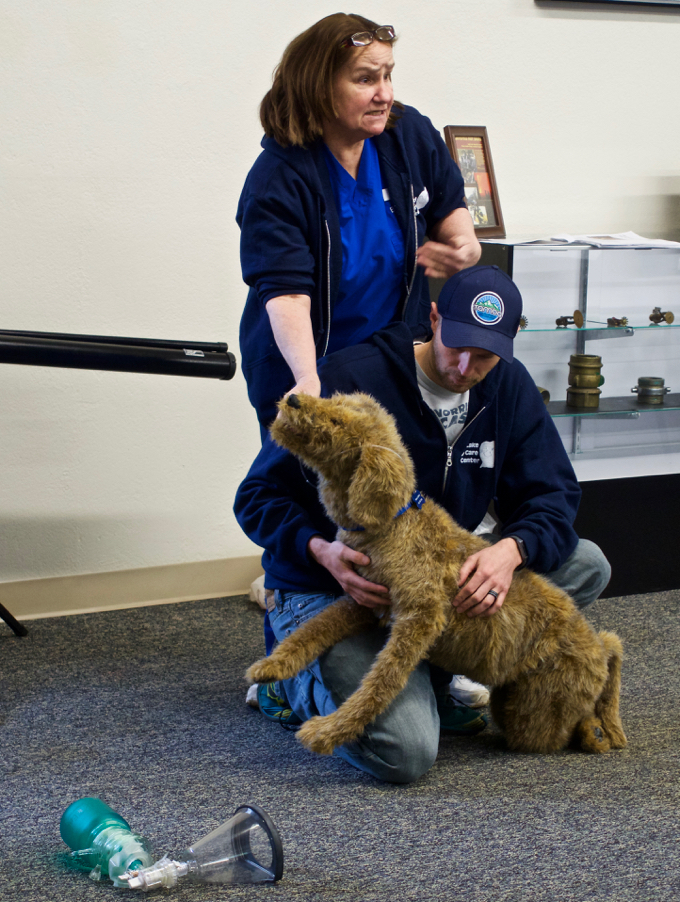
Zoe Hill, a nurse at Blue Lake, demonstrated the various apparatuses, how best to position a large dog, as well as small dog or cat, and suggested ways they could use tools on the fire truck to help.

Zoe Hill and Neil Powell with Blue Lake Animal Care Center use a stuffed dog to demonstrate care in an emergency situation. Photo/Kathryn Reed

Having a large dog’s back to the person is key to avoid being lashed out at when the animal comes to. It can be easier to hold a small dog or cat. If a towel or blanket is nearby it’s a good idea to put a cat on it so its claws can be wrapped up for protection.

“You need to make sure the head is extended so they have an air way,” Hill told the firefighters. “I’d do mouth to snout on a big dog.” Sweeping the animal’s mouth for obstructions is a good idea, just like with humans.

When using the air bag a tight seal is mandatory to be effective.

It doesn’t matter which side the animal is on for compressions. It’s near impossible to break a cat’s ribs, and is only a real concern in dogs 13 and older because theirs are more brittle.

“If they are unresponsive, do CPR,” Powell advised. But he said after 10 minutes saving the animal is not likely to happen.

With smoke inhalation, the animal’s airway swells, which is why it is difficult for them to breath.

Hill talked about how IV tubing or a leash can become a muzzle of sorts. She stressed not putting a hand or head under a table to retrieve an animal fleeing a fire or some other emergency because that is likely to result in a human injury. Instead, she suggested making a lasso out of leash or other device and coaxing the animal into it.

Getting the animal to a veterinarian as soon as possible is the best course of action.

Battalion Chief Karl Koeppen recalled how when a dog was hit he got into his vehicle and took it to Powell.

That can’t always happen depending on the emergency.

If an owner is not available to authorize veterinary care, then at least in California it is the county animal control officer who may grant permission. Animal control is supposed to be available 24/7. An animal hospital is not always available after hours on the South Shore, but they all have a recording suggesting where to go.

Statistics provided to the firefighters from Blue Lake Animal Care said that 40,000 pets die in house fires in the United States each year, with another half million affected by the event.


Billions of gallons of water saved by thinning forests

By Cheryl Dybas, National Science Foundation

There are too many trees in Sierra Nevada forests, say scientists affiliated with the National Science Foundation Southern Sierra Critical Zone Observatory.

That may come as a surprise to those who see dense, verdant forests as signs of a healthy environment. After all, green is good, right? Not necessarily. When it comes to the number of trees in California forests, bigger isn’t always better.

That’s in part because trees use lots of water to carry out basic biological tasks. In addition, they act as forest steam stacks, raking up water stored in the ground and expelling it as vapor into the atmosphere, where it’s accessible to humans and forest ecosystems only when it falls back to Earth as rain and snow.

Read the whole story


Global timber trafficking harms forests

By Kenneth E. Wallen, The Conversation

If a tree falls in the forest, do you care how it was brought down?

Few people think about where the wood in their furniture, floors or doors comes from or how it got there. And few would guess that one of the most illegally traded wild products worldwide is a tree, rosewood (Dalbergia).

Rosewood is so widely trafficked it is called “the ivory of the forest.” Its rich reddish-brown timber is used to make furniture, flooring and musical instruments. Yet many of the trees that produce it are threatened and internationally protected.

Rosewood is an extreme example of a wider problem. Globally, 15 to 30 percent of timber is taken illegally. According to Interpol, the illegal timber trade is worth $50 billion to $150 billion annually.

This complex issue will not be solved overnight. But I believe that social science can help curb it by showing the damage illegal timber trade causes to humans and forests, and by stigmatizing the sale and purchase of contraband wood products.

The role of rules

My research uses social science to address conservation issues like wildlife trafficking and invasive species. I focus on the role of norms and rules, which guide human behavior by signaling whether an action is common or approved. When people or organizations know that doing something is unacceptable and punishable, they are more likely to refrain from it.

Today, many rules designed to protect against timber trafficking are either not strict enough or poorly enforced. This signals that illegal activity can occur with impunity, although some nations are tightening up regulations in an effort to curb the problem.

A global trade

Illegal timber is estimated to account for 50 to 90 percent of wood harvested from Amazonia, central Africa and Southeast Asia. Interpol estimates that 40 to 60 percent of timber exports from Indonesia, 25 percent from Russia and 70 percent from Gabon are illegal. In 2016 the U.S. Trade Representative’s Office estimated that 90 percent of U.S. timber imports from Peru were sourced from illegal logging.

North America is not exempt. Tree poachers target centuries-old cedars and redwoods in British Columbia and the Pacific Northwest.

Illegal activities lower global timber prices by 7 to 16 percent, costing source nations up to $5 billion in lost annual revenue. This would suggest governments have a significant incentive to act. But weak regimes, corruption and unresponsive agencies – particularly in source countries – are failing to curb timber trafficking.

Improving enforcement

To protect forests and guide timber use, governments create rules. International treaties and trade regulations restrict timber imports based on quantity or species. Domestic management plans, certification programs and procurement policies dictate how timber should be harvested, bought and sold.

But the effectiveness of these rules often depends on sanctions that penalize rule violators. Many source countries have little capacity to effectively monitor forests or enforce penalties for illegal logging. This makes it easy for traffickers to avoid being caught.

Countries with few or weak regulations also act as trans-shipment points. For example, traffickers send timber from Papua New Guinea to nations like China that do not ban illegal timber. It is then processed and exported as finished products to the United States.

Over the past decade the United States has acted to bolster rules and sanctions against illegal timber purchases. Notably, in 2008 Congress amended the Lacey Act, which prohibits trade in illegal wildlife, fish and plants, to include timber.

Several high-profile sanctions followed. Lumber Liquidators was fined $13 million in 2011 for selling flooring made from illegal Russian timber. In 2015, the Yacu Kallpa, a Peruvian vessel carrying illegal timber destined for Houston, was detained by Mexico. And in late 2017 the U.S. trade representative blocked timber imports from Peru.

But until source countries can effectively monitor and enforce laws against illegal harvesting, intercepting a single shipment does little. Importing countries – particularly the United States, European Union nations and China – must also initiate actions that reduce illegal timber production. And this is where social science can play a role.

Learning from wildlife trafficking

Timber trafficking has many parallels with illegal trade in charismatic and endangered wildlife, such as pangolins, turtles and rhinos. In both cases, the trade is extremely lucrative, and consumer demand is a major driver of the black market.

To reduce demand, many countries use social science to stop consumers from purchasing illegal wildlife. Social influence approaches attempt to convince us that peers are engaging in or refraining from certain actions, such as recycling or reusing grocery bags. They can also help convince organizations that certain actions are inappropriate and counter to rules and norms.

For example, advocates in China and Hong Kong have reduced pressure on endangered sharks by convincing elites and professionals through public awareness campaigns and political advocacy to eat less shark fin soup. And in Indonesia and Malaysia, Muslim clerics declared fatwas against wildlife poaching to signal social disapproval of it. Using the powerful medium of religion and their role as public leaders, clerics have aligned religious faithfulness with existing rules against poaching. In doing so, they make it easier to peer-pressure others and further stigmatize poaching and illegal purchasing.

Steering consumer choices

Governments and businesses can use similar strategies to address timber trafficking. They can educate consumers about the scale of the contraband trade and which products are likely to be illegally logged, much as ocean advocates are working to steer consumers away from buying fish that are overharvested.

Organizations exist to track, monitor and certify timber and timber products. But awareness is not enough. Stigmatizing or sanctioning the sale and purchase of illegal timber would be a useful further step. For example, governments could destroy shipments of confiscated timber in the same way that the United States and some African countries burn or crush confiscated ivory from slaughtered elephants.

Through events like Arbor Day, many Americans develop a generalized warm glow toward trees and forests. Portraying contraband wood products as harmful and damaging can help shape these views into more focused and sustained opposition to illegal timber trafficking.

Kenneth E. Wallen is an assistant professor of human dimensions of natural resources at the University of Arkansas.
Social media redefines how people plan travel

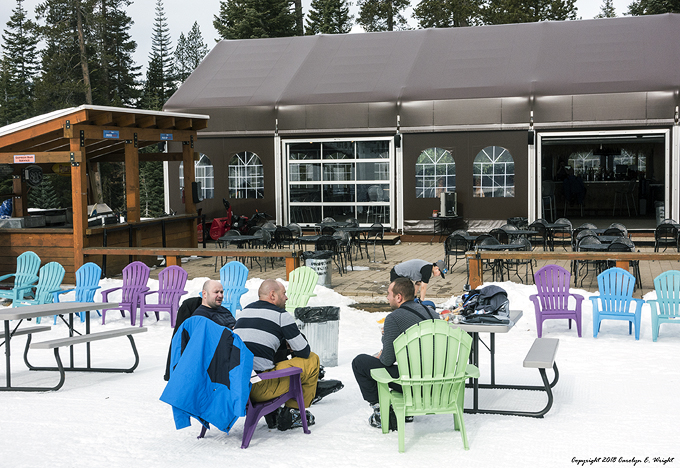
Travelers want to see people in photos to entice them to visit a destination. Photo Copyright 2018 Carolyn E. Wright

By Kathryn Reed

STATELINE – Social media continues to challenge marketers when it comes to promoting a destination because people are using multiple platforms and how they use them differs. In other words, the exact same message used every place probably isn’t going to work.

Geotags are the latest way people are searching social media. It’s about tagging a location, not just using a hashtag. Most smart phones can geotag automatically via the GPS device that is built in.

Even with all the technology that is available today, word of mouth is the No. 1 way people get introduced to a destination. According to research done by marketing firm Chute, 57 percent of people rely on word on mouth, with social media being No. 2 at 44 percent.

Geotagging can help combine the two by people looking up on social media what they’ve heard about from a friend.

Jody Farrar with Chute led a session about travelers’ social media preferences and habits during this month’s Mountain Travel Symposium at Harrah’s Lake Tahoe.


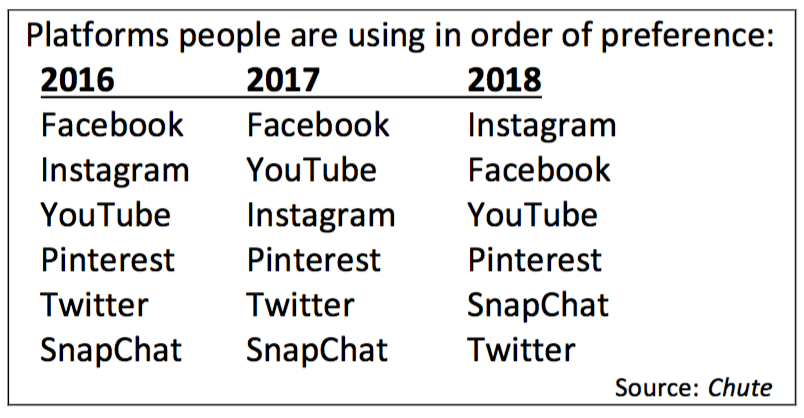
Facebook, Instagram and YouTube combined account for 50 percent of travel searches.

Farrar said Instagram’s rise to the top could be because “it’s easier to find inspiration.” She added, “Following a hashtag is easier than following a brand.”

Instagram has changed some things on its platform in the last 18 months which allows people to create collections. It’s a way to save photos they like.

What Chute researchers are finding is that 75 percent of travelers are not following a destination. The No. 1 reason, Farrar said, is because people don’t know they exist. Forty-one percent believe the information is too promotional.

For Tahoe this would mean they aren’t following Tahoe South, Go North, Lake Tahoe Visitors Authority or North Lake Tahoe Resort Association.

However, for those who are following a brand, the reasons are because they are researching a trip (38 percent), have already been there (37 percent), they like the content (25 percent.)

What could make SnapChat appealing for destinations is the ability to reach people once they are in the market. This is because of how people use the platform, but more important is that 80 percent of travelers don’t make plans until they get to their destination, according to Farrar.

It’s not just pretty pictures people want to see. They want to see others in the photos so they would have an easier time imagining themselves being transported to that spot. Travelers also tend to prefer authentic photos – ones shot by people actually experiencing the destination, and not professionally shot stills or videos.

Farrar said it’s important to tell people to use key hashtags, to share collections and to tag other accounts so travelers are spreading the message in a different word of mouth format.


Serious ‘precipitation whiplash’ predicted for Calif.

By Dale Kasler, Sacramento Bee
 
It was the greatest flood in recorded California history, 43 days of rain and snow that swamped the state, killed thousands of people and forced the newly elected governor to take a boat to his inauguration at the Capitol.

Now a group of climatologists says global warming will increase California’s risk to repeat performances of the devastating flood of 1862.

In a study published Monday in the scientific journal Nature Climate Change, the scientists say climate change will increasingly expose California to a phenomenon they call “precipitation whiplash,” in which drought or drought-like conditions will alternate with intensely rainy winters. Rain and snow will become concentrated in narrow windows of time at the peak of winter, instead of being spread between October and April.

Read the whole story


Nev. gaming board OKs amendment regarding drug impairment

By Richard N. Velotta, Las Vegas Review-Journal

Gaming regulators are used to tweaking rules to keep up with changes in the industry. Last week the Nevada Gaming Commission took a step toward keeping up with societal change.

Under an amendment unanimously approved by the five-member commission, casinos will be subject to the same disciplinary standards for letting people gamble while impaired by drugs as they are for letting them play while intoxicated by alcohol.

The new rules may result in additional workforce training for floor staff to be aware of potentially impaired patrons.

Read the whole story