Truckee, Placer County grapple with housing

Kings Beach opened an affordable housing complex in 2014. Photo/LTN

Kings Beach opened an affordable housing complex in 2014. Photo/LTN

By Mayumi Elegado and Dave Zook, Moonshine Ink 


Agreements and execution are different beasts, and sizable differences exist between the two. It could be said that nowhere is that distance greater than in the creation of affordable housing.

As home prices soared in the late 1990s and families found themselves priced out of the market, local agencies were pressured to find solutions. Prompted by government regulations, developers now are commonly required to incorporate affordable or employee housing as part of a project’s overall scope, and specifics hinge on the individual requirements of the jurisdiction or county.

Within the last decade or so, the Truckee has established affordable housing regulations for development mitigation, and Placer County has had a workforce housing policy for more than 20 years, but for projects in Tahoe, it would be fair to say that implementation is still in the pilot phase.

While affordable housing has been built into the conditions of approval for more than a handful of development projects, the completion record for the affordable projects is mixed. Successful projects in the past 15 years have put at least 200 new affordable housing units on the ground, but many developers have fallen short of their finalized plans, and some have built nothing at all.

Meanwhile the resulting lack of beds affects the community daily: Waitlists for the few rent-controlled apartment complexes in the area sit hundreds deep.

Read the whole story


Expect ad blitz in Nev. for recreational pot

By Colton Lochhead, Las Vegas Review-Journal

Don’t be surprised to see a slew of television ads touting a measure to legalize recreational marijuana use during the weeks leading up to the general election in November.

A political action committee, the Coalition to Regulate Marijuana Like Alcohol, reserved more than $800,000 worth of advertising time slots across the major news stations, according to recent Federal Communications Commission filings.

The ads are scheduled to start in early October and run until Election Day on Nov. 8 when Nevadans will vote on Question 2, which will decide whether to legalize the recreational use of marijuana for adults in the state.

Read the whole story


State money issues stall future EDC Courthouse

By Joann Eisenbrandt

The New Placerville Courthouse Project has traveled a rocky and contentious road since a new court facility on the West Slope was first envisioned several decades ago. It just hit another bump. The approximately $1.4 billion reduction in state funding originally allocated in the budget for new courthouse construction in California has put the brakes on the project, at least temporarily.

Since 2002, California courts have been under the jurisdiction of the Judicial Council. This state agency created a list of “immediate and critical need” courthouse projects. These were to be the first projects implemented once funding became available. The New Placerville Courthouse Project is on this list.

In 2008, Senate Bill 1407 authorized up to $5 billion in bonds to build or renovate courthouses in the state. Funding for these projects comes from increased court user fees. State budget problems since have caused funds to be diverted from the funding accounts for these projects, causing a number of delays. Finally, a site was selected for the Placerville project and the Judicial Council prepared and certified an environmental impact report under the California Environmental Quality Act (CEQA) in June 2015. This paved the way for the next steps: the transfer of land from the county to the state and the putting out of construction bids. Completion was projected to be in the second quarter of 2021.

The two-colored building in the front to the left of the existing Main Street Courthouse is what used to be the Placerville City Hall. It is also an old, historic building.  If I remember it correctly, these two buildings are separate but have connecting doors on both floors. An additional building and a covered parking garage would be in back of that. Rendering/Placerville Historic Preservation League

An alternative to a new courthouse is an annex. The two-colored building in the front to the left of the existing Main Street Courthouse are what used to be the Placerville City Hall. An additional building and a covered parking garage would be in back of that. Rendering/Placerville Historic Preservation League

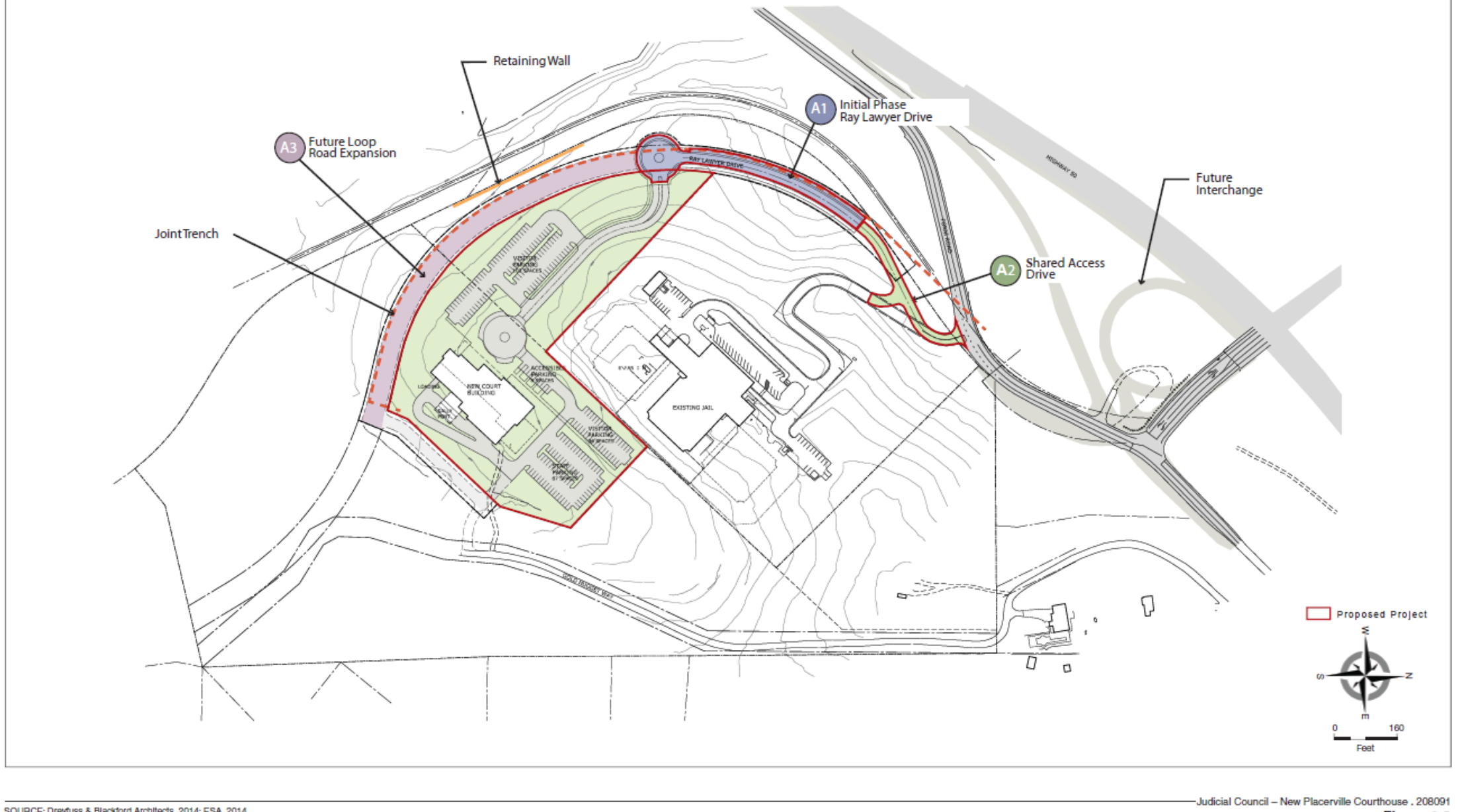
The Placerville project will replace current court facilities on the West Slope with one new 88,000-square-foot courthouse facility next to the existing county jail just off Forni Road in Placerville. Superior Court services are now divided between Building C at the County Government Center on Fair Lane, a civil court facility in Cameron Park and the historic courthouse on Main Street in downtown Placerville.

State budget problems have once again affected the project. Redirection of $1.4 billion from the critical needs account and $250 million of annual funds from the construction account, and a dramatic decrease in court filing fees has now drastically reduced the amount of money available for the bonds to finance the 23 current courthouse projects.

On Aug. 11, the Court Facilities Advisory Committee met in San Francisco to consider recommendations to the Judicial Council on how to proceed given current financial circumstances.

Committee Chairman Presiding Justice Brad Hill told those assembled that, “We understand how concerned you all are and what all of you in this room have gone through to get to this point. After years of planning, we are here to transmit some bad news in terms of current financing.”

Judges, members of boards of supervisors and staff from 16 counties with current courthouse projects gave presentations, all advocating strongly that their particular project be allowed to continue. Hill acknowledged at the beginning of the five-hour session that, “These facilities are the worst of the worst … everyone in this room is desperately in need of a new courthouse.” The extent of their need, he noted, is why these projects remain on the list while others have been cut along the way.

Presentations were in alphabetical order by county, so El Dorado County presented first. Presiding El Dorado County Superior Court Judge Suzanne Kingsbury gave a PowerPoint presentation outlining the problems with the county’s current court system. The fact that court services are divided among a number of different facilities makes them “operationally inefficient.” Kingsbury went through a laundry list of structural, environmental and safety deficiencies, especially highlighting those at the 100-plus year-old Main Street courthouse in downtown Placerville. These ranged from lack of ADA compliance, to an old and often non-operational elevator, lead in the water system, asbestos, lack of holding cells for in-custody defendants and lack of on-site parking.  Security for judges, jurors, witnesses and court staff is lacking. The abundance of windows gives direct line-of-sight to potential snipers from the nearby Highway 50 overpass and adjacent buildings. Security and space problems also exist at the facility in Building C at the county government center on Fair Lane.

All of the presenters from subsequent counties had very similar stories. The current Shasta County courthouse had experienced 108 elevator malfunctions; the courthouse in Siskiyou County can be so easily broken into that thieves got in and stole gold bars from a courthouse display.  Many courthouses have serious seismic issues, with some rated so low, at Level 5, that the state declined to have them transferred to state ownership.

Kirk Smith of the Placerville Historic Preservation League spoke during the public comment session that followed the presentations. In July 2015, the organization challenged the Judicial Council’s certification of the EIR for the Placerville Courthouse Project in San Francisco Superior Court. The EIR failed, the writ stated, to adequately address or provide mitigations for the impacts on downtown Placerville that removal of court services from the Main Street courthouse would cause. The Main Street economy would be seriously affected, leading to “urban blight and decay.” The writ was denied by the court last month.

Smith told advisory committee members that given the current financial shortfall for critical needs projects, the construction of a courthouse annex and covered parking structure next to the existing Main Street courthouse would be a much more cost-efficient option. Smith had made similar presentations to the Placerville City Council and the El Dorado County Board of Supervisors, but noted, “They weren’t interested.”

The annex concept would provide for approximately 140,000 square feet of space as compared to the 88,000 square feet of the project as currently approved. It would not require the construction of roads, sewer lines and other supporting infrastructure and would preserve the historic Main Street courthouse. Smith presented the committee with architectural renderings of the concept.

Smith later confirmed to Lake Tahoe News that the Placerville Historic Preservation Society still intends to appeal the denial of thee writ. Such an appeal would be to the First Appellate District Court of Appeals in San Francisco. The last day to file the appeal is Aug. 30.

Architect's rending of how the future El Dorado County Courthouse could look.

Architect’s rending of how the future El Dorado County Courthouse could look.

The Court Facilities Advisory Committee then received a report from Capital Program Director Mike Courtney outlining recommendations on how to proceed. The courthouse projects were grouped into four categories based on their current status: currently under construction, acquisitions, ongoing design work, and 2016-17 construction awards. The New Placerville Courthouse Project is in the “acquisitions” category. The recommendation for projects in this category is to, “complete site due diligence then hold.” Due diligence means that site analysis, environmental review and associated studies have all been completed. The Placerville project has completed its due diligence and would, under Courtney’s recommendations, be placed on hold until needed funding became available.

The six projects currently under construction would complete construction, but projects in the other two categories would continue until they reached the end of their existing phase and then be put on hold.

Hill emphasized that this was just “day one” of effort to secure the needed funding. Now that the state is back on firmer financial footing, he noted, “We’d like our money back.” Members of the committee and representatives from the affected counties will be going to Sacramento soon to lobby the governor and legislators for that very purpose.

“We need to demonstrate to the Legislature that we will be good stewards of the money they give us now and will be in the future … we’re building courthouses that are safe and secure but are economical and cost-effective,” Hill said.

The committee approved Courtney’s recommendations. A report will be compiled and presented to the Judicial Council for their Aug. 25-26meeting. The Judicial Council can then adopt the recommendations, modify them or propose new ones.


Calif. public retirees with $100K pensions growing

By Teri Sforza, Orange County Register

Back in 2005, 1,841 retirees pulled down more than $100,000 a year in pension checks from the California Public Employees’ Retirement System.

A decade later, membership in the so-called $100K Club had swelled by nearly 20,000 souls.

CalPERS data provided to the conservative-leaning group Transparent California, and analyzed by the Register, found that 21,652 public retirees received annual benefits of more than $100,000 in 2015.

That’s a jump of 28 percent in just two years – which might seem jarring at first blush, but actually represents a slowdown in the club’s explosive growth of late.

Read the whole story


LTCC-SNC launch 4-year degree partnership

By Kathryn Reed

It’s no longer necessary to leave South Lake Tahoe to obtain a four-year college degree – and this has nothing to do with online education.

Lake Tahoe Community College and Sierra Nevada College are partnering to offer a bachelor’s degree in global business management.

“Over the last five years they are the No. 1 transfer institution coming to our institution. We have been working with their students for a number of years,” SNC Provost Shannon Beets told Lake Tahoe News. “We talked about all the issues people face being place-bound — family, work obligations, snow. These are things that keep them from coming to the North Shore.”

With business being the No. 1 degree LTCC students seek after leaving the college, it was a natural that this be the first four-year degree offered students.

Sierra Nevada College is a private four-year school based in Incline Village. Instructors will come to LTCC to teach the classes.

The goal is for classes to start Aug. 29, with cross cultural management and international business the first two on the schedule. The limited schedule is because so many LTCC students attend school part time. SNC would like to start with 25 students.

Three open houses have occurred in the last few weeks to familiarize people with the program, with 17 interested students showing up this week.

Besides being convenient, it will cost less for students to obtain the degree at LTCC than if they were to go to SNC’s main campus.

“We were shooting to try to get as close to about $20,000 for a degree in four years. We got it down to about $23,000 for California residents if they come to Lake Tahoe Community College for two years and then transfer to the Sierra Nevada College program here,” Kindred Murillo, LTCC president, told Lake Tahoe News. It will cost Nevada residents approximately $31,000 for the same degree at LTCC.

That total cost is what some universities charge for one year.

“The shared goal for everyone is access to affordable, high-quality education,” Beets said. “We want to be good neighbors and good partners.”

The ability to obtain a four-year degree at LTCC was a goal of Murillo’s when she first started at the college, and is now in place to be a reality before she leaves in February. (She tendered her resignation in January. The notice for her position will go out Aug. 15.)

Plus, offering a bachelor’s degree was an overriding desire during a strategic planning session conducted in 2013.

If there aren’t enough students to start the program this fall, it will roll out in the spring. Also at that time four-year degrees in education and psychology might begin.

This, though, would just be the start of bachelor programs at LTCC.

“We set the goal to have three different colleges at the university center when it opens in fall 2018. We intend to meet that goal,” Murillo said.

Talks are under way with UC Davis and CSU Sacramento to be the other two partners.

Building student housing is one way to potentially draw even more students to LTCC for associate and bachelor programs. The lack of dorms and the expense of housing on the South Shore are roadblocks for some people.

“In the master plan we are looking at about 150 units, possibly expanding it to 200 beds. We’ll know more when the feasibility study is done,” Murillo said. The feasibility study should be completed in November, and the master plan is being worked on with the Tahoe Regional Planning Agency. “We put $1.5 million for site development in the (facilities) bond (for housing). We are looking for a private developer to own and operate it on our campus. Our preference is not to be in rental business. That seems to be working for a lot of colleges nationally.”

It is penciled to be built between the gym and student center in the forested area. Still to be worked out is whether this would be too close to the South Tahoe PUD plant in terms of odor regulations.

Student housing today is more like a suite of rooms with a shared living and kitchen, as opposed to traditional dormitories.

Murillo said it’s possible the college could request proposals for the student housing in the spring, and then have them ready in 2018 when the university center opens.


Calif. water supply pits farmers against fish

By Robin Abcarian, Los Angeles Times

The offer was too tempting to refuse: Westlands Water District, the ethically challenged agency that often finds itself in the news for all the wrong reasons, invited me on an aerial tour of its watershed.

From high above, I would be able to see the public works projects that have allowed the San Joaquin Valley to bloom, cities to explode and the natural environment to implode.

As someone who spends every flight between Los Angeles and Northern California with her nose pressed against the window, checking out reservoir levels, snow lines and lately, plumes of wildfire smoke, how could I say no? The engineering of water is the ultimate California story.

Soon, we were skirting the western edge of the Sierra Nevada, Yosemite’s granite peaks visible in the distance. Suddenly we were over Friant Dam, one of dozens of early- to mid-20th century federal dams, canals and reservoirs designed to transport Northern California’s abundant water to the dry but fertile San Joaquin Valley.

Friant harnessed the flow of the San Joaquin River, which was great for farmers. But it was a disaster for the river, and its Chinook salmon, which will probably never recover.

Read the whole story


Nev. may allow gambling without cash

By Richard N. Velotta, Las Vegas Review-Journal

Nevada casino customers inched closer Thursday to being able to sign up for and fund a wagering account that could be used to gamble at slot machines, table games and bingo parlors.

The concept of using wagering accounts is already in play for sports betting, mobile wagering and online poker play within the state. Extending the use of an account through a loyalty card is the next iteration of making it more convenient for customers to play without cash.

Members of the state Gaming Control Board conducted a workshop meeting Thursday to discuss amendments to regulations that would enable play through pre-established accounts.

Read the whole story


Commissioners OK Squaw Valley mega project

squaw

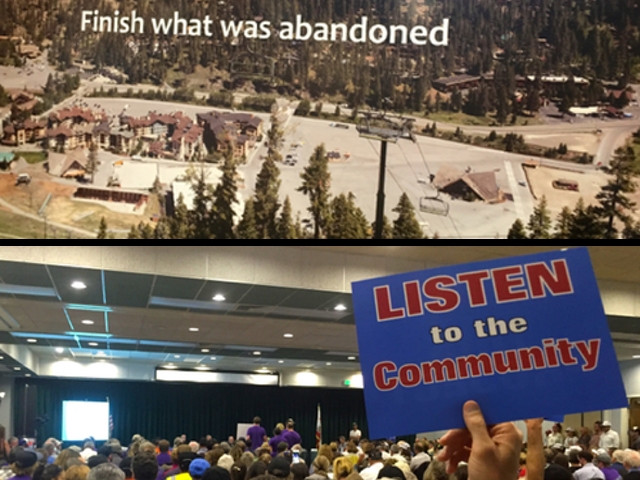
The two sides of the proposed development at Squaw Valley’s village. Photos/LTN

By Kathryn Reed

KINGS BEACH – On eight 4-2 votes, the Placer County Planning Commission on Thursday approved several items pertaining to the future of Squaw Valley.

KSL, which has owned Squaw since 2010, wants do what former Squaw Valley Village owner Intrawest did not do; complete the four-phase project. But this would be on a grander scale.

While the 1983 Squaw Valley General Plan allows for 4,200 bedrooms in Olympic Valley, the plan being proposed has 1,493 bedrooms. This includes 35 cabins (developer’s description) (time share mansions is opponents’ description) in Shirley Canyon – an area currently not developed.

“We would like to restore Squaw Valley-Alpine to a pre-eminent destination,” Andy Wirth, CEO of Squaw Valley, said. “There is a substantial deficit in the vacation experience in terms of the quality of lodging and variety.”

After nine hours, which included comments from nearly 100 people, the commissioners spent the next hour asking staff clarifying questions before they voted.

Commissioner Richard Johnson asked about issues in the 15-page letter Attorney General Kamala Harris sent on Tuesday.

Chief Deputy County Counsel Valerie Flood said, “I don’t see anything in the letter that would prevent us from going forward.” She said Harris didn’t say anything that others hadn’t already said.

(It is unusual for an AG to weigh in on an EIR.)

Harris wrote, “… the FEIR should be revised and recirculated to adequately address the project’s (green house gas) impacts and potential impacts to Lake Tahoe. Climate change is a critical issue for California and Lake Tahoe is a national, state, and local treasure and the county should not disregard impacts in these areas in reviewing the project. More information is needed to fully understand what the project’s impacts will be on greenhouse gas emissions and on Lake Tahoe.”

Immediately after the vote Aug. 11, Squaw CEO Andy Wirth, left, went to speak with Commissioner Wayne Nader, who voted no. Photo/LTN

Immediately after the Aug. 11 vote, Squaw CEO Andy Wirth, left, went to speak with Commissioner Wayne Nader, who voted no. Photo/LTN

Voting no were commissioners Wayne Nader and Mickey Gray. Gray represents the district where the project resides. Commissioner Fred Arcuri was absent.

The main decisions the commissioners had to make were whether to certify the final environmental impact report, approve the specific plan, amend the Squaw Valley General Plan, approve the development agreement and OK the water assessment.

Traffic was a main topic for the opponents – the level of service and the lack of analysis in regards to other proposed projects inside and outside the basin. (Squaw Valley is not in the Tahoe basin.)

Harris wrote, “Because of the proximity-of the proposed development to Lake Tahoe, we are concerned about the impacts the development will have within the Tahoe basin. We are particularly concerned with the project’s resulting increases in vehicular use and traffic within the basin.”

The EIR for the most part ignored Lake Tahoe.

Harris’ letter was one of more than 300 that were submitted.

This is not the end of the road for Squaw Valley Real Estate, the applicant and a subsidiary of resort owners KSL. The Board of Supervisors will have the final say regarding the potential billion-dollar, 25-year project. The supes are likely to hear the project proposal this fall.

The vote on Aug. 11 came after the Squaw Valley Municipal Advisory Council voted no in May.
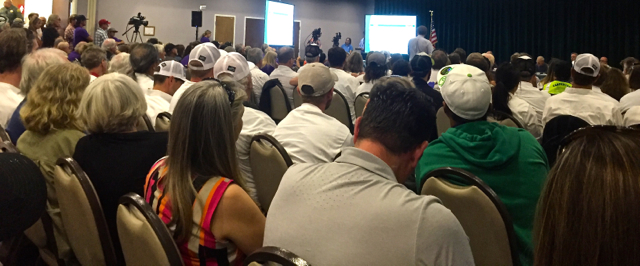
More than 400 people turned out at the Squaw hearing, even though the capacity sign said 268. Photo/LTN

More than 400 people turned out for the Squaw hearing, even though the capacity sign said 268. Photo/LTN

Proponents say it’s necessary to offer year-round activities as well as something to do for non-skiers and for when the weather isn’t ideal. Opponents say the natural surroundings should be good enough.

Squaw is not unique in wanting to be more than a ski resort. Being a year-round destination and a self-contained playground is more profitable than a one-season business. Opponents don’t want resort owners to make a buck while sacrificing what the community is today.

It’s not that all opponents are satisfied with the status quo; many said they were open to improvements, but on a much smaller scale.

Wirth described the base of the mountain as being an 82-acre parking lot; in other words, it’s being wasted.

The plan includes a controversial mountain adventure center. Some call it a 90,000-square-foot indoor water park, others call it an athlete’s training facility. At the meeting a Squaw representative said it would be both and then some, with the final components decided as the resort gets closer to actually putting something in the ground.

A simulation was shown of what the buildings will look like as one drives up Squaw Valley Road from Highway 89. Six of them will be 96-feet tall, or eight stories.

About 400 people turned out for the daylong hearing – many showing their colors. Purple vs. white. If only it were that simple, the purple would have won by sheer numbers. They were the ones representing “Keep Tahoe True”. Those in white were about “Squaw Tomorrow”. The colors are strategic – purple and white have long been the colors of this resort.

The opposition was set out in front of the North Tahoe Event Center with signs, shirts and bumper stickers. Proponents were inside the lobby with large posters promoting the benefits. In the hearing room people held up signs saying “Deny this project” and “Listen to the community”.

Of the 98 people who spoke, 58 were against the project, while 40 were for it.

Most of those who spoke in favor of the project worked for Alpine or Squaw Valley, or somehow financially benefit from the resorts.

Water, traffic and affordable housing were the overriding concerns of opponents. The resort believes the water supply will be adequate even though data is based on wells yet to be drilled. Traffic is already an issue, as underlined by a captain with the California Highway Patrol. While commissioners touched on this, gridlock was not enough to derail the project. As for housing, 300 units will be built for people who work at the resort – some of which will be dormitory style.

Northern Nevada hits record dry spell

By Cassie Wilson, KRNV-TV

Dry weather is common in Northern Nevada; we are of course a high desert. But as of Aug. 10, the Reno-Tahoe Airport officially hit a 79-day dry spell.

In the last 10 years, the longest dry pattern we’ve seen was 92 days in the summer of 2011. And the current dry spell record is 129 days, which was set from July 19-Nov. 24, 1995.

The airport hasn’t registered rain since May 23, but many other places across Nevada have.

Read the whole story


DEA: Marijuana has no medical value

By Rob Hotakainen, McClatchy News Service

Delivering a big blow to backers of pot legalization, the Obama administration said Thursday that it would keep marijuana classified as one of the nation’s most dangerous drugs, similar to heroin and LSD.

The long-awaited decision by the U.S. Drug Enforcement Administration keeps intact a 1970 law that lists marijuana as Schedule 1 drug, one defined as having no medical value. That runs counter to decisions made by 26 states that have already approved use of the drug as medicine.

The DEA’s ruling shocked legalization supporters, many of whom had considered Obama an ally after the Justice Department decided in 2013 to allow Washington state and Colorado to sell recreational marijuana.

Read the whole story