SLT voters may decide competing VHR initiatives

By Lake Tahoe News

South Lake Tahoe residents known as the Tahoe Neighborhoods Group on April 30 submitted 1,651 signatures on a petition to limit vacation home rentals in the city.

The group wants voters to decide in November if short-term rentals should only be allowed in the tourist core. VHRs would be eliminated elsewhere over a three-year period if voters so decide.

The signatures will be validated in the next 30 days by the El Dorado County Elections Department, with 1,036 needed to qualify.

If validation occurs, the South Lake Tahoe City Council would then have to adopt a resolution for the initiative to be on the ballot.

This is the second petition regarding VHRs that has been submitted that could end up before voters in the fall.

The other one is the work of real estate agents Jerry Williams and Craig Woodward, and VHR owner Melissa Wong.

In part their petition says, “Despite their importance to the city’s economy, vacation home rentals can result in impacts to the community and the quality of life for permanent residents. As such, a balance must be struck between maintaining the economic viability of vacation home rentals as an important element of the city’s tourism industry, while at the same time placing certain restrictions on the establishment and management vacation home rentals in order to protect and preserve the quality of life in the city’s residential neighborhoods.”

Their goal is to continue to allow VHRs in neighborhoods, but with constraints. They also want to create a commission that would have some oversight on the industry.

Collateral in all of this is that the recreation center has been put on hold by staff. It’s not something that has come before the council. That facility was to be paid for by transient occupancy tax. Voters in 2016 approved a measure to increase TOT by 2 percentage points. That additional revenue is dedicated solely for recreation.

The plan was to seek bonds to fund the facility, with the TOT used to pay the debt. Now with TOT collections in jeopardy if the number of VHRs is drastically reduced, the city’s finances are no longer stable.

It’s not just the rec center that will be impacted by less TOT, but all city services. TOT is one of the top three revenue sources for South Lake Tahoe. The other two are sales and property taxes. Those, too, would be affected by changes to VHR regulations.


LTN Book Club: Baseball and internment camps — great read

By Kathryn Reed

It was the summer of 1942 and life for those of Japanese descent living in the United States had been upended when they were sent to internment camps. A few pleasures, though, were possible – with baseball being one of them.

Jay Feldman weaves a tale of history, love and the American pastime into an easy to read novel. “Suitcase Sefton and the American Dream” (Triumph Books, 2006) doesn’t gloss over the hardship of living in the camps, but it also doesn’t delve too deep as to make this a downer.


While this is a work of fiction, it didn’t surprise me a guy not from the West Coast didn’t know about the camps. He got an education and some readers might as well.

As for the baseball element, well, even non-fans are bound to find some aspects interesting – like the color barrier and icons like Joe DiMaggio leaving the ball club to enlist in the military.

Mac “Suitcase” Sefton is a scout for the New York Yankees. A freak accident cut his playing days short, but he was able to stay in the game looking for prospects. In many ways it was a lonely existence being on the road, going from one small town to the next looking for boys who might one day make it to the Major Leagues.

It was a glimpse into a segment of baseball during an era I really knew nothing about. It was a simpler time then. Guys would sign for $100 and then see how they did in spring training.

Feldman does a good job of moving the story line along, even if at times it’s rather simplistic and a bit predictable. It was a book I actually looked forward to reading each night.

—–

Notes:

  • The next Lake Tahoe News Book Club read will be “The Doomsday Machine: Confessions of Nuclear War Planner” by Daniel Ellsberg.
  • “Suitcase Sefton” questions: Was Suitcase’s character believable? Did the book minimize the internment camps or bring awareness to them? How in your life has sports been a bridge between people?


Opinion: SLT’s transparency remains elusive

By Kathryn Reed

“If they don’t trust you, they’ll keep asking for public records. There is nothing you can do but produce those records.”

Those are the words of attorney Leah Castella of Burke, Williams and Sorensen, the outside law firm the city of South Lake Tahoe uses. Castella was at the special City Council meeting on April 30 to give the electeds and senior staff an update on ethics training, the Brown Act and state Public Records Act. The training is mandatory every two years.

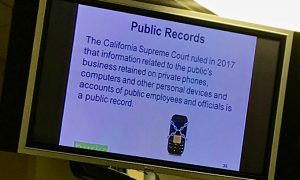
A message delivered to the South Lake Tahoe City Council on April 30 by counsel. Photo/LTN

This training is even more relevant in this era when Councilwoman Brooke Laine has made accusations of Brown Act violations occurring and when Lake Tahoe News has not been able to obtain public records.

This is an email sent April 13 to Lake Tahoe News by City Clerk Suzie Alessi, “This email is in response to your public records request (below) dated April 4, 2018. Please be advised that due to the voluminous nature of your request and the process of obtaining and reviewing relevant records, the records which are subject to disclosure will be provided to you within two weeks. We will endeavor to provide the records sooner if possible. (Gov. Code § 6253(c).)”

Normally the requests are due 10 days after being submitted.

Those two weeks, which were in addition to the initial two weeks, have come and gone without another email from Alessi.

Alessi was sitting in on the ethics/public records training when Castella said public records are a constitutional right – as in it’s the right of the seeker to be provided them. Castella also said the institution not providing them would be liable for the attorney fees incurred by the person or entity seeking the records.

Lake Tahoe News was seeking text messages of certain electeds and staff, with Alessi being one of the people whose texts are being requested.

This request came after LTN earlier this year sought phone records. That request was denied, though the denial came months after the request. These are the phone records that Alessi provided. Essentially it a blank piece of paper.

Transparency it is not.

Interim City Attorney Nira Doherty emailed LTN citing the following information as authority for not disclosing the phone records: “Rogers v. Superior Court, 19 Cal.App.4th 469 (1993) Court of Appeal denied reporter’s petition for writ of mandate on the grounds that the telephone numbers of calls placed by city councilmembers were covered by the deliberative process privilege and not subject to disclosure under CPRA request.” 

What is interesting about the public records regarding the texts being delayed is that another request, a lengthier one, was submitted after Lake Tahoe News’ by some “friends” group.

However, it was not until April 16 that council members were sent an email to bring their city issued phones to the next day’s meeting. This comes after the deadline to respond to LTN’s request and after Alessi sent the email to LTN saying the text messages would be delayed.

An additional interesting piece to all of this is that Councilman Austin Sass claimed that on April 6 his cell phone, tablet and backpack were stolen from his vehicle that was parked outside St. Theresa Church where his wife works. As of April 30 they had not been recovered.

It seems peculiar the devices go missing after data from them had been sought by Lake Tahoe News.

The electronic devices are city owned. While Sass might not want certain communications revealed and thought he could prevent that from happening if he were to no longer be in possession of them, those devices can be automatically backed up. The city’s IT department can retrieve the information without the device and without the user knowing.

Another thing the attorney told the group is that using a personal device for public work is not a great idea because that information can also be subject to public review.


Nev. transparency site graded B for accessibility

By Ramona Giwargis, Las Vegas Review-Journal

When it comes to shedding light on state spending and making those details accessible to taxpayers, Nevada ranks near the top of the class.

A new study by the United States Public Interest Research Group Education Fund ranked transparency websites for all 50 states based on content and user-friendliness. Nevada was tied for 10th nationally and scored a B for making its open government site informative and easy to navigate.

Officials from the Nevada Policy Research Institute, the think tank that publishes public employee pay and benefits, said the B grade is not a reflection of overall government transparency in the state.

Read the whole story


Summer driving going to be wallet drainer

By Alex Veiga, AP

Get ready for a little bit more pain at the pump this summer.

Crude oil prices are at the highest level in more than three years and expected to climb higher, pushing up gasoline prices along the way.

The U.S. daily national average for regular gasoline is now $2.81 per gallon. That’s up from about $2.39 per gallon a year ago, according to Oil Price Information Service. And across the U.S., 13 percent of gas stations are charging $3 per gallon or more, AAA said last week.

Read the whole story


STPUD budget includes sewer, water rate hikes

By Kathryn Reed

Water conservation comes with a double-edged sword – it saves the commodity and throws off budget projections.

For South Tahoe Public Utility District, conservation has led to a $900,000 shortfall over 10 years based on the 2014 rate study. Still, the district is doing better than many of its California counterparts because only 20 percent of metered water rates are based on consumption. For districts that reversed the 20-80 percentages, they are in a financial conundrum.

The district is preparing to adopt its 2018-19 budget, which takes effect July 1. In the budget are a water rate increase of 5 percent and sewer rate hike of 6 percent. Those, too, would become effective in two months. This will be an additional $15.04 per quarter for residential customers.

Quarterly rates for STPUD ($276) remain the lowest in the basin, with the average being $367.

These increases were part of the five-year rate increase plans. This is the last year for the increases as approved in the Proposition 218 notice. It is possible for the board to approve lower increases; the electeds just can’t make them higher.

General Manager Richard Solbrig told Lake Tahoe News he expects the board this fall to begin another Proposition 218 process in order to plan for future rate hikes.

The district relies on sewer and water payments for about 70 percent of its $40 million budget, with property taxes accounting for just more than 20 percent. Investment, grants and capacity fees make up the bulk of the remainder of revenues.

One thing the board is looking at is to allow for sewer transfers in order to foster work force housing construction. Today, sewer units stick with a property and cannot be traded, so to speak.

The budget calls for a 22 percent increase in capital projects compared to the current fiscal year. Many of these are one-time expenditures:

·      Proposition 218 campaign — $50,000

·      Rate studies — $60,000 (The last water one was five years ago, and about 15 years for sewer.)

·      Sewer crossing assessment — $100,000

·      Groundwater management plan — $150,000

·      Well destructions — $120,000

·      South Y PCE analysis — $310,000

·      Wastewater treatment plant master plan — $75,000.

The district has two years left to install water meters, with another 1,600 planned for this season.

A concern of the district’s is that 10 percent of the water lines are still below capacity to fight a major fire.

“We need to have a conversation about price, water and fire,” Solbrig said. “Until a few years ago fires were not the responsibility of water agencies. That has changed. Water companies are now named in lawsuits.”

On the sewer side the district will be using cameras to better assess the system.

“If you wait until it collapses, the cost is 10 times more than if you rehabilitate it,” Solbrig told LTN.

The goal with the new technology is to avoid surprises like the Tahoe Keys sewer collapse and the Al Tahoe manhole issues in the last year.

The employees have a four-year contract that expires in June 2021.Of the 115 positions, about 100 are represented by a union. A consultant has been hired to do a salary study. Everyone will be receiving a 2.5 percent cost of living allowance, with a 5 percent step increase for many of the newer employees. CalPERS will cost the district an additional $116,000 in the next year.

—–

Notes:

·      STPUD public hearing on the budget is May 3 from 6-7:30pm.

·      Board expected to vote on 2018-19 budget on May 17 at 2pm.

·      Meetings are at 1275 Meadow Crest Drive, South Lake Tahoe.


Opinion: Land use control key to Calif. housing crunch

By Dan Walters, CALmatters
 
The death of far-reaching – even revolutionary – legislation to facilitate housing development crystallized a conflict that’s been simmering in California for decades: Who controls land use?

Based on “police powers” in the state Constitution, cities and counties have, for many decades, regulated how land may be used. They do this most obviously by zoning it for specific purposes, such as residential, commercial, industrial or agricultural, with countless subcategories, but also by controlling specific projects within those zones.

Dan Walters

In theory, such regulation avoids incompatible uses. But there are enormous social and economic consequences as well, and it’s a purely political process with a veneer of civic benefit but often with corrupt undertones.

Zoning and other land use tools also affect the “character” of a community, as opponents of specific projects often contend. But they also may reinforce its tendencies toward racial and economic segregation by ensuring that only those with higher incomes can afford to live there.

Local governments also have financial stakes in land-use decrees – by, for instance, maximizing land available for retail developments that generate sales taxes.

Historically, state government has taken a more or less hands-off attitude toward land use, even though its activities, such as building highways and water systems, have obviously affected how land is developed, or not. Indeed, one could argue with ample authority that the perennial wrangling over water has been a proxy war over land use.

Over the last several decades, however, the state has become more directly involved by requiring localities to have general plans to guide their development, by setting housing quotas (although not really enforcing them until this year), by requiring more housing near transit lines to reduce greenhouse gases and by the creating powerful regional regulators such as the Coastal Commission and the Tahoe Regional Planning Agency.

Today, however, the state’s ongoing, and ever-worsening, housing crisis has placed the land-use question on the front burner of political consciousness.

California, state officials say, needs to be building 180,000 new units of housing a year to keep up with population growth, replace housing that’s lost to fire and old age and make a dent in the backlog. However, the state is scarcely meeting 60 percent of that goal and is particularly deficient in low- and moderate-income housing.

The biggest impediment to building more housing is resistance within local governments that control land use. City councils and other elected bodies reflect their voters’ disdain for having more neighbors that would bring more traffic and other consequences of population growth, a syndrome especially virulent when it comes to high-density “affordable” projects.

It has a name: “not in my backyard,” or NIMBY.

State Sen. Scott Wiener, a San Francisco Democrat, proposed to override local land use control with legislation to allow construction of up to five-story apartment buildings near major public transit stops, including areas zoned for single-family homes.

Local governments, labor unions and even some housing advocates lined up against Senate Bill 827, some contending it went too far and others saying it didn’t go far enough. Ultimately, it received just four votes in its first committee hearing, far short of what it needed to advance.

SB827 may be dead, at least for the time being, but the underlying land-use question is very much alive.

It’s highly unlikely that California can deal with its housing crisis unless it somehow overrides local authority over land use to blunt NIMBYism. But could it be done without also shifting the high-stakes, often smarmy political gaming over specific projects to Sacramento as well?

If not, the cure could be just as bad as the disease.

Dan Walters is a columnist at CALmatters.


Late winter storms bad omen for fire season

By Associated Press

The late winter storms that helped bolster Nevada’s lagging snowpack also jump started the growth of grasses and brush that potentially could fuel another big wildfire season.

“I hate to use the term ‘worst-case scenario,’ but it’s kind of leading into another potentially very active fire season,” National Weather Service meteorologist Chris Smallcomb told Gov. Brian Sandoval Wednesday.

Smallcomb said the late precipitation push in March raised the snowpack from 36 percent of normal in February to 85 percent of normal as of March 27 at Tahoe.

Read the whole story


Travel gurus get a dose of leadership reality

Tina Sampson with Vail Resorts talks leadership to a group of travel experts. Photo/Kathryn Reed

By Kathryn Reed

STATELINE – “High-functioning teams lead to high-performing organizations.”

That was one of the messages delivered by Tina Sampson, vice president of sales for Vail Resorts. She was a speaker this month at the Mountain Travel Symposium at Harrah’s Lake Tahoe. Her topic – Leadership for Innovation.

She was there to put a hammer to the belief that culture building should be considered “soft stuff.”

“We believe innovations begins with culture,” Sampson said of the Colorado-based company that has three ski resorts in the Lake Tahoe area. “We believe superior financial performance is unlocked through leadership.”

She said that Vail Resorts CEO Rob Katz has said he is not striving to be the best ski or travel company, but instead is working to be the best leadership company in the world.

A title does not make one a leader. Leadership is a journey.

“You have to make a priority for this soft stuff,” Sampson said.

Sampson had the group of more than 50 people answer 18 questions/statements related to their work teams with “rarely,” “sometimes,” or “usually.” Questions ranged from: Morale is significantly impacted by the failure to achieve team goals to team members acknowledge their weaknesses/mistakes.

The scores indicated whether an area was probably not a problem for the team, could be a problem or an issue needs to be addressed.

“If you have high trust, you should have high conflict,” Sampson said.

Sampson had a handout that said high-functioning teams are ones whose members:

·      Trust one another on a fundamental, emotional level, and are comfortable being vulnerable with each other about their weaknesses, mistakes, fears, and behaviors.

·      Use conflict as a catalyst.

·      Share a strong sense of identity.

·      Exercise superior levels of participation, cooperation, and collaboration in making decisions.

·      Set aside their individual needs and agendas and focus almost exclusively on what is best for the team.

·      Have high levels of personal and interpersonal mastery, resulting in high group emotional intelligence.


States prepping for sports betting legalization

By Jennifer Roberts, The Conversation

The gambling world is waiting with bated breath for the United States Supreme Court decision that could result in an expansion of sports betting. The decision could be announced anytime between today and the end of June.

Since I teach sports betting regulation and gambling law, I’ve been closely watching the developments as well. Although Nevada has had a robust sports betting industry for decades, New Jersey has been at the forefront of the push to legalize sports betting.

In recent years, many other states have prepared for a ruling from the Supreme Court that would overturn the prohibition of sports betting. Even professional sports leagues – which have emerged as the leading opponents of efforts to legalize and regulate sports betting – are looking to cash in.

How we got here

According to the 10th Amendment of the United States Constitution, “The powers not delegated to the United States by the Constitution, nor prohibited by it to the States, are reserved to the States respectively, or to the people.”

For this reason, states have traditionally overseen and regulated casino gambling. The Nevada Supreme Court specifically recognized, in a case involving the infamous Frank Rosenthal (portrayed as Ace Rothstein by Robert De Niro in the movie “Casino”), that gaming is “a matter reserved to the states within the meaning of the 10th Amendment to the United States Constitution.”

However, in 1992, responding to concerns about the spread of state-sponsored sports wagering, Congress enacted the Professional and Amateur Sports Protection Act, also known as the Bradley Act, named after its lead sponsor, then-U.S. Senator Bill Bradley.

The Bradley Act made it unlawful for any governmental entity, such as states, municipalities or Indian tribes, to “sponsor, operate, advertise, promote, license, or authorize by law or compact” any sports betting. In addition, the act prohibited any individual from operating any sort of sports betting enterprise.

However, the Bradley Act exempted four states from the prohibition: Nevada, Oregon, Delaware and Montana. Of these four states, Nevada was – and remains – the only one with full-scale sports wagering. New Jersey was given a one-year window to legalize sports wagering, but the state legislature failed to take action within the allotted time.

Fast forward to 2011. That year, New Jersey government officials decided they wanted to have regulated sports wagering, so the state introduced a referendum on a statewide ballot that would amend the state Constitution to permit wagering on college, amateur, and professional sports at Atlantic City casinos and racetracks across the state.

New Jersey voters supported the ballot referendum, and in 2012 the New Jersey legislature passed a law to legalize sports wagering.

However, the major professional and college sports leagues – NCAA, NFL, MLB, NBA and NHL – opposed the legislation and filed a lawsuit to stop New Jersey from regulating sports wagering.

In response, New Jersey claimed that the Bradley Act was unconstitutional because it violated the state’s 10th Amendment rights to regulate gambling in the form of sports wagering. In 2013, the Third Circuit Court of Appeals ruled in favor of the leagues, and the U.S. Supreme Court declined to consider the case. The Bradley Act remained intact.

New Jersey pressed on. Having lost on the argument that legalizing sports wagering is equivalent to “authorizing” it under the existing Bradley Act, New Jersey got creative and decided to simply repeal the state’s criminal laws and regulations that prohibited sports book operations in casinos and racetracks.

Once again, the sports leagues sued to stop New Jersey. In response, New Jersey argued that it would be a violation of the 10th Amendment if the state were prevented from repealing an existing law. Again, the lower courts and Third Circuit Court of Appeals ruled in favor of the leagues – but for the first time, the U.S. Supreme Court decided it would weigh in.

Prepping for the inevitable?

Now we await the decision.

It’s important to note that this case is about more than sports betting, which is simply the subject matter before the Supreme Court. It has more to do with states’ rights, and the decision has the potential to affect other areas of dispute, from marijuana legalization to the ability of cities to protect undocumented immigrants to gun control.

There are several possible outcomes. The U.S. Supreme Court could decide in favor of the leagues, which would mean New Jersey – and any other nonexempted state – would remain prohibited from allowing any sports wagering.

At the other end of the spectrum, the court could declare the Bradley Act unconstitutional, and states and Indian tribes would no longer be blocked from authorizing and regulating full-scale sports wagering.

Another possibility is that the court sides with New Jersey and allows the state to decriminalize sports wagering – on an either limited basis (in casinos and racetracks) or entirely – but not regulate it.

Finally, the Supreme Court could strike the prohibition that prevents states and tribes from permitting sports wagering, but keep the restriction so that individuals cannot conduct legal sports wagering. If this were to happen, sports betting could be permitted by states, but individuals would be prevented from operating their own sports betting business.

About 20 states are already preparing for the event that the Bradley Act gets overturned and are gearing up to pass laws (or have already done so) that will give them the ability to offer regulated sports wagering.

However, there are many unknowns and issues that will need to be addressed: Will state-sponsored sports wagering be run by state lotteries or private enterprise such as casinos or racetracks? Will amendments be needed to permit Indian tribes to offer sports wagering? And will information on sporting events for wagering purposes – such as scores, outcomes or game statistics – be restricted to data generated from the leagues?

There are already disagreements over something called an “integrity fee.” In states where sports betting will likely become legal, leagues have been pressing to receive 1 percent of all amounts wagered on a sporting event.

In Nevada – where legal, regulated sports wagering has taken place since 1949 – such a fee has never been in place. Instead, casinos simply pay the state up to 6.75 percent in a tax on revenues (which is the same tax paid by casinos on other forms of gambling), in addition to a federal tax of 0.25 percent on amounts wagered. States looking to legalize sports betting are proposing varied rates of taxation.

So how might an integrity fee affect sports books?

If we look at the most recent Super Bowl, over $158 million was wagered in Nevada on the game. If there were a mandated integrity fee, this means that the NFL would have received $1.58 million from Nevada sports books.

But in the case of the Super Bowl, Nevada sports books only made $1.17 million, or 0.7 percent of the total amount wagered. So that means that if Nevada sports books had to pay an integrity fee on the Super Bowl, it would have lost money even before having to pay state and federal taxes, rent, employee salaries and the other costs of operating a sports book. From the industry’s perspective, sports wagering isn’t always as lucrative as it’s often portrayed to be.

For this reason, states must be educated and informed when considering whether to legalize sports betting. If they think they’ll get a tax windfall for schools and roads, they could be sorely mistaken – especially if the leagues end up getting a cut.

Jennifer Roberts is an adjunct professor of law at UNLV.