Payouts coming from bankrupt Nevada Fire Safe Council, but accounting questions remain

By Susan Wood

After five years of wrangling between parties, Lake Tahoe businesses and fire agencies left burned by shoddy accounting practices from the bankrupt Nevada Fire Safe Council are expected to see reimbursements for fuel reduction efforts.

U.S. Bankruptcy Court of Nevada Judge Bruce T. Beesley ruled in favor of approving a settlement with the U.S. Department of Justice a few weeks ago to disburse a total of $2.02 million to claimants. Property owners, fire units, contractors and vendors had performed work to protect against wildfire destruction  through U.S. Forest Service and federal Bureau of Land Management grants managed by the NVFSC.

The Forest Service won’t comment about the settlement.

Allen Dutra, trustee for the estate of the Nevada Fire Council, estimated he might know the exact allocations for the claimants in about 45 days. All those with money due for hazardous fuel reductions work will have 30 days to file a request form for the $1.4 million and $613,003 in claims. Allocations will be determined by how many claims are filed.

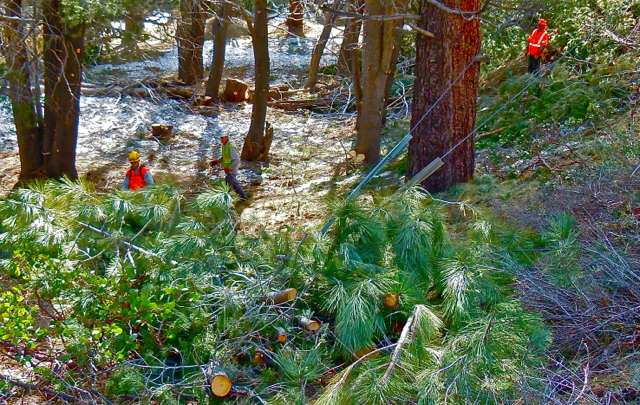
The Lake Christopher fuels reduction project in South Lake Tahoe got tied up with the Nevada Fire Safe Council bankruptcy. Photo/LTN file

The Lake Christopher fuels reduction project in South Lake Tahoe got tied up with the Nevada Fire Safe Council bankruptcy. Photo/LTN file

Some claimants appear confused, disheartened or weary about their allocations as word begins to trickle out about the payouts.

“They’ll receive nothing if they don’t file. Others who do file will get theirs,” Dutra told Lake Tahoe News. “It’s unfortunate, but it’s called bankruptcy.”

In November 2012, the NVFSC filed for bankruptcy – which resulted in the federal agencies freezing all grant funds.

The matter was dragged into the courts when upon a tip the U.S. Department of Agriculture Office of Inspector General found in its investigation the NVFSC violated several federal regulations. It co-mingled federal grant money with other funds, allowed one person to handle the money and failed to conduct annual audits.

Lake Tahoe News in 2011 broke the story about the accounting discrepancies.

The OIG report recommended the Forest Service recover $2.7 million of the $9.8 million it awarded the nonprofit. Gaps in grant money collected and reimbursements either paid or due to be paid out remain a mystery. The work amounting to $3.4 million began as early as 2010.

“The report found that the debtor did not properly account for the grant funds awarded by the Forest Service, including the $3.6 million Recovery Act grant and also a $6.2 million non-Recovery Act grant. The OIG also found that funds from the Recovery grant and non-Recovery grant were co-mingled with debtor’s own funds and used to pay unauthorized expenses,” bankruptcy court documents obtained by Lake Tahoe News read.

The report indicated that Andrew List, a Carson City attorney who served as the NVFSC executive director between 2006-11, was responsible for handling the grants.

The NVFSC board pledged to the OIG it would hire an interim director, develop new accounting practices and turn to an accounting firm to manage its grants. About a year later, the fire safe council went under.

“I didn’t know I was doing anything wrong. I was just running it like previous directors,” List told Lake Tahoe News. “I’m proud of the work we did. I’m sorry it got caught up in some accounting irregularities, but not one penny was spent on anything not related to fuel reduction.”

But former board member Ann Brown, who served on the 11-member NVFSC from 2005-11, said she was concerned when contractors were paid in earmarked reimbursements from the same account employees were paid in salaries and benefits. She knew something wasn’t right.

That’s Accounting 101.

“We were getting a sense of something wrong in 2011. I think (List) got in over his head. There was no proof he did anything wrong,” Brown said of the former director. “It was bad oversight.”

Brown has a few regrets. She told Lake Tahoe News it’s unfortunate “the settlement does not pay everyone.” She said she has worked hard to not drop the ball on the claimants.

“There’s no way I’d feel comfortable not to do my utmost to try to get contractors paid,” she said.

“It’s a double-edged sword. We had to settle to get a pro-rated share of the bankruptcy money. It’s a no brainer we had to say yes. Now we are eligible for a share of this money,” Lake Valley interim Fire Chief Jeff Michael said about the lawsuit during its Sept. 8 meeting.

Lake Valley stands to get about $280,000.

The newly hired chief, Tim Alameda, attended that meeting as fire marshal for the North Tahoe Fire Protection District. He shared a similar sentiment.

“At first we said we would not accept the agreement. Our lawyers said if we go another step, we’ll lose everything for everybody,” Alameda said of fighting the compromise. “The good part is the work is done. It created a fuel break. We did good honest work.”

Ditto from North Tahoe Fire Chief Mike Schwartz.

“The fire district respects the Department of Justice’s approved payments and the Bankruptcy Court’s settlement. The payment amounts vary, but not the outstanding forest fuels management work that was accomplished through these grants,” he said.

And there lies the one glimmer of light from the messy accounting debacle – especially when hazardous fuel reduction is a must in an area that lost 254 homes in the devastating Angora Fire of June 2007.

South Lake Tahoe homeowners like Susan Swift are all too familiar with that constant threat hanging over the eves of those trying to make a life in Tahoe.

One of her claims amounting to $750 for tree removal, gravel laying and other work performed almost four years ago was finally approved by the judge. She’s gratified with the latest news, but feels like the other fire districts that more should be paid out. She’s due $2,500 from two different properties.

“They kept saying, ‘Don’t worry’,” Swift said, further admitting to having a trust issue with the money disbursements. “We still don’t have an answer where it all went.”


Matthews: Will fight for every child

Publisher’s note: Lake Tahoe News asked candidates for South Lake Tahoe City Council, Lake Tahoe Community College, Lake Tahoe Unified School District, Douglas County School District, South Tahoe Public Utility District and Lake Valley Fire Protection District a series of questions. We are running the responses in the order received. All profiles may be found under the Special Projects listing and then the 2106 November Candidate Profiles category.

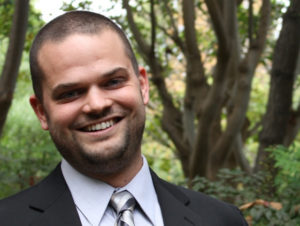
Troy Matthews, while running unopposed for Area 4 Lake Tahoe Unified School District's board seat, asked to answer the questions for the public to get to know him.

Troy Matthews, while running unopposed for the Lake Tahoe Unified School District’s Area 4 board seat, asked to answer the questions for the public to get to know him.

Name: Troy Matthews

Age: 32

Job/profession: Nonprofit management

What boards, commissions, or other experience, including volunteering, do you have?: I am a graduate of the Leadership Lake Tahoe program and sit on the board for the Tahoe Regional Young Professionals, the Progress For Tahoe Steering Committee, and I am project director for the South Tahoe Drug Free Coalition.

Why are you seeking this position?: I am running to fight for every child, regardless of background, because I believe a good education is a human right.

Why should voters vote for you?: I don’t have an axe to grind as I don’t have children in the district and I have never worked for the district. I am a fresh young voice. I love this community and am the best choice to fight for every child, because I am only running to serve all youth and families to the best of my ability.

What distinct experience or competency makes you uniquely qualified to lead effectively as an elected official?: Education is in my blood. Both of my parents were teachers and my mother was a high school principal for 14 years. I grew up going to school board meetings with my mom. I was a substitute teacher in the Los Angeles Unified School District and then got a permanent teaching job in an inpatient treatment center for adolescents. From my very first day of teaching, I fought for students that traditional schools had given up on. I got my Master’s Degree while teaching full-time. Currently, I work for Tahoe Youth & Family Services. I have dedicated my life to working for disadvantaged and at-risk youth. Fighting for quality educational opportunities for all youth is my life’s passion, and this is what I carry with me to the LTUSD board.

Public agencies have been under scrutiny the last few years for lack of transparency and accountability. What will you do to ensure both?: The Brown Act goes a long way to ensure transparency. Public schools belong to the community. I will make sure that the LTUSD continues to be an open book that seeks positive constructive feedback from the entire community. I want to be an open pipeline for parent and community contact with the district. I will always be available to discuss new ideas and hear concerns.

What stands out for you in the current budget that you support and that you would change?: I support CTE programs and AVID. I would like to see more support from the district for local pre-K and after school programs as well arts education for younger students.

Do you support current legislation for $15 minimum wage? Please explain: I do support the $15 minimum wage. I understand why people are opposed to it, but the fact is wages have not kept up with inflation over the past 30 years. According to research from Pew Charitable Trusts, 80 percent of Americans are in debt. It’s not a mystery as to why: the cost of living is way too high and people don’t earn enough income. South Lake Tahoe exemplifies this issue even more than most locales, unfortunately. It is simply not possible to live on $9 per hour in this community. A wage of $15 per hour for 40 hours per week means a yearly salary of about $31,000 before taxes. Even that is not enough to support a family of four in California. Many parents cannot take an active interest in their child’s schooling because of the amount of hours they have to work to make ends meet, and this negatively impacts student performance, and, at last count, nearly 250 youth in our district were homeless. Higher wages means more discretionary spending which boosts the economy, and that means we all benefit. At the same time, local regulatory agencies have got to make life easier for our small businesses. We have to create an environment where paying employees more does not amount to an existential threat to local businesses.

Do you support Proposition 55? Please explain: I do support Prop 55. Prop. 55 is an extension of Prop. 30, passed in 2012, which is set to expire in 2018. South Lake Tahoe schools greatly benefit from this measure at no cost to the vast majority of people who live here. Prop. 55 will prevent billions of dollars in cuts to California schools while ensuring local control of funds.

Describe three attributes for a successful board: Compassion, transparency, and cooperation

What are your thoughts about public employee defined benefits?: Public employee benefits are essential to attracting and retaining qualified teachers and administrators. Teachers are often unfairly scapegoated for economic issues in the state due to their benefits. Teachers deserve every benefit they receive and the success of Prop. 30 proves that there are solutions to protecting funding for schools besides cutting wages and benefits for public workers.

Please explain your position on contracting out work normally done by staff: I do not support contract work that undercuts the wages and benefits of regular staff.

What is your 10-year vision for the school district?: I would envision that we have one of the highest graduation rates in the state; work with Douglas County and Placer County and Washoe County schools to promote lakewide educational cooperation and success; continue to grow CTE, AVID, and college readiness programs; continue to enhance the LCAP to include student wellness programs; promote civics education and the humanities to develop well rounded citizens of the nation and the world; develop environmental science and fire science programs utilizing the amazing natural resources all around us; become a hub for arts education with award winning music, culinary, studio art, and theater programs; become a hub for athletics, physical fitness, and sports science programs to fit our recreation destination and athletic community; have the majority of LTUSD students fluent in another language by the time they graduate; be known statewide as a community with some of the best schools in the country; continue to promote STEM education and integrate “STEAM” education adding an arts component; establish a K-14 education culture in Tahoe; work to promote a four-year university in Tahoe and develop a strong partnership between the university and the LTUSD to keep local students local.

What one vote in the last four years that the current Board made do you disagree with and why?: While not every board decision has been perfect, I support the current direction of the board. I don’t have a specific decision that I strongly disagree with. I do think the board needs to be more proactive in its governance and, as a board, establish a clear vision for the district moving forward.

How many meetings have you attended this year for the board you are running for?: Three meetings, including the most recent LTUSD board retreat.

What do you know about the strategic plan, finances, debt, goals of the school board?: I support the current direction of the district to foster growth of the whole student as well as provide continual educational opportunities to EL students and disadvantaged youth. The vast majority of funding for all California schools comes from the state level, which is why Prop. 55 is so important. School district budgets in California are incredibly complex, but the gist is: we need to increase spending per pupil to compete with other states. California is well below average in per-pupil spending despite the high priority the state puts on public education.

Being on the school board means working as a team. How will you work with the next board for the greater good of the community?: Myself and other members of the board will without doubt have disagreements, but the students of the district must always remain the focus for the board. I will do what I can to voice my opinion and fight for what I believe in, but once the board has voted, that is the decision of the board. I will support it even if I voted against it.

What should be the three main priorities for the board?: Increase parent involvement, attract and retain great teachers, increase graduation rates.

What do you know about Common Core? What is your opinion about it?: Common Core is a new set of standards for K-12 English and math competency established by the U.S. Department of Education. States may choose to opt in to these standards. California is one of 46 states to have opted in to Common Core. My thoughts are: the jury is still out. Teachers in LTUSD are still transitioning to Common Core, so it may take a couple years to know if they are successful or not. I believe the intent behind Common Core is good, but I also believe in local control of education. Every school district is unique. I will oppose Common Core if it proves to be a detriment to our students. I will oppose any test score requirements tied to school funding.

How can the school district partner with the city to improve high school graduation rates?: The city and the LTUSD can work together to increase parent involvement in the schools, and that means creating an economy where parents aren’t forced to work three jobs and never see their kids in order to feed their kids. The 61 percent poverty rate for our students is a tragedy. I do not accept it. The city should also focus on fostering the growth of available and affordable housing in our community. The LTUSD can hire great teachers, but that won’t matter if they have to leave Tahoe because they can’t find a place to live.

What is your opinion about career and technical education at the high school level?: I strongly support it. I believe CTE has transformed education as we know it and made South Tahoe High a unique success story in California. Our students have learning opportunities few in other districts have.

Do you support the expansion of charter schools? Why or why not?: I support heavily regulated charter schools with identical standards to regular public schools. I believe charter schools that go unchecked pull money away from public schools while not necessarily providing their students with a quality education. They can be essentially private schools that receive public funding. However, I do support innovation in education, and this is where charter schools can be very successful.

What are you thoughts on the accreditation status at STHS?: It is an unfortunate situation that needs to be remedied quickly.

Tell us something about yourself that people may not know: I’m terrified of flying, I love to cook, and I am a huge fan of the Los Angeles Lakers, unfortunately.


Gamesmanship impacts SLT Knights Inn project

By Kathryn Reed     

The animosity between the California Tahoe Conservancy and city of South Lake Tahoe was palpable last week at the state agency’s board meeting.

Tom Davis, who is the city’s rep on the CTC board, said it’s time to clarify what the staff can do and what should come to the board.

The acrimony is about the CTC staff, Executive Director Patrick Wright in particular, deciding without the board weighing in to pull funding for a city project on Highway 50 near Ski Run Boulevard.

At the March CTC board meeting, the state put $4 million aside for the project that in some circles is known as Bijou Park Creek Watershed and SEZ restoration project, to some it’s the Knights Inn project and to others it is the Whole Foods project. It was to be on the September agenda. Instead, the agenda item was a $397,900 planning grant to study an even larger swath of land beyond the Knights Inn parcel.

While the CTC board approved it, the City Council could turn it down.

Razing the Knights Inn, bringing the stream that is piped underground to the surface, and other improvements paired with work at the neighboring parcel at Highway 50 and Ski Run would prohibit about 11,000 pounds of sediment a year from reaching Lake Tahoe.

While City Manager Nancy Kerry gave the CTC board a fast, detailed rundown of the last six months, Wright stared in the opposite direction at the screen that showed the text for the item the board would vote on. Then while City Councilman Austin Sass spoke, Wright stared at him intently. The hostility was evident from everyone.

The hang-up appears to be over bonus units, which is yet another commodity the Tahoe Regional Planning Agency has created. The bi-state regulatory agency allocates extra tourist accommodation units (TAUs) when stream environmental zones are restored. These TAUs have value – and the city and CTC each have a pot. They can be sold; and Placer County is an eager buyer because it has so few TAUs.

While Wright’s written report to the board questioned whether Proposition 1 money would be appropriate for this project, this is just the sort of thing Prop. 1 dollars have been used for in the past. And in March it was all but a done deal; the exact dollar amount was more of the question than whether a check would ever be written.

In August, Wright would not return phone calls to Lake Tahoe News to talk about the project and board Chair Larry Sevison had no idea what was going on. Last week Sevison said maybe something could be worked out at the December meeting. Otherwise the board was silent.

After everyone spoke Sept. 15, Wright said, “We will do everything we can to make this work.” This was also after Kerry and Sass had left the room, and Davis had made his statement.

The city intends to go forward with the development. What remains to be seen is if Pradip Patel, who owns the Knights Inn, will abide by the tentative agreement or keep asking for more money. It’s Halferty Development out of Southern California that wants to buy both parcels and essentially do one project.

A private developer, though, is under no obligation to do the environmental upgrades. That is why government dollars were being sought – to make this not just an economic project, but also an environmental one.


Loneliest road in America suits Nev. residents just fine

By John M. Glionna, Las Vegas Review-Journal

BAKER — In 1977, when Highway 50 was still the road less traveled, just another anonymous stretch of asphalt traversing the American West, Denys Koyle’s life took an unpredictable turn.

At age 28, she moved her young family from Huntington Beach, California, to this windblown frontier town on the state line between Nevada and Utah. She founded the Border Inn and scratched out a living tending to the occasional motorist who passed her ramshackle spread that baked under a relentless sun amid skittering lizards and prickly desert scrub brush.

To squeeze out the day’s last dollar, she would stand on the empty roadway well after dark, gazing up a 19-mile grade east into Utah: If she saw headlights descending, she’d stay open. Most times she closed.

That was before Highway 50 became famous.

It was an unlikely stroke of luck for Koyle and countless merchants along this meandering two-lane road that bisects Nevada’s midsection like an unadorned cowboy belt: In 1986 – three decades ago this year – the old highway became known as “The Loneliest Road in America.”

Read the whole story


Riddle: Preparing for this his whole life

Publisher’s note: Lake Tahoe News asked candidates for South Lake Tahoe City Council, Lake Tahoe Community College, Lake Tahoe Unified School District, Douglas County School District, South Tahoe Public Utility District and Lake Valley Fire Protection District a series of questions. We are running the responses in the order received. All profiles may be found under the Special Projects listing and then the 2106 November Candidate Profiles category.

Trey Riddle is running for one of two seats on the South Lake Tahoe City Council.

Trey Riddle is running for one of two seats on the South Lake Tahoe City Council.

Name: Harold “Trey” Thomas Riddle III

Age:  38

Job/profession: Bar manager

What boards, commissions, or other experience, including volunteering, do you have?: My wife and I have spent the last few years settling into South Lake Tahoe after moving here from Hermosa Beach, where we were small business owners and active members of the Hermosa Beach Chamber of Commerce.

Why are you running for City Council?: We can do better.

Why should voters vote for you over another candidate?: Voters shouldn’t vote for me over another candidate. A voter should vote for me because they feel my views as a whole align with theirs and that I would be their voice on the City Council.

What distinct experience or competency makes you uniquely qualified to lead effectively as an elected official?: I’ve always naturally gravitated toward leadership roles. From team sports to work environments, I have vast experience as a leader. I lead by example, and I believe a true leader is there to serve others. Others are not there to serve the leader.

Public agencies have been under scrutiny the last few years for lack of transparency and accountability. What will you do to ensure both?: I think we should investigate the possibility of merging some of the many agencies in Tahoe and ensure that all meetings held by these agencies are open to the public.

What stands out for you in the current budget that you support and that you would change?: The largest revenue sources for the general fund are property taxes and transient occupancy taxes (TOT), both being at 19 percent. I like that a strong portion of the city’s budget comes from outside the city. I would like to keep it that way, and look for ways to increase that percentage (Measure P, if it passes, is a special use tax so it won’t go into the General Fund. If it fails to pass, I would consider amending it for the next ballot so that it goes into the general fund and only requires a simple majority for approval).

Nearly two-thirds of our city’s general fund is spent on personnel; salaries, pensions, health care and other benefit costs. Police services comprise the largest share of the costs at 25 percent of the annual budget. Fire safety is a distant second at almost half of that. I believe we can reduce those costs and create more money for other community improvement projects by reducing overtime for police personnel and increasing volunteer patrols such as the STAR program.

Do you support current legislation for $15 minimum wage? Please explain: Yes. In fact I believe the minimum wage for South Lake Tahoe residents should always be 20 percent more than whatever the California minimum wage is at any given moment. I feel this way because we are a town that runs on tourism, which makes us unlike other towns. We’re not just moving money back and forth between our own residents; we have a large influx of money from outside of our city. The people who bring this money in also put a heavier burden on our infrastructure which our residents must pay for, and they also force businesses to hire more people in the busy seasons than they can support in the off season, so our residents face layoffs and reduced hours in the shoulder seasons. A lot of businesses are all too happy to charge higher than average prices for this destination location, but they don’t bother sharing that money with the people who make this town function. We can do better than the California bare minimum.

Do you support Proposition 55? Please explain: No. Higher income taxes are not the answer. When a government is irresponsible with the money it’s been given, you don’t respond by giving it more money.

Describe three attributes for a successful council: Open ears, open minds, and the willingness to compromise.

What are your thoughts about public employee defined benefits?: I wish every worker, public or private, could retire at 50 and receive 3 percent of their salary for every year they’ve worked, but that’s not sustainable. I think we should honor the agreement we’ve already made with the current public employees and make some adjustments for new employees.

Please explain your position regarding contracting out work normally done by staff: People should do the jobs they’ve been hired to do.

What is your 10-year vision for South Lake Tahoe?: I would like to see the revitalization of South Lake Tahoe, with fresher, more homogeneous building facades and a well thought out and completed infrastructure that encourages an active and healthy lifestyle among its residents and guests alike.

What one vote in the last four years that the current council made do you disagree with and why?: One of the most recent votes, and that was the one to eliminate VHRs on multi-unit properties. Whether we like it or not, VHRs are vital to the success of this city. VHR owners contribute to the largest sources of revenue for the city’s general fund. Those are property taxes and TOT. Together they comprise 38 percent of the General Fund revenue. You can read more about my opinion on VHR’s below and how we should treat them in relation to other property types. The reason I disagree with City Council’s decision to ban any new VHRs on multi-unit properties specifically is because this is the only way some people can afford to own their own home. They live in one unit and have to vacation rent the other side. The City Council talks about affordable housing and then in the same breath turns around and eliminates the only chance some families have at owning their own place and maybe even gaining a little financial independence. It’s hypocritical.

How many City Council meetings have you attended this year?: I watch all of the City Council meetings online and I encourage every resident to do the same if they can’t make it there in person. Just go to www.cityofslt.us and roll over the government tab, then roll over City Council in the drop down box and click on Watch Council Meetings. There you can watch all of the council meetings as far back as 2007.

What do you know about the strategic plan, finances, debt, and goals of the city?: You don’t have to read beyond the first sentence of the strategic plan to know all you need to know about it. It refers to the residents of South Lake Tahoe as the city’s “customers.” The City needs to get one thing straight; in business parlance the residents of South Lake Tahoe are not “customers.” The residents of South Lake Tahoe are “the boss.”

Being on the council means working as a team. How will you work with the sitting members for the greater good of the community?: I’ll compromise where I can. Where I can’t, I won’t.

What should be the three main priorities for the council?: The residents of South Lake Tahoe should always be the main priority, meaning we should take care of our neighborhoods first, then invest money in the tourist areas. Second, City Council should foster positive growth by making it easier for the private sector to grow South Lake Tahoe, then fill in the gaps with government funded improvements. Third we should investigate merging some of the many agencies in Tahoe to cut down on all of the red tape that has been preventing positive growth.

What have you done to make yourself ready to be a council member?: I’ve been preparing for this my whole life.

What role should government have in housing for residents?: None, directly. There’s a lot of chatter about affordable housing. When I hear “affordable housing,” I hear “let’s round up all the poor people and stick them in one spot.” The only role the government should play in housing is making sure that local residents are paid a fair wage and can afford housing that already exists. Then we wouldn’t be spending tax dollars on housing projects and residents would be able to buy more luxury items thereby generating more revenue for the city in sales tax dollars instead of costing the city money in project housing.

How can the city partner with the school district to improve high school graduation rates?: That’s something that needs to take place in the home. The city can monitor test scores and evaluate teacher performance, but if parents aren’t teaching their kids the importance of education, none of that really matters.

How can local government support and expand job creation and small local businesses?: We need to refine the whole process when it comes to entrepreneurs trying to start a new business. All of the rules and regulations that have been put in place to try to improve the South Shore have had the opposite effect and they’re choking the life out of our city. Everything is so cost prohibitive that people can’t afford to create their own startups here. So, our highway is littered with old outdated motels and dilapidated buildings instead of fresh new job-creating businesses.

If you believe in the one South Shore concept, what would you do to further make this a reality? If you don’t believe in blurring the state line, why don’t you?: We are one city divided by a state line. We share common interests. We’re neighbors. It’s important for us to work together as such. But, I also feel we need to get our own affairs in order before we start meddling in our neighbor’s business.

What are your views on:

a: Vacation home rentals: I feel that a person’s house is their domain. When someone purchases a home it comes with what’s known as a homeowner’s bundle of rights. One of those rights is the right of disposition. This means that the owner has the right to sell or rent their property at will.

I am aware that some residents take issue with vacation home rentals (VHRs), and the issues can sometimes stem from real problems, but I don’t believe it’s fair to say all VHRs cause problems or that it’s solely VHRs that cause problems in our neighborhoods. We all have neighbors that are long-term renters or even homeowner occupied that generate as much if not more noise, more trash or more parking issues than the VHR’s.

City Council should not be singling out VHRs when it comes to policymaking. If a VHRs spa jets are loud after 10pm are long-term renters’ and homeowner occupied spa jets not equally loud? If a long-term renter or homeowner occupied unit has three cars in the yard and two illegally parked on the street is it not equally if not more burdensome than a VHR that’s typically occupied only 25% of the time?

If City Council is going to regulate these issues, they need to do it equally for all homeowners and hold everyone accountable for violations, not just VHRs.

I believe we can make our neighborhoods more pleasant with increased STAR patrols and stiffer penalties for infractions by VHRs, long-term renters, and homeowner occupied units alike, without singling out any one type of homeowner.

b: Loop road: I support democracy. Let the residents decide.

c: City streets: They’re not safe for pedestrians or cyclists. Addressing this will be my number one priority on the council.

d: Relationships with other public agencies: Interagency cooperation is essential to progress.

e: Recreation: I love recreation. I recreate as much as possible. We should encourage more people to do it. I feel making our streets safer for pedestrians and cyclists is a great way to do that.

f. TRPA defined commodities: TRPA defined commodities are just one more thing getting in the way of positive growth.

g. Transient occupancy tax measure: I am voting yes on the transient tax increase. I feel tourists should share more of the burden they place on our infrastructure. The only thing I would have done differently is to have it go into the General Fund instead of being designated solely for recreation.

h. Sales tax measure: I am 100 percent against a sales tax increase. Sales taxes are a regressive tax that take a larger percentage from low-income individuals than high-income individuals, so it hits lower-income people harder. Here we are going on about affordable housing, then we turn around and try to raise taxes on the lowest-income people in the city. We can do better.

i. What do you want the additional sales tax money to go to?: N/A

Tell us something about yourself that people may not know: Anyone who knows me knows I’m a new dad. Even if we just met. I can’t stop talking about my 6-week-old son, Hank. He’s by far the coolest thing I’ve ever done with my life.

Something people may not know about me though is my first brush with Tahoe. In college I was captain of the cross country team, and president of the student government and Herodotus Society, but I couldn’t help but feel there was something missing. Then my counselor suggested I join one of the school’s community service organizations. So I did, and immediately became more fulfilled. In 2001 I had the honor of riding my bike with the Journey of Hope team over 4,000 miles from San Francisco to Washington, D.C., to raise funds and awareness for children with disabilities. On one night of our 72-day adventure we stayed at Kirkwood after a full day of climbing. It was without a doubt one of the toughest legs of the journey. I grabbed a Kirkwood sticker and put it on my bike frame as if it were a trophy. It was one of the two stickers that I put on it throughout the whole trip. The other was from Roswell, N.M., of course. I still ride that same road bike with my trophy Kirkwood sticker on it. When I put that sticker on there, I had no clue I would wind up some day living in Tahoe and riding Kirkwood on my snowboard every winter. It’s funny how things happen like that, almost like it was fate.


Made in Nevada label promotes state businesses

By Alex Soeth, Reno Gazette-Journal

Does your business have a product made in Nevada? If so, the Nevada Small Business Development Center would like to help you spread its awareness.

Made in Nevada, managed by the Nevada SBDC, is a nonprofit marketing and branding initiative that has proudly promoted Nevada-made products for more than 25 years. This program, a champion for Nevada-based manufacturers and artisans, is designed to promote goods that are grown, created, made or enhanced more than 51 percent in Nevada. The program encourages members of the community to support local businesses, which is vital to Nevada’s economy.

Made in Nevada represents small businesses as well as multiple manufacturing subsectors across the state. A membership with Made in Nevada allows businesses to promote their goods with the Made in Nevada logo, letting buyers know they are purchasing locally sourced products.

Read the whole story


Echo to Sierra — spectacular hiking terrain

Reflections in one of the pools of water along the route. Photo/Kathryn Reed

Reflections in one of the pools of water along the route. Photo/Kathryn Reed

By Kathryn Reed

ECHO SUMMIT – Casually walking along the Pony Express Trail we wonder how pioneers had the gumption to push on through the Sierra.

Hiking with ample water and modern clothing is a breeze. And we had a map. To have done so with wagons, cumbersome clothing and at times with inadequate supplies on roads, that well, weren’t roads, is a bit mindboggling.

These thoughts crossed our minds as the three of us hiked a stretch of land none of us had been on before. We did a 7.5-mile out-and-back from Echo Summit to the road that goes to Sierra-at-Tahoe.  This stretch is part of the Pony Express Trail, Pacific Crest Trail and links to the Tahoe Rim Trail. The trail is to the south of Highway 50.

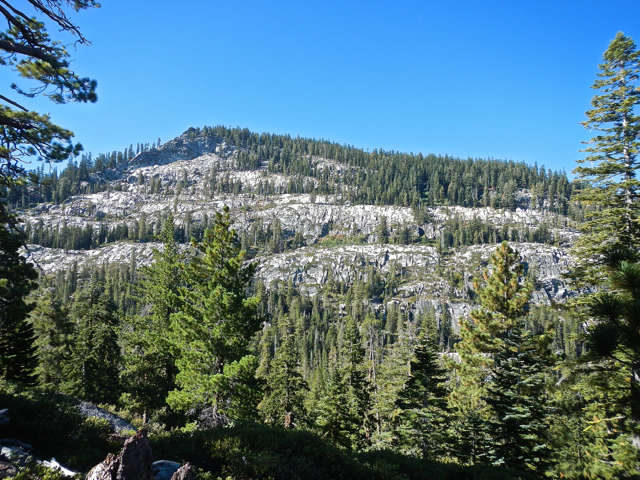
A wall of granite is visible at the start of the trail. Photo/Kathryn Reed

A wall of granite is visible at the start of the trail. Photo/Kathryn Reed

And while it is part of wildly popular trails, on the Sunday of Labor Day weekend we only saw a handful of people.

Besides being relatively secluded, what made this hike a bit unique was the changing terrain. Staring out we were treated to a wall of granite. The grandeur made us pause.

At times we were on a road, other times single-track dirt. Signs posted for a trail run that is now over kept us going in the correct direction. But even without them I know we would not have gotten lost.

It didn’t take long for Lake Audrain to come into view. It looked like quite a descent – which meant an even more strenuous climb out. We opted to forego that side trip and headed forward.

This was the most unusual vegetation on the hike. Photo/Kathryn Reed

This was the most unusual vegetation on the hike. Photo/Kathryn Reed

Much of the trail is up and down, with nothing too extreme either way.

Bushes with spiky berries were something new for each of us to see. Ferns filled several sections. With this lushness, meant there were a couple spots where AJ could get running water. Massive sugar pines covered part of the landscape.

We were treated to a couple eagles soaring overhead. Their screech is what first got our attention.

Once we got to the road at Sierra we thought we’d walk up to the resort to have lunch. Then we realized that road is longer than we had remembered. Bees kept us from sitting for lunch, so we ate and walked back to our starting point. We could have gone farther; the trail picks up on the other side of Sierra’s road.

Rosemary, Sue and I agreed this would be a great snowshoe trek this winter – starting from either location. Parking that time of year will be different because the sledding operation charges and none of us could remember if no parking signs are posted on Sierra’s road in the winter.

At times views are expansive, other times its closed in with tree. Photo/Kathryn Reed

At times views are expansive, other times it’s closed in with trees. Photo/Kathryn Reed

—–

   Getting there:

From South Lake Tahoe, take Highway 50 west to the top of Echo Summit. Park at Adventure Mountain, which is on the left. The trail is to the right, almost immediately as you turn in.


Sheehan: Leading by example, hard work

Publisher’s note: Lake Tahoe News asked candidates for South Lake Tahoe City Council, Lake Tahoe Community College, Lake Tahoe Unified School District, Douglas County School District, South Tahoe Public Utility District and Lake Valley Fire Protection District a series of questions. We are running the responses in the order received. All profiles may be found under the Special Projects listing and then the 2106 November Candidate Profiles category.

Kelly Sheehan is running for one of two seats on the South Tahoe PUD board.

Kelly Sheehan is running for one of two seats on the South Tahoe PUD board.

Name: Kelly Sheehan

Age: 58

Job/profession: Owner/manager Steamers Bar & Grill

What boards, commissions, or other experience, including volunteering, do you have?: I served two terms on the St. Theresa school board, two terms St. Theresa Pastoral Council and am currently on the St Theresa Parish Finance Committee. I am currently the vice president of the board of  directors at the district, as well as the board’s alternate representative to the El Dorado County Water Agency.

Why are you seeking re-election to the South Tahoe PUD board?: I have gained so much knowledge these past four-plus years, leading me to believe I still have much to offer as a board member.

Why should voters vote for you over another candidate?: I have no personal agenda and base my decisions on what is best for the district and its customers.

What distinct experience or competency makes you uniquely qualified to lead effectively as an elected official?: I have been in management for most of my adult life. I have always tried to lead by example and hard work. Objectivity is one of my best traits.

Public agencies have been under scrutiny the last few years for lack of transparency and accountability. What will you do to ensure both?: The district has policies and procedures in place to ensure transparency. I, along with fellow board members and staff, have just completed ethics training. The district and its board are always mindful of the importance of transparency.

What stands out for you in the current budget that you support and that you would change?: The district is on a good path with the budget and long term planning. Staff has done an excellent job of prioritizing projects. It is definitely a balancing act to keep rates reasonable without ignoring the infrastructure. I would not change this direction.

Do you support current legislation for $15 minimum wage? Please explain: I struggle with the $15 minimum wage as I am in an industry where the employees receive gratuities. As a small business owner, payroll is always one of your largest expenses. Someone, most likely the consumer, is going to have to help shoulder that cost. But I am a firm believer in a fair, living wage.

Do you support Proposition 55? Please explain: Yes, especially for the benefit to K-12 and community college education.

Describe three attributes for a successful board: Respect for your fellow board members, even when you may disagree with them.
Objectivity: making decisions based upon what is best for the district and all of its customers, leaving your personal feelings and benefits aside.
Preparedness: do your homework and make informed decisions.
By the way, I feel our current board has all of the above attributes.

What are your thoughts about public employee defined benefits?: There has been such a large shift between the benefits of public and private sector employees in the last 40 years for multiple reasons. I feel the most important thing about public employee benefits is that they don’t become an unfunded liability.

Please explain your position on contracting out work normally done by staff: This something that is done for various reasons, most importantly efficiency and cost effectiveness. I have no problem with this practice as long as those are the factors considered.

What is your 10-year vision for STPUD?: To continue to provide clean and safe drinking water, as well as environmentally responsible wastewater collection, treatment, and export for our community in a financially responsible manner.

What as an elected official are the three things you are most proud of during your tenure?: I don’t know that I can name three specific things. But, I know that I have strived to handle myself in a gracious and adult manner even when being publicly criticized for decisions I have made. This was hard for me. By nature, I tend to be a people pleaser, I want everyone to be happy. But I know that cannot always be the case. I have based every decision made since being a board member on fact and the good of the district and its customers, whom I represent. I have never made a decision based on what would be easiest and most beneficial for myself.

Which votes would you change and why?: I would not change a vote.

Being on a board means working as a team. How will you work with the other board members for the greater good of the community?: I will continue to listen and be prepared, I will respect my fellow board members’ opinions, while ultimately basing my decisions on fact, the good of the district and its customers.

What should be the three main priorities for the board?: 1.) Provide clean and safe drinking water.
2.) Provide environmentally responsible wastewater collection, treatment, and export.
3.) Make sure our infrastructure is able to provide protection against the devastation of forest fires.
Further to achieve all of the above in a fiscally responsible manner.

How do you balance the economic situation of the community with the infrastructure needs of the district?: As I have said before, this is a balancing act. We need to be sensitive to our local economy, but realize the infrastructure ages regardless. We can’t ignore the infrastructure. But, we need to explore every funding source, such as state and federal grants in an effort to keep our rates affordable.

STPUD is often criticized for having some of the highest paid public employees on the South Shore. Any comment?: It takes a significant responsibility and skill to maintain the district’s systems, especially in Lake Tahoe’s sensitive environment. We need to be able to attract and maintain a skilled work force. This is not to say that we should not ask for exceptional performance in return for one of the best local public compensation packages.

When it comes to permits for construction, the district has high fees. Do you believe they are fair? Why or why not?: I think they are bit high. I would like to see the board do some research and perhaps consider more affordable options.

Tell us something about yourself that people may not know: I am actually quite shy. Speaking in public is hard for me. I tend to get tongue tied around people I do not know and am not comfortable with. Once I do feel comfortable though, this all changes.


Study: Calif. drought could last indefinitely

By Tracy Bloom and Eric Spillman, KTLA-TV

A grim study led by a UCLA geography professor revealed that the current five-year drought in California could last indefinitely, with the resulting arid conditions becoming “the new normal” for the state.

The study, which looked at prolonged periods of dryness in California over the past 10,000 years, was published Thursday in the Nature.com journal Scientific Reports.

It noted that the state’s drought in the 21st century has been the most intense ever recorded, with drier than normal conditions in 10 of the past 14 years; the last three years have also been the hottest and driest in about 120 years.

Read the whole story


Tax revenues good omen for SLT budget

By Kathryn Reed

The budget the South Lake Tahoe City Council will be asked to approve on Tuesday has been built with cautious optimism.

City Manager Nancy Kerry likes to look at the big picture when putting numbers together. In particular she is paying attention to models that show recessions in the last 50 years have hit on average every six years. It’s been eight years since the last one.

And while that last recession was a doozy, Kerry doesn’t want to forget the lessons learned from it. She doesn’t want to spend money with abandon or overinflate the payroll with employees.

The global economy has a direct correlation to Lake Tahoe as a whole because if money tightens elsewhere, people tend to stop traveling. And with a tourist-based economy, the area gets slammed harder when the economy heads south.

The California travel forecast is for the international tourist market to shrink a bit.

South Lake Tahoe’s three main revenue sources are hotel, sales and property taxes. The first is all tourists, sales is a mix of locals and others, and property taxes are both as well, though with second homeowners at 70 percent they are still the predominant purchasers of houses here.

Property taxes grew 3.5 percent in fiscal year 2014, 4.7 percent in FY 2015 and are expected to hit 4.3 percent this year. The 2016-17 budget calls for a spike of 5.1 percent. But after that the city projects property taxes to be flat at 1.5 percent for several years. The upward trend in the last few years is attributed to housing being one of the last sectors to recover from a recession, so it’s just now that prices are returning to prerecession figures.

With sales tax, the city saw an increase of 9 percent in FY 2014, 3.7 percent in FY15, and a7.4 percent was budgeted for this year. The budget that goes into effect Oct. 1 forecasts a 1.4 percent increase.

TOT has been fabulous of late. In FY 2014 there was a 17 percent increase from the previous year, it was up 16 percent in FY 2015 and it expected to hit 8 percent at the close of this fiscal year. The budget for 2016-17calls for a 4 percent increase. After that the city is reeling in the numbers, saying a 1 percent increase is likely.

Kerry believes now might be the time to rethink having 25 percent reserves. After all, that money was not touched during the Great Recession. Lowering that percentage to 20 would loosen up the overall budget a bit and still have plenty in the bank for a catastrophic situation. To change the allocation would take a four-fifths vote of the council.

There is much to be celebrated with where the city is today economically compared to recent times. The city is $100 million better off today than it was five years ago. Half of that is from state and federal grants; the other half is what the city did via health care and debt refinancing. The city’s debt accounts for 4 percent of the General Fund. Refinancing bonds has lessened that burden.

The General Fund for 2016-17 calls for $38.4 million in revenue and $37.2 million in expenses for a net revenue of $1.2 million.

“This is the first budget in the city’s history that we can find where we are budgeting with a positive cash flow,” Kerry told Lake Tahoe News.

Between 2010 and 2012 the city was experiencing $5 million in structural deficits. Thirty percent of the workforce was laid off. In 2003 the city didn’t even have any reserves.

A little more than three years ago Kerry said for the South Shore to be an economically viable region $1 billion in capital investment would be needed. That goal, through public and private dollars, is more than halfway to being a reality. It includes such things as single-family residences, BevMo and the hotel complex at Edgewood Tahoe.

Looking forward the city may have more money in its coffers if voters this November increase the transient occupancy and sales taxes. TOT would be used exclusively for recreation infrastructure, while the sales tax could be used for anything. Voters will be asked where they want the extra sales tax money to go, but the council is under no obligation to follow that suggestion.

Admittedly, the budget doesn’t cover the costs of all the needs South Lake Tahoe has – such as roads, future raises for employees (their current contract expires at the end of September 2017 and negotiations are under way), and the nearly $4.6 million unfunded pension liability. Those are bigger picture issues council members will have to face, though they are not expected to do so at their Sept. 20 meeting.