SLT council candidate in serious crash

Updated 7:10pm:

South Lake Tahoe City Council candidate Jason Collin was in a serious accident on Kingsbury Grade this afternoon.

The RV Collin and his wife, Natalie, were traveling in with five others collided head-on with a Nissan Pathfinder.

The female driver of the SUV died at the scene. She was from Wellington.

“It looks like the Nissan crossed over into the other travel lane and struck the motorhome head-on,” Dan Lopez, Nevada Highway Patrol trooper, told Lake Tahoe News. “At this time we can’t say if alcohol or drugs were a contributing factor, but we will be investigating that.”

The Collins were headed down Kingsbury Grade toward the Carson Valley just after 1pm Sept. 23. Their children were not in the vehicle, according to a family friend.

The front end of the rented RV is smashed in. Photo/NHP

The wreckage from the accident that killed one person and injured five. Photo/NHP

Jason Collin was airlifted to Renown Medical Center in Reno with non-life threatening injuries. Reports are that one of his legs sustained the most serious injury. Natalie Collin was taken to Barton Memorial Hospital where she was treated for a broken finger. She has been released.

Three people were transported by air ambulance, two by ground ambulance to area hospitals, according to Douglas County sheriff’s deputies. People had to be extricated, according to officials. Names of the others involved in the crash have not been released.

Lopez said one of the injured — not Collin — is in serious condition, but does not have life-threatening injuries.

Kingsbury Grade was closed in both directions. It was expected open about 7:30pm Friday. The accident was 1½ miles from the top of the summit.

Witnesses are asked to contact NHP at 775.687.0400.

— Lake Tahoe News staff report


Federal education law could be chaotic for Nev.

By Neal Morton, Las Vegas Review-Journal

Nevada Superintendent of Public Instruction Steve Canavero warned members of a U.S. House of Representatives subcommittee Wednesday that proposed rules to implement a new federal education law could create chaos and confusion as Nevada schools try to help at-risk students.

Canavero, whose department oversees about 460,000 students, also testified during a nearly two-hour congressional hearing that a new accounting method in the draft regulations threatens a recently approved plan to drive more control over budget, instruction and staffing decisions to individual school communities.

The hearing centered on the U.S. Department of Education’s proposed rules for the Every Student Succeeds Act, which President Obama signed into law in December.

Read the whole story


Cocktail contest brings awareness to cancer

By Kathryn Reed

If only it were as easy to concoct a cure for cancer, as it is to mix a cocktail to raise funds for the expansion of Barton Health’s cancer wellness program.

The cancer program is free for people living in the South Shore area; funding comes from donations. The goal is to expand services to include things like massage, exercise, psychotherapy, and nutrition classes. The idea is to recognize the various needs a patient has during his or her cancer journey.

Cocktails for a Cause is Barton Foundation’s annual fundraiser; each year – this being the seventh – there is a different beneficiary.

Bartenders from seven South Shore establishments on Sept. 21 came up with a libation featuring Tahoe Blue Vodka. A different spin this year was tying the drink to cancer. Many of the bartenders have a personal connection to the cancer they chose to represent.

A panel of five judges did a blind tasting. They were critiquing originality, use of Tahoe Blue Vodka, taste, presentation and how well the bartender tied it to their cause. Judges were this reporter, Meghan Burke, Mike Peron, Howie Nave and Troy Matthews.

LewMarNels is the 2016 winner of Barton's Cocktail for a Cause contest. Photo/Molly Hucklebridge

LewMarNels is the 2016 winner of Barton’s Cocktail for a Cause contest. Photo/Molly Coolidge

Taking top honors was LewMarNels with Krista’s Cure. The South Lake Tahoe restaurant embraced brain cancer in honor of local Krista Carson who is battling the disease. Bartenders for the night were Gary Gramprie and James Olson.

The drink was not the most attractive, but that’s what happens when it is grey to go with the theme. For judges Peron and Nave this drink topped their list. The banana in the drink made it like a smoothie with vodka, they said.

The blue ribbon made out of a cucumber as garnish on the English cucumber cocktail from Azul Latin Kitchen made it standout with the theme and presentation. Bartender Hannah Fridholm came in second with her creation that was representing colon cancer awareness.

Third place honors went to Whitney Gielow from the Chart House who came up with a drink honoring melanoma. Some judges thought it tasted a bit like mulled wine. It was one of the least sweet drinks, almost with a dry finish.

The winning cocktail will be featured at the Barton Foundation’s gala in December, which is now tied to the Festival of Trees and Lights.

The most congenial bartender of the night award went to Jacob Craig from Cold Water Brewery. This honor was based on his $313 in tips – the most of all the bartenders. Brewmaster Ryan Parker was at the event. Their cause was esophageal cancer in honor of Parker’s wife, Rose, who was diagnosed with this cancer six weeks ago.

Other bars participating were Heavenly, Riva and Boathouse.


Why Tahoe never became a national park

By Abby Stevens, Moonshine Ink

When John Muir visited Lake Tahoe in 1888 and saw the devastating effects of the loosely regulated timber business, he felt deep-seated sadness, and grieved for the loss of the old growth forests. By 1897 Muir was crusading to make Tahoe a national park. He knew it would be a gritty and uphill battle.

Scott Lankford, a professor at Foothill College in Silicon Valley, delves into the argument behind the effort to turn Lake Tahoe into a National Park in his 2010 book “Tahoe Beneath the Surface”. He describes how in order to achieve his goal, Muir formed unlikely alliances behind closed doors with powerful businessmen.

The main targets Muir needed on his side were Elias Jackson “Lucky” Baldwin, owner of the Pacific Stock Exchange and the newly opened Tallac House on the South Shore, and Edward Harriman, the powerful and rich owner of Southern Pacific Railroad. Muir convinced both of these men that if Tahoe were to become a National Park, tourism would increase, benefitting both of their businesses. After some persuasion, the two men agreed.

Read the whole story


USFS wins California bottled water permit fight

By Associated Press

A federal judge has ruled against environmentalists who sued the U.S. Forest Service claiming the agency was letting Nestle pipe water out of forest land on an expired permit.

U.S. District Judge Jesus Bernal said Tuesday that the permit by Nestle Waters North America “is still valid.” The judge noted that Nestle’s predecessor contacted the Forest Service to renew the permit before the old one expired in 1988, but the company never heard back from the agency.

The ruling was a setback to environmental groups, which sued the federal government last year to halt the piping of water in the San Bernardino National Forest unless a new permit is obtained.

The groups estimated Nestle siphoned 98,000 gallons of water a day from springs in the forest last year. The water is then trucked to a nearby plant, where it is bottled as Arrowhead Mountain Spring Water.

Last year, the Forest Service began an environmental review of Nestle’s spring water pipeline as part of the permit renewal process. The agency had said Nestle’s permit was in full force during the renewal period.

Nestle, which wasn’t a party in the case, said it is pleased with the latest decision.

Arrowhead has been sustainably bottling “water from the springs in Strawberry Canyon for more than 121 years — since before the creation of the San Bernardino National Forest,” the company said in a statement.

Environmentalists said the prolonged drought and water withdrawal in the San Bernardino National Forest are affecting wildlife.

“The court’s decision is disappointing, but the real tragedy lies in the fact that Strawberry Creek is drying up, dooming the plants, fish and animals that have relied on it for tens of thousands of years,” Ileene Anderson of the Center for Biological Diversity said in a statement.

A message asking for comment from the Forest Service was not immediately returned.


Douglas County residents face stormwater fee

The Burke Creek stormwater project under way in Stateline involves Douglas County, Nevada Department of Transportation, Nevada Tahoe Resource Conservation District and the U.S. Forest Service. Photo/LTN

The Burke Creek stormwater project under way in Stateline involves Douglas County, Nevada Department of Transportation, Nevada Tahoe Resource Conservation District and the U.S. Forest Service. Photo/LTN

By Kathryn Reed

STATELINE – Douglas County wants to get a handle on its stormwater. It’s been trying to do so for years.

In this incarnation residents are likely to foot the bill via a special fee.

It’s estimated that countywide about $2 million is needed on an annual basis, with much of that money to be used for ongoing maintenance. Individual households are likely to see a $4 to $7 monthly bill. It’s being called a fee, not a tax.

How this dollar amount was calculated has not been revealed, nor have the valley and lake needs been broken out.

A vocal and concerned group of citizens turned out Sept. 19 at Kahle Community Center to hear what officials had to say.

People are worried money collected at the lake will be used in the valley. The administrative costs are another concern; people are worried not enough money will go for real work. Lack of trust in the county commissioners as a whole was a common theme.

Larry Werner, interim Douglas County manager, and Jeff House with House Moran Consulting led the discussion.

“There is a stormwater plan in place, but it is inadequate because of the lack of funding. It’s not because of the lack of expertise,” House told Lake Tahoe News.

His contract with the county expires at the end of the year. Between now and then the commissioners are each supposed to appoint two people to a committee. That group will take comments from the various public meetings, look at the work that needs to be done, and help come up with a credit program.

The credit program was also met with skepticism at Tuesday’s meeting. People wondered how it would be equitable and administered.

There is already a credit program in place for the total maximum daily load (TMDL) mandate handed down from the feds. This credit is given to entities like the county and Nevada Department of Transportation.

In 2011, Douglas County was being more innovative with its TMDL-stormwater issues.

Some people have their Tahoe Regional Planning Agency best management practices certificate and want that to be considered. The various general improvement districts have a variety of programs in place, but there is no consistency.

Then there are companies like Edgewood Tahoe that receives stormwater from a variety of sources based on being a lakefront business. Patrick Rhamey with Edgewood said it would be “crazy” for his company to pay a dime when it is spending more than $5 million on stormwater issues related to the lodge construction.

That would be where the credit program comes into play – some entities might get cash back.


Poll: Sandoval one of nation’s most popular guvs

By Sean Whaley, Las Vegas Review-Journal

He may not be running for political office in 2016, but Gov. Brian Sandoval is weighing in on races and ballot measures. His latest popularity rating may help in those efforts.

Sandoval, who’s amid his second and final term as governor, had the fifth-lowest disapproval rating among governors at 21 percent, a survey by Morning Consult, a Washington-based politics and polling publication, shows.

His approval rating was 62 percent; seven governors had higher approval ratings.

Read the whole story


Sierra lake offers clues about ongoing drought

By Bettina Boxall, Los Angeles Times

In 2000, researchers took a coring from the bed of a small, shallow lake in the Eastern Sierra Nevada mountains.

They analyzed the organic matter and chemicals in the sediments to reconstruct a climate record of the past 10,000 years. They then compared it with reconstructions of ancient ocean temperatures.

The results echoed previous studies that have found a link between past periods of climate warming, cool sea-surface temperatures in the eastern Pacific Ocean and centuries-long droughts in California and the West.

Does that mean that global warming is pushing California to the threshold of endless drought?

Read the whole story


SLT council candidates try to stand out

Eight of the 10 South Lake Tahoe City Council candidates on Sept. 20 make their voices heard. Photo/LTN

Eight of the 10 South Lake Tahoe City Council candidates on Sept. 20 make their voices heard. Photo/LTN

By Kathryn Reed

Watching eight of the 10 South Lake Tahoe City Council candidates answer an array of questions Tuesday night gave the voting public and others an opportunity to see who has prepared well for this four-year job and who needs some polishing.

Candidates Dan McLaughlin and Bob Topel did not attend the forum at Lake Tahoe Resort Hotel that was sponsored by Lake Tahoe South Shore Chamber of Commerce and South Lake Tahoe Lodging Association.

Moderator Evon Yakar tried to keep the candidates on point, had follow up questions to get them to actually answer the question, and asked questions they all answered and interspersed them with ones targeted to individuals. The sponsors prepared some questions, while others came from the audience.

For the most part they all agree listening is one of the best ways to learn.

Some of their responses based on the order they sat:

John Shearer:

·      Regarding how he as a business owner would increase economic opportunities: He believes the Lake Tahoe Visitors Authority and chamber do well with marketing and that the city does not need to have a role.

·      Asked to define “sensible regulations” that he says are needed to deal with affordable housing: He wants the Tahoe Regional Planning Agency to change; in particular he has issues with building allocations.

·      How important is it to meet the needs of the people living outside the city, but who are in the sphere of influence: He would like them to vote. [This would violate the Constitution.]

·      If the loop road measure passes, what should the city do: Supports the loop road. Recognizes houses won’t be torn down without rebuilding new ones. Anticipates more events in that area.

·      How to solve the traffic problem in town: Free transit; emulate successful ski towns.

Patrick Jarrett:

·      How would he grow the economy: More events.

·      How important is it to meet the needs of the people living outside the city, but who are in the sphere of influence: They should have some voice.

·      If the loop road measure passes, what should the city do: With the number of people who signed the petition, believes the public wants a say; doesn’t want project “crammed down our throats.” Doesn’t see benefits of project.

·      How to solve the traffic problem in town: Pointed out how when he lived in Germany years ago the transit was reliable; would like to see that happen here. And sync the traffic signals.

Ted Long:

·      He was asked about his 10-year vision: Tourism, he said, is a two level platform – to get them here and then to get them back.

·      How important is it to meet the needs of the people living outside the city, but who are in the sphere of influence: He wants to do more and is open to suggestions.

·      If the loop road measure passes, what should the city do: He would support the voters, but realizes that still might not be what the majority in town wants based on voter turnout. “I think people who are in charge are going to do what they want.”

·      How would you solve the traffic problem in town: Put in light rail to get people to Camp Richardson and Stateline. Focus on getting tourists out of their vehicles.

JoAnn Conner:

·      The most urgent issue in the city: Housing, with roads a close second.

·      With a contentious first term nearly over, she was asked how things would be different the next four years: “Literally hundreds of people have asked me to run again.” She said she has already put the issues behind her and that there have been many successful meetings. “I have no personal agenda.” [The reality is tension, animosity and lack of professionalism are still the norm at council meetings, and no personal agenda is disputable.]

·      How important is it to meet the needs of the people living outside the city, but who are in the sphere of influence: Meyers can vote to annex themselves. She said she understands why they would not want to.

·      If the loop road measure passes, what should the city do: Better to listen to the citizens, not the five council members. “Caltrans has assured me it will not proceed if the City Council doesn’t want it to happen.” She believes the project has too many unanswered questions.

·      How to solve the traffic problem in town: Advocate for bike trails, said she got the snow cleared from them last winter; use smaller buses.

Tamara Wallace:

·      What areas of South Lake Tahoe present an opportunity for redevelopment and what would the appropriate approach be: She wants the Tahoe Valley Area Plan to be implemented, but did not state a specific project.

·      She was then pressed to answer what she thought the city’s role in the loop road would be: She stumbled a bit, said eminent domain and easements and “things like that” would be the city’s role; then she said the council will not vote yes or not on it because it’s not a city project.

·      How important is it to meet the needs of the people living outside the city, but who are in the sphere of influence: “I think we are one community in very many ways. We will always be just a little bit separate.” She mentioned how kids in Alpine County go to Douglas County schools and she wishes Whittell students could go to South Tahoe High. [They can.]

·      If the loop road measure passes, what should the city do: Doesn’t matter if the measure is vague, it’s what the people want. “I’m against three people making a million vote.” [Earlier that day the five councilmembers made a multimillion-dollar vote when they approved the 2016-17 budget; million dollar votes are pretty routine.]

·      How to solve the traffic problem in town: Get businesses to subsidize transit.

Brooke Laine:

·      She was asked what a successful vacation home rental program looks like: She wants the laws on the books enforced, for the code enforcement officers to work more than swing shift on the weekends, bear boxes to be mandatory and for VHRs to pay the same transient occupancy tax as the redevelopment area so that added revenue could pay for enforcement officers.

·      How important is it to meet the needs of the people living outside the city, but who are in the sphere of influence: She wants to create one Tahoe county so there is a larger voice.

·      If the loop road measure passes, what should the city do: “I think it’s taking the pulse of the community.” She also believes the ballot measure is premature.

·      How to solve the traffic problem in town: Mentioned how in the 1980s the city subsidized transit; wants it to be frequent, fun and free.

Jason Collin:

·      How best to address infrastructure: “Roads are the most pressing issue.” He wants added sales tax dollars to go toward roads.

·      Purpose of loop road lawsuit: “The intent was to raise awareness to what I feel is an invalid measure. (The measure) would not allow the city to act.”

·      How important is it to meet the needs of the people living outside the city, but who are in the sphere of influence: When he was on the city’s economic development team they came up with the “One South Shore” slogan.

·      If the loop road measure passes, what should the city do: A vote for or against the measure is irrelevant because it’s vague and if it passes, there will be a court hearing on Dec. 5; plus the city doesn’t have jurisdiction over the project. Believes educating public is necessary.

·      How to solve the traffic problem in town: In the short term, work on sidewalks and trails. The trails he was on this winter were not cleared. Would like free transit, but doesn’t know how to pay for it.

Trey Riddle:

·      With his platform being all about infrastructure, he was asked which project is most important to support and why: He said the Mobility 2035 program. [This is a TRPA, not a city program.] He said his 9-week-old son would be in college by then, and that doing more now so his child could experience it as a kid would be ideal.

·      How important is it to meet the needs of the people living outside the city, but who are in the sphere of influence: Important to listen to friends and neighbors.

·      If the loop road measure passes, what should the city do: He supports democracy, and wants the public’s opinion to prevail.

·      How to solve the traffic problem in town: Rides his bike to work almost every day and doesn’t feel safe; he’d like to change that experience.




Migratory birds flocking to Tahoe basin

A female downy woodpecker does not need a wide branch to hang on to. Photo/Dale Roberts

A female downy woodpecker does not need a wide branch to hang on to. Photo/Dale Roberts

By Dale Roberts

STATELINE – For those who love Tahoe for its wildlife and natural grandeur, the Tahoe Institute for Natural Sciences has something for everyone whether they are just learning about the wildflowers surrounding their campsite to the serious student of ornithology.

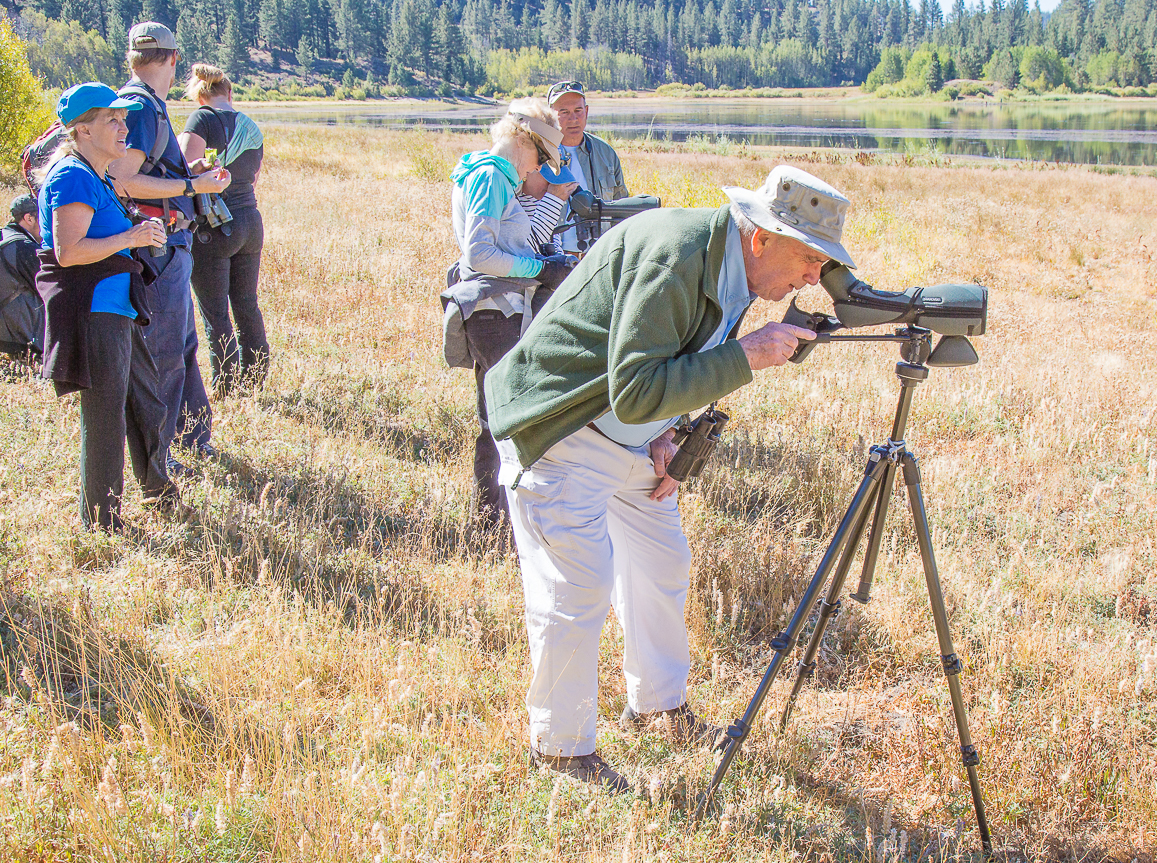
Charles Hopkins from Maryland confirming a bird identification. Photo/Dale Roberts

Charles Hopkins from Maryland confirming a bird identification. Photo/Dale Roberts

The Tahoe Institute For Natural Sciences (TINS) is a nonprofit organization dedicated to bringing world-class interpretive studies and education to the Tahoe area. Its staff is comprised of individuals who are widely recognized as experts in their fields, and has a volunteer staff that draws from various naturalists and environmental scientists that live in the Tahoe area.

Last weekend TINS offered two bird watching walks focusing on the migratory birds of the Tahoe basin. There was also a focus on the various bird songs to help people locate and identify the various birds in their habitats.

Western gulls are a common migratory bird in the Tahoe basin. Photo/Dale Roberts

Western gulls are a common migratory bird in the Tahoe basin. Photo/Dale Roberts

Saturday’s walk at Spooner Summit was led by founding member Kirk Hardie and assisted by Rich Chambers. Sunday’s walk was at Rabe Meadows off of Kahle Drive in Stateline, and was led by Chambers and assisted by staff member Michelle Witte.

Birds were not the only animals out -- a praying mantis tries to blend in. Photo/Dale Roberts

Birds were not the only animals out — a praying mantis tries to blend in. Photo/Dale Roberts

In all, approximately 40 species of birds were identified in several habitats in both locations. Between sightings the leaders pointed out various flowers, trees and animals seen along the way. With their depth of knowledge of the area’s ecosystems, they were able to answer practically any question a participant may have had relating to the natural sciences.

Most events TINS sponsors are free and are ideal for families. Group sizes are kept small to maximize the learning experience.