Women’s fund embracing the power of one

Annual membership in the Tahoe Women's Community Fund starts at $100. For for information, call 530.622.5621 or go online.

Annual membership in the Tahoe Women’s Community Fund starts at $100. For for info, call 530.622.5621 or go online.

By Kathryn Reed

STATELINE — One person cannot do as much good as a group of like-minded individuals, but one person can make a difference.

The power of one. That was the theme of the Tahoe Women’s Community Fund gala last week at Harveys.

“We talk about the word collective. Our collective power is why we are here,” Wendy David told the 170 people in the room. While it was mostly women at the dinner, a few men were in attendance.

David along with Kathy Haven are the co-chairs of the South Shore-based group that was founded in 2015.  Their concept is “giving together for our community.” It’s not a traditional service club. The group raises money, gives it out and has an annual dinner. Email is how they get things done.

Three membership levels are possible, with part of the money going to an endowment.

The areas of need the 200 members identified include:

·      Children and youth

·      Poverty and housing

·      Education and literacy

·      Mental health and wellness

·      Women’s issues

·      Environment and community

·      No focus.

The plan is to give out grants each year; $22,000 was given in 2016.

As principal of South Tahoe High School, Ivone Larson oversaw a transformation of the school into state-of-the-art institution. Photo/LTN file

As principal of South Tahoe High School, Ivone Larson oversaw a transformation of the school into a state-of-the-art institution. Photo/LTN file

Educator Ivone Larson, who has lived in South Lake Tahoe since 1980, was the keynote speaker Oct. 12. She came to the United States just before her 7th birthday, not knowing a word of English. It became her fourth language. The family had to leave Brazil for political reasons.

In her classroom in Hollywood she was put in the back of the room facing the wall because she didn’t speak the language. She would go home and cry. She began to hate everyone and everything.

She figured it out and by 16 was a full-time student at UCLA. Then she transferred to UC Irvine, where the class sizes were smaller and more to her liking. Her areas of study were criminal justice and mental health.

Larson, like so many others, came to Tahoe thinking it was a visit and ended up making it her home.

She worked for the El Dorado County Probation Department, went back to school, and then started teaching. She rose through Lake Tahoe Unified School District to where she eventually retired as the assistant superintendent a couple years ago.

How did she achieve all of her successes? “One person believed in me,” she said. “At each and every turn there was someone to motivate me. The power of one person helped guide my life’s trajectory.”

It hasn’t always been easy. Acceptance to change helped, as well as a willingness to learn and to try again. It meant figuring out how to blend work and home. And to this day Larson continues to grow and adapt. She said it’s about making small changes — progress, not perfection.

“How will you use your power of one to make a difference today and every day?” Larson asked as she concluded her talk to a standing ovation.


Legality of home pot delivery scrutinized

By Peter Hecht, Sacramento Bee

The evening’s first customer emerged sleepy-eyed from the doorway of his apartment near Sacramento State for his marijuana concentrates: 3 grams each of strawberry, banana and pear flavors. He had few words for the delivery driver who handed him a white bag containing the order. Their transaction lasted mere seconds.

The pot-delivery business is booming in California. Using cars instead of dispensary counters, small marijuana startups have proliferated in recent years, serving a diverse customer base that includes homebound medical patients as well as people in communities where dispensaries are banned or few in number.

The estimated hundreds of mobile services for medical marijuana are operating in a largely unregulated sector of the cannabis economy, and state lawmakers and officials in cities such as Sacramento are scrambling to draft rules for the businesses or seeking ways to close them down.

Two leading online pot-consumer sites, Weed Maps and Wheres Weed?, each list 110 marijuana delivery services in Sacramento and nearby communities, including in Yolo, El Dorado and Placer counties.

Read the whole story


Overcrowded forests creating fire danger

By Kathryn Reed

Even though millions of federal dollars are headed to California to remove dead trees in national forests, if they had arrived sooner it would not have made a difference for the Emerald Fire.

None of the $11 million allocated last week by the U.S. Department of Agriculture is coming to Lake Tahoe. That isn’t to say forest projects aren’t happening, it’s just this latest round of funding bypassed the basin.

On the first day of the Emerald Fire by Cascade Lake it was Lake Valley Fire Chief Tim Alameda who told Lake Tahoe News one of the issues the firefighters were dealing with was all the dead trees. They just add fuel to the fire.

The new money will help complete 10 dead tree removal projects on 12,000 acres of California’s national forests. Eldorado, Sierra, Stanislaus and Sequoia national forests are the beneficiaries.

But clearly there is not enough money or manpower to take care of all the forests.

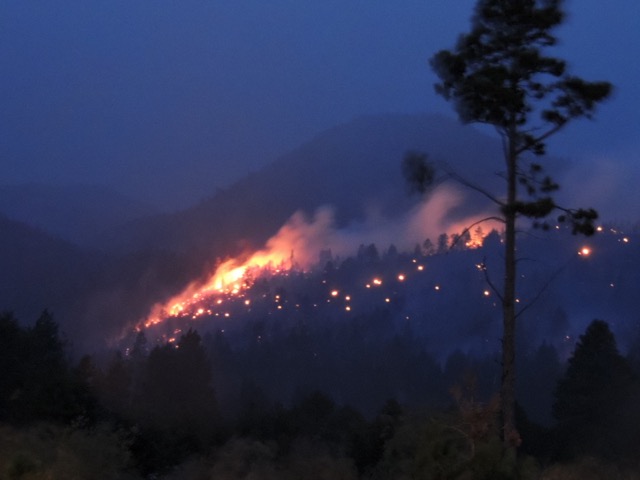
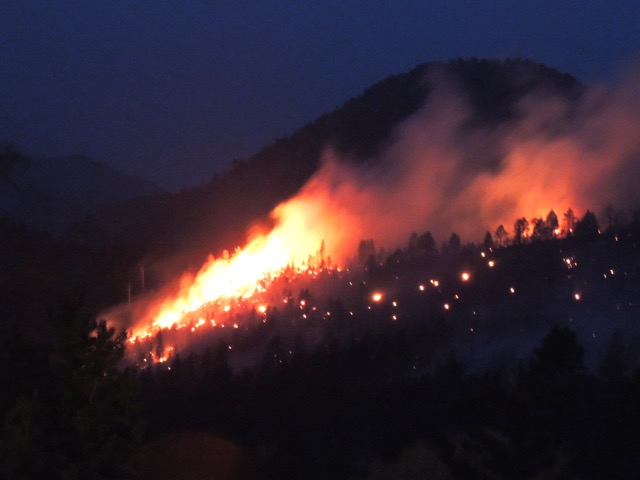
Flames from the Emerald Fire are visible on Oct. 14 as fire rips though 200 acres of dry forest. Photo/Taylor Flynn/Tahoe Mountain News

Flames from the Emerald Fire are visible on Oct. 14 as fire rips though 200 acres of dry forest. Photo/Taylor Flynn/Tahoe Mountain News

“More federal investment will be needed to remove the dead trees most likely to fuel destructive wildfires, but these funds are a down payment to begin to address this crisis and reduce the risk to public safety. Trees that pose a threat to people and property will be removed—there will not be clear cutting,” Sen. Dianne Feinstein, D-Calif., said in a statement.

She has been a strong advocate to get funding for these projects.

Fire season in the West is now a year-round phenomenon and not relegated to the dry months. This is obvious with the 200-plus acre fire on the South Shore that as of today is 90 percent contained, but also with the Little Valley Fire burning in Washoe Valley. Both started while it was raining. As of Oct.16 the amount of land burned in the Nevada fire is holding at 3,400 acres, with 20 percent containment. But 22 residences and 17 out buildings were destroyed.

The cause of these fires is still under investigation. While no lightning was reported when they both started about 1:30am Oct. 14, winds were howling. Power lines don’t need to drop to start a blaze; wires touching each other are enough to spark a fire.

As of the first week in September, in California there had been 5,354 fires this year that had burned 496,126 acres, resulting in seven fatalities and the destruction of more than 1,270 homes and other structures.

“Five years of punishing drought and resulting pest infestations have resulted in 66 million dead trees in California’s forests. According to firefighting officials, about 5.5 million of these trees pose a particularly high risk to people and property,” Feinstein said. “They are most likely to contribute to increasingly destructive and unpredictable fires near population centers and fall on roads, power lines and homes.”


Court slows West Slope tribe’s project

By Joann Eisenbrandt

Completion of the Shingle Springs Village project, a gas station/convenience store complex on tribal lands of the Shingle Springs Band of Miwok Indians, has been slowed by a stay granted Oct. 7 by El Dorado Superior Court Judge Curt Stracener.

The project has been quickly taking shape just off Highway 50 south of Red Hawk Casino in Shingle Springs.

It is being built on land held in trust for the tribe by the Bureau of Indian Affairs (BIA). Tribes can purchase privately owned lands not directly attached to their Rancheria and then request they be put into trust, thereby removing them from local jurisdictions’ tax rolls and regulations. While the title to the land rests with the federal government, the tribe retains control over its use. Development of projects on these lands are not subject to county planning regulations, but are controlled by NEPA, the National Environmental Policy Act. No NEPA document was required or prepared for Shingle Springs Village.

The loss of local control over what the Shingle Springs Band of Miwok Indians has chosen to do with their lands has been a source of ongoing concern as far back as the construction of Red Hawk Casino. Recent requests by the tribe to put additional land they have purchased into trust have only exacerbated local residents’ fears.

When the tribe originally requested the federal government put the gas station complex parcel and others around it into trust, the paperwork they submitted to the BIA indicated they would be used for needed tribal housing and a health facility. Instead, a gun range and motocross track were constructed and now the gas station/convenience store complex is well under way. Tribes are allowed to change the use of lands put into trust as long as they develop them in accordance with federal guidelines.

County residents on surrounding parcels, mainly zoned 5-acre rural residential, have been vocal about being upset not only with the tribe, but also with the county Board of Supervisors, who they believe could have done more to protect their interests. The character of their neighborhoods is changing; the peaceful rural lifestyle they enjoyed is being lost and they have been powerless to stop it. El Dorado Council (EDCI), a local nonprofit advocacy group, has been among the most outspoken.

While the county cannot control what is built on tribal lands, it can control “encroachments” from them onto county lands or roadways. The tribe was required to obtain a county encroachment permit for construction of the one driveway entrance to the gas station property and, after receiving approval from EID (El Dorado Irrigation District), the installation of pipeline extensions and connections for water and sewer service to the property.
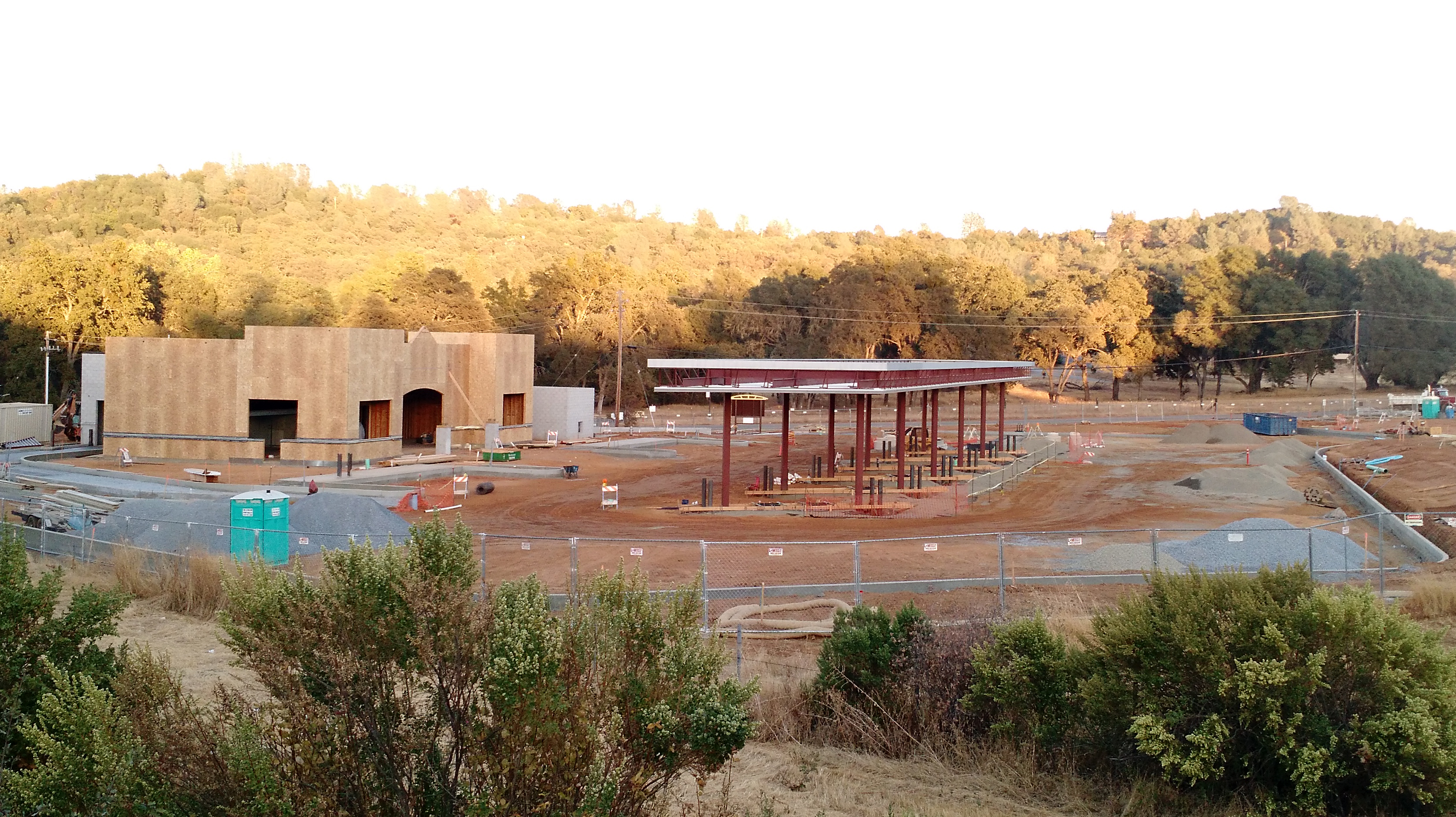
Shingle Springs Village continues to take shape on tribal lands just off Highway 50 on the West Slope. Photo/LTN

Shingle Springs Village continues to take shape on tribal lands just off Highway 50 on the West Slope. Photo/LTN

The Board of Supervisors approved the tribe’s encroachment permit on June 28. EDCI believes the county’s environmental review was insufficient. They filed a lawsuit alleging the mitigated negative declaration the county prepared violated the requirements of CEQA (California Environmental Quality Act) because it did not fully analyze the environmental impacts of the entire project.

Because the facilities themselves are on tribal land, the lawsuit did not prevent the tribe from continuing to construct the fueling bays and commercial buildings as they waited for the legal process to play out. Lawsuits take time, as the lengthy administrative record is prepared by both parties, briefs are submitted and settlement conferences are scheduled. El Dorado Council requested a stay which would prevent the county and EID from moving forward with any actions related to implementing the encroachment permit itself—the disturbance of any county roadways to construct the permanent driveway access to the property or for the installation of connections to existing EID water and sewer lines offsite.

At issue is what the actual scope of the Shingle Spring Village project is, what potential impacts on traffic, noise, aesthetics, water and sewer capacity it will have, and whether the county’s environmental review before granting the encroachment permit was legally adequate.

As requested by the county, the tribe provided a complete project master plan as part of their encroachment permit application. It showed the gas station/convenience store complex as Phase I and a restaurant, retail and office space fast-food establishments, an entertainment venue and an 80-room hotel and conference center as Phase II. A traffic impact analysis was prepared which outlined how both phases of the project would affect traffic circulation in the immediate area, but the county’s review of environmental impacts and needed mitigation measures only focused on Phase I. Analysis of the impacts of Phase II was deferred to a later time. Such segmentation of the environmental review process, EDCI contends, violates CEQA; a full environmental impact report analyzing the impacts of the entire project is required.

What concerns El Dorado Council is that the admittedly more significant impacts of Phase II have not been taken into account and that the county may not ever get another chance to do so.

Speaking for the tribe and its development corporation, attorney Matthew Adams told the court Phase II of the project was, “a long-range concept, a hypothetical plan submitted by the tribe at the county’s request.” He added that the tribe has not planned or budgeted for it. He added that before Phase II of the project could take place, there would have to be additional environmental review by the county.

Attorney Marsha Burch, representing EDCI, disagreed. The environmental analysis the county just completed might be, “their only opportunity to address all of the project’s impacts … the idea of a second (encroachment) permit process is not supported by fact,” Burch contended. If the tribe did not request approval for additional encroachments to access the property or changes to the pipes needed to supply water and sewer for Phase II, then there would be no further county review.

Phase II as presented in the Master Plan, or an even bigger project, could be built with no opportunity to mitigate the increased traffic and other impacts. The traffic impact analysis indicated that Phase I would generate 807 new daily vehicle trips, but that Phase II would generate 8,549.

Lake Tahoe News asked El Dorado County Development Services Director Roger Trout what would trigger additional review of the Shingle Springs Village project by the county. Trout pointed to the provision in the motion made by District 4 Supervisor Michael Ranalli at the June 28 board meeting which included the stipulation that, “Future encroachments onto right-of-way from APN 319-220-18 shall require board approval.”

Right now, Trout added, there is the approval of one encroachment for the fueling station. If the tribe later adds relatively small commercial development, such as a restaurant, then the existing encroachment permit will be adequate.

“If they build something bigger, they will need more encroachments and they will have to approach us. That’s what the board action on June 28 said,” Trout said.

The county also has the option of revoking the existing encroachment permit should the tribe do something that abuses the agreements under that permit.

In addition to the county’s encroachment permit, the project also requires an environmental review under CEQA by EID and their approval to provide water and sewer service to the property.

EID requested the tribe include the potential water and sewer demands of all phases of the project right at the beginning. A March 16, 2015, letter from EID supervising civil engineer Michael Brink to Tamara Murray-Guerrero, chairperson of the tribe’s business development corporation noted, “Service is only requested for Phase I of an apparent multi-phased development. Based on the conceptual site plan provided, it appears future phases (hotel) will have a much higher demand than the proposed Phase I retail/fuel station.”

Some concern was expressed in that letter whether EID’s then-existing sewer system could accommodate the demands of Phase II.

Brink told Lake Tahoe News that is not an issue now. “The pipes (on the project site) are sized to meet all anticipated demands of all phases of the project as we know them. We do have the capacity to serve their needs. There is no expansion needed at the Deer Creek Wastewater Treatment Plant in Cameron Park.”

Judge Stracener questioned Adams on this same point. Adams responded it was, “in the public interest” to put in the larger pipes now as it would avoid tearing up country roadways a second time and be less expensive for everyone should there be a Phase II. He added, “We are speculating about the future. CEQA says that since the county can’t shape the project, environmental review is meaningless.”

Stracener called this “Wizard of Oz logic.” “Pay no attention to the man behind the curtain. Pay no attention to the large water and sewer lines put in just in case we build something bigger, because it’s more cost efficient. Ignore the fact it can feed all of Phase II because we haven’t decided on this.” Phase II, he added, “Is more than a gleam in someone’s eye.”

EID has not yet given its final approval to the tribe’s request for water and sewer service. Brink explained that EID has submitted its final comments and is still awaiting a resubmittal of site plans from the tribe’s engineering firm, Baker Williams Engineering of Sacramento. Plans and revisions have been going back and forth since March 2015. As of Aug. 31, 2016, EID did its final review and is ready to sign off once they receive the project’s final site plans.

EID will also issue a notice of determination regarding their CEQA environmental documentation.  Brink noted that they are using the county’s mitigated negative declaration from the encroachment permit as the basis of their review.

It is the effect of the Shingle Springs Village project on the “public interest” of El Dorado County residents that is at the heart of the controversy surrounding it. El Dorado County Deputy Counsel Breann Mobius told the court on Oct. 6 that it “cannot issue a stay against the public interest.” She added, “There is already constant litigation in this county. If the stay is allowed, no one can rely on their permits.”

Stracener responded, “Isn’t the public interest involved in the impact of that project on all of that outlying area?”

El Dorado Council co-founder and spokesperson Carol Louis agrees.

“The judge made a good ruling (granting the stay) for the families and businesses surrounding the Casino Tribe’s Village project,” she told Lake Tahoe News. “The tribe’s chairman, Nick Fonseca, his tribal council, and the Board of Supervisors have taken an adversarial position toward the families in this community. All citizens of El Dorado County both Indian and non-Indian are suffering from bad leadership which forces the residents to act on their own behalf to protect their constitutional rights.”

Stracener’s Oct. 7 minute order reads, “After careful review of the moving and opposing papers and further consideration of the arguments of the parties following oral argument, the court adopts its tentative ruling as the final ruling on the submitted matter.” That tentative ruled concluded, “The court finds that it is in the public’s interest to stay the encroachment project approval/encroachment permits pending a judgment in this action.”

Fonseca, chairman of the Shingle Springs Band of Miwok Indians provided this statement to Lake Tahoe News: “The judge’s decision issuing a stay on the utility and road construction portion of the Tribe’s gas station project is disappointing. However, the Shingle Springs Band of Miwok Indians is continuing construction on its trust land and will work through the court process to resolve the judge’s outstanding concerns. The tribe continues to be excited to provide the gas station services to the community.”

El Dorado County Counsel Michael Ciccozzi had not yet reviewed the minute order, but noted via email, “We have not yet seen the judge’s ruling, but will review it when received and advise our board accordingly.”

Only actions by the county or EID with regard to the encroachment permit are halted by the minute order until it is either appealed or the lawsuit filed by EDCI is settled. An appeal would be filed with the Third District Court of Appeals. Continued construction of the gas station complex onsite is not affected.


Nev. agencies submit $8.2B in budget requests

By Sandra Chereb, Las Vegas Review-Journal

CARSON CITY — Nevada state agencies submitted budget requests totaling $8.2 billion for the upcoming two-year cycle, $800 million more than the current spending level, administration officials said Friday.

The release of agency requests is one step in a complicated budget-building process and likely will not be reflected in the final executive budget that Gov. Brian Sandoval recommends to lawmakers early next year before the Legislature convenes in February.

The requests include 5 percent budget cuts that Sandoval asked agencies to prepare for in March. Without those, the total is $8.5 billion.

Read the whole story


Old, new Nevada clash over economic future

By Jason Hidalgo, Reno Gazette-Journal

On a clear September day in 2014, Nevada’s brain trust for economic development gathered in Carson City to celebrate the turning of a new chapter in Silver State history.

Tesla’s $5 billion Gigafactory was coming to the Reno area, a coup for a state considered an underdog against formidable competition such as Texas. It was the perfect symbol for a new Nevada, one that embraced emerging industries — nothing like the outdated images of divorce and prostitution lampooned by shows such as “Reno 911.”

As Gov. Brian Sandoval and Tesla Motors CEO Elon Musk celebrated the partnership in front of a throng of local and national media, two people who played key roles in wooing the electric car and battery company to Northern Nevada smiled in the audience. One was Economic Development Authority of Western Nevada President and CEO Mike Kazmierski, whose organization was tasked with showing potential sites to Tesla. The other was Lance Gilman, principal of the Tahoe Reno Industrial Center, which Tesla picked as the location for its Gigafactory.

The partnership seemed unlikely at first glance. On one hand, you had Kazmierski, a buttoned-down West Point graduate and former garrison commander who prefers not to call attention to himself. On the other hand was Gilman, a colorful personality who shows up at events in a Stetson hat and knows how to work a crowd. Despite differences in personality, both established a symbiotic relationship.


Behind the scenes, however, some cracks were starting to show in the otherwise rock-solid partnership between EDAWN and Tahoe Reno Industrial Center.

Read the whole story


Stateline event center relying on higher bed tax

By Kathryn Reed

STATELINE – Hotel guests in Stateline are going to help fund the special events center that is going to be built on the front parking lot of MontBleu at Highway 50.

The Tahoe Douglas Visitors Authority board this week approved raising the Douglas County lodging license fee. Now the county commissioners must OK the increase. That board is likely to hear the issue in December. This does not have to go to the voters.

The current fee is 3 percent. It would increase to 4 percent. Hotel guests also pay a 10 percent transient occupancy tax. The total 14 percent, if approved, would be the same rate guests would be paying in the redevelopment area of South Lake Tahoe if Measure P passes in November.

All of the money collected in Stateline would stay at the lake specifically for the planning, construction and operation of the facility.

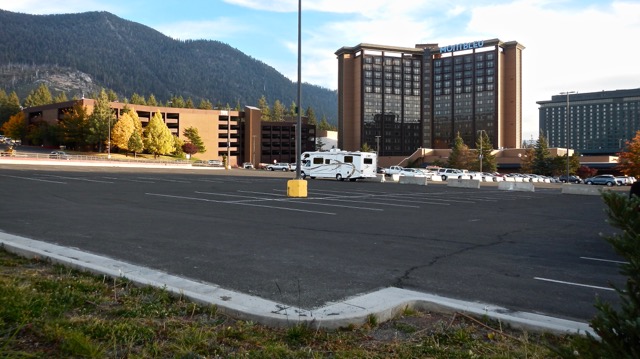
The parking at MontBleu could become an events center. Photo/LTN

The parking lot at MontBleu could become an events center. Photo/LTN

In January the county created a redevelopment area that basically encompasses the casino area to Kahle Drive. With Edgewood Lodge and Tahoe Beach Club being built, this will bring added revenues to the county to help raise money for the entertainment venue.

Originally the event center had been envisioned for the other side of the street and was going to be a 6,000- to 7,500-seat indoor-outdoor venue. After further study the MontBleu site was deemed best. It will be totally indoors, seating between 4,000 and 5,000 people.

The actual land is owned by Edgewood Companies.

Douglas County, Edgewood Companies and the casino properties have been talking about a performing arts center at Stateline for years. The casino showrooms cannot hold that many people and the Harveys outdoor facility is seasonal.

“The community recognized that group activities benefit tourism. And it is consistent with the transition of the economy from a gaming based model to a resort destination, recreation based model,” Lew Feldman, attorney for TDVA, told Lake Tahoe News.

As of today, TDVA would own and operate the facility. The goal is to drive more people to Tahoe, especially in the off-season.

Also at the Oct. 12 board meeting $12,060 was allocated for a parking analysis.

Board members Mike Bradford (representing Lakeside Inn) and Nancy McDermid (Douglas County) were appointed to the subcommittee to deal with the entertainment venue issues. They have the authority to spend up to $100,000, though that could be multiple $100,000 expenditures. Allocating money for a design fee will likely be an immediate need after the parking study is done.


LT Boys & Girls Club in search of new home

By Kathryn Reed

Proposition 51 could turn out to be a mixed blessing for entities in South Lake Tahoe.

If it passes, Lake Tahoe Unified School District intends to reopen Al Tahoe Elementary School next fall. If that happens, the Lake Tahoe Boys & Girls Club will be on the street.

This is why the nonprofit is in the hunt for a permanent home.

The statewide proposition is a $9 billion school facilities bond. LTUSD is expecting to receive $1.4 million.

With enrollment increasing in LTUSD, the district needs more space. Al Tahoe closed after the 2003-04 school year because of declining enrollment and budget deficits.

“It will start as a K-2 school and build from there. It will be a STEM school. However, if Prop. 51 does not pass, we will likely not open the school,” Shannon Chandler, spokeswoman for LTUSD, told Lake Tahoe News. “The funds are necessary to do significant upgrades at the site, including a boiler system which could cost upward of $400,000.”

The Boys & Girls Club, which has more than 500 members and averages 300 kids a day, had hoped to be able to be part of the new South Lake Tahoe recreation center if Measure P passes in November. But the building of that structure would be a few years off.

The organization this month received a check for $50,000 from Rob Katz, CEO of Vail Resorts, to help with finding a permanent location.

“The club is backing Measure P on the city ballot to fund recreation as that is currently our best bet of a new home. But for the integrity of both the rec center and the club we would still like to have dedicated space of our own paid for by the club and in close proximity to the rec center — and utilize the rec center for daily sports, recreation, large group activities, etc.,” Jude Wood, executive director of the Boys & Girls Club, told Lake Tahoe News.

The club keeps growing. In 2015, it grew by 125 percent. Last summer there was a waiting list. So, even if Al Tahoe were to continue to be an option, the reality is the club could use a bigger space.

The nonprofit is the only afterschool program on the South Shore for youth 5 and older. Two-thirds of the families fall below the California poverty line.

It costs $100 a year per child to attend for a year, though many qualify for a discount based on their income.

Besides needing space for activities, the club wants room for school related activities such as being able to conduct science experiments as well as a kitchen because meals are part of the offerings. More than 27,000 free meals are served a year, plus an additional 54,000 free evening snacks.


80% containment in fire near Cascade Lake

The Emerald Fire burns on Cascade Ridge Friday morning just before daybreak. Photo/Taylor Flynn/Tahoe Mountain News

The Emerald Fire burns on Cascade Ridge Friday morning just before daybreak. Photo/Taylor Flynn/Tahoe Mountain News

Updated 7:10pm:

By Susan Wood

CAMP RICHARDSON — The Emerald Fire burning near Cascade Lake is 80 percent contained. It has burned more than 200 acres.

According to Kit Bailey, U.S. Forest Service local fire chief, “We have stopped the forward progress.”

The fire, though, is unpredictable. At one point the flames were going toward Lake Tahoe even though the wind was pushing it in the other direction, Bailey told Lake Tahoe News.

It started near Highway 89 at Spring Creek tract about 1:30am Oct. 14 and ran hard toward Lake Tahoe. Flames reached Lake Tahoe on a beach north of Camp Richardson, according to CalFire. However, the fire as of 10:20am was only burning on the mountain side.

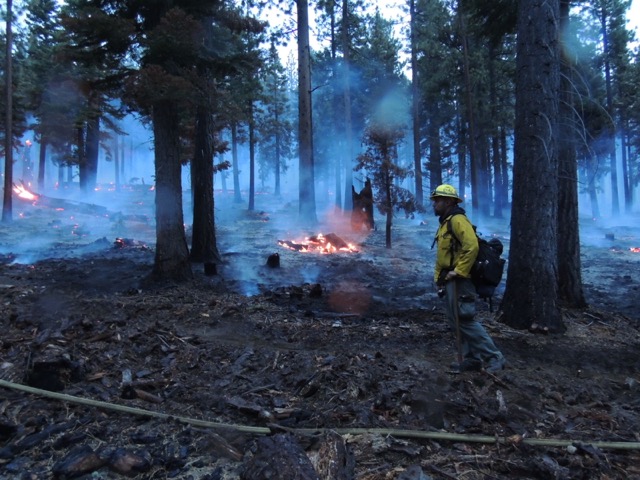
A firefighter keeps a watchful eye on the blaze along a fire line near Highway 89 north of Spring Creek tract on Oct. 14. Photo/Taylor Flynn/Tahoe Mountain News

A firefighter keeps a watchful eye on the blaze along a fire line near Highway 89 north of Spring Creek tract on Oct. 14. Photo/Taylor Flynn/Tahoe Mountain News

It is burning west of Spring Creek near Cathedral Road. Evacuations have been ordered for Spring Creek, Cathedral, Fallen Leaf Lake’s west shore, Cascade Properties and Cascade Lake. Five hundred people are on mandatory evacuation orders, while another 500 have voluntary orders. While an evacuation center has been set up at the South Lake Tahoe Recreation Center, people are being told to drive north on Highway 89 toward Tahoe City. Rideout Community Center located at 740 Timberland Lane in Tahoe City has been opened for evacuees.

Highway 89 is closed from Fallen Leaf Road to Bayview Campground, and the evacuation area north of Bayview has been released. The highway will remained closed until hazardous trees can be cleared, this could be a day or two.

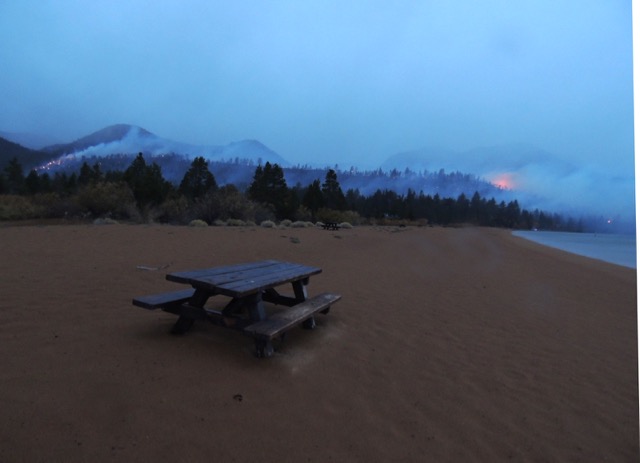
From the vantage point of Baldwin Beach, hot spots continued on the western and eastern sides of Cascade Ridge, though large flare ups appeared to be diminishing as rainfall continued about 7:30am. Photo/Taylor Flynn/Tahoe Mountain News

From the vantage point of Baldwin Beach, hot spots continued on the western and eastern sides of Cascade Ridge, though large flare ups appeared to be diminishing as rainfall continued about 7:30am. Photo/Taylor Flynn/Tahoe Mountain News

One of the big issues with suppression is that no aircraft can fly because of the strong winds. Visibility is also a concern because the rain, smoke and low clouds are a problem.

Fire officials have been hoping the rain will give them the relief they need to help put this out. Right now they are building a line around the fire.

“The rain has been extremely helpful and has stopped it significantly,” South Lake Tahoe Fire Chief Jeff Meston told Lake Tahoe News.

Fire trucks are parked at the residences of Cascade Lake. No houses have been threatened.

“There was a lot of big firefighting going on last night,” Lake Valley Fire Chief Tim Alameda told Lake Tahoe News. However, he added, what isn’t helping is “there is no shortage of dead trees.” Ironically, that is what the Lake Valley board discussed at its meeting Thursday night.

Lee Webber of Antioch, who was celebrating his birthday by camping at Camp Rich with his family, was on standby to decide whether they would evacuate. “Last night the wind was rough,” he told Lake Tahoe News.

The cause of the fire is under investigation.

While this fire was going, South Lake crews got called at about 3:30am Oct. 14 to a brush fire Meeks Lumber. It is another one of the “suspicious” fires that has been confounding firefighters.

— Kathryn Reed contributed to this story.


KMS sale in jeopardy; county-TRPA involved

By Kathryn Reed       

STATELINE – The conversion of Kingsbury Middle School into affordable housing is in jeopardy because the county has not completed the area plan that encompasses the site and the allowable number of vehicle miles has been drastically reduced per Tahoe Regional Planning Agency rules.

Patrick Taylor in July entered into an agreement with Douglas County School District to purchase the 22-plus acre site with 36,000-square-feet of space for $3.25 million, which included paying half the utilities — $25,000 – for a year.

At this week’s board meeting the four who attended (Ross Chichester, Neal Freitas and Cindy Trigg were absent) deliberated for some time about what to do with the due diligence period ending the following day, Oct. 12. All four had to agree for any motion to pass. Ultimately they agreed to extend the period one month to Nov. 16, one day after their next meeting.

But based on how slow government works in the basin, there is no way all of the issues will be resolved in that time period.

“For the Kingsbury Middle School site, TRPA previously determined that the vehicle miles traveled was limited to 286. This is based on TRPA code provisions that deal with previous uses. Since the school had been closed for over 60 months, the higher vehicle trips originally associated with the school use was no longer recognized by TRPA,” Mimi Moss, director of Douglas County Community Development, told Lake Tahoe News. “Any increase in the VMT will now require a change to the area plan, including additional environmental study and traffic analysis.”

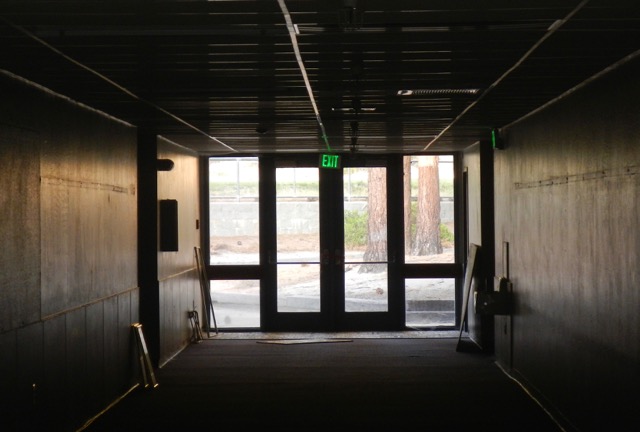
The halls of Kingsbury Middle School have been vacant for eight years. Photo/LTN

The halls of Kingsbury Middle School have been vacant for eight years. Photo/LTN

At the school meeting Oct. 11, Superintendent Teri White said the allowable VMT was 1,500 when KMS was open. The school site has been sitting empty since students left at the end of the 2007-08 school year.

Because there was a 1½ year delay by the county in submitting the area plan to TRPA some of the technical data needs updating. The Tahoe Doulas Area Plan was most recently sent to TRPA on Aug. 24, with TRPA sending it back to the county with comments on Sept. 23. The county is working to address the bi-state regulatory agency’s concerns.

Ascent Environmental is the consultant helping the county with the planning document.

A sticking point between the county, school district and KMS buyer is who will pay for all the necessary studies to move the project forward.

“The county is in discussions with our environmental consultant regarding additional timelines, costs, and area plan changes based on our recent discussions with the school district. Ultimately, the new buyer would be responsible for the cost,” Moss said.

Traditionally the county would pay for the environmental review of the area plan as a whole and the developer would pay for the analysis of impacts associated with his project. The traffic analysis is also necessary because the property use is changing from a school to housing.

Taylor told the DCSD board he isn’t going to put another penny into the project (he put up a $15,000 deposit) until the VMT issue is resolved.

Board member Teri Jamin, who was once the head planner for the city of South Lake Tahoe, advocated for extending the due diligence period two months if a non-refundable deposit could be secured from Taylor so he would have some skin in the game.

Board member Robbe Lehmann said, “If they want to buy it, it should be as is.”

Board member Tom Moore said, “We are gambling to a certain extent because we don’t know how it would change in value based on the perception of zoning.”

The district is paying about $5,000 a month for the upkeep of the site, which includes utilities.

Taylor is the first person to come forward with an offer on the site. That is what has some board members nervous, is that it will sit vacant for another eight years. But some board members are reluctant for the district to expend money when the zoning and VMT issues are not their problem.

Vehicle miles traveled, while always an issue in Tahoe, has been getting more attention of late with projects inside and outside the basin.

At the July meeting of the Regional Plan Implementation Committee of the Tahoe Regional Planning Agency there was a lengthy discussion about the topic. VMT for the TRPA has more to deal with air and water quality than congestion. But it’s gridlock that impacts drivers – locals and tourists.

“We can’t build road capacity therefore the only thing we can do then is restrict car use,” RPIC member Bill Yeates said.

There was talk of needing to think outside the box as well as work on basics like offsite parking and a reliable transit system.

That discussion will affect the KMS site if and when the affordable housing project goes before the TRPA.