Social media impacting backcountry decisions

By Paddy O’Connell, Adventure Journal

“Hold my beer and watch this.” The famous last words of a redneck, as the joke goes. But, could “take my picture and post this” be the last words of millennial backcountry skiers and snowboarders? It would seem very possible.

The latest human factor in avalanche terrain decision-making is the pressure of social media and the influence of an omnipresent digital group dynamic.

At the International Snow Science Workshop at Breckenridge, Colo., earlier this month, State University of New York at Plattsburg Associate Professor Jerry Isaak presented his paper “Social Media and Decision Making in Avalanche Terrain.” Isaak explained that decision-making and risk-taking in backcountry terrain is highly influenced by heuristic issues. Our human desire to be accepted by those we respect or seeking the acceptance of those we want to notice us will many times silence that cautious internal dialogue. We convince ourselves to engage in dangerous activities due to social influence. In the digital age, Kodak Courage has morphed into Facebook Fame and Instagram Celebrity. And that social influence is omnipresent. We carry it in the smartphone in our pocket.

In his paper, Isaak describes acceptance and social facilitation as the major heuristic influencers of backcountry “digital natives,” millennial off-piste practitioners who are experts in the creation and consumption of social media content.

Read the whole story


Placer transportation sales tax plan divisive

By Tony Bizjak, Sacramento Bee

Placer County roads and highways are increasingly congested and local leaders say they don’t have enough money to provide traffic relief. After years of debate, they are asking voters on Nov. 8 to approve a half-cent sales tax increase to fund an estimated $1.6 billion of transportation improvements over the next 30 years.

Measure M, the Keep Placer Moving initiative, will need a two-thirds yes vote to pass. It’s a tough hurdle in a largely Republican county where voters are known to be fiscally conservative. But congestion problems have led some low-tax advocates to offer support for the measure.

The tax is similar to transportation sales tax measures on the ballot in 14 California counties, including neighboring Sacramento. County officials say they are asking voters for the tax because the state and federal governments have failed to provide adequate funds for roads, and there appears to be no movement at either state or federal levels to come up with a reliable, long-term revenue source.

Read the whole story


Tahoe memorial honors 5 firefighters who died

By Susan Wood

CARSON CITY – If you don’t think wildland fire is on the back of Clear Creek residents’ minds, just look at road landmarks.

One of which was just established on Highway 50 east of Spooner Summit where the Tahoe Douglas Fire Protection District, with its brethren, came out a few weeks ago to memorialize the five firefighters who died during the 1926 Clear Creek Fire.

More than 40 people attended the ceremony on Sept. 28, the 90th anniversary. A version of “Taps” played while people reflected on the five unmanned helmets to signify George Brown, J.E. Mitchell, Bryant Whitmore, Arthur Sunday and Ross Morres.

A little-known permanent plaque on a cement block describing the horrendous fire has been installed at the Highway 50 turnout. The memorial overlooks the “Double Barrel” turn in the canyon where the three inmates, forest ranger and V&T railroad gandy dancer, respectively, were trapped there by swirling Zephyr winds.

These represent the same notorious winds residents in the sleepy neighborhood southwest of Carson City were keeping their eyes on earlier this month. On Oct. 13, a wildland fire broke out east of the canyon.
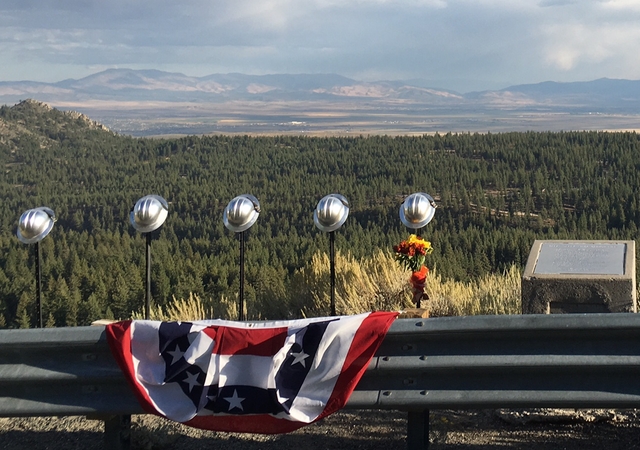
Five helmets just east of Spooner Summit on Highway 50 represent the firefighters killed in 1926. Photo/Provided

Five helmets just east of Spooner Summit on Highway 50 represent the firefighters killed in 1926. Photo/Provided

The men and women who defend the area are fully aware of the danger and know the possibility of another tragedy like the 1926 fatal fire exists when strong winds and drought conditions are combined with a dangerous topography like Clear Creek.

During the 1926 fire that started at 4am, those notorious winds kicked up and a fire was sparked, with the results disastrous.

“The wind shifted three times on them,” Tahoe Douglas Fire spokesman Eric Guevin said while looking over the canyon.

“Their lives were spent saving resources important to Nevada,” Guevin pointed out, referring to the forested area.

As the modern-day firefighter glanced out on the perch overlooking the valley, an ominous haze lay hanging above the valley floor from an El Dorado County prescribed burn.

“This was our largest fatal wildland fire in this area. The fire went downhill, then came back up when the winds shifted. I think they thought to go into a defensive mode, but caught too much fire. It must have been difficult,” Guevin told Lake Tahoe News. “Our crew was named the Zephyr crew from those winds. (That 1926 fire) was definitely fanned by those winds.”

He admits the protective equipment has improved dramatically, including the uniform, goggles and masks. Ninety years ago, firefighters wore water-soaked bandanas – but they would get fatigued breathing into them.

What hasn’t changed are the winds known to shift dramatically. Another constant threat — more people live in what’s called the wildland fire urban interface – meaning on the edge of the forest.

Guevin described the memorial ceremony as having a somber mood mixed with a fitting sense of camaraderie. “A lot of our younger guys didn’t know about it. So having them there standing brother to brother was a neat feeling for something so well deserved.”

Three of the firefighters died at the scene. The other two succumbed to burns on 80 percent of their bodies in the hospital.

Consequently, two of the inmates were pardoned.

“They gave the ultimate sacrifice,” Guevin summarized.

Residents to this day are constantly worried about another fire.

“We worry about people starting fires up here,” contractor Steve Cote told Lake Tahoe News.

The 20-year resident has put a lot of money and effort behind keeping his 12 acres maintained. He has a large mower and other heavy equipment designed to manage the brush around his property.
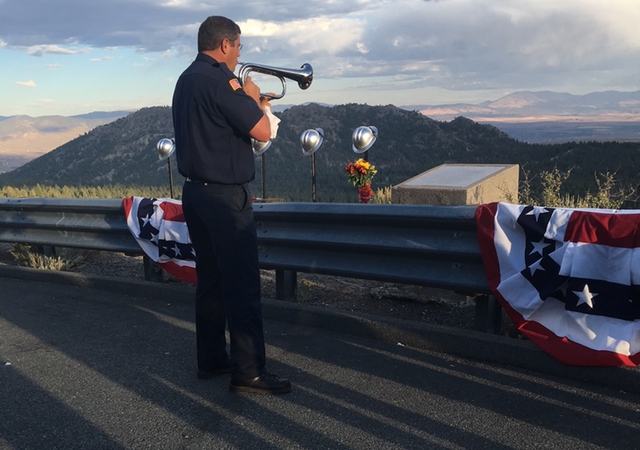
Tahoe Douglas firefighter Eric Guevin plays the bugle during the ceremony this fall honoring those who died 90 years ago. Photo/Provided

Tahoe Douglas firefighter Eric Guevin plays the bugle during the ceremony this fall honoring those who died 90 years ago. Photo/Provided

“These (firefighters) are heroes, but sometimes (the fires) get away,” he said outside his home perched on a hill as strong winds blew the vegetation in the distance. “Sparks can even cause one.”

Cote was referring to power equipment, adding he doesn’t run his when it’s really hot outside.

If a fire is sparked, vigilant neighbors are on hyper alert.

“We all kind of look out for each other here,” he said, pointing out how he saw the lightning strike for another fire sparked closer to Jacks Valley months ago.

Down his driveway to the privately-owned Clear Creek Road, signs of every sort are placed on the road to remind residents and the limited visitors who drive the seldom-used road to be extra careful.

One sign reads: “Beware of Fires.”

Others declare a list of “fire safety rules” as in no “off road activity, camping, campfires, fireworks, outside smoking and open flames.”

Another homemade plywood sign at a fork in the road marking a development even notes the emergency exit.

To a longtime resident like Dixie Busch, there’s no messing around or leniency when it comes to the threat made by the careless. The intrepid senior who’s lived at her Clear Creek Road home for 30 years has even stood up to a stranger trying to camp in the canyon telling him to move along.

“I asked him where he lives,” said Busch, who lives on a road named after her family. When the man answered, she said: “Good, then I’ll come camp on your lawn.”

“We’ve been lucky this year. We’ve had more rain, and that’s helped a lot. But it’s still dangerous,” she said.

To alleviate the threat, Busch has much of her property mowed down like Cote. But beyond the Busch estate, she wished some of her neighbors on the other side of Clear Creek Road took the same extra care. The canyon is heavily forested, with ladder fuels blanketing the area.

When the strong Zephyr winds roar through, residents like Cote and Busch become even more sensitive to traffic on the road. Their stranger danger threat could be someone setting a fire.


Makerspaces expanding influence in Tahoe-Truckee

Lake Tahoe School in Incline Village opened a makerspace last year. Photo/Provided

Lake Tahoe School in Incline Village opened a makerspace last year. Photo/Provided

By Laura Read, Moonshine Ink

With the imminent arrival of the Truckee Roundhouse membership-based workshop, set to open at the Truckee Tahoe Airport Dec. 1, the region joins ranks with places around the world that offer work spaces where anyone can construct the projects of their imaginations.

But Truckee Roundhouse isn’t the only local enterprise that’s sharing resources and costs to bring brains and brawn together under one roof.

Like in similar communities, Tahoe area locals have been building things together for years: A house construction site is a makerspace where people of different skills make objects on a single site in order to build a shelter; Riverside Studios, in its original form on Riverside Drive, was a makerspace where in a collection of low-rent buildings several artists created work for sale; North Tahoe Arts in Tahoe City has held artisan classes for both hobby and sale in a large room above its downstairs galleries.

Read the whole story


EDC voters still waiting to get mail ballots

By Brad Branan, Sacramento Bee

Some El Dorado County voters have inundated their elections office with calls after not receiving mail ballots for the Nov. 8 election.

Registrar of Voters Bill Schultz said the problem lies with the U.S. Postal Service, since his office mailed the ballots Oct. 11-14. That means USPS has failed to deliver some of them within 10 days.

Schultz said he thinks the delays are due to the volume of mail – his office sent about 70,000 ballots – and because of the way the Postal Service distributes mail. USPS hauls the ballots down Highway 50 to West Sacramento for sorting before delivering them back up in El Dorado County.

Read the whole story


CalSTAR, ski workers prep for winter transports

CalSTAR on Oct. 21 explains to Heavenly employees how to work around a helicopter. Photo/Kathryn Reed

CalSTAR on Oct. 21 explains to Heavenly employees how to work around a helicopter. Photo/Kathryn Reed

By Kathryn Reed

A helicopter ride isn’t anyone’s idea of a good way to end the ski day. But when minutes matter an air ambulance can be the difference between life and death.

It’s a group effort to ensure injured skiers and riders get to a hospital as quickly as possible.

“Our goal is skids down to skids up of 10 minutes or less,” CalSTAR flight nurse Beth Frisby said.

Kip McCarthy, Kirkwood Mountain Resort’s health and safety manager, told Lake Tahoe News an air ambulance is an integral part for that resort as well at Heavenly Mountain Resort.

“What would have been over an hour is now 20 minutes,” McCarthy said of driving vs. air time to get a patient to a hospital.

Every year CalSTAR trains with employees of the local mountains so they are ready when the helicopter arrives. On Friday it was a group from Heavenly learning about the loading procedures and the necessary respect to have for the H235, P3 Airbus.

“We need to get this right 100 percent of the time,” flight nurse Ted Langevin told the group huddled around the landing zone at the California Lodge parking lot. “If you are not sure what to do, stop.”

Because accidents happen at all times of the day, even to workers, it’s not just the patrollers who train with CalSTAR.

Sky Meadows is the busiest on-mountain landing zone for CalSTAR at Heavenly. Photo/Kathryn Reed

Sky Meadows is the busiest on-mountain landing zone for CalSTAR at Heavenly. Photo/Kathryn Reed

The blades on the helicopter are not visible at night and the back of the bird is a dangerous place to be. Ironically, though, the back is where patients are loaded.

With this being the first year for the new helicopter, it will mean some training for the CalSTAR crew, too. The back end is lower to ground, which will make a difference in snowy conditions.

Bear paws are put on the skids in the winter for traction in the snow.

In a mock situation, with blades not rotating and no snow on the ground, the Heavenly gang got to see what it would be like to carry a backboard (sans patient) to the rear of the helicopter and then lift the patient in.

Those on the ground are responsible for telling the flight crew – which consists of a pilot and two nurses – the wind and landing conditions. If they don’t know the direction of the wind, saying they are facing a certain way and then if the wind is to their front or back, or if it’s swirling will help the pilot.

Dusty snow on the ground will kick up and blind the pilot. Stomping the snow to make it more solid might be needed. Putting a sack with chains in it (so it doesn’t blow away) can be a good marker for where the nose of the helicopter should be.

Don’t be afraid to call for helicopter was repeated multiple times on Oct. 21.

“If you are thinking about it more than one time, call the helicopter,” Frisby told the workers. “We’d rather be called and there’s no patient than to be called too late.”

It doesn’t cost anyone anything if it turns out the person should be transported via regular ambulance.

Langevin added, “Weather will always be an issue, but don’t let that be a determining factor for you.”


Patients are loaded from back into the CalSTAR helicopter. Photo/Kathryn Reed

Patients are loaded from the back into the CalSTAR helicopter. Photo/Kathryn Reed

Wind can be an issue, not so much for the helicopter, but for the people inside of it. Sudden gusts are the worst for the nurses.

“We can fly in a lot of wind. But if we can’t help the patient, it does us no good,” pilot Mark Davis told Lake Tahoe News.

It’s the CalSTAR team that decides where the patient will go and the type of care needed. Most ski patrollers have an extremely limited medical background.

Trauma and stroke patients go to Renown Medical Center in Reno, burn patients to UC Davis in Sacramento, cardiac cases to Carson-Tahoe in Carson City and fractures to Barton Memorial Hospital in South Lake.

CalSTAR, which has eight nurses, four pilots and a base mechanic, is like a flying hospital.

It’s not just injured skiers CalSTAR is lifting from area resorts. Babies have been delivered and sometimes the person has already died.

Of the 72 ski resort calls CalSTAR received in 2015-16, 35 percent were from Heavenly. Crews also went to Kirkwood, Sierra, Squaw Valley and Bear Valley. The No. 1 reason is for falls – which includes terrain park injuries, then hitting a fixed object like a tree, third is skier vs. rider (or some combination), and fourth is cardiac.

Hard conditions and busy times, like holidays, are when the call volume goes up.

Most resorts have designated landing zones for CalSTAR, though it is possible to land at other locations. Besides the Cal Lodge at Heavenly, Sky Meadows is the next busiest landing location. The Galaxy location near East Peak, Stagecoach and Boulder lodges are also landing sites.


Second home owners offer first-hand advice

By Marni Jameson, Orland Sentinel

Is owning a second home all it’s cracked up to be? That’s the question I cast to my experience-wizened readers. And their resounding answer? A definitive sometimes.

I am giving the reins over to my readers, who have shared their first-hand knowledge of second-home ownership. Here are their lessons from the trenches, beaches, mountains and golf communities:

“Just think!”

“There we were, stretched out on the beach — in January!” begins Bonnie Wilkes, explaining how she and her husband, then Chicago residents, came to own a second home in Sarasota, Fla. “The temperature was in the mid-80s. Wow! We thought — just think if we could have this all the time! We should buy a second home here.”

And they did. That was 34 years ago. “Never again did we feel that same level of relaxation while on vacation at that same beach,” she continued. “Some days we didn’t even make it to the beach because we were waiting for the refrigerator repair guy. Instead of strolling the gift shops in the village, we were at a big box store looking for a TV for the guest room.”

Waiting until the kids were grown made a second-home investment pay off for Jane Gold, of Saratoga. After their three children were out of the house, she and her husband bought a second home in Lake Tahoe.

“Our family always vacationed there, and we have fond memories of those times.” Five years ago, they bought a house close to the lake and just a four-and-a-half-hour by car from their main home, so they can take their dogs. “We don’t regret buying one bit.”

Read the whole story


Winter outlook not good for California

By Seth Borenstein, AP

Federal forecasters predict this winter may paint the U.S. in stripes of different weather: Warmer and drier than normal in the south, and colder and wetter than usual in the far north.

The National Weather Service winter outlook , issued Thursday, gets murky in the nation’s middle belt, with no particular expectation for trends in temperature or precipitation.

Still, some nasty storms might make the winter there memorable, said Mike Halpert, deputy director of the weather service’s Climate Prediction Center.

The major driver of the winter forecast is a budding La Nina, a cooling of the central Pacific that warps weather worldwide and is the flip side of the better-known El Nino, Halpert said.

For the South and California, “the big story is likely to be drought,” Halpert said.

And that’s not good news for California, which is in year five of its drought. The winter is the state’s crucial wet season when snow and rain gets stored up for the rest of year. Halpert said the state’s winter looks to come up dry, especially in Southern California.

“It’s probably going to take a couple of wet winters in a row to put a big dent into this drought now,” said weather service drought expert David Miskus. He said it will take “many, many years and it’s got to be above normal precipitation.”

The northern cold band that the weather service predicts is mostly from Montana to Michigan. Maine is the exception, with unusually warm weather expected.

The prediction center’s track record on its winter outlooks is about 25 percent better than random chance for temperature and slightly less than that for precipitation, Halpert said.

Private weather forecasters are predicting quite a different winter. They foresee a harsher one for much of the nation, including a return of the dreaded polar vortex, which funnels cold Arctic air into the U.S.

Judah Cohen of Atmospheric and Environmental Research in Lexington, Massachusetts, forecasts an unusually cold winter for the eastern and middle two-thirds of the nation, especially raw east of the Mississippi River.

Cohen, whose research is funded by the National Science Foundation and closely followed by meteorologists, links North America’s winter weather to Siberian snow cover in October.

He agrees that Maine will have a warm winter, and also predicts a warm Southwest.

The private Accuweather of State College, Pennsylvania, calls for frequent storms in the Northeast, early snow in the Great Lakes, bitter cold in the northern tier and occasional cold in the middle. Like other forecasters, it predicts a warm and dry southwest, with some hope for rain and snow from San Francisco northward.


Safety driving Meyers roundabout, Echo bridge

By Kathryn Reed

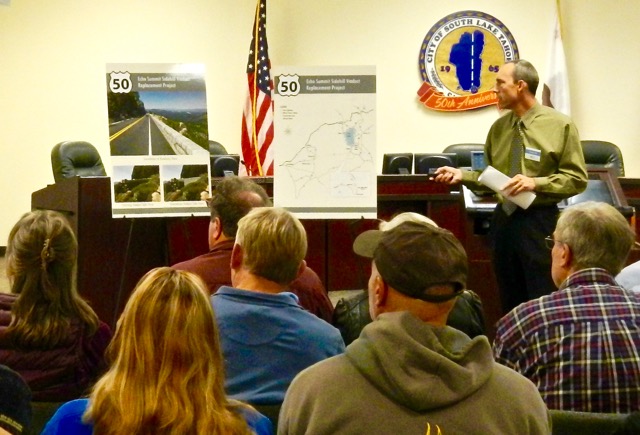
By the end of the 2020 construction season motorists should be driving over a new bridge near the top of Echo Summit and through a roundabout in Meyers.

Caltrans on Thursday night spent a couple hours telling the more than 30 people at an informational meeting about the two projects.

The bridge is needed to replace the one built in 1939. It’s located 7 miles west of South Lake Tahoe. It is crumbling, rebar is showing, steel is rusting and structurally it is unsound.

Today it has three spans; in the future it will be one. Travel lanes will go from 11-feet to 12-feet wide.

Clark Peri, Caltrans project manager, talks Oct. 20 about the Echo Summit bridge project. Photo/LTN

Clark Peri, Caltrans project manager, talks Oct. 20 about the Echo Summit bridge project. Photo/LTN

Three alternatives plus a no build are being studied, with comments on the environmental documents being taken until Nov. 3 (Details are online.)

The cost ranges from $6.5 million to $8.2 million.

What concerned some in attendance is that with all of the alternatives the highway would have to be closed for at least 10 consecutive days. Johnson Pass Road will be accessible with a permit, otherwise most people will be getting to western destinations going Highway 89 to Highway 88. At other times there will be one-way control.

In 2011, the highway over Echo Summit was closed for the retaining wall replacement. A Caltrans official on Oct. 20 said during that time it’s estimated the South Shore lost $1 million a day. With tourism rebounding, the economic impact could be even greater this time.

The bridge project is expected to take place in 2019 and 2020.

Public outreach will be part of the protocols.

Alternative 2 calls for a little wider roadway so a bike route could be added. Alternative 3 would have the cast done onsite.

Caltrans looked at repairing the bridge instead of replacing it. It was determined this would cost more money, and with the possibility of unknown issues arising, this could add to the expense and time to complete the project.

A geological study still needs to be completed.

One attendee asked whether building a tunnel had been study; it wasn’t.

During the first year of bridge construction Caltrans intends to build a roundabout at the intersection of highways 50 and 89 in Meyers. This discussion was the most heated, with many people flummoxed that it is already a done deal.

Caltrans said the 21 accidents, eight of which involved injuries, between 2007-12 triggered a safety study. A roundabout was determined to be better than adding stop signs or a signal.

What worries Brad Zlendick, battalion chief with Lake Valley Fire Protection District, is being able to get up Echo Summit, particularly in winter. Instead of going through the roundabout, it will be more expeditious to head into oncoming traffic even though this is more dangerous. He and Caltrans officials agreed to talk more.

The 135-diameter roundabout will be a single lane of traffic. What will be a bit unique is there will be a passing lane of sorts going west.

Pedestrian and cyclist crossings will be incorporated into the design.

On the original maps the legacy tree deemed worthy of protection during the Meyers Area Plan meetings was slated for removal. That is no longer the case. The large Jeffery pine on the southeast corner will not be harmed.

Tom Brannon, deputy director of the local Caltrans district, admitted the backups during peak times are not going to be alleviated with the roundabout. This particular roundabout is for safety, not traffic flow.


Questioning the easing of Calif. water restrictions

By Adam Nagourney, New York Times

EAST PORTERVILLE — California slashed urban water use over 25 percent in the face of a punishing drought last year, exceeding a mandatory order issued by Gov. Jerry Brown and turning the state into a model of water conservation. Californians tore out lawns, cut back landscape watering and took shorter showers as they embraced Brown’s call to accommodate what he warned were permanently drier times.

But this year, after regulators lifted the mandatory 25 percent statewide cut following a relatively wet winter, water use is up again, a slide in behavior that has stirred concern among state officials and drawn criticism that California abandoned the restrictions too quickly. In August, water conservation dropped below 18 percent compared with August 2013, the third consecutive month of decline.

By any measure, California is confronting a complicated new chapter as it enters the sixth year of a drought that has forced it to balance huge demand for a sparse resource — water — from farmers, residents, municipalities and developers. For one thing, the situation is not as dire as a year ago after a relatively normal rainy season. Some of the most searing symbols of the drought, such as near-empty reservoirs, are harder to find.

Read the whole story