Special accommodations for vets at LTCC

By Kathryn Reed

A little used meeting space at Lake Tahoe Community College is now a dedicated area for veterans.

“You don’t have to be a student to access these services. We are considering ourselves as a hub and will be able to refer vets to other services,” Aaron Barnett, the LTCC counselor who oversees the center, told Lake Tahoe News. “We’ve never had a place for them to meet before.”

The South Lake Tahoe school has been helping vets for years, especially with those using the post-Sept. 11 GI Bill. The Veterans Resource Center expands the offerings and gives those who have served a place to call their own.

Lake Tahoe Community College has created a Veterans Resource Center. Photo/Provided

Lake Tahoe Community College has created a Veterans Resource Center. Photo/Provided

At any given time LTCC averages about 30 veterans who are enrolled. With the center, it will be easier to welcome non-students into the fold and provide them with help as well.

The center is equipped with computers, printers, copiers, television, comfortable furniture, a fridge (snacks, water and coffee will be provided for free), and other amenities. It’s part work space, part lounge.

But it’s also a resource center to get information about financial aid, veteran benefits, priority registration, as well as obtain general assistance regarding transitioning back into civilian life.

The state is advocating community colleges have these centers for vets. LTCC started working on this one a year ago. More than half of all veterans who receive education benefits in California’s public higher education systems attend one of the 113 community colleges.

Counseling will come in many forms. A readjustment therapist from the Veterans Affairs center in Reno is at LTCC every other Thursday. If the need increases, it’s possible he could come every week. Stress management and psychological services are also available.

Greg Hoover, who served in the Marines for 20 years, will be the student worker in the center. By having students who are also veterans work in the center the goal is to boost camaraderie. Barnett and other LTCC employees will be available to work in the center as needed.

The El Dorado County Community Foundation provided money to outfit the LTCC center. El Dorado County dedicates a portion of transient occupancy tax dollars to veterans services. Those are the funds the community foundation is tapping. The college’s foundation has also been a player in getting the center started.

—–

Notes:

·      The public unveiling of the center will be Nov. 10 from 12:30-1:30pm. It is located in Room A203 on the second floor of the main building.



Drought ends in nearly one-fourth of Calif.

By Ellen Knickmeyer and Olga R. Rodriguez, AP

A heavy dousing of autumn rain in Northern California has lifted a quarter of the state out of drought, the highest percentage in more than three years, according to a federal report Thursday.

Water officials who oversaw mandatory water conservation by cities and towns emphasized three-fourths of the state remains in the five-year drought.

“Droughts are like recessions. Recovery from a recession doesn’t happen overnight; recovery from a drought doesn’t happen overnight,” said Max Gomberg of the state Water Resources Control Board.

Read the whole story


Nev. climate expert Redmond dies at 64

Climate expert Kelly Redmond died Nov. 3. Photo/DRI

Climate expert Kelly Redmond died Nov. 3. Photo/DRI

By Henry Brean, Las Vegas Review-Journal

Kelly Redmond was a leading expert on the climate of the West and how humans are changing it, but it was his ability to talk about science in an engaging and understandable way that might be his greatest legacy.

Redmond died Thursday at his home in Reno after a long illness. He was 64.

Since 1989, he served as the regional climatologist for the Western Regional Climate Center at the Desert Research Institute in Reno, where he also worked as a research professor. His work spanned every facet of climate and climate behavior, its physical causes and variability and how climate interacts with other human and natural processes.

“He knew the ins and outs of climate, but he was also very keen on what climate meant to society,” said Tim Brown, director of the climate center.


Read the whole story


Truckee craft beer industry dates to the 1800s

Lake Tahoe’s Boca Brewing in the 19th century shipped its lager worldwide. Photo/Truckee Donner Historical Society

Lake Tahoe’s Boca Brewing in the 19th century shipped its lager worldwide. Photo/Truckee Donner Historical Society

By Jay R. Brooks, San Jose Mercury News

We think of Lake Tahoe as a major tourist destination, famous for its ski slopes and deep, blue water. But in the 19th century, this region was prime mining territory, mined for gold and silver — and the lumber needed by growing settlements throughout the West. The area’s first breweries sprang up to satisfy those early fortune seekers.

The earliest of those breweries was probably Truckee’s St. Louis Brewery, which was also known as Grazer & Stoll. It began its 14-year brewing stint in 1874, the same year that saw the opening of the Paul Menk Brewery & Saloon. Think of it as an early brewpub, or at least a bar that served its own beer.

The short-lived Truckee Brewing Co. — which began as Kielhofer & Woods — opened in 1896, followed by the Eureka Brewery, which ran from 1899 to 1911.


Read the whole story


Whole Foods signs SLT lease agreement

By Kathryn Reed

Whole Foods is coming to South Lake Tahoe after all.

The announcement came this week in conjunction with the high-end supermarket chain’s fourth quarter earnings report. Leases for its 365 by Whole Foods Market stores have been signed in South Lake Tahoe, Redlands, and Fairfax, Va.

Details of the lease have not been disclosed. A representative from Whole Foods did not respond to an inquiry from Lake Tahoe News.

“The stores will feature a simple, affordable and convenient shopping experience that offers the high quality standards that Whole Foods Market pioneered,” the Austin, Texas-based chain said in a press release.

It will be built where the Knights Inn currently sits on Highway 50 near Ski Run Boulevard.

“The fact that Whole Foods has issued a press release is encouraging to us that they have comfort in the contract that we have,” City Manager Nancy Kerry told Lake Tahoe News.

This is an example of the architecture Whole Foods uses. Rendering/Provided

This is an example of the architecture Whole Foods uses. Rendering/Provided

The city and Pradip Patel, who owns Knights Inn, entered an agreement earlier this year for the city to purchase the parcel for $6 million. That agreement fell apart this fall when the California Tahoe Conservancy started talking privately to Patel as it angled for the commodities associated with the property.

(Tahoe Regional Planning Agency, the bi-state regulatory entity, has put a price on hotel units, commercial floor area and land coverage which has falsely inflated the value of properties in the basin and has stifled redevelopment.)

Patel did not return a call.

Mike McLaughlin, his attorney, told Lake Tahoe News he was unaware of any deal. McLaughlin does not believe the contract with the city is still viable.

“There was a financing contingency as part of the contract and the city didn’t satisfy that contingency. So by its terms the contract automatically terminated,” McLaughlin told Lake Tahoe News.

City Attorney Tom Watson told Lake Tahoe News, “Our position is we have an enforceable agreement.”

The City Council last month gave Watson direction to look into a potential lawsuit to enforce the agreement with Patel. The contingency was written to give the city an out in case funding from the California Tahoe Conservancy didn’t come through. And while that money isn’t available to the city, the city came up with the $6 million.

Patel used the contingency to his advantage to say he could pull out because the CTC wasn’t involved. The city says Patel and his attorney are wrong.

Since the blow up this fall Patel has been speaking directly with Halferty Development of Southern California.

Chris Peto with Halferty could not be reached.

What the terms of their agreement are have not been disclosed.

Halferty is in escrow to buy the neighboring property on the corner of Highway 50 and Ski Run Boulevard. The plan is to blur the property lines with commercial development that flows from one parcel to the other.

There is no way, according to officials, that the southwest lot could house Whole Foods because the store needs about 25,000-square-feet of commercial floor area and the corner parcel comes with about half that much.

The city originally wanted to make this a commercial and environmental project. That is why the CTC was involved.

“This is economic development first,” Kerry said.

Environmentally the creek that runs under the property was going to be day-lighted and 10,000 pounds of sediment diverted from the lake. The developer is under no obligation to make that happen. It was the Conservancy’s money – aka California taxpayers’ — that was going to pay for it. That aspect of the project may never happen.


Housing dominates loop road forum discussion

By Jessie Marchesseau

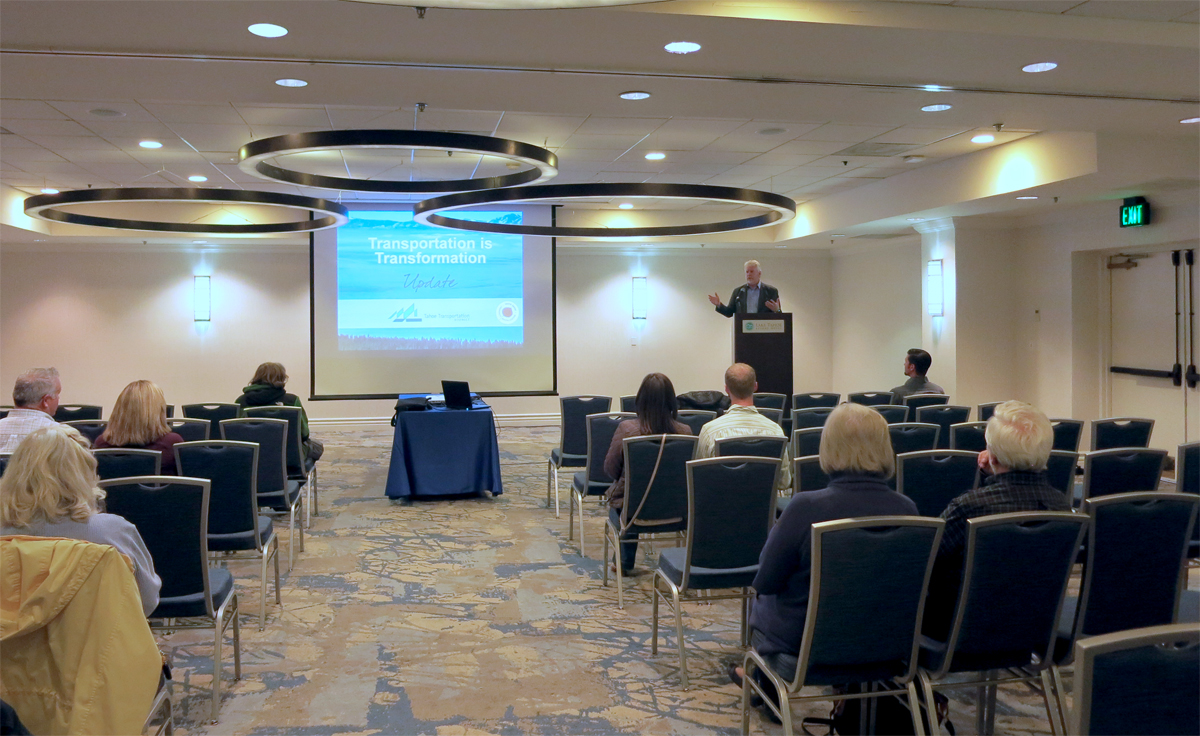
The loop road has been a hotly debated topic in recent years. As such, it was surprising to see more empty seats than filled ones in the conference room at Lake Tahoe Resort Hotel on Thursday night.

About 35 people were in attendance to hear Tahoe Transportation District’s District Manager Carl Hasty talk about the logistics of the loop road project and what his organization views as the benefits of it.

Hasty began by explaining that even though the plan for this project has been in discussions since the 1970s, the TTD believes the need for it now is much greater than it was then. As evidence of this, he pointed to traffic problems such as how people are cutting through residential neighborhoods to avoid congestion along Lake Tahoe Boulevard, an issue the TTD believes will be resolved by the loop road. He also pointed out that the casinos are not providing the draw for tourists the way they once did, and suggested having a pedestrian-friendly resort-style commercial core may help attract more visitors.

However, the issue which earned the most talk time for the evening was South Lake Tahoe’s housing woes.

Hasty mentioned time and again how hard it is for residents, especially people wanting to move to the area, to find affordable housing. He asserted that this project will help with that issue.

Carl Hasty, head of TTD, talks about the loop road on Nov. 3. Photo/Jessie Marchesseau

A sparse audience listens to Carl Hasty, head of TTD, talk about the loop road on Nov. 3. Photo/Jessie Marchesseau

For the preferred project plan which was presented at the forum, 76 current residential units would be removed. The intent is to replace those with the same number of new residential units, most likely in the form of apartment buildings along the new highway. Hasty said there is “potential” for additional housing units, but the plan as of now only includes replacing the ones being removed.

Of those 76 new residences, more than half would be designated low-income housing, and some would likely be senior housing. Hasty presented a few options for where new apartment buildings may be erected. The area behind Raley’s which is currently a parking lot is one of those options, as is the area where Naked Fish currently sits.

Hasty told attendees building this new housing would be the first step in the construction process. Before any houses are torn down, the new ones will be up, he said. Only after the housing is ready would demolition and construction of the actual road begin. Traffic would continue as usual on the current Highway 50 until the new road is completed, so traffic should be affected minimally, if at all, by the construction.

From approval to finish, Hasty estimates it to be about a five-year process.

the project is still a ways from approval. The TTD is hoping to release the draft environmental impact study for public review and comment before the holidays, which means no major decisions would be made on the project before late spring 2017.

After the presentation, attendees were encouraged to submit written questions for Hasty to answer. Many of the questions concerned the housing and existing property issues:

·       Would there be any new low income housing in Nevada? It’s not planned, but could be possible down the road.

·       Would they be looking for money from HUD? Yes, and also California’s Cap-and-Trade Program.

·       Who would own the new residential units? The TTD initially, but “TTD is not looking to be in the long-term landlord business,” Hasty said. They would look at other long-term options such as a land trust or companies designed to own and manage such housing.

·       Would residents, both residential and commercial, be compensated for the inconvenience of construction? TTD would try to minimize the impact of construction, but Hasty said he was not sure how they could compensate a non-commercial resident for something like that.

·       Would the property be acquired by eminent domain? Technically, yes, but fair market value will be offered for all parcels, and they hope to have willing sellers. Hasty said they do not want to force anyone to sell.

Other questions involved parking issues, roundabouts, overhead walkways and the upcoming election.

When asked whether he thought this project, 35 years in the making, was actually going to happen, Hasty offered an emphatic, “Yes.” He said if projects like the one in Tahoe City and the bike path on the Nevada side could finally come to fruition, this will, too.

The draft EIS for the U.S. 50 South Shore Community Revitalization Project will be available for public review sometime in the upcoming months. The Nov. 3 forum was hosted by the Lake Tahoe South Shore Chamber of Commerce.


Future of Tahoe’s shore zone being debated

By Kathryn Reed

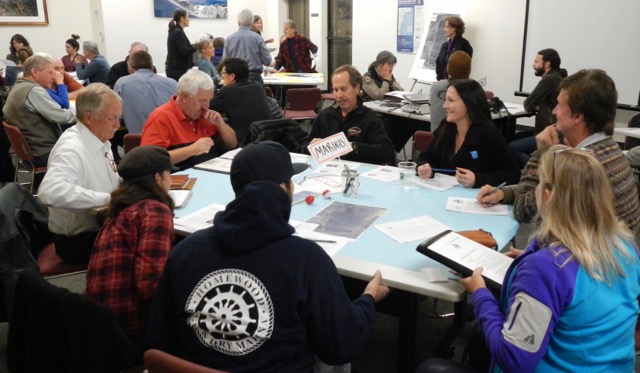
STATELINE – What if motorized boats were no longer allowed on Lake Tahoe? That’s what one table at a workshop proposed.

That idea was one of many discussed Thursday night when the public got together to work on the Tahoe Regional Planning Agency’s shore zone plan.

Piers and buoys have long been controversial at Lake Tahoe. When the bi-state regulatory agency adopted the shore zone plan in 2008 the League to Save Lake Tahoe and the Sierra Club that same month filed a lawsuit challenging it. Two years later TRPA challenged the court’s ruling which had sided with the conservation groups. Then in 2012 the Ninth Circuit Court of Appeals partially ruled in favor of each side.

That in part is why the TRPA is conducting more outreach and is in the process of updating this segment of the Regional Plan

Shore zone issues are discussed Nov. 3 in Stateline. Photo/LTN

Shore zone issues are discussed Nov. 3 in Stateline. Photo/LTN

Sitting at tables, the more than 30 people on Nov. 3 discussed piers, low lake adaptation, access, boating and marinas. Their comments along with those from the more than 70 people who attended a similar meeting on the North Shore in September will be considered as the bi-state regulatory agency moves forward.

Many of the issues are interrelated. Several of the 14 marinas (12 are in California, two in Nevada) are struggling to provide access to boaters because of the low lake level. Piers can’t be extended per current rules, but floating docks could be the answer.

Marinas are dealing with slips that no longer fit boats as they keep increasing in length. Piers-docks are inaccessible because the lake is so low.

While being able to be on the lake itself is an economic driver for the entire basin, protecting this national treasure from an environmental standpoint is also a concern. Part of the shore zone plan components will be to balance those two issues which at times can be conflicting.

Suggestions that came out of the discussion Thursday night included:

·      Needing to allow marinas to expand;

·      Enforcing the 600-foot TRPA mandated no wake zone, and the 200-foot California zone;

·      Storage for watercraft on and off the water;

·      Signs talking about rules of the water and pointing to where access is;

·      Multi-use piers, including ones that can accommodate water taxis;

·      Paying attention to public health and safety;

·      Reviving the bus that went around the lake so people can get to the water without driving themselves;

·      Figure out how low the water level must get before people stop trying to adapt to it;

·      Making sure non-motorized boats have access;

·      Education;

·      Streamline permitting process;

·      Speed limit on the lake;

·      Working more cooperatively with various agencies and landowners.


Sierra, Northstar part of 15 ski resort sale

By Lake Tahoe News

Florida-based CNL Lifestyle Properties is selling Northstar and Sierra-at-Tahoe ski resorts to EPR Properties of Kansas City, Mo.

“CNL has had the profile for sale for a while, Booth Creek Resort Properties owns the management contract with them. I work for Booth Creek and nothing will change for Sierra when and if the REIT sells. Northstar is owned by CNL as well, and Vail holds the management contract,” John Rice, general manager of Sierra, told Lake Tahoe News last year when a sale was pending. “Each ski property in their profile has continued to operate under their management contracts as they did prior to CNL purchasing the ownership. It is correct nothing will change with resorts like Sierra who are under long-term management contracts.”

The 15 ski resorts in the deal are selling for $374 million, while other entertainment properties have a $456 million price tag.

The other ski resorts are: Brighton Ski Resort, Utah; Crested Butte Mountain Resort, Colo.; Cypress Mountain, British Columbia; Gatlinburg Sky Lift, Tenn.; Jiminy Peak Mountain Resort, Mass.; Loon Mountain Resort, N.H.; Mount Sunapee Mountain Resort, N.H.; Mountain High Resort, Calif.; Okemo Mountain Resort, Vt.; Stevens Pass, Wash.; Sugarloaf Mountain Resort, Maine; Summit-at-Snoqualmie Resort, Wash.; and Sunday River Resort, Maine.

No operational changes are expected at any of the resorts.

The deal is expected to close in the second quarter of 2017.

“We are extremely pleased to announce this transaction, which is the culmination of a two-year process of disciplined underwriting, due diligence and negotiations,” EPR President-CEO Gregory Silvers said in a statement. “This portfolio of high quality ski and attractions assets builds on our expertise in the Recreation segment, where we have a track record of delivering consistent and reliable cash flows. The transaction is not only expected to be immediately accretive, but it will also diversify our portfolio with proven, durable assets that are aligned with the positive trends we are seeing in the experience economy.”


Paragon to be majority owner of Hard Rock Lake Tahoe

By Richard N. Velotta, Las Vegas Review-Journal

The Las Vegas company that manages the casino at the Westgate Las Vegas Resort has received preliminary approval to acquire a majority interest of the Hard Rock Hotel at Lake Tahoe.

The state Gaming Control Board on Wednesday unanimously recommended approval of a series of management and ownership licenses for Paragon Gaming for the 539-room Hard Rock in Stateline.

Final approval of the licenses is expected by the Nevada Gaming Commission on Nov. 17.

Read the whole story


More Tahoe visitors = more unwanted trash

The annual dump day is sponsored by Clean Tahoe and South Tahoe Refuse as a way to give people a cheap option to get rid of junk. Photo/Provided

The annual dump day is sponsored by Clean Tahoe and South Tahoe Refuse as a way to give people a cheap option to get rid of junk. Photo/Provided

By Kathryn Reed

One big negative to more visitors in the area is that they leave behind garbage for Clean Tahoe crews to pick up.

“We have definitely noticed a correlation between the busiest times of year and higher amounts of litter collected,” Catherine Cecchi, who heads up the nonprofit, told Lake Tahoe News.

Clean Tahoe works on the California side of the South Shore cleaning up litter. Sometimes it’s junk people leave on the curb, some of it is dumped illegally, other times critters have turned over cans or gotten into dumpsters.

The organization is necessary because people are not being responsible for their own garbage. Without Clean Tahoe, Tahoe would not be clean.

For the fiscal year that just needed, Clean Tahoe picked up 560 cubic yards of litter. The previous year 490 cubic yards were collected. This compares to 608 cubic yards in 2013-14 and 583.5 in 2012-13.

“I was honestly a little bit surprised at seeing an increase in illegal dump incidents, even though it wasn’t a huge jump — 191 in 2015-16 compared to 156 in 2014-15,” Cecchi said. “I’m not sure why that would have happened, but it is helpful for us to know so that we can consider possibly doing some outreach and education on the issue. We’d like to let people know that it is a punishable offense and also that Clean Tahoe has a program where we can haul items to the transfer station for residents.”

Source: Clean Tahoe

                                                                                  Source: Clean Tahoe

People still have to pay the dump fee, and Clean Tahoe adds a service fee. Seniors and disable residents can get a break on those fees.

Miscellaneous furniture, mattresses, and TVs continue to be the top three items that are abandoned.

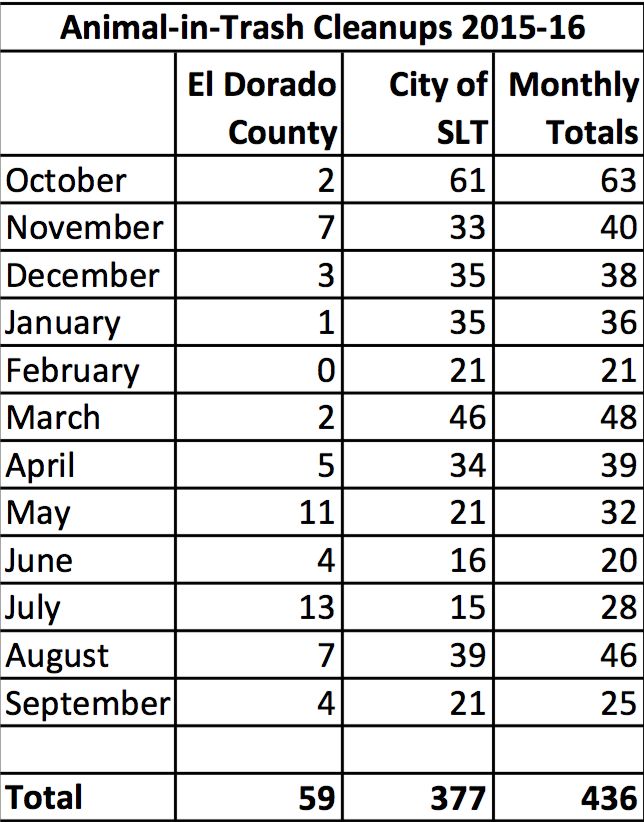
A bright spot in the annual report is that the number of times crews responded to trash involving an animal decreased. In the city, the numbers dropped by 20 percent. There were 377 incidents in South Lake Tahoe and 59 in El Dorado County.

“It’s still higher than we’d like, but I think it’s decreasing in part because the city has been making it more of a priority for their Code Enforcement Division and because of the county’s ordinance requiring a bear bin after repeat offenses,” Cecchi said.

Two offenses in two years triggers the bear box mandate in the county.

Cecchi is hoping when the bear box loan program is implemented that the animal-trash incidents will become even less of a problem.