Measures P and T pass in S. Lake Tahoe

By Kathryn Reed

Recreation, roads and a say in the loop road. That’s what voters in South Lake Tahoe want.

Measure P, with more than the required two-thirds needed to pass, sent a message that locals want better recreation facilities. It will increase the hotel tax from 10 to 12 percent for most properties, while those in the redevelopment area will pay 14 percent instead of the current 12 percent. It is estimated to bring in $2 million per year.

The measure passed with 3,214 votes, or 67.65 percent.

“This in unbelievably exciting,” City Manager Nancy Kerry told Lake Tahoe News.

The transient occupancy tax would be raised 90 days after the election is certified, which is 28 days from now.

First thing on the to-do list is to build a new recreation center to replace the outdated, dilapidated 40-plus-year-old structure. Preliminary designs have been drawn.

The goal is to begin construction in 2018, with people able to use the facility in 2020.

The council would sell bonds to pay for the facility, then use the revenue from Measure P to pay that debt.

While Measure U did not pass, the advisory measure wanting to have had that money go toward roads dominated the proposals. U would have raised the sales tax by one-half cent to 8.5 percent. While the city asked voters where to spend the money – roads, housing or facilities – the allocation was not binding. However, roads did get the most support.

Measure U needed only a simple majority, but lost with only 42.26 percent wanting it.

Kerry was not completely discouraged by this turn of events.

“If the public is saying the highest priority is roads, I will recommend the council have a dedicated tax go to roads,” she said. That vote, though, could be two years away. It will likely be discussed at the February strategic plan workshop.

Measure T was the other South Lake Tahoe initiative on the ballot. This was brought forward by concerned citizens who want the town to have a say in the loop road. This is the proposal to turn Highway 50 near the state line into a city street and city streets into the highway, going from near Pioneer Trail, then behind Harrah’s and MontBleu.

“It forces the city to seek approval of the citizens before they can start supporting something,” Bruce Grego, one of the advocates for Measure T, told Lake Tahoe News. “It doesn’t stop the process; it just requires another level of consent.”

T passed by 2,852 votes, or with 60.5 percent. It required a simple majority.

Next up will be the Dec. 5 court hearing. City Councilman-elect Jason Collin brought a lawsuit to stop the measure from going on the ballot. The judge allowed it, saying he would take action after Nov. 8. The judge could order a settlement conference, a trial date or something else – there just won’t be resolution that day.


Laine, Collin elected to SLT City Council


Brooke Laine and Jason Collin

By Susan Wood

Former South Lake Tahoe City Councilwoman Brooke Laine returns to the panel with a renewed vigilance, joining newcomer Jason Collin. They captured the two seats with 22.32 and 16.71 percent, respectively.

That’s Laine with 1,887 votes and Collin with 1,413, the El Dorado County Elections Department reported early Wednesday morning. The election will be certified in 28 days.

One thing is for sure in this year of election unpredictability – the council has evolved over the years with varying personalities, missions, visions, challenges and tasks.

Serving this community often serves as a balancing act for candidates considering politics and people. The two seats came up for grabs this 2016 election with longtime member Hal Cole bowing out and JoAnn Conner trying to answer to the community again. Conner, who didn’t return phone calls election night, came in fourth with 11.97 percent, or 1,012 votes, El Dorado County Elections reported.

Tami Wallace’s 1,359 votes at 16.08 percent had her in third. Another City Council returning candidate, Ted Long, follows behind with 968 votes at 11.45 percent.

Laine has served six years on the council; the first term during a critical time for the city managing redevelopment.

They say timing is everything.

Laine admitted to Lake Tahoe News her “heart wasn’t in it” during that last go-around two years to serve on the council and wondered if the community sensed it. Her nephew had just died.

“I needed that space,” she said.

Now she’s returning strong and confident because there’s a lot to accomplish.

“I’m in this because I feel the future of our community is at a tipping point. I always felt there was more to do,” she said.

She emphasized that this 2016 election is about the community moving forward, adding she hopes for those with dissenting voices to have “public discourse that’s polite.”

“This national election has shown a divide. People are so unhappy. We as a council cannot allow it to get to that level. We’ll have to adjust and make accommodations,” Laine told Lake Tahoe News.

She proceeded to thank those who believed in her during the campaign.

Collin congratulated Laine and said he felt “excited” about his own race. He was saying goodbye to a few friends from his home when LTN called.

Although Collin early on became known as a widely supported candidate, he said he “honestly didn’t know what to expect.”

What he’s not surprised about is how close the race turned out to be.

On the other hand, Wallace told LTN she predicted the top four vote-getters would be who they are.

She pledged to run again for council again because if anything “there’s not a single one of these people who I couldn’t work with” even though they “may not agree 100 percent of the time.” She wants to work with patriarch Councilman Tom Davis and embrace his institutional knowledge.

The rest of the field included: Danny McLaughlin with 6.7 percent; John Shearer with 6.58 percent, Trey Riddle with 2.77 percent; Bob Topel with 2.64 percent; and Patrick Jarrett with 2.42 percent.


Expected record voter turnout in El Dorado County

More than 50 people celebrate election night at the Tahoe Mountain Lab in South Lake Tahoe. Photo/Susan Wood

More than 50 people celebrate election night at the Tahoe Mountain Lab in South Lake Tahoe. Photo/Susan Wood

By Susan Wood

A contemptuous, yet engaging, presidential race, multiple California ballot initiatives and a slew of local measures and races brought El Dorado County voters out in record numbers today.

Registrar of Voters Bill Schultz reported that more than 116,000 residents registered to vote, dwarfing the June primary in which 106,000 or so ballots were issued. The number of registered in South Lake Tahoe is 10,202.

“It’s the most we’ve ever had,” Schultz told Lake Tahoe News from his busy elections office on Nov. 8. He attributed the level of interest to “one of those perfect storms” in which “people came out who haven’t come out in years.”

He even took three families who wanted to see the process on a tour. Polling “observers,” who showed up across the nation amid claims of prospective voter fraud were also on hand in Placerville, but the office remained civil.

The level of interest kept the Elections Department hopping. The staffers emptied the absentee drop box six times during the day. With just the absentees numbering at least 47,000 collected from the more than 86,000 issued, the county sits at an estimated 48 percent turnout just on the absentees. The county turnout is estimated at a 73.5 percent.

Schultz also pointed out how his department has seen a run-on with provisionals, those ballots counted last and command more attention in checks on accuracy. The county takes 28 days to certify the election largely because of those. Provisional ballots are ones that need extra verification.

South Lake Tahoe was hopping with anticipation – some good and bad – over the election. Parties dot the landscape, including a large group that came out to socialize at Tahoe Mountain Lab.

Many people admitted to being nervous, exhausted and somewhat glad the campaign season is over – if only it culminates with their candidates winning a seat or their pet measures passing. California had an unprecedented number of ballot initiatives that turned the voter guide into a document the size of a small phone book.

Some people who kept one eye on the large screen television in the lobby area at the lab and another on the other people said the one thing about the exhausting and heated presidential race that was welcome was that in turn the local candidates would get their due.

Coleen Shade characterized the election season as a war of sorts, adding she’s shell-shocked by the process.

“I’m nervous for my community and my country,” she told Lake Tahoe News, noting how the divisiveness in the nation has hit at many levels. “I see the same level of divisiveness in the smaller elections too.”

She’s not alone.

David Orr, who runs the Tahoe Mountain Lab, said he’s drained by the mean-spirited nature of election campaigns.

“We’re going for each other’s throats,” he said. Being a parent, some people who run for office “scare the hell out of me,” he admitted.

Heidi Hill Drum, no newcomer to election politics and activism, said it was difficult to balance a full time job and her family and being politically active. But she isn’t about to shirk from her civic duty.

“It’s pretty hard to be passive,” she said.

As the Tahoe Prosperity Center’s chief executive officer, she would like to see South Lake Tahoe City Council members “work with the community and staff” to get things done. That to her is what it takes to build a successful community.


USFS wants to stop putting out some fires

Crews on Nov. 6 try to stabilize the burn scar left from the Emerald Fire on Tahoe's South Shore. Photo/LTN

Crews on Nov. 6 try to stabilize the burn scar left from the Emerald Fire on Tahoe’s South Shore. Photo/LTN

By Lauren Sommer, KQED-TV

California’s fire season hasn’t turned out to be as bad as some feared this year. In fact, forest managers say that certain kinds of fires — the “good” fires — were sorely lacking.

Sierra Nevada forests are adapted to low-intensity fires that clear the underbrush and prevent trees from getting too dense. After a century of fire suppression, many forests are overgrown, which can make catastrophic fires worse.

So forest managers are piloting a new policy designed to shift a century-old mentality about fire in the West.

The idea is to let naturally-caused fires burn when they aren’t a threat to homes or people. But actually making those decisions on the ground isn’t easy in a crowded state like California.

Read the whole story


Polluted water not stopping EDC road project

Publisher’s note: This is the second of two stories investigating the toxic storm water runoff on the West Slope of El Dorado County.

By Joann Eisenbrandt

A major El Dorado County roads project slated to begin construction in spring 2017 has raised additional concerns as well as questions about what actually remains of the Diamond Lime Plant underneath the material recovery facility (MRF) and whether it, too, is a source of toxic storm water runoff.

The Diamond Springs Parkway (DSP) project is a county Transportation division roads project that was envisioned in the county’s 2004 General Plan. It has been in the works for even longer.

Its stated goal is to improve traffic circulation along Pleasant Valley and Missouri Flat roads north of the town of Diamond Springs. It includes the widening of Highway 49 from Bradley Drive south of Placerville to its intersection with Pleasant Valley Road in Diamond Springs. It also includes the construction of a four-lane connector road—Diamond Springs Parkway—between Missouri Flat Road and Highway 49. This road will border the property owned by Michael Lindeman.

The project will take place in two phases. Phase 1A is scheduled to begin in spring 2017 and includes the widening of Highway 49, the addition of sidewalks and improved access to bordering properties and realignment of Highway 49’s intersection with Pleasant Valley Road in Diamond Springs. Phase 1B, the construction of Diamond Springs Parkway, will not happen sooner than 2021.

Concerns have been voiced that the soil disturbances that will come with the project could escalate problems with the unmitigated toxic remnants of the Diamond Lime Plant.

The alkalinity of storm water in areas of Placerville is nearly off the charts. Photo/Provided

The alkalinity of storm water in areas of Placerville is nearly off the charts. Photo/Provided

A history of toxic storm water runoff

Hazardous storm water runoff along the El Dorado Trail that runs between Missouri Flat Road and Highway 49 near Placerville on the county’s West Slope has been a concern for years. The runoff has impacted this popular walking and biking trail as well as the tributaries bordering it that lead to Weber Creek and eventually to the American River. Numerous tests have shown the runoff to be strongly alkaline with high pH levels. Properties adjoining the trail were the former site of the Diamond Lime Plant which processed limestone for a variety of industrial uses. One of the properties is owned by Lindeman and the other, owned by Waste Connections, is the site of the material recovery facility (MRF).

The Lindeman property has been the main focus of investigations and citations by state and county agencies. It has been identified in reports as the source of the toxic runoff from past lime processing activities. Despite investigations by state and county agencies, the problem has not been fully abated. The beginning of this season’s rainy season in October and the storm water runoff that has come with it brings new concerns.

A road runs through it

An environmental impact report (EIR) required by the California Environmental Quality Act (CEQA) was prepared to identify potential impacts to the environment from the parkway project and propose mitigation measures and mitigation monitoring plans which would reduce them to insignificance. It was approved by the El Dorado County Board of Supervisors in 2011.

The project also required an environmental site assessment (ESA). The Phase 1 ESA was done in 2009. The ESA is a necessary precursor before the county acquires property or rights-of-way and identifies any issues on the property that would affect its value. If the Phase I ESA finds that the site has significant issues, then a Phase II ESA is also prepared with remediation of the problems to take place before construction begins.

According to Dustin Harrington, senior civil engineer with the Transportation division of the county’s Community Development Agency and DSP project manager, “No recognized environmental conditions or hazardous materials have been found within the footprint for the DSP’s Phase 1A. It’s all clean dirt.”

But because the original Phase I ESA was done so long ago, it requires a review to account for changes that have taken place in the interim. Harrington said that it is being reviewed as part of the Phase II ESA which is being prepared for Phase 1B of the parkway project, but he doesn’t anticipate that this review will lead to the need for a Phase II ESA for the first part of the project that begins next spring.

After multiple days of rain in October, a tributary that drains into Weber Creek contains caustic lime sediment. Photo/Provided

What the grand jury said

The 2013-14 grand jury report included a response to a citizen complaint regarding the illegal grading on the Lindeman property in 2012 done without a county grading permit and the failure to notify state Fish and Wildlife as required by their code. Among its recommendations was that the county review the wisdom of spending public money for the Diamond Parkway Project given what it termed “environmental concerns.”

The county responded that it is “spending ‘public monies’ to construct the Diamond Springs Parkway which has benefits for a wide range of county residents,” adding that the preparation of the EIR and ESA and the mitigation measures that come with them will resolve any environmental issues.

Some have said that the extent of the hazards from the toxic materials used at the Diamond Lime Plant have not been fully explored because of the financial benefits to the county and developers of both the Diamond Dorado and Diamond Springs Parkway projects. Finding out what’s really under there could jeopardize such projects or make them prohibitively expensive to construct.

Follow the money

George Turnboo, a member of the county’s Solid Waste Advisory board, has been involved with the toxic storm water runoff issue along the El Dorado Trail for years. He first became aware of it in 2014 when he was told by boys who had been playing in Weber Creek that they’d gotten burned. He has continued to speak about it ever since at town hall meetings, Solid Waste Advisory Committee meetings and before the Board of Supervisors. He and other local residents have reported the spills to state and county agencies, but believe their concerns have been largely ignored.

“They are downplaying it because they want the Diamond Springs Parkway project to go through no matter what. You have to look at past and present supervisors. It’s all tied together,” Turnboo told Lake Tahoe News. “The old saying is true, ‘follow the money’.”

Similar concerns were raised in 2011 when the board approved the Parkway’s EIR. Dave Gutierrez of True Value Hardware commented on the document, “This design is intended for one thing in mind and that’s for more development on the new parkway not to make traffic move faster through Diamond Springs. It looks to me, and many others, that DOT has fallen into the same pattern as our federal and state government and caters to special interest groups, such as developers in this situation.”

El Dorado County’s Solid Waste Advisory board member George Turnboo finds the storm water runoff to be caustic in January. Photo/Provided

El Dorado County’s Solid Waste Advisory board member George Turnboo finds the storm water runoff to be caustic in January. Photo/Provided

Testing, testing, testing

The Phase II Environmental Site Assessment for Phase 1B of the parkway project is just beginning. According to Harrington, soil samples have been taken from the locations designated in the ESA’s work plan. This work plan was created with input from other county agencies as well as the approval of the state Water Board. The exploratory field work is in progress now and will wrap up sometime this month, with a report expected in December.

Sites for testing were selected based on site reconnaissance, the researching of old records and maps of the Diamond Mine Plant and interviews of those with knowledge of the area’s history. Leonard Bartley, former vice president of operations for the Diamond Lime Plant, indicated that he had been called by Youngdahl Consulting, the firm doing the testing, and had shared his firsthand knowledge of the site with them.

Site testing includes varying degrees of exploration from surface samples to trenches to the boring of deep holes. No lab tests of the samples have been completed.

Asked about whether storm water runoff was being tested as part of the process, Harrington said that a very small amount of such testing had been done but that the Storm Water division is “the first line of defense” with regard to toxic storm water runoff. The Transportation Department’s main focus is on what is beneath the soil. He added that both county agencies are under the jurisdiction of the Water Board and ultimately answer to it as the “larger arm of authority.” No moving of dirt or excavating has taken place yet for Phase 1A of the Diamond Springs Parkway project.

The local division of the state Water Board, the Central Valley Regional Water Quality Control Board, administers the provisions of the federal Clean Water Act and requirements regarding storm water discharge and water quality associated with it on the county’s West Slope.

What about the MRF?

While the Lindeman property has been repeatedly identified and scrutinized as a source of hazardous runoff, the material recovery facility (MRF), also part of the Diamond Lime Plant site, has not. Some say it is time to find out if the MRF, owned by Waste Connections, may also be a source of the toxic storm water discharges.

Harrington indicated that no soil testing was being done on the MRF property as part of preparations for construction of the Diamond Springs Parkway project because of its distance from the project footprint. He said that the testing being done for the project is thorough and adequate, but added that, “The issue right now is that we’re not quite sure of the extent of where the (toxic) materials are and what kind they are.”

Lake Tahoe News asked Walter Floyd, engineering geologist with the state Water Board, in early summer 2016 if his agency had considered investigating the possibility that toxic runoff was coming from the MRF site. At that point, they had not, but on a June visit to the Lindeman property, Floyd measured the soil pH levels in two locations where the Lindeman property abuts the MRF property. On an exposed hillside adjacent to the MRF the pH was nearly neutral, while in a pit by the MRF it was strongly alkaline.

The pH (potential hydrogen) scale measures the acidity or alkalinity of a solution. It goes from 0 to 14. A reading of 7 is neutral, as would be found in distilled water. More than 7 is alkaline (a base) and less than 7 is acidic.

In July, Floyd indicated that, “It is expected that additional investigation will be required in the general vicinity of the MRF and sampling results obtained so that the Water Board will be able to complete a conceptual model of the site that truly represents the current environmental conditions.”

He indicated that Waste Connections, owner of the MRF property, was conducting its own investigation and testing and would be forwarding the results to the Water Board. He added that “no scenarios are being excluded,” including the possibility that the toxic runoff that has been found in the area around the El Dorado Trail could also be coming from the MRF property. Testing results were provided to the Water Board in late July.

According to Floyd, “The results indicate soils with elevated pH underlie portions of the Waste Connections property.”

This testing site along the El Dorado Trail shows how close a toxic site is to the public. Photo/Provided

This testing site along the El Dorado Trail shows how close a toxic location is to the public. Photo/Provided

The current situation

Under the federal Clean Water act, businesses like the MRF that discharge pollutants from point sources like pipes or ditches must have a National Pollutant Discharge Elimination System (NPDES) permit and a Storm Water Pollution Prevention Plan (SWPPP) showing how they are controlling pollutants in storm water runoff on their property. Compliance is administered locally by the regional office of the state Water Board.

Some have alleged that the MRF’s storm water discharge system is not currently designed as stated in their SWPPP and that there have been issues with overflow from the three retention ponds that catch storm water runoff and inaccurate information on where that runoff is then directed.

In March 2016, Central Valley Water Board staff conducted an inspection at the MRF. The pH in the three ponds was tested and found to be near neutral, but discrepancies were found with their SWPPP and a notice of violation (NOV) was prepared and sent to them in April. It indicates that the Central Valley Water Board “can impose administrative civil liabilities (monetary fines) for violations of the general permit. The maximum administrative civil liability for each day of violation is ten thousand dollars and ten dollars per gallon of polluted storm water discharged in excess of 1,000 gallons.”

Floyd indicated that the Water Board is “continuing to assess compliance with the Industrial General Permit requirements, including the site SWPPP.”

Waste Connections submitted a remedial investigation work plan to the Water Board for additional investigation of soil and groundwater on their property on Oct. 19, which the Water Board approved. According to Floyd, field work is expected to be done in mid-November, with a report documenting the results in January 2017.

Waste Connections’ response

Susan VanDelinder, divisional vice president for the Northern California Division of Waste Connections and district manager for El Dorado Disposal, was asked by Lake Tahoe News if Waste Connections has received any previous violation notices or requests for remediation other than the current one. VanDelinder said no, adding, “The MRF’s SWPPP has been updated to reflect additional best management practices.”

Questions have been raised whether the high-pH storm water runoff that has impacted the El Dorado Trail and adjacent waterways actually originated on the MRF site and then went over the Lindeman property and then on down to the trail and the tributaries alongside it.

VanDelinder responded, “We disagree with this contention; the storm water discharged from the MRF during last season’s winter period met the state benchmarks for water quality including pH.”

She added, “Storm water from the MRF is first stored in the site’s storm water ponds and then discharged from the site once water quality is below state benchmarks. Storm water is not discharged to neighboring property but to the storm drain.”

Per their exclusive Solid Waste Services Agreement with the county, Waste Connections will be required to construct a new state-of-the-art MRF in the same location as the current one. Asked what additional plans they have for more intensive removal of the lime-processing based materials on the site before this project begins, VanDelinder said, “Once investigative work is complete, we will evaluate remedial options while working closely with the CVRWQCB (Central Valley Regional Water Quality Control Board).

A sample location on the south side of El Dorado Trail. Photo/Provided

A sample location on the south side of El Dorado Trail. Photo/Provided

The path forward

More will be known about exactly where the remaining toxic materials from the Diamond Lime Plan are located and what needs to be done to permanently remove them once all the soil testing in the area is completed. In the meantime, storm water runoff along the El Dorado Trail has already begun for this fall and will continue to be an issue this winter.

Recent tests by Central Valley Water Board staff confirm this. According to Walter Floyd, pH data was collected on Oct. 14 “at the onset of the storm that reportedly provided 6.5 inches of precipitation to Placerville” and again on Oct. 18. “Elevated pH (i.e., in the range of 10 to 12 standard pH units) was noted in the pond by the El Dorado Trail and at the southeast corner of Throwita Way and Bradley Drive. These are the same locations where elevated pH has been recorded historically.”

What is clear is that disagreement remains on precisely where the high pH storm water discharges are originating from, how dangerous they are and who is to blame for the fact that after years of investigation and attempts at mitigation, the toxic legacy of the Diamond Lime Plant still remains.

What is less clear is how to fix the problem. The recommendation made by Fish and Wildlife environmental specialist Carol Oz in a report on the issue from July 2012 has remained hard to achieve. “All agencies,” she suggested, “need to communicate plans for a focused corrective action at the site compatible with respective agency goals.”

More recently, El Dorado County Assistant District Attorney Jim Clinchard, whose office has also been involved, told Lake Tahoe News, “Government as a whole does have problems when an issue crosses over into the potential jurisdictions of multiple agencies. Government has difficulty addressing issues that cross boundaries.” He added that he would be willing to get together with other county departments and outside agencies to brainstorm and that setting up such a meeting might expedite the process. “That,” he said, “is how responsible government should work.”


How to hit the slopes strong, avoid injuries

By Paul McHugh, Sacramento Bee

Had your skis or board freshly tuned? Good. Layered clothes, helmet and sunscreen all packed? Check. Car ready with new wipers, antifreeze fluid, tire chains in the trunk? Great. But let’s consider the most important piece of gear. Is your body truly in shape for winter recreation?

As they used to say on the streets, “Betta’ check yourself, before you wreck yourself.”

The absolute best time to begin preparing for a new ski season is at the close of your last ski season. That’s due to a simple truth: It’s much smarter – as well as much easier – to keep fit than it is to become fit.

This maxim is particularly apt for heart-lung fitness, your “VO2 max,” or aerobic capacity. Generally, this measure of athletic health falls by about 1 percent per year after age 25. The only thing that slows the decline to any significant degree is maintaining a regular aerobic regimen.

Read the whole story


Poll: Nearly half in U.S. support legalized sports betting

By Wayne Parry, AP

ATLANTIC CITY — A poll finds nearly half of Americans approve of legalized sports betting, reasoning that so many people are already doing it.

The Fairleigh Dickinson University PublicMind poll released last week finds 48 percent support changing federal law to make sports betting legal throughout the country; 39 percent are opposed.

“Betting on sports does not have an access issue for anyone in the United States,” said Donald Hoover, senior lecturer at the university’s International School of Hospitality and Tourism Management. “Most of the sports betting in the U.S. is fairly easy to do, but happens in the shadows and in violation of federal law.”

The poll comes as New Jersey opens another front in its eight-year war on a federal law restricting sports betting to those states that met a 1991 deadline to legalize it: Nevada, Oregon, Montana and Delaware.

New Jersey lawmakers have come up with another potential way around the ban involving a complex repeal of sports betting regulations in the state, followed by a limited reinstitution of restrictions. And the state’s horse racing industry is asking the U.S. Supreme Court to decide the matter once and for all.

The telephone poll using cellphones and landlines to reach 1,019 adults nationwide has a margin of error of plus or minus 3.8 percentage points.

Among those in favor, the two biggest reasons given are that many people are already doing it (45 percent) and that legalized sports betting would result in increased revenue for the state (39 percent).

Among opponents, top concerns are fostering gambling addiction (55 percent); the potential involvement of organized crime (22 percent) and concerns about the perceived integrity of the games (16 percent).

“The public is divided on this issue, and it looks like the reasons behind the division stem from the age-old difficulty of reconciling the competing pulls of money and morality,” said Krista Jenkins, a professor of political science and the poll’s director. “People are clearly worried about the effects of gambling on individuals and their families, but also aware of the benefits that come from more money for the state from something that people are already doing.”

The poll also found that although people are more supportive of legalized sports betting, they don’t necessarily want more casinos: 68 percent say the U.S. currently has enough casinos, compared to 16 percent who want fewer casinos and 11 percent who want more.


Rains stir toxic storm runoff concerns in EDC

Publisher’s note: This is the first of two stories investigating the toxic storm water runoff on the West Slope of El Dorado County.

By Joann Eisenbrandt

Last year’s El Nino winter brought much-needed rain to El Dorado County’s West Slope. But it brought something else as well. It brought allegations of repeated mismanagement and lack of timely corrective action by El Dorado County to control toxic storm water runoff from properties near the El Dorado Trail between Missouri Flat Road and Highway 49 just south of Placerville.

With the 2016-17 rainy season already starting, some are asking if last winter’s issues have been adequately addressed or if more needs to be done now, before another winter arrives in earnest.
CausticRunoff2

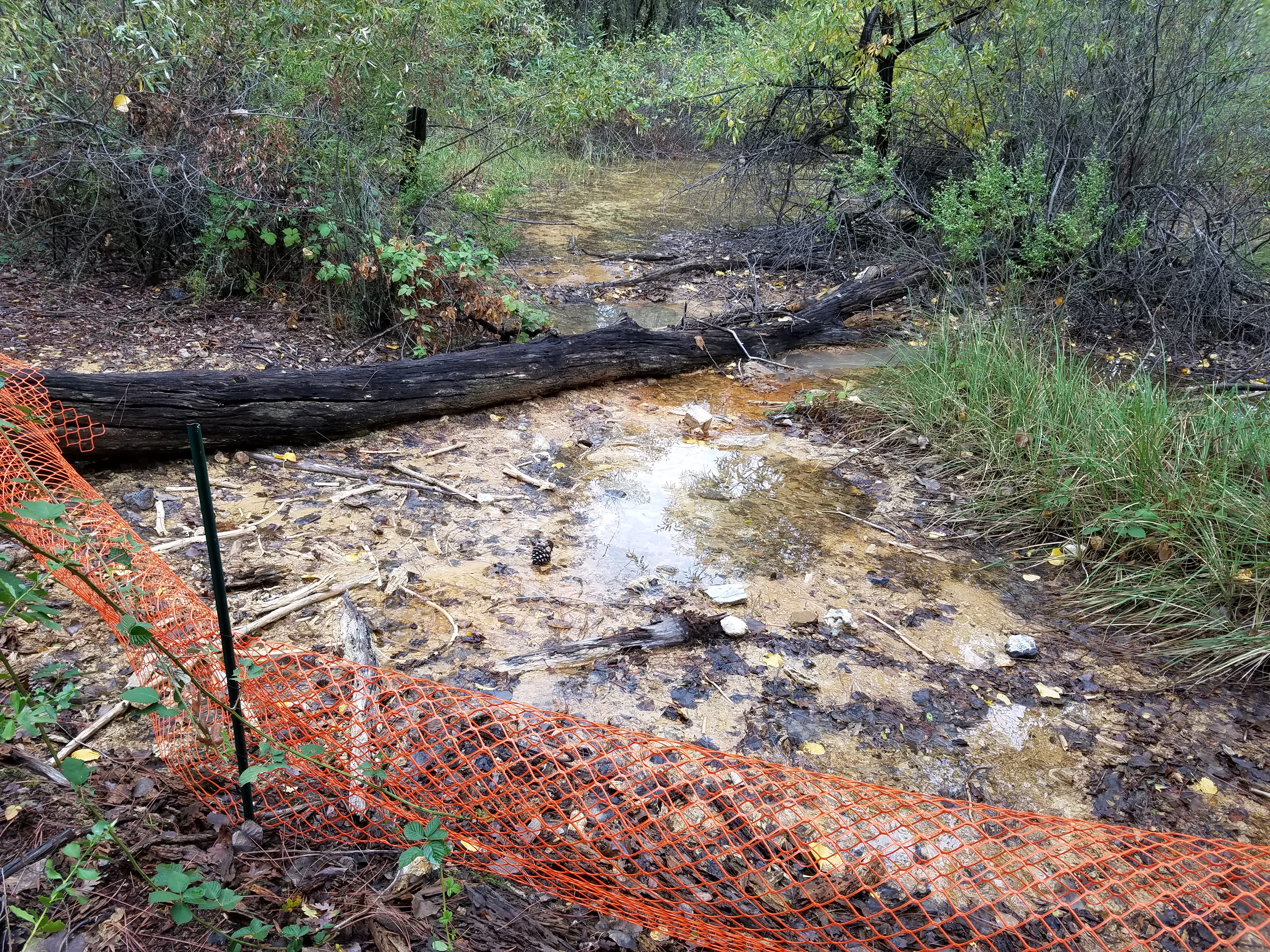
The temporary fencing that exists today was put up along the El Dorado Trail by county Environmental Management. Photo/Provided

Storm water runoff has high pH

The El Dorado Trail is a popular, highly-used biking and walking trail for adults and children situated in an area surrounded by dense vegetation and populated by a variety of native wildlife and aquatic species. Tributaries in the area drain into nearby Weber Creek and from there into the American River.

In March 2011, a hazardous materials spill report received from a local citizen by the California Department of Fish and Game (now Fish and Wildlife) stated that the tributary near property owned by Michael Lindeman adjacent to the trail contained lime waste materials. The Lindeman property as well as the material recovery facility (MRF) property next to it owned by Waste Connections was the former site of the Diamond Lime Plant.

The report said there was “white milky water and dead mammals in two tributaries of Weber Creek.”

Carol Oz, environmental specialist with Fish and Wildlife who responded to that report, said her agency’s concern was with state water quality as it relates to aquatic organisms.

Public health or water quality issues related to storm water discharge would be in the hands of the county or the State Water Quality Control Board.

The early rains in January 2016 again raised concerns about the safety of those using the trail and the impacts of the storm water runoff around it on the surrounding ecosystem.

George Turnboo, a member of El Dorado County’s Solid Waste Advisory board, was walking along the El Dorado Trail in January and noticed significant storm water discharge bubbling up. He told Lake Tahoe News his hands started burning after contact with it. He called Don Nizolek, also a member of the Solid Waste Advisory board. He is an environmental engineer qualified to do storm water testing. They tested the runoff using professional-grade pH testing strips.
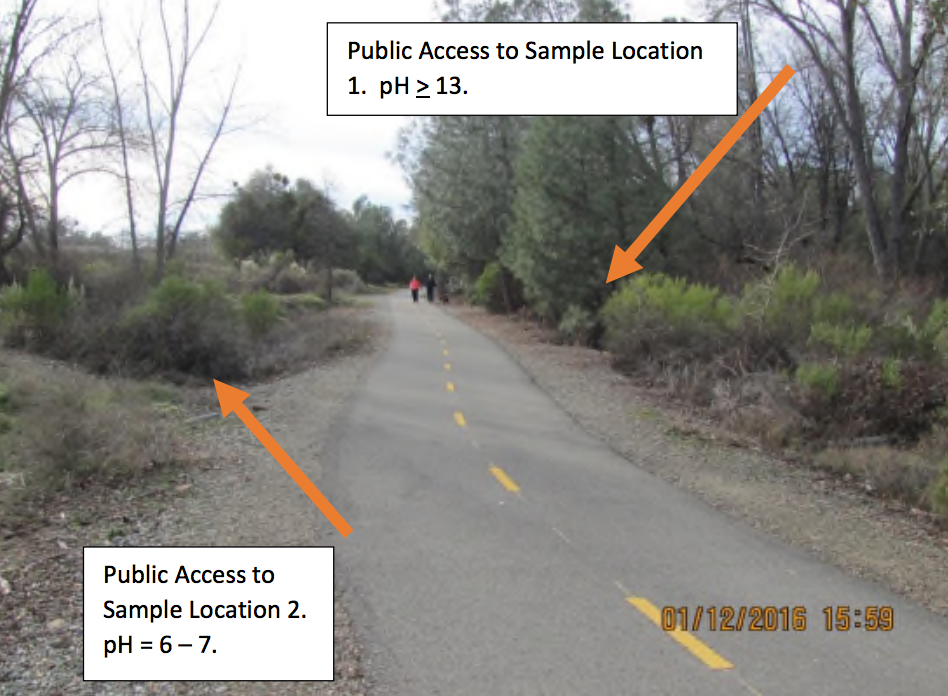
The hazardous water is just off the popular multi-use El Dorado Trail in Placerville. Photo/Provided

The hazardous water is just off the popular multi-use El Dorado Trail in Placerville. Photo/Provided

“We pulled a reading of 13.5 (pH). We did a 32-page report and sent it to Greg Stanton, the director of county Environmental Management,” Turnboo told Lake Tahoe News.

The pH (potential hydrogen) scale goes from 0 to 14, and is a measure of the acidity or alkalinity of a solution. A reading of 7 is neutral. More than 7 is alkaline (a base) and less than 7 is acidic.

Save Our County, a local nonprofit land use watchdog group, posted a video of the storm water runoff on its website. It included explanations about the area’s history and previous concerns over storm water runoff. Turnboo did a live pH test on the video that registered a reading of 13.5 on a pH test strip.

Cheryl Bly-Chester, professional engineer who is an environmental engineering consultant and owner of Rosewood Environmental Engineering, narrated a large portion of the video.

Bly-Chester explained that anything with a pH of 10 will burn your skin and anything above a 12.5 pH is a corrosive hazard. She added that the amount of burning depends on the concentration of the corrosive materials and the length of exposure. According to the EPA (Environmental Protection Agency), samples must be tested within 15 minutes of being taken as the longer a lime-based sample is exposed to air the more the pH level goes down.

Bly-Chester reported the storm water discharge to Fish and Wildlife, the state Water Board and to county Storm Water Management who then reported it to Environmental Management.

On Jan. 12, 2016, Fish and Wildlife personnel were present when county Environmental Management staff took samples in the area and verified a pH reading of 12.8 at a location on the north side of the trail near the end of Stage Court. Additional samples were taken the next day with a confirmed field test pH reading of 12.7.

Bly-Chester called Greg Stanton expressing concern that county staff had left the site after their initial testing without posting any warning signs or putting up any type of physical barriers to access.

Testing was done on Jan. 12 and a number of following days. A citizen report to the state Office of Emergency Services on Jan. 28 prompted additional testing at a location one-eighth mile away from the original site. A warning sign and caution tape were posted on Jan. 15, and temporary fencing was installed at the original site on Jan. 26.

Turnboo spoke at the Jan. 26 El Dorado County Board of Supervisors meeting and handed the board a copy of his 32-page report. Sue Taylor of Save Our County also spoke, telling them, “The buck stops with you.”

A press release was posted on the county website on Jan. 29 telling residents to “avoid contact with storm water in the vicinity of the El Dorado Trail near the end of Stage Court due to high alkaline levels.”

Two more press releases followed.

The current situation

Turnboo walked along this same area of the El Dorado Trail the last week of October. He told Lake Tahoe News, “All that milky material (from last winter) was dried up, but now it’s come back. (The runoff) is still as milky as before and is leaching out of the ground. Human safety is more important to me than anything else, especially when you are talking about little kids walking along that trail.”

Permanent fencing to restrict access to the area below the trail where the high pH runoff was found in January has still not been installed.

Stanton told Lake Tahoe News, “The signage was removed by unknown persons last winter. We welded signs onto posts at the end of last season. The fencing is scheduled to go up in the next couple of weeks. We were waiting to see the progress of the Water Board with the property owner. Once the issue is abated on that property, there will be no need for a fence.”
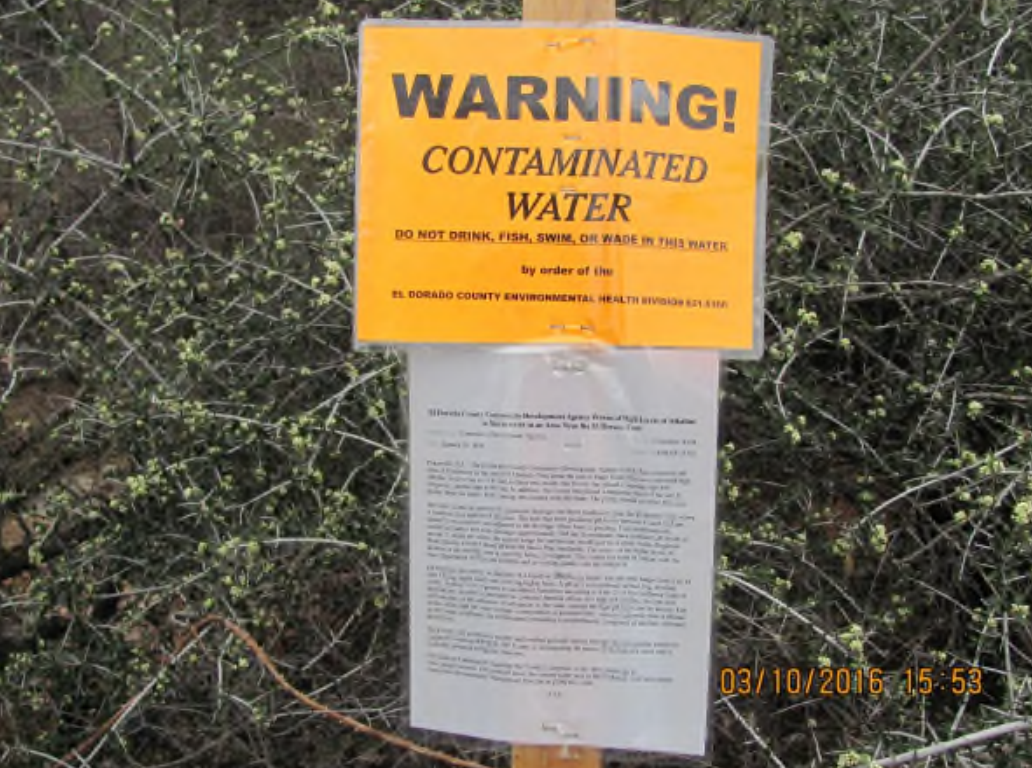
Proper and permanent signage has been an issue. Photo/Provided

Proper and permanent signage has been an issue. Photo/Provided

What lies beneath?

Much of the area between Missouri Flat Road and Highway 49 has been the location of heavy industrial and commercial uses, including auto dismantling, orchards using pesticides, a railroad, railroad depot, engine house and railroad maintenance facility, as well as lumber mills and sawmills.

Beginning in 1927 and ending in 1977, the Diamond Lime Plant processed limestone from local quarries for road building, agricultural and industrial uses. Lime rocks were crushed and mineral piles were stored on the property alongside lime kilns and sludge settling ponds. A railroad ran parallel to the site to ship out the finished products and an aerial tramway carrying cars full of limestone ran from a nearby quarry to the plant for processing. In 1977, the plant ceased operation and the site was abandoned. Remnants of the material processed there and the sludge ponds underneath were covered over, but not fully cleaned up.

Leonard Bartley was vice president of operations for the Diamond Springs Lime Company, the plant’s official name. The Heller Foundation was the plant’s parent company. Bartley worked at the plant from 1964 until its closing in 1977. He confirmed that there were settling ponds on the property, both on the current Lindeman property and in the area where the MRF now sits. They were used to settle out the lime and they remained on the property after the plant closed. There was also a large oil tank full of bunker seed oil that was used to light the kilns. It was so large, he told Lake Tahoe News, that four or five railcars could have fit into it. The oil tank was still there when the plant closed down. Some remediation was done and the kilns were removed, but a large amount of materials were “just left lying there.”

How dangerous is it?

There is disagreement on where the current high pH runoff is originating from, what areas it is impacting and how toxic to humans and animals it really is.

Barbara Houghton, county environmental health manager, told Lake Tahoe News last summer, “Weber Creek has not been impacted. It’s the drainage where the high pH is. It is only by the bike path where there is an impact. Today it is dry. I would be more concerned about rattlesnakes, ticks or poison oak.”

According to El Dorado County Public Health Officer Nancy Williams, “As a highly alkaline substance, solid calcium hydroxide (created when calcium oxide [lime] is mixed with water) is considered to be a moderately caustic irritant to exposed skin. However, because calcium hydroxide barely dissolves in water, casual contact with the pooled water next to the El Dorado Trail is not likely to produce any harmful effects. While a pH of 12.5 or greater is considered hazardous as defined by state regulations …  the type of substance(s) in the water and the concentration of these substances must also be known in order to determine the degree of hazard.”

Bly-Chester believes the county’s press releases have not accurately reflected the dangers of the runoff. She told Lake Tahoe News, “As the temperature of the water gets colder, more reaction can happen and the pH can go up higher … in the middle of winter in the morning, it is probably even more hazardous … with high bases it seeps into your skin and starts reacting with your skin and you don’t know it until it’s fairly deep in your skin.”

Asked if the workers at the Diamond Lime Plant had any problems dealing with the materials they processed, Leonard Bartley said, “We had regular safety meetings on it. People there knew how to handle that stuff. People got little burns, but nothing serious. You knew not to get into it or get it on your clothes. It was hot lime. If you did (fall in), all they’d find are the fillings in your teeth.”
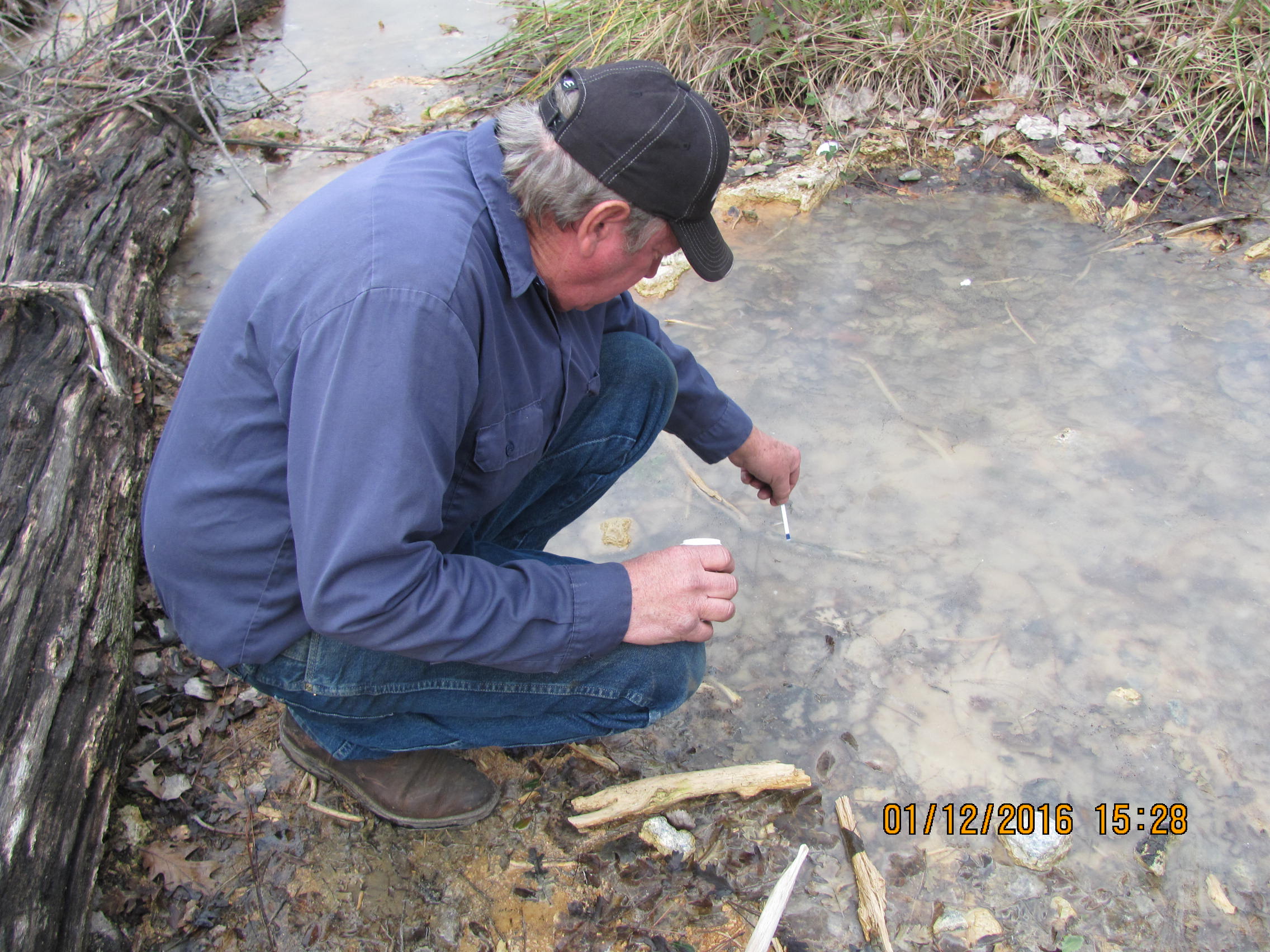
El Dorado County’s Solid Waste Advisory board member  George Turnboo in October tests the toxicity of storm water runoff in Placerville. Photo/Provided

El Dorado County’s Solid Waste Advisory board member George Turnboo tests the toxicity of storm
water runoff in Placerville. Photo/Provided

Where does the buck stop?

When asked by Lake Tahoe News if Environmental Management was planning any ongoing monitoring of storm water runoff along the El Dorado Trail as this rainy season progresses, Greg Stanton said, “Environmental Management is not. We are an emergency response agency, not involved in ongoing monitoring. Storm water issues are handled by Long Range Planning, but this is really a Water Board case.”

With many federal, state and local agencies having some degree of regulatory power over water quality and storm water management, untangling the hierarchy of public responsibility can be difficult.

At the federal level, water quality is controlled by the EPA under the Clean Water Act. A 1987 amendment to that act expanded the National Pollutant Discharge Elimination System (NPDES) to cover storm water discharges. The county as well as businesses like the MRF that discharge pollutants from a point source like a pipe or a man-made ditch into U.S. waters are required to have a NPDES permit showing that they have complied with the Clean Water Act and have regulations in place to deal effectively with controlling pollutants in storm water runoff.

In California, the State Water Resources Control Board (SWRCB) and the nine regional branches beneath it, manage water quality issues, including the NPDES permit system, for the EPA.

On El Dorado County’s West Slope, the Central Valley Regional Water Quality Control Board is the agency with authority. At the Lake, it is Lahontan.

The county regulatory umbrella

County agencies with responsibility include Environmental Management, Long Range Planning, Development Services, Transportation and Public Health. They all sit under the umbrella of the Community Development Agency except for Public Health, which is part of the Health and Human Services Agency.

The county adopted a Storm Water Quality Ordinance in 2015 which established a Storm Water Management Plan (SWMP) overseen by Long Range Planning. The SWMP outlines how the county will comply with the requirements of the NPDES permit.

There is also a county Grading, Erosion and Sediment Control Ordinance, overseen by the Transportation division. It details the requirements for grading permits and related mitigation measures for any construction activities that could potentially impact storm water runoff and water quality.

Long Range Planning, Development Services and Transportation are also involved with projects that require preparation of an environmental impact report (EIR) under the California Environmental Quality Act (CEQA) and deal with mitigation measures required to offset potential environmental impacts.

Environmental Management includes divisions dealing with hazardous materials, environmental health, solid waste and solid waste franchises in the county. The Hazardous Materials division deals with emergency response and spills and has a 24-hour emergency response program for hazards, including water pollution, reported by citizens.
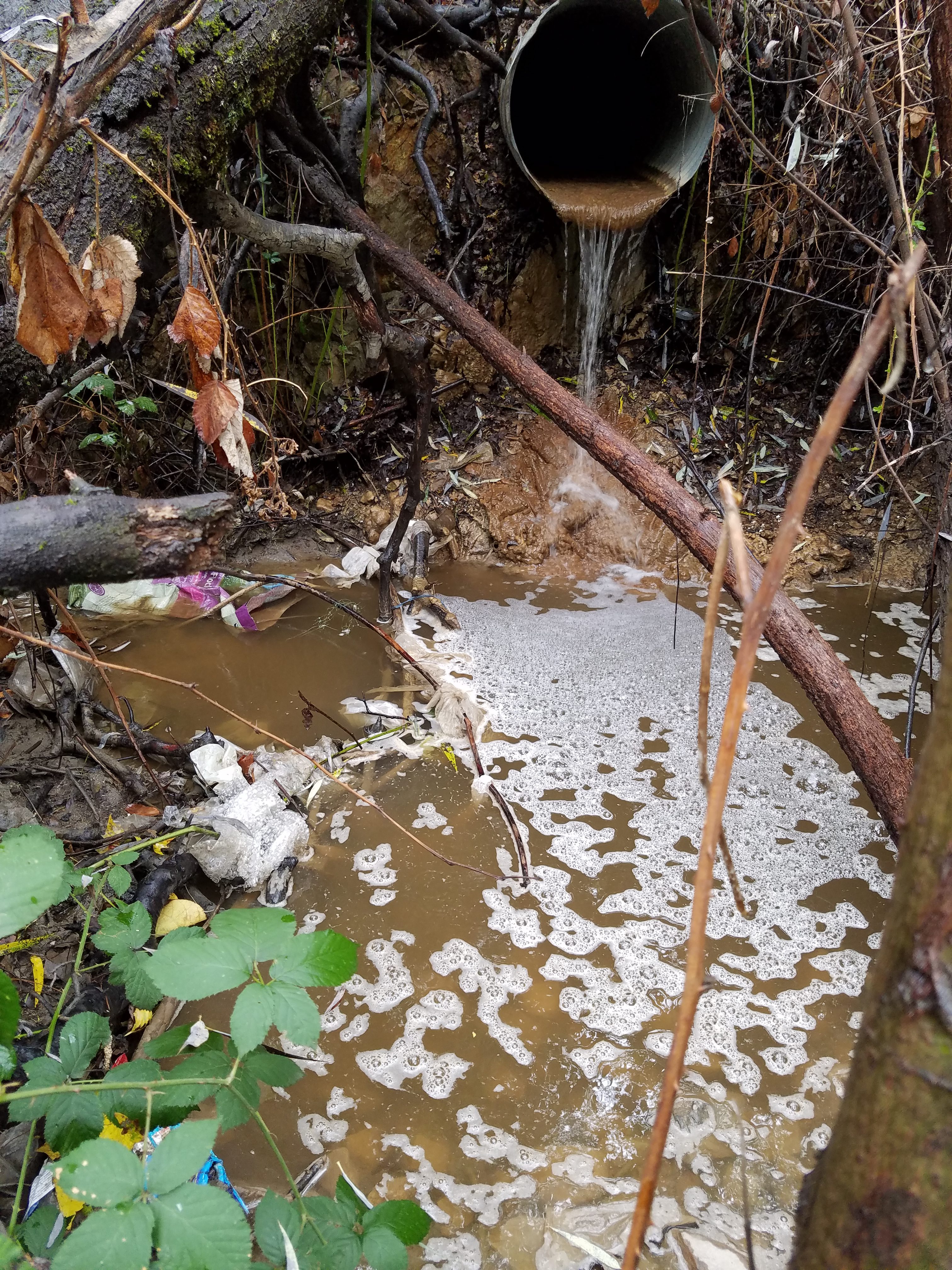
October rains brought the caustic water problem on the West Slope to the surface again. Photo/Provided

October rains brought the caustic water problem on the West Slope to the surface again. Photo/Provided

Too many cooks?

Brendan Ferry, principal planner and storm water program manager in the Long Range Planning division, agrees that water quality is a multi-agency issue.

“We have played a role, and Transportation has played a role, and Environmental Management has played a role,” he told Lake Tahoe News. “We all work within the same Community Development Agency. It’s not cut and dried. (The former Diamond Lime Plant) is a complex historical site with lots of moving parts.”

There is an enforcement response plan for storm water quality which outlines the roles and responsibilities of the various departments with regard to response and enforcement of storm water issues depending on whether they require an emergency or non-emergency response. According to Ferry, multiple county agencies might respond to the same toxic storm water discharge report.

A decadeslong problem

The Diamond Line Plant closed in 1977. There has been a clearly documented awareness for many years of the legacy of hazardous materials it left behind. Why, then, is high-pH storm water runoff still occurring in the areas around it in November 2016?

In February 2016, the Water Board issued an order to Michael Lindeman identifying his property as “a source of high pH waters leaching from the former lime rock processing facility found to be polluting soil and groundwater beneath the site, and leaching into unnamed waterways in the vicinity of the site.”

He was to prepare a technical report documenting the historic uses of the site, its current status and thoroughly identify remaining hazardous surface and subsurface materials and outline a program to clean them up. But this was far from the first time a public agency had become involved.

In 2008, Youngdahl Consulting, a geotechnical engineering firm, prepared an environmental site assessment (ESA) for Lindeman and his development partners in preparation for the planned construction of the Diamond Dorado Retail Center on his property. It was to include a mix of small and big-box retailers such as Home Depot or Target. An ESA is prepared prior to the county purchasing any property or accepting easements related to a development project to identify recognized environmental conditions that might affect the property or its value.

The Youngdahl report concluded that the surface water, storm water runoff, and groundwater quality on and around the property “may be compromised by pollutant loading,” and recommended that additional subsurface exploration take place before any grading operations began.

Finding the best solution

In March 2011, the California Department of Fish and Wildlife received the Hazardous Materials Spill Report that referenced milky water and dead wildlife in Weber Creek. Staff took photos of the site documenting the discharge. Testing showed pH levels ranging from 8.5 to 11.2. A Fish and Wildlife code violation case was filed with the county District Attorney’s Office. Lindeman was given a notice to appear in El Dorado County Superior Court in November 2011. He didn’t show up and a warrant was issued, but the warrant was recalled and the misdemeanor criminal case dismissed in early December 2011.

Assistant District Attorney Jim Clinchard explained that his office believed there was not enough evidence to prove the case and that based on ethical standards it had to be dismissed.

“Part of our proof problem in (the Lindeman) case was that the whole area was contaminated. How do you prove specifically where the problem came from when rain comes and washes lime from a number of properties? How could we say where it came from? There was lime on all these properties,” Clinchard said.

The same rationale would apply, he added, for any subsequent referrals by outside agencies for action by the District Attorney’s Office.

Clinchard said that in this type of case the administrative process is a better solution. “A criminal case,” he told Lake Tahoe News, “only has so much power over a defendant to fix a problem. Even if a defendant pleads guilty and pays a fine, it doesn’t fix the problem.”

He pointed to the county regulations such as the grading and storm water ordinances, and the enforcement mechanisms available to the state Water Board as better solutions.

More actions and reactions

Fish and Wildlife recommended that the Lindeman property site be stabilized to prevent further runoff. A corrective action plan was created by Lindeman and approved by Fish and Wildlife. In July 2012, Carol Oz met at the site with representatives from the Water Board and El Dorado County to review the plan’s progress. The visit revealed that extensive grading of the site had taken place without a grading permit from the county or notification to Fish and Wildlife. A stream and wetland on the property had been destroyed and soil had been put into the streambed of a tributary to Weber Creek. Monofilament erosion control netting that is hazardous to wildlife was being used.

Filing for a grading permit with the county’s Transportation Division triggers county inspection of the site and a review of the grading plans. A grading permit is required when grading would create “a condition which could adversely affect the water quality of any water body or watercourse.”

An applicant for a grading permit also files a notice of intent with the Water Board that he will comply with the NPDES permit requirements for storm water discharges associated with construction activity.

A second violation notice was sent by Oz to the county District Attorney’s Office. It indicated that the county and the Water Board had also observed the non-compliance at the site and were preparing documentation to submit to the DA’s Office. The potential costs for which Lindeman could be responsible were listed at $92,500.

A follow-up visit in February 2013 by Oz and a representative of the Water Board showed that the approved corrective action plan was still not being followed. Water Board staff observed lime waste in the graded cap material at the Lindeman property.

As the Water Board’s February 2016 order to Lindeman later explained it, “The capping material (obtained off site) is highly permeable and therefore, impacts from the lime waste through surface leaching are probable, as indicated by the continued high pH.”

A letter from Fish and Wildlife region manager Tina Bartlett to Lindeman stated, “…the department is forwarding this notice of violation to the District Attorney’s Office for civil or criminal prosecution.”
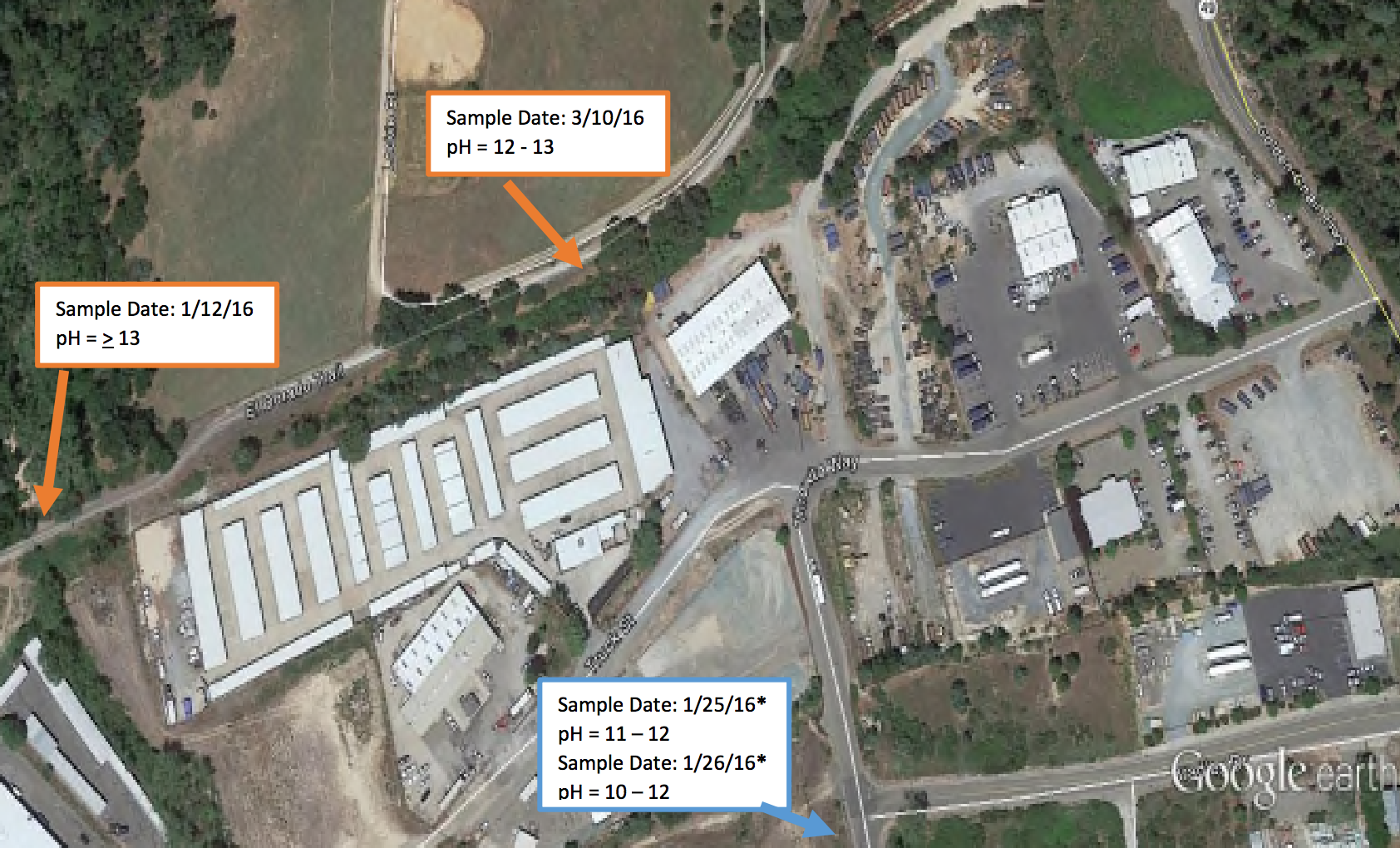
Testing of the hazardous water is done in close proximity to populated areas. Photo/Provided

Testing of the hazardous water is done in close proximity to populated areas. Photo/Provided

The grand jury is not pleased

The 2013-14 El Dorado County Grand Jury investigated the allegations of illegal grading on the Lindeman property and the failure by the county to take effective enforcement action.

The report referenced Fish and Wildlife code violations, the failure of Lindeman to follow the approved corrective action plan, grading conducted without a county grading permit and failure to comply with a Transportation division stop work order.

“The physical manifestations of the lime plant are long gone,” their report concluded. “However, the last vestige of the Diamond Lime Plan may be the lime waste that today continues to contaminate the property, surrounding area and adjacent waterways.”

The grand jury report added that in addition to criminal action by the District Attorney’s Office, enforcement action can be taken under the county’s Grading Ordinance and county employees or contractors can enter the property as the ordinance states “to abate hazards to public health and safety.”

Assistant District Attorney Clinchard agrees. “If it appears there is illegal grading, the county can go in or hire a contractor to fix it and then bill the landowner. If he doesn’t pay, they can lien the property.”

The grand jury concluded, “Both county staff and officials reported that they perceived it to be the will of the Board of Supervisors that the ordinance not be enforced. They stated that El Dorado County is a property rights county, the will of the Board of Supervisors is that property owners not be burdened by strict compliance with requirements perceived to be onerous for some property owners.”

In its response to the report, the county agreed that the illegal grading had “spread toxic limestone waste over the site causing dangerously high levels of pH in surrounding tributaries.” It disagreed with the grand jury’s contention that, “nobody is doing anything to stop it. Not the owner, not the county and not the state.”

The county response noted that the Transportation division issued a stop work notice and that they “followed the actions prescribed in the Grading Ordinance and forwarded the complaint to the appropriate agency for follow up and enforcement.”

The grand jury recommended that the county not allow Lindeman’s Diamond Dorado project to continue without ensuring that “all the environmental issues and mitigations have been resolved.”

The Diamond Dorado project had been approved by the Board of Supervisors in 2012, but the development agreement was rescinded by the county this year due to changes in the partnership and funding mechanisms, and lack of substantive forward progress on the project by the proponents.

Currently, all the requirements of the Water Board’s February 2016 order to Lindeman have still not been fulfilled. According to Walter Floyd, engineering geologist with the Water Board, the work plan presented by Lindeman was conditionally approved at the end of September 2016, with a report presenting the investigation results expected at the end of this month.



Casino industry not betting on recreational pot

By Richard N. Velotta, Las Vegas Review-Journal

You won’t see the casino industry leading the charge for passage of Question 2, Nevada’s recreational marijuana initiative.

Odds are you also won’t see resorts sponsoring gatherings involving cannabis use or allowing guests to smoke in their rooms.

That’s because the state Gaming Control Board, which regulates the gaming industry in Nevada, has been quite public about its concern that marijuana possession will remain a federal crime even if Question 2 is approved by voters Tuesday. Promoting marijuana use could be perceived as flouting federal statutes.

The potential for federal prosecution helps explain why casino companies and the Nevada Resort Association won’t support Question 2 — and why they won’t talk about recreational marijuana’s potential effects on tourism and conventions.

Read the whole story


Control of Nevada Legislature could flip

By Megan Messerly, Las Vegas Sun

Down ballot, Democratic and Republican candidates are waging a quieter war for control of the Nevada Legislature.

They’re not running the million-dollar races that have taken over your television, but they may have knocked on your door or given you a call, and their yard signs are probably parked in your neighborhood. It’s a battle with tremendous consequences for the Silver State.

Two years ago, Republicans took control of both houses of the Legislature, marking the first time that the governor and legislative leaders all have been Republicans since 1929. It was part of a phenomenon across the nation where Republicans enthusiastically turned out to the polls seeking change, while a significant number of Democrats stayed home.

Read the whole story