Placer County OKs Squaw’s mega development

By Benjamin Spillman, Reno Gazette-Journal

A proposal to dramatically upgrade resort offerings in Squaw Valley won approval by the Placer County Board of Supervisors on Tuesday on a 4-1 vote.

The proposal by Squaw Valley Ski Holdings, which owns Squaw Valley Resort, is a plan with multiple, village-style developments with new hotel rooms, restaurants, retail, condominiums, time shares and an indoor water park or mountain adventure center.

The project, which would take as many as 25 years to build, has divided much of the Lake Tahoe community between people who see it as an important step forward for the iconic winter resort that hosted the 1960 Winter Olympics and others who see it as a blight on some of the most scenic and lucrative real estate in the Lake Tahoe area.

“I meditated on this process for days and I relied on my head and my heart and my gut to make this decision today,” Supervisor Jennifer Montgomery said of her “no” vote.

Read the whole story


Californians fleeing high cost of housing

By Kevin Smith, San Jose Mercury News

California’s warm weather, sunny beaches and world-class schools have lured people to the Golden State for decades, but rising home prices are turning that equation around.

Data analysis firm CoreLogic says that for every home buyer coming into California, another three are selling their homes, packing up and moving out, CNN Money reported recently.

The trend of out-migration was also noted in a separate trio of reports released earlier this year by Beacon Economics. Beacon noted that 625,000 more U.S. residents left California between 2007 and 2014 than moved into the state. The vast majority ended up in Texas, Oregon, Nevada, Arizona and Washington.

Read the whole story


NDOW denies relocating bears to hunting areas

By Terri Hendry, KRNV-TV

Lake Tahoe Basin bears are at the center of a unique controversy. Some animal advocates are claiming the Nevada Division of Wildlife is putting relocated nuisance bears into hunting areas. It is a claim NDOW flatly and firmly denies.

Bear advocate Carolyn Stark said, “A majority of the bears are relocated out of the Tahoe basin and into the high desert hunting areas.” She added, “It is to stalk up the bear hunt. They hoping by moving these bears to hunting areas. some will stay in the area.”

NDOW spokesman Chris Healy said, “We haven’t done that. I can continue to say we don’t do it, we don’t do it, we don’t do it. Then I could follow that up with a we don’t do it. That is not how this works.”

Read the whole story


Search calls surge with wilderness rookies

After running from law enforcement, the SAR team rescued two suspects.Running from law esubjects who suffered hypothermia and other cold related illnesses. Photo/Provided

After running from law enforcement, the SAR team rescued two suspects who suffered from hypothermia. Photo/Provided

By Kathryn Reed

Inappropriate clothing and shoes, no plan for if things go wrong, and unrealistic expectations that a cell phone will reach help that is nearby.

This is increasingly what search and rescue teams with El Dorado County are finding. It’s the result of more people in the woods and so many of them being unprepared. The movie “Wild” has helped perpetuate the idea that inexperienced hikers will survive.

This fall two women had to be rescued near Cascade Falls because they weren’t prepared for the storm that came in even though forecasters had been talking about it for days. They said they didn’t know about the pending storm and thought spandex leggings would be sufficient. They got disoriented and told rescuers they were going to die. They didn’t – thanks to volunteers who brought them back to safety.

That’s a routine call.

The number of calls El Dorado County search and rescue crews go on has doubled since 2010. In 2015, EDSO SAR was called 89 times. (That doesn’t mean they went out each time.) In the first 10 months of 2016, SAR has been called 130 times. Most of those people don’t live in the area.

Training is necessary to keep the team sharp. Photo/Provided

Training is necessary to keep the team sharp. Photo/Provided

“People are coming to the area without physical fitness or the experience to recreate safely,” sheriff’s Deputy Greg Almos told Lake Tahoe News.

Almos runs the El Dorado County Sheriff’s Department SAR program. It’s made up about 30 volunteers in Tahoe; of those about a dozen are active on a regular basis.

Eagle Falls is where they go to the most; with twisted ankles a routine issue. Many people are less than a mile from the trailhead. Their lack of fitness contributes to the initial injury and then not being able to make it out, Almos said. The altitude and weather are other contributing factors.

The veteran SAR leader is an advocate for getting people outdoors, but he also believes there needs to be responsibility and common sense. This means education before getting on the trail.

A hiker who suffered a foot injury this summer at Eagle Falls is carried to the trailhead. Photo/Provided

A hiker who suffered a foot injury this summer at Eagle Falls is carried to the trailhead. Photo/Provided

People go for day hikes without bringing another layer for when the temperatures in the mountains drop. They don’t have packs with the essentials – like enough water, food, a flashlight, even a map. Nor do they have a plan in case they don’t make it out.

“It’s amazing how many people I talk to when I discuss a save your life plan over the phone and they cannot fathom why we are not there. When I say it will take several hours to get there and that they need to make preparations to survive, and I tell them what to expect and say it could be four hours, I get arguments,” Almos said. “After 20 minutes they call to say ‘where are you?’ I ask them how long it took to get to the top of Tallac. They say six hours. I’ve had people straight up say where is the helicopter. This isn’t Uber. People have a hard time understanding that.”

Then there are the times when people don’t know where they are. It’s getting harder to trace cell phone numbers because of privacy laws. Search warrants can sometimes be obtained after the fact. That is why dispatchers ask for consent to track people’s phones.

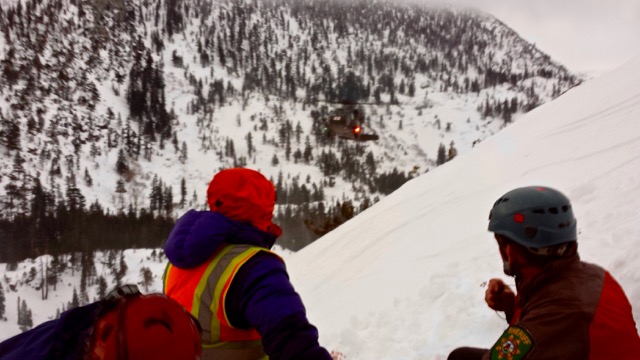
The helicopter arrives to transport a lost person from Maggies Peak in February. Photo/Provided

The helicopter arrives to transport a lost person from Maggies Peak in February. Photo/Provided

A relatively new phenomenon searchers have been dealing with is “meet-up groups.” These are Internet-based groups where random people meet for a certain activity. They aren’t abiding by the basic protocols of hiking at the speed of the slowest person and making sure everyone returns to the trailhead.

“We are getting people who are leaving people out there. This is an epidemic I think we are going to see an awful lot more of,” Almos said.

Descriptions of what they were wearing or looked like are often vague.

Compounding the problem is friends and relatives back home who might call to report the person overdue often don’t know where the person was exactly going or with whom.

About a dozen of these calls are now happening annually.

Nothing is routine, and it’s not unusual for rescues to require technical skills – especially at Lover’s Leap and the cliff area at Vikingsholm. Climbers get stuck.

Their rescuers aren’t getting paid. Search team members provide their own gear.

It’s not unusual in the busy summer season to get back-to-back calls. Sometimes they are on a call for consecutive days. They receive training, but they all come to the “job” with a love for the outdoors and a desire to help others.

All of the volunteer search and rescue members are on-the-ground team. There is the management team that runs the command post and sets up the coordination, a Nordic team, snowmobile group, mountain rescue unit that handles extreme weather backcountry cases, and K-9 teams. The West Slope has an equestrian group and OHV.

And the people they rescue are not charged a dime.


Treasury finds troubles with TARP in Nevada

By Daniel Rothberg, Las Vegas Sun

Seeking to address the housing crisis in the states most affected by unemployment, the federal government created a fund in 2010 to help homeowners pay mortgages. Nevada stood to benefit from an allocation of about $200 million as part of the Hardest Hit Fund. But six years later, half the funding has yet to be disbursed, with many homeowners turned away from the program.

Although the fund — controlled by the nonprofit Nevada Affordable Housing Assistance Corp. (NAHAC) — approved payouts for thousands of homeowners in its first three years, assistance plunged after 2014, a trend that prompted federal and state inquiries into the fund’s management and day-to-day operations. Under new management, it is in the process of reforms.

In a harsh September report detailing wasteful spending, an auditor for the Treasury Department criticized the fund for acting with “a sense of entitlement and no appreciation for the fact that it was taking funds for itself from the homeowners the program intended to help.”

Read the whole story


2016 on target to be world’s warmest year

By Matt McGrath, BBC

2016 looks poised to be the warmest year on record globally, according to preliminary data.

With data from just the first nine months, scientists are 90 percent certain that 2016 will pass the mark set by 2015.

Temperatures from January to September were 1.2 degrees Celsius above pre-industrial levels, according to the World Meteorological Organization.

The body says temperatures should remain high enough for the rest of the year to break the previous record.

El Nino has had an impact, but the most significant factor driving temperatures up continues to be CO2 emissions.

Read the whole story


Ski exec: California industry thriving

By Kathryn Reed

TRUCKEE – Those living in Lake Tahoe know the ski industry is big business. But it’s also a lucrative industry for the state of California with a $1.3 billion annual impact.

Michael Reitzell, executive director of the California Ski Industry Association, and Daphne Lange with Visit California, the state tourism agency, spoke at the Truckee Chamber of Commerce breakfast this month about trends in the industry.

California averages nearly 7 million skier visits a season. Colorado’s average is 20 million. Nationally the average is 56 million.

Half of those skiers in California are going to the Tahoe-Shasta area, while 30 percent are hitting the Central Sierra slopes – which includes Mammoth. What makes this market different, according to Reitzell, is that people spend more money in this region. This area captures 57.1 percent of the skier-boarder dollars or $742.8 million a year.

“Participation is strong and steady,” Reitzell told the group. One thing that is changing is people are doing more than just skiing – they are participating in the other activities resorts offer.

In recent years there have been more skiers on the slopes, while the number of snowboarders is decreasing. Seventy percent of those skiers are younger than 50.

Reitzell in part attributed the increase in skiers to better equipment, newbies seeing their friends and family members on skis, and the Olympics introducing more exciting events that in the past had been dominated by snowboarders.

Snow clearly is what makes the difference in whether people are coming to Tahoe. Last season there were 7.3 million skier visits in the state – so more than average. Even though it was normal snow-wise, it came after three years of substandard snowfall. The 2014-15 skier visit total in California was 4.4 million.

When it comes to marketing the area, Tahoe falls under the High Sierra region for the state. Ninety-three percent of the trips to the state are domestic travelers, but the international travelers account for 20 percent of the spending.

Half of the visitors to California come from either Washington, Oregon, Nevada, Utah, Colorado or Arizona, according to Lange.

The 2015 tourism numbers improved over 2014:

·      Total direct spending — $2.7 billion – 5.7 percent change

·      Tourism supported jobs – 29,400 – 3.1 percent change

·      Local tax receipts — $108 million – 9 percent change

·      State tax receipts — $110 million – 1. 8 percent change.

While promoting the resorts in the state is one of the ski association’s main responsibilities, safety and sustainability are the other two key platforms.

“Our resorts even in normal times can be right around where the snow is. We have to be concerned if the snow levels rise,” Reitzell said.

His agency is also worried about the rising number of fires as the climate changes. Because of this the association is working with the U.S. Forest Service in regards to fire suppression funding. Most of the state’s ski resorts are on Forest Service land.


Reno’s family-friendly makeover

By Susan Moeller, Boston Globe

On a cold night in March, Great Full Gardens restaurant in a nondescript brick building in Reno’s MidTown District is jamming. Locavores tuck into plates that are paleo-friendly at one table, vegan at the next, grass-fed at another. One of my daughters, Emily, is eating a black bean burger. The other, Sophie, is sipping an artisan kombucha. There’s not a slot machine, cigarette, exotic dancer, or daiquiri in sight. Welcome to 21st-century Reno.

Tell someone you’re headed to Reno and you’re likely to hear a story involving copious amounts of alcohol and activities unfit for a family newspaper. But because Sophie has lived in the area for almost 10 years, I’ve developed a soft spot for “The Biggest Little City in the World.” Often thought of as a smaller, less glitzy — but generally more affordable — cousin to Las Vegas, Reno is in the midst of a big makeover. And it’s not just about the food.

In the last few years, Reno’s city leaders and entrepreneurs have embraced its easy access to the outdoors, reasonable climate (at 4,000 feet, it’s markedly cooler than Vegas and has lots of sunshine); central location (about a four-hour drive from the San Francisco Bay Area); and the culture of Burning Man (about 30,000 “Burners” fly into the Reno-Tahoe International Airport each summer on their way to the arts gathering in Black Rock Desert).

Read the whole story


Study: Biodynamic, organic vineyards produce better wine

By Thomas Ulrich, Sierra

For decades, vineyard managers and wine aficionados have wondered whether growing organic and biodynamic grapes is worth the trouble. Last summer, the Journal of Wine Economics may have unveiled the answer via a report from researchers out of UCLA’s Institute of the Environment and Sustainability. For the study, environmental economists evaluated the results of 74,148 wines reviewed by Wine Spectator, Wine Advocate, or Wine Enthusiast, accounting for the variation in region, vintage, and variety. They discovered that wine made from biodynamic and organic grapes on average scored four points higher on a 100-point scale than wine made from conventionally grown grapes.

“We found that organic or biodynamic farming made a significant difference in wine quality,” says lead author Magali Delmas, an environmental economist and professor at the UCLA Anderson School of Management.

Dozens of eco-certified California vineyards are embracing dry, no-till, and biodynamic farming. Vignerons cultivate the land organically, tend farm animals across a varied landscape, blend their own compost, mix and apply their own soil preparations, and harvest grapes according to a celestial calendar. To find out exactly how regenerative vineyard practices are enhancing the quality of grapes, enriching the soil, and reducing greenhouse gas emissions, I ventured onto two such leading vignerons’ vineyards—one of whom farms biodynamically and the other organically.

Read the whole story


West Shore Café creating a wine mecca

Wine service at West Shore Cafe in Homewood is under the direction of two sommeliers. Photos/Kathryn Reed

Wine service at West Shore Cafe in Homewood is under the direction of two sommeliers. Photos/Kathryn Reed

By Kathryn Reed

HOMEWOOD – It’s one thing for a restaurant to have an exceptional wine list, it’s quite another to employ two sommeliers – especially in Lake Tahoe.

West Shore Café earned the 2016 Award of Excellence from Wine Spectator. This is given to restaurants that have at least 90 wines to choose from, as well as a thematic match to the menu in terms of price and style.

While other Tahoe restaurants earned this award, what distinguishes the Homewood eatery is that it is the only one in the basin to have two level two sommeliers. Most don’t even have one sommelier.

West Shore Café facts: •It will reopen Nov. 23 • Every season there is a new menu • In winter it is open for dinner Friday-Monday • Lunch is also served Saturday-Sunday • It has been owned by JMA, the owners of Homewood Ski Resort, since 2010 • Seats 150 • Located in Homewood on the other side of Highway 89 from the ski resort.

West Shore Café facts:
• It will reopen Nov. 23
• Every season there is a new menu
• In winter it is open for dinner Friday-Monday
• Lunch is served Saturday-Sunday
• It has been owned by JMA, the owners of Homewood Ski Resort, since 2010
• Seats 150
• Located in Homewood on the other side of Highway 89 from the ski resort.

The overly simplistic definition of a sommelier is someone who is an expert in wine and is able to assist diners with which wine to pair with their meal. There are four sommelier classifications, with Lisa Small and Rob Dubben at West Shore both at level two.

Together Small and Dubben create the wine list.

“When it comes to our list at West Shore Café, we look at a number of things. First, we look at what our competitors have and how it is selling. Second, we think about the balance of the list, how to make it functional but also have the right choices so guests can be happy with their selection,” Dubben told Lake Tahoe News. “Beyond that, we really try to look at classic styles from all regions of the world. I often ask myself questions like, what is interesting about this wine? What can I find that is off the beaten path that has great value and quality? What is something I know our clients will love?”

Looking at environmental practices is another component, as in organic farming. Last summer the menu was revamped to tell guests if a winery is certified organic, biodynamic or uses green practices.

Special chef-sommelier pairing: Appetizer: King Crab with a pepper crusted orange relish Wine: Leeuwin Estate, Dry Riesling, Margaret River, Australia   Salad: Strawberry salad with a white balsamic dressing and arugula Wine: Chateau Gassier, "Epritgassier", Rose, Provence, France   Entrée: Red wine braised short ribs with salted roasted potatoes Wine: Robert Craig "Affinity", Cabernet Sauvignon, Napa Valley   Dessert: Mascarpone crusted cheese cake with chocolate dipped Madeline Wine: Saracco, Moscato d'Asti, Piedmont, Italy.

Special chef-sommelier pairing:
Appetizer: King crab with a pepper crusted orange relish
Wine: Leeuwin Estate, Dry Riesling, Margaret River, Australia
 
Salad: Strawberry salad with a white balsamic dressing and arugula
Wine: Chateau Gassier, “Epritgassier”, Rose, Provence, France
 
Entrée: Red wine braised short ribs with salted roasted potatoes
Wine: Robert Craig “Affinity”, Cabernet Sauvignon, Napa Valley
 
Dessert: Mascarpone crusted cheese cake with chocolate dipped Madeline
Wine: Saracco, Moscato d’Asti, Piedmont, Italy.

To make the list more approachable it highlights flavor profiles. A Chardonnay might indicate if it has a big, buttery taste or is more oaky.

The menu also balances classic favorites with small case productions.

It’s not all about the sommeliers’ favorites, but what guests want and what will sell.

The sommeliers also work closely with Chef Ben Deinken so they have an understanding of what will be coming out of the kitchen. Based on a sampling of food and wines prepared for Lake Tahoe News, the trio is clearly in sync.

The guidance of a sommelier will often lead people to trying wines they have not heard of, but could be similar to what they are used to. The wine experts ask diners what they regularly drink, what they like in a wine – that’s more important than what they are ordering.

“I’m less of traditionalist in finding the right wine for the right food. It’s what they like,” Small told Lake Tahoe News.

Dubben said, “When guests ask for your opinion this can open up dialogue about which direction they want to go. Generally, I follow up in asking if they are feeling adventurous or if they are interested in trying something that they cannot get everywhere. Reading the guest isn’t always easy, but another way I sometimes go about it is to just bring up a wine that I love and tell the story about the wine, winemakers and the location of the winery. It paints a picture for the guest about what they are about to enjoy and it is my favorite way to talk about wine.”

Sommeliers Lisa Small and Rob Dubben

West Shore Cafe Sommeliers Lisa Small and Rob Dubben

Becoming a sommelier is no easy task. Tests are rigorous, involve blind tastings, written exams, knowing varietals, where in the world the wine came from and more complexities.

A few years ago at a different restaurant Small was called out by a diner for her lack of wine knowledge. That got her interested in learning, and now making a career out of her expertise.

Dubben took a bit more traditional route, starting in the restaurant business at age 14. Eventually he attended the International Culinary Center in Campbell where he spent three months studying under five master sommeliers.

Dubben is studying to take the exam for the next level, called advanced. The top level is master sommelier.