Did money buy Calif. ballot measure contests?

By Taryn Luna, Sacramento Bee

California voters passed a measure on Election Day urging state politicians to use their authority to limit corporate and special interest spending in elections.

Then they sided with the campaign that raised the most money on the majority of statewide ballot measure contests.

Proposition 59 was advisory-only, aimed at overturning a Supreme Court decision in an effort to rein in outside spending. It carries little weight. Nonetheless, the vote demonstrates Californians’ concern over the role of money in politics.

Read the whole story


Legal squabbles may doom lone SLT pot shop

By Kathryn Reed

“You have just hit us with a bomb.”

That was the reaction of a care-giver when told Tahoe Wellness Cooperative will likely close next month.

The medical marijuana dispensary’s permit expired in May. City officials have been working with Cody Bass, who operates the nonprofit, to get the business into compliance. The city finally said enough is enough and told Bass the company must cease operations Dec. 13 if it does not have a valid permit.

A condition of the two-year permit is for the collective to have written permission from the landlord to operate this type of business. That permission has been elusive.

Patty Olson owns the commercial strip in the Bijou Center where the collective is located. She was a pioneer here, having moved to the city in the 1950s before it was a city. Olson moved to Sparks a couple years ago.

The property is under the auspices of a family trust that is controlled by her son, Patrick. The family has run into some difficult financial times since she relinquished control of her finances. They almost lost the family house behind the center. This fall a local businessman came forward with funding so the house would not be foreclosed on. Patrick Olson still lives in the house.

Patty Olson told Lake Tahoe News she has been advised by her attorney, Bruce Grego, to not talk about what is going on.

“I’m not privileged to give you any information,” the 91-year-old Olson told Lake Tahoe News.

Grego also is not talking.

The trust also owns the cabin that houses the tattoo shop.

Bass and the Olson family are involved in several lawsuits.

In March, Bass told Lake Tahoe News he was buying the property where the collective is as well as the Olson family home. He has sued the family for breach of contract. Those close to the case told Lake Tahoe News that the option to buy expired.

The Olsons have filed suit trying to evict Bass, contending that he is arrears in rent by at least six months.

Bass could not be reached for comment.

A settlement conference is scheduled for Nov. 29 regarding the eviction and a trial is set to start in February for the breach of contract lawsuit.

Waiting in the wings for the lawsuits to settle is a well-known South Lake Tahoe businessman who owns other property in the Bijou area. LTN sources said the sale of the Olson property is contingent on Bass not being there.

What isn’t known is why the Olsons prefer selling to the unnamed businessman over Bass. However, it is well-known that city officials have wanted TWC to close and are working with the businessman.

With TWC being the last place to get medicinal marijuana in South Lake Tahoe, if it closes, it would create a void in the lives of those who need the product.

“The patient that I am caregiver for has been going to the collective since it opened. I go weekly to get this person’s medicine and it has allowed this person to have a better appetite, and dramatically cut back on pain medication,” Rosemary Manning told Lake Tahoe News. She is the one who said news of the closure hit her like a bomb.

Recreational marijuana is not likely an option because that will be a while before California actually allows it even though voters approved the use earlier this month. Going to Nevada will be an option she and the patient will look into.

The original moratorium in South Lake Tahoe on three pot clubs was approved in November 2009. Bass’ is the last one in existence. Part of the ordinance that was later passed said the dispensaries were only allowed to operate at the address of their original permit. That means that even if Tahoe Wellness Cooperative wanted to move, it would require the council rewriting the ordinance.

Marijuana is going to be a big part of the Dec. 13 council agenda – the same day as TWC’s deadline to come into compliance or lock its doors. Police Chief Brian Uhler is scheduled to give a presentation about Proposition 64, the recreation marijuana initiative that voters OK’d this month. The city probably has to change its ordinance in regards to growing marijuana.



USFS: 102 million dead California trees

By Matt Stevens, Los Angeles Times

The number of dead trees in California’s drought-stricken forests has risen dramatically to more than 102 million in what officials described as an unparalleled ecological event that heightens the danger of massive wildfires and damaging erosion.

Officials said they were alarmed by the increase in dead trees, which they estimated to have risen by 36 million since the government’s last survey in May. The U.S. Forest Service, which performs aerial surveys of forest land, said in a study released Friday that 62 million tree died this year alone.

“The scale of die-off in California is unprecedented in our modern history,” said Randy Moore, the forester for the region of the U.S. Forest Service that includes California. Trees are dying “at a rate much quicker than we thought.”

Read the whole story


Prohibition of pot use in Nev. casinos likely to continue

By Thomas Moore, Las Vegas Sun

Even after Question 2’s passage last week, casinos will likely avoid dealing with the marijuana industry and continue to prohibit guests from using pot on their properties, if the discussions of Nevada’s gaming regulators Thursday are any indication.

Both the Nevada Gaming Control Board and Gaming Commission heard testimony and talked about the question that allows adults to legally possess up to one ounce of marijuana, or one-eighth ounce of concentrated marijuana, starting next year.

The issue was listed only as a discussion item on the agenda, so the commission did not vote or make a formal recommendation.

Read the whole story


Bijou park hindered by lack of master plan

By Kathryn Reed

Bijou Community Park needs help.

“There are a lot of things people would like to do and add to the park but there is no master plan,” Pete Fink told the South Lake Tahoe City Council on Nov. 15.

Fink is a member of the city’s Parks and Recreation Commission. That advisory board has become a more vocal and active group in the past couple of years. One of the main purposes of the commission is to identify needs in the community and bring them to the council’s attention.

Just like when Commissioner Scott Valentine spoke last month about bike trails, Fink also advocated for an expanded budget. This would be for more front line staff and maintenance, as well then allowing for the expansion of programs.

Fink said the parks in town are being loved to death, especially Bijou.

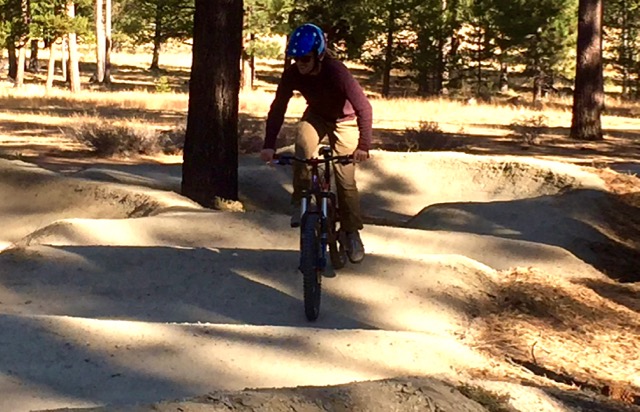
Bijou Bike Park has multiple courses for all ability levels. Photo/LTN

Bijou Bike Park has multiple courses for all ability levels. Photo/LTN

The city has talked about doing a master plan, but that is as far as it has gotten. It will likely be brought up again at the council’s February strategic plan meeting.

With the passage of Measure P this month, the city will soon have more money for recreation. About 60 percent of the revenues will be used to pay back the bonds once those are issued. That means there will be “leftover” money that could be used for more immediate and routine needs that the commission identifies – as well as for a consultant to prepare the master plan.

A master plan would also help with conflicts that exist.

“The gate is open for the dog park, but the park is closed (in winter). Having the gate unlocked sends mixed messages. A master plan can help with a solution,” Fink said.

As the Greenway Bike Path continues to be built, it will tie into Bijou park. But what’s on the books now would affect disc golf. A master plan would help plot where the various users would recreate.

The commission recommends:

·      The council continue discussions with the California Tahoe Conservancy in regards to property exchanges so Bijou Community Park could expand.

·      Installing a pedestrian-triggered crosswalk from the entrance of the park to the community ball fields on the other side of Al Tahoe Boulevard.

·      Considering more concessionaires in the park.

·      Having the park open in the winter – which would mean bathrooms, drinking fountains, snow play area and parking.

When a police officer is needed the incident at a park is often not the first priority. Fink suggested a park ranger of sorts to be dedicated to patrolling the various entities.

He broached the idea of altering the city’s agreement with TAMBA so the cycling organization could hire a part-time person dedicated to working on the bike park at Bijou.

The nonprofit spent $18,000 on the park this summer, which included redoing the pump track so it’s not as steep. Benches have been added along with a repair station. A new line was added on the slopestyle course. More features were put in on the loop route to help people build skills. The BMX hill is now asphalt.

City recreation areas also include Lakeview Commons, Regan Beach, Bonanza Park, Campground by the Lake, Bijou Golf Course and the recreation center.


Federal grant to combat Nev. property, drug crime

By Sandra Chereb, Las Vegas Review-Journal

CARSON CITY — Nevada has received a $978,000 federal grant to combat and reduce recidivism among inmates convicted of property crimes and drug offenses, the state Department of Corrections announced Wednesday.

The grant from the U.S. Department of Justice will fund a program targeting male property crime offenders between the ages of 18 and 55, who are assessed as moderate to very high risk of reoffending and where substance abuse was a factor in the crime. Inmates serving sentences for drug crimes are also included.

“We know that property crime accounted for 80 percent of all crime in Nevada in 2014,” James Dzurenda, director of the Department of Corrections, said in a statement. Nevada was one of three states awarded grant funding.

Read the whole story


Tracking Sierra snow via instruments on planes

By Alexandra Witze, Air & Space

To know California’ true water content in the mountains help is coming in the form of a King Air A90. Scientists have loaded the airplane with instruments to study California’s snowpack in unprecedented detail.

Each spring, they fly back and forth over the mountain ranges, measuring where the snow lies and how deep it is. That information helps water managers plan for exactly how much snowmelt to expect rushing downstream each spring—and, in turn, how to divvy up those scarce gallons among the people who need it the most. The airplane can’t make more snow fall from the sky, but it can help officials make smarter decisions about how to use what’s already there.

The idea for the mission arose in the late 2000s, before the current drought really took hold of California. Thomas Painter, a snow hydrologist who was then at the University of Utah, attended a colleague’s talk about using an airplane with a laser to measure tropical forest loss. Scientists aboard that airplane shot lasers down to the ground and measured how quickly the pulses returned, and the results made a three-dimensional picture of the landscape. Returning to the same spot time after time enabled them to study how quickly loggers were stripping trees away.

Not long after the talk, NASA’s Jet Propulsion Laboratory in Pasadena, California, recruited Painter to study water resources and climate science, and he thought back to how that laser technique might be used to study snow levels. He called Frank Gehrke, chief of snow surveys for the California Department of Water Resources in Sacramento, and asked if he wanted to know more about imaging the state’s snowpack from the air. In 2012, the Airborne Snow Observatory took off on its first mountain pass.

Read the whole story


SLT embarks on path to find consensus on VHRs

Several dozen people on Nov. 16 weigh in on vacation home rentals in South Lake Tahoe. Photo/LTN

Several dozen people on Nov. 16 weigh in on vacation home rentals in South Lake Tahoe. Photo/LTN

By Kathryn Reed

Sifting through assumptions and reality. That is the goal of a consulting team hired by the city of South Lake Tahoe to work on the vacation home rental quagmire.

More than 70 people attended a meeting Wednesday night aimed at getting the public’s opinions about these rentals that are usually found in residential neighborhoods.

Reps from Michael Baker International have been in town for a few days gathering data. They are tasked with coming up with ideas of how the city can go forward with VHRs (or not) in order to appease people and the city’s budget.

These whole house rentals pay transient occupancy tax, which is one of the city’s main revenue sources.

But plenty of people are less worried about the city’s coffers and more worried about their quality of life.

People at the Nov. 16 meeting spoke about how these extra people in town are impacting the condition of city streets, some questioned if everyone is paying TOT, and many are concerned with lack of enforcement.

Restricting the number of VHRs was an idea, while others recognize hotels aren’t where people want to stay.

Some said VHRs are already regulated, noting these owners face more scrutiny than those renting to full-time residents.

Others fear the value of their home is lessened with neighboring VHRS.

Three stations were set up in the senior center where people could write comments as well vote via a sticker on what they like-dislike about VHRs, as well as cast a vote related to their perceptions about current conditions.

Most people agreed VHRs are a good source of revenue for the city and the homeowner, that they contribute to jobs, and expand lodging opportunities for tourists. They also don’t believe there has been an increase in commercial enterprises in neighborhoods.

It was a pretty even split on agreeing-disagreeing about whether VHRs put a strain on public services and if they degrade neighborhoods.

The consultants will compare the trends and perceptions of the public against the factual data. The results of the study are likely to be released in the spring, at which time the City Council will address the findings. There will be more time for public comment before then. Taking this survey is another way to have a voice about VHRs.


Study: Human actions influence fire in Sierra

By Science Magazine

While climate contributes strongly to fire activity in the Sierra Nevada Mountains, human activity, starting well before European contact, has also played an important part in the severity, frequency and sheer numbers of forest fires occurring in the area, according to researchers.

“Initially, we did work to see if we could develop long-lead forecasts for fire in the area — six to 18 months in the future — using climate patterns such as El Nino,” said Alan Taylor, professor of geography at Penn State. “This would be a significant help because we could place resources in the west if forecasts indicated it would be dry and the southeast would be wet. However, the climate relationships with fire did not consistently track.”

Taylor, working with Valerie Trouet, associate professor of dendrochronology at the University of Arizona, merged a tree-ring-based record of Sierra Nevada fire history with a 20th century record based on annual area burned to create a record of fires spanning 415 years, from 1600 to 2015. While year-to-year fire variability was influenced by climate throughout that time, they found that large decadal-scale shifts in the Sierra Nevada fire regime were related to changes in human activity.

Read the whole story


Experts: Stop squeezing table game players

By Thomas Moore, Las Vegas Sun

In the early 1980s, a battle was fought and lost in the casinos of Las Vegas and Atlantic City. The result, said two experts at the Cutting Edge Table games conference at the Flamingo Las Vegas this week, was that slot machines won the high ground on the casino floor.

“1984. What does that year mean to us?” Michael A. Meczka, president of Meczka Marketing Research Consulting, said during a session titled “We Have Met the Enemy: It is Us!” “In 1984, across Nevada and Atlantic City, it was the year when slot revenue began to exceed table revenue.”

Corporate ownership may be more to blame for the decline of table games — and also diminishing gambling revenue — than any generational shift if the arguments of Meczka and other speakers on Tuesday, the second day of the conference, hold any weight.

Read the whole story