Biting cold to sweep through Tahoe region

By Kathryn Reed

While no records are expected to be broken in the next week, it’s going to get even colder in the Tahoe-Truckee area in the coming days.

Wednesday morning is expected to be the coldest, according to the National Weather Service in Reno. Most lows will be in the teens, though Truckee may hit 5 degrees.

Record lows for this area are below zero, which isn’t expected to occur with the series of storms that are lined up to the west.

The initial system will bring more cold than moisture.

“The snow level is going to be tough to predict with this one. We are still working out numbers on that,” Zach Tolby, meteorologist with the Weather Service, told Lake Tahoe News. “It’s going to start cold, warm up and then cool down so the snow level will fluctuate a lot as the storm comes in this weekend.”

Not only are the snow levels unknown right now, but the amount of white stuff also isn’t being predicted.

The bulk of rain and snow is expected to reach Tahoe on Thursday and Friday. The weekend system is not expected to be as strong.

With the cold temps it means area ski resorts have been able to make snow. Add that to what Mother Nature will be dropping, and it means more terrain will be opening.


Tahoe funding restored to federal water act

By Kathryn Reed

The Lake Tahoe Restoration Act, once thought unable to be approved by Congress this session, has been resurrected.

It was announced Monday that it is now part of the final bicameral Water Resources Development Act (WRDA), titled the Water Infrastructure Improvements for the Nation Act. 

In October, it had been removed from the House version of the WRDA.

The House and Senate still need to vote on it, and the president must sign the legislation. 

“This is a monumental step in the legislative process for the Tahoe basin. After fighting for years to refocus federal policy on the twenty-first century threats to the Lake, we have ensured important work that preserves the Jewel of the Sierra for future generations will advance. This was a total team effort by both the Nevada and California delegations which required bicameral and bipartisan support,” Sen. Dean Heller, R-Nev., said in a statement.

He was the lead sponsor on the legislation.

The bill would deliver $415 million to the Lake Tahoe Basin across seven years. The money would be used for wildfire prevention, the environmental improvement program, invasive species management, stormwater projects, Lahontan cutthroat trout recover, and other projects.

“This is great news for Lake Tahoe. TRPA is excited to see such strong and widespread bipartisan support for this comprehensive legislation that is so important for continued environmental conservation and restoration work at Lake Tahoe, one of America’s natural treasures,” Tom Lotshaw with TRPA told Lake Tahoe News.

The original Lake Tahoe Restoration Act was passed by Congress in 2000, three years after President Bill Clinton was here for the initial Lake Tahoe Environmental Summit. The bill brought $300 million in federal money to the basin in 10 years.

Since the 1997 summit more than $2 billion has been spent in the basin on what officials call environmental projects. This is a combination of federal, state, local and private dollars.

With the U.S. government owning about 80 percent of the land in the basin, that has always been one of the leading arguments that the feds should have a major role in the upkeep of the area.


USS Arizona survivor recalls tragedy 75 years later

By Audrey McAvoy, AP

HONOLULU — Lauren Bruner was getting ready for church in 1941 on his battleship, the USS Arizona, when the alarm sounded.

The Japanese attack on Pearl Harbor had begun, and Bruner, then 21, scampered up five stories by ladder to the enormous anti-aircraft guns he was responsible for manning.

But bullets hit his left leg and explosions set off by the Sunday morning bombardment rocked his ship before he could get to the weapons. The ship sank just nine minutes later. Bruner escaped, but suffered severe burns.

This week Bruner, now 96, plans to visit a memorial over the Arizona’s sunken wreckage and attend a remembrance ceremony at Pearl Harbor on the 75th anniversary of the Dec. 7, 1941, attack.

Bruner has traveled from his Southern California home for the events many times, but doesn’t know how long the Arizona’s few remaining survivors will able to keep up the tradition.

“It’s getting close to being the end pretty soon. There’s only five of us left now,” Bruner said.

More than 2,300 servicemen died in the Japanese attack that plunged the United States into World War II. Nearly half of those killed were on the Arizona, most still entombed in the wreckage.

The Navy and National Park Service expect several dozen attack survivors to attend the remembrance ceremony Wednesday on a pier overlooking the harbor. They, along with thousands of others, will observe a moment of silence at 7:55 a.m. — the same minute the Japanese planes hit their first target in the harbor.

Back then, in 1941, Bruner didn’t know who was attacking until the planes got close enough for him to see the red Rising Sun Japanese insignia on their sides. The aircraft shot at “everything in sight,” he said. Then an explosion tore through his battle station.

“That’s where the flames blew right through and cooked me right there,” Bruner said in a telephone interview from his home in La Mirada.

With “everything burning,” Bruner tried to get off the ship as fast as he could. But the water in the harbor 80 feet below — infused with leaked oil — was on fire, too, so jumping wasn’t an option.

Bruner and a few fellow shipmates shouted to a sailor on the ship moored next to the Arizona to toss over some rope. The six of them tied the rope and carried themselves hand-over-hand across the 100-foot expanse to the USS Vestal.

“You’re like a chicken getting barbecued,” he said. All of them made it, becoming six of the 335 sailors and Marines on the Arizona to survive. Another 1,177 shipmates died.

Doctors on the USS Solace hospital ship wanted to amputate most of Bruner’s hands, leaving him with just his forefingers and thumbs, he said. Ultimately they peeled off his dead skin and let new skin grow in. They put him in a special bed with hoops that allowed sheets to be draped above him but not touch him.

Navy documents recently uncovered by the genealogy and historical records company Ancestry show Bruner suffered burns on his face and the back of his neck, his right shoulder, right arm and forearm, fingers, hands, outer thighs and lower legs.

The burns on his right arm were particularly severe and took longer to heal, according to the documents, which Ancestry has posted in a special section for Pearl Harbor survivors within its military records site Fold3.com.

Bruner spent seven months recovering but returned to service, he said, because the Navy needed sailors to train new recruits to fight the war. He was on the USS Coghlan when it bombed Japanese positions on Attu Island in Alaska in 1943. His ship later took troops to the South Pacific and was near Guam when the war ended.

He doesn’t like to rehash many details from Dec. 7. He said he just “grins and bears it” to cope with the memories.

“There are parts of this whole thing that I can’t talk about. If I do talk about it, I cannot sleep,” he said.

After the Navy, Bruner went to work for a former Marine’s refrigeration business and spent 39 years with the company. He married twice, but outlived both wives.

Bruner wants his ashes interred inside his old battleship after he dies, like many other Arizona survivors who have chosen to be buried with their shipmates. Bruner said he prefers this to lying in a sparsely visited cemetery.

“I think I’ve got the last spot,” he said, expressing confidence he’ll be the last of the survivors to go.

Associated Press writer Christine Armario in Los Angeles contributed to this report.


Efficient woodstoves improve Tahoe air quality

By Kathryn Reed

Black smoke billowing from chimneys is exactly what air quality regulators don’t want to see.

Woodstoves have become so efficient that little or no smoke should be seen. The problem is there are thousands of open face fireplaces and inefficient woodstoves in the basin. This contributes to poor air quality, and the soot reaching the lake degrades the clarity of Lake Tahoe.

“Older, outdated woodstoves generate significant emissions that harm air quality and the environment. Newer, more efficient woodstoves certified by EPA burn one-third less wood and can result in particulate matter emission reductions that are equivalent to removing five diesel buses from the roads,” Tom Lotshaw with the Tahoe Regional Planning Agency told Lake Tahoe News.

The California Air Resources Board’s initial draft plan that was released Dec. 2 calls for reducing greenhouse gas emissions by 40 percent below 1990 levels by 2030. This mandate is the most ambitious of any state.

“This plan lays out a road map for California – and the rest of the world – to achieve climate goals that were inconceivable only a decade ago,” Gov. Jerry Brown, who established this 2030 target by Executive Order in April 2015 and signed SB32 in September to codify it, said in a statement. “There are steep hills ahead, but we’ll scale them by continuing to take a series of bold actions, including extending California’s Cap-and-Trade Program.”

El Dorado County is doing what it can to work on air quality issues. The problem is that much of the pollution is not generated in the county, but instead blows in from the west.

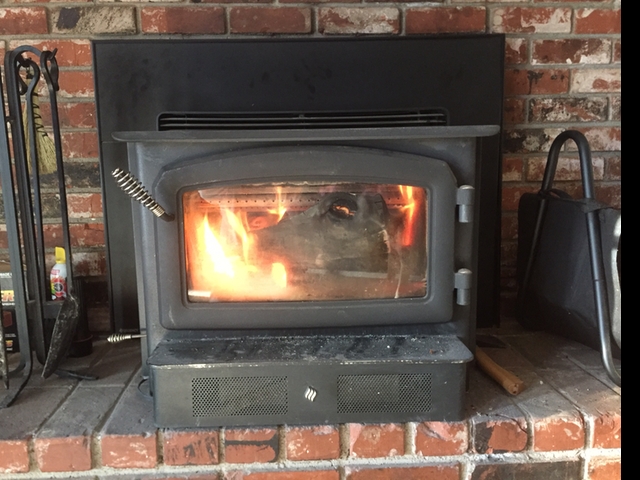
Efficient woodstoves improve air quality. Photo/LTN

Efficient woodstoves improve air quality. Photo/LTN

“Parts of our county are in non-attainment for ozone standards and particulate matter standards,” Adam Baughman, air quality engineer with the El Dorado County Air Quality Management District, told Lake Tahoe News. “We have deadlines in which to attain standard. We have to show reasonable forward progress. We will meet the ozone standard by about 2022.”

By providing rebates to people to take out their inefficient wood burning device and replacing it with a better model or even gas, the county is doing what it can to achieve the state air quality standards. Not all areas of the county can go to gas; only the basin and El Dorado Hills have natural gas.

“We try to do things like this with the incentives that help get us there without laying the hammer down,” Baughman said.

The program started in 2007, but has been revamped through the years. Funding has come from the feds and state. The rebate throughout the county is a few hundred dollars, in the basin it is more because TRPA has provided $88,750 to the cause.

In the basin in El Dorado County 122 people have received rebates. Of these, 58 went to gas only units and 41 went back to wood. The rest did complete removal, with a couple going to pellet or electric. 

Baughman said these conversions mean 6 tons of particulate matter that is 2.5 to 10 micrometers in diameter are no longer being emitted. Greenhouse gas emissions have been reduced by 300 tons. Countywide, those numbers are 20 tons of particulate matter and 777 tons of greenhouse gas emissions.

According to the website AirNow, “Particles less than or equal to 10 micrometers in diameter are so small that they can get into the lungs, potentially causing serious health problems. Ten micrometers are less than the width of a single human hair.”

For more information about the rebate program in El Dorado County, go online


Lawmakers want to reform Calif. bail system

By Jazmine Ulloa, Los Angeles Times
 
California lawmakers next year will make it a top priority to reform the system through which judges award criminal offenders bail, saying courts across the state are punishing “the poor for being poor.”

Assemblyman Rob Bonta and state Sen. Bob Hertzberg said they plan to fire the first salvo Monday, when lawmakers descend upon the Capitol for the start of the 2017 legislative session. They will introduce bills stating the Legislature intends to enact laws that will reduce the number of people detained before trial and address the racial and economic disparities in the bail process.
 
The details of upcoming legislation are still under deliberation, but Bonta and Hertzberg said they have assembled a broad coalition of organizations and lawmakers from both sides of the aisle to tackle what they consider to be one of the most significant pushes — and likely one of the hardest battles — of the year.

Read the whole story


USFS to upgrade Taylor Creek area

By Kathryn Reed

Improvements to the ecosystem near Taylor Creek as well as the physical structures is expected to begin in May.

The work will be done in phases across multiple years, and all work is dependent on funding.

Lake Tahoe Basin Management Unit Forest Supervisor Jeff Marsolais signed off on the decision last month.

Changes from the original proposal include eliminating work on the Fallen Leaf Dam and old Lucky Baldwin Dam. This is because of their complexity. Work on the dams will be looked at in the future as separate projects.

“… the selected alternative will begin restoring ecological processes and functions in Taylor and Tallac creeks and the greater wetland-marsh area by eradicating or controlling aquatic invasive species, improving hydrological connectivity of the swales and creeks, and upgrading infrastructure to guide public use and protect natural resources. The project will also enhance existing recreational facilities and infrastructure, and enhance opportunities for universally accessible, non-motorized access,” the decision says.

This area of the South Shore encompasses about 2,600 acres. Taylor Creek Visitors Center and Baldwin Beach are part of the project area.

The Forest Service acknowledges that this area has become neglected, has thousands of dollars of deferred maintenance that needs addressed, and that the habitat is degraded from overuse. The Rainbow Trail often floods.

Restoration efforts at Taylor Creek Visitor Center would include upgrading the stream profile chamber to meet contemporary building codes and reconfiguring the Rainbow Trail to reduce impacts to the stream environment zone, such as raising sections of trail or replacing them with boardwalks.

The current center was designed in 1960s. Bats and mice infested the upstairs. While that problem was taken care of long ago, the area cannot be used.

A price tag on all of the work has not been calculated. A previous estimate of just replacing the visitor center was seven figures.


Bomb sniffing dog keeps South Shore safe

By Susan Wood

ROUND HILL – “Find it, find it, find it,” Battalion Chief Todd Moss said, while running around the Round Hill fire station.

He wasn’t looking for his socks.

Instead, the Tahoe Douglas firefighter was giving out instructions to his dog Gunner, who acted like there was a leftover turkey stashed on the engine in the garage or behind the exercise machines in the living room.

His nose went into overdrive at the cabinets in that room as well as in the kitchen. And the 4-year-old chocolate Labrador retriever thought nothing of stretching out on his hind legs to get a higher vantage point.

He was searching for explosives. For training purposes, it was just a sack of suspicious powder. With a snout able to pick up scents 40 times better than humans, the canine gets his target.
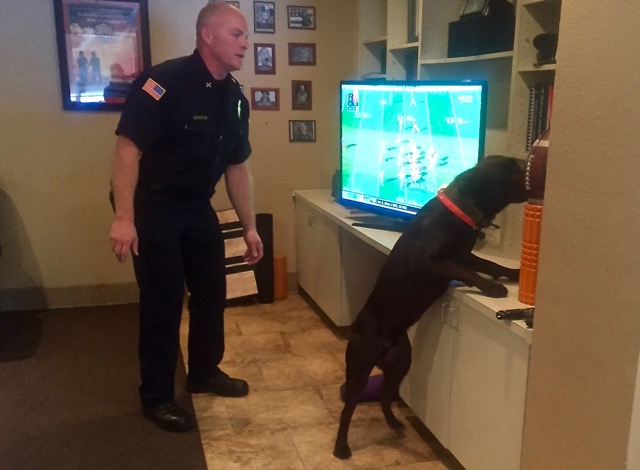
Gunner searches for "explosives" under the watchful of handler Battalion Chief Todd Moss. Photo/Susan Wood

Gunner searches for “explosives” under the watchful eye of handler Battalion Chief Todd Moss. Photos/Susan Wood

Gunner has recently completed his 120 hours of training to be a certified “explosive detection canine.” This means the work is just beginning. Moss will now log 16 hours a month practicing exercises with his four-legged companion.

“He’s a dog until it’s time to go to work,” Moss said as the canine stared at his master-handler. Gunner waits for the “squeaky” toy to come out as a signal it’s time for work. His reward? It goes without saying for a Lab – tennis balls.

Gunner will be used more often than what the public might think – but not for what one would think.

Post 9/11: If there’s a suspicious package, the fire protection district has a robot complete with a camera. It’s followed by a bomb squad crew member with an X-ray machine.

At times, Gunner may be used with Moss by his side. But Gunner – who always appears to stand at attention and willing to please – is more likely to be called out when buildings or venues need to be “swept” as in searched.

Bomb dogs have been brought out for events such as the summer concerts at the Harveys casino parking lot and across the street at the Edgewood Tahoe Golf Course for the American Century Championship.

Think of the Boston Marathon as a good example.

The squad had been recently contacted by the U.S. Secret Service during the election season from August to November, when then presidential nominees Donald Trump and Hillary Clinton had rallies in Northern Nevada, and Trump flew into South Lake Tahoe.

Gunner and Battalion Chief Todd Moss

Gunner and Battalion Chief Todd Moss

UNR has an explosive detection canine, along with the Reno Police Department and Washoe County Sheriff’s Department. Two make their office at the Reno Tahoe International Airport.

“With all these dogs, they make a task force,” Moss pointed out.

Douglas County felt a need to have its first bomb dog instead of tapping into one miles away.

“We really use them,” Moss said. “We wanted to be a contributor (in the task force).”

As an exercise that serves as a wake-up call, Moss made pipe bombs by emptying shells from a 12-gauge shotgun to show his comrades that “it doesn’t take much to hurt you.”

The U.S. Department of Defense spent $19 billion researching the best way to detect explosive devices and came up with dogs as the answer.

Trainers expose the canines to the smells of different explosives and give them a reward.

Bomb dogs are more commonly known for their work in the field at war. More than 2,000 have been trained to sniff out explosives through handlers in the battlefields of Afghanistan and Iraq, the National Geographic reported. The Smithsonian estimated that about 10,000 detection canines are at work around the world.

When the opportunity to have a special bomb dog arose, Tahoe Douglas got lucky when a Carson City military family moving to San Diego donated Gunner because the handler had two other dogs.

The dog was free as well as the training, which would normally cost a department about $14,000. Handler and master dog trainer Jim McNeil of the Washoe County Sheriff’s Department donated his time to the effort and brought the dog to Moss.
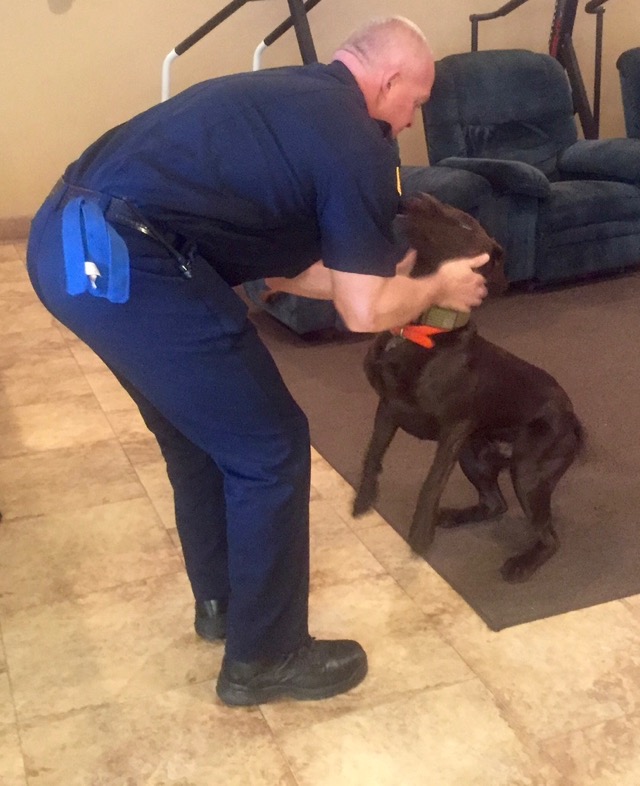
Battalion Chief Todd Moss and Gunner always training and playing.

Battalion Chief Todd Moss and Gunner always training and playing.

After 20 minutes of the first day of training at the vacant Kingsbury Middle School, the dog kept returning to Moss opposed to McNeil.

“I guess he’s your dog,” Moss recalled McNeil saying to him. Now McNeil has embraced the great uncle status.

“He’s attached to me 100 percent of the time,” Moss said, glancing at Gunner. The Lab, who Moss has had since June, remained focused on Moss with those deep, sincere eyes.

The mutual respect and love is obvious.

So how does a handler love a dog but remove oneself enough to do a job in which he sends his companion in harm’s way?

“It’s a job. We’re trained to do what we do. We do it as safe as we possibly can. We put hours and hours in. Unfortunately, (accidents) are a part of the job. We try not to think about it,” Moss explained.

A Labrador retriever is an ideal dog as an explosive detection canine because they have a hunting drive. The drive to seek remains constant.

When it fades, Moss gives him a break that allows him to hydrate and regroup through a change in environment.

“We take as long as we need,” he said.

Gunner may even be influenced by his handler’s current attitude. The dog is keenly perceptive and knows when to be intense and when to be fun-loving.

“They have a better temperament for this work,” Moss said.

How?

“Look at him,” Moss said, laughing and pointing to Gunner lying down by his feet. The dog was warned earlier not to tear up yet another squeaky toy. He looked up sheepishly like a child.

He’s presentable in an event setting too, as public safety agencies make appearances to show off all the “tools in the toolbox,” Moss noted.

“He’s definitely an added plus. We’ve always depended on other (handlers and their dogs). Now we’re a part of (the team),” Tahoe Douglas Fire Chief Scott Baker said.

The district wants to collect donations for a temperature control unit for the truck bed Gunner rides in so he won’t be cold out on the job.


Calif. asks Trump for guidance on pot, banking

By Michael R. Blood, AP

LOS ANGELES — California Treasurer John Chiang on Friday appealed to President-elect Donald Trump for guidance on how the state’s projected $7 billion marijuana industry can participate in the nation’s banking system while pot remains illegal under U.S. law.

California voters last month approved Proposition 64, which legalized the recreational use of marijuana, beginning in 2018. Largely at issue is how the state will collect an estimated $1 billion in annual taxes from legal pot sales and cultivation, when cannabis businesses can face obstacles opening bank accounts, getting loans or obtaining insurance.

The “conflict between federal and state rules creates a number of difficulties for states that have legalized cannabis use, including collecting taxes, increased risk of serious crime and the inability of a legal industry under state law to engage in banking and commerce,” Chiang wrote to Trump.

“We have a year to develop a system that works in California and which addresses the many issues that exist as a result of the federal-state legal conflict,” he added. “Uncertainty about the position of your administration creates even more of a challenge.”

The California vote on Nov. 8 represented the national legalization movement’s biggest victory to date. The new law will attempt, at least in theory, to tame a market that now ranges from legal, medicinal production and sales to vast illegal grows operated by drug cartels.

With pot illegal on the federal level, it’s unclear what stance the incoming Trump administration will take with the new California pot economy and other weed-friendly states. Trump’s pick for attorney general, Alabama Sen. Jeff Sessions, has called marijuana a danger that should not be legalized.

Twenty-eight states and Washington, D.C., allow marijuana for medical or recreational purposes.

In other states, the business of legal marijuana has created a patchwork of banking and tax practices.

In Oregon, officials have built a fortified office, with bulletproof glass, security cameras and armed guards, for collecting huge cash payments for pot taxes. In Washington, most businesses are paying taxes electronically, a sign of better access to bank accounts.

And the number of U.S. banks and credit unions willing to handle pot money under Treasury Department guidelines issued two years ago is growing, though they are often smaller institutions.

California tax collectors, however, released a report that concluded tax payments from marijuana-related businesses would be made in cash, since pot is illegal under federal law and businesses struggle to get access to banks.

Chiang wrote that federal policies have not provided certainty for financial institutions to give access to the cannabis industry and “California might exacerbate the banking problem even more.”

The treasurer said he was forming a group to study banking issues that he says could hamper the coming legal pot economy in the state.

In general, the state will treat cannabis like alcohol. Taking effect in 2018, the law allows people 21 and older to legally possess up to an ounce of pot and grow six marijuana plants at home.

Associated Press writer John Antczak contributed.


The coming California drought in 2017

By Jay Lund, KQED

California is a big, diverse place.

California probably will experience droughts this year of different types in different places, and no drought at all in some places, simultaneously. Even if conditions this year are very wet, with flooding, parts of California will have drought issues. (This is what makes California a great place to work on water problems.)

The first two months of this new water year have been wetter than average in the north and much drier than average in the south. But it is still early days.

Reservoir storage in California is now about 2.5 million acre-feet (3.08 billion cubic meters) below historical averages for this time of year. (This is 0.8 million acre-feet – 987 million cubic meters – better than two months ago.) Some major reservoirs are below average, particularly Oroville, Trinity, San Luis, New Melones and the Tulare Basin. Cachuma Reservoir near Santa Barbara is in the worst shape at 7 percent of capacity or 10 percent of average storage for this time of year.


Read the whole story


Vail CEO uses casino model to drive performance

By Daniel Fisher, Forbes

Like a monk on a mountaintop, Rob Katz is sitting in the Eagle’s Nest, a gourmet restaurant high above the quaint faux-Swiss village of Vail, ready to impart wisdom. “If you’re a casino you have these very committed, addicted gamblers,” the 49-year-old CEO of Vail Resorts says, explaining his business. “Well, we have these very committed, addicted skiers.”

As with resorts in Las Vegas and Macau, Vail Resorts accumulates enormous amounts of information about its customers and obsessively tracks their activities. On the slopes, for instance, there are radio-chip-equipped lift passes that record which runs skiers take and with whom they ride the lifts. Vail can even send targeted cable-television ads to their TV sets when they are home contemplating next winter’s ski season.

High-end amenities like the Eagle’s Nest or the Vail Mountain Club–with an initiation fee of $275,000–may not add much to profits, but like the fine restaurants and high-roller clubs at a casino, they’re necessary to entice and reward loyal skiers.

Vail owns Heavenly, Kirkwood and Northstar in the Lake Tahoe area.

Read the whole story