Implementing recreational pot rules won’t tax Nev. budget

By Sean Whaley, Las Vegas Review-Journal

CARSON CITY — Neither state regulators nor a lawmaker who pushed through Nevada’s medical marijuana program in 2013 expect funding to be an issue as the state now moves into the realm of recreational pot sales.

While at least one other state is trying to figure out where to obtain startup funding for recreational marijuana sales, state Sen. Tick Segerblom, D-Las Vegas, said implementing it in Nevada won’t cause financial problems for the state budget.

Nevada has money in its medical marijuana program that could be used for any upfront costs for recreational marijuana, such as licensing and inspections of the new dispensaries, he said.

Read the whole story


Wet start to season puts dent in Calif. drought

By Ellen Garrison, Sacramento Bee

October was wet, November dry. And December? The soft but steady rains this weekend were enough to push the Sacramento region to 155 percent of normal precipitation for the season.

And there’s more to come. After a break between storms, wet weather is expected to return Tuesday, according to the National Weather Service. The wet system should linger over the region through Thursday, dropping 2 to three 3 of rain in Sacramento and 5 to 8 inches of rain and snow in the Sierra.

So what does that mean for California’s drought, now entering a sixth year? While Northern California has seen a wet start to winter, the situation is more complicated across the state. Central and Southern California continue to experience unusually dry conditions. And even in the north state, it’s not clear how the rest of the rainy season will shape up.

Still, the early-season rains are making a dent. A year ago, the U.S. Drought Monitor listed all four counties in the Sacramento region as being in “exceptional drought,” the worst classification. This year, the drought monitor’s weekly report shows conditions in Sacramento and Yolo counties have been upgraded two categories to “severe drought,” while El Dorado County is another step up in “moderate drought,” and parts of Placer are listed as just “abnormally dry” – the least severe category.

Read the whole story


Kirkwood Mountain Resort, state water board reach settlement in contamination case

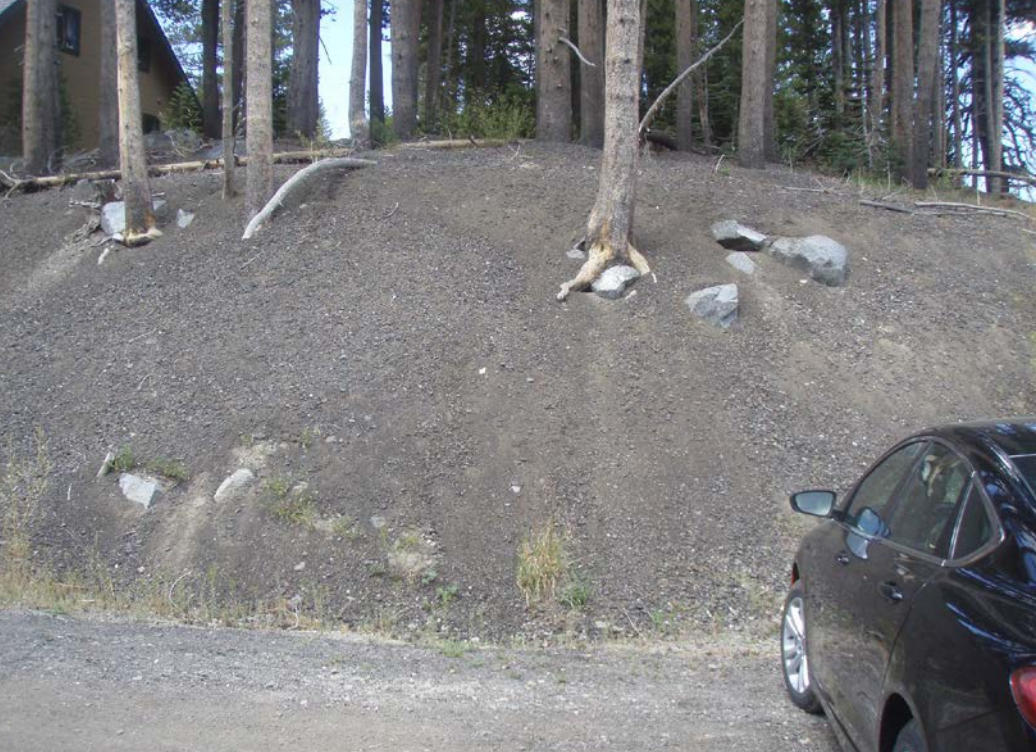
 Slope north of the cross-country ski area parking lot covered with asphalt grindings blown during snow removal operations.

A slope at the parking lot of Kirkwood’s cross country ski area is covered with asphalt grindings that were blown there during snow removal operations. Photo/Provided

By Susan Wood

Vail Resorts’ Alpine-Amador county ski resort known for its deep snow got out of deep trouble with the state water board this ski season by reaching a tentative settlement to clean up the parking areas adjoining Kirkwood Creek and wetlands. The environmental agency had found asphalt grindings were contaminating sensitive zones.

Upon a tip, the Central Valley Regional Water Quality Control Board found Kirkwood Mountain Resort staff spread the petroleum-based grindings measuring between 2- and 4-inches in diameter in the Timber Creek, Nordic Center and Red Cliffs areas. Specifically, the resort used the gravelly mixture in the parking lots at chairs 7 and 9 (TC Express and Funny Bunny, respectively) and the Red Cliffs Day Lodge, as well as in nearby maintenance yards.

In October, Vail was facing a $4.44 million fine in civil liabilities for a violation of the Federal Clean Water Act and the California Water Code. The practices and subsequent legal wrangling date back to the 2014-15 season.

The California Department of Fish and Wildlife described one of the wetlands and creek areas as “a black snow field.” The agency informed Lake Tahoe News that the asphalt-laced snow removal resulted in no fish kill in the creek.

The two parties reached a preliminary agreement a few weeks ago after the board staff made a Nov. 9 site visit and determined the ski area was implementing best management practices in its restoration efforts.

This area has been cleaned-up and is ready for restoration. Vail is proposing to use this area for snow storage. Board and CDFW staff has concerns based on its proximity to the meadow. Photo/Provided

This area has been cleaned-up and is ready for restoration. Kirkwood is proposing to use this area for snow storage. The water board and CDFW staff have concerns based on its proximity to the meadow. Photo/Provided

Roughly 700 cubic yards of debris were collected in the off-season restoration, which equates to 70 loads in a standard dump truck, water board Assistant Executive Officer Andrew Altevogt reported.

“They’ve done as much as they can do this year,” Altevogt told LTN on a conference call with the water board’s environmental project manager Wendy Wyels. His main concern lies in the surface and ground water quality. The duo has been compiling reams of documents related to the contaminants pulled from the California Department of Transportation’s resurfacing piles from Highway 88.

“We know (Kirkwood has) taken asphalt grindings for multiple years in the cross country areas,” Wyels added.

The site visit produced an additional finding of asphalt grindings discharged into the creek near Chair 1 “Snowkirk” and “evidence of erosion was observed in the drainage between the lower Red Cliffs parking lot on the east side of Kirkwood Meadows Drive,” a report written by water resource control engineer Mike Fischer stated. “Board staff recommended that the drainage be stabilized.”

Overall though, the clean-up work plan appears headed in the right direction.

One example: a barrier made of concrete bin blocks was installed on the north end of the parking lot to block access and snow storage in the area closest to the meadow.

Vail brought in San Francisco-based Kennedy/Jenks Consultants to oversee the cleanup operation. It noted Kirkwood staff performed removal of the grindings by hand in the meadow – a mitigation that took hours to complete.

A full assessment of the ongoing efforts will be made next spring because the ski season bore down on work crews this year.

In August the meadown was covered with soil. Photo/Provided

In August the meadow at Kirkwood was still covered with soil. Photo/Provided

For one, crews will need to return to the maintenance yard across from the Timber Creek beginners area identified as Site 4C.

The work seems hardly over, but the snow removal practices of the past appear to be.

Further mitigation calls for Kirkwood staff to identify adequate alternative snow storage areas and procedures. In a memo addressed to the board and obtained by LTN, Kirkwood stated it plans to remove snow “at least 35 feet from wetlands and naturally functioning riparian vegetation areas,” and measures will be made during snow removal “to prevent asphalt grindings and other sediment from entering surface waterways and groundwater.”

The Vail-hired consultant piled on further concessions made or those needing to be made. Beyond the physical work, staff training on how to handle snow removal near wetlands is expected to be implemented.

The work as planned will continue into 2017.

“Since the drainage culvert at Site 4C appears to be a relic from past drainage configurations, the culvert system is essentially plugged, and given the time constraints leading up to the impending winter season, Vail Resorts does not intend to disturb the existing drainage structure at Site 4C and will cover the drainage system to restore grade in the area. Backfill material will be sourced from the stockpiles of material removed from Sites 1 through 4. The removal process has generated stockpiles comprised of a mixture of varying degrees of asphalt and soil materials. Stockpile material largely comprised of soil, with only a small proportion of asphalt grindings will be used to backfill the culvert at Site 4C,” Kennedy/Jenks supervising engineer Rick Teczon wrote in an email to involved parties.

The legal issue serves as a black eye of sorts for a ski resort giant that prides itself on eco-friendly business practices.

Part of the water quality report indicated Kirkwood used the asphalt grindings for traction in its parking lots.

But when asked why the ski area used petroleum-based materials there, Kirkwood spokesman Coop Cooper told Lake Tahoe News, “Grindings are a commonly used material for dust mitigation.”

When asked for a further explanation, he did not respond to LTN.

Kirkwood would also not respond to questions about the settlement.

Cooper did explain what measures the ski resort was making to alleviate future contamination.

“Since receiving notice of this issue on May 6, 2016, we have worked closely with the Central Valley Regional Water Quality Board and other agencies to implement immediate remediation actions that we believe have contained any environment concerns,” he shared in an email. “It’s important to note that the samplings the agencies asked us to conduct did not demonstrate any impact on groundwater.”

Cooper added that Kirkwood – which ushered in new General Manager Doug Pierini last summer — and its parent company “take seriously our role in responsibly stewarding the environment and the public land in which we are entrusted.”



Rob Wheatley — 1949-2016

Rob Wheatley

Rob Wheatley

Rob Wheatley’s love of tennis never wavered, even when he was battling cancer.

Cancer, though, was the one opponent he could not beat. Rob died Nov. 24, 2016, in Indian Wells. He was 67.

Rob split his time between the desert and the mountains. For the past eight summers he was the pro at Zephyr Cove Tennis Club. He was an instructor for more than 40 years.

He had words of advice or a smile for all levels of tennis players at Zephyr Cove. Rob would attend matches to support the club as he enjoyed being a major part of the Zephyr Cove tennis community.

Rob was a constant presence at Zephyr Cove. If he didn’t have a lesson to give, he was tidying up the courts or in the office doing work. He was also integral in helping with the annual Tahoe Tennis Classic each summer.

Rob had a regular group of guys he would play with when he wasn’t doing one of his duties related to being head pro at ZCTC.

He first started playing competitively when he was 13. He attended San Jose State University on a tennis scholarship; graduating with bachelor’s degrees in physical education and psychology.

After graduation, Rob participated in the ATP circuit in Europe, Asia, and Australia.

He was the Southern Cal Sectional and Pacific SW 55 doubles champion, a four-time National USPTA senior doubles champion (40, 45, 50, 55), a four-time National USTA singles semifinalist on grass (35-40), and a lifelong member of the USPTA. 

In 1982 he founded the Desert Tennis Boutique in Palm Desert. Rob had been the head pro at The Reserve in Indian Wells, associate pro at La Quinta Resort, tennis director at Club at Morningside in Rancho Mirage, advisory staff member of Wilson and Fila sports, USPTA member and former vice president of the San Diego Division, and head tennis coach at College of the Desert in Palm Desert.

Robert Thompson Wheatley Jr. was born in Tucson, Ariz., on June 12, 1949.

He is survived by brother Jack Wheatley of San Antonio, Texas; sister Shelley Kosarek-Weir of Richardson, Texas; nieces and nephews Kristen Rosenburg, Meghan Scully, Nicole Stancel, Mac Wheatley, and Ryan Kosarek; and numerous friends.

There will be a celebration of life Jan. 7 at 1pm at Palm Desert Community Presbyterian Church, with a reception to follow.

The Tahoe community will honor Rob in the spring when the tennis season resumes at Zephyr Cove.

In lieu of flowers, donations may be made to the American Lung Association.


It may be legal, but pot use can still get you fired

By Chris Kudialis, Las Vegas Sun

Although passage of Question 2 will make recreational marijuana use legal for people 21 and older in Nevada as of Jan. 1, employees can be fired for testing positive for the drug, state lawmakers said.

Sen. Tick Segerblom says that while he believes the testing practice isn’t always fair, preventing impairment in the workplace is important. Segerblom spearheaded 2013 legislation to establish the state’s framework for medical marijuana dispensaries.

A staunch advocate of Question 2, he cited jobs in construction and others that involve operating motor vehicles and heavy machinery as examples of work in which a positive marijuana test may warrant firing. But he distinguished between smoking on the job and using marijuana days before a potential test — both of which can produce positive results.

Read the whole story


Tahoe works to consolidate environmental ed

By Kathryn Reed

Lake Tahoe is one step closer to improving environmental education in the basin for locals and visitors.

It all started about a year ago when the California Tahoe Conservancy gave the Tahoe Fund an $85,000 grant to delve into what visitors’ centers should look like in the future. 

For Amy Berry, executive director of the Tahoe Fund, it was about “how to move the needle of environmental stewardship in the basin.”

She gave an update to the CTC board on Dec. 8 about where things stand today. With her was Devin Middlebrook with the Tahoe Regional Planning Agency. The bi-state regulatory agency is now an active participant in the project and will coordinate the group going forward.

Under Berry’s leadership various entities in the basin that have some sort of education component came up with a mission, vision and target audience:

·      The purpose of this initiative is to connect people with the basin to nurture a culture of stewardship and sustainability.

·      The basin is an environmental success story and global role model for sustainability.

·      People who visit more than once a year or live in the basin and have the desire and ability to learn more about the basin.

They worked with Global Studios, the consulting arm of the San Francisco Exploratorium, to come up with ideas and potential solutions to better coordinate the basin’s message.

It was determined that a new paradigm is needed to create “a unified community mission that acts as an anchor for a larger network of educational and environmental organization across the region.”

Going forward a website will be created to be a one-stop shop, a 12-month working plan will be developed. A formal name beyond the working names of Tahoe Basin Project and One Tahoe will be developed.

A more long-term goal would be creating an education center that all the agencies – from TRPA, to the U.S. Forest Service, state parks, CTC, resort associations, TERC and others – could be part of. A floating observatory is what is being envisioned. It could be built on a barge – perhaps the fire damaged Tahoe Queen.

CTC Chair Larry Sevinson said it should have a glass bottom. The Queen used to have one.

It would have the ability to travel between marinas, as well as be docked and have people come aboard to see the educational exhibits. This in turn would be an economic driver.


Casino industry adding more people to Black Book

By Nicole Raz, Las Vegas Review-Journal

Nevada casinos are kicking out and banning more people from their floors than possibly ever before.

“Definitely in the last four years we’ve seen what I would consider a bit of an uptick in individuals that we put on the Excluded Persons List (commonly referred to as the Black Book),” Gaming Control Board Chairman A.G. Burnett said. “We’ve probably included 25 percent more individuals on the Excluded Person List in the last four years than in the last 12.”

A report on the U.S. gaming industry found the industry as a whole is banning more individual bad actors from casino floors.

Read the whole story


Tahoe funding survives final federal water bill

By Sarah D. Wire and Bettina Boxall, Los Angeles Times
 
Over Sen. Barbara Boxer’s objections, the Senate voted 78 to 21 Friday evening to pass sweeping water infrastructure legislation that changes how much water is pumped from the Sacramento-San Joaquin Delta to San Joaquin Valley farmers and Southern California.

The bill — co-authored by Boxer — authorizes hundreds of water projects across the country, including new infrastructure to fix lead issues in Flint, Mich., and and millions of dollars for projects connected to the Los Angeles River, Salton Sea and Lake Tahoe.
 
Earlier in the week, House Majority Leader Kevin McCarthy inserted 90 pages of California water policy that drew Boxer’s opposition, negotiated over the past year by the state’s 14 GOP members, Sen. Dianne Feinstein, D-Calif., and a handful of House Democrats.

Now it goes to President Obama for his signature.

The bill would bring $415 million to the Lake Tahoe Basin across seven years. The money would be used for wildfire prevention, the environmental improvement program, invasive species management, stormwater projects, Lahontan cutthroat trout recover, and other projects.

The original Lake Tahoe Restoration Act was passed by Congress in 2000, three years after President Bill Clinton was here for the initial Lake Tahoe Environmental Summit. The bill brought $300 million in federal money to the basin in 10 years. Since the 1997 summit more than $2 billion has been spent in the basin on what officials call environmental projects. This is a combination of federal, state, local and private dollars.

“I’m thrilled that the Lake Tahoe Restoration Act is included in this bill. We’ve been working to pass an updated Tahoe restoration bill for seven years,” Feinstein said in a statement. “This bill authorizes $415 million to carry on the work of the original bill, improving water quality, reducing hazardous fuels to prevent wildfires, fighting the spread of invasive species and restoring critical habitat throughout the Tahoe basin.”

Lake Tahoe News contributed to this story.

Read the whole story


SLTFD decorated engine brings good cheer

The annual South Lake Tahoe fire holiday truck begins its rounds tonight. Photo/Provided

The annual South Lake Tahoe fire holiday truck begins its rounds tonight. Photo/Provided

By Kathryn Reed

There’s a certain sound this time of year that brings a smile to kids of all ages – the holiday fire engine making the rounds of South Shore streets.

This annual tradition with South Lake Tahoe and Lake Valley fire departments goes back decades. It’s something youngsters look forward to – though some adults seem just as excited.

“There are always kids who are extremely excited to see Santa and then the ones who are scared,” South Lake firefighter Danny Vallejo told Lake Tahoe News. “For local people like myself and Capt. Tyler Jack who grew up here, this is a tradition we are pretty fond of.”

In South Tahoe the decorated vehicle started in the Public Works Department. Employees would drive around city streets with a little house on the back of a flatbed truck, with Santa in the house.

The Lake Valley tradition dates to the mid-1960s. Fire Chief Tim Alameda remembers getting his candy cane from Santa. That’s all the history that department has about the truck.

About 20 years ago the South Lake Tahoe Firefighters’ Association took over the responsibility of the city’s tradition. For three years they kept things the same as Public Works.

Then the firefighters started decorating a fire engine and driving it around town. Everyone on the decorated truck is volunteering their time.

That same year the house never left Station 2. However, that is where Santa would be. (Three years ago the department stopped staffing Santa’s house because the reserve program was disbanded and that job fell to them.)

Santa is now on the fire truck handing out the candy canes. His arrival is hard to miss as Christmas tunes can be heard before the lights are even visible in most neighborhoods.

“This year we are going to be decorating one of our brush rigs,” Vallejo said. Various apparatuses have been used throughout the years.

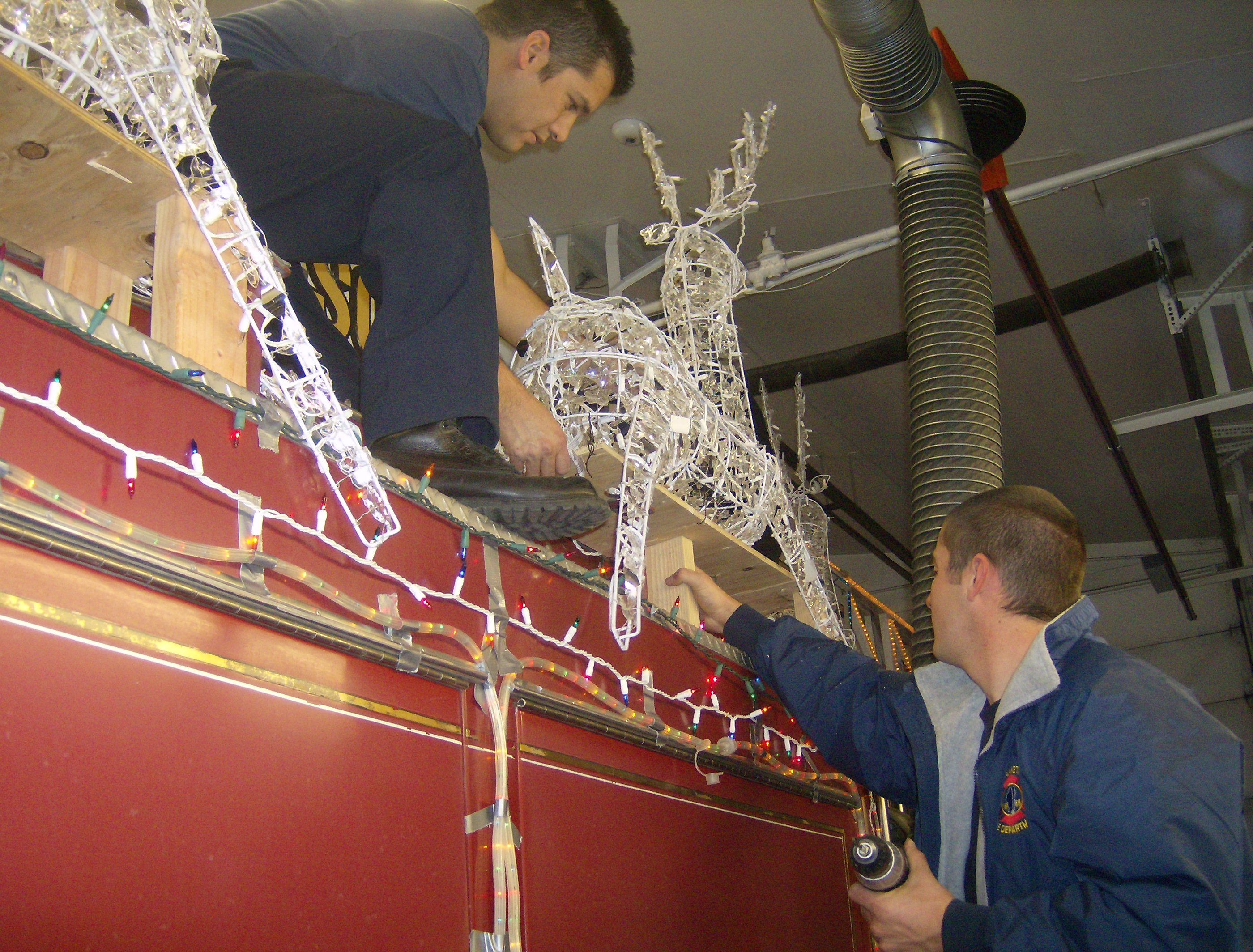
It takes more than 75 strands of lights to illuminate the vehicle. Plus, the reindeer made out of thick wire are all aglow. The truck is wrapped in such a manner that all the compartments can be accessed in case it is called into action.

New this season is the crew on board will be taking pictures of youngsters they meet. Those photos will be posted on the agency’s Facebook and Twitter pages as they drive along. The firefighters are hoping people will tag themselves to spread the cheer a little further.

Firefighters decorate the South Lake Tahoe engine. Photo/Provided

Firefighters decorate the South Lake Tahoe engine. Photo/Provided

Here is the South Lake Tahoe fire engine schedule:

Dec. 10 — Tahoe Keys/Venice
Dec. 11 — Glenwood
Dec. 12 — Keys Boulevard/state streets
Dec. 13 — Barton/Tahoe Island
Dec. 14 — South Y /Tata
Dec. 15 — Al Tahoe Boulevard
Dec. 16 — Springwood/Bijou Pines
Dec. 17 — Sierra Boulevard
Dec. 18 — Ski Run area
Dec. 19 — Heavenly Valley
Dec. 20 — Stateline/Pioneer Trail
Dec. 21 — Gardner Mountain
Dec. 22 — Stateline hotels
Dec. 23 — Main areas
Dec. 24 — Highway 50.


USS Nevada, crew honored anew for Pearl Harbor exploits

By Keith Rogers, Las Vegas Review-Journal

HONOLULU — Resting at the bottom of the Pacific but very much alive in naval history books, the storied battleship USS Nevada received fresh accolades Thursday aimed at ensuring that she and her crew continue “inspiring sailors for as long as there is a United States Navy.”

On a drizzly Hawaiian morning the day after the 75th anniversary of the attack on Pearl Harbor, four USS Nevada veterans and a few dozen dignitaries and Nevadans gathered to commemorate a plaque dedicated to the ship and her crew.

The ceremony at Hospital Point — the spot where the Nevada was intentionally grounded — provided another opportunity to remember their exploits on Dec. 7, 1941, when the crew managed to get the Nevada underway after she was hit by a torpedo and bombs and make a valiant run for the open sea, fighting all the way.

They didn’t make it, but the maneuver spared the ship from possible ruin at anchor and inspired every American who saw or read about it, said Sam Cox, a retired rear admiral and director of the Naval History and Heritage Command.

Read the whole story