Nevada benefits from forgotten casino tickets

By Thomas Moore, Las Vegas Sun

Gamblers left more than $35 million on casino floors in the past five years, money the state of Nevada was happy to come along and pick up. The cash came in the form of slot and video machine tickets that players either lost, forgot about or simply didn’t bother to turn in.

With the days of coin-based slots long receded, these tickets are how slot and video poker players collect their winnings. Machine-dispensed tickets must be taken to either a kiosk — the industry name is a ticket-in, ticket-out machine — or the casino’s cage and exchanged for cash.

According to Nevada gaming regulations, the tickets expire at a date the casino sets or 180 days, whichever is sooner. State government only gets a portion of what players abandon.

Read the whole story


Ollie Hayden — 1927-2016

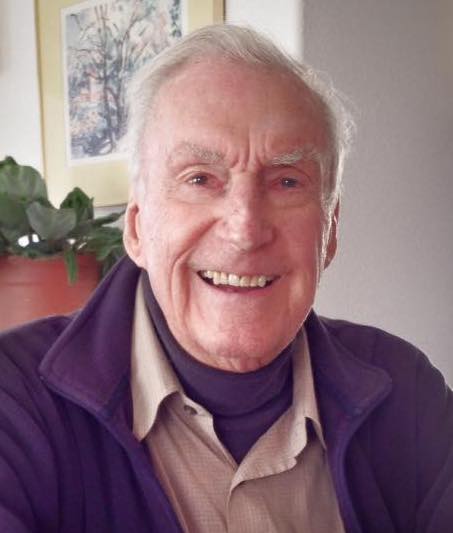
Ollie Hayden

Ollie Hayden

Oliver Wendell Hayden was born at home Nov. 18, 1927, in Nicholson, Pa., to Hallie I. Hayden and Leta Cooley Hayden; the fifth of seven children. He passed way Dec. 17, 2016, at Carson Tahoe Medical Center in Carson City. He was 89.

Ollie graduated from Nicholson High School in 1945, and entered the U.S. Navy where he served as bugler aboard the aircraft carrier USS Leyte.

He acquired his life-long passion for classical music during that period.

Ollie entered the field of media marketing in the late 1940s, working for three newspapers on Long Island, N.Y. In 1954 he changed his focus to broadcasting, becoming an account executive at WNBF AM-FM in Binghamton, N.Y. During that time he also undertook higher learning education, taking courses mainly in the arts at Syracuse University’s extension school at Endicott, N.Y. (Harpur College). In 1956 he was promoted to a similar position at WNBF-TV, where he served until 1962.

He moved to California in 1962, taking a position as account executive at KSBW-TV in Salinas, followed by KGO radio in San Francisco. In 1965 he moved into national sales with CBS Radio spot sales. He was transferred to the Chicago sales group in 1966 and in 1968 was awarded a double promotion, first to the New York sales team, and in July of that year named general sales manager at KCBS, San Francisco.

In 1972 he became general manager of KRE, Berkeley, and following that held similar positions at KTIM, San Rafael, and KTHO, South Lake Tahoe, all in California. He became part owner and president of the latter station from which he retired in 1992.

For the next several years he continued to work, doing fieldwork for Ridge Tahoe and Selective Properties in Stateline and Zephyr Cove.

He was a member of the Tahoe-Douglas Rotary Club and served as president in 1995-96.

Ollie was an avid reader and his main interests outside of work were in the areas of classical music, history and travel. Over many years he had collected more than 700 CDs and a large library of history, military history and music reference books. He also enjoyed downhill skiing and hiking.

Ollie was a kind and thoughtful man and was loved and respected by all who knew him. He will be greatly missed, but we will treasure the wonderful memories of the life he shared with us.

He is survived by his beloved wife, Nancy Oliver Hayden of Carson City; children Dean of Long Island, N.Y., Stuart of San Jose, Michael of Albany, Calif., and Jai of Seattle; grandson Kai DeSpain of Seattle; sister Carol Vest of Cedar Rapids, Iowa; stepsons John Oliver of Reno and Mark Oliver of Bell, Texas; and several nieces and nephews.

He was predeceased by two sisters, Lucille Lewsader and Betty Hartman, and three brothers, Edward, Hallie Jr. and David.

At his request no services are planned at this time. A celebration of life will take place at a later date.


Intricacies of snowmaking rival Ma Nature

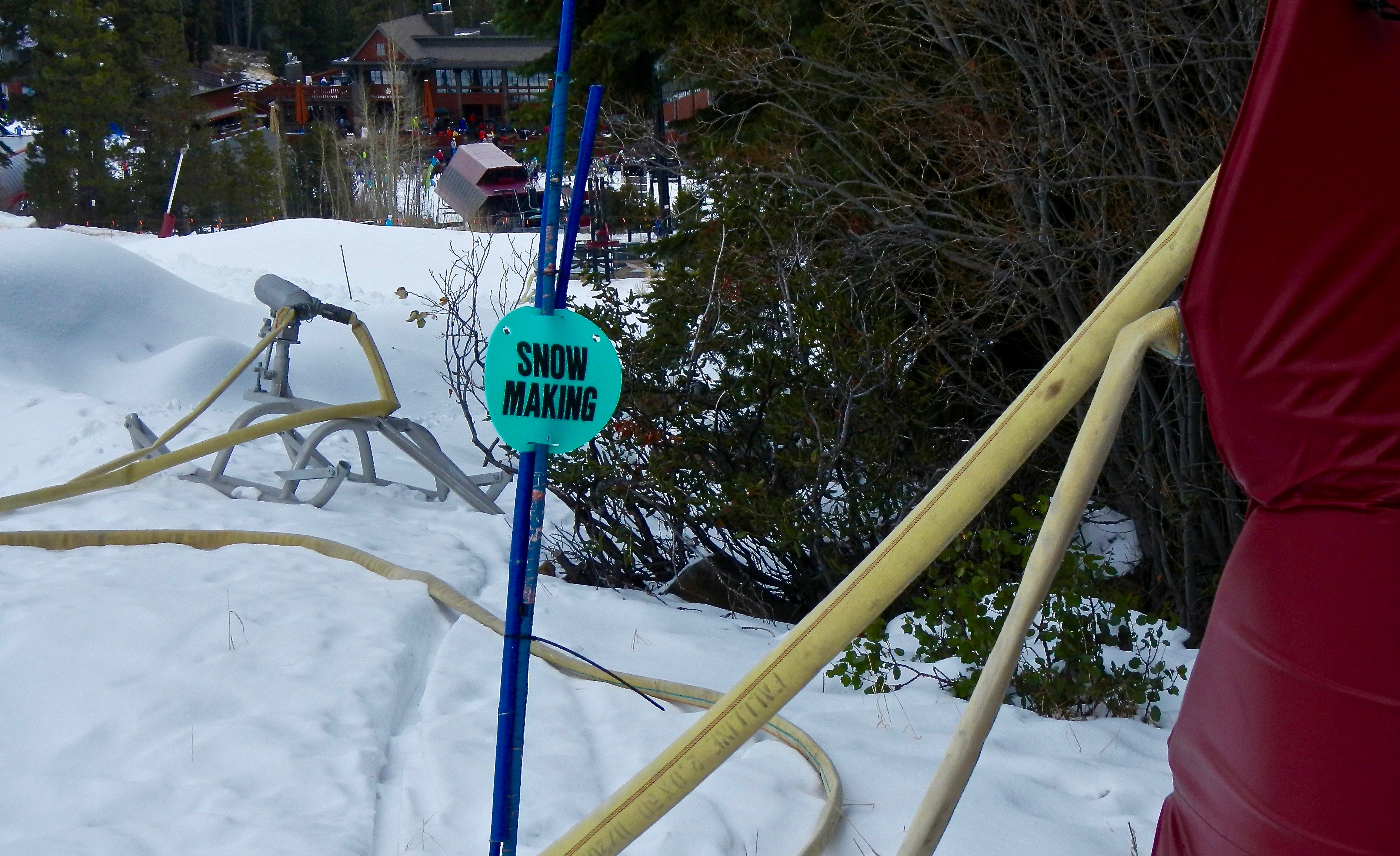
Snowmaking is integral to Northstar's desires to provide enough terrain for all ability levels. Photo/Kathryn Reed

Snowmaking is integral to Northstar’s desires to provide enough terrain for all ability levels. Photo/Kathryn Reed

By Kathryn Reed

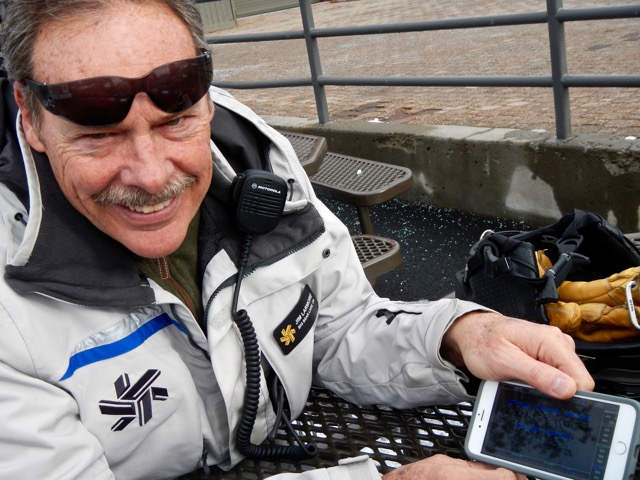
TRUCKEE – It looks like Jim Larmore is playing a sophisticated video game on his phone. But this is no game. As director of mountain operations at Northstar Larmore oversees the entire snowmaking operation.

He is essentially Father Nature. When Mother Nature doesn’t deliver snow, Larmore and his gang do.

Many of the pumps and guns are at his fingertips via his phone.

“If I had to do everything manually, it would be too tough,” Larmore told Lake Tahoe News.

northstar-jim larmore

Jim Larmore is able to control snowmaking at Norhstar with his phone. Photo/Kathryn reed

Looking at the mountain Larmore knows there is more to do. But on this first day of winter he’s more than satisfied with the coverage. Each day more terrain opens. On Wednesday it was Logger’s Loop; today it could be Castle Peak.

Knowing the mountains suffered a rain on snow event in the last week one might think the conditions are nasty. Just the opposite. Snowmaking and grooming can do wonders to ski slopes. Snow is often moved around fill in spots. 

northstar-snowmaking-1

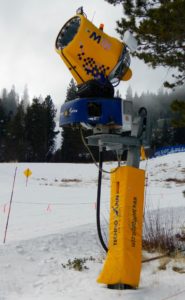
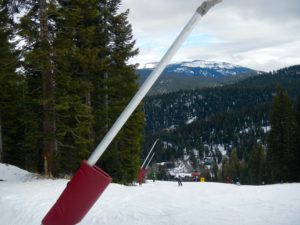
Snowmaking equipment comes in various sizes. Photos/Kathryn Reed

northstar-snowmaking-5northstar-snowmaking-2And the consistency no longer resembles something that came out of a high school science project. Most of the time it’s hard to tell Mother Nature didn’t create it.

Snowmaking can be a 24-hour endeavor. Mostly, though, a cadre of workers are on the job when the public is long gone. Larmore says it takes someone who embraces the outdoors, doesn’t mind getting wet and likes physical labor.

Scattered about the ski resort are an array of snowmaking guns. Some operate on air and water, some don’t have any air. Newer ones can use less than half the energy of older models, but they don’t blow as much white stuff.

With at least half of them being automated, it means a more consistent quality is guaranteed. They turn on and off based on the temperature.

This is a huge change from the old days when the crew would sling pumps and hoses over their shoulders and walk all the equipment to the slopes.

Today the devices are too big to even contemplate doing that.

It’s a balancing act to get enough varied terrain open to cater to the diverse group of skiers who come to this resort just outside the Lake Tahoe Basin. While the ultimate goal is to provide the best guest experience possible, it’s not as easy as flipping a switch and suddenly there is snow.

There’s the big picture plan of what staff wants to have covered at various times in the season, and then there are the daily snowmaking plans that get down to the nitty gritty. And even those plans are fluid because nothing is constant. Temperatures and humidity – the key factors in when to blow – are constantly monitored.

South facing slopes, high traffic areas and lower terrain need more help.

An advantage Northstar has over some other resorts is that it isn’t that rocky. This means less snow – real or manmade – is needed to ski on because it doesn’t take that much to cover grass.

Northstar has the capacity to cover 50 percent of its runs.

The water to make the snow comes from Sawmill Reservoir, which is on the mountain beyond the Nordic center. It’s estimated that 86 percent of manmade snow returns to the aquifer.

If it weren’t for snowmaking during recent winters, there would not have been a ski season.

“We did quite well during the drought,” Larmore said. “But it’s better for everyone if it snows.”


Beyond ‘pinking it’: Women’s skis evolve

By Elisabeth Vincentelli, CNN

For a long time, women’s skis suffered from a phenomenon known as “pink it and shrink it”: take a men’s model, make it shorter (and softer) and give it a pastel top sheet.

Thankfully we’ve come a long way since. The offerings have improved and last season the best-selling ski in specialty shops was the Black Pearl from Blizzard — the first time a women’s ski had ever topped the overall list.

In Lake Tahoe, Jen Gurecki took matters into her own hands and three years ago introduced Coalition Snow, the only women’s ski and snowboard manufacturer in the U.S.

“An expert woman could purchase a men’s ski, but wouldn’t you want to have more options?” Gurecki says. “You can also choose to support businesses that are overtly pro-women. All of that aside, we make f—-ng good skis!”

Read the whole story


Trump presidency could be huge for gaming

By Jason Hidalgo, Reno Gazette-Journal

A leading association for the gambling industry is hopeful that a Trump administration will be huge for gaming.

Increased mainstream acceptance of gambling, combined with the results of the presidential election, represent an opportunity to push key goals for the industry on a wide range of issues, including regulations and sports betting, said Geoff Freeman, president and CEO of the American Gaming Association, during a Tuesday conference call with media.

“We have a former casino owner elected as the next president of the United States,” Freeman said. “We are better positioned than at any time to achieve our objectives.”

Read the whole story


TRPA leaders worried about transportation

By Kathryn Reed

STATELINE – While there are 178 thresholds the Tahoe Regional Planning Agency is trying to achieve, it was traffic-transportation that garnered the most discussion this month.

The Governing Board adopted the 2015 Threshold Evaluation Report at its meeting last week. Within all of those standards are nine categories: air quality, water quality, soil conservation, vegetation, fisheries, wildlife, scenic resources, noise, and recreation.

“We need to start formulating a traffic management standard to get a handle on this. We need to understand how traffic works,” board member Clem Shute said.

Vehicle miles traveled – or VMT for short – is what TRPA and many other entities use when it comes to traffic. This was originally devised as an air quality tool. It’s a traffic count method.

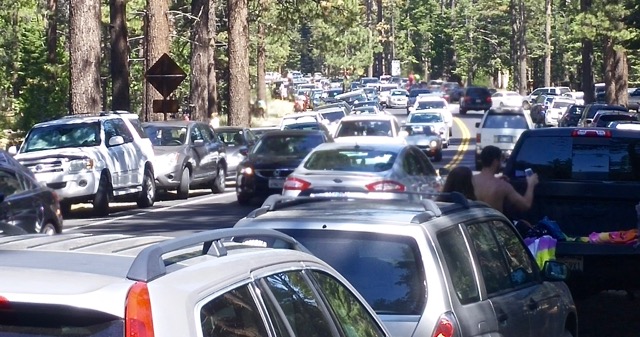
Traffic at Camp Richardson on July 3, 2016. Photo/Bill Kingman

Traffic at Camp Richardson on July 3, 2016. Photo/Bill Kingman

Board member Jim Lawrence is not convinced VMT should be used for all things the agency uses it for. He said transportation is too important to rely on one metric that might not be doing the job everyone says it does.

Executive Director Joanne Marchetta agreed that a better understanding of VMT is needed.

Anyone who drives in the basin knows traffic can be an issue. During peak periods with tourists it becomes a problem.

And anyone who tries to ride the bus, especially on the South Shore, knows it’s not reliable and certainly doesn’t come at frequent intervals. For those don’t know what a BlueGo is, they wouldn’t even know where the bus stop is because all it says is BlueGo — no bus symbol, not even the words “bus stop”.

Austin Sass, who is South Lake Tahoe’s rep on the TRPA board and the Tahoe Transportation District, believes the Governing Board should have better communication with the TTD board and staff.

“We need funding for free transportation,” Sass said.

TTD’s proposal to achieve that goal is a regionwide sales tax increase dedicated to transit. Before voters could weigh in on this it will take both state legislatures to agree to it.

These threshold reports are compiled every four years by TRPA. Just like in 2011, this report was peer reviewed by 15 independent scientists. They found 77 of the standards to be in attainment, either at or better than target or considerably better than target. That’s up from 58 that were in attainment in 2011.

The report states, “Status continued to improve for water clarity, air quality, scenic and soil conservation. Areas needing continued focus include removal of land coverage on sensitive lands, new threats to forest vegetation, deep water plant communities, and the need for continued emphasis on water quality conditions (for) macroinvertebrates, periphyton (algae) and AIS control.”

Board members voiced concern that there are too many thresholds and wonder if looking at what is being evaluated should be a priority. This way staff time could be better concentrated on issues that are relevant and not just doing something because the Compact says to.

Updating the threshold standards is a priority of staff. It’s something that has not been done since they were adopted in the 1980s.


Study: Mortality rates higher in cold weather than hot

By Jane E. Brody, New York Times

Most of the Northern Hemisphere is now in the throes of the deadliest time of the year. Cold kills, and I don’t mean just extreme cold and crippling blizzards. I mean ordinary winter cold, like that typically experienced, chronically or episodically, by people in every state but Hawaii from late fall through early spring.

While casualties resulting from heat waves receive wide publicity, deaths from bouts of extreme cold rarely do, and those resulting from ordinary winter weather warrant virtually no attention. Yet an international study covering 384 locations in 13 countries, including the United States, found that cold weather is responsible, directly or indirectly, for 20 times more deaths than hot weather.

Over time, milder winter temperatures are likely to result in fewer cold-related deaths., a benefit that could outweigh a smaller rise in heat-caused mortality. In winter in the United States, mortality is generally 10 percent to 15 percent higher than on typical summer days.

Read the whole story


Grizzly bear poised to return to the West

A grizzly finds its salmon dinner in Alaska's Denali National Park. Photo Copyright 2016 Carolyn E. Wright

A grizzly finds its salmon dinner in Alaska’s Denali National Park. Photo Copyright 2016 Carolyn E. Wright

By Jim Yuskavitch, Sierra

It’s been nearly 50 years since one of the last grizzly bears in Washington State’s wild North Cascades was shot and killed. It’s been even longer, more than 90 years, since the last known grizzly vanished from California, where the great bear’s image is still emblazoned prominently on the state flag.

But they may be poised for a comeback. There are plans in the works to reintroduce grizzlies into the North Cascades ecosystem, initiated by the federal government in the early 1990s. Also, conservationists have proposed doing the same in the remote regions of the southern Sierra Nevada, which could also open the door for grizzly reintroductions into other parts of their historical range beyond their current Northern Rockies stronghold. 

Grizzly bear populations began dropping in the West in the mid-1850s, mostly from hunting. By 1920, they were gone from 95 percent of their historical range. Grizzlies were deemed extinct in California by 1924. 

Read the whole story


CTC staff trying to control makeup of board

By Kathryn Reed

Two board members of the California Tahoe Conservancy have refused to resign even though they have been asked to do so.

And now the state agency’s attorney is backpedaling when it comes to what exactly he wants them to do. Tom Davis and Sue Novasel, who represent South Lake Tahoe and El Dorado County, respectively, on the CTC board aren’t going quietly.

“They recommended that I immediately resign. I have not resigned,” Novasel told Lake Tahoe News.

Earlier this month she received a phone call from Executive Director Patrick Wright and a staff attorney telling her she suddenly had a conflict by being on the board and an elected official.

Davis received the same news, only in person the week before the December board meeting.

“We had some strong words. I was pissed off,” Davis told Lake Tahoe News.

Now the Conservancy is changing its message, at least with the media. On Dec. 19 staff attorney Mike Steeves told LTN, “The AG’s Office is not requesting any action nor is this agency. We are not asking for board members to resign or for board members to be removed.”

He said he has no written correspondence from the Attorney General’s Office. Neither the city nor the county have anything in writing from the AG either.

When Lake Tahoe News contacted the AG’s Office, the response was, “We represent the Conservancy so you should reach out to them directly.” When told the CTC said to contact the AG, the AG folks replied, “The Conservancy is our client, and we’ll continue to direct inquiries their way.”

Another player in all of this is the state Natural Resources Agency. While CTC is an independent board, it operates under this larger state organization.

The CTC was created in 1984. In that time the makeup of the board has included: one member appointed by the South Lake Tahoe City Council, one member appointed by the El Dorado County Board of Supervisors, one member appointed by the Placer County Board of Supervisors, the secretary of the Resources Agency or his or her designee, one member appointed from the general public by the Senate Committee on Rules, one member appointed from the general public by the Speaker of the Assembly, and the director of Finance or the director’s designee. The U.S. Forest Service member does not have a vote. Most of these 30-plus years the three local jurisdictions have had an elected councilmember or supervisor on the CTC board.

Today, Placer has Larry Sevison, who is not an elected official. However, Sevison has been a Placer County supervisor and was instrumental in the creation of the Conservancy.

“I don’t think I’m in a position that I can comment right now because there is so much in transition. I would be happy to let you know when we get clear definition of where we are headed. Right now there is no clear direction,” Sevison told Lake Tahoe News. “Obviously there is so much disagreement going on between the city and the Conservancy and the county and the Conservancy.”

That last statement by the CTC board chairman is what is rankling elected and staff officials within South Lake Tahoe and El Dorado County. They believe the potential ousting of Davis is retribution by Wright et al because the city has been critical of the CTC and the executive director in particular. Novasel is essentially collateral damage.

“It is certainly interesting that when the executive director is called into question as to his activities for which the board should or can hold him accountable, there is then a question if those very board members can sit as board members,” South Lake Tahoe City Attorney Tom Watson told Lake Tahoe News.

The city and Conservancy’s rift started with the potential development project involving the Knights Inn. The Conservancy was going to provide funding for the land acquisition and subsequent water quality project. Then they backed out when the commodities became an issue. It is through the acquisition and then selling of commodities as well as the Asset Lands Management Program that the Conservancy continues to stay solvent because it is no longer receiving large sums of cash from the state.

Wright has been behind this change in the direction of the CTC, which helps to ensure this Nevada resident has gainful employment by the taxpayers of California.

Councilman Davis has been a recent vocal critic of Wright. This fall he asked for the board to do a performance review of the executive director. He was last evaluated in 2013.

At the board meeting this month there was much discussion about Wright’s future eval. The board only meets quarterly and because Wright won’t be at the March meeting the review won’t take place until June. (Novasel was not at this meeting because of a family emergency.)

“There was a movement to silence me and they dug deep,” Davis said.

The depth he refers to is the Conservancy coming up with this potential conflict after 30 years. It was CTC staff who contacted the AG.

“Two precipitating events led to the Office of the Attorney General reviewing potential conflict of interest issues for California Tahoe Conservancy board members. First, at the Conservancy’s September board meeting, a board member (Novasel) raised concerns regarding potential conflicts associated with voting on a Prop. 1 grant award to that board member’s jurisdiction,” Nancy Vogel, spokeswoman with the Natural Resources Agency, told Lake Tahoe News. “Second, the Conservancy was made aware in October that the city of South Tahoe may sue the Conservancy over the City’s Prop. 1 grant application for the Bijou Park Creek Watershed and SEZ Restoration Project. The Conservancy coordinated with the Office of the Attorney General on issues associated with any future board meeting closed sessions regarding this potential litigation and whether the appointed city of South Lake Tahoe board member (Davis) should attend these closed sessions.

“Based on these events, attorneys from the Office of the Attorney General conveyed information to the Conservancy regarding the applicability of conflict of interest laws to the Conservancy board members, and this information was passed on to individual board members.”

It is not unusual for elected officials to have conflicts of interest and then have to recuse themselves from specific agenda items. Davis didn’t stay for the CTC closed session item involving the city.

According to Vogel, “The Conservancy has not recommended any specific remedy to the individual board members, nor is the Conservancy contemplating any action to remove individual board members. Furthermore, the Conservancy is reviewing legislative options to remedy these potential conflicts.”

No one from any state agency has been able to explain why state lawmakers need to become involved and why recusal is not sufficient to avoid conflicts.

The city and county are operating as though their elected reps may be banished from the board because that is what the Conservancy has told them is the course of action it plans to take.

“We don’t agree with their position and we do believe the best person to represent the CTC is the supervisorial board member,” El Dorado County CAO Don Ashton told Lake Tahoe News.

The city and county both make appointments to various boards, including the CTC, in January. Both intend to have closed session discussions about the CTC.

The city already knows who it would put on the board if an elected official can’t be on it – former Councilman Hal Cole.

“I would be willing to,” Cole told Lake Tahoe News. “I think there should be a bigger challenge to the overall idea. To have a board dealing with the public’s money not have any elected officials does not seem healthy.”

Watson with the city thinks it would be interesting if the county had one of its attorneys on the CTC board.

“Maybe legal counsel reviewing procedures under which the CTC is acting might be appropriate,” Watson said.
From guns to sex crimes, new laws affect Calif.

By Jeremy B. White, Sacramento Bee

Every Fall, Gov. Jerry Brown’s time is consumed by what could best be described as legislative triage.

He sifts through the hundreds of bills sent to his desk and decides which ones will become law. This year, the Legislature sent Brown 1,059 pieces of legislation, 898 of which the governor deemed worthy of his signature. He vetoed 159 and let two become law without signing them.

On Jan. 1 we’ll start seeing the results. What follows is a list of the laws taking effect Jan. 1.

Read the whole story