How to live the good life in a ski town

By Megan Michelson, Outside

Ski bumming is hardly a glamorous lifestyle. It means things like eating ramen for dinner, sleeping in your car, and taking an assortment of odd jobs. But the payoff can be worth it when you get an all-you-can-eat buffet of powder days. So how do you make life work in a ski town? We called some authentic ski bums to ask them how they’ve pulled it off.

There’s a severe housing shortage in mountain towns right now, which means it can be tough to find affordable housing near ski hills. If you’re working for a ski resort or another larger company, start by asking your employer (see the next tip on finding a job) if they offer workforce housing. Word of mouth rentals are likely your best bet: ask the coffee shop baristas and the ski tuners at your favorite shop, because they know everyone. For short-term solutions, look for caretaking gigs or ski leases, which are winter-only rentals.

“If you don’t want to live in a van or a snow cave, and renting a room is too expensive, look into a ski lease,” says Bevan Waite, 24, who lives in his van in Tahoe City, and works part-time for an architect and as an editor at SnowBrains.com. “People buy into a seasonal lease for a large house and split costs. Ski leases are often more popular with weekenders from the city but if you can weasel your way in as a full-time resident, you become the house caretaker and pay dirt cheap rent for living full-time in a fancy vacation house all winter long.”

Read the whole story


Report slams hidden fees in travel industry

By Hugo Martin, Los Angeles Times
 
In the final report before the end of his term in office, President Obama’s National Economic Council lashed out against “hidden fees” charged by airlines, hotels and other businesses.

The council, made up of various department and agency heads within Obama’s administration, said fees that are not readily disclosed make it hard for consumers to pick the lowest price in airfares, hotel rates and other services.

“When pricing is unclear, it threatens the competitive process by which consumers make decisions,” the report said.

Read the whole story


Challenge to Prop. 66 by former EDC supervisor

By Kathryn Reed

Former El Dorado County Supervisor Ron Briggs wants the state Supreme Court to overturn Proposition 66, which voters narrowly approved in November.

“Prop. 66 is a sloppily written document, failing several constitutional tests,” Briggs told Lake Tahoe News. “… from firsthand experiences we know it takes approximately 17 years post penalty phase to work toward exoneration.”

The end goal for him is to have the court deem Proposition 66 unconstitutional.

The intent of the prosecutors who wrote Proposition 66 was for the state Supreme Court to rule on death penalty appeals within five years of sentencing. Today it usually takes 10 years or longer for that to occur.

Briggs said changing the “appeals process creates a system ripe for executing the wrong person. If the state is going to execute condemned persons, it must be perfect. Rushing anything is fraught with errors.”

Briggs filed the challenge with former Attorney General John Van de Kamp.

It was Briggs’ father, John Briggs, who as a state senator in 1978 sponsored the state’s current death penalty law.

In a July 2016 column in the Sacramento Bee, Ron Briggs wrote, “Though I was once California’s biggest proponent of the death penalty, I now feel compelled to admit the policy is destructive to our great state. What we didn’t know then is that the death penalty would become an industry that benefits only attorneys and criminals, and no one else. It’s an extreme expense to taxpayers, does not make our communities safer and fails to deliver the justice it promised.”

Briggs used a local case as an example of how the system is flawed. Joseph Nissensohn, 64, was sentenced to death June 5, 2014, for the murder of a South Lake Tahoe teenager and two others.

“That case cost El Dorado County $3.1 million to send a (then) 62-year-old man to Death Row. The $3.1 million came out of our General Fund that pays for libraries, roads, sheriff, mental health, senior services and on,” Brigg said. “At the time in 2013 the $3.1 million represented two-thirds of the county’s total contingency. And for what purpose? The average appellate time is 24 years post penalty phase. Life without parole would have cost the county about $750,000 and had the same effect in sending that monster away forever. Instead, he now has three appeals pending with two full-time attorneys along with a special care status instead of being in general population. This puts the victims’ families in a legal hell as they are now subjected to living with Nissensohn, almost forever or until his death, whichever comes first.”

In Briggs’ challenge to Proposition 66 he contends the new law will be a greater financial burden to taxpayers.

Briggs told LTN that because the proposition keeps the appeals in the trial court it eliminates the appellate and Supreme Court from entering the appeals process. “This is in conflict with the Constitution that vests jurisdiction within all courts in any legal proceeding. This means if you or I are condemned, our appeals are kept with the trial court who, in a Prop. 66 world, is charged in reviewing their own proceedings to discover any wrong steps. I do not know about you; I want a separate set of eyes reviewing, not the judge who made the decisions.”

Briggs and Van de Kamp also take issue with the proposition’s giving unqualified attorneys death penalty appeals cases.


Vail Resorts reports slow start to the season

By Jason Blevins, Denver Post

The slow start to the ski season did not help Vail Resorts. The Broomfield, Colo.-based resort operator reported Friday that early-season visitation to its nine North American mountain resorts and three urban hills was down more than 13 percent compared with the previous season.

By the end of December though, visitation was back on track with destination guests buoying flagging revenue with spending on lift tickets, passes, dining, rentals, lessons and retail shops.

Season-to-date lift ticket revenue at Vail Resorts’ ski areas was up 4.3 percent through the first week of January compared with the same period last season. Rental revenue was down 2 percent. Ski school revenue was up 1.5 percent and dining revenue was down 6.4 percent.

Read the whole story


Bill Mosher — 1953-2017

Bill Mosher

Bill Mosher

Bill Mosher, a descendent of several prominent South Lake Tahoe pioneer families, has died. He was 64.

William Merwin Mosher IV passed away Jan. 6, 2017, after a lifelong battle with rheumatoid arthritis.

He was born Jan. 2, 1953 in Sacramento to Melba and William G. Mosher Sr.

Mr. Mosher was a fourth generation cattleman in South Lake Tahoe and Sloughhouse. He ran cattle from the Barton Ranch to their summer range on family property in South Lake Tahoe.

He was owner/operator of the WM Cattle Co. With his easy going personality he had the same cattle crew for many years.

While serving as president of the Amador El Dorado Sacramento County Cattlemen’s Association he organized the Cattlemen’s Jackpot Show, which he continued for more than 30 years.

He also served on the Sloughhouse RCD Board and the last several years as chairman. He hosted many events including the Sheriff’s Ride and Elk Grove’s Project Ride at the Barton Ranch. He spent many years helping with Elk Grove’s Western Festival Days.

Mr. Mosher was a 45-year member of Elk Grove Parlor No. 41 Native Sons of the Golden West.

He had a love for agriculture, was an avid reader and loved his family. During his childhood Mr. Mosher went on many trips and visited many countries with his grandparents.

Mr. Mosher was a graduate of Elk Grove High School and Cal Poly, San Luis Obispo.

He was preceded in death by father William G. Mosher Sr., grandparents Lester and Fay Ledbetter, grandparents William and Rosalyn Mosher, great-aunt Alva Barton, uncle William Ledbetter and aunt Madelyn Valensin.

He is survived by wife Kay of 39 years; daughter Melanie Mosher Baiz (Sean) and grandchildren Madelyn and William; his mother Melba Mosher; sisters Faye Krull (Robert) and Ouida Garms (Herb); and many nieces, nephews and cousins.

A funeral Mass will be said at St. Vincent de Paul, 14673 Cantova Way, Rancho Murieta on Jan. 14 at 10am.

Donations may be made to Project Ride, 8840 Southside Ave., Elk Grove, CA 95624.


Calif. leads charge to combat climate change

By Susan Wood

STATELINE – Everybody talks about the weather. And few can accurately analyze it – especially when we speak of the climate, which is technically the statistics of weather.

But that’s just what many tried to do Thursday morning at Harveys as Operation Sierra Storm wrapped up amid an unprecedented series of storms that knocked out power, closed roads and buried residents with water and snow.

Making the case for the reality of climate change. Photo/Denise Haerr

Making the case for the reality of climate change. Photo/Denise Haerr

The annual climate conference brought out more than 30 stakeholders and weather enthusiasts to hear preeminent climate expert Richard Somerville of the Scripps Institution of Oceanography and California state Senate President Pro-tem Kevin de Leon.

For the first time, the Weather Channel sent three crews to cover the events – which seemed to take place both inside and out.

“Why is an El Nino happening in a non-El Nino year?” meteorologist and Weather Channel anchor Jim Cantore posed the question to Lake Tahoe News after the conference. The question could have been on the minds of everyone in the room after Mother Nature dumped a deluge of floodwaters and multiple feet of snow on the Sierra Nevada region.

Climatologists have long warned that climate change would be most noticeable with extreme weather events.

And despite a new Congress and administration filled with climate change deniers taking residence in Washington, D.C., this month, those on the frontline in forging the science to monitor man’s fossil-fuel impacts on the natural world see the lights at the end of the tunnel.

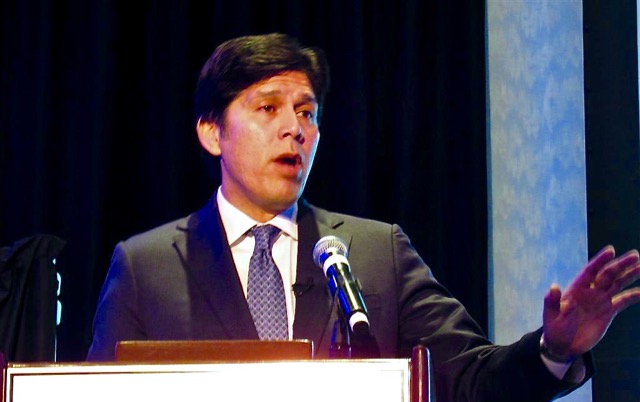
Sen. De Leon assured the attentive crowd that his state government would do everything in its power to hold back the weight of a changing federal government that has positioned human-caused climate change as a hoax at the very top spot in elected office.

“California is not waiting for Congress to pull its head out of the desert sand,” de Leon said, while reminding those in attendance that the state alone represents the sixth largest economy in the world.

This economy is discovering the financial benefits of converting dirty energy into clean, renewable technology. He even made the case that clean energy is becoming more cost efficient, as well as one that protects the livelihoods of current and future generations.

California Senate President Kevin de Leon won't let the feds change state policy. Photo/Denise Haerr

California Senate President Kevin de Leon won’t let the feds change state policy. Photo/Denise Haerr

“Clean energy is already out competing dirty energy on prices – even without subsidies,” he said. “With (President-elect Donald) Trump, there’s nothing he can do to make the case for coal.”

At one point, de Leon theorized that the reason why coal miners fight to hold onto the method of resource extraction is because it’s part of their culture – a way of life that past generations have come to rely on to put food on the table.

Further, he made it clear that he understands the pain of losing one’s way of life, an overwhelming abyss that may lead to divorce, loss of home, children and job and even suicide in some cases. 

So de Leon advocated using a simpler way of talking about global climate, minus the massive statistics, to have a reasonable discussion with those who doubt the science.

He also urged believers to involve the human factor in the discussion.

“Climate change is not about polar bears. It’s about people,” he said. “A majority of Americans don’t understand the risk (of not acting).”

In California, the senator’s goal of building a new, low-carbon economy hit a major milestone with Senate Bill 350, which essentially dictates that half the electricity in the state will be generated through renewable energy by 2030.

“That’s a big step,” he said.

California has always been on the forefront of emissions control compared to other states. But with a perceived threat from a new federal government, de Leon pledged the state would not only refuse to halt efforts, but would “double down” on its initiatives to change the tide of looming global danger.

“We’re not going to let one election change our values. Our biggest threat to our state is our (federal) head of state,” he said.

So how do we double down?

When asked by Lake Tahoe News if California should build its own wall becoming isolationist or reach out in a consortium of other states, de Leon replied that efforts are already under way for the latter.

“We’re reaching out to other like-minded states to reach agreements in MOUs,” the keynote speaker said, listing Oregon, Washington, Nevada, Illinois and the cluster of New England states as kin to the cause.

The first Latino leader of the state Senate also revealed that state representatives have met with federal authorities in Mexico to pool their resources and support each other’s causes.

“In Mexico, climate change is not controversial. It’s not left wing or right wing,” he said.

Mexico’s empathy to California’s plight was a crucial point in the underlying theory mentioned through the morning that climate change denying is rooted in politics, not science.

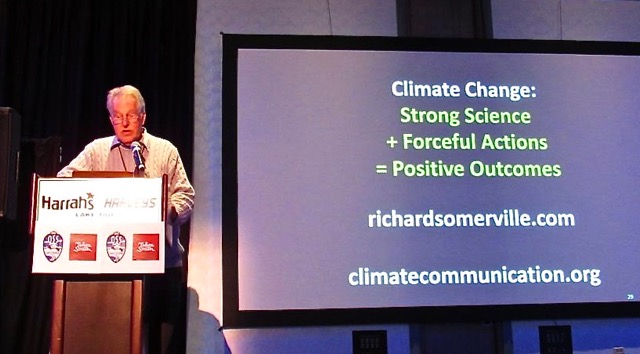
Scientist Richard Somerville speaks Jan. 12 in Stateline about climate change. Photo/Denise Haerr

Scientist Richard Somerville speaks Jan. 12 in Stateline about climate change. Photo/Denise Haerr

Climate change – right or wrong?

Scientists like Somerville are in good company in California.

In a stern rallying cry, Gov. Jerry Brown pleaded with thousands of scientists last month at one of the largest international gatherings of its kind to mobilize for the climate fight.

“The time has never been more urgent or your work never more important,” he said, promising the “truth-tellers” that the state and its main cause will persevere. “We will pursue a path of collaboration and bold political advancement – whatever they do in Washington – and eventually the truth will prevail.”

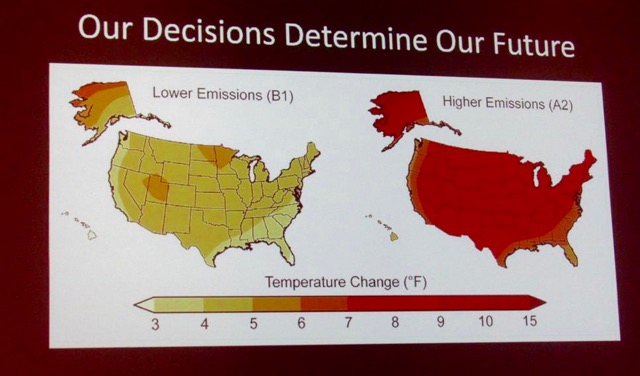
To climate experts like Somerville, the evidence is overwhelming as he placed image upon image of revealing data on a screen that supports the notion that the climate is changing and humans are the main cause.

“CO2 levels are rising conclusively. Each new decade is getting warmer,” he told the hushed audience. “This isn’t a string of evidence. This is a thick rope of evidence.”

At one point, he turned to the evidence going on outside as an extreme weather event supporting his claim.

Somerville broke his explanation down to sport.

“Carbon dioxide is the steroids of our climate system,” he said.

The analogy is: Do we ask ‘do the steroids of the (baseball) slugger cause the home run?’ Or, ‘does it increase the odds?’

“There’s no silver bullet that solves this problem. It’s silver buckshot,” Somerville said, mentioning more use of solar power and reducing our dependency on resource extraction energy methods as things to do.

“We have to change the lack of political will to act,” he said.

Somerville turned to France – the world’s largest producer of electricity — as an example of a nation that has turned around its method of operation in energy use. In just a quarter century, it’s now dominated by nuclear power.

“Those who claim we can’t change from fossil fuels are just wrong. It’s been proven. France did it,” he said.

The prospect of the silver buckshot has a slight silver lining – but much work in store.

Somerville noted he’s encouraged by the majority of Americans accepting the science of climate change.

“However, when the entire Republican leadership doesn’t accept the science, then we have a long way to go,” he said.

The scientist proposed that even if Trump doesn’t believe the science, he may cave to averting becoming “a laughing stock” in front of other world leaders who overwhelming have supported the global climate action plans as recently as the Paris Agreement signed last November, days before the election.

Somerville believes the truth-tellers should make an economic argument since the climate change deniers use that as a way to spur inaction.

During the question-and-answer session, attendees even asked for tips to convince climate change deniers to see the science differently.

“What’s worked for you?” longtime environmentalist Karen Fink asked Somerville.

He suggested more empathy and open minds to have a meaningful discussion.

“People tend to trust people who share their values. You could say: ‘Let’s (at least) agree on this,’” he said.

Somerville uses a cute analogy of the “Uncle Pete” in the room, the naysayer that ruins the family dinner with his refusal to refute climate myths. Uncle Pete is the inspiration for developing a website www.skepticalscience.com to combat closed-mindedness.

“We found the enemy. And the enemy is us,” he said.


Nevada casinos earn 1st profit since 2008

By Associated Press

Stateline casinos helped contribute to 2016 being the first time since the 2008 fiscal year that Nevada casinos showed net income instead of a loss.

The Gaming Control Board released the figures Wednesday.

The South Shore reported a 5.1 percent increase year-over-year to $375 million. In 2015 the Stateline casinos had a net loss of $150.8 million. 

But it wasn’t due to gambling winnings, which in Stateline were down $2.1 million.

The report highlighted a continuing trend — revenues tilting away from tables and slot machines toward restaurants, retail, entertainment and rooms.

This “other” income is helping Tahoe tremendously. Also contributing the local increase is the addition of the Hard Rock Lake Tahoe.

The state says room rentals and fees helped resorts generate income of almost $1 billion from total revenues of $25.2 billion in the year ended June 30. 

That compared with a net loss of almost $662 million on revenues of $24.6 billion a year earlier.

Board analyst Michael Lawton says the bottom line is that casinos across the state recorded net income for the first time since fiscal 2008.

— Lake Tahoe News contributed to this report.


March Madness renews legalized sports betting war

By Richard N. Velotta, Las Vegas Review-Journal

March Madness is upon us, another time of the year when people who almost never set foot inside a race and sports book become sports experts and serious gamblers.

It was only a month ago that twice-a-year bettors showed their expertise on Super Bowl Sunday.
 
But come this afternoon — now known as Selection Sunday — college basketball fans will be glued to their televisions to learn how a committee constructed the brackets for the 68-team NCAA Tournament that will last through April 3.

Read the whole story


Snow removal ongoing; more weather next week

Crews will continue today to remove snow from roads in the basin. Photo/Provided

Crews will continue today to remove snow from roads in the basin. Photo/Provided

Update 5:34pm:

While a winter storm warning remains in effect for the Tahoe area until 10 tonight, the forecast for next week is for another atmospheric storm to hit the region. It is expected to arrive Tuesday night and last through Wednesday. 

Forecasters are saying it will not be as strong as the storms that just pummeled the region.

In the mean time, things should start to dry out — at least in terms of what is falling out of the sky.

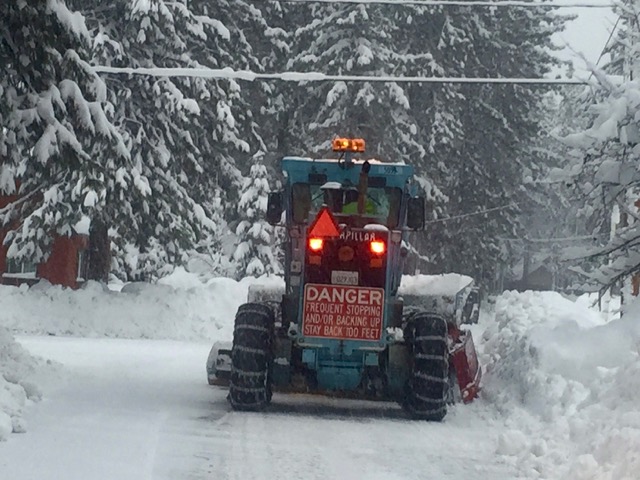
There is plenty of snow that still needs to be moved. Snowplows in the greater Lake Tahoe area continue to work to clear the white stuff.

All South Lake Tahoe streets have been plowed at least once. Snow removal crews will continue their 12-hour shifts with primary snow removal. It is estimated that the widening of streets and snow removal of bike paths will begin Saturday morning.

The city’s pool dome suffered damage during the storm which has resulted in the pool closure. The pool may open after the weekend.

A Go Fund Me account has been set for the Sokolov family of South Lake Tahoe. On Jan. 10 a tree fell on their home in the middle of the night, pinning Jamie Sokolov who was shielding her daughter, Alyssa, from the falling tree. The longtime locals both work in town. They were quoted $12,000 for the tree removal.

Thursday’s weather forced UNR to close down the campus.

Sporadic outages continue for Liberty Utilities customers. The West Shore continues to be out of power between Tahoe City and Fallen Leaf Road. Restoration work will continue by working in two directions. This is a very dynamic situation and this can change as large trees continue to fall. Customers in neighborhoods with heavy damage should prepare to be out for multiple days. The goal is to energize up to Tahoe Pines by midnight. 

The Rubicon Trail is open, but officials say, “Go prepared for weather and trail condition changes.”

Mount Rose Highway is open. 

Westbound Highway 88 at Picketts Junction is still closed, as is Highway 89 around Emerald Bay.

A plow clears snow Jan. 12 in the Bijou Pines area of South Lake Tahoe. Photo/Susan Wood

A plow clears snow Jan. 12 in the Bijou Pines area of South Lake Tahoe. Photo/Susan Wood

By Kathryn Reed

All the moisture from the fall and the start of this winter has dramatically improved the drought conditions in California and Nevada.

Even though 58 percent of California is still in a drought, only 2 percent is at the most critical stage. A year ago 98 percent of the state was in a drought. Most of El Dorado County is no longer considered in a drought, which includes the Lake Tahoe Basin. The same goes for Placer County.

Thirty-seven percent of Nevada remains in a drought. However, that does still include Douglas County. Even so, the conditions are tremendously better.

The storms have added 350 billion gallons of water to California’s biggest reservoirs. Lake Oroville, the state’s second-largest reservoir, is 35 feet higher than it was on Jan. 1. This makes it at 74 percent of capacity, which is 117 percent of average for this date.

Shasta Lake is 81 percent full. It is the largest reservoir in California.

State officials are not declaring the five-year drought over. It’s possible the spigot could be turned off. That’s happened in previous winters where there has been a deluge and then nothing.

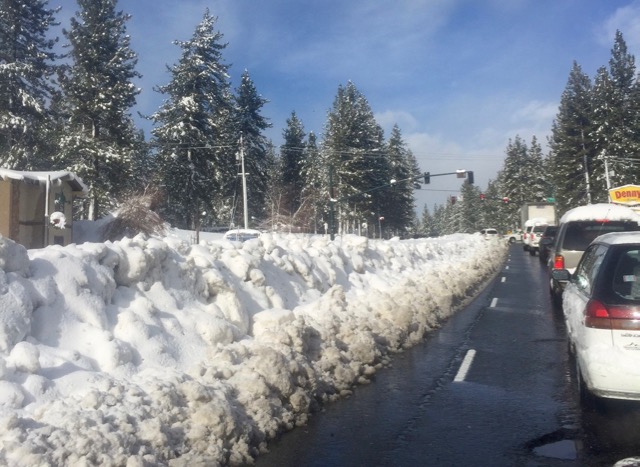
Thirteenth Street in South Lake Tahoe is a snowy mess on Jan. 12. Photo/Susan Wood

Thirteenth Street in South Lake Tahoe is a snowy mess on Jan. 12. Photo/Susan Wood

However, for the immediate future more moisture is on the way to this region.

A winter storm warning remains in effect for the greater Lake Tahoe area through 10pm Thursday. Eight inches of snow are expected above 5,000 feet.

The sun is expected to come out Friday, though highs through the weekend will only be in the 30s.

Rivers and streams will continue to run high for the next couple of days. The drying trend should help them to recede to non-threatening levels.

Douglas County schools at the lake are open today, but only the main bus stops are being serviced. Lake Tahoe Community College begins its new quarter today.

Lake Tahoe Unified is closed in order to let city crews plow the streets. Tahoe Truckee Unified and Sierra Nevada College are also closed on Thursday. All schools in Incline Village are closed through Friday. El Dorado County workers in the basin have another day off.

Travel along local streets and state highways could be slow and dangerous. Chain requirements and closures could change at any time. For up to date information for highways, click on the state icons on the home page of Lake Tahoe News.

The avalanche danger remains considerable, according the Sierra Avalanche Center.

Ski resorts are digging out from the big dump. Check the resort’s website to make sure it is open before driving there.

A power outage is keeping Homewood Mountain Resort closed today. It has received 13 inches of snow in the last 24 hours.

Liberty Utilities and NV Energy crews have been working around the clock to try to restore power, with no estimated time when the remaining customers will have electricity.


Ski industry strives to curtail injuries

By Susan Wood

With Christmas snow conditions ripe, Heavenly Mountain Resort’s Chief Operating Officer Pete Sonntag tweeted he was about to drop into Killebrew Canyon and thanked his “ski patrol for keeping us safe.”

This January marks the 16th year of National Ski Safety Awareness, changed from a weeklong event to a month in 2013. And with the resorts bound to be packed for this coming three-day weekend, safety is a big concern with more people on the slopes.

Despite reports of accidents, incidents, a landmark Colorado court hearing and a slight rise in fatalities last ski season compared to the previous year, most stakeholders from the National Ski Areas Association and California Ski Industry Association to a Lake Tahoe ski area general manager and ski patroller believe the awareness campaigns are working.

There were 39 fatalities among U.S. ski areas last year, up by four from the 2014-15 season, according to the NSAA. This is out of 52.8 million ski days reported. Granted, the ski visits were at a slight decline from the previous year, but one needs to place the assessment into perspective.

That’s 0.74 fatalities per 1 million skier or snowboarder visits – near the decadelong average fatality rate of 0.67 deaths per 1 million riders visiting the hills.

Another perspective – the National Safety Council pointed out that in 2014 35,400 Americans died in motor vehicle accidents, 32,000 in unintentional falls and 42,000 from unintentional poisoning.

The NSAA also reported 45 catastrophic injuries in the 2015-16 season, a dip in the ski industry’s 10-year average. Catastrophic constitutes those involving forms of paralysis, broken necks, broken backs and life-altering head injuries.

“If you look at ski injuries broadly, it’s been declining for decades,” NSAA President Michael Berry told Lake Tahoe News. “Think of all the things we see that didn’t exist 25 years ago (that help the cause).”

Berry, who ran Kirkwood Mountain Resort for 13 years, listed the level of awareness, equipment and better grooming as contributing factors to a stunted growth of these types of serious incidents.

“Layer all those things, and we continue to see a decline in ski injuries,” he said.

For one thing, Berry cited an extraordinary number of signs on the mountains in the last decade. The ones indicating slow zones have popped up all over the slopes.

Berry suggested to those skiers or boarders who believe some riders are going too fast or get too close to perhaps consider this perspective.

“That skier flying by used to be me,” the 69-year-old ski executive said. “It generates some conflict. But when you say ‘I can’t believe he passed me that fast,’ consider that you were that person 20 years ago.”

Ski patrol as Sierra early this month train on chairlift evacuation techniques. Photo/Kathryn Reed

Ski patrol as Sierra early this month train on chairlift evacuation techniques. Photo/Kathryn Reed

It takes a level of courtesy, awareness and knowing your limits

Most of the time the mingling of people works out. But sometimes it doesn’t, resulting in impact on not only those who experience the injury, but to those who witness the incident.

Take Lake Tahoe skier Brenda Knox who witnessed a horrifying collision at Northstar last season. On Super Bowl Sunday she was coming down West Ridge from the summit of the backside when out of nowhere a skier acted like a linebacker by clobbering a snowboarder who was cruising into the slow zone.

The woman was between 15 to 20 feet in front of Knox doing her 10-foot turns when the man on skis who was straight lining down the hill sent her flying into the air. 

“He came from my left going really fast. As she turned, he ran into her, and she flew into the air. I saw her leg break. She was screaming. She kept screaming,” Knox said.

When the ski patrol arrived, Knox told them what happened and that she saw the woman’s leg snap.

“I told them they needed to treat her for shock,” she said. “It really shook me.”

She was forced to calm down in the Zephyr Lodge after witnessing such an incident.

“What he did was so wrong. It was a slow zone. Signs were up everywhere,” Knox told Lake Tahoe News.

Ski area stakeholders believe they can only do so much in making the slopes safer. They can’t make people be more courteous, despite what Squaw Valley-Alpine Meadows CEO Andy Wirth told Lake Tahoe News he would like to see in 2017.

“We do everything we can to make it safer. Still, there’s accountability with our guests. I’d like a reboot of people being more courteous,” Wirth said.

Granted, gravity goes with the sport of skiing.

“Gravity and the thrill of skiing is part of the general passion, but you have to have balance between what gravity does for us and safety,” Wirth said. “I’m of the very firm belief that our sport is safe, if not safer than most sports.”

Wirth pointed to training — which is “extensive and exhausting,” technical advancements and the focus on maintenance of equipment that have contributed to better safety.

And by all means, the awareness helps. At its core, all ski areas operate on the seven-point mantra of having riders live by the “responsibility code,” – which is posted in many places.

Ski patrollers at Sierra work to slow down skiers/snowboarders who go too fast. Photo/Provided

Ski patrollers at Sierra work to slow down skiers/snowboarders who go too fast. Photo/Provided

Knowing the code helps:

  • Always stay in control, and be able to stop or avoid other people or objects.
  • People ahead of you have the right of way. It is your responsibility to avoid them.
  • You must not stop where you obstruct a trail or are not visible from above.
  • Whenever starting downhill or merging into a trail, look uphill and yield to others.
  • Always use devices to help prevent runaway equipment.
  • Observe all posted signs and warnings. Keep off closed trails and out of closed areas.
  • Prior to using any lift, you must have the knowledge and ability to load, ride and unload safely.

Heavenly and Kirkwood spokesman Coop Cooper joined Northstar in declining input for this story, citing “our company’s corporate media policy,” but he didn’t indicate what the policy of parent company Vail Resorts is.

At Sierra-at-Tahoe on the South Shore, ski patroller Shannon Maguire notes the ski area goes a little further than the safety message.

Sierra takes its recruits for ski patrol and has them work as trail crew manning the slow zones.

“That program has grown since I’ve been here. More people are working the slow zones to have more eyes and ears on the hill,” Maguire said.

For patrollers, it’s just part of their training.

In the decade Maguire has been with Sierra, there are also more markers indicating mergers, high traffic areas and blind spots.

The ski resort has even expanded enhanced safety education to its racers – knowing they ski at ability levels that are quite different from beginners on the hill.

Tools of the trade when someone is injured on the slopes. Photo/LTN

Tools of the trade when someone is injured on the slopes. Photo/LTN

Education before punishment

Although there are no hard numbers on passes revoked locally or nationally for the season, Maguire indicated that’s done as a last resort.

She noted the resort has the option of stripping away a pass for a few weeks.

“Sometimes the situation is more severe demanding stronger repercussions. But our goal is to educate them rather than go that route,” she said of pass revocation.

And rarely do the consequences rise to the level of that of what Casey Ferguson endured. The Keystone (Colo.) Resort snowboarder was ordered to pay more than $260,000 in damages from a collision that separated the shoulder of Chicago resident Tom Dubert. He was charged with reckless skiing, a rarity in the courts because many cases are settled between attorneys and insurance companies. In this case, Ferguson’s parent’s homeowners’ insurance policy covered the damages.

This all comes with the territory for California Ski Industry Association President Michael Reitzell, who’s also a personal injury attorney.

The legal cases are few and far between, despite the accidents being dramatic. The outcomes may also be determined by the state they’re made in.

“Colorado is different when it comes to litigation. It’s thought of as a skier-friendly state, a place to go to ski,” he said. This means skiing, and therefore being safe skiing, is part of the image of Colorado.

“No doubt we’re gonna see increased efforts through the years and see less tolerance for less courtesy,” Reitzell told Lake Tahoe News. “Snowboarder, skier — whatever the equipment, if you choose to not be courteous, you’re an increased hazard on the hill and an increased risk to people around you.”

Reitzell also admitted a ski area can only do so much to reduce the risk – especially since the number of skier visits grew from 4.6 million in 2014-15 to 7.2 million the following year. The average of the six-year period is 6.5 million.

The association is beefing up its safety measures for the state including coming out with a generic ski safety map that highlights what to do at certain hazard zones at any given ski resort. For example, it would warn skiers and boarders to watch out for the hazards of tree wells.

“Our goal is 100 percent injury free,” Reitzell said.