Caesars wraps up $18B bankruptcy case

By Tracy Rucinski, Reuters

Caesars Entertainment Corp has wrapped up the $18 billion bankruptcy of its main operating unit, allowing the casino company to focus on restoring the tarnished Harrah’s, Caesars and Horseshoe brands after two years of Chapter 11 proceedings.

Caesars’ subsidiary, Caesars Entertainment Operating Co Inc., won court approval on Tuesday for a plan to shed $10 billion of debt and separate its U.S.-based property assets from its gaming operations.

The company expects to emerge from bankruptcy later this year.

Caesars is the parent company of Harrah’s Lake Tahoe and Harveys at Stateline.

Read the whole story


SLT recaps storm, applauds its response

By Kathryn Reed

Snowmageddon tested South Lake Tahoe personnel and infrastructure in ways that are still being assessed.

The full impact of last week’s rain and snow storms might not be known until things fully dry out. This is especially true of roads and drainage systems.

The City Council on Jan. 17 received an update by department heads about how the multi-day event played out; what worked, what didn’t and what needs to be improved upon. Overall, though, staff was pleased how everyone and everything worked. Training was lauded as being a key for everyone knowing their job.

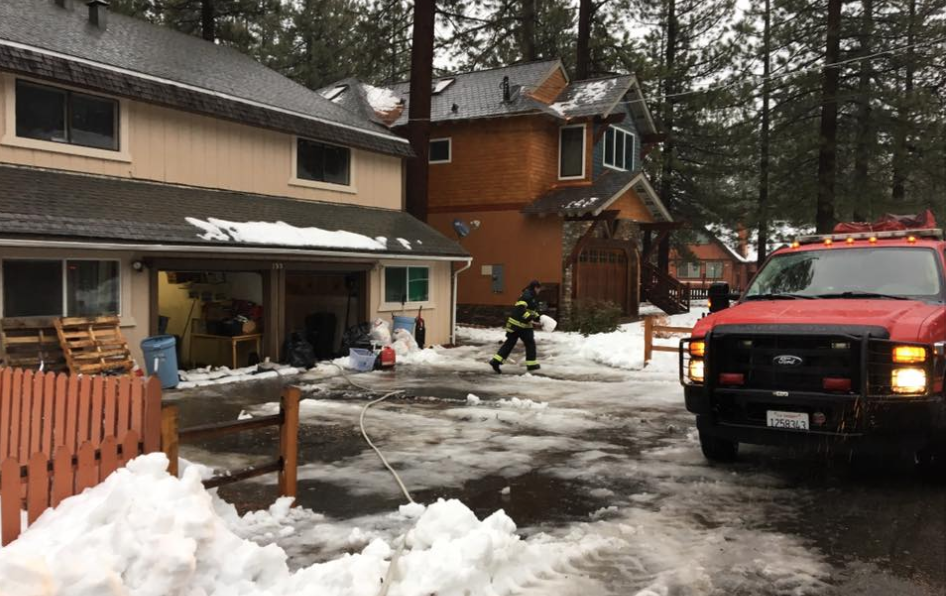
South Tahoe firefighters respond to water in a garage. They use a sump pump to clear the area. Photo/Provided

South Tahoe firefighters respond to water in a garage. They use a sump pump to clear the area. Photo/Provided

The electeds voted to declare a state of emergency, which will allow the city to apply for money from the state and feds. Businesses and residents would be able to seek financial relief, too, not just the city.

“During the height of the storm we doubled our capabilities,” Fire Chief Jeff Meston said.

The police department brought in more people, too. When snow removal personnel came to work, so did the mechanics; such are the requirements with old equipment.

Meston headed up the emergency operations center at the airport. It was a fluid situation. When urgent care flooded it was necessary to have a backup plan. When the recreation center, which is the usual shelter, flooded, Plan B was implemented. When the school district didn’t want pets at South Tahoe High School, education by the Humane Society was necessary to explain how animals wouldn’t damage the school-shelter.

City staff helped Denny’s and Pet Supermarket deal with their flooding. The Knights Inn and residences on streets in that vicinity are still recovering. Flooding was also an issue in the state streets. Sump pumps are still running to clear water from under houses.

The width of the roads was problematic at times for fire personnel. Meston admitted there is damage to some of the apparatuses. He said it’s either that or risk not reaching a patient in time.

It wasn’t until this Tuesday that streets started to be widened. The snow gang was given the weekend off to recover; especially with more storms arriving today.

In preparation for last week the police department had a small boat, motorcycles and snowmobiles ready in case standard vehicles wouldn’t suffice.

Cops had their own flooding to deal with when the roof at the station started to leak. Plastic was already in the building since this wasn’t the first incident.

Plows work to clear the parking lot at the library in South Lake Tahoe. Photo/Susan Wood

A plow works to clear the parking lot at the library in South Lake Tahoe. Photo/Susan Wood

For the first time the city used a drone. This provided near live coverage to the EOC regarding how high the Upper Truckee River was. Had roads been blocked and post-storm assessment been needed, the drone could have provided a visual.

During the chaos regular conference calls were made with about 100 people from throughout the region, including the National Weather Service.

Staff assessed various businesses for safety concerns, issuing one of three flyers: a) all is safe; b) some storm damage; and c) do not enter.

While the bubble on the pool sustained damage, the facility will reopen this morning at 10.

Ray Jarvis, head of public works, said one of the biggest problems was dealing with parked cars on streets. It delays plows and then sometimes a backhoe had to be employed to dig out the vehicle just so it could be towed.

He is going to be in contact with Caltrans to see if that agency can do anything to provide a longer left turn lane, which would make travel safer. This was a request of Councilman Jason Collin’s.

Councilman Tom Davis was critical of Liberty Utilities, saying no one was telling the city when power would be restored. He wanted them to be part of the emergency operations center. The reality if they have their own command post and cannot allocate personnel to every EOC in their service area.

Police Chief Brian Uhler said if Liberty were to give out more information, he believes dispatch would not have received as many power outage related calls.

Other city staff, in talking with Lake Tahoe News, was less critical of Liberty.

“Every time we respond to wires down we ask for an ETA, which is done by our dispatch,” Fire Chief Jeff Meston told Lake Tahoe News after the meeting. “The utility then puts them into a priority system; generally with widespread emergencies they do not offer an ETA.”

City Manager Nancy Kerry told LTN, “Throughout the event, I spoke to Randy Kelly (with Liberty), who accepted my phone call every time and directed me to the person who could provide more detail as to when the power would be back on; he also provided us a direct phone number to Liberty’s EOC that was activated on the North Shore, because power was out and the conditions on the South Shore – snow-flooding — were more substantial.

“What Tom Davis was referring to is that we have to take the initiative to contact Liberty, we seek out information. Previously Liberty would often send emails regarding outages. Also Liberty does not have any social media presence, which would greatly assist everyone in knowing when power would be restored – or that they are working on it – and people could share information on Liberty’s social media platform.”

Lake Tahoe News on the other hand received regular emails from Liberty during the storms, which were then included in the multitude of updates on the news site each day.

Things the city will consider in the future include moving the sand away from the Rufus Allen location so it does not interfere with city vehicle traffic, putting in a device to make it easier to load sand into bags, enlisting the California Conservation Corps members to help, having a conversation with Heavenly so the resort isn’t encouraging people to drive when the city is saying shelter in place, and assembling a volunteer snowplow team to assist those who can’t remove their own snow.

Snow finally replaced days of rain. Photo/Denise Haerr

Snow finally replaced days of rain. Photo/Denise Haerr

Some stats from last week’s storms:

·      Seven graders in the snowplow fleet went down; but all were fixed in house

·      2 million gallons of water tested the storm drain system

·      150 tons of sand were scooped up by residents

·      The ladder truck was used 2½ days; it was never used in 2016

·      South Tahoe Action Team was called in for the first time; mostly these volunteers helped at the emergency operations center

·      On Jan. 8 the fire department responded to 21 calls

·      65 disabled vehicles were tended to

·      16 flooding issues were handled by the police

·      86 snow citations were written

·      11 tows were required because of the snow

·      12 other tows were made

·      More than 6 inches of rain fell between Jan. 7-10

·      2-5 feet of snow fell from Jan. 10-15

·      More than 100 people called to complain about berms.


E-sports on track to become $1B industry

By Colton Lochhead, Las Vegas Review-Journal

Less than two decades ago, e-sports consisted of a few dozen elite gamers gathering in warehouses to compete for modest-at-best prizes.

There were no televised events. No live-streaming or uploading the tournaments to YouTube. And of the fanfare, there was little.

But today, e-sports has climbed out of basements and warehouses and onto major cable networks such as ESPN and TBS and is on the verge of becoming a $1 billion industry.

Read the whole story


Ski industry targeting millennials

By John Kekis, AP

WILMINGTON, N.Y. — When Aaron Kellett peers out the window of his office at Whiteface Mountain, these days he’s usually smiling.

“My office is right next to our beginner trail, and when I look out I see people on our beginner trail,” said the 38-year-old Kellett, who’s been the manager at Whiteface for four years. “That means we’ve got new people learning how to participate in our sport.”

And that’s a good thing. As baby boomers begin to pull back from the athletic endeavors of their youth, ski resorts are focusing on attracting new participants to the slopes. The idea is to get them there and keep them, and the millennial generation (those between the ages of 18 and 34 in 2015) tops the target list.

According to the latest demographics from the Colorado-based National Ski Areas Association (NSAA), baby boomers (aged 52-70 in 2016) and those 71 and older have steadily become a smaller share of the visitor base as they’ve aged. Combined, in the past decade they’ve declined from 36.2 percent of visitors to 21.3 percent.

Millennials, on the other hand, represent the largest group of snowboarders and skiers, but they also have the fewest number of days per season. The figures show that the industry will need to increase the frequency of the millennial participant to match that of the exiting baby boomer.

“That’s a significant wakeup call for us. There’s some challenges there,” said Nate Fristoe, director of operations at RRC Associates, which last year produced a report on the millennial generation. “We have this funny little dilemma. We’re trying to build participation. We know we have to grow participants, but we also know that on most of our weekend days we’re hitting capacity.

“It’s a fascinating conundrum,” Fristoe said. “Yes, we have a product offering that has appealed to an older generation for years. It also appeals to this generation in many ways, but there are ways in which we need to tweak it.”

To be sure, millennials are different. They embrace the environment, like to plan spontaneously, prefer to travel with friends and crave healthy food. They also relish sharing their adventures on social media.

“Millennials are harder to attract, for sure. It’s not as cut and dried as it was even 10 years ago,” Kellett said. “They want the best deals and they’ll do whatever it takes to get the best deal. They don’t mind spending money to do what they want. It’s the experience. It’s so much more than just skiing.”

Kellet says online ticket sales have been “huge” for Whiteface because of the savings they offer.

Whiteface, which has plenty of apres ski destinations in nearby Lake Placid, offers a Parallel from the Start program for beginners. It costs $169 and includes everything needed to start skiing, except the clothing — lesson, equipment rental, and three days of skiing. “It’s an awesome way to be introduced to the sport. It works,” Kellett said.

In neighboring Vermont, the cost is $129 for a Take 3 pass — three ski or snowboard lessons that includes rental equipment for the day plus a lesson and access to beginner terrain. The Green Mountain State also offers a $49 beginners package during January, national Learn to Ski and Snowboard Month nationwide.

“Cost can be a hurdle, so anytime we can lower that hurdle a little bit, especially for beginners, we see more people participate for a longer period of time,” said Sarah Wojcik, marketing director for Ski Vermont. “Getting new people to the slopes with incentives and then keeping them are two of the biggest goals nationwide.”

The granddaddy deal of them all might be the epic pass offered by Vail Resorts. It’s the most popular pass in the ski industry and features unlimited, unrestricted skiing at all of the company’s mountain resorts (Vail, Beaver Creek, Keystone and Breckenridge in Colorado; Park City in Utah; and Heavenly, Northstar and Kirkwood in Lake Tahoe). It also will include Whistler Blackcomb next winter season (2017-18), and offers five days at 30 resorts in Europe.

With the rise of social media and mobile phones, most ski resorts are trying to provide easy-to-navigate websites and free Wi-Fi so visitors can share their experiences digitally — think Snapchat. Excellent cellphone service is a must.

“Your website being mobile-friendly is kind of millennial-speak 101,” Wojcik said. “If you can’t look it up on your phone, it’s really difficult to get the message out there.”

At Taos Ski Valley in New Mexico, which was cited by NSAA for having the best overall marketing campaign for 2016, millennials aren’t separately targeted but the demographic is important.

“Millennials are big on experience, and Taos Ski Valley has long been known for delivering an authentic, unpretentious and culture-rich winter mountain experience,” marketing manager Dash Hegeman said. “That is something we work very hard to protect and cultivate.”


LVFPD chief restores traditions to department

By Kathryn Reed

Tradition is in large part what the fire service was built upon. It is those rituals that help bind the men and women who put the uniform on each day.

Lake Valley Fire Protection District, though, has been lacking those ceremonial rites. That’s all about to change.

Tim Alameda, who became chief last year, immediately knew he wanted to create an honor guard and reward his staff with commendations. These are some of the traditions he is introducing to the department even though they are the norm so many other places.

“This will probably be one of the most important things I will do in my career here,” Alameda said of creating the honor guard. “It’s a beautiful, gorgeous tradition. I’m just tickled to think I could bring that home.”

It is considered an honor to be chosen to be in this guard. The U.S., California and Lake Valley Fire flags are part of the ensemble. Another person gives the orders. They present the colors at official events, including funerals.

This summer the crew will be sent to a special training in Carson City to learn what to do in a full honor guard ceremony, which will include a mock funeral.

Another job of the honor guard is to make sure everyone’s uniform is correct.

The chief didn’t have his full dress uniform yet when it was time to attend Zach McAllister’s services at Sierra-at-Tahoe last month. He was going to wear a white shirt and tie. Honor guard members wouldn’t let him leave the station until they pieced together the uniform.

“They insisted their fire chief be in the right uniform to pay tribute to this young man,” Alameda told Lake Tahoe News.

The other team Alameda has assembled is the commendation group.

“What that means is if someone does something out of the ordinary, really special, then any firefighter in the organization can nominate them for a commendation,” Alameda explained.

The chief, though, is not involved in who gets what. That is entirely up to the select group, which is made up various ranks within the department as well as a board member.

The first award ceremony will be in the first quarter of this year. Mostly it will be from events in 2016, though it’s possible if something significant happened in 2015 that it may be included.

Most of the awards are a ribbon that then goes on the individual’s dress uniform.

The awards include:

Valor – This is going beyond the call of duty; where the risk is beyond the normal scope of the person’s job. “We don’t just hand that out,” Alameda said.

Lifesaver medal – Where someone’s life was saved because the employee either did something dangerous, technical or extraordinary. This goes beyond the routine lifesaving firefighters/paramedics do every day. “It’s when you get the patient to the hospital and the doctor says if you didn’t do what you did, the patient would have died.”

Merit – This can be awarded to employees and the public. It is the highest level award a civilian can receive. It’s about hard work. It can be hard to get the pin. Sometimes a letter of recognition is given instead of the ribbon.

Fire chiefs commendation – A plaque is given to the individual by the chief officers for doing something special, something that changed the dynamics of a situation.

Field save – This deals with CPR specifically. “You get the person to the hospital and that person then walks out of the hospital,” Alameda said.

Campaign ribbon – This is for significant events like last fall’s Emerald Fire. The first responders will receive a green and white ribbon to wear. This summer for the 10-year anniversary of the Angora Fire the department will be awarding ribbons for that fire to those who were involved in the initial attack.

“These rich traditions are so important,” Alameda said.


Sandoval report card: Progress made, work to be done

By Sandra Chereb, Las Vegas Review-Journal

CARSON CITY — When Gov. Brian Sandoval delivers his final State of the State address Tuesday, Nevada lawmakers will receive a written report card from the administration highlighting achievements realized over the past six years.

Titled “Shared achievements for the Nevada Family,” the report is a synopsis of gains made since Sandoval took office in 2011, when the state was in the throes of recession, the housing market was in the gutter, unemployment soared and state finances were in shambles.

“We were not on the brink, we were over the brink in 2011,” Sandoval reflected during an interview Friday at his Capitol office.

In his first address to lawmakers that year, Sandoval pointed out the obvious: “Nevadans are confronted on all sides with bad news.”

Read the whole story


Hal Cole Sr. — 1922-2017

Hal Cole Sr.

Hal Cole Sr.

Even though Hal Cole Sr. brought in the New Year dancing with family and friends, he died of a short illness two weeks later. He was 94.

Harold Cole Sr. died Jan. 14, 2017, in Reno.

Mr. Cole was born in St. Louis, Mo., on July 24, 1922.

He overcame a rough start in life to become decorated for his service in the Navy during World War II and then ran his own electronics firm.

Mr. Cole was orphaned at age 5 when his mother died. He was shuffled between orphanages and an aunt.

He enlisted in the Navy at 17, where he served aboard the USS Nashville in the Pacific during World War II. He was a radioman, which was where he learned the trade that would shape his future. He was in the Battle of Guadalcanal, escorted Jimmy Doolittle in his raid on Japan, was with Gen. Douglas MacArthur for his return to the Philippines in 1944, and was hit by a kamikaze in December of that year that killed 133 of his fellow sailors. He received two battle stars.

Mr. Cole also played drums in a band aboard the Nashville. Between battles they would perform aboard various ships in the Pacific. He continued playing the drums throughout his life, favoring Dixieland and jazz music.

Mr. Cole’s love of music ultimately resulted in meeting his future wife. Carmen Rushing was playing the piano at a USO. They were married in Reno in 1948.

With their two sons, the family of four enjoyed many jam sessions at home.

After his stint in the Navy, Mr. Cole attended UC Berkeley, graduating in 1954.

Many summers were spent in Sciots Camp just west of Strawberry Lodge at the cabin Mr. Cole’s father-in-law had built in the early 1920s. Trips to Tahoe for groceries and beachcombing instilled a desire to relocate there. 

During the 1950s Mr. Cole worked for Shell Development as an electronics technician in the research department. It was there he used his skills and knowledge of radios, which later expanded into television. On one trip to Lake Tahoe he found a TV shop on Ski Run Boulevard for sale. It included the rock house at the corner of Aspen Boulevard, a building next door, a television shop with all the inventory, a Volvo station wagon and a malamute husky. All for $38,000. 

With the help of an aunt, Mr. Cole mustered up enough money for the down payment and opened up Cole Electronics in 1960. He operated the business through 1972. He then bought and operated Alpine Security, a local burglar alarm company, until he retired in 1998. 

While living in South Lake Tahoe, Mr. Cole was an active member of the Senior Center. He even served as president.

He was the drummer in the local Dixieland band The Tahoe Toads, which would often perform at the Senior Center.

Mr. Cole was the ski reporter for the Tahoe Daily Tribune. He also had a weekly column for much of the early 1960s.

He would transport the local high school ski racers to many events.

He also was an avid photographer and had his own darkroom.

After his wife died in 2000, Mr. Cole met Ruth Eachus at the Senior Center. She became his partner and loving companion. They lived in Reno until his death.  

He was preceded in death by his wife, Carmen Cole, and daughter Rhonda Cole.

Mr. Cole is survived by sons Hal Cole Jr. and Robert Cole, both of South Lake Tahoe; grandchildren Clayton Cole, Casey Cole, Melody Cole and Robert A. Cole; and companion Ruth Eachus.

The family will get together at an undetermined date to celebrate his life.


Unlikely basketball star recalls her glory days

By Linda Fine Conaboy

Maybe some of you know South Lake Tahoe resident Maureen Stuhlman who is employed as the city’s vacation home investigator. Maybe not.

Perhaps a few readers know about Immaculata University in Malvern, Pa., just outside of Philly.

There is even a chance that some have seen the movie “The Mighty Mac,” released in 2011.

Stuhlman is the linchpin holding this unlikely triumvirate together.

As it turns out, both Stuhlman and Immaculata have stories to tell. Stuhlman’s, starting in the early 1970s when Immaculata was not more than 60-years-old, and she, a mere fun-loving lass in her teens living in Havertown, Pa., taking advantage of a special pre-college scholarship program offered by nearby Immaculata, a private Roman Catholic university founded in 1920 by the Sisters of the Immaculate Heart of Mary as an all-girls school. (In 2005 it became co-educational.)

The athletic teams at Immaculata University are known as the Mighty Macs.

When Stuhlman and her friends entered the college as freshmen, on a lark, they decided to join the basketball team. As she told Lake Tahoe News, it looked like a fun thing to do, although their knowledge of the game was limited. “Anyone who wanted to play just showed up,” she said. “And it was a pleasant way to spend an afternoon.”
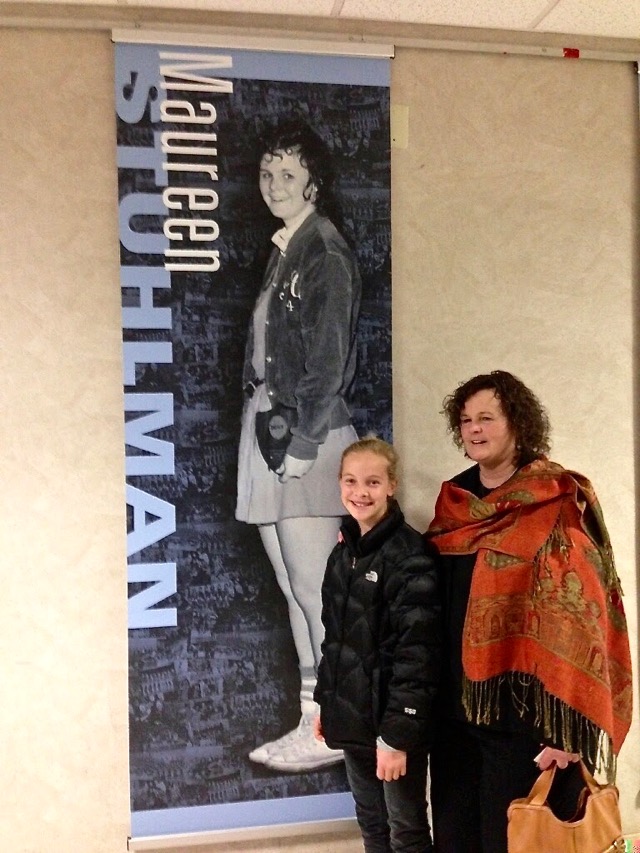
Maureen Stuhlman has passed the basketball bug onto her niece. Photo/Provided

Maureen Stuhlman has passed the basketball bug onto her niece. Photo/Provided

Nevertheless, lark or not, lack of skill on the part of her team didn’t deter Cathy Rush, the new girls’ basketball coach. She had a job to do. She was hired in the late 1960s at a salary of $450 a month with the mandate to mold a basketball team … and while she was at it, to build a gym since the old fieldhouse had burned down.

Stuhlman mused that in the early 1970s there were no sports scholarships for girls and there most definitely was no Title IX protection for women in sports. Title IX requires that all college students receive the same opportunity to play college sports under any education program or activity receiving federal financial assistance.

This was soon to become a significant factor to the fledgling team, who unbelievably began to win games. Not only did they win games, they also won tournaments, only to discover they would have to raise their own funds to attend the tournaments that were the spoils of their winning streak.

Stuhlman, who played forward, said her parents were troopers, ferrying she and as many teammates as they could fit into to the family station wagon to the games.

 “We didn’t know there were such things as tournaments. To us, basketball was totally a social thing,” Stuhlman said.

But win tournaments they did; these Mighty Macs, garbed in their wool tunics draped over the pleated skirts that served as their uniforms. These same Mighty Macs soon found themselves going door-to-door or accosting their friends and loved ones in an attempt to sell toothbrushes to fund their airfare to get to the national tournament at the University of Illinois in Normal.

“We did happen to win all of our games in one season,” she said. “We went to the regionals where they brought out their second string and we trounced them. When we returned to the regionals, they played their first string, and they trounced us.”

Feeling dejected by their defeat, upon their return to school the girls prepared to beat a hasty and silent retreat to their rooms. But their classmates as well as their teachers had other ideas. “The entire school gathered in the rotunda to greet us—we were all in tears.”

Although they came in second, they were invited to play in the National Championships. Surprisingly, they hammered the team that had just slaughtered them, although, according to Stuhlman, only one of the team members was a naturally good athlete.

screen-shot-2017-01-04-at-1-52-30-pmThe flight to Illinois was probably the first flight that many of the girls had taken. “It was such a lark for us. We had two hotel rooms, four to a room. We played four games in three days,” she said.

Stuhlman recalls the wins as much more than just wins. “We grew a lot and we learned we could do what we set our minds to do. We had confidence in each other; it was a team effort. At the time, it was new for women to train; [basketball] was considered a pastime. But these were formative years, they taught us what it meant to be a part of a team—we had formative experiences that still serve me today.”

As Stuhlman reminisced about the Mighty Macs, she recounted the achievements of her team: Of the starting five players, one, Theresa Shank Grentz, went on to become the first women’s basketball coach at Rutgers as well as a coach for the women’s Olympic basketball team.

Cathy Rush, the Macs coach from 1972 to 1977, led the school to three consecutive  AIAW national titles from 1972-74 and was inducted into the Basketball Hall of Fame in 2008. She had also been inducted to the Women’s Basketball Hall of Fame in 2000 and the Philadelphia Sports Hall of Fame in 2005.

Another Maureen (there were three on the team), coached women’s basketball at Pennsylvania State University and was an Olympic coach. Her married name is Rene Courtland; she is now retired.

“And then our entire team was inducted into the Basketball Hall of Fame in 2014—this was such an honor,” Stuhlman said. At the ceremony, Stuhlman recalled, the team had the opportunity to rub elbows with the likes of basketball greats Larry Johnson and Meadowlark Lemon.

To their amazement, 40 years later, “The Mighty Macs”, a movie about the season leading to the winning of the first women’s national basketball championship in 1972, was released. And just to prove that camaraderie is not fleeting, the entire team attended the movie’s premier en masse, which was at the Kimmel Center in Philadelphia.

According to the movie trailer, the film is about Cathy Rush, a woman ahead of her time who takes a job as the coach of the women’s basketball team at Immaculata College, as it was known in the 1970s. She and her team face huge challenges competing against perennial powerhouses—and the rest, as we know is history.

“The general theme of the movie is true,” Stuhlman said. “The coach who was married to an NBA referee, that was Cathy. But a lot of the details didn’t really happen.”

She laughed, describing a good bit of the movie as artistic license. But to those of us who were not part of the Mighty Macs, the movie does not seem to be merely artistic license. It’s the tale of a cohesive team of females, led by a tough but respectful coach, who were united to strive for a single goal—winning, while maintaining their youthful eagerness and their sense of loyalty to each other.

Now, Maureen Stuhlman is a happy resident of South Lake Tahoe, where she moved several years ago after visiting a friend and falling love with the place. Prior to her Tahoe gig, she lived in Venice Beach for 30 years working in the travel business. She said she also for a time worked in Dubai.

Not surprisingly, her niece is now a basketball player in Philadelphia. Stuhlman says although she’s not in the shape she was in her playing days, she loves snowshoeing out the back door of her Lake Tahoe home.



Tahoe-Truckee digs out before next big dump

Lake Tahoe has a couple days to recover before the next storms arrive. Photo/Denise Haerr

Lake Tahoe has a couple days to recover before the next storms arrive. Photo/Denise Haerr

By Peter Hecht, Sacramento Bee

Brian Santos felt conflicting currents of emotion Saturday after historic winter storms dumped a bounty of snow on the northern Sierra Nevada – a region dependent on winter tourism and also vulnerable to the heartache such storms can bring.

At the Truckee Donner Lodge, where Santos was working as day manager, the heat was back on. The massive frosty mound that had covered the parking lot was cleared. The place was filled with guests as Interstate 80 jammed with skiers flocking to mountain resorts for the three-day Martin Luther King Day weekend.

Yet Santos had just emerged from a few hellish days. His family was snowed in from Tuesday until Friday in their nearby Pla Vada Woodlands home. They went without electricity for four days, and trees throughout the neighborhood had toppled under the snowfall.

Now the Tahoe region is bracing for – and cautiously celebrating – more snow to come. A second significant storm system, called an “atmospheric river,” is expected to hit late Tuesday. It stands to blanket the upper Sierra and Truckee-Lake Tahoe resorts under another 2 feet of snow while also creating new perils for residents and motorists.

Read the whole story


Elected officials forced off CTC board

By Terra Breeden

The California Tahoe Conservancy’s special meeting on Jan. 13 was primarily to discuss the conflict of interest that has arisen within its regime. The conflict has specifically targeted board members Tom Davis of South Lake Tahoe and Sue Novasel of El Dorado County, who had been on the CTC board as elected officials.

Davis resigned at the end of Friday’s meeting. He told Lake Tahoe News it was important for the board to know why.

Who will take his place remains to be seen. The city on Tuesday has its annual reorganization meeting when it comes to who is seated on which board-committee-commission. There is talk of having former Councilman Hal Cole, who is no fan of the agency’s – especially Executive Director Patrick Wright, be the appointed representative.

El Dorado County Board of Supervisors on Jan. 10 temporarily appointed Senior Deputy County Counsel Paula Frantz to the CTC board.

“The county Board of Supervisors remains of the opinion that the claimed incompatibility of offices issue is without merit and that Supervisor Novasel, as the elected representative for District V, has demonstrated the highest ethical and professional standards while serving on the CTC board,” CAO Don Ashton told Lake Tahoe News.

The CTC meeting agenda had two discussion items:

·      The applicability of the doctrine of incompatible offices to the Conservancy board and potential legislative options to remedy the issue.

·      Status of projects and partnerships with South Lake Tahoe.

The lone action item pertained to the Greenway Bike Trail.

It was noted the two discussion items and this special meeting came about after Lake Tahoe News in December brought the potential conflict to the public’s attention. 

That story points out the conflict issue only came to light after the city and Wright began to have disagreements. At the same time Davis was calling for the board to evaluate Wright who had not had a performance review in three years. (That review is slated to occur in June.)

California Deputy Attorney General Marian Moe opened the CTC board meeting with a statement saying the dilemma was complex and that it addressed an array of issues from contracting as an official to economic disclosure problems.

Moe explained that CTC members Davis and Novasel stirred up conflicts of interest by being on the board and by being elected officials at the same time. The Conservancy was created in 1985.

The doctrine states, “Members might have potential conflicts of interest related to voting on matters within jurisdiction of both the Conservancy and El Dorado County.”

Moe expressed that although there has been a lot of tension within the board, the CTC is looking for a solution.

“We want elected officials to continue to serve in the Conservancy,” Moe told Lake Tahoe News.

The problem stems from a law that requires CTC board members to automatically vacate their position if a conflict of interest arises.

“When we set up the commission to create the Conservancy, we had no idea that the conflict of interest would become the issue it is today,” board Chairman Larry Sevinson said. “I have to apologize because unfortunately, we let it fall through the cracks.”

Some board members expressed their disappointment in the system.

Davis at the end stated he couldn’t continue as a member of the board until the issue had been clarified. Davis said he wanted to be transparent with the public and then resigned from the board.

“It’s been an honor working with this board, every one of you is a class act,” Davis said. “But after this discussion, I officially reassign from the board. This is a non-voting item. I’m going to go get lunch.”

Davis took his belongings and left the room after speaking.

Novasel, who was sitting in the audience, said following the September meeting she was asked to resign from the board. At that time she refused to.

“I think this board is incredibly valuable to our community and it was under the threat of losing my office that I am no longer on the board. I’m sitting in the audience instead,” Novasel said.

The CTC is now looking to the Legislature to update the law to avoid the conflict of having elected officials on the CTC board. Board members said they want the new legislation to reflect the conversation that took place during the meeting. A draft of the proposed legislation had already been sent to the governor’s office.

“We are very much interested in seeking a legislative remedy to work toward the greater good for our community,” board member Todd Ferrara said. “There is nothing to gain in the long term from any of this confusion.”

When it came to the Greenway, the CTC staff wanted the board to approve a memorandum of understanding regarding how the maintenance for the bike trail would be funded. El Dorado County’s rep on the board – an attorney – said she wasn’t about to vote for an MOU that the board had not even seen.

It was also pointed out that the board that oversees Measures S-R has not voted to fund the maintenance, yet the CTC staff said this is in part where the money to maintain the trail would come from.

While the city and Lake Tahoe Community College support the trail and land swaps to make it a reality, neither entity has money for maintenance.

The CTC board voted down the agenda item because of its presumptive nature, and lack of detail and facts.

Kathryn Reed contributed to this story.