South Tahoe marches in solidarity for equality

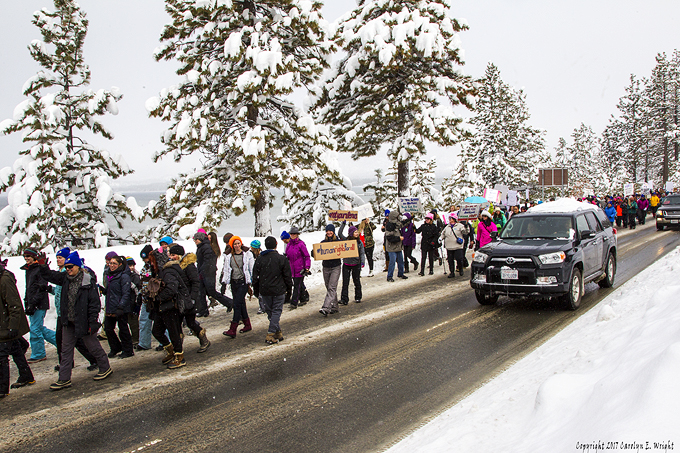
The women's march on the South Shore drew more than 500 people. Photo Copyright 2017 Carolyn E. Wright

The women’s march on the South Shore drew more than 500 people. Photo Copyright 2017 Carolyn E. Wright

By Susan Wood

It was like the 1960s all over again Saturday – with a mountain twist.

More than 500 women and their supporters in the South Lake Tahoe region braved the elements to show how advocating women’s rights is not for the faint of heart or the body.

Blowing snow, winter boots, parkas and cross country skis on some participants made the bi-state, high-altitude 2-mile-plus march unique as it wove along Highway 50 from the Hard Rock at Stateline past Lakeview Commons at midtown to the South Lake Tahoe Senior Center.

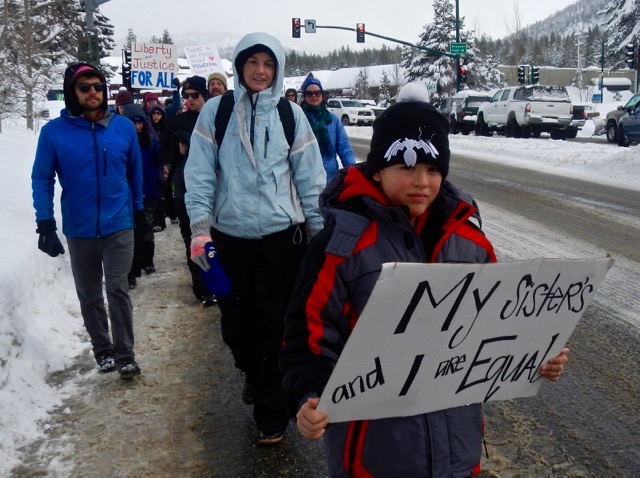
Kayden Morales, 8, said he wants his three younger sisters to have the same opportunities he has. Photo/Kathryn Reed

Kayden Morales, 8, wants his three younger sisters to have the same opportunities he has. Photo/Kathryn Reed

The resilient mass of mountain women, children and men joined millions of sisters in arms at walks that took place around the world in an act of peaceful solidarity on Jan. 21. A million women were expected to march on Washington, D.C., alone to demonstrate their defiance over what’s perceived as a threat to their reproductive rights and other aspects of their lives because of their gender – all because of the 45th president of the United States.

Ironically, Sunday marks the 44th anniversary of Roe vs. Wade, the landmark U.S. Supreme Court decision that ultimately gave women the right to choose to end their pregnancy in a medically safe environment.

People voiced their opinions with a variety of signs. Photo Copyright 2016 Carolyn E. Wright

People voice their opinions with a variety of signs. Photo Copyright 2017 Carolyn E. Wright

The women of South Lake Tahoe’s opinions and signs were as diverse as our nation. The constant message – treat women and men equally.

“I’m here to support my community. It’s important to be a part of this global event. It means we’re done with being discriminated against and isolated. The world is coming together,” Lori Cramer said, while she launched her march from the Hard Rock parking lot.

She was not alone.

“I am just hoping to make a statement regarding our values that make our country great,” Janice Eastburn said, while holding a sign that read: “Love makes America great.”

She listed freedom, compassion, love and dignity as worthwhile goals for humanity.

“And I’ll continue fighting for these values through this president and through the rest of my life,” she said.

Longtime South Lake Tahoe Peg Kortes talks of the fight women have had to get the rights that are now being threatened by the current administration. Photo Copyright 2016 Carolyn E. Wright

Longtime South Lake Tahoe resident Peg Kortes talks of the fight it took women to get the rights that are now being threatened by the current administration. Photo Copyright 2017 Carolyn E. Wright

The unified message not only got through to the mass of walkers. Honking in support from a long line of vehicles on Highway 50 resonated throughout the march.

A very excited Naylet Martinez of Santa Clara hung out the window of the honking vehicle she was in, taking pictures.

“Do you feel like you’re part of the parade?” Lake Tahoe News asked.

“Now I do,” she yelled. “I love it.”

Ditto from local Whisper Krimmer, who didn’t make it in time to get to the starting point – but had an excellent vantage point of the long line of marchers from her vehicle.

Snowy weather did not diminish the turn out Jan. 21 in South Lake Tahoe. Photo Copyright 2016 Carolyn E. Wright

Snowy weather did not diminish the turnout Jan. 21 in South Lake Tahoe. Photo Copyright 2017 Carolyn E. Wright

People from all walks of life took part in hitting the streets. Some parents brought their youngsters as a history lesson in different stages of activism in our democracy.

“I wanted to show them how they can use their voices to be heard by those who make the rules in telling them what we want,” Erin Buck said, while marching with husband Josh and daughters Winter, 7, and Elin, 5. The youngest was holding one of several creative signs. Hers said: “Girls can be president.”

Jane Frame intended to show the same example. Her daughters Liberty, 8, and Sierra, 10, took the sentimental approach – holding a sign that read: “I wish with all my might to be treated right.”

Peacefully people march along Highway 50 on Jan. 21 in support of equality for all. Photo Copyright 2017 Carolyn E. Wright

Peacefully people march along Highway 50 on Jan. 21 in support of equality for all. Photo Copyright 2017 Carolyn E. Wright

As a tourist bus going by honked loudly, Frame explained she had a discussion with her offspring about why they were marching – and the girls agreed to it.

Sierra looked up with piercing eyes and belted out: “Women don’t get paid enough.”

And lest we forget how far the women’s movement has come.

Jenny Hdariis and Leo Singer from Carson City were carrying a “Battleborn” Nevada banner and provided Lake Tahoe News with a moving tribute to the U.S. women’s movement.

All ages show their support of women's rights. Photo Copyright 2017 Carolyn E. Wright

All ages show their support for women’s rights. Photo Copyright 2017 Carolyn E. Wright

The couple originally hails from the Middle East.

“We took it for granted all the women’s rights we have. At least we have them,” she said, calling the latest in a series of threats toward women’s benefits such as Planned Parenthood “a wake-up call.”

In Jordan, Hdariis felt she never had rights. So when a U.S. election emerges in which references to women being equated to chattel from elected leaders in high office are made, she takes offense to women resting on their laurels.

Her Israeli husband was right alongside her. He took to Hebrew in sharing his thoughts of the recent diatribe associated with the presidential campaign.

“There’s a saying we have that when the head feels pain, the whole body suffers. When the leading country of the free world suffers, the whole world suffers,” he said, while passing cheering supporters on the second-floor balcony of their Lake Tahoe Vacation Resort unit at Ski Run Boulevard.

In other words, women’s plights are human plights – which afflict the whole world.

Allen Strickland William, who is in town performing at the Improv Comedy Club, said marching "is a positive way to cope and process and commiserate with what's going on." Photo/Kathryn Reed

Allen Strickland Williams, who is in town performing at the Improv Comedy Club, said marching “is a positive way to cope and process and commiserate with what’s going on.” Photo/Kathryn Reed

“I support our democracy. Even though (President Donald Trump) is not who we voted for. I still wish the best for our country,” Singer said.

Cara Battalico, 33, of South Lake Tahoe was a little more biting and specific with her expectations of the man who took office Friday and the cabinet he is assembling.

In a passionate plea, she listed immigration and women’s reproductive rights as being issues she has no intention of seeing returning to the Middle Ages. She doesn’t want to compromise with what is deemed as the most conservative federal government in modern times – from the executive to legislative branches.

“I thought we were passed this s—,” she said of what the pioneers of woman’s suffrage accomplished. “We are not going to go back. We are only going forward. I’m here to raise awareness – no matter what the weather,” she added, giggling over the tufts of snow and slush.

Battalico held a cerebral sign that read: “Examine what you tolerate.” It appeared she was prepared to take on the “never go back” cause in which women performed back-alley abortions and had fewer rights in comparison to their husbands.

Her husband, Jesse Mancillas of South Lake Tahoe, had been wrestling with issues of his own – trying to hear the opposing political views of his family without arguing. Being the progressive he is, Mancillas proudly waved a sign that identified him as “Men of quality don’t fear equality.”

Rachel Krufpe worries about her 13-year-old daughter's generation; fearful the country is going backward. Photo/Kathryn Reed

Rachel Krufpe worries about her 13-year-old daughter’s generation; fearful the country is going backward. Photo/Kathryn Reed

The signs of the days were the signs of entering an era anticipated to be hard-fought and grueling.

Signs read: “Proud to be a nasty woman,” “Our rights are not up for grabs,” “Left or right, we all see wrong,” “Vagina power,” “Pussies in formation,” “No grope zone,” “Tweet women with respect,” “I believe in Planned Parenthood” and others.

One woman carried a wooden sign of a bear that read: “Mamma bear marches for human rights.” Another carried the American flag to get her point across.

The chants were just as creative and intense “Love not hate makes America great.” “What do we want? Equality. When do we want it? Now.”

The demonstration was reminiscent to the gay rights, black and women’s movements.

“I think we’re in for a hail storm (of a resurgence) like we’ve never seen before,” South Lake Tahoe businesswoman Debbie Brown said, while gliding on her cross country skis. “Think about this. We had a blizzard going on, and I thought we’d have 12 people. Look at this – hundreds (of people).”

“This is so much fun – cathartic,” longtime local Sandy Myron described the march.

“South Lake Tahoe women, you rock,” City Councilwoman and Soroptimist member Brooke Laine yelled out with a fist pump to the energized crowd of women and their supporters gathered at the Senior Center.

Laine didn’t even flinch at saying she expected hundreds of people – despite the weather.

“We’re mountain women,” she said.

“I can truly say I’m the only Puerto Rican woman to walk (today in all the marches) through a snowstorm,” former El Dorado County Supervisor Norma Santiago quipped.

While she did so, Santiago shared that she came out to “send a clear message that the strength of our community lies in our diversity and commitment to constitutional values.”

Stuck in the snowbank at the center was the Soroptimist sign that read: “We recognize that in our vibrant and diverse community lie our strength….”

The banner read like a testament to all who have stood together in times that try men and women’s souls.

Charlene Jones got out of her car on Highway 50 at Ski Run Boulevard, blocked traffic and made her opinion known -- Womens' Rights are Human Rights. Photo/Kathryn Reed

Charlene Jones got out of her car on Highway 50 at Ski Run Boulevard, blocked traffic and made her opinion known — Womens’ Rights are Human Rights. Photo/Kathryn Reed

One such person who knows all about those times – Peggy Kortes — addressed the crowd to provide a history lesson of the women’s movement.

“There have always been obstacles. This is just part of the mix,” Kortes laid out to the assembly of willing listeners.

Take those critical years. Although women were allowed the right to vote in 1920 when ratified, it came with an asterisk for black women – who essentially gained the freedom in 1965. Seven years later, another milestone tested women.

“The Equal Rights Amendment was difficult because women couldn’t figure out what it meant,” she said.

So, we may have come a long way baby – but perhaps not far enough.

Kortes left the audience with three major points:

·      Women have advocated for their rights for a long time.

·      Democracy is threatened when we sit back and take the system for granted.

·      Democracy is hard work and “not a spectator sport.”

The segue was ideal for Annie Davidson’s appeal for women wanting to channel the energy gained by the day to get involved.

“If you take that chairlift up and look out at that beautiful lake and care about the Earth, then get involved,” she said, as her daughter, Miri, 6, hugged her mother.

“Care” is right within women’s nature, Davidson explained – in how we care for children, families, the environment and humanity.

“This is our time for women in America. We have an important history in the things we know. We’ve been controlled in the past and had to take direction from our husbands and our leaders. I want all our girls to be in a position to take control of their own voices. The most important thing is to get involved,” she said.


Property tax fight expected in Nev. Legislature

By Michael Scott Davidson, Las Vegas Review-Journal

Republican leadership in the Nevada Legislature appears split on a proposal to modify a decade-old property tax cap law.

Michael Roberson, the top Republican in the Senate, has vowed to stop the bill, but Assembly minority leader Paul Anderson is keeping a more open mind ahead of the legislative session that begins Feb. 6.

Assembly Bill 43, submitted by the Nevada Association of Counties, would modify formulas used to calculate annual property tax increases and set a floor of 3 percent for annual commercial property tax increases. The bill would not remove caps on annual increases of residential and commercial property taxes, which are set at 3 and 8 percent, respectively.

Read the whole story


Severe storm warning for Sierra

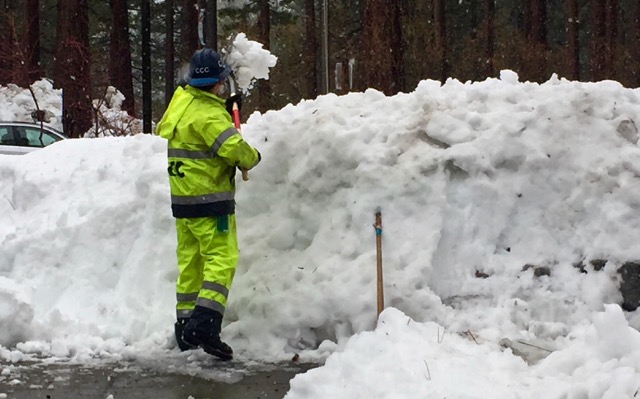
California Conservation Corps members help Lake Tahoe Community College on Jan 18 with snow removal. Photo/LTN

California Conservation Corps members help Lake Tahoe Community College on Jan. 18 with snow removal. Photo/LTN

By Lake Tahoe News

Caltrans is alerting motorists traveling to the Sierra, particularly those using Interstate 80 over Donner Summit or Highway 50 over Echo Summit, to be prepared for significant travel delays through Monday.

Expect passes to be closed at times either for avalanche control or to clear wrecks. For current road conditions, click on the state icons on the home page of Lake Tahoe News.

Non-essential travel is being discouraged on Sunday and Monday, even on local streets.

The National Weather Service in Reno has issued a winter storm warning through 4am Monday. “Travel into the Sierra on Sunday could be nearly impossible. Strongly consider staying at home on Sunday,” the agency says.

Liberty Utilities and Nevada Energy anticipate outages as snow and trees bring down lines. Prepare in advance by having other sources of lighting and heat, and keeping communication devices charged.

Residents in Tahoe-Truckee are reminded to clear gas meters of snow and are encouraged to clear neighborhood fire hydrants.

Backcountry adventure could be deadly. Ski resorts are having a hard enough time keeping up with conditions.

Sierra-at-Tahoe on Jan. 20 issued this statement, “The forecast is calling for an additional 3-4 feet of snow to fall throughout the weekend with as much as 3 inches falling per hour at points, so please be patient as we work to get lifts spinning and trails open. This is what dreams are made of, but guest safety is always our top priority, which means delayed starts and limited operations are sometimes necessary during the variable conditions we’re expected to face throughout the weekend. If it’s closed, it’s closed for a reason. Please respect all closures and signage.”

Squaw Valley’s record snowfall for January came during the 1981-82 season with 175 inches. In the first 20 days of this year, the resort has received 115 percent of that accumulation.

The U.S. Forest Service office in South Lake Tahoe will be closed Monday because of the storm.

Waste Management in Incline Village will close collection and transfer station operations on Jan. 23 because of the incoming storm. Residential collection will occur Jan. 28 for customers who are missed Monday. Commercial collection will be Jan. 26.

El Dorado County continues to deal with infrastructure problems because of the January storms. In the Tahoe, staff have been working 24 hours a day to plow roads, clear blocked drains due to snow berms, and remove downed trees.

There is a sinkhole on Arapahoe Road between San Diego Street and Country Club Drive.

Current West Slope road closures:

  • Fort Jim Road at Newtown Road — failing drainage structure.
  • Kyburz Drive — mudslide/trees/ debris blocking drainage. Will take several days to remove. Local access available for residents.
  • Weber Creek at Jurgens/Luneman — low water crossing flooded and unsafe for vehicle traffic.
  • Cosumnes Mine Road at North Fork of Cosumnes River — bridge approach failure. In addition, other sections of the road not associated with the bridge, have slid down the slope.
  • Peavine Ridge Road just to the north of Highway 50 – The road is slipping.

County staff has been responding to calls regarding hundreds of downed trees, flooding, potholes, and small and large slides. The most significant slides have occurred along Salmon Falls Road, Rock Creek Road, Mosquito Road, Newtown Road, Forni Road, and Hassler Road.


There’s no such thing as sidecountry

By Sage Sauerbrey, Moonshine Ink

Anyone who has spent a reasonable amount of time in the mountains can probably remember at least a few times when they made a real bonehead move and got lucky. 

Even though the “sidecountry” — the out of bounds area surrounding a ski resort — may give the illusion of safety due to its proximity to controlled terrain, there have actually been more avalanche fatalities in the California “sidecountry” over the last 60 years than in the backcountry. 

“It’s a false sense of security, I think,” said Randall Osterhuber, director of Donner Summit Avalanche Seminars. “You’re either in the backcountry or you’re not; you’re either on one side of the rope line at the ski area or you’re not.”

Read the whole story


Sandoval proposes marijuana tax for schools

By Seth A. Richardson, Reno Gazette-Journal

CARSON CITY — Gov. Brian Sandoval is proposing a 10 percent excise tax on retail marijuana sales once the recreational industry gets moving in Nevada.

Sandoval made the announcement during his State of the State address on Tuesday in Carson City where the Republican outlined his proposed $8.1 billion budget, an 11 percent increase from the 2016-17 $7.3 billion budget. Despite earlier indications, there will not be a deficit for lawmakers to figure out if Sandoval’s budget is adopted.

Besides the marijuana tax, Sandoval backed improvements for for Reno’s Spaghetti Bowl, a new engineering school at UNR and funding for education savings accounts despite the Nevada Supreme Court putting a halt to that program last year.

Read the whole story


Lack of affordable housing nothing new in Tahoe

Publisher’s note: This is one in a series of stories looking at the affordable housing issue in the Tahoe-Truckee area.


“For any community, the quality of life experienced by its residents depends, to a great extent, 

on the quantity and quality of available housing.”

                                          — 20-20 Committee report to the South Lake Tahoe City Council, Jan. 2, 1979


By Joann Eisenbrandt

The lack of affordable housing for many of South Lake Tahoe’s permanent residents, for homebuyers and renters, has been a clearly recognized but largely unsolved problem for decades. Recently, El Dorado County District Five Supervisor Sue Novasel put together a Housing Task Force to revisit the issue and hopefully identify some realistic solutions.

South Lake Tahoe was incorporated on Nov. 30, 1965. Laurel Ames, an active participant in that incorporation process, spoke about the new city’s high hopes in a March 2015 article for Lake Tahoe News celebrating the city’s 50th anniversary. She explained the city hired a land use planner and began a yearlong effort called 14,000 Planners. It was called 14,000 Planners because that was the city’s population at the time. The idea was that everyone had a role to play and a voice in the process. South Lake Tahoe, as Ames put it, “could have any kind of community it wanted, provided they could articulate and agree on a picture of what that vision was.”

In the decades since, a number of exterior forces and geographic constraints have influenced the city’s ability to create such a cohesive vision. This is especially true when it comes to the development of affordable housing.

A statewide issue

Affordable housing is not just a Tahoe basin or El Dorado County issue. Providing affordable housing is a statewide requirement and a statewide problem. Each governing body in California is required to adopt a general plan outlining the long-range physical development of their jurisdiction. The Housing Element is a mandated part of that plan. It must show how local governments plan to meet the existing and projected housing needs of all economic segments of their population.

affordable housing logoAt the local level

For some time, the city’s affordable housing issue centered on those who work in the service industry sector. This is what many call “workforce housing.” More recently, however, the affordability question has moved up the income scale to include established middle-income professionals and college-educated millennials.

At the Oct. 25, Board of Supervisors meeting, Novasel requested $15,000 in El Dorado County transient occupancy tax) funds to contract with consultant Michael Ward of High Bar Global Consulting. The plan is to create the framework for a group of stakeholders to meet and develop strategies to address what Novasel terms South Lake Tahoe’s “affordable housing crisis.”

She told the supervisors that at the lake the Tahoe Regional Planning Agency had created commodities/development rights to control growth. These, she said, had the effect of driving up construction and rehabilitation costs and creating a barrier to redevelopment of the city’s aging infrastructure. There are a limited number of tourist accommodation units available for new construction. TAUs have value and can unrealistically escalate the purchase price for motels or the transfer of those units. Vacant or deteriorating properties still dot the landscape, too expensive to rehabilitate or rebuild as affordable housing. Like all construction, affordable housing must pencil out economically or it will not get built.

“Our housing is in a critical mass right now,” Novasel insisted.

TRPA is taking a hard look at many of its regulations and standards for the first time, commodities among them. It is anticipated this process will take several years. Novasel doesn’t want to wait. Her goal is to have her newly-formed group composed of representatives of the California and Nevada jurisdictions at the lake, “sit down and start a real direct discussion to see what we can do.” The first six organizational meetings will involve mainly public agencies with additional groups such as nonprofits, real estate agents, employers, social service agencies and local residents brought into the process after that.

Participants share their views

TRPA is represented on the task force by Executive Director Joanne Marchetta and COO John Hester. The bi-state agency’s public information officer Tom Lotshaw told Lake Tahoe News that TRPA supports Novasel’s effort.  

“We wouldn’t want Sue (Novasel) to wait for our (Development Rights) Strategic Initiative to be completed. The commodity system is creating some friction for the affordable housing process. The Strategic Initiative is a major undertaking and it won’t change things overnight,” Lotshaw said.

He added, “We are there to help … to come up with a menu of potentially viable solutions to take back to each jurisdiction around the lake and apply them situationally. We are excited and optimistic to see what’s happening.” Novasel is a member of the TRPA Governing Board.

screen-shot-2017-01-19-at-9-03-20-pmWhat city leaders say

South Lake Tahoe Mayor Austin Sass attended the first meeting of Novasel’s group in November. He told Lake Tahoe News, “I don’t know how much blame you can put on TRPA. This is a very desirable tourist destination. In comparison to Aspen and Vail it is affordable, so people from the Bay Area have bought second homes here. These people may not be willing to rent out these homes at affordable housing rates.”

Sass, who is also a member of the TRPA Governing Board, said the city has 350 rent-controlled or affordable housing units that were built before redevelopment money was taken away by the dissolution of redevelopment agencies by Gov. Jerry Brown in 2012.  “These types of projects don’t pencil out now for any city. El Dorado County has zero affordable housing units in the unincorporated area of the Tahoe basin.”

“I’m a pragmatic guy,” Sass explained. “I want to know how we are going to get it done and where we are going to get the money from. The purpose of this group is to put our heads together to find out if there is money in places we don’t know about.”

South Lake Tahoe Mayor Pro Tem Wendy David also attended the task force’s initial meeting. She told Lake Tahoe News, “We have a gorgeous lake that must take priority in protecting, but along with that has come very strict building restrictions and availability. It’s a very delicate balance that we’ve tried to maintain.”

David is encouraged that TRPA is now “sitting at the table with us. It is important to work together with the regulatory agencies to see how to address the housing issue. That is a very positive thing that is happening.”

David noted that city housing prices have surpassed their highest peak in 2006. She sees vacation rental properties as a contributing factor.

“We are seeing an increase in the percentage of single-family homes that are being sold and then used primarily as vacation rentals. How people are vacationing has changed and that has led to a lot of commercial activity in residential areas,” David said.

She noted that the City Council just recently revised the city’s Vacation Rental Ordinance to ban future vacation rentals in multi-unit complexes, one of the main sources of affordable housing for low- and moderate-income residents.

According to David, “workforce housing” is not the full extent of the problem. “What we have,” she insists, “is a lack of adequate housing at all economic levels. If professionals take jobs here and then find they cannot find a home in their price range, they will eventually leave. At the other end are young professionals just starting out as well as the lower-income residents who just want to live the dream of Tahoe and are willing to be a bartender or a dishwasher.”

David is hopeful the involvement of basinwide elected decision-makers will lead to agreement among agencies and jurisdictions on what needs to be done and what the first steps should be.

Affordable housing and economic development

Novasel believes it’s appropriate that TOT money is being used to help finance her efforts. TOT is charged to those renting lodging in the county or the city for less than 30 days. Renters pay it to property owners as a percentage of the rent charged. Property owners then pay that money to the local jurisdiction.

The county’s 2004 General Plan loosely defines how TOT money can be spent. “The majority of transient occupancy tax generated revenue shall be directed toward the promotion of tourism, entertainment, business, and leisure travel in El Dorado County.”  

Novasel said, “This is economic development. We want millennials. We want our workforce to find homes to live in. If employees can’t find housing, then businesses can’t have employees.”

Housing stock varies throughout South Lake Tahoe. Photos/LTN

Housing stock varies throughout South Lake Tahoe. Photos/LTN

The 20-20 viewpoint

14,000 Planners was South Lake Tahoe’s first attempt at strategic planning, but it was certainly not the last. In 1976, 11 years after the city’ birth, the 20-20 Committee was formed. It was called the 20-20 Committee because each of the five city councilmembers chose four community members to help identify significant issues and provide 20-year-long solutions. There were a number of public meetings to encourage community input. In December 1979, the group presented its final report to the City Council.

Barriers and solutions

Among the group’s objectives was to, “Improve the quality of residential life by ensuring that adequate housing is available to all residents.”

A number of barriers were going to make this difficult. “Due to the lower salaries and seasonal nature of employment in the region,” the report concluded, “the available housing is beyond financial reach of the majority of residents.”

It found the community had a high transiency rate and those service-industry employees who did live in town, “appear to accept a ‘natural’ lowered standard of living by virtue of living in such a unique area.”  This, the report noted, can lead to intense negative reactions to tourists generated by, “a feeling of being a ‘second-class’ citizen.”

The lack of affordability of housing led to overcrowding in rental units, many of which were substandard or dilapidated. The group believed the city needed to update its Housing Element to encourage more affordable housing and create a housing advisory committee to administer solutions. A public/private partnership was essential, as was the need for Nevada’s large employers to produce “adequate and available housing for their employees.”

The 20-20 Committee felt, as 14,000 Planners had, that South Lake Tahoe first needed to decide what type of town it wanted to be. It recognized the need to preserve the basin’s beauty given tourism as the prime industry. 

“At the same time,” they insisted, “the needs of residents must be met to assure a cohesive, happy community, and enhance the quality of the visitor experience.”

screen-shot-2017-01-19-at-9-11-21-pm

The labor pains continue

In the late 1980s, Renaissance 90 hoped to accomplish what 14,000 Planners and the 20-20 Committee had not. Of these earlier efforts, Renaissance 90’s Strategic Plan noted, “Inexperience with strategic planning and the timing of both efforts have resulted in some unmet expectations.”

The group’s effort to achieve a “Tahoe rebirth” was spearheaded by then City Manager Kerry Miller. It was divided into six committees—among them Economic Development and Land Use, Well-Being and Housing. It was a mix of public officials, community leaders and ordinary citizens, including this reporter who served on the Housing Committee. The final report was presented to city leaders in June 1989.

The Housing Committee found that affordable housing remained a pressing issue. It thought prior efforts had focused too much on planning and not enough on action. However, it agreed with them that there needed to be “significant citizen involvement in planning for the city’s future.” Before such planning could take shape, city leaders needed to ask, “Where does the city want to go?” Renaissance 90 hoped its Strategic Plan would “establish a sense of direction for the community as a whole.”

Need for meaningful planning

Apart from the new redevelopment area, the group noted that the city had no economic development program or meaningful land use planning. The city’s population had a high per capita education level and there was a high quality of life to attract workers and businesses, but there was also a transient local population and a high percentage of small business failures.

The committees suggested “champions” to implement the strategies they proposed. The Housing Committee identified the city and an as-yet-to-be-formed nonprofit housing group as “champions” for the development of more low-income housing.

The committee carried out a detailed analysis of the city’s housing inventory, condition and availability through street-level physical surveys and interviews. It concluded that a “substantial number” of residents were low income, given the preponderance of low-wage jobs at the casinos, resorts and ski areas. These residents had to spend a “disproportionate amount” of their income for housing or choose to live in overcrowded multi-family units that were in “poor to substandard condition.”

The lake’s complex regulatory environment took some of the blame. “The area’s history of stringent building constraints and complex inter-agency oversight functions, combined with economic infeasibility, has led to delays in both new construction and rehabilitation or reconfiguration of existing residential units, especially in the median to lower income ranges.”

The final report pointed to past failures to, “include the psychological needs of residents in the planning process.” 

It recommended an ongoing forum be created to evaluate progress and provide opportunities for citizen input, finding that, “Affordable, desirable and appropriately configured housing for all residents is central to a community’s social and economic vitality.”

Chamber takes on the issue

As the affordable housing shortage began to affect local businesses more substantially, they also became involved in trying to solve the problem. In March 2001, the South Lake Tahoe Chamber of Commerce had an Affordable Housing/Work Force Housing forum at Harveys. An employee/labor pool survey had been distributed in the weeks prior to the meeting asking chamber members for employee statistics and issues related to affordable housing.

Questions the survey asked included: “Do you feel that your employees are able to live in our region comfortably with the wage/salaries that you pay?” and “Do any of your employees have housing problems?” One hundred-twenty businesses responded to the survey.

Attorney Lew Feldman, who led the discussion for the chamber, said, “The quality of the resort is the quality of the people who live and work in the resort.” Steve Teshara from the Gaming Alliance told the group that lower-end casino employees could not live on their wages unless they were a two-person household. The casinos were going out further and further into other communities to recruit—often as far as Europe and Mexico. Andrew Strain of Heavenly said that housing supply and demand was “out of balance.” He referenced people living behind the loop road in the woods underneath the Heavenly gondola. He said affordable housing must make “bottom line sense” to happen, pointing to the negative impact of the “local and regional regulatory maze.”  

Kathy Southern, president of the Board of Realtors, noted a decline in the low-income housing pool and the subsequent rise in rental prices. Investors found developing moderate income properties in Tahoe “stifling.” She said that 10 percent of the market pool of housing was “lost to second homes and vacation rentals.” She pointed to the conversion of older motels into employee housing as one possible solution.

Hal Cole, South Lake Tahoe mayor, said, “We’re becoming a more elitist community like Aspen. Workers are bused in and Tahoe is only enjoyed by the rich.”

The survey showed that 82 of the responding businesses had from one to 20 positions unfilled; 52 of them believed that the lack of affordable housing affected their ability to hire and retain employees. The majority of employees had salaries in the $6-$10/hour range. Fifty-five business owners said their employees were not able to live in the region comfortably with the wages they paid, and 61 respondents said their employees were experiencing housing problems.

Looking toward tomorrow

In 2002, Tahoe Tomorrow, a volunteer group of local businesspeople and community leaders addressed the same issues the chamber had identified the year before. They sought to help create “a better tomorrow for everyone.” Their board of directors included familiar faces like Feldman, Jeff Tillman of South Tahoe Refuse, chamber Executive Director Duane Wallace, Lakeside Inn owner Mike Bradford, former South Lake Tahoe City Attorney Dennis Crabb and marketing consultant Carl Ribaudo. They created task forces to identify community issues. Action teams would then implement solutions. 

The Building a Stronger Community Task Force focused on affordable housing. Their data showed that 56 percent of South Lake Tahoe households qualified as low-income or lower and that 25 percent of the housing stock was owner-occupied with 75 percent being rentals or second homes. They found the “significant shortage of affordable housing, decent rentals, and starter homes—with ever-escalating costs of real estate,” came to a large degree from “a lack of shared vision and proactive multi-jurisdictional leadership.”   

Tahoe Tomorrow only lasted a few years. “It was a volunteer group,” Ribaudo told Lake Tahoe News. “It fell apart because of lack of funding.”

screen-shot-2017-01-19-at-9-22-00-pm

Study and more study

Over the years, a number of housing condition studies were conducted and reports prepared by the city to determine the extent of the affordable housing need and the best way to spend the required 20 percent tax increment funding in the redevelopment area as well as how to allocate Community Development Block Grant money and funding from other sources such as the state Rental Rehabilitation Program.

The city’s Housing Authority had a housing priority workshop in July 1996. At its next meeting that August, city Housing Coordinator Patrick Conway noted that, “Approximately 40 percent of the housing stock in the city is considered substandard.” His report focused on the question of what was South Lake Tahoe’s “fair share” responsibility to provide housing when a significant portion of the city’s housing stock is used to support those who work in Douglas County. He referenced the Douglas County Population and Housing Element which showed that the city provided housing for 4,667 workers from Douglas County, but only 640 Douglas County residents worked in South Lake Tahoe.

In February 2003, the Parsons division of P&D Consulting prepared a report for the city entitled, Housing Issues and Challenges. It found, “Local workers, both service sector employees and professionals such as teachers, government employees, and social service agency staff, can no longer afford housing in South Lake Tahoe.” 

Rental prices were lower than in urban areas, but when these rates were compared to incomes, rental rates in the city were “high.” Additionally, the least expensive housing stock is, “old, not well-maintained, substandard, and owned by absentee landlords who are not responsive to tenants’ complaints.”

In 2016, the city hired the consulting firm of Michael Baker International to conduct a vacation home rental economic impact study. The proliferation of vacation rentals in the city has been frequently mentioned as a contributing factor to the affordable housing shortage. An online survey is available on the city’s website. The first public meeting was Nov. 16, 2016, with the second one scheduled for Jan. 25. According to the city’s website, the goal is, “to find out how (vacation rentals) affect you and your neighborhood.”

Councilmembers Sass and David formed South Lake Tahoe’s subcommittee that studied vacation rentals for the last year and a half. Sass called it a “socio-economic study looking at how vacation home rentals are affecting our town.”  He believes the study will give the city needed information to come up with a long-range solution. He told Lake Tahoe News the finished report should be ready in April or early May.

Hard to kill

Despite the fact that it has been studied to death by a plethora of public and private agencies, the affordable housing problem in South Lake Tahoe lives on. In her October 2016 monthly column, “Working Together on Lake Tahoe’s Housing Problems,” TRPA’s Marchetta acknowledged that median home prices of nearly $400,000 on South Shore are, ”simply too high for our region’s low wages, putting the cost of home ownership and even rent out of reach for many working people.”

She referenced a study on affordable housing by the Tahoe Prosperity Center. Heidi Hill Drum, executive director of the Tahoe Prosperity Center, is a participant in Supervisor Novasel’s affordable housing task force. In the October 2015 Measuring for Prosperity report, the Prosperity Center agreed that “second home ownership rates are increasing in the region and there is little market momentum currently for additional workforce housing. However, even in 2010, TRPA reported that housing affordability in the Tahoe basin was more challenged than in the San Francisco Bay Area, primarily due to lower wages in relation to housing prices. The more recent trends have widened the affordability gap.”

They reported that Tahoe has lost close to 7,000 jobs since 2008, has an unemployment rate higher than the state average, has seen declining school enrollment and a drop in prime working-age adults between 25 to 44 years as a proportion of the total population. Drum told Lake Tahoe News she agrees with the emphasis Novasel’s task force is putting on regional solutions.

Novasel wants to see her group, “go beyond our specific little silos and collaborate because that’s how we are going to see real progress.” She acknowledges the long history and complexity of the affordable housing issue.  “We can’t solve all the housing problems,” she emphasized. “We can solve specific issues within the housing problem. It’s like saying you are going to solve poverty. It’s too big of a moving target. If we can wrap ourselves around an issue or two, we can get that done now.”

The group’s next meeting is expected to take place in early February.


Tahoe bracing for another round of storms

South Lake Tahoe residents on Jan. 19 deal with more snow and narrow roads. Photo/Kathryn Reed

South Lake Tahoe residents on Jan. 19 deal with more snow and narrow roads. Photo/Kathryn Reed

By Lake Tahoe News

Thursday’s weather was nothing compared to what is expected to come. Remember last week? Part II is about to hit.

“I would encourage residents and visitors to do their grocery and supply shopping on Friday and Saturday and to stay off the roadways on Sunday and Monday. Thankfully, it looks like we’ll get a break starting on Tuesday,” Tracy Franklin, spokeswoman for South Lake Tahoe, told Lake Tahoe News.

Officials in the Tahoe-Truckee region are bracing for another deluge. A winter storm warning is in effect through 4am Monday. Between now and then there could be 2 to 4 more feet of snow at lake level and 3-6 feet above 7,000 feet.

Forecasters with the National Weather Service in Reno expect a break Saturday afternoon before the white stuff starts up again.

The National Weather Service warns roofs and carports could collapse because of snow weight and depth.

Truckee is asking resident to adopt a fire hydrant. This would mean keeping it clear of snow. A minimum 3-foot clearance around the hydrant makes for easier access.

Power outages should be expected and roads dangerous, especially as the snow keeps piling up.

Parts of the West Shore and Truckee just barely had power restored.

“We had people without power for many days with the last storms and we want to ensure if something similar happens, that we can direct them to the appropriate places to get warm and get information,” Placer County Supervisor Jennifer Montgomery said in a statement.

Should power be knocked out again for an extended period, North Shore residents can find warming centers open during the day at:

·      Tahoe City Public Utility District, 221 Fairway Drive in Tahoe City

·      North Tahoe Public Utility District, 875 National Ave. in Tahoe Vista

These centers will offer people a place to stay warm, charge communications devices and get the latest information on changing weather conditions and storm related news or advisories.

Snow removal crews throughout the basin are trying to widen streets as fast as possible. Along many side streets the road is only wide enough for one vehicle at a time.

South Lake Tahoe snow removal crews will resume clearing snow from the primary arterial and collector roadways such as Pioneer Trail, Al Tahoe Boulevard, Tahoe Keys Boulevard, Venice Drive, Sierra Boulevard and Ski Run Boulevard

Once these roadways are cleared, city snow removal crews will return to removing snow from the center lane roadways in neighborhoods.

Snowplows have the right of way. Vehicles left unattended in the streets are subject to citation and/or tow. The best policy is to keep vehicles parked off the streets at all times.

The following are suggestions from South Lake Tahoe:

·       If you don’t have to go out, don’t. Even if you can drive well in the snow, not everyone else can.

·       Get sand bags. They are available at the city yard at 1160 Rufus Allen Blvd. and fire Station No. 3 at 2101 Lake Tahoe Blvd.

·       Clear storm drains.

·       Prepare for utility outage. Gather flashlights and replace batteries. During the storm, Liberty Utilities crews will work 24/7 to restore power where needed. To report a power outage, call 844.245.6868.

·       Keep roofs cleared. Snow with high water content is heavy. When it’s followed up by torrential rain, existing snow on your roof will become heavier.

·       Expect berms.

·       Stock up on supplies.

·       Don’t drive through water.


How ski retailers have evolved in the digital age

By Devon O’Neil, Powder
 
Ever since the traditional ski-shop business model—buy a lot of product and hope to sell it for twice as much—ran into the e-commerce meat grinder a decade ago, it has only gotten tougher for shops to exist, never mind thrive.

According to SnowSports Industries America, consumers bought nearly $1 billion worth of snow sports equipment online last winter, up more than 20 percent from four years ago. It is probably not a coincidence that more than 1,300 snow sports retailers—or about 20 percent of the total—have closed in the past six years.

In addition, direct-to-consumer sales have become more widespread by manufacturers, many of which have opened their own retail stores in ski towns.

Read the whole story


Tahoe concert promoter wants to use SLT field

By Kathryn Reed

Music festivals in the Stateline casino corridor are the norm throughout the summer. Now one of the promoters wants to bring them across the state line to South Lake Tahoe.

Paul Reder, founder and principal of PR Entertainment, gave a presentation Jan. 17 to the South Lake Tahoe City Council about his desire to put on concerts at the same field the three-day December SnowGlobe music festival uses.

Reder, who also owns The Loft in the city, has been in the entertainment industry for more than 30 years. He has staged shows in Stateline, North Shore, Truckee and Reno.

The main reasons to move the reggae, bluegrass and electronic music festivals are to be in a bigger space and at a venue with grass.

A festival on asphalt is not ideal – which is what happens at Hard Rock and MontBleu casinos because the events are in the parking lot. Attendees are standing or sitting on that hard surface. Even though 10,000-square-feet of turf was laid at Hard Rock last year, it wasn’t ideal, according to Reder.

While SnowGlobe was at a new location last month, the area was all dirt. The city opted to hold off on putting in the sod until this spring, after SnowGlobe. Chad Donnelly, promotor of SnowGlobe, has a contract for 2017 contingent upon inspection of the field after the snow melts.

City Attorney Tom Watson told Lake Tahoe News that even though there was no field per se in December, ruts in the dirt and potential debris found after the snow melts would be a concern, while at the same time if the ground looks as good as it did before the event, then Donnelly will have met his obligation.

That field is a community ball field, with the main purpose being for sports as soon as the grass is put in. Keeping it playable will be a requirement no matter what takes place on it outside of athletics.

Even though the concerts are a day or two, set up and break down would take the field out of commission for a few other days.

While the topic about Reder’s summer concerts was not an action item Tuesday, council members voiced comments about Reder’s desires. What the impact to the field will be, making sure the sports community would not be adversely affected, and noise were some the concerns brought up.

The council agreed to put the topic on a future agenda. However, timing is important because Reder needs to get contracts signed with the music acts, as well as market the events. He is looking at a one-day reggae festival and having the two-day electronic music fest to start with.

There is only one council meeting in February. Reder would need a decision by March. He would also need approval from Lake Tahoe Community College’s board.

After the meeting, Reder told Lake Tahoe News, “I’m looking at this as more of a future possibility. But we plan on keeping the festivals at Stateline until the right opportunity comes around on those grass fields or other grass areas on the South Shore.”

Reder said the noise level has not been an issue at his concerts, and added that he would be willing to work with the city to make sure his concerts don’t disturb neighbors. The Base Camp Festival is electronic music, just like SnowGlobe. City Manager Nancy Kerry said she intends to recommend the maximum decibel level for SnowGlobe be lowered when there is no snow on the ground to absorb the sound.

If the council does not green light Reder to bring his concerts to the city for this year, he is not taking the events out of the area.

“We are also talking to the Hard Rock about the possibility of building a larger grass field in their parking lot very similar to MontBleu and keeping it there all summer. If Hard Rock can build that kind of infrastructure, then we will keep the festivals there indefinitely,” Reder told Lake Tahoe News.


3rd consecutive hottest year on record

By Seth Borenstein, AP

WASHINGTON — Earth sizzled to a third-straight record hot year in 2016, government scientists said Wednesday. They mostly blame man-made global warming with help from a natural El Nino, which has since disappeared.

Measuring global temperatures in slightly different ways, NASA and the National Oceanic and Atmospheric Administration announced that last year passed 2015 as the hottest year on record.

NOAA calculated that the average 2016 global temperature was 58.69 degrees — beating the previous year by 0.07 degrees.

NASA’s figures, which include more of the Arctic, are higher at 0.22 degrees warmer than 2015. The Arctic “was enormously warm, like totally off the charts compared to everything else,” said Gavin Schmidt, director of NASA’s Goddard Institute of Space Studies in New York, where the space agency monitors global temperatures.

Records go back to 1880. This is the fifth time in a dozen years that the globe has set a new annual heat record. Records have been set in 2016, 2015, 2014, 2010 and 2005.

The World Meteorological Organization and other international weather monitoring groups agreed that 2016 was a record, with the international weather agency chief Petteri Taalas saying “temperatures only tell part of the story” of extreme warming.

“This is clearly a record,” NASA’s Schmidt said in an interview. “We are now no longer only looking at something that only scientists can see, but is apparent to people in our daily lives.”

Schmidt said his calculations show most of the record heat was from heat-trapping gases from the burning of oil, coal and gas. Only about 12 percent was due to El Nino, which is a periodic warming of parts of the Pacific that change weather globally, he said.

“Of course this is climate change, it’s overwhelmingly climate change,” said Corinne Le Quere, director of England’s Tyndall Centre for Climate Change Research, who wasn’t part of the NOAA or NASA teams. “Warming (is) nearly everywhere. The Arctic sea ice is collapsing. Spikes in fires from the heat. Heavy rainfall from more water vapor in the air.”

According to NOAA, 2016 was 1.69 degrees warmer than the 20th Century average. The first eight months of 2016 all broke heat records. NASA has last year at 1.78 degrees warmer than their mid-20th Century average and about 2 degrees warmer than the start of the industrial age in the late 19th Century.

The effects are more than just records, but actually hurt people and the environment, said Oklahoma University meteorology professor Jason Furtado. They’re “harmful on several levels, including human welfare, ecology, economics, and even geopolitics,” he said.