Brutal winter has been tough on animals

By Andrew Selsky, AP

Antelope injured while falling on ice. Horses stranded in snowy mountains. Cougars descending from their wilderness lairs to forage in a town.

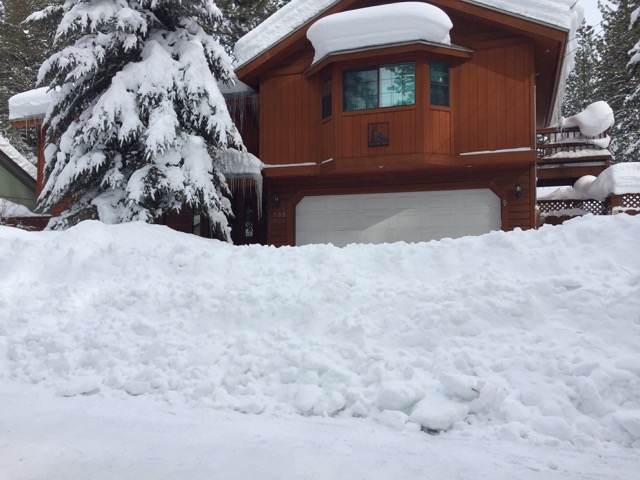
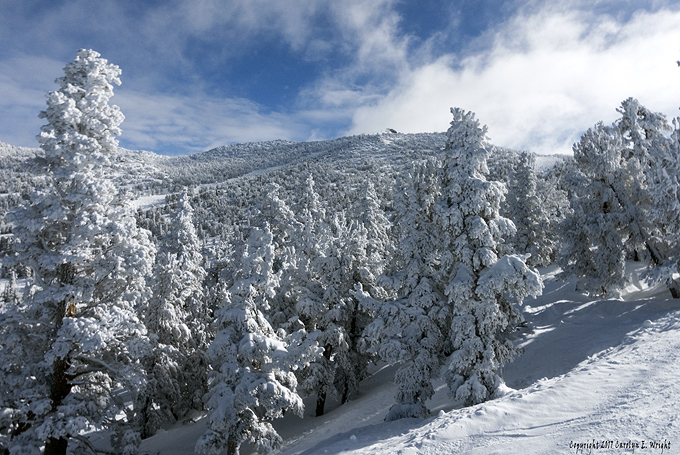
It’s been a beastly winter in the American West, not just for people but for animals too. One storm after another has buried much of the region in snow, and temperatures have often stayed below freezing, endangering a rich diversity of wild animals.

In southern Idaho, about 500 pronghorn antelope tried to cross the frozen Snake River earlier this month at Lake Walcott, but part of the herd spooked and ran onto a slick spot where they slipped and fell. Idaho Fish and Game workers rescued six of the stranded pronghorn, but 10 were killed by coyotes and 20 had to be euthanized because of injuries suffered when they fell down.

Another 50 pronghorn were found dead in the small western Idaho city of Payette after they nibbled on Japanese yew, a landscaping shrub that’s toxic. Tough winter conditions have forced some wildlife to feed on the plant in urban areas.

Heavy snow has forced Idaho’s fish and game department to begin emergency feeding of big game animals in southern Idaho.

In eastern Oregon, state wildlife officials are feeding elk, but the weather makes accessing them difficult. When highways and the Interstate are closed because of the snow, the workers must still get to the rural feeding stations where they feed the elk alfalfa hay.

“When you run feed programs, you can’t take a day off because of bad weather. If you take a day off, the elk wander away,” said Nick Myatt, district manager of La Grande office of the Oregon Department of Fish and Wildlife.

Wandering elk tend to feed on haystacks that ranchers have left for their cattle, and congregate in low-elevation sites along Interstate 84 in northeastern Oregon, where cars have hit them in recent weeks, Myatt said.

In western Wyoming, supplemental feeding of elk wintering on the National Elk Refuge near Jackson started the first week of January, three weeks earlier than usual because heavier than normal snowfall buried the natural forage the thousands of elk graze on at the 24,700-acre refuge.

Mule deer, which are smaller than elk, have not only been prevented by a layer of ice from pawing through powdery snow to reach their natural forage, but that ice also makes them easier prey. The deer break through the ice and stumble while animals like coyotes can stay on top of the surface.

“With conditions that we have, we do anticipate higher mule deer mortality,” Myatt said.

John Stephenson of the U.S. Fish and Wildlife Service said wolves are also more agile in deep snow than deer or elk because their lighter bodies and big feet help them stay on the surface better. Stephenson said he is amazed that a wolf he’s tracking south of Crater Lake, Oregon, traveled roughly 30 miles through 6-foot-deep snow in less than 12 hours recently.

Some animal lovers have been taking matters into their own hands by feeding deer, but experts warn they will likely do more harm than good and could end up killing the animals.

“What they’re feeding the deer is an improper diet,” said Rick Hargrave, a spokesman for the Oregon wildlife department. “They have a complex digestive tract, and they require the right mix of crude protein, fat, carbohydrates, vitamins and minerals.”

The deep snow likely caused a group of normally elusive cougars to come to the woodsy community of La Pine in recent days, where they preyed on pets and chickens, the Oregon wildlife department said. Authorities on Thursday killed a fifth cougar in the central Oregon town. Four others were shot dead on Saturday and Monday, raising an outcry among some conservationists.

Amid the grim news, there were some bright spots.

In central Idaho, volunteers earlier this month rescued a horse stranded on a snowy mountain by tranquilizing it, placing it in a sling and then attaching it on a long line to a helicopter. It was flown, dangling from the belly of the chopper to safety. A second stranded horse was not found and is believed to have died.

The experience was emotional for the rescuers.

“You get your adrenaline going and everyone gets all excited and choked up,” Robert Bruno, president of Idaho Horse Rescue, told KTVB-TV of Boise.

In California, some of the heaviest snow and rain in decades should prove a life-saver for threatened native salmon, whose numbers have dropped during the state’s five-year drought that is now easing.

Flooding this winter has greatly expanded the bug-rich wetlands where young salmon can eat and grow strong on their way to the ocean, said John McManus of the Golden Gate Salmon Association, a fishing-industry group.

“They eat like little pigs, and they love it,” McManus said. “It’s a little smorgasbord for them.”

AP journalists Rebecca Boone in Boise, Idaho, Bob Moen in Cheyenne, Wyo., and Ellen Knickmeyer in San Francisco contributed to this report.

Demo event proves all gear is not the same

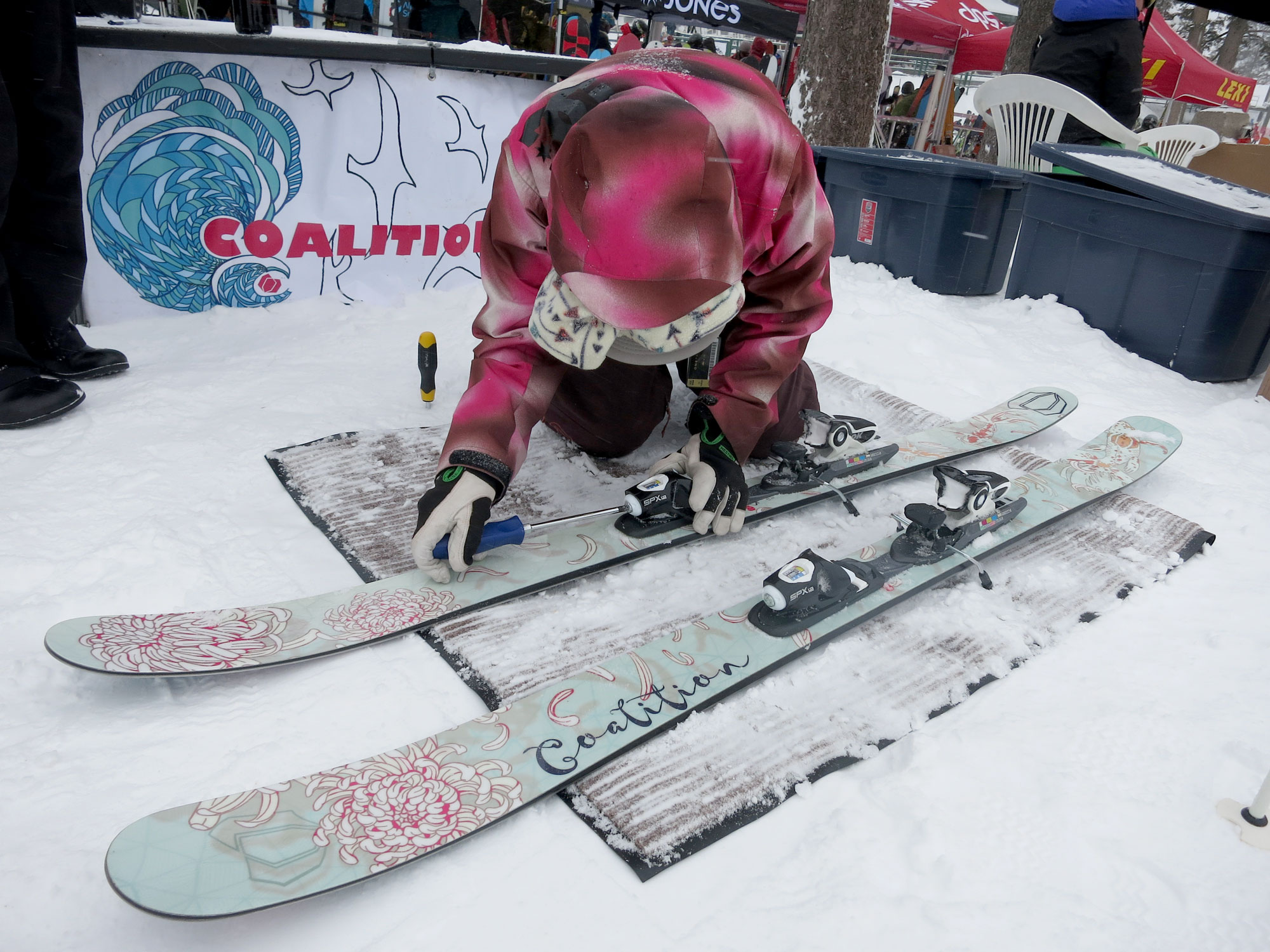
Jenn Sheridan of the women's ski and snowboard line Coalition Snow sets up a pair of SOS all-mountain skis. Photo/Jessie Marchesseau

Jenn Sheridan of the women’s line Coalition Snow sets up a pair of SOS all-mountain skis. Photo/Jessie Marchesseau

By Jessie Marchesseau

ALPINE MEADOWS – New ski and snowboard gear can set you back hundreds or even thousands of dollars. Most of the time we’re expected to spend this money based solely on the recommendations of salespeople, friends and gear reviews.

Occasionally you can catch a ski or snowboard company doing a demo day at a local ski resort, allowing you to try out their lineup. While a side-by-side comparison of different brands would often prove more useful, it’s not generally an option.

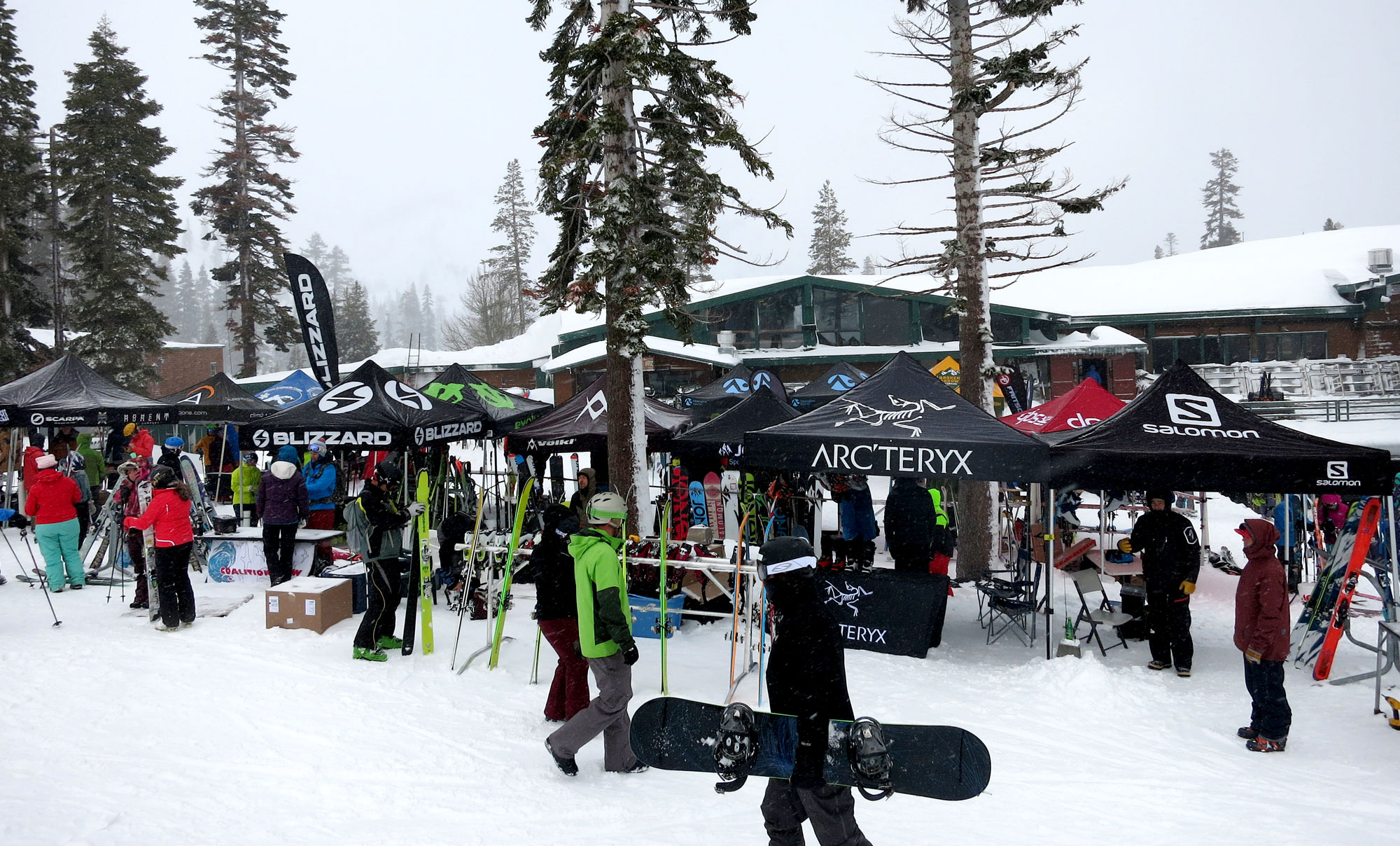
However, on Jan. 21, Tahoe City’s Alpenglow Sports hosted North America’s largest backcountry gear demo event. More than 20 vendors came out to share their wares with the skiers and riders at Alpine Meadows.

For 11 years running, the Lake Tahoe Backcountry Demo Event has provided skiers and riders the opportunity to ride this year’s top-of-the-line telemark, alpine skiing, touring and snowboard gear.

Testing out the gear is totally free, and hundreds of snow sports enthusiasts took advantage, as did I. Mixed in with the major ski companies like Blizzard, Salomon, and Volkl was a selection smaller, less mainstream ski companies. Those were the ones which piqued my interest.

More than twenty vendors set up shop at Alpenglow Sports' 11th Annual Lake Tahoe Backcountry Demo Event at Alpine Meadows on Jan. 21. Photo/Jessie Marchesseau

More than 20 vendors set up shop at Alpenglow Sports’ 11th Lake Tahoe Backcountry Demo Event at Alpine Meadows on Jan. 21. Photo/Jessie Marchesseau

The gear test

My first stop was Coalition Snow. I’ve heard of the women-run ski and snowboard company, but had never seen any of the gear in person. Based in Truckee, Coalition Snow was started by a group of women fed up with riding skis and boards designed for men. Their lineup of snow sticks is engineered specifically with women in mind. Coalition’s creative director Lauren Bello assured me there is no reason men can’t ride their gear, they even had a few men demo it that day, it’s just designed with a focus on the way females ride.

I’m not usually one to judge a ski by its cover, but I have to admit, the stuff was pretty. I think I may have drooled a little over the peacock feather topsheet of the Abyss powder ski. Ultimately though, Bello suggested I test out the SOS. It’s a solid all-mountain design and what their website calls a “one-quiver” ski. I normally ski on a 166 length, but she put me on a pair of 173s, assuring me they ski shorter. She was right.

A full 7 centimeters longer than what I’m used to, the skis didn’t feel too long at all. In fact, after a couple runs, I was thinking maybe I could go even longer. They smashed through the crud with a little help from the rockered tip and tail, and even though I didn’t test them out on a groomer, I have no doubt the traditional camber underfoot would arc a nice turn there, too.

Next, I made my way over to the Moment tent. I’ve been dying to try a pair of handmade skis from the Reno-based ski company for years, but always seem to miss the local demo days. Colton Shaff, and intern with Moment, put me on the Hot Mess in a 172. The women’s version of the popular PB&J, it’s an all-mountain ski with camber in the center and rockered tip and tail.

At first glance, I thought the Hot Mess may be a little too narrow for the afternoon’s chopped up crud. On the contrary, they charged right through. I didn’t find myself being tossed or bounced around, but instead felt like I was in four-wheel drive, crushing everything in my path. Not bad for a ski that was only 91mm at the waist.

For my final test ride of the day, I asked Alpenglow manager Jeff Dostie to hook me up with a ski. He grabbed one from a collection of brightly-colored skis all the way at the other end of the aisle. I wasn’t familiar with the company, but they seemed to have the largest presence at the event. The ski brand was DPS.

Based out of Park City, DPS has been around for a decade, constructing skis out of materials such as carbon, bamboo and even balsa wood. Dostie handed me a pair of Foundation Nina 99s in a 168 and I was off to the chairlift. Much like the other skis I had been riding all day, DPS considers this a middle-of-the-road, all-mountain women’s ski. I admit, having never heard of the company before, my expectations for the skis were not high. They proved me wrong.

The choppy crud I had been skiing all afternoon suddenly felt like butter. Smooth sailing all the way to the bottom. I thought perhaps the wind had just filled in the ruts, so I tried again on a slightly more bumped out slope: the same thing. Cut, camber, construction or some combination of all three, the skis managed to practically cancel out any unevenness underfoot. I was smitten.

While all the skis I rode were fun and legitimate contenders for my next ski purchase, the DPS took the cake for me. More of a boutique ski company, and, according to Dan Benshoff, director of marketing and PR, the pioneers of the carbon fat powder ski, DPS has the prices to reflect the exclusivity, ranging from $799 to more than $1,200.

“When they can get out there and ski and have fun, that’s what it’s all about,” Benshoff said of giving people the chance to demo their skis. “It’s not easy to sell a $1,200 ski, but once they ski and experience and see what it’s all about, they get it.”

And while that price tag may be a lot to swallow, I totally get it.

Colton Shaff works on a pair of Moment Hot Mess skis at the Moment demo tent. Photo/Jessie Marchesseau

Colton Shaff works on a pair of Moment Hot Mess skis at the Moment demo tent. Photo/Jessie Marchesseau

The event

I was far from the only one testing out gear last weekend. The annual event averages more than 500 participants a year, both resort and backcountry riders.

I rode the chairlift with Monica, a local who was excited to be trying out a new pair of Scarpa boots she’d had her eye on. She was riding them with the same DPS skis she had at home, but with a different binding. She explained how she has been skiing with A/T bindings but was considering switching to telemark. Trying the new boots and bindings on skis she already owned was a great way to see if she would like the new setup with her existing skis.

A few chair rides later I met Chris from Folsom. He had on a pair of Salomon skis, his fourth pair of the day. It was his first time at a demo event, and he readily declared the Moments and Black Diamonds his favorites so far. Accustomed to riding relatively narrow skis, he was enjoying the opportunity to try out some fatter more powder-oriented ones.

Both the conditions of the day and the available terrain provided an ideal opportunity to test a variety of ski types. Known for its backcountry and sidecountry access, Alpine Meadows is a “natural fit” for this demo event, said Brendan Madigan, owner of Alpenglow Sports.

Madigan explained that backcountry snow sports is the only growing segment of the snow sports industry right now. This is part of the reason he believes the event is so important, and so successful. The way Madigan sees it, everyone benefits.

Alpine Meadows benefits from hosting the largest consumer backcountry event in North America. Ski companies get the chance to have hundreds of people try their gear. And, most important, skiers and snowboards have the opportunity to try myriad gear before they purchase.

This was Moment’s sixth year as a vendor at the Lake Tahoe Backcountry Demo Event. Dane Dacus, event coordinator and ski builder for Moment, said the consumer is the biggest winner of the day. “Otherwise they’re buying something on a hope and a dream and a prayer,” he said.

Alpenglow even added non-gear companies to the list of partners at the event this year such as Sierra Avalanche Center, Clif Bar and Alpenglow Expeditions. Their booths stood alongside companies including DPS, Black Crows, Dynafit, Tecnica, Blizzard, G3, Scarpa, NTN, Salomon, Scott, Marker, Volkl, Twenty-Two Designs, La Sportiva, Voile, Moment, Julbo, Fly Low, Jones Snowboards and more.

With so many options in one place, the event is a goldmine for anyone considering new backcountry, alpine, telemark or snowboard gear.

Madigan said Alpenglow hosts the annual demo day, not so much for the shop, as for the community. “We’ve been doing it because we want to share the passion behind the sport,” he told Lake Tahoe News. “We feel we want to support the community who supports us.”


Measure T deemed invalid, unconstitutional

By Kathryn Reed

South Lake Tahoe’s Measure T is not valid.

That was the decision today by El Dorado County Superior Court Judge Jim Wagoner.

He ruled that the measure was unconstitutional, unenforceable and fundamentally flawed. These are the same arguments the city said from the get-go.

Measure T was put before the voters in November asking them to decide if they should have a say via the ballot process on the loop road.  (The proposed loop road would realign Highway 50 in the state line area.) The question, though, was not that straightforward. It would have prevented the City Council from being able to do its job; one of the reasons it was ruled unconstitutional.

Jason Collin before he got elected to the council last fall filed a lawsuit challenging the measure. His goal was to have the court decide before the election. Wagoner said he’d decide after the election. That decision came Jan. 27.

Collin was not able to attend the Friday hearing in Placerville because he is out of town at a conference. By phone he told Lake Tahoe News he is happy with the outcome.

“I hope we solve issues like this farther upstream in the future,” Collin said. “It’s not a good use of time and resources for anyone.”

The city was the defendant because it is the entity that put the measure on the ballot at the request of the Measure T proponents. 

“It is as done as it possibly can be because the only people who could possibly appeal is the city and we are not going to,” City Attorney Tom Watson told Lake Tahoe News.

The proponents have no recourse. Bruce Grego, who was one of the Measure T backers, had not read the decision and therefore could not comment.


Trump versus Calif.: The feud becomes real

By Cathleen Decker, Los Angeles Times
 
Between his executive orders on immigration and the investigation he wants into voter fraud, President Trump had a clear target on Wednesday: California.

The state was one of two singled out as a focus of the vote fraud investigation stemming from Trump’s belief that he lost the popular vote due to “illegals” taking part in November’s election. 

California also was the unnamed center of Trump’s announcement of plans to tighten immigration rules and punish jurisdictions that offer sanctuary to those without proper papers— penalties that in California could rise to millions or billions of dollars.

The new president’s moves came one day after Gov. Jerry Brown used his State of the State speech to challenge Trump’s presidency and assert that California intended to go its own way.

Read the whole story


Snow removal expectations, reality differ

By Kathryn Reed

When it comes to snow removal, South Lake Tahoe and El Dorado County officials are defensive and bristle with the barrage of criticism.

They point to the amount of snow – several feet in consecutive days – as being a literal barrier to being able to clear streets.

Those who have lived in the basin for a short time seem to complain the most. They have cleared their property and now expect the public right-of-ways to be snow-free zones.

Those who have been here more than a decade have a bit more tolerance. Some remember a time when businesses were mom and pop operations, nothing corporate. Residents didn’t go to work because the boss couldn’t make it either, nor could any potential customers. It’s not that way today. People don’t expect commerce to stop for Mother Nature.screen-shot-2017-01-26-at-8-29-38-pm

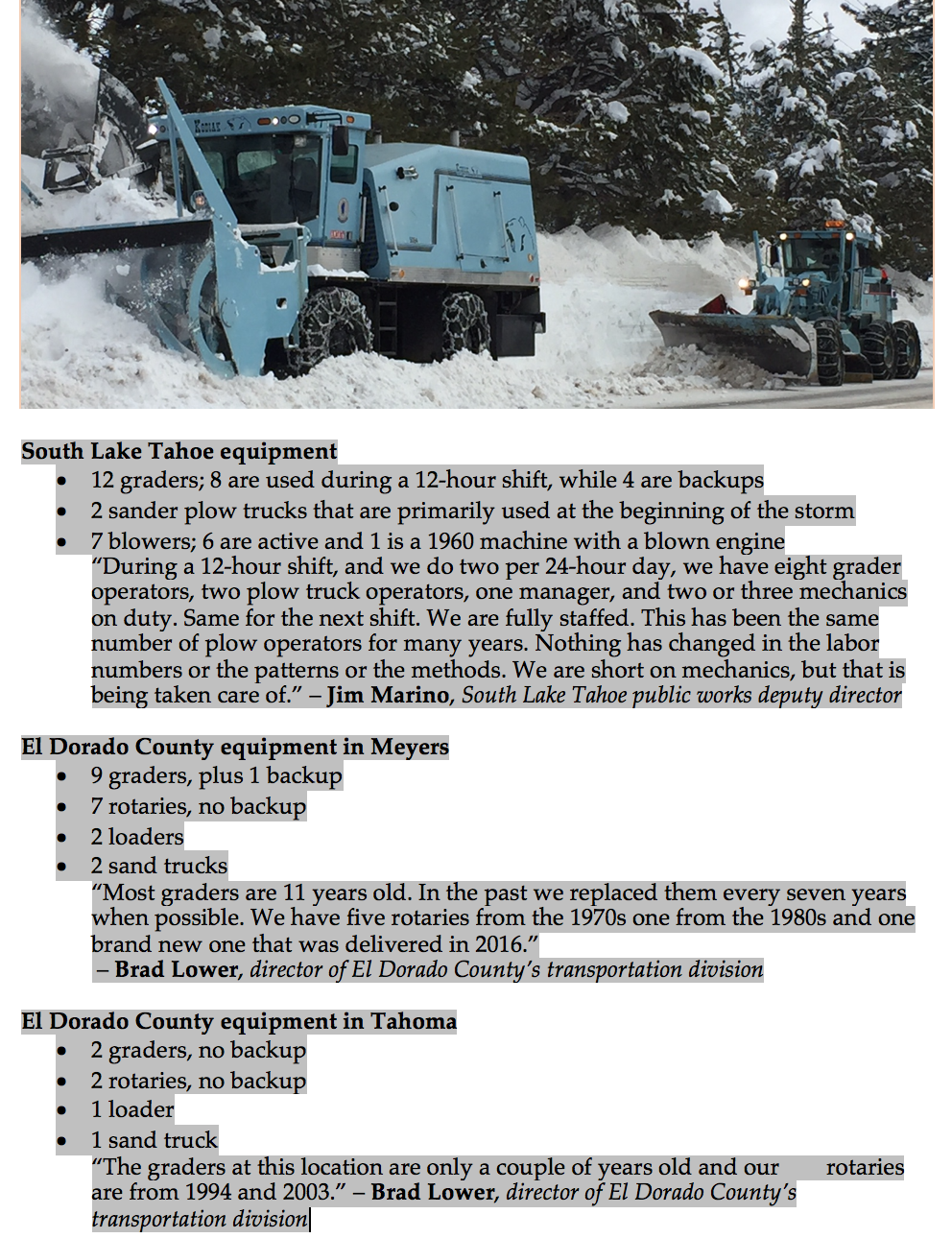
The city and county in large part are operating with decades-old equipment. This has a lot to do with voters not upping the snow removal tax and the jurisdictions then not putting together a fleet replacement plan in time to deal with the problem. Tahoma residents voted to pay $50 a year. South Lake Tahoe and El Dorado County South Shore property owers pay $20/year.

South Lake Tahoe sends a mechanic out to a broken down apparatus. It’s fixed in the street, not back at the shop. It’s faster, but clearly not ideal working conditions. The county mechanics are based in Meyers; one of the four is out.

Bard Lower, director of El Dorado County’s transportation division, told Lake Tahoe News, “Our crews have been working seven days a week 24 hours a day since the New Year without a break.”

Experience driving the plows makes a difference, too. Two-thirds of the city’s crew has five or more years’ experience plowing with graders. The remaining third is new. The county drivers based in Meyers have an average of 14 years of snow removal experience.

(This is a story about a snowplow ride-along this reporter did in 2011 that explains what it is like to do that job.) 

Both agencies say they provide better service than the other. That internal bravado is not carrying over into reality, at least with some residents. This is Day 4 since there has been any substantial snow and yet some neighborhoods are still a mess.

“This is the worst year in my 50-year history for snow removal from our roads. What changed? Places like Angora Highlands and Echo View Estate have yet to see a rotary plow — this is at 1:30 on Thursday. This is extremely substandard,” one resident wrote to Lake Tahoe News.

Lake Tahoe Unified School District called a snow day on Tuesday because officials said the roads were impassable for buses.

Yet, fire trucks that are 38-feet-long were going down those same roads.

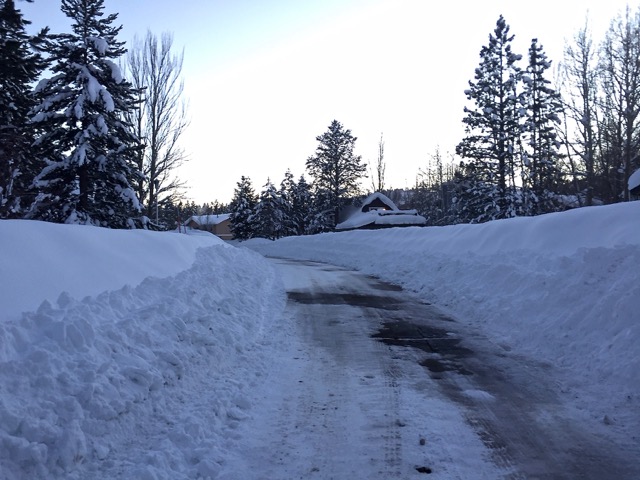
Some residents have little tolerance for narrow streets. Photo/LTN

Some South Shore residents have little tolerance for narrow streets. Photo/LTN

Issues continued for school bus drivers on Wednesday.

“A couple of buses did get stuck in neighborhoods where they couldn’t clear the turns on the roads. There were some minor delays in dropping students at school, but no damage to buses, and no accidents,” Shannon Chandler, spokeswoman for LTUSD, told Lake Tahoe News.

Years ago the district used main bus routes when side streets were not plowed. Not so anymore. No explanation was provided by the district why this no longer occurs. (When LTUSD has at least three snow days it applies for a waiver from the state Department of Education to not have to have the maximum days of instruction.)

The county says school bus routes are a priority after main routes like Pioneer Trail and Upper Truckee Road are plowed. The city doesn’t factor in school bus routes in its prioritization.

“Our guys have been going 24/7 since Dec. 28 and in that time have only had three days off. We experienced mechanical issues with the plows, downed trees, power lines, grader diversions to accident scenes for fire and police, and a gazillion cars abandoned in roadways all compounding a long duration storm. Couple that with the ‘instant gratification need’ of some of our population and we have trouble satisfying,” South Lake Tahoe Deputy Public Works Director Jim Marino told Lake Tahoe News.

The county has the same obstacles.


Gates are not dropped on snowplows when a driveway is not cleared. Photo/LTN

Gates are not dropped on snowplows when a driveway is not cleared. Photo/LTN

“Each of these items add significantly to the time required to clear not only the street, but those around them. For example, county staff has to wait to remove snow from streets until power lines have been removed for safety reasons and in an effort not to destroy the infrastructure of the power provider,” Lower said.

Both agencies say plows have now hit every street at least once. Still, many are narrow, requiring cars to stop in order to have oncoming traffic pass.

The city used to have a GPS system where the public could track the plows. It didn’t work as expected and therefore was discontinued. If better technology presents itself, the idea might be revisited.           

The county’s Meyers office is responsible for snow removal down to Strawberry. A separate group handles Tahoma.

Much contention in all jurisdictions surrounds the use of the gate on plows. The irony is the gate was created years ago by a South Lake Tahoe employee who then sold the concept to a snowplow manufacturer. Now those gates are the norm.

“If you watch our operators, you will see that they lower the gate when they can see they are going to pass a driveway. If there are only a few inches of snow the snow will be moved beyond the driveway – no berm. However, if there is more than 6 to 8 inches of snow, even with the gate down, snow will boil over the gate and is left in the adjacent driveway,” Lower said. “With the amount of snow we’ve had recently, graders can no longer move the snow effectively and our crews are using blowers to open up the road. A blower generally leaves a fairly straight line along the edge of the road and leaves little or no berm.”

Marino said, “I can honestly say our guys really do try and minimize problems for properties as much as we can, but this storm gave us no respite, we simply did not have a long enough break between snowfall to break out the blowers and widen.”


Calif. drought is over in roughly half the state

Heavenly Mountain Resort has enough snow to provide skiing well into spring. Photo Copyright 2017 Carolyn E. Wright

Heavenly Mountain Resort has enough snow to provide skiing well into spring. Photo Copyright 2017 Carolyn E. Wright

By Paul Rogers, San Jose Mercury News

Hammered with record rainstorms and blizzards, nearly half of California is no longer in a drought, and the rest saw dramatic improvement over the past week, federal scientists reported Thursday.

Overall, 49 percent of the state is now drought free, the highest level since April 2013, according to the U.S. Drought Monitor, a weekly study by the National Oceanic and Atmospheric Administration, the U.S. Department of Agriculture and the University of Nebraska, Lincoln.

A year ago, only 5 percent of the state was classified as not in drought conditions.

Read the whole story


Storms tap Caltrans’ Tahoe budget

By Alexa Renee, KXTV-TV

So how are the recent storms affecting the Caltrans budget?

“We budget for this annually,” said Deanna Shoopman, chief spokesperson for Caltrans District 3. “It’s not something new.”

Caltrans keeps a maintenance budget which covers cleanup after storms, according to Shoopman.

The total budget for District 3 this fiscal year is about $44.3 million, according to Caltrans. District 3 has spent approximately $31.5 million, not including the recent storm damage. The storm cleanup will include the costs of massive sinkholes, fallen tree cleanup, road repairs, snow removal and much more so the costs will likely exceed the $44.3 million budget.
 
Read the whole story


Little consensus on VHRs in S. Lake Tahoe

South Tahoe City Manager Nancy Kerry addresses questions about VHRs on Jan. 25. Photo/LTN

South Tahoe City Manager Nancy Kerry addresses questions about VHRs on Jan. 25. Photo/LTN

By Kathryn Reed

Wednesday night’s vacation home rental workshop became more about whining than an information gathering opportunity.

People were becoming angry when the majority didn’t agree with them. Those in the room were upset that those voting online often had different answers. Then there were the people who claimed they were not being listened to because they didn’t get their way.

South Lake Tahoe is in the throes of an economic study about vacation home rentals. Jan. 25 was the second workshop conducted by consultants Michael Baker International, the group tasked with compiling all the data.

The consultants will be looking at perceptions people have as well as the facts. The preliminary report is expected to be released this spring, with another workshop after that and then the final document to be out in the summer.

From there it will be up to the City Council to decide if any policies are changed.

VHRs have been a regulated entity in the city since 2003. It has been contentious ever since then, with tweaks to the policy coming seemingly every year. The lack of enforcement, neighborhoods becoming party zones, regional regulations and the increasing inability to find long-term rental housing have triggered anger toward VHRs to the point some would like a moratorium or outright ban.

On the flipside is those who want to stay somewhere other than a hotel – whether it’s here or elsewhere. Then there are all the people who have a job related to the industry. And there is the money involved.

Ten questions were asked Wednesday. The more than 40 people at the senior center were polled as well as people online. Statistically this survey is not valid, but it did give an indicator of what people are thinking. What isn’t known is who was voting online. Those at the meeting were predominately residents, most over 60, and almost all Caucasian.

The answers by people at the meeting are hard numbers, while the online responses are percentages. The number of respondents online for each question were not given. It was possible for online voters to have also voted in person.

The majority believed VHRs expand the lodging options for tourists and provide jobs.

When it came to whether VHRS strain public services, those at the meeting said yes, while those online said no.

When it came to saying whether VHRs in residential areas are an inappropriate use, 21 people at the meeting said yes, 16 said no. The online percentage – 22 percent said yes, 71 percent no.

The question about whether VHRs have a negative impact on the character of a neighborhood also differed between the in-person vs. online response. Yes said the majority physically present, no said those remotely.

Those in person believe VHRs decrease the supply of affordable housing, while those online said the opposite.

VHR owners were asked what they would do if they could not use their property in this manner: 11 percent would make it a long-term rental, 53 percent would leave it vacant, 28 percent would do something else, and 8 percent said “not applicable”. No one at the meeting answered the question, signaling that no VHR owners were in attendance or that they didn’t want to make themselves known to a crowd that was clearly against them.

After the questions were asked and answered the conversation was more directed to city staff. 


New table games have steep hurdles

By Thomas Moore, Las Vegas Sun

When it comes to slots, new skill-based games have generated a lot of industry buzz. But in the world of table games, blackjack and baccarat (and to a lesser extent, craps and roulette) continue to dominate, and experts say that won’t change anytime soon.

When it comes to games played on green felt, innovation means adding features to existing games or inventing variations of existing casino stalwarts, not creating entirely new concepts.


It’s not that no one is trying to develop new games. According to Jonné Brunette, an agent with the Nevada Gaming Control Board, gaming regulators received 19 new game applications in 2016, of which 12 won final approval.

Read the whole story


Entrepreneurs redefining South Lake Tahoe

By Daniel Duane, Bloomberg

Chris McNamara, an experienced rock climber and BASE jumper, was dangling from a cliff near the city of South Lake Tahoe in March 2016 when he had a vision: “It was snowy and super beautiful, and I realized this place ought to be a world capital of outdoor recreation—San Francisco’s cool, alternative mountain city, like what Boulder is for Denver,” he says. “We’ve got skiing and mountain biking. There’s sailing and stand-up paddling. I’m trying to get other entrepreneurs to realize they can do what I did, trade in their commute for a better lifestyle and still pop down to San Francisco for meetings.”
 
South Lake Tahoe has 21,000 year-round residents, spectacular nature—and a long way to go in the charm department. Tawdry casinos, strip malls, and run-down motels dominate the landscape. Still, it’s just three hours from the Bay Area; gondolas to the immense Heavenly Mountain Resort depart from downtown; and the average home price is $390,000, compared with $1.16 million in San Francisco.

McNamara’s vision shouldn’t be that far-fetched: Of all the areas along the lake, South Lake Tahoe has the best combination of affordability and convenience to skiing and beaches. “My inspiration comes from what Tony Hsieh did,” he says, referring to the Zappos chief executive officer’s $350 million attempt at revitalizing downtown Las Vegas.

Read the whole story