Super Bowl wagering sets $138.5M record in Nev.

By Todd Dewey, Las Vegas Review-Journal

A game that featured the greatest comeback in Super Bowl history also produced a record wagering handle in Nevada.

The state’s 196 sports books had $138.5 million wagered on Sunday’s game, according to figures released Monday by the Nevada Gaming Control Board. The books won $10.9 million for a hold percentage of 7.9.

The handle eclipsed the $132.5 million that was wagered last year for Super Bowl 50, a 24-10 win by the Broncos over the Panthers. This is the fourth consecutive year that the state’s handle has surpassed $100 million.

Read the whole story


Bike committee outlines priorities for 2017

By Kathryn Reed

Finding ways to improve the South Shore cycling scene is not a difficult endeavor.

The advisory committee to the South Lake Tahoe Recreation Facilities Joint Powers Authority recently outlined its goals for this summer through 2019.

Snow removal of bike trails expects to be an ongoing project. Cyclists and pedestrians are regularly using these thoroughfares in the winter. It was only in the past couple years that they have been plowed for winter use.

David Reichel, the committee member who gave the report to the board last month, stressed the need for the JPA and city to pursue the connection at Sierra Boulevard and Highway 50 to the bike trail behind Scusa and Fitness Evolution. This might be doable when the health club seeks a permit to improve its parking lot.

“It’s a valuable connection,” Reichel said.

An easement would be needed to make this happen.

The money the JPA has to spend comes from Measure S/R that was passed by South Shore voters on the California side. South Lake Tahoe, El Dorado County and Tahoe Paradise Resort Improvement District representatives make up the JPA board.

While the JPA board won’t allocate funds until its July meeting, the following is where the volunteer committee recommends the dollars be spent this year:

·      $25,000 – Improve surface of boardwalk in front of Lake Tahoe Golf Course

·      $10,000 – 2017-18 winter snow removal in the city

·      $20,000 – 2017-18 winter snow removal in El Dorado County

·      $10,000 – Class 1 bike trail maintenance.

For 2018, the committee wants snow removal to continue. The bulk of the funds — $50,000 – would go toward the match for the Al Tahoe, Johnson boulevards, Highway 50 project that should be constructed that year.

The following year, snow removal is projected to continue. Money for ongoing maintenance of Class 1 trails is also recommended.

Not all recommendations from the committee cost substantive dollars. Those include:

·      Installing a yellow center line on the Linear Park bike path. That should happen this summer. The city, though, says the path cannot be widened.

·      Adding green paint to the Class 3 street crossing at Eloise, Dunlap and Fifth streets.

·      Continue putting in signs to help cyclists. More are expected to be installed this summer.


Dissecting wage gap in Nev. and elsewhere

By Julie Ann Formoso, Las Vegas Sun

Seventy-nine cents to the dollar. You’ve probably heard that statistic on the gender pay gap, a longtime wedge issue and soapbox topic for politicians, feminists and celebrities.

Some say the gap — a simple Census Bureau ratio of the difference in median earnings — is a myth, or at least misleading. The Washington Post’s Fact Checker emphasizes the significant effect of life choices tied to gender, and the fact that the gap narrows going from median to weekly wages, or that women on average have less work experience than men and favor flexible hours over higher pay. So, while public figures and pundits on both sides of the issue make definitive pronouncements about what’s true, economic experts continue to examine questions of gender circumstance as well as gender bias.

Compared with the 79-cent national figure, Nevada looks progressive. With women making about 85 cents for every dollar earned by men, the state is among those with the narrowest gaps (alongside New York, Maryland and Hawaii), according to a 2016 report by the U.S. Joint Economic Committee.

Numbers from the Nevada Department of Employment, Training and Rehabilitation align with the wage gap at its widest among professionals and utility workers, though women do earn more than their male counterparts in wholesale trade.

Read the whole story


Future of USFS, BLM law enforcement threatened

By Benjamin Spillman, Reno Gazette-Journal

Federal law enforcement agents who combat illegal dumping, conduct wildland fire investigations and eradicate environmentally damaging illicit marijuana growing operations would lose their jobs under a proposal by seven western lawmakers.

A bill by Rep. Jason Chaffetz, R-Utah, seeks to eliminate the law enforcement branches of the U.S. Forest Service and Bureau of Land Management.

The bill, which includes Rep. Mark Amodei, R-Nev., among co-sponsors, would shift their duties to sheriff’s departments which would receive block grants to pay for the extra work. Lawmakers have introduced similar measures in past years, to no avail.

Read the whole story


South Lake may end retiree health care benefits

By Kathryn Reed

Health care benefits for former and current South Lake Tahoe employees may soon look dramatically different.

South Lake Tahoe is about to start negotiations with its six labor unions. Health care will be one of the main subjects. This affects retirees because they get whatever their respective labor group agrees to. Through the years everyone has endured changes in premiums, deductibles and coverage.

The skyrocketing price of health care is making it almost impossible for public and private sector employers to offer a reasonable plan. South Lake Tahoe is trying to be creative with how it does business, with the desire to be equitable to current workers, retirees and taxpayers.

“It is very chaotic in the health care industry. The only way employers can manage those costs is with the continuation of cuts,” City Manager Nancy Kerry told Lake Tahoe News. “Salaries have not kept up with health care for anyone in this country.”

The premium for the city ‘s medical plan is $556.07 per month for retiree only coverage, $1,112.14 for retiree plus one, and $1,573.68 per month for family coverage. This is for those not on Medicare.

On Tuesday the City Council will be presented with an option to revamp retiree health coverage. The approximately 150 retirees, as well as those whose dependents qualify for coverage, may be given the opportunity for a one-time buyout.

Staff is proposing using the $6.5 million in the Other Post Employment Benefits (OPEB) trust fund to pay the retirees. The amount each person would receive depends on years of service, whether they are on Medicare and other criteria. The average compensation would be $68,000 for those who are not on Medicare, and $32,000 for those in the Medicare group.

The OPEB account was created in fiscal year 2008 by then City Manager David Jinkens and the council at the time as a way to begin dealing with the city’s $42 million unfunded liability for retiree health care. That obligation ballooned to $55 million at its highest point. The amount the city contributes to OPEB fluctuates each fiscal year, with $250,000 allocated for 2016-17. During part of the recession zero dollars were earmarked for OPEB.

A step toward curtailing these defined benefits took effect Jan. 1, 2008, with the mandate that no new hires would be eligible for health care upon retirement.

In 2014, the council approved City Manager Kerry’s plan to radically change health care. The main outcome was that all the employee groups agreed to give up their retiree health care effective Oct. 1, 2014. Some opted to retire before that date.

These changes brought the unfunded liability to about $20 million.

In December 2015 South Lake Tahoe was sued by a group calling themselves the South Lake Tahoe Retirees Association. Last August a judge said the group will not receive monetary compensation.

The case is still active. The proposal before council on Feb. 7 is not expected to impact that lawsuit.

Kerry’s rationale for the lump sum is that it provides more security for the retirees than what they have today. Today they are at the whim of what their old bargaining unit decides. Retirees have no voice at the negotiating table. If the city and labor groups agreed to do away with health care coverage, the retirees would have nothing. Or a plan could become cost prohibitive for a retiree. The point is they have no guarantee what their health coverage will be from contract to contract.

The lump sum being proposed would go into a health savings account. This way the individuals would not be subjected to paying income tax.

The ultimate long-term savings to the city will be determined after it is known how many retirees decide to take the offer – assuming the council on Tuesday approves the plan. The retirees would have until May 31 to make a decision. They would then be on their own to come up with health care coverage once all the paperwork is processed.


California considers an end to bail

By Alexei Koseff, Sacramento Bee

On any given day, most inmates in California jails have not yet been convicted of a crime.

About 63 percent are being held awaiting trial, according to data collected by the Board of State and Community Corrections, an average of nearly 47,000 people. Federal statistics on the largest urban counties show that from 2000 to 2009, California kept unsentenced felony defendants in jail at nearly twice the rate of the rest of the country.

For state Sen. Bob Hertzberg, the problem is clear: Bail is “just too expensive.” The median amount in the state is $50,000, according to the Public Policy Institute of California, five times higher than the national average.

Read the whole story


Retiree obligations have stranglehold on LTUSD

                                                                                                                                                                         Source: LTUSD

By Kathryn Reed

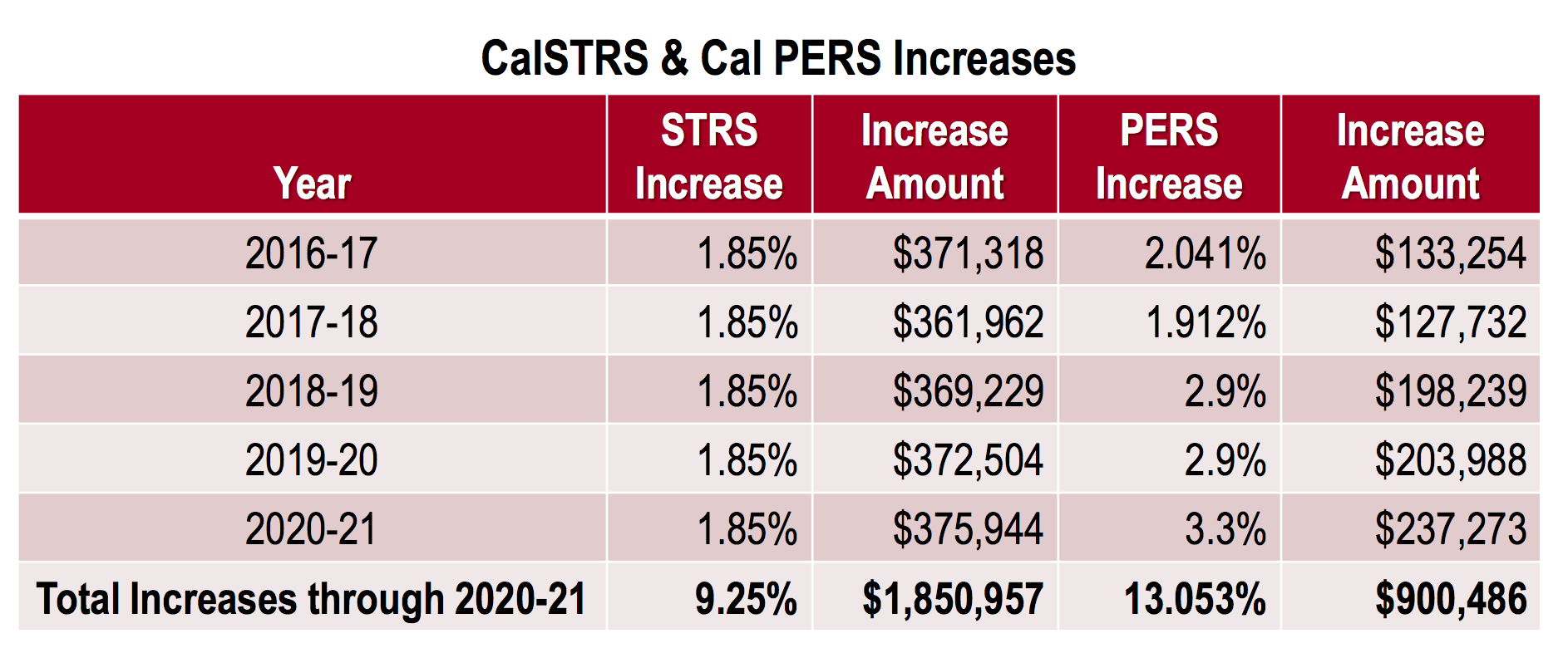
Skyrocketing retirement costs are impacting Lake Tahoe Unified School District.

“It’s a half million-dollar hit. We will not be able to keep it going,” Superintendent Jim Tarwater said of the shift in CalSTRS and CalPERS allocations.

Certificated employees pay into the California State Teachers Retirement System, while classified staff are part of the California Public Employment Retirement System.

Billy Wessell, chief business and operations officer for LTUSD, gave a presentation last week to the board about what the governor’s budget proposal will mean locally.

“He really didn’t help us out in his budget,” Wessell said of Gov. Jerry Brown. He called the PERS/STRS situation “scary.”

LTUSD is contributing 12.58 percent to STRS this fiscal year. It’s proposed to go up to 14.43 percent for 2017-18. Today the PERS contribution is 13.888 percent. Next year it is projected to be 15.8 percent.

These percentages are of an employee’s salary that local taxpayers put into the worker’s retirement account. Those workers get a defined amount of money for life when they retire and have stopped contributing in any way to the district.

When investments by PERS and STRS don’t keep up with what those agencies have to pay retirees it is then up to member agencies via the taxpayers in those jurisdictions to come up with the shortfall.

Five years of increases for retiree benefits through 2020-21 is expected to cost LTUSD an additional $2,751,443.


LTWC returns three bears to Yosemite


Wildlife officials ready the bears for their return to the wild. Photo/Kathryn Reed

By Kathryn Reed

If only these cubs could talk. What would they say about the treatment they received for nearly seven months at Lake Tahoe Wildlife Care? Do they remember their mom being hit by a car last summer in Yosemite?

No more being poked and prodded by needles. That has to be a good thing. But no more watermelon either. They will have to forage for every meal.

Tom Millham with Lake Tahoe Wildlife Care puts ointment in one of the bear’s eyes. Photo/Kathryn Reed

While LTWC has 99 percent of all animals’ diets be natural, it isn’t always what they’d find in the wild. Watermelon and grapes are two things almost all critters like. These bears were fed a lot of fish, but kokanee isn’t something they’ll find in Yosemite.

For now, the three Yosemite cubs that came in at 8, 8 and 10 pounds are back in the national park. They left the South Shore animal rehab facility last week weighing 62.9, 80.4 and 94.5 pounds.

“They are at a better weight than we had hoped for,” Tom Millham told Lake Tahoe News. He and his wife, Cheryl, are the founders of LTWC.

The size of the bears’ paws have grown substantially since their arrival to Tahoe in July. Photo/Kathryn Reed

On this particular day a bevy of activity is going on. Veterinarian Kevin Willitts is taking blood and performing one last exam on these bruins. Three Yosemite officials are doing what’s needed to ensure the bears have a restful ride back to the park. They take hair samples, measurements, weight, make sure that their collars fit just right and that all the paperwork is in order.

Normally only bears weighing more than 100 bears receive GPS collars. This is the only study beyond the one on the East Coast where bears weighing less than that minimum are being tracked. The collars are programmed to come off six months from the day they were put on.

GPS collars will provide national parks officials with data on the bears. Photo/Kathryn Reed

As with all animals brought to LTWC, the goal is to return them to the area they came from. Because the bears are going into a wilderness area, it required teams of men and women on skis to haul the animals to their den on separate sleds. The goal is they will sleep together the rest of the winter and then wakeup in their old/new home. For their safety, the exact location is not being disclosed.

The collar will tell researchers if the two males and one female travel the same or different distances, if they stick together, who comes out first and a slew of other data.

South Lake Tahoe vet Kevin Willitts is an integral component to LTWC animals returning to the wild. Photo/Kathryn Reed

A website is expected to be launched in March that will provide information about the bears. It will regularly be updated about their activity. LTWC plans to have a link to it from its website.

Once the collars come off they will be retrieved, refurbished and used again.

These were the last of the five bear cubs brought to LTWC in 2016 to be released. Another bear that arrived earlier this year will stay in Tahoe through the winter.


Sports books project record Super Bowl handle

By Chris Murray, Reno Gazette-Journal

While New England Patriots star Tom Brady looks to break the record for most Super Bowls won by a quarterback Sunday when his team takes on the Atlanta Falcons, Nevada sports books are eyeing their own record: largest handle in Super Bowl history.

A record $132.54 million was bet on Super Bowl 50 – a 24-10 win by the Denver Broncos over the Carolina Panthers. That total surpassed the record of $119 million set in 2014. But the wagers laid down leading into this year’s game has left local sports book managers optimistic last year’s mark will be surpassed.

Ben Knutson, William Hill’s local area manager who oversees 30 of the bookmaker’s 108 statewide books, believes the game will set a record handle.

Read the whole story


Not enough reservoir space for Calif. water

By Ryan Sabalow, Dale Kasler and Phillip Reese, Sacramento Bee

After five years of drought, could California really have so much rain and snow there’s no room to store all the water?

The answer – as the state’s water picture careens from bust to boom – is yes.

One month into an exceptionally stormy 2017, river flows though the Sacramento-San Joaquin Delta have been so powerful that the massive pumps that ship north-state water to Southern California and the San Joaquin Valley have roared at full throttle for weeks. The federal and state pumping stations near Tracy delivered more water in January than in any month in the last 12 years, according to a Sacramento Bee review of data supplied by the U.S. Bureau of Reclamation.

Read the whole story